Government ?
It is a system by which a state, nation or community is governed. It is
something that makes the law of the land and ensures that all the people in
that nation or community are treated fairly by those laws.
It makes laws for the social and economic welfare of all members of the
community.
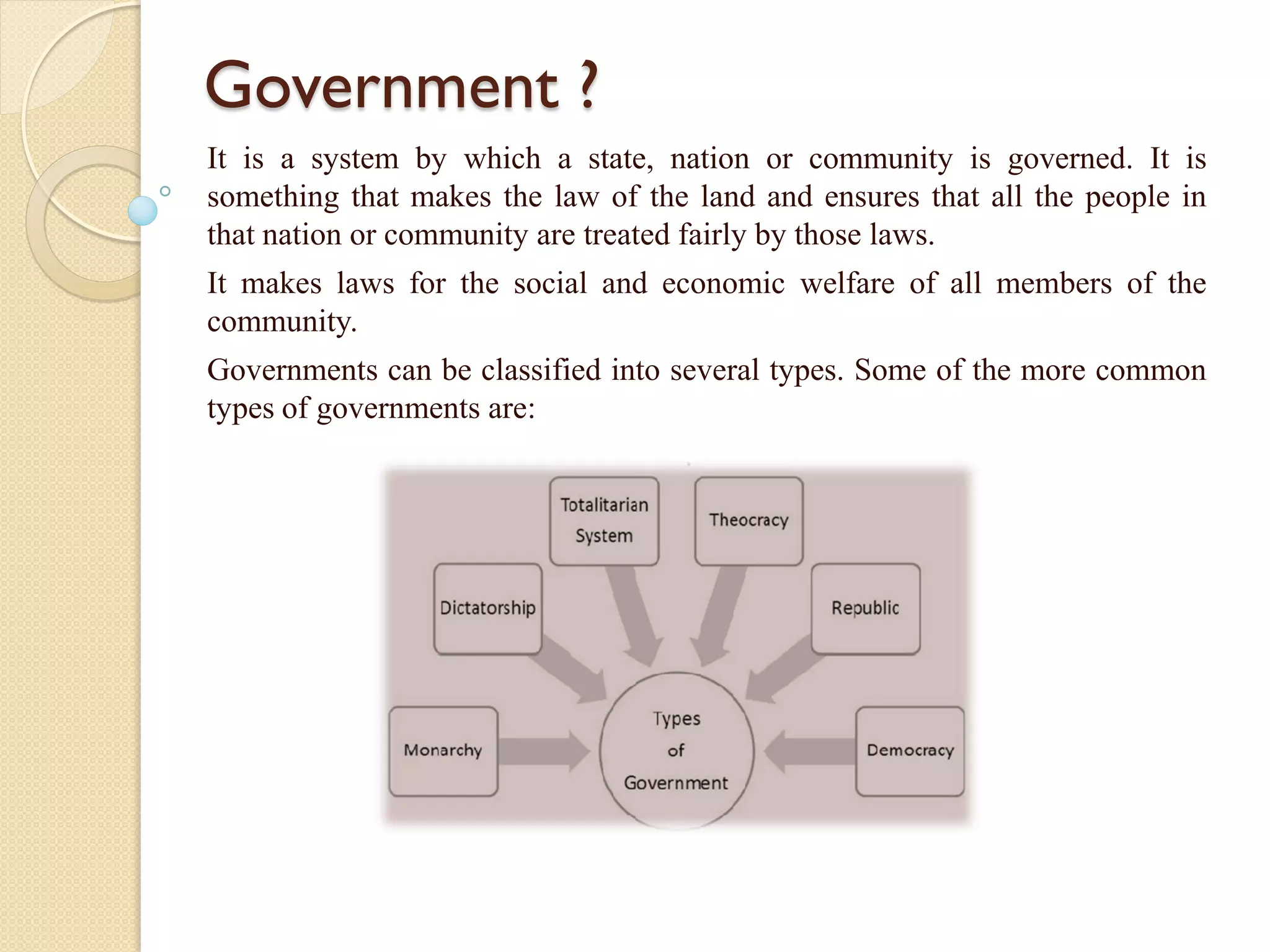
Governments can be classified into several types. Some of the more common
types of governments are:
Governance ?
The exercise of political, economic and administrative authority in the
management of a country’s affairs at all levels.
Governance comprises the complex mechanisms, processes, and institutions
through which citizens and groups articulate their interests, mediate their
differences, and exercise their legal rights and obligations.
Governance is a broader notion than government. Governance involves
interaction between formal institutions and civil societies. Governance" is the
art of public leadership.
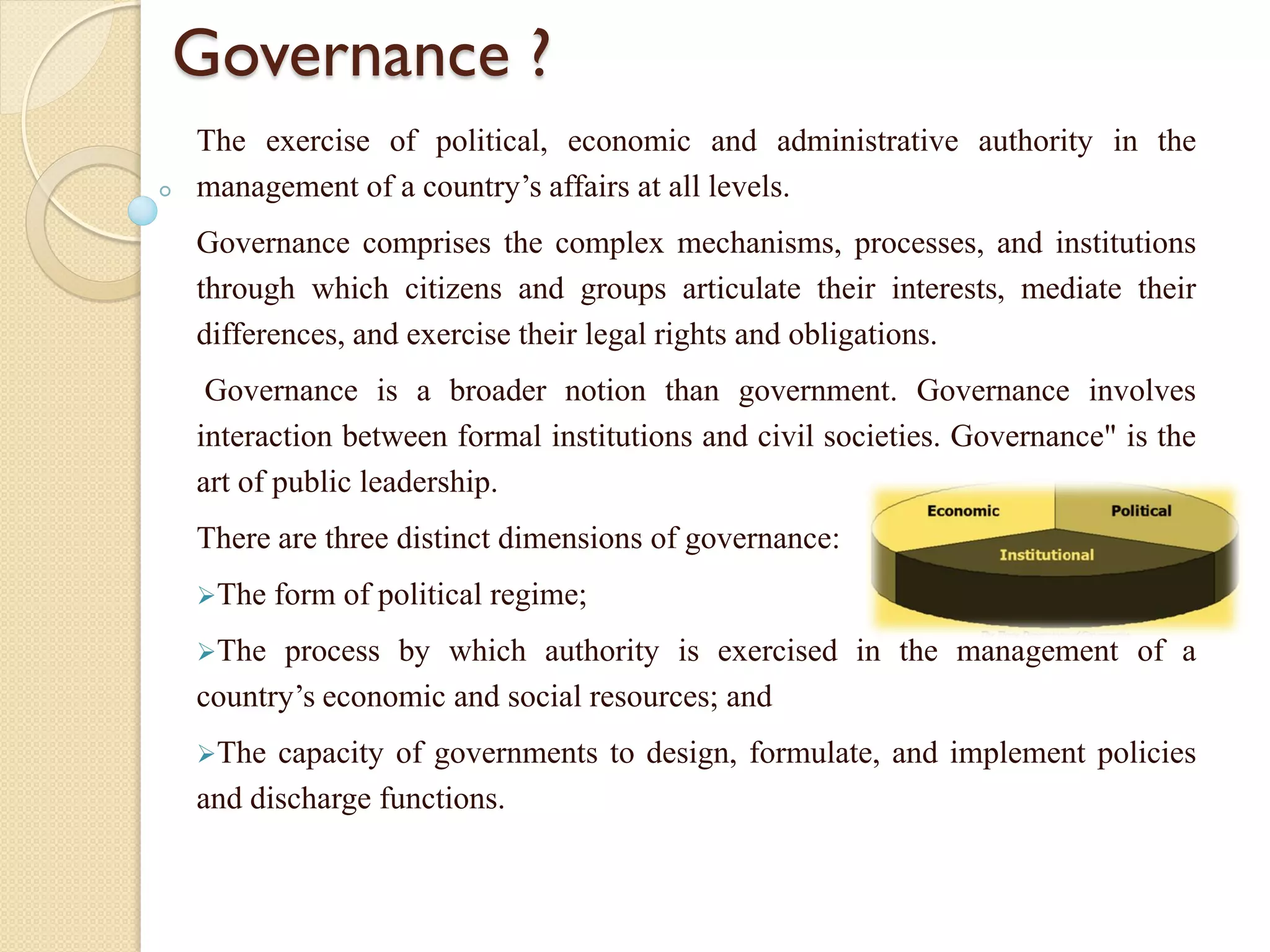
There are three distinct dimensions of governance:
The form of political regime;
The process by which authority is exercised in the management of a
country’s economic and social resources; and
The capacity of governments to design, formulate, and implement policies
and discharge functions.
Good governance?
Good governance occurs when societal norms and practices empower and
encourage people to take increasingly greater control over their own
development in a manner that does not impinge upon the accepted rights of
others
The criteria that constitute good governance:
 legitimacy of government (degree of "democratization"),
 Accountability of political and official elements of government (media
freedom, transparency of decision-making, accountability mechanisms),
 Competence of governments to formulate policies and deliver services,
 Respect for human rights and rule of law (individual and group rights and
security, framework for economic and social activity, participation).
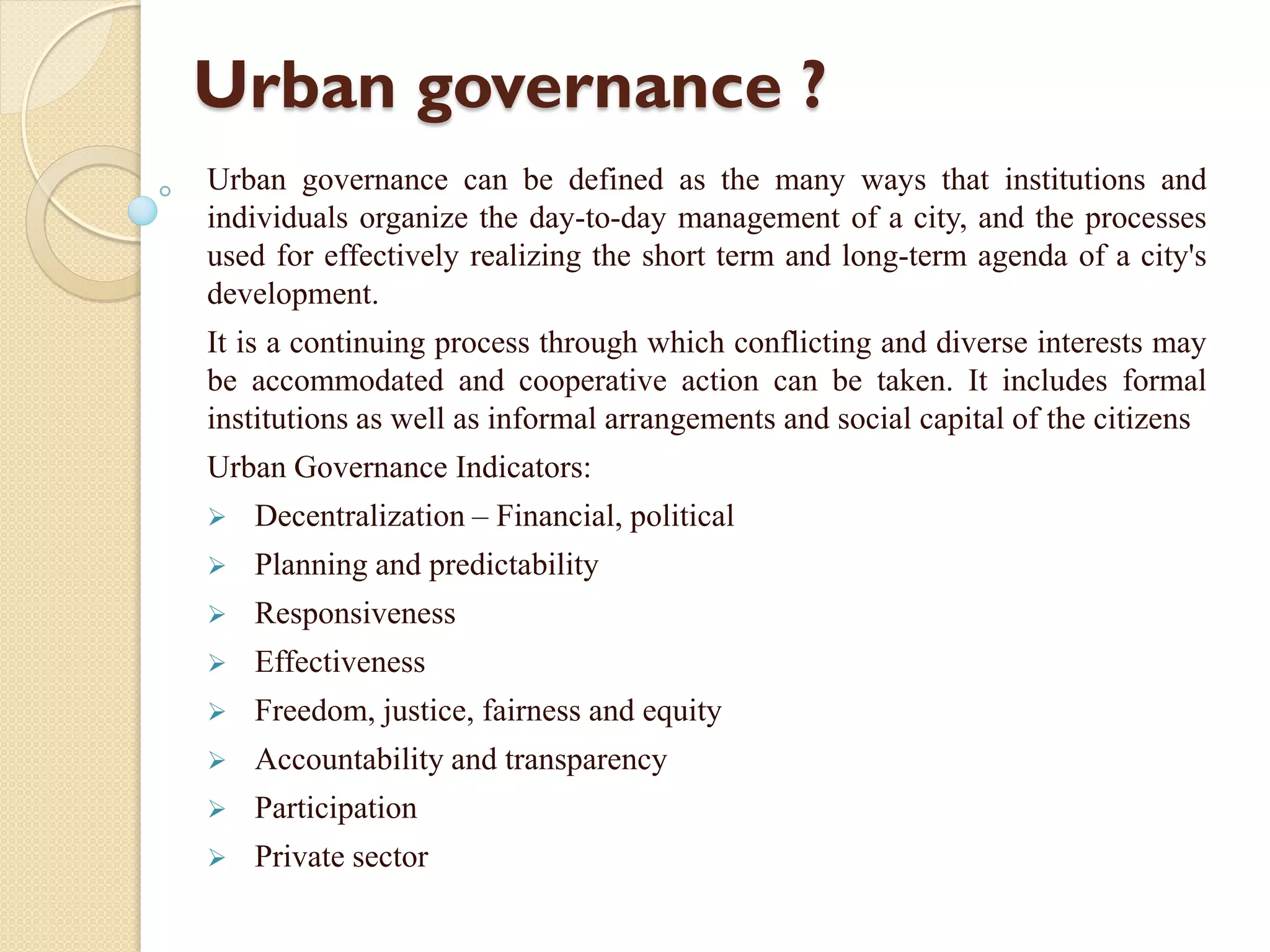
Urban governance ?
Urban governance can be defined as the many ways that institutions and
individuals organize the day-to-day management of a city, and the processes
used for effectively realizing the short term and long-term agenda of a city's
development.
It is a continuing process through which conflicting and diverse interests may
be accommodated and cooperative action can be taken. It includes formal
institutions as well as informal arrangements and social capital of the citizens
Urban Governance Indicators:
 Decentralization – Financial, political
 Planning and predictability
 Responsiveness
 Effectiveness
 Freedom, justice, fairness and equity
 Accountability and transparency
 Participation
 Private sector
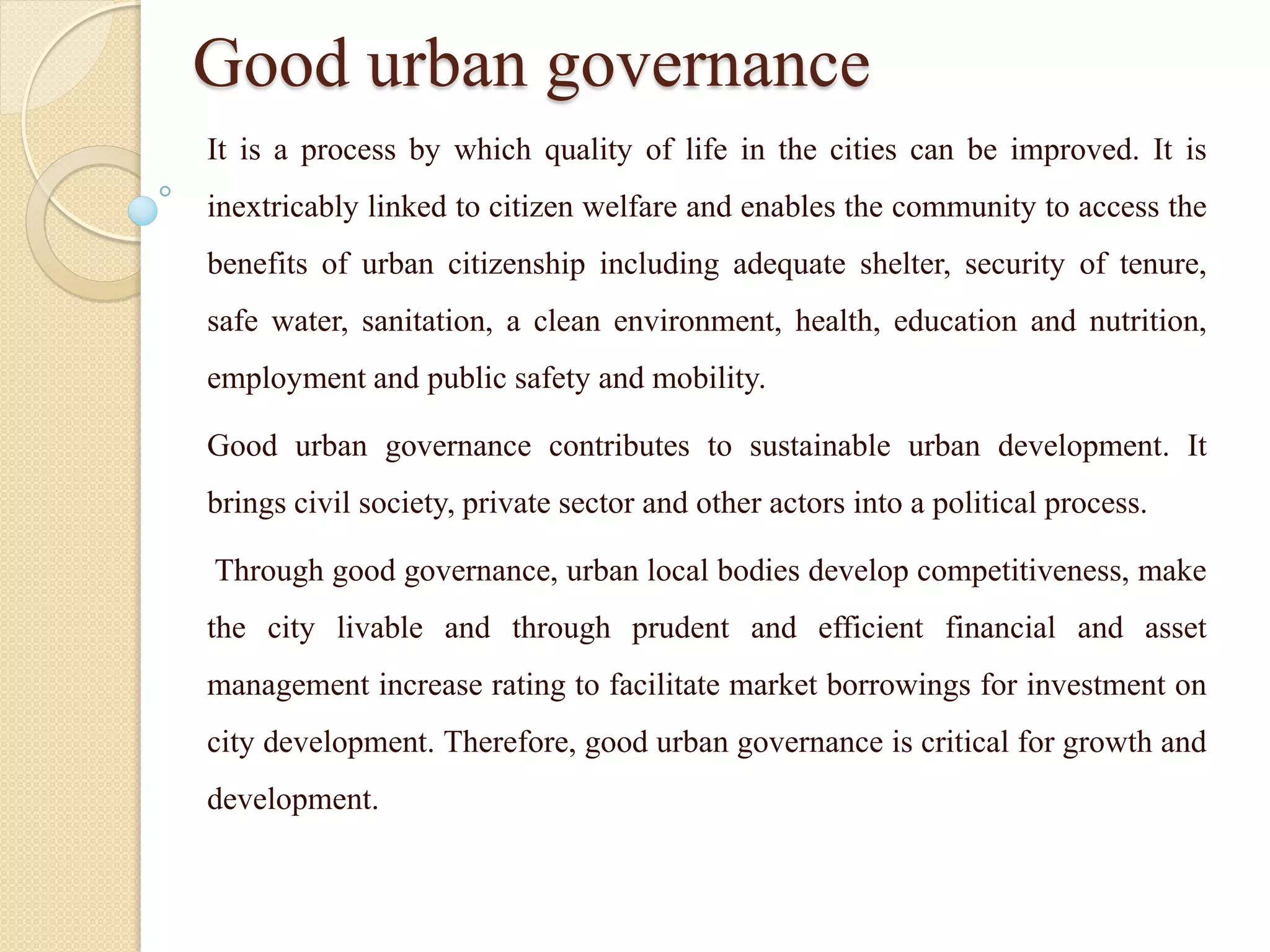
Good urban governance
It is a process by which quality of life in the cities can be improved. It is
inextricably linked to citizen welfare and enables the community to access the
benefits of urban citizenship including adequate shelter, security of tenure,
safe water, sanitation, a clean environment, health, education and nutrition,
employment and public safety and mobility.
Good urban governance contributes to sustainable urban development. It
brings civil society, private sector and other actors into a political process.
Through good governance, urban local bodies develop competitiveness, make
the city livable and through prudent and efficient financial and asset
management increase rating to facilitate market borrowings for investment on
city development. Therefore, good urban governance is critical for growth and
development.
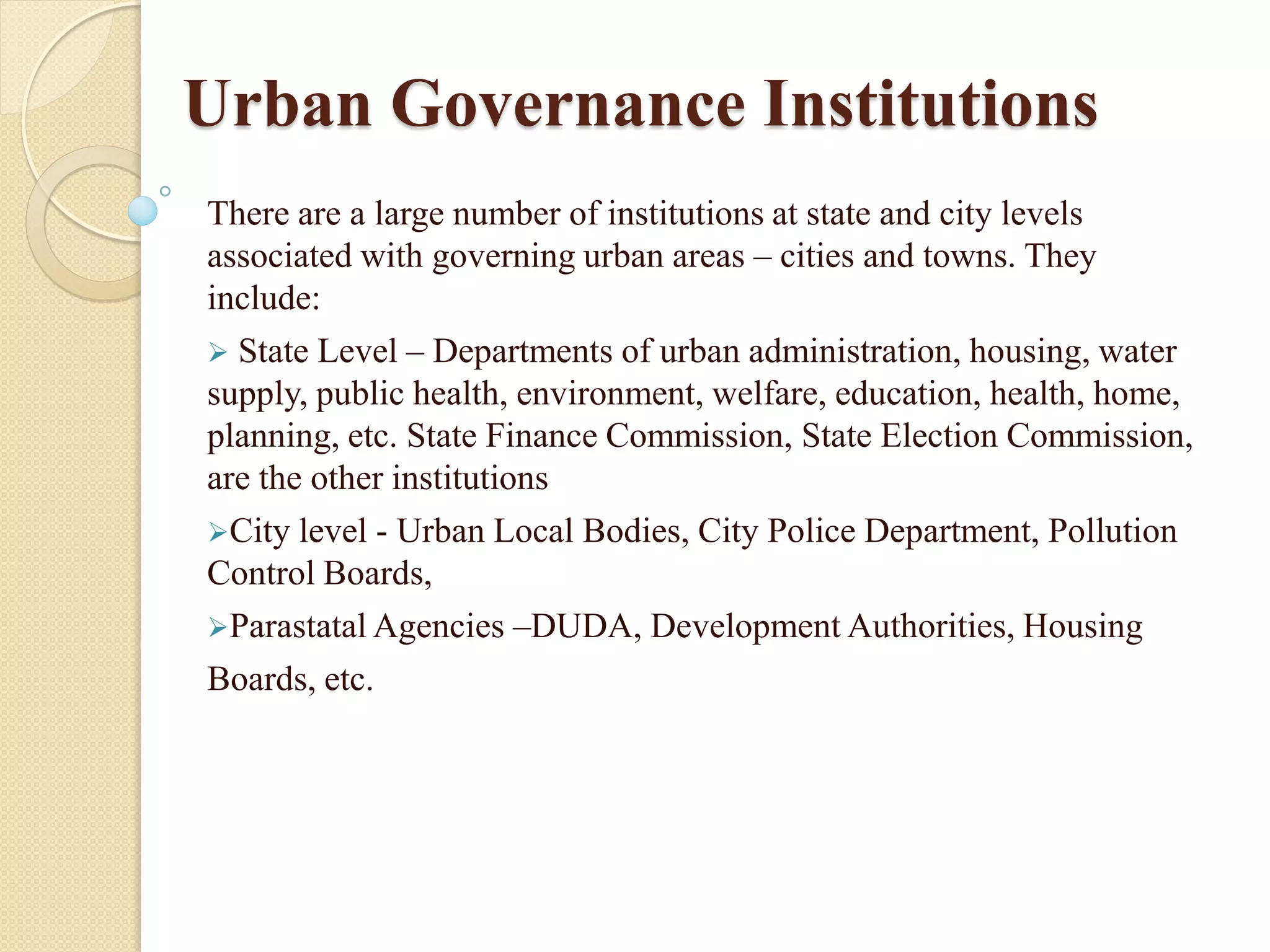
Urban Governance Institutions
There are a large number of institutions at state and city levels
associated with governing urban areas – cities and towns. They
include:
 State Level – Departments of urban administration, housing, water
supply, public health, environment, welfare, education, health, home,
planning, etc. State Finance Commission, State Election Commission,
are the other institutions
City level - Urban Local Bodies, City Police Department, Pollution
Control Boards,
Parastatal Agencies –DUDA, Development Authorities, Housing
Boards, etc.
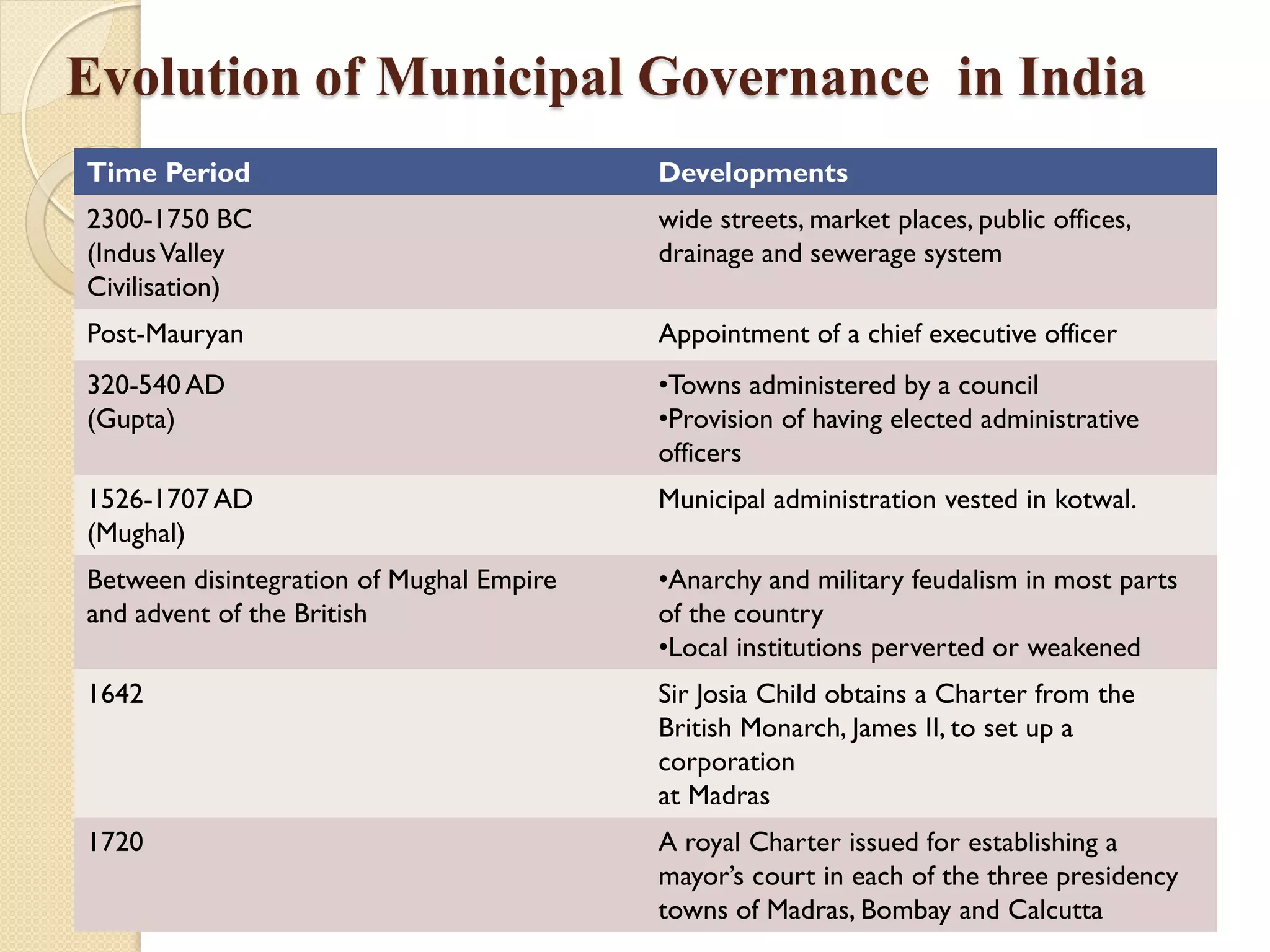
Evolution of Municipal Governance in India
Time Period Developments
2300-1750 BC
(IndusValley
Civilisation)
wide streets, market places, public offices,
drainage and sewerage system
Post-Mauryan Appointment of a chief executive officer
320-540 AD
(Gupta)
•Towns administered by a council
•Provision of having elected administrative
officers
1526-1707 AD
(Mughal)
Municipal administration vested in kotwal.
Between disintegration of Mughal Empire
and advent of the British
•Anarchy and military feudalism in most parts
of the country
•Local institutions perverted or weakened
1642 Sir Josia Child obtains a Charter from the
British Monarch, James II, to set up a
corporation
at Madras
1720 A royal Charter issued for establishing a
mayor’s court in each of the three presidency
towns of Madras, Bombay and Calcutta
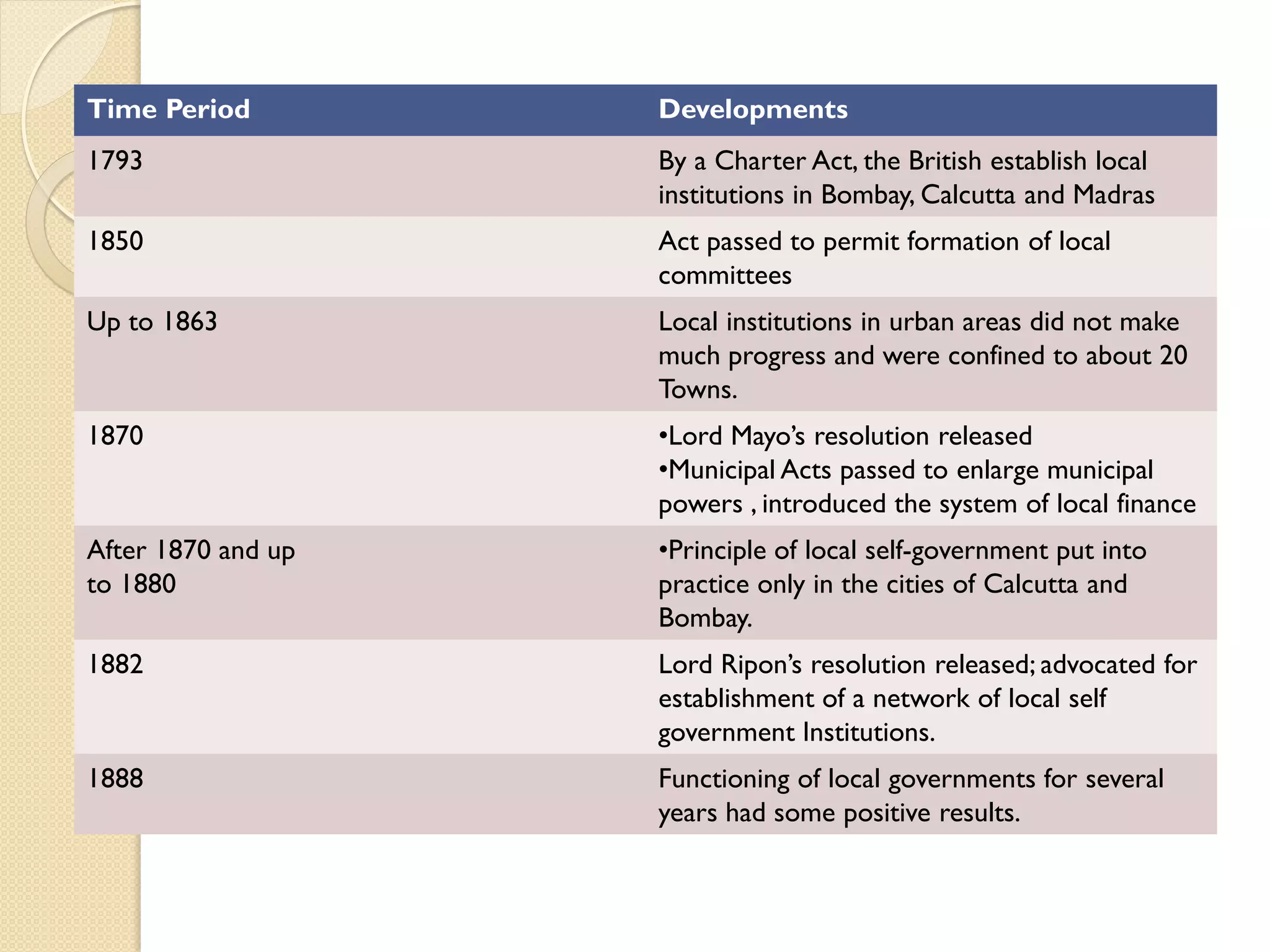
Time Period Developments
1793 By a Charter Act, the British establish local
institutions in Bombay, Calcutta and Madras
1850 Act passed to permit formation of local
committees
Up to 1863 Local institutions in urban areas did not make
much progress and were confined to about 20
Towns.
1870 •Lord Mayo’s resolution released
•Municipal Acts passed to enlarge municipal
powers , introduced the system of local finance
After 1870 and up
to 1880
•Principle of local self-government put into
practice only in the cities of Calcutta and
Bombay.
1882 Lord Ripon’s resolution released; advocated for
establishment of a network of local self
government Institutions.
1888 Functioning of local governments for several
years had some positive results.
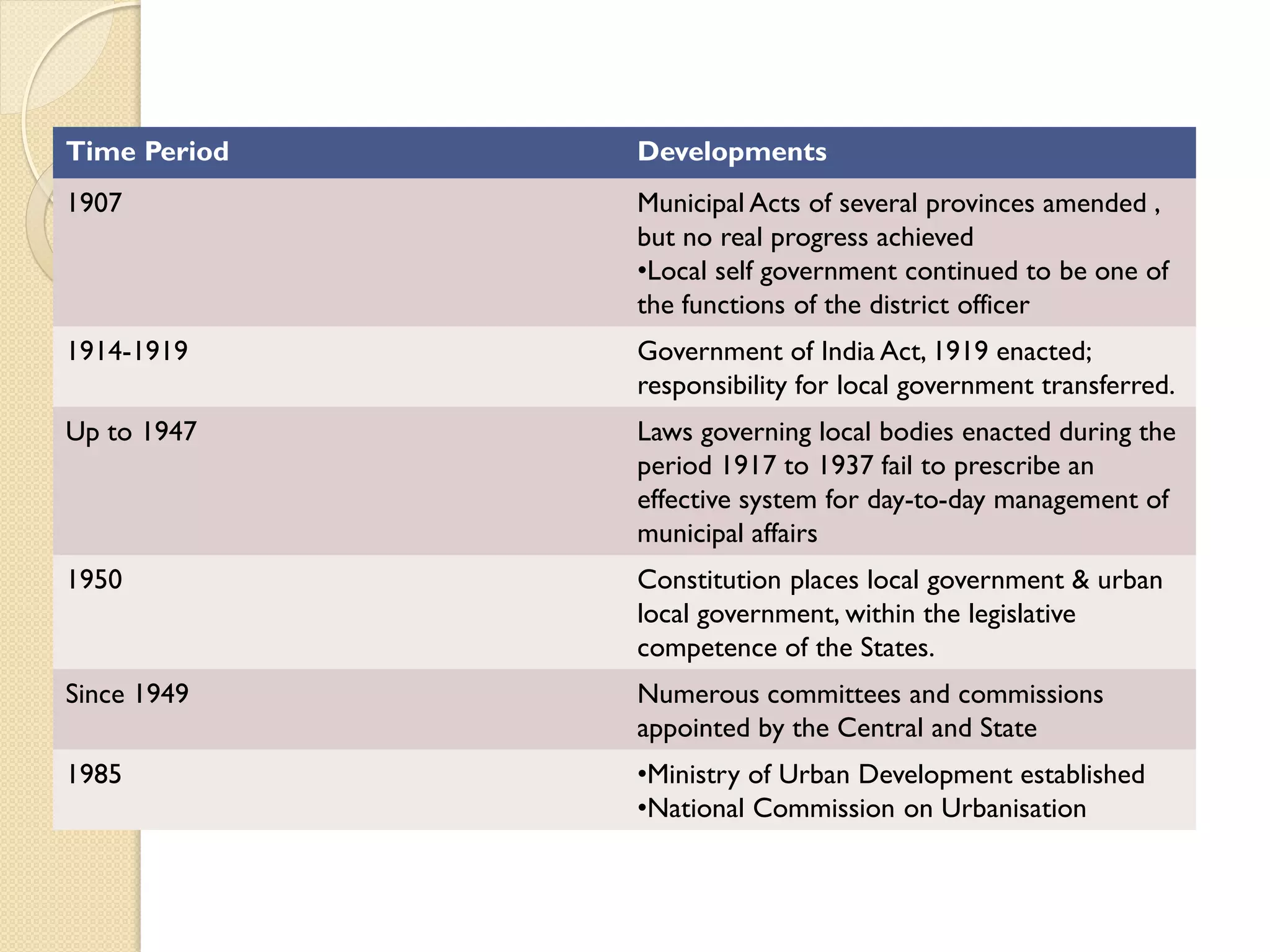
Time Period Developments
1907 Municipal Acts of several provinces amended ,
but no real progress achieved
•Local self government continued to be one of
the functions of the district officer
1914-1919 Government of India Act, 1919 enacted;
responsibility for local government transferred.
Up to 1947 Laws governing local bodies enacted during the
period 1917 to 1937 fail to prescribe an
effective system for day-to-day management of
municipal affairs
1950 Constitution places local government & urban
local government, within the legislative
competence of the States.
Since 1949 Numerous committees and commissions
appointed by the Central and State
1985 •Ministry of Urban Development established
•National Commission on Urbanisation
Time Period Developments
1989 Attempt to introduce the Constitution (63rd
Amendment) Bill; also known as Nagarpalika
(Municipality) Bill; contained provisions for
strengthening of urban local governments
1991 Bill [named Constitution (73rd Amendment)
Bill] introduced again by the Government
1992 Constitution (74th Amendment) Act finally
accepted and enacted
Since 1992 Most State municipal Acts amended
• Reforms underway in the structure and
functioning of urban local governments
AMRUT & JNNURM
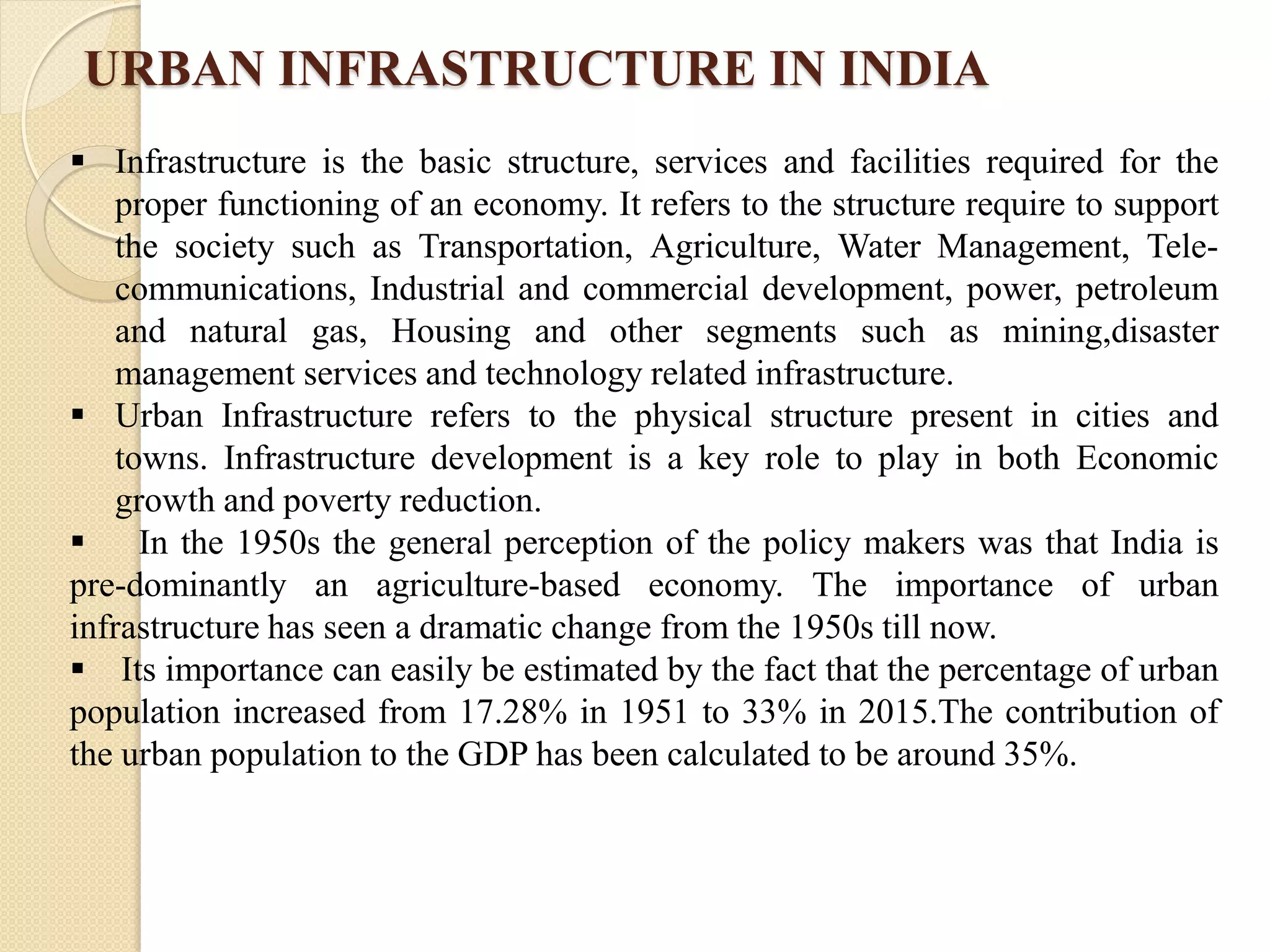
URBAN INFRASTRUCTURE IN INDIA
 Infrastructure is the basic structure, services and facilities required for the
proper functioning of an economy. It refers to the structure require to support
the society such as Transportation, Agriculture, Water Management, Tele-
communications, Industrial and commercial development, power, petroleum
and natural gas, Housing and other segments such as mining,disaster
management services and technology related infrastructure.
 Urban Infrastructure refers to the physical structure present in cities and
towns. Infrastructure development is a key role to play in both Economic
growth and poverty reduction.
 In the 1950s the general perception of the policy makers was that India is
pre-dominantly an agriculture-based economy. The importance of urban
infrastructure has seen a dramatic change from the 1950s till now.
 Its importance can easily be estimated by the fact that the percentage of urban
population increased from 17.28% in 1951 to 33% in 2015.The contribution of
the urban population to the GDP has been calculated to be around 35%.
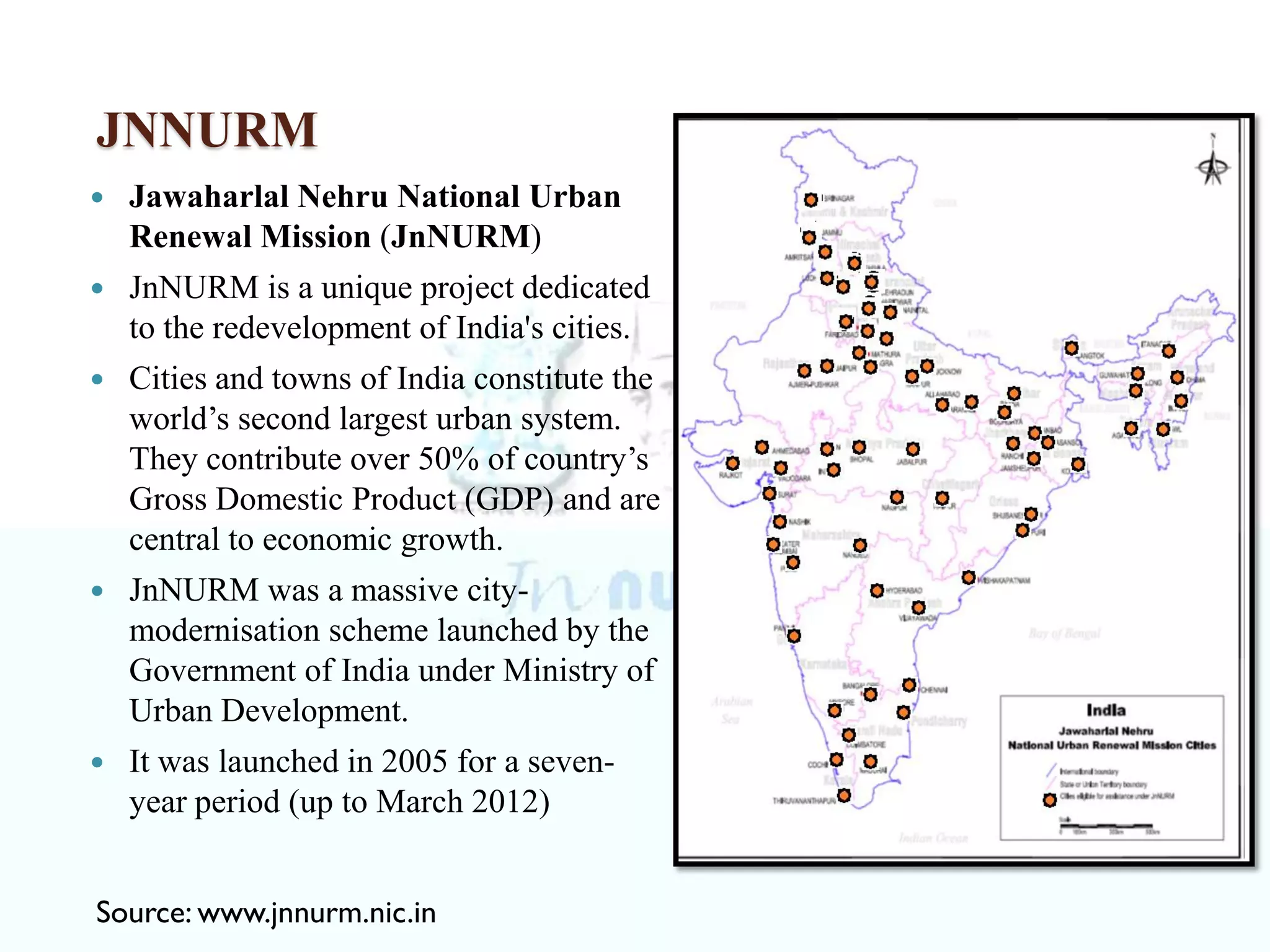
JNNURM
 Jawaharlal Nehru National Urban
Renewal Mission (JnNURM)
 JnNURM is a unique project dedicated
to the redevelopment of India's cities.
 Cities and towns of India constitute the
world’s second largest urban system.
They contribute over 50% of country’s
Gross Domestic Product (GDP) and are
central to economic growth.
 JnNURM was a massive city-
modernisation scheme launched by the
Government of India under Ministry of
Urban Development.
 It was launched in 2005 for a seven-
year period (up to March 2012)
Source: www.jnnurm.nic.in
AMRUT
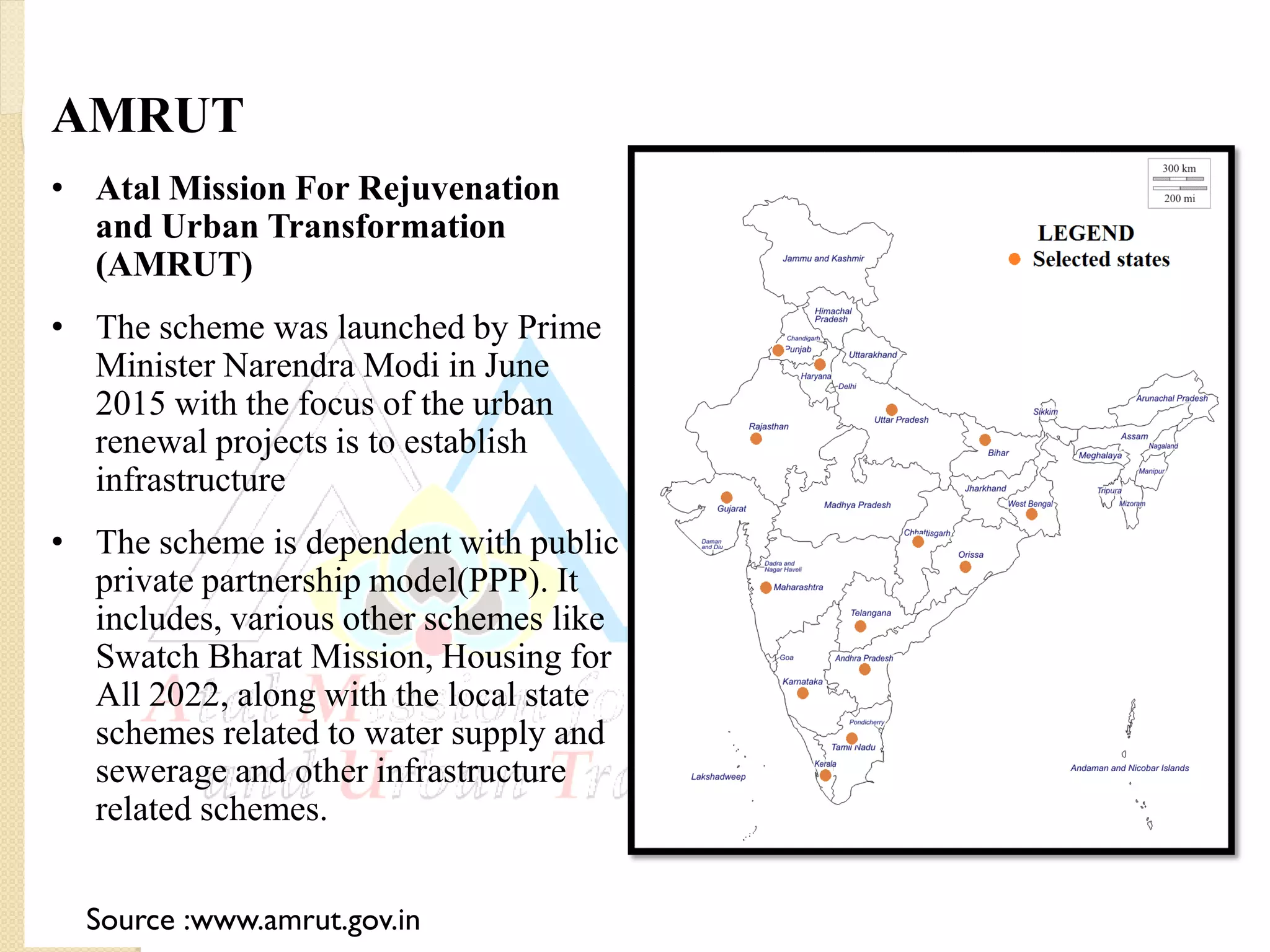
• Atal Mission For Rejuvenation
and Urban Transformation
(AMRUT)
• The scheme was launched by Prime
Minister Narendra Modi in June
2015 with the focus of the urban
renewal projects is to establish
infrastructure
• The scheme is dependent with public
private partnership model(PPP). It
includes, various other schemes like
Swatch Bharat Mission, Housing for
All 2022, along with the local state
schemes related to water supply and
sewerage and other infrastructure
related schemes.
Source :www.amrut.gov.in
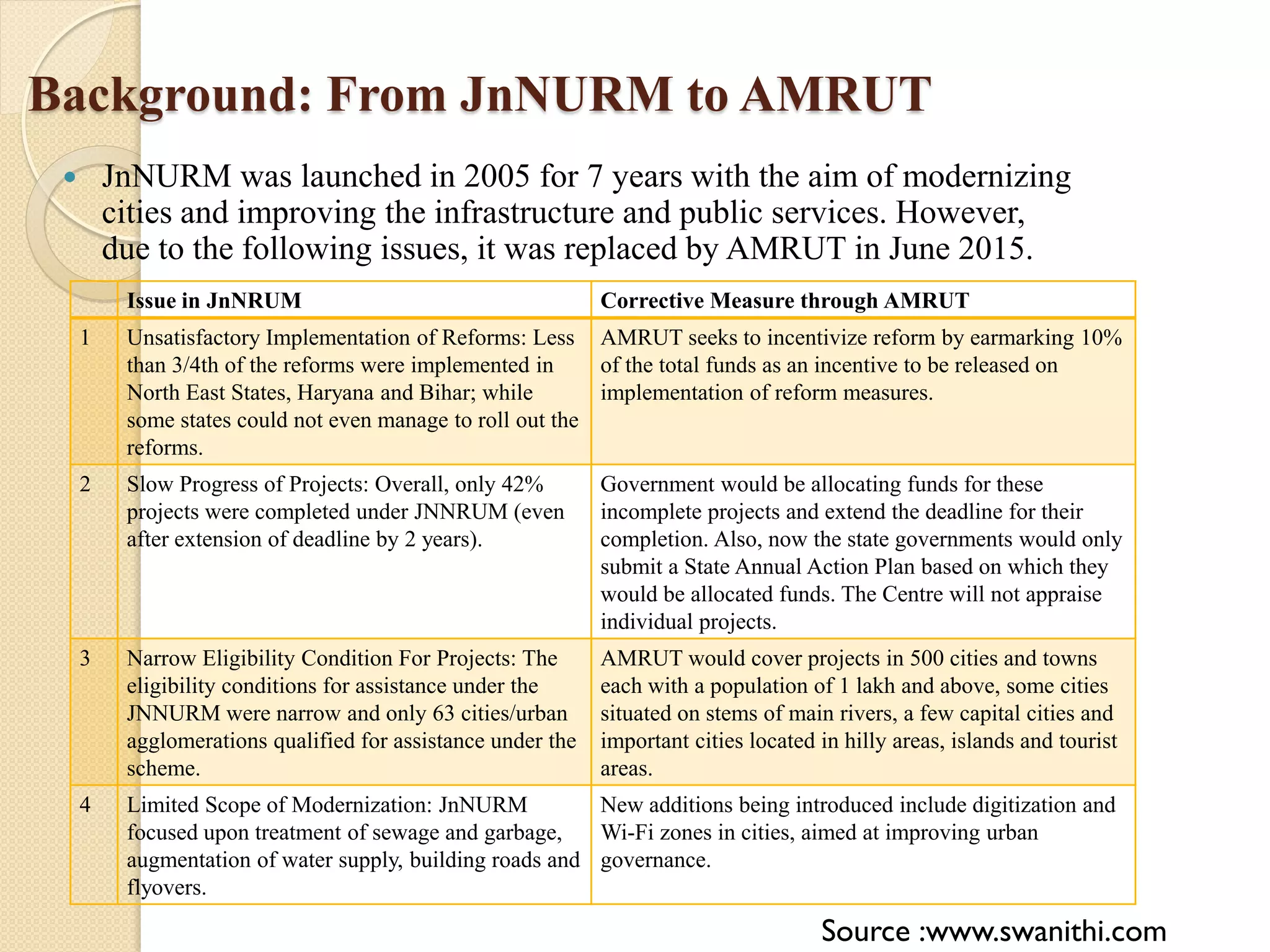
Background: From JnNURM to AMRUT
 JnNURM was launched in 2005 for 7 years with the aim of modernizing
cities and improving the infrastructure and public services. However,
due to the following issues, it was replaced by AMRUT in June 2015.
Issue in JnNRUM Corrective Measure through AMRUT
1 Unsatisfactory Implementation of Reforms: Less
than 3/4th of the reforms were implemented in
North East States, Haryana and Bihar; while
some states could not even manage to roll out the
reforms.
AMRUT seeks to incentivize reform by earmarking 10%
of the total funds as an incentive to be released on
implementation of reform measures.
2 Slow Progress of Projects: Overall, only 42%
projects were completed under JNNRUM (even
after extension of deadline by 2 years).
Government would be allocating funds for these
incomplete projects and extend the deadline for their
completion. Also, now the state governments would only
submit a State Annual Action Plan based on which they
would be allocated funds. The Centre will not appraise
individual projects.
3 Narrow Eligibility Condition For Projects: The
eligibility conditions for assistance under the
JNNURM were narrow and only 63 cities/urban
agglomerations qualified for assistance under the
scheme.
AMRUT would cover projects in 500 cities and towns
each with a population of 1 lakh and above, some cities
situated on stems of main rivers, a few capital cities and
important cities located in hilly areas, islands and tourist
areas.
4 Limited Scope of Modernization: JnNURM
focused upon treatment of sewage and garbage,
augmentation of water supply, building roads and
flyovers.
New additions being introduced include digitization and
Wi-Fi zones in cities, aimed at improving urban
governance.
Source :www.swanithi.com
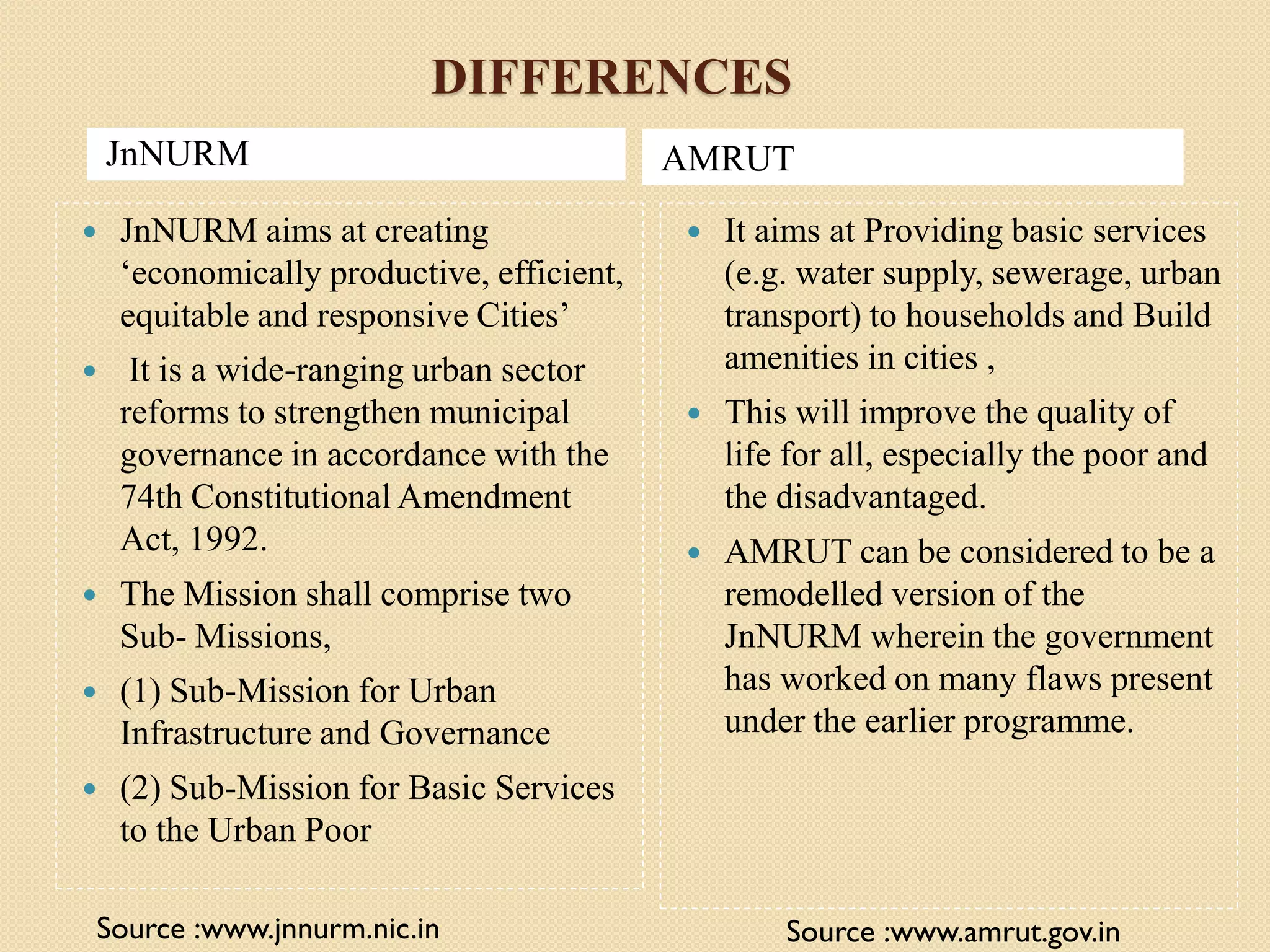
DIFFERENCES
JnNURM
 JnNURM aims at creating
‘economically productive, efficient,
equitable and responsive Cities’
 It is a wide-ranging urban sector
reforms to strengthen municipal
governance in accordance with the
74th Constitutional Amendment
Act, 1992.
 The Mission shall comprise two
Sub- Missions,
 (1) Sub-Mission for Urban
Infrastructure and Governance
 (2) Sub-Mission for Basic Services
to the Urban Poor
AMRUT
 It aims at Providing basic services
(e.g. water supply, sewerage, urban
transport) to households and Build
amenities in cities ,
 This will improve the quality of
life for all, especially the poor and
the disadvantaged.
 AMRUT can be considered to be a
remodelled version of the
JnNURM wherein the government
has worked on many flaws present
under the earlier programme.
Source :www.amrut.gov.inSource :www.jnnurm.nic.in
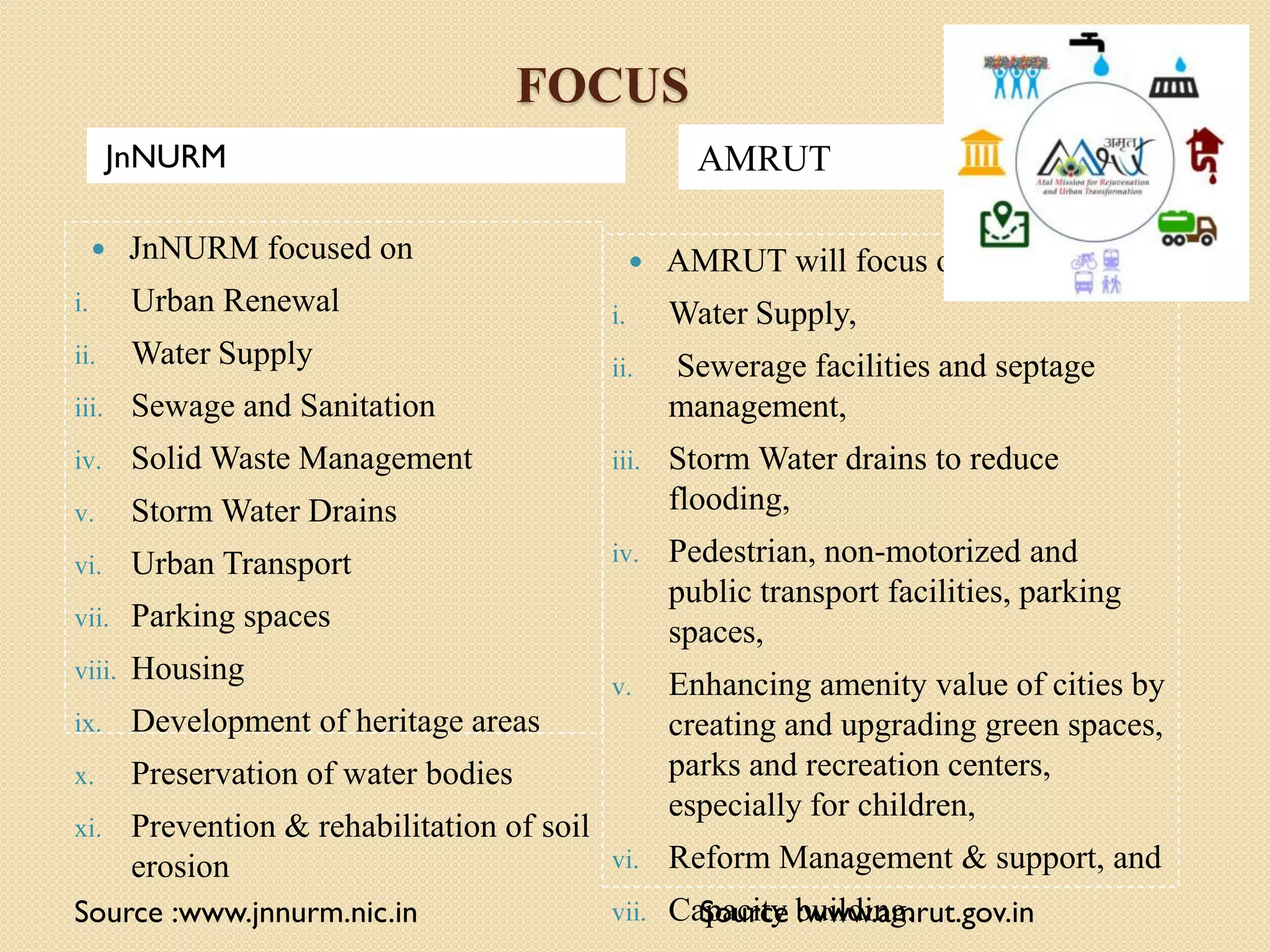
FOCUS
JnNURM
 JnNURM focused on
i. Urban Renewal
ii. Water Supply
iii. Sewage and Sanitation
iv. Solid Waste Management
v. Storm Water Drains
vi. Urban Transport
vii. Parking spaces
viii. Housing
ix. Development of heritage areas
x. Preservation of water bodies
xi. Prevention & rehabilitation of soil
erosion
AMRUT
 AMRUT will focus on
i. Water Supply,
ii. Sewerage facilities and septage
management,
iii. Storm Water drains to reduce
flooding,
iv. Pedestrian, non-motorized and
public transport facilities, parking
spaces,
v. Enhancing amenity value of cities by
creating and upgrading green spaces,
parks and recreation centers,
especially for children,
vi. Reform Management & support, and
vii. Capacity building.Source :www.amrut.gov.inSource :www.jnnurm.nic.in
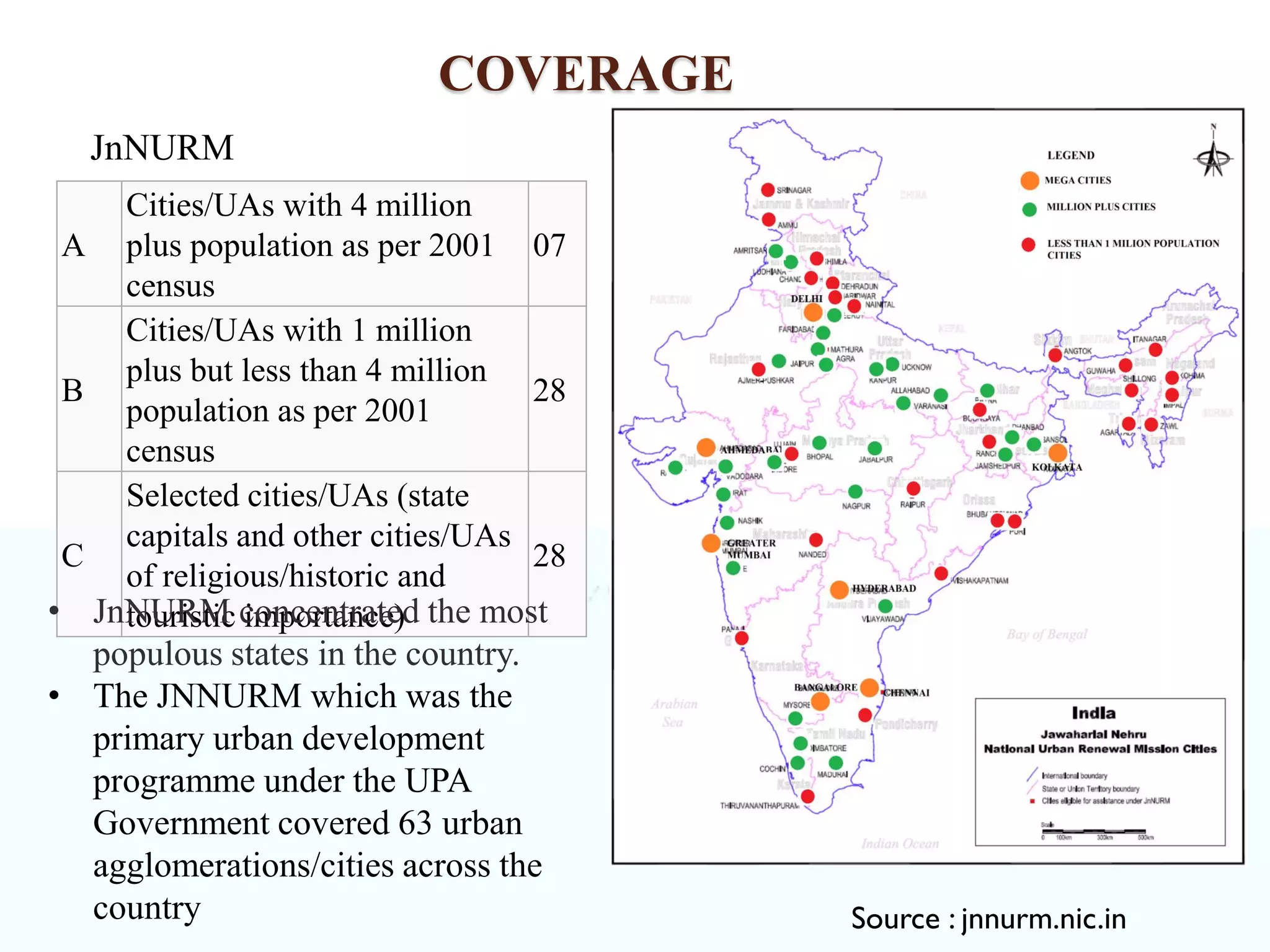
COVERAGE
JnNURM
A
Cities/UAs with 4 million
plus population as per 2001
census
07
B
Cities/UAs with 1 million
plus but less than 4 million
population as per 2001
census
28
C
Selected cities/UAs (state
capitals and other cities/UAs
of religious/historic and
touristic importance)
28
• JnNURM concentrated the most
populous states in the country.
• The JNNURM which was the
primary urban development
programme under the UPA
Government covered 63 urban
agglomerations/cities across the
country Source : jnnurm.nic.in
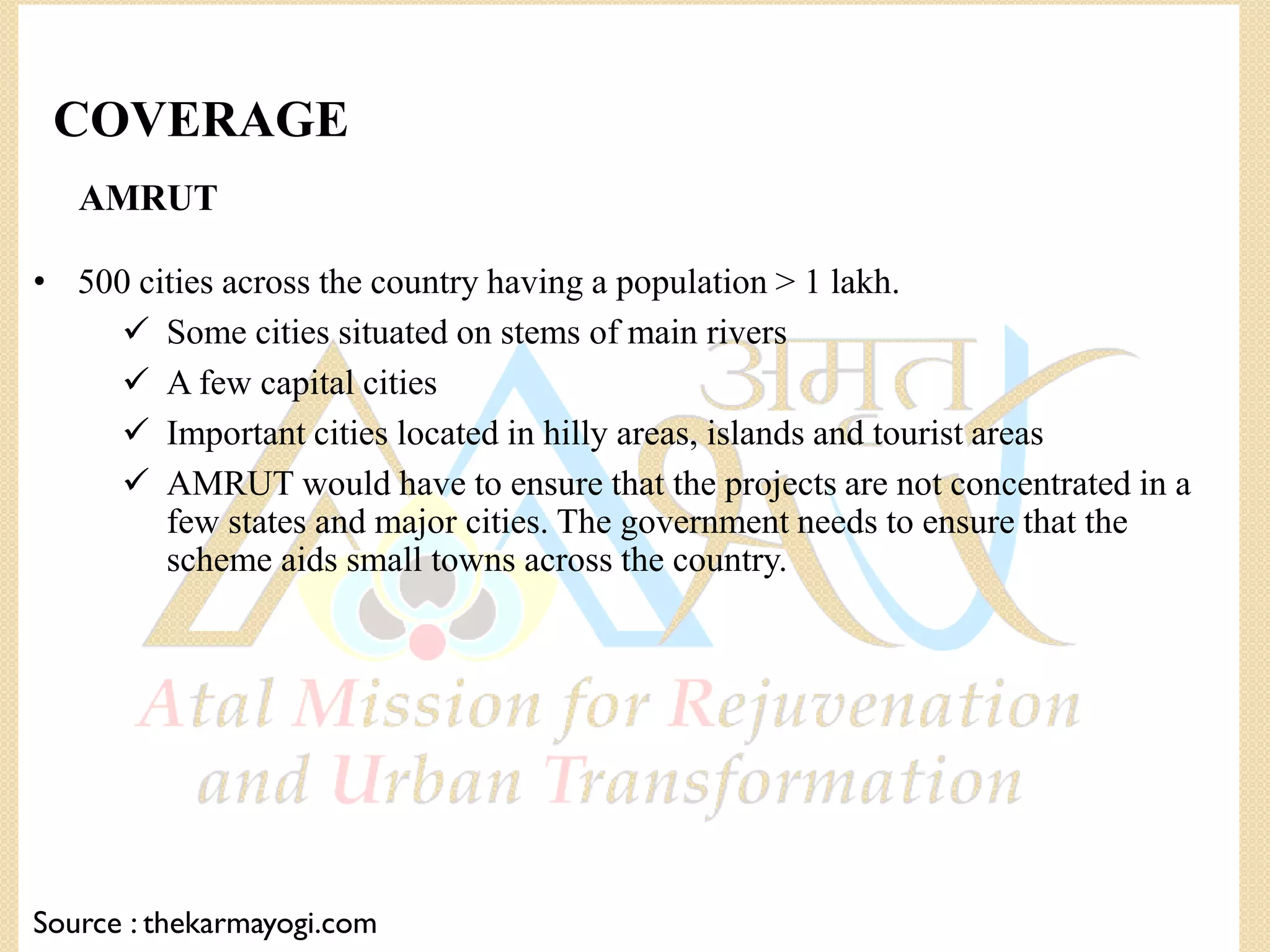
AMRUT
• 500 cities across the country having a population > 1 lakh.
 Some cities situated on stems of main rivers
 A few capital cities
 Important cities located in hilly areas, islands and tourist areas
 AMRUT would have to ensure that the projects are not concentrated in a
few states and major cities. The government needs to ensure that the
scheme aids small towns across the country.
Source : thekarmayogi.com
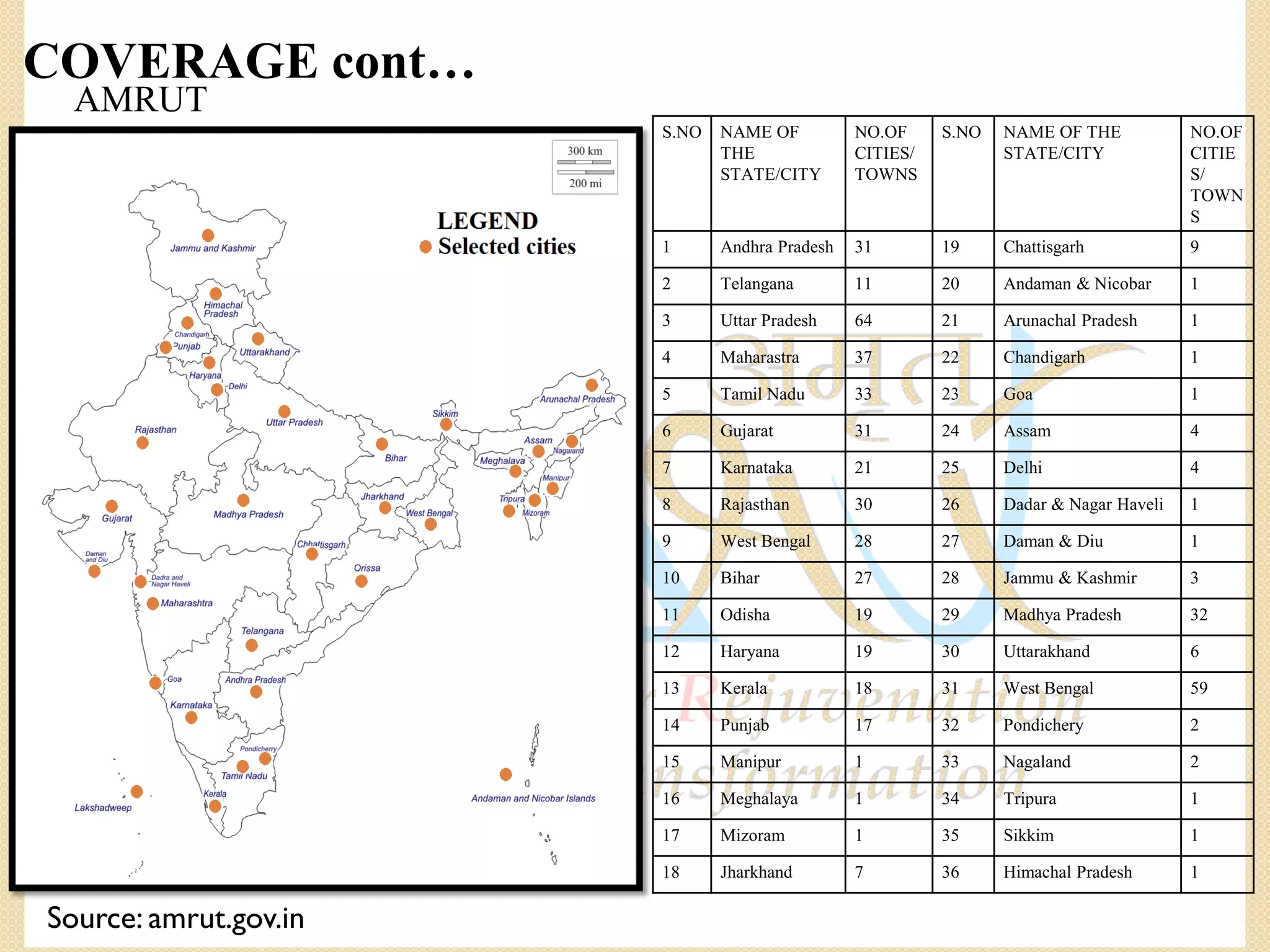
COVERAGE
AMRUT
S.NO NAME OF
THE
STATE/CITY
NO.OF
CITIES/
TOWNS
S.NO NAME OF THE
STATE/CITY
NO.OF
CITIE
S/
TOWN
S
1 Andhra Pradesh 31 19 Chattisgarh 9
2 Telangana 11 20 Andaman & Nicobar 1
3 Uttar Pradesh 64 21 Arunachal Pradesh 1
4 Maharastra 37 22 Chandigarh 1
5 Tamil Nadu 33 23 Goa 1
6 Gujarat 31 24 Assam 4
7 Karnataka 21 25 Delhi 4
8 Rajasthan 30 26 Dadar & Nagar Haveli 1
9 West Bengal 28 27 Daman & Diu 1
10 Bihar 27 28 Jammu & Kashmir 3
11 Odisha 19 29 Madhya Pradesh 32
12 Haryana 19 30 Uttarakhand 6
13 Kerala 18 31 West Bengal 59
14 Punjab 17 32 Pondichery 2
15 Manipur 1 33 Nagaland 2
16 Meghalaya 1 34 Tripura 1
17 Mizoram 1 35 Sikkim 1
18 Jharkhand 7 36 Himachal Pradesh 1
Source: amrut.gov.in
COVERAGE cont…
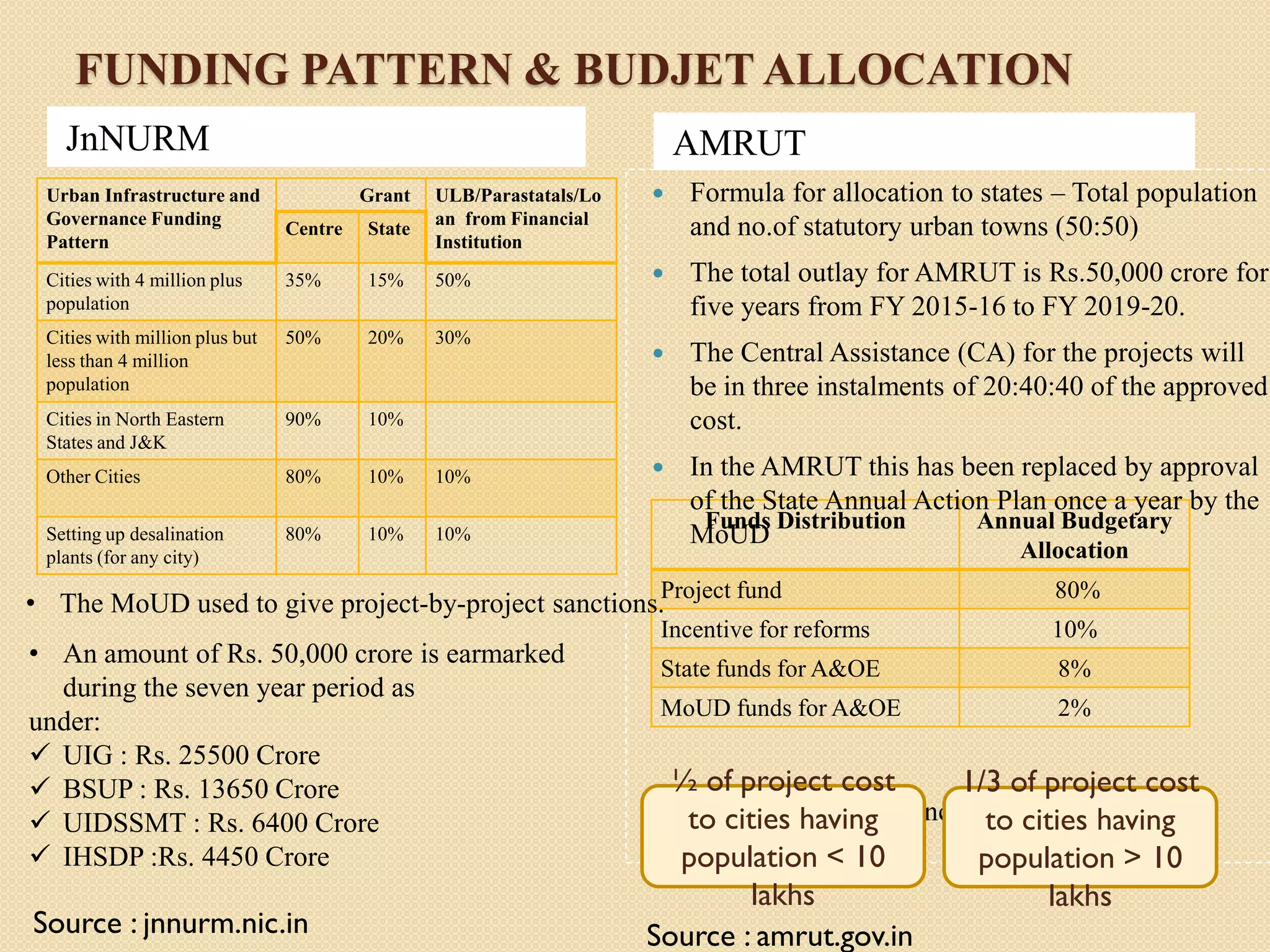
FUNDING PATTERN & BUDJET ALLOCATION
JnNURM
Funds Distribution Annual Budgetary
Allocation
Project fund 80%
Incentive for reforms 10%
State funds for A&OE 8%
MoUD funds for A&OE 2%
AMRUT
 Formula for allocation to states – Total population
and no.of statutory urban towns (50:50)
 The total outlay for AMRUT is Rs.50,000 crore for
five years from FY 2015-16 to FY 2019-20.
 The Central Assistance (CA) for the projects will
be in three instalments of 20:40:40 of the approved
cost.
 In the AMRUT this has been replaced by approval
of the State Annual Action Plan once a year by the
MoUD
 Central Govt. assistance:
½ of project cost
to cities having
population < 10
lakhs
1/3 of project cost
to cities having
population > 10
lakhs
Urban Infrastructure and
Governance Funding
Pattern
Grant ULB/Parastatals/Lo
an from Financial
Institution
Centre State
Cities with 4 million plus
population
35% 15% 50%
Cities with million plus but
less than 4 million
population
50% 20% 30%
Cities in North Eastern
States and J&K
90% 10%
Other Cities 80% 10% 10%
Setting up desalination
plants (for any city)
80% 10% 10%
Source : jnnurm.nic.in Source : amrut.gov.in
• An amount of Rs. 50,000 crore is earmarked
during the seven year period as
under:
 UIG : Rs. 25500 Crore
 BSUP : Rs. 13650 Crore
 UIDSSMT : Rs. 6400 Crore
 IHSDP :Rs. 4450 Crore
• The MoUD used to give project-by-project sanctions.
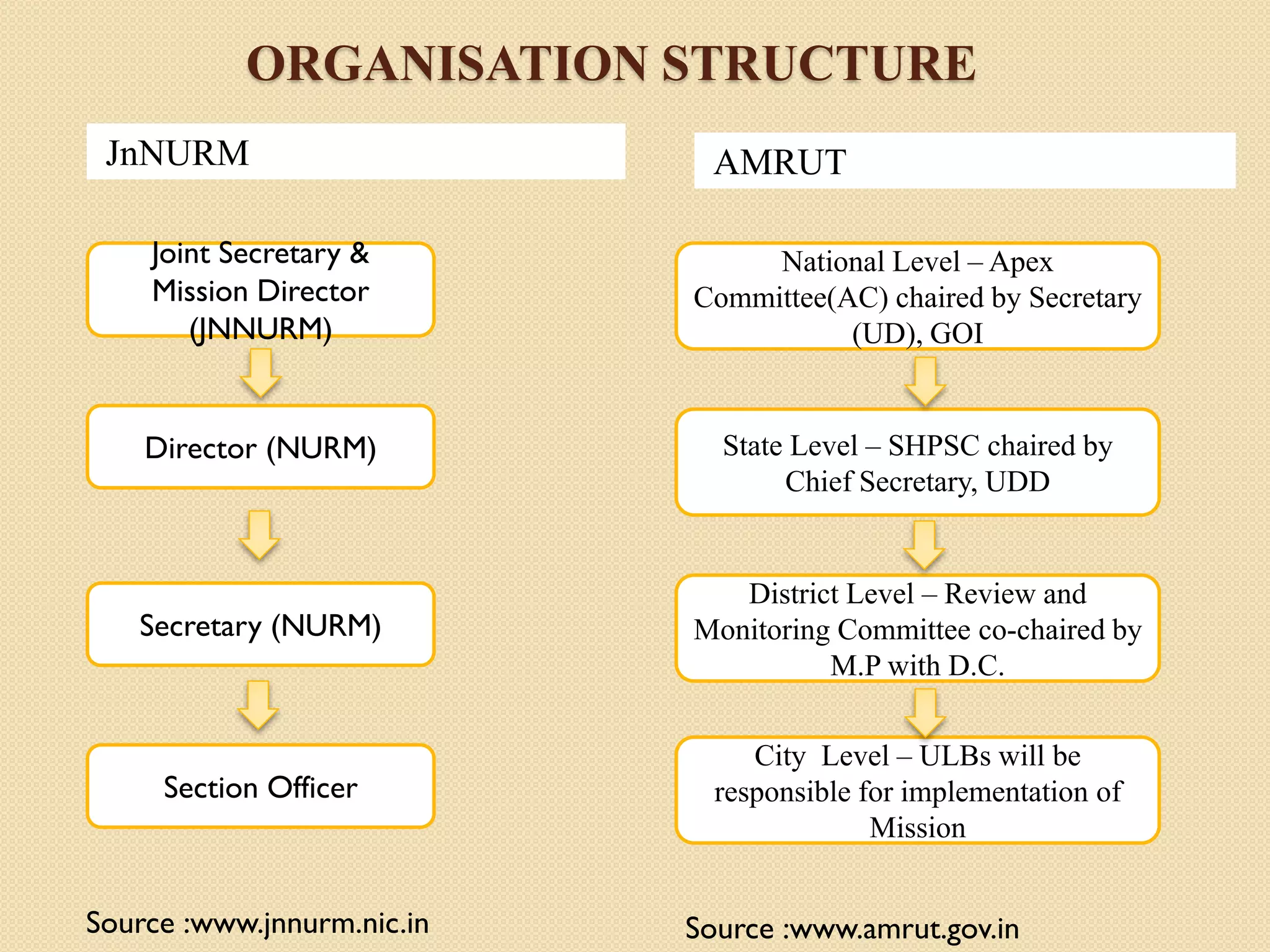
ORGANISATION STRUCTURE
JnNURM AMRUT
National Level – Apex
Committee(AC) chaired by Secretary
(UD), GOI
State Level – SHPSC chaired by
Chief Secretary, UDD
District Level – Review and
Monitoring Committee co-chaired by
M.P with D.C.
City Level – ULBs will be
responsible for implementation of
Mission
Source :www.amrut.gov.in
Joint Secretary &
Mission Director
(JNNURM)
Director (NURM)
Secretary (NURM)
Section Officer
Source :www.jnnurm.nic.in
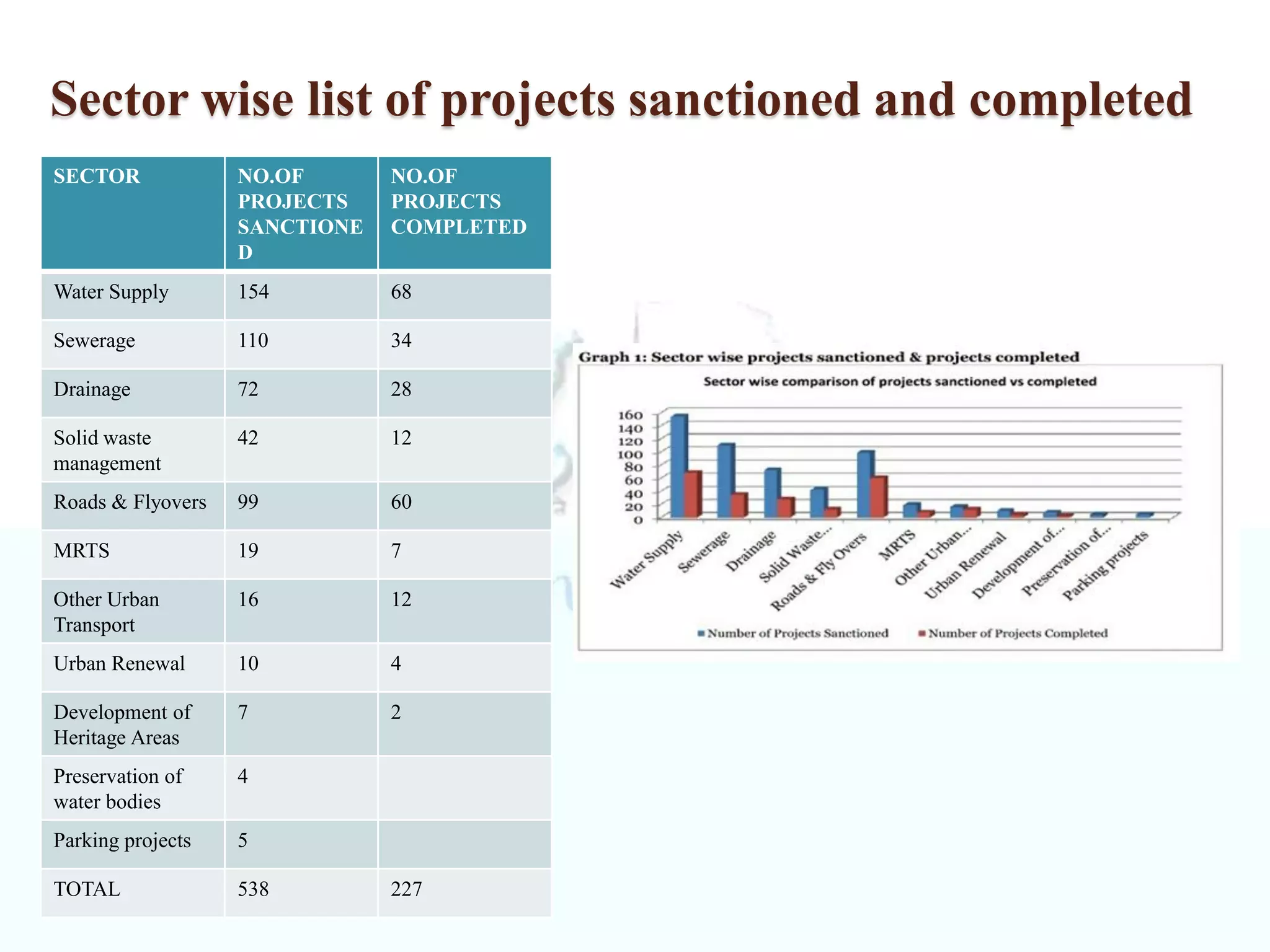
Sector wise list of projects sanctioned and completed
SECTOR NO.OF
PROJECTS
SANCTIONE
D
NO.OF
PROJECTS
COMPLETED
Water Supply 154 68
Sewerage 110 34
Drainage 72 28
Solid waste
management
42 12
Roads & Flyovers 99 60
MRTS 19 7
Other Urban
Transport
16 12
Urban Renewal 10 4
Development of
Heritage Areas
7 2
Preservation of
water bodies
4
Parking projects 5
TOTAL 538 227
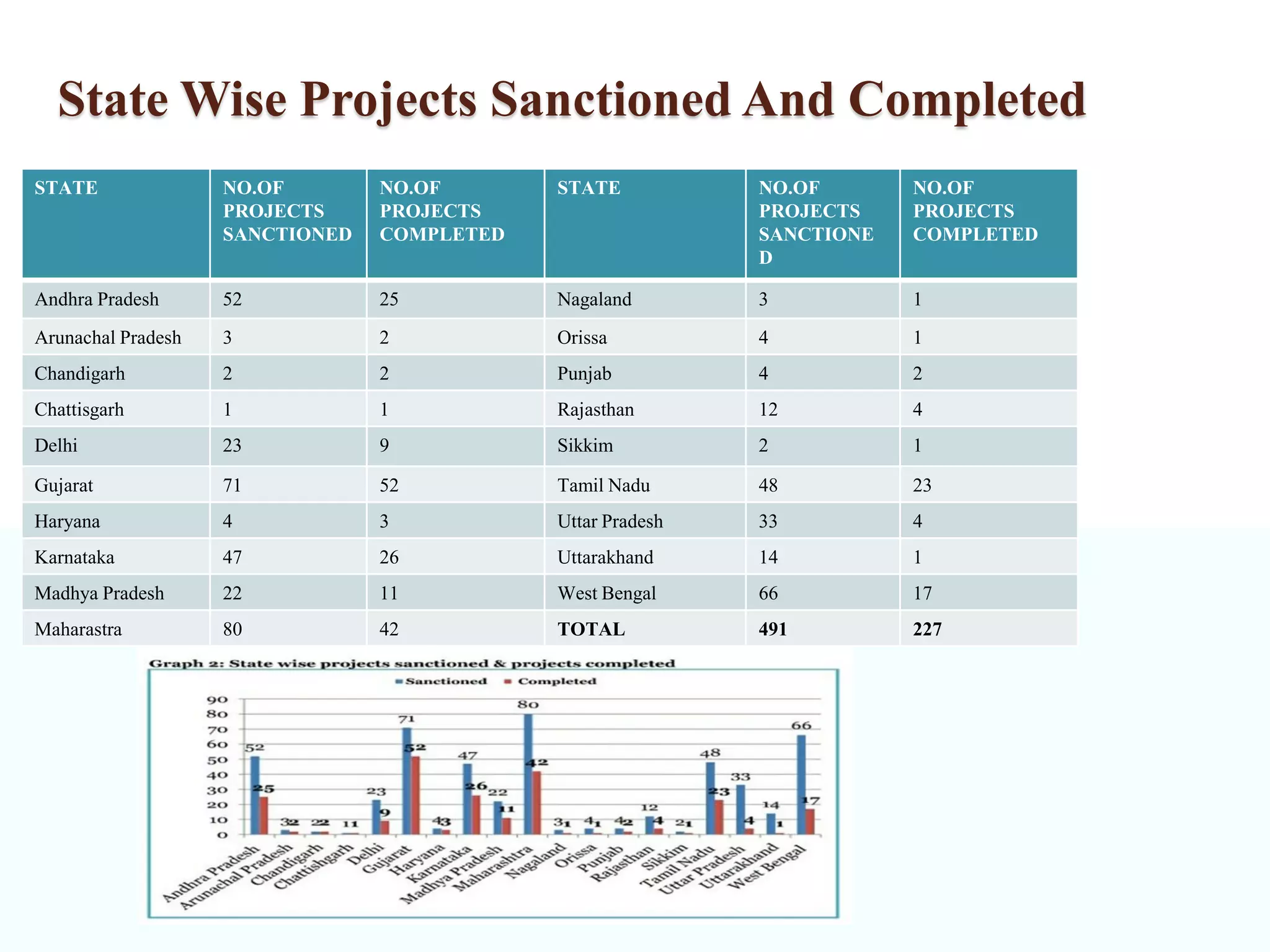
State Wise Projects Sanctioned And Completed
STATE NO.OF
PROJECTS
SANCTIONED
NO.OF
PROJECTS
COMPLETED
STATE NO.OF
PROJECTS
SANCTIONE
D
NO.OF
PROJECTS
COMPLETED
Andhra Pradesh 52 25 Nagaland 3 1
Arunachal Pradesh 3 2 Orissa 4 1
Chandigarh 2 2 Punjab 4 2
Chattisgarh 1 1 Rajasthan 12 4
Delhi 23 9 Sikkim 2 1
Gujarat 71 52 Tamil Nadu 48 23
Haryana 4 3 Uttar Pradesh 33 4
Karnataka 47 26 Uttarakhand 14 1
Madhya Pradesh 22 11 West Bengal 66 17
Maharastra 80 42 TOTAL 491 227
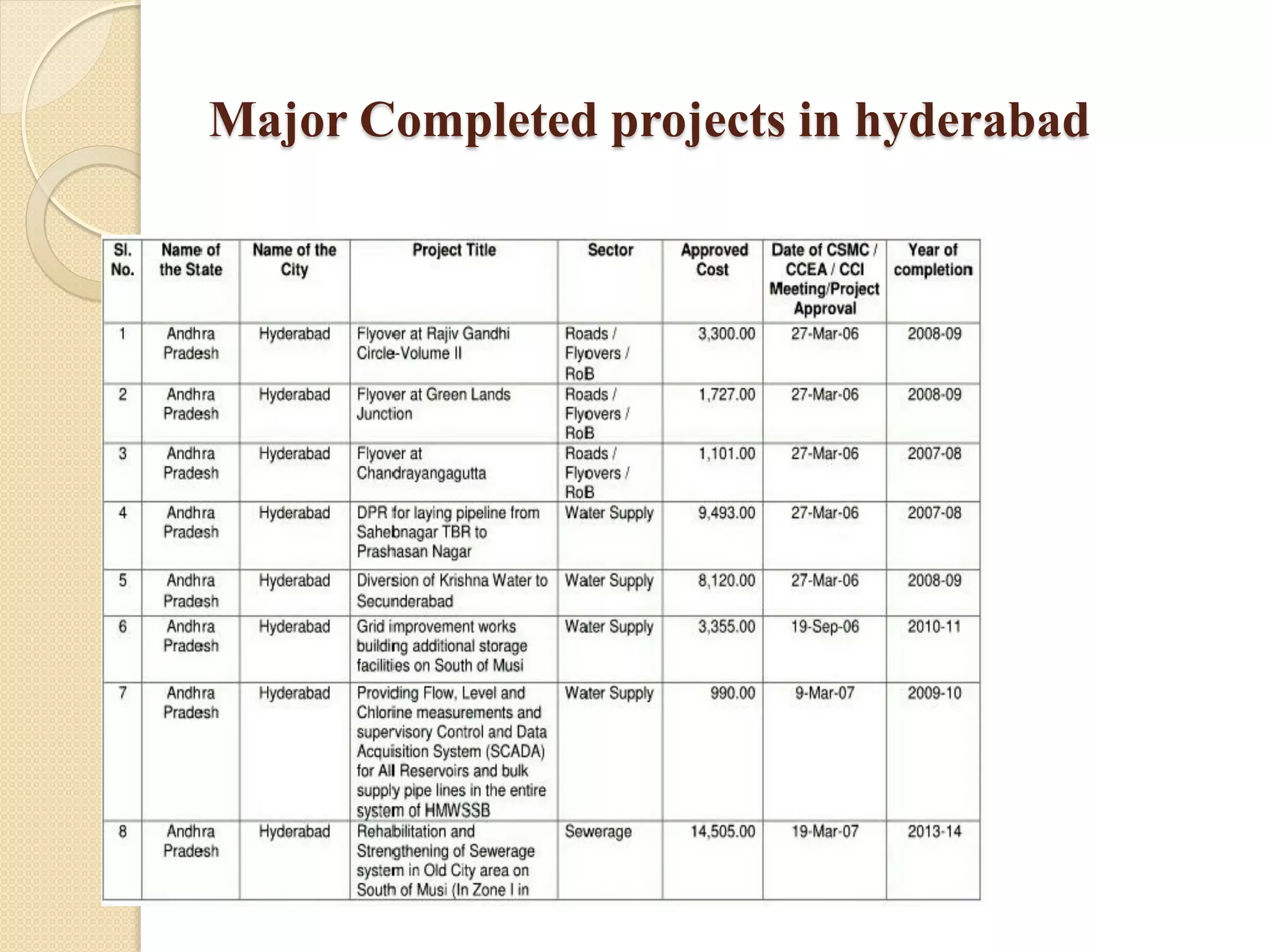
Major Completed projects in hyderabad
FAILURES
 Competence of Planners
 The mission was centrally planned in New Delhi and its objectives were
blindly accepted and adopted across the states
 The required administrative reforms and accountability were ignored.
 The infrastructure planning was limited to just addition of new Core
Infrastructure as suggested by private consultants.
 The planners were neither trained nor competent in understanding the
social needs for which they were planning
 This was one of the major flaws that resulted in failure
 Approach adopted by Planners.
 One of the mission's primary objective was a projection that improving
infrastructure would be a solution and would cause urban renewal.
 The objective failed to account for capability/capacity & willingness of
ULB authorities to learn, participation of the citizens being limited to
just inviting comments, and lack of focused research were the important
reasons for its failure.
 Funding of Projects.
 Since the Objectives of the mission were vague and not easily
understood, the funds were either diverted or misused.
The central funding had to be matched by the states to achieve stability. But
lack of monitoring, review and no provision for midterm course correction
caused serious damage to the renewal mission.
FAILURES
URBAN GOVERNANACE
(GHMC)
1 THE QUTB SHAHI STAGE (OR) THE FIRST TWIN CITY STAGE (1591-1687).
Hyderabad city was planned on a grid pattern consisting of two main roads, running East–West and North–
South and intersecting at Charminar, the city centre.
This city’s growth continued E-W along the commercial highway of the Kingdom until 1687.
It was suddenly halted by annexation of the Kingdom to the Moghul Empire. The first Twin City phase
(Hyderabad – Golconda) ended with the collapse of the Kingdom and the subsequent abandonment of
Golconda fort.
2 THE TRANSITIONAL PHASE (1687-1725).
This period began with a halt in the active life and growth of the city.
The authority was shifted from Hyderabad to Aurangabed, the Southern headquarters of Moghul Empire.
Towards the end of 1725 Nizam Mulk Asaf Jah founded the Asaf Jahi Dynasty of Hyderabad and took firm
control of the Deccan & the Hyderabad city.
3 THE EARLY ASAF JAHI PERIOD (1725-1798).
This period is characterized by two distinct phases,
Inhibition (1725–1763):-
It was one of the great economic stress and strain for Hyderabad because Aurangabad was still the capital.
The death of Asaf Jahi I in 1748 and the Anglo – French struggle for supremacy over Deccan (1750-1760)
renewed political uncertainty which adversely affected Hyderabad’s growth.
Acceleration (1763–1798):-
The Nizam of the Deccan, Nizam Ali Khan (1761-1796) shifted his head quarters to Hyderabad.
Hyderabad thus re-emerged as the Chief City of the Deccan after an eclipse of seventy six years.
4 THE SECOND TWIN CITY STAGE (1798-1874).
In 1798 two significant political decisions profoundly altered the course of the city’s development.
Decision 1:-
In the first instance the subsidiary alliance of the Nizam with the East India Company in 1798 created Secunderabad
and consequently ushered in second phase of the development of Hyderabad through with settlements.
Decision 2:-
The Nizam’s permission for the construction of the British Residency on the North bank changed the trend of the
Hyderabad’s growth.
5 THE RAILWAY PERIOD (1874-1908).
The inception of the Railway in the twin cities led to a considerable growth, much of it oriented to the Railway
stations, goods yards, associated ware house areas and industrial regions. From Bombay, the Railway line spanning
Hyderabad and Secunderabad in 1874 was extended to Madras via Warangal in 1898.
6 THE MODERN (OR) METROPOLITAN STAGE (1908-1956).
The modern area of the twin settlements and their fusion into a great metropolis. The flood of 28th September, 1908
was subsequently followed by events of economic & political significance which changed the social, cultural,
political & economic structure of the twin cities.
In the year 1912 and greater attention was given to the provision of infrastructure facilities have added to the physical
growth of the city.
THE DEVELOPING STAGE (1956-1985).
Hyderabad is constructed as Capital of Andhra Pradesh from 1st November, 1956. Its importance has grown as a
metropolitan centre of the country for highly specialized and advanced medical and educational services.
The Metropolitan Area of Hyderabad has a number of large scale units. Among the Public sector Units mention may
be made of HMT, HAL, IDPL, HCL, ECIL, NFC, NRSC, CCMB,
NIN, IDL, BHEL, Survey of India etc.
8 THE PRE-IT REVOLUTION STAGE (1986-2000).
Hyderabad witnessed growth of public sector enterprises. Numerous organizations set up base and attracted people to
come and settle down in Hyderabad.
The population grew steadily between these periods and Hyderabad city become one of the important cities of India
in terms of size and contribution.
Hyderabad was already an established centre of education and learning and was ready to take on the IT revolution.
9 THE TRI-CITY STAGE HYDERABAD-SECUNDERABADCYBERABAD (2001 ONWARDS).
The development of HITECH City led to the formation of Cyberabad City.
The city grew in leaps and bounds during this decade. the civic agencies were faced with complex urban challenges.
Highlights of this period are the development of the International Airport, Financial District, Outer Ring Road and the
expressways.
AREA & DEMOGRAPHY
Hyderabad is the sixth largest city in the urban agglomeration in India.
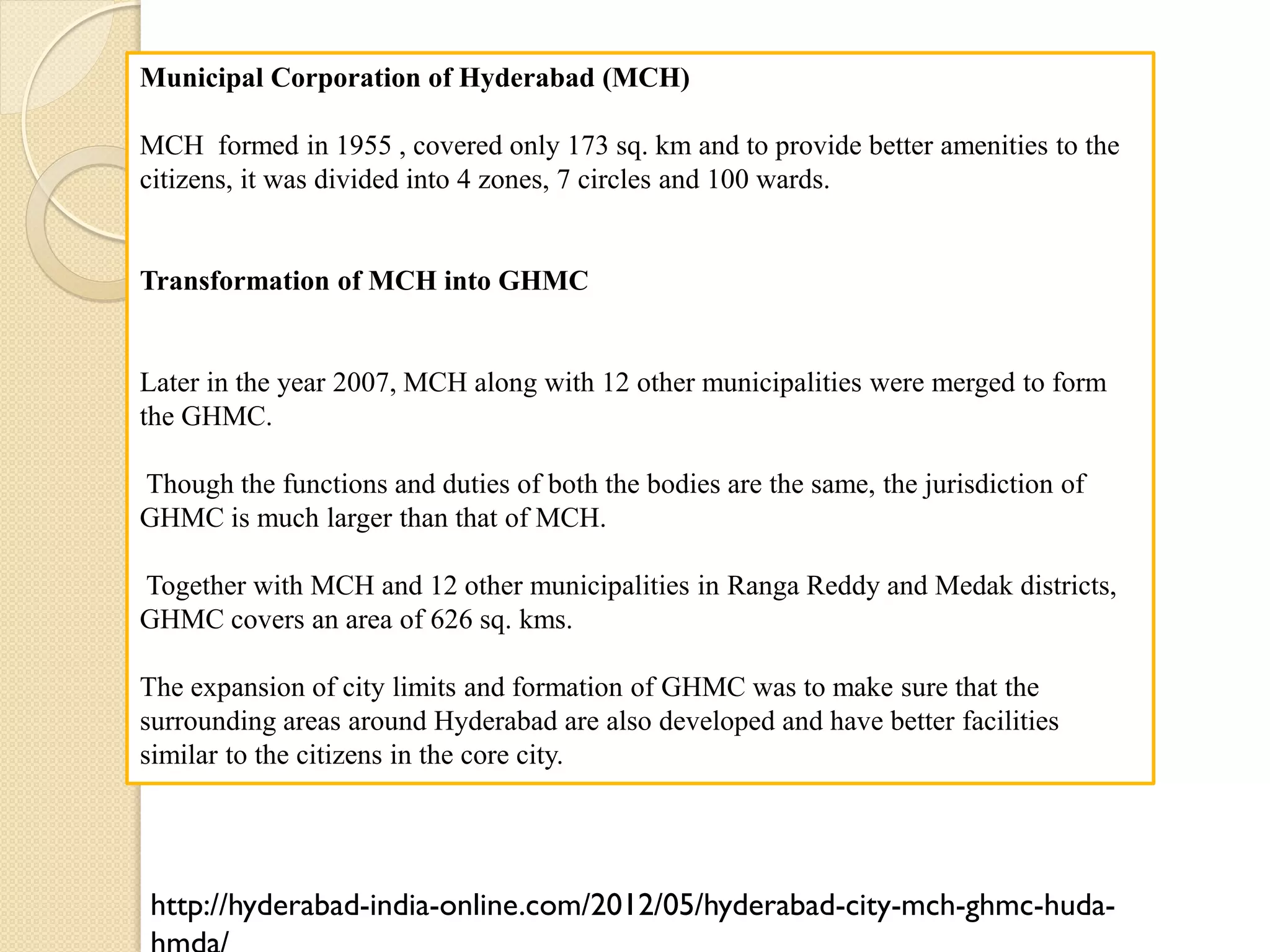
The Urban Agglomeration consists of the Municipal Corporation of Hyderabad (MCH)
(172 sq.km), surrounding 12 municipalities which are now merged with Greater
Hyderabad Municipal Corporation, Secunderabad Cantonment, Osmania University and
other areas.
The urban agglomeration population has increased from 4.3 million in 1991 to 5.7 million
in 2001. This as more than 50 % during 1981-91 and 27% during 1991-2001.
Municipal Corporation of Hyderabad (MCH)
MCH formed in 1955 , covered only 173 sq. km and to provide better amenities to the
citizens, it was divided into 4 zones, 7 circles and 100 wards.
Transformation of MCH into GHMC
Later in the year 2007, MCH along with 12 other municipalities were merged to form
the GHMC.
Though the functions and duties of both the bodies are the same, the jurisdiction of
GHMC is much larger than that of MCH.
Together with MCH and 12 other municipalities in Ranga Reddy and Medak districts,
GHMC covers an area of 626 sq. kms.
The expansion of city limits and formation of GHMC was to make sure that the
surrounding areas around Hyderabad are also developed and have better facilities
similar to the citizens in the core city.
http://hyderabad-india-online.com/2012/05/hyderabad-city-mch-ghmc-huda-
 GHMC administers through the Head Office, 5 Zones (south, east, north,
west and central zones), and 18 Circles and 150 wards. GHMC provides the
following services:
a)Public Health, Sanitation, Street Lighting
etc.
b) Provision and maintenance of infrastructure
– Roads, Storm Water Drainage, Under
Ground Drainage (in Ranga Reddy and
Medak), Street Lights, Parks & Play Grounds
etc
c) Regulatory activities – building
constructions, trade licenses etc
d) Resource mobilization.
e)Implementation of urban poverty alleviation
programmes.
f) GHMC introduced an online Grievance.
GHMC
• As per the 2011 census, the urban population of Hyderabad city was more than 77
lakh.
• Total Metropolitan Area Population of Hyderabad in 2015 - 11,458,741 (11.4
million)
• According to recent estimates, Hyderabad Metropolitan area or Hyderabad
Urban Agglomeration is all set to cross 12 million (1.2 Crore) populations by the
end of 2015. This figure was recorded at 77,49,334 in 2011 census.
• After the formation of GHMC, infrastructure works costing Rs.13470 Crores
have been sanctioned out of which works costing Rs.6531 Crores have been
completed.
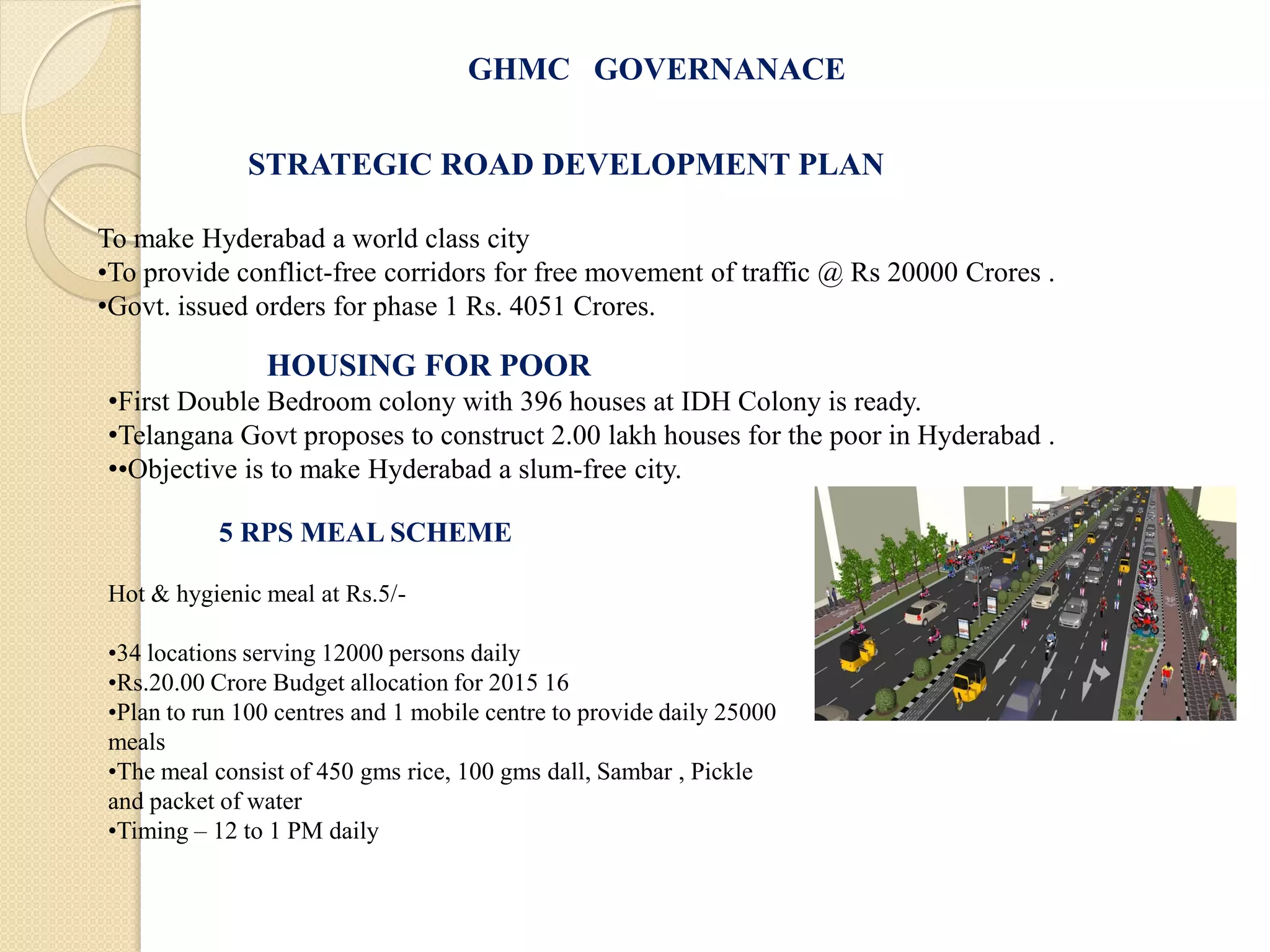
GHMC GOVERNANACE
STRATEGIC ROAD DEVELOPMENT PLAN
To make Hyderabad a world class city
•To provide conflict-free corridors for free movement of traffic @ Rs 20000 Crores .
•Govt. issued orders for phase 1 Rs. 4051 Crores.
HOUSING FOR POOR
•First Double Bedroom colony with 396 houses at IDH Colony is ready.
•Telangana Govt proposes to construct 2.00 lakh houses for the poor in Hyderabad .
••Objective is to make Hyderabad a slum-free city.
5 RPS MEAL SCHEME
Hot & hygienic meal at Rs.5/-
•34 locations serving 12000 persons daily
•Rs.20.00 Crore Budget allocation for 2015 16
•Plan to run 100 centres and 1 mobile centre to provide daily 25000
meals
•The meal consist of 450 gms rice, 100 gms dall, Sambar , Pickle
and packet of water
•Timing – 12 to 1 PM daily
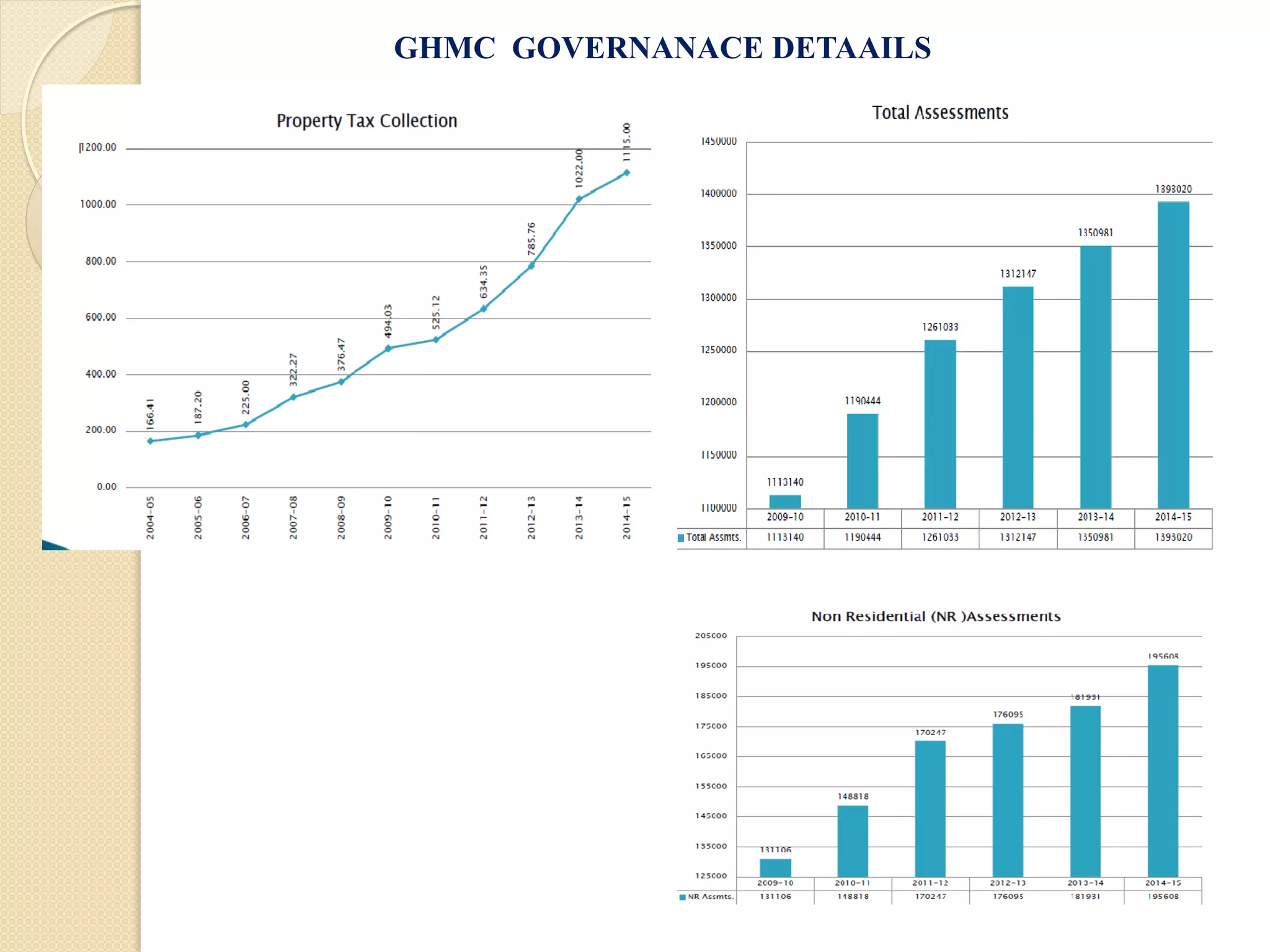
GHMC GOVERNANACE DETAAILS
GHMC ISSUES
ROADS
 The Greater Hyderabad Municipal Corporation’s (GHMC) failure in maintaining standards
in laying the roads in the capital city.
 Use of sub standard material on BT roads causes damage of roads instantly on busy
roads, a report says
 Delay in repairs on stretches carrying heavy vehicular traffic causes frequent road
accidents
 Govt proposes to set up Road Development Corporation for proper maintenance of
roads in city
 Long-pending proposal to hand over roads maintained by R & B to corporation
scrapped
 Roads and Buildings Department and submitted a report to the government revealed that
The Black Tap (BT) roads laid by the contractors on the busy areas have not more than 6
months life due to usage of substandard material.
 The road network connecting Hi-tech City to Panjagutta and Hi-tech city to Borabanda
eroded within a month after the works completed in the last two years due to the use of low
quality substances.
 The R&B was maintaining 190 km, including intercepting State highways, and the
remaining 80km road was owned National Highway Authority.
CONTINUED ……
ISSUES
 Now the GHMC will control road stretches up to 240.9 kms in length in the core city area.
Even those roads which are under the control of the roads and buildings department
originally belonging to the national highways department will be maintained by the
GHMC. Now the GHMC stands to gain 32.8 kilometres of state highways and 208.07
kilometres of major district roads.
 There are about 20,000 potholes, surface erosion and craters were identified on various
major (BT) roads. It is known that Rs 17.79 crores was sanctioned for repairs of the
damaged roads. For other roads, the complete stretches needed to be recarpted.
CONTINUED ……
•Greater Hyderabad Municipal Corporation (GHMC) has prepared Strategic Road Development Programme
(SRDP) to ease traffic congestion at a cost of Rs 2,700- 2,800 crore.
•GHMC has identified 10 roads for development on priority basis having a length of 82 km with grade
separators at intersections. It is estimated to cost around Rs 1,605 crore.
•It has also planned 10 multi-level grade separators at different junctions costing Rs 715 crore and another six
grade separators at junctions surrounding KBR Park costing Rs 380 crore.
•GHMC officials told Express that priority roads identified include Uppal-Sangeeth Junction (8 km, Rs 80
crore), Biodiversity Junction-Kukatpally (9 km, Rs 90 crore), Ambedkar statue-Afzalgunj (4.5 km, Rs 45
crore), Abids-Chaderghat junction via Koti (2.5 km, Rs 25 crore), Habsiguda-IDA Mallapur via Nacharam
(9.5 km, Rs 95 crore).
•Hayathnagar-Nalgonda crossroad (14 km, Rs 140 crore), Chaderghat-Puthibowli-Jambagh-Ek Minar
Junction-Nampally (3 km, Rs 30 crore).
•KBR Park surrounding roads (7 km, Rs 135 crore), Road No 45-Inorbit Mall crossing Durgam Cheruvu (5
km, Rs 250 crore). Also an amount of Rs 650 crore has been earmarked for providing grade separators at
intersections on the above 10 roads.
•Similarly, 10 multi-level grade separators were also proposed at different junctions. They include Koti (Rs
60 crore), RTC crossroads (Rs 30 crore), Secunderabad railway station (Rs 60 crore), Uppal junction (Rs 85
crore), LB Nagar (Rs 100 crore), Chaderghat Rotary (Rs 120 crore), Putlibowli (Rs 30 crore), Bahadurpura
(Rs 54 crore), Rasoolpura (Rs 90 crore) and Balanagar (Narasapur crossroads) (Rs 86 crore).
http://www.newindianexpress.com/cities/hyderabad/GHMC-Road-Development-Project-to-Cost-Rs-2700-
Cr/2015/01/21/article2629263.ece
STREET LIGHTS
After the formation of GHMC, efforts were made to improve the
lighting uniformly in the entire GHMC area. Several capital works have
been taken up in the peripheral areas for improvement of the lighting.
• Total No. of Street Lighits - 3,40,941
• Connected Load – 58.75 mw
• 2666 modern street lighting works costing Rs.111 Crores sanctioned
since GHMC formation. Works costing Rs.95 Crores completed.
•The corporation spends about `190.84 crore annually for street lights.
• New package system with 54 packages for entire GHMC area
launched from 01.07.2009 for maintenance of street lights.
CONTINUED ……
 A proposal on the issue has been submitted. Under the project, the capital investment
of `1,000 LEDs will be met by the Energy Efficient Services Limited (ESSL).
 The main objective of the ESSL is to implement energy-efficient projects on a
turnkey basis with assistance from urban local bodies and state governments.
 As many as 3,40,941 streetlights fall under the GHMC limits and consume about
58.75 mw of power. The corporation spends about `190.84 crore annually for street
lights.
 Of the total number of street lights, about 1,71,793 are 150w high pressure sodium
vapour (HPSV) lights. Other types of lights include 250w HPSV (70,209), 70w
HPSV (47,520), 40w tubes (16,475), 250w MH (16,536), 400w MH (18,150), 120w
LEDs (254) and 250w Induction (4).
 GHMC officials said the maintenance staff of the electrical wing were switching on
the streetlights by 5 pm and leaving them that way till 8 am the following morning.
“Through LED lighting, this can be eliminated besides conserving power for two to
three hours a day,”.
 Currently, the GHMC utilizes about 20 million units of electricity per month.
RAIN WATER PITS
 A whopping Rs 100 crore collected by the Greater Hyderabad Municipal Corporation
(GHMC) from house owners and building contractors over the past three years for
digging rainwater harvesting pits have allegedly been diverted or lying unaccounted.
 The GHMC, under the Water, Land and Trees Act (WALTA) had been collecting Rs 8 for
every square yard for recharge pits. "It is evident that no proper records were maintained
about the funds.
TAX PAYERS
 Home owners who paid their tax early are disappointed with the GHMC for its failure to
live up to its promise. The Greater Hyderabad Municipal Corporation had announced
that five per cent discount would be offered on property tax for owners who paid their
tax by April-end.
 With just four days to go for the first month of the current financial year to end, the
tempting sop is yet to be implemented. Over 90,000 tax payers have till now paid
`22 crore, but nobody has got the rebate.
 “The tall promises of five per cent discount on tax paid before April-end,2013.
UNDERGROUND DRAINAGE SYSTEM
 The under ground drainage system in the city is about 60 kms.
 There are about 30 NALAS in the city which are not maintaining properly and some
under KABJAH which are blocking the passage.
 Due this the rain water is stagnating on the roads.
 Through JnNURM about 266 crores has been sanctioned which are been wasted.
 Due the KABJAHS, the 30feet NALAS are getting decreased to just 7 feet.
 According to the govt about 10,000 crores has been sanctioned for improvisation.
https://www.youtube.com/watch?v=CESD5DFuJMA
SLUMS:
 Over the last five years, though the Centre sanctioned Rs 59 crore towards
development of slums in Hyderabad, the Greater Hyderabad Municipal Corporation
took up no work from 2011 to 2014.
 It spent only Rs 9.8 crore in 2014-2015 towards the project. Around Rs 50 crore was
left unspent by the corporation.
 In 2010 GHMC had taken up massive slum free city plan of action covering over
1,476 slums which need basic amenities.
 The GHMC council had approved the proposal to make Hyderabad a slum free city
and appointed two consultants to prepare a detailed report. And by 2016 by spending
over Rs 12,500 crore, Hyderabad was said to be a slum free city.
CONTINUED ……
 Report has been prepared for a year of 290 slums covering only limited work at
an estimated Rs 545 crore and sent it to the Centre, but it was not approved since
GOI suggested taking up one pilot project covering all works.
 Accordingly Keshavanagar slum was selected for a pilot project at an estimated
cost of Rs 59 crore for which the GOI approved and released the funds. However,
the RTI information revealed a different story.
 “As about 1,476 slums needing basic civic amenities only two slums Keshava
Nagar and IDH Colony were taken up during the last five years by spending Rs
9.8 crore which includes Rs 2.47 crore given to two consultants for preparing the
project.
 When 30 lakh people are living in slums in need of basic amenities, the state
government and GHMC has proposed to go ahead with other expensive projects
which is of not much use.
Solutions:
 Measuring effectiveness:
 Public opinion polling results on satisfaction with government
performance.
 Polling results and customer satisfaction ratings of individual urban
services.
 Rate of vandalism in public places and theft of public property.
 Rate of community participation in planning and implementation of
programs.
Public Engagement in Decision-Making :
 Engage residents as elected or appointed members of governing
boards of appropriate municipal organizations,such as libraries,
schools, police oversight boards or power authorities.
 Conduct systematic public consultations before adopting plans and
budgets, and adopt results of consultations within limits of available
resources
Public Information and Access:
Provide public and media access to most city council sessions.
Provide minutes of council sessions on notice boards at city hall, in
public libraries and other public locations.
Publish proposed plans for land use, municipal budgets, etc. in
advance for public comment.

Urban Institutional Framework - A Maze or A Route map

  • 2.
    Government ? It isa system by which a state, nation or community is governed. It is something that makes the law of the land and ensures that all the people in that nation or community are treated fairly by those laws. It makes laws for the social and economic welfare of all members of the community. Governments can be classified into several types. Some of the more common types of governments are:
  • 3.
    Governance ? The exerciseof political, economic and administrative authority in the management of a country’s affairs at all levels. Governance comprises the complex mechanisms, processes, and institutions through which citizens and groups articulate their interests, mediate their differences, and exercise their legal rights and obligations. Governance is a broader notion than government. Governance involves interaction between formal institutions and civil societies. Governance" is the art of public leadership. There are three distinct dimensions of governance: The form of political regime; The process by which authority is exercised in the management of a country’s economic and social resources; and The capacity of governments to design, formulate, and implement policies and discharge functions.
  • 4.
    Good governance? Good governanceoccurs when societal norms and practices empower and encourage people to take increasingly greater control over their own development in a manner that does not impinge upon the accepted rights of others The criteria that constitute good governance:  legitimacy of government (degree of "democratization"),  Accountability of political and official elements of government (media freedom, transparency of decision-making, accountability mechanisms),  Competence of governments to formulate policies and deliver services,  Respect for human rights and rule of law (individual and group rights and security, framework for economic and social activity, participation).
  • 5.
    Urban governance ? Urbangovernance can be defined as the many ways that institutions and individuals organize the day-to-day management of a city, and the processes used for effectively realizing the short term and long-term agenda of a city's development. It is a continuing process through which conflicting and diverse interests may be accommodated and cooperative action can be taken. It includes formal institutions as well as informal arrangements and social capital of the citizens Urban Governance Indicators:  Decentralization – Financial, political  Planning and predictability  Responsiveness  Effectiveness  Freedom, justice, fairness and equity  Accountability and transparency  Participation  Private sector
  • 6.
    Good urban governance Itis a process by which quality of life in the cities can be improved. It is inextricably linked to citizen welfare and enables the community to access the benefits of urban citizenship including adequate shelter, security of tenure, safe water, sanitation, a clean environment, health, education and nutrition, employment and public safety and mobility. Good urban governance contributes to sustainable urban development. It brings civil society, private sector and other actors into a political process. Through good governance, urban local bodies develop competitiveness, make the city livable and through prudent and efficient financial and asset management increase rating to facilitate market borrowings for investment on city development. Therefore, good urban governance is critical for growth and development.
  • 7.
    Urban Governance Institutions Thereare a large number of institutions at state and city levels associated with governing urban areas – cities and towns. They include:  State Level – Departments of urban administration, housing, water supply, public health, environment, welfare, education, health, home, planning, etc. State Finance Commission, State Election Commission, are the other institutions City level - Urban Local Bodies, City Police Department, Pollution Control Boards, Parastatal Agencies –DUDA, Development Authorities, Housing Boards, etc.
  • 8.
    Evolution of MunicipalGovernance in India Time Period Developments 2300-1750 BC (IndusValley Civilisation) wide streets, market places, public offices, drainage and sewerage system Post-Mauryan Appointment of a chief executive officer 320-540 AD (Gupta) •Towns administered by a council •Provision of having elected administrative officers 1526-1707 AD (Mughal) Municipal administration vested in kotwal. Between disintegration of Mughal Empire and advent of the British •Anarchy and military feudalism in most parts of the country •Local institutions perverted or weakened 1642 Sir Josia Child obtains a Charter from the British Monarch, James II, to set up a corporation at Madras 1720 A royal Charter issued for establishing a mayor’s court in each of the three presidency towns of Madras, Bombay and Calcutta
  • 9.
    Time Period Developments 1793By a Charter Act, the British establish local institutions in Bombay, Calcutta and Madras 1850 Act passed to permit formation of local committees Up to 1863 Local institutions in urban areas did not make much progress and were confined to about 20 Towns. 1870 •Lord Mayo’s resolution released •Municipal Acts passed to enlarge municipal powers , introduced the system of local finance After 1870 and up to 1880 •Principle of local self-government put into practice only in the cities of Calcutta and Bombay. 1882 Lord Ripon’s resolution released; advocated for establishment of a network of local self government Institutions. 1888 Functioning of local governments for several years had some positive results.
  • 10.
    Time Period Developments 1907Municipal Acts of several provinces amended , but no real progress achieved •Local self government continued to be one of the functions of the district officer 1914-1919 Government of India Act, 1919 enacted; responsibility for local government transferred. Up to 1947 Laws governing local bodies enacted during the period 1917 to 1937 fail to prescribe an effective system for day-to-day management of municipal affairs 1950 Constitution places local government & urban local government, within the legislative competence of the States. Since 1949 Numerous committees and commissions appointed by the Central and State 1985 •Ministry of Urban Development established •National Commission on Urbanisation
  • 11.
    Time Period Developments 1989Attempt to introduce the Constitution (63rd Amendment) Bill; also known as Nagarpalika (Municipality) Bill; contained provisions for strengthening of urban local governments 1991 Bill [named Constitution (73rd Amendment) Bill] introduced again by the Government 1992 Constitution (74th Amendment) Act finally accepted and enacted Since 1992 Most State municipal Acts amended • Reforms underway in the structure and functioning of urban local governments
  • 12.
  • 13.
    URBAN INFRASTRUCTURE ININDIA  Infrastructure is the basic structure, services and facilities required for the proper functioning of an economy. It refers to the structure require to support the society such as Transportation, Agriculture, Water Management, Tele- communications, Industrial and commercial development, power, petroleum and natural gas, Housing and other segments such as mining,disaster management services and technology related infrastructure.  Urban Infrastructure refers to the physical structure present in cities and towns. Infrastructure development is a key role to play in both Economic growth and poverty reduction.  In the 1950s the general perception of the policy makers was that India is pre-dominantly an agriculture-based economy. The importance of urban infrastructure has seen a dramatic change from the 1950s till now.  Its importance can easily be estimated by the fact that the percentage of urban population increased from 17.28% in 1951 to 33% in 2015.The contribution of the urban population to the GDP has been calculated to be around 35%.
  • 14.
    JNNURM  Jawaharlal NehruNational Urban Renewal Mission (JnNURM)  JnNURM is a unique project dedicated to the redevelopment of India's cities.  Cities and towns of India constitute the world’s second largest urban system. They contribute over 50% of country’s Gross Domestic Product (GDP) and are central to economic growth.  JnNURM was a massive city- modernisation scheme launched by the Government of India under Ministry of Urban Development.  It was launched in 2005 for a seven- year period (up to March 2012) Source: www.jnnurm.nic.in
  • 15.
    AMRUT • Atal MissionFor Rejuvenation and Urban Transformation (AMRUT) • The scheme was launched by Prime Minister Narendra Modi in June 2015 with the focus of the urban renewal projects is to establish infrastructure • The scheme is dependent with public private partnership model(PPP). It includes, various other schemes like Swatch Bharat Mission, Housing for All 2022, along with the local state schemes related to water supply and sewerage and other infrastructure related schemes. Source :www.amrut.gov.in
  • 16.
    Background: From JnNURMto AMRUT  JnNURM was launched in 2005 for 7 years with the aim of modernizing cities and improving the infrastructure and public services. However, due to the following issues, it was replaced by AMRUT in June 2015. Issue in JnNRUM Corrective Measure through AMRUT 1 Unsatisfactory Implementation of Reforms: Less than 3/4th of the reforms were implemented in North East States, Haryana and Bihar; while some states could not even manage to roll out the reforms. AMRUT seeks to incentivize reform by earmarking 10% of the total funds as an incentive to be released on implementation of reform measures. 2 Slow Progress of Projects: Overall, only 42% projects were completed under JNNRUM (even after extension of deadline by 2 years). Government would be allocating funds for these incomplete projects and extend the deadline for their completion. Also, now the state governments would only submit a State Annual Action Plan based on which they would be allocated funds. The Centre will not appraise individual projects. 3 Narrow Eligibility Condition For Projects: The eligibility conditions for assistance under the JNNURM were narrow and only 63 cities/urban agglomerations qualified for assistance under the scheme. AMRUT would cover projects in 500 cities and towns each with a population of 1 lakh and above, some cities situated on stems of main rivers, a few capital cities and important cities located in hilly areas, islands and tourist areas. 4 Limited Scope of Modernization: JnNURM focused upon treatment of sewage and garbage, augmentation of water supply, building roads and flyovers. New additions being introduced include digitization and Wi-Fi zones in cities, aimed at improving urban governance. Source :www.swanithi.com
  • 17.
    DIFFERENCES JnNURM  JnNURM aimsat creating ‘economically productive, efficient, equitable and responsive Cities’  It is a wide-ranging urban sector reforms to strengthen municipal governance in accordance with the 74th Constitutional Amendment Act, 1992.  The Mission shall comprise two Sub- Missions,  (1) Sub-Mission for Urban Infrastructure and Governance  (2) Sub-Mission for Basic Services to the Urban Poor AMRUT  It aims at Providing basic services (e.g. water supply, sewerage, urban transport) to households and Build amenities in cities ,  This will improve the quality of life for all, especially the poor and the disadvantaged.  AMRUT can be considered to be a remodelled version of the JnNURM wherein the government has worked on many flaws present under the earlier programme. Source :www.amrut.gov.inSource :www.jnnurm.nic.in
  • 18.
    FOCUS JnNURM  JnNURM focusedon i. Urban Renewal ii. Water Supply iii. Sewage and Sanitation iv. Solid Waste Management v. Storm Water Drains vi. Urban Transport vii. Parking spaces viii. Housing ix. Development of heritage areas x. Preservation of water bodies xi. Prevention & rehabilitation of soil erosion AMRUT  AMRUT will focus on i. Water Supply, ii. Sewerage facilities and septage management, iii. Storm Water drains to reduce flooding, iv. Pedestrian, non-motorized and public transport facilities, parking spaces, v. Enhancing amenity value of cities by creating and upgrading green spaces, parks and recreation centers, especially for children, vi. Reform Management & support, and vii. Capacity building.Source :www.amrut.gov.inSource :www.jnnurm.nic.in
  • 19.
    COVERAGE JnNURM A Cities/UAs with 4million plus population as per 2001 census 07 B Cities/UAs with 1 million plus but less than 4 million population as per 2001 census 28 C Selected cities/UAs (state capitals and other cities/UAs of religious/historic and touristic importance) 28 • JnNURM concentrated the most populous states in the country. • The JNNURM which was the primary urban development programme under the UPA Government covered 63 urban agglomerations/cities across the country Source : jnnurm.nic.in
  • 20.
    AMRUT • 500 citiesacross the country having a population > 1 lakh.  Some cities situated on stems of main rivers  A few capital cities  Important cities located in hilly areas, islands and tourist areas  AMRUT would have to ensure that the projects are not concentrated in a few states and major cities. The government needs to ensure that the scheme aids small towns across the country. Source : thekarmayogi.com COVERAGE
  • 21.
    AMRUT S.NO NAME OF THE STATE/CITY NO.OF CITIES/ TOWNS S.NONAME OF THE STATE/CITY NO.OF CITIE S/ TOWN S 1 Andhra Pradesh 31 19 Chattisgarh 9 2 Telangana 11 20 Andaman & Nicobar 1 3 Uttar Pradesh 64 21 Arunachal Pradesh 1 4 Maharastra 37 22 Chandigarh 1 5 Tamil Nadu 33 23 Goa 1 6 Gujarat 31 24 Assam 4 7 Karnataka 21 25 Delhi 4 8 Rajasthan 30 26 Dadar & Nagar Haveli 1 9 West Bengal 28 27 Daman & Diu 1 10 Bihar 27 28 Jammu & Kashmir 3 11 Odisha 19 29 Madhya Pradesh 32 12 Haryana 19 30 Uttarakhand 6 13 Kerala 18 31 West Bengal 59 14 Punjab 17 32 Pondichery 2 15 Manipur 1 33 Nagaland 2 16 Meghalaya 1 34 Tripura 1 17 Mizoram 1 35 Sikkim 1 18 Jharkhand 7 36 Himachal Pradesh 1 Source: amrut.gov.in COVERAGE cont…
  • 22.
    FUNDING PATTERN &BUDJET ALLOCATION JnNURM Funds Distribution Annual Budgetary Allocation Project fund 80% Incentive for reforms 10% State funds for A&OE 8% MoUD funds for A&OE 2% AMRUT  Formula for allocation to states – Total population and no.of statutory urban towns (50:50)  The total outlay for AMRUT is Rs.50,000 crore for five years from FY 2015-16 to FY 2019-20.  The Central Assistance (CA) for the projects will be in three instalments of 20:40:40 of the approved cost.  In the AMRUT this has been replaced by approval of the State Annual Action Plan once a year by the MoUD  Central Govt. assistance: ½ of project cost to cities having population < 10 lakhs 1/3 of project cost to cities having population > 10 lakhs Urban Infrastructure and Governance Funding Pattern Grant ULB/Parastatals/Lo an from Financial Institution Centre State Cities with 4 million plus population 35% 15% 50% Cities with million plus but less than 4 million population 50% 20% 30% Cities in North Eastern States and J&K 90% 10% Other Cities 80% 10% 10% Setting up desalination plants (for any city) 80% 10% 10% Source : jnnurm.nic.in Source : amrut.gov.in • An amount of Rs. 50,000 crore is earmarked during the seven year period as under:  UIG : Rs. 25500 Crore  BSUP : Rs. 13650 Crore  UIDSSMT : Rs. 6400 Crore  IHSDP :Rs. 4450 Crore • The MoUD used to give project-by-project sanctions.
  • 23.
    ORGANISATION STRUCTURE JnNURM AMRUT NationalLevel – Apex Committee(AC) chaired by Secretary (UD), GOI State Level – SHPSC chaired by Chief Secretary, UDD District Level – Review and Monitoring Committee co-chaired by M.P with D.C. City Level – ULBs will be responsible for implementation of Mission Source :www.amrut.gov.in Joint Secretary & Mission Director (JNNURM) Director (NURM) Secretary (NURM) Section Officer Source :www.jnnurm.nic.in
  • 24.
    Sector wise listof projects sanctioned and completed SECTOR NO.OF PROJECTS SANCTIONE D NO.OF PROJECTS COMPLETED Water Supply 154 68 Sewerage 110 34 Drainage 72 28 Solid waste management 42 12 Roads & Flyovers 99 60 MRTS 19 7 Other Urban Transport 16 12 Urban Renewal 10 4 Development of Heritage Areas 7 2 Preservation of water bodies 4 Parking projects 5 TOTAL 538 227
  • 25.
    State Wise ProjectsSanctioned And Completed STATE NO.OF PROJECTS SANCTIONED NO.OF PROJECTS COMPLETED STATE NO.OF PROJECTS SANCTIONE D NO.OF PROJECTS COMPLETED Andhra Pradesh 52 25 Nagaland 3 1 Arunachal Pradesh 3 2 Orissa 4 1 Chandigarh 2 2 Punjab 4 2 Chattisgarh 1 1 Rajasthan 12 4 Delhi 23 9 Sikkim 2 1 Gujarat 71 52 Tamil Nadu 48 23 Haryana 4 3 Uttar Pradesh 33 4 Karnataka 47 26 Uttarakhand 14 1 Madhya Pradesh 22 11 West Bengal 66 17 Maharastra 80 42 TOTAL 491 227
  • 26.
  • 27.
    FAILURES  Competence ofPlanners  The mission was centrally planned in New Delhi and its objectives were blindly accepted and adopted across the states  The required administrative reforms and accountability were ignored.  The infrastructure planning was limited to just addition of new Core Infrastructure as suggested by private consultants.  The planners were neither trained nor competent in understanding the social needs for which they were planning  This was one of the major flaws that resulted in failure
  • 28.
     Approach adoptedby Planners.  One of the mission's primary objective was a projection that improving infrastructure would be a solution and would cause urban renewal.  The objective failed to account for capability/capacity & willingness of ULB authorities to learn, participation of the citizens being limited to just inviting comments, and lack of focused research were the important reasons for its failure.  Funding of Projects.  Since the Objectives of the mission were vague and not easily understood, the funds were either diverted or misused. The central funding had to be matched by the states to achieve stability. But lack of monitoring, review and no provision for midterm course correction caused serious damage to the renewal mission. FAILURES
  • 29.
  • 30.
    1 THE QUTBSHAHI STAGE (OR) THE FIRST TWIN CITY STAGE (1591-1687). Hyderabad city was planned on a grid pattern consisting of two main roads, running East–West and North– South and intersecting at Charminar, the city centre. This city’s growth continued E-W along the commercial highway of the Kingdom until 1687. It was suddenly halted by annexation of the Kingdom to the Moghul Empire. The first Twin City phase (Hyderabad – Golconda) ended with the collapse of the Kingdom and the subsequent abandonment of Golconda fort. 2 THE TRANSITIONAL PHASE (1687-1725). This period began with a halt in the active life and growth of the city. The authority was shifted from Hyderabad to Aurangabed, the Southern headquarters of Moghul Empire. Towards the end of 1725 Nizam Mulk Asaf Jah founded the Asaf Jahi Dynasty of Hyderabad and took firm control of the Deccan & the Hyderabad city. 3 THE EARLY ASAF JAHI PERIOD (1725-1798). This period is characterized by two distinct phases, Inhibition (1725–1763):- It was one of the great economic stress and strain for Hyderabad because Aurangabad was still the capital. The death of Asaf Jahi I in 1748 and the Anglo – French struggle for supremacy over Deccan (1750-1760) renewed political uncertainty which adversely affected Hyderabad’s growth. Acceleration (1763–1798):- The Nizam of the Deccan, Nizam Ali Khan (1761-1796) shifted his head quarters to Hyderabad. Hyderabad thus re-emerged as the Chief City of the Deccan after an eclipse of seventy six years.
  • 31.
    4 THE SECONDTWIN CITY STAGE (1798-1874). In 1798 two significant political decisions profoundly altered the course of the city’s development. Decision 1:- In the first instance the subsidiary alliance of the Nizam with the East India Company in 1798 created Secunderabad and consequently ushered in second phase of the development of Hyderabad through with settlements. Decision 2:- The Nizam’s permission for the construction of the British Residency on the North bank changed the trend of the Hyderabad’s growth. 5 THE RAILWAY PERIOD (1874-1908). The inception of the Railway in the twin cities led to a considerable growth, much of it oriented to the Railway stations, goods yards, associated ware house areas and industrial regions. From Bombay, the Railway line spanning Hyderabad and Secunderabad in 1874 was extended to Madras via Warangal in 1898. 6 THE MODERN (OR) METROPOLITAN STAGE (1908-1956). The modern area of the twin settlements and their fusion into a great metropolis. The flood of 28th September, 1908 was subsequently followed by events of economic & political significance which changed the social, cultural, political & economic structure of the twin cities. In the year 1912 and greater attention was given to the provision of infrastructure facilities have added to the physical growth of the city.
  • 32.
    THE DEVELOPING STAGE(1956-1985). Hyderabad is constructed as Capital of Andhra Pradesh from 1st November, 1956. Its importance has grown as a metropolitan centre of the country for highly specialized and advanced medical and educational services. The Metropolitan Area of Hyderabad has a number of large scale units. Among the Public sector Units mention may be made of HMT, HAL, IDPL, HCL, ECIL, NFC, NRSC, CCMB, NIN, IDL, BHEL, Survey of India etc. 8 THE PRE-IT REVOLUTION STAGE (1986-2000). Hyderabad witnessed growth of public sector enterprises. Numerous organizations set up base and attracted people to come and settle down in Hyderabad. The population grew steadily between these periods and Hyderabad city become one of the important cities of India in terms of size and contribution. Hyderabad was already an established centre of education and learning and was ready to take on the IT revolution. 9 THE TRI-CITY STAGE HYDERABAD-SECUNDERABADCYBERABAD (2001 ONWARDS). The development of HITECH City led to the formation of Cyberabad City. The city grew in leaps and bounds during this decade. the civic agencies were faced with complex urban challenges. Highlights of this period are the development of the International Airport, Financial District, Outer Ring Road and the expressways.
  • 33.
    AREA & DEMOGRAPHY Hyderabadis the sixth largest city in the urban agglomeration in India. The Urban Agglomeration consists of the Municipal Corporation of Hyderabad (MCH) (172 sq.km), surrounding 12 municipalities which are now merged with Greater Hyderabad Municipal Corporation, Secunderabad Cantonment, Osmania University and other areas. The urban agglomeration population has increased from 4.3 million in 1991 to 5.7 million in 2001. This as more than 50 % during 1981-91 and 27% during 1991-2001.
  • 34.
    Municipal Corporation ofHyderabad (MCH) MCH formed in 1955 , covered only 173 sq. km and to provide better amenities to the citizens, it was divided into 4 zones, 7 circles and 100 wards. Transformation of MCH into GHMC Later in the year 2007, MCH along with 12 other municipalities were merged to form the GHMC. Though the functions and duties of both the bodies are the same, the jurisdiction of GHMC is much larger than that of MCH. Together with MCH and 12 other municipalities in Ranga Reddy and Medak districts, GHMC covers an area of 626 sq. kms. The expansion of city limits and formation of GHMC was to make sure that the surrounding areas around Hyderabad are also developed and have better facilities similar to the citizens in the core city. http://hyderabad-india-online.com/2012/05/hyderabad-city-mch-ghmc-huda-
  • 35.
     GHMC administersthrough the Head Office, 5 Zones (south, east, north, west and central zones), and 18 Circles and 150 wards. GHMC provides the following services: a)Public Health, Sanitation, Street Lighting etc. b) Provision and maintenance of infrastructure – Roads, Storm Water Drainage, Under Ground Drainage (in Ranga Reddy and Medak), Street Lights, Parks & Play Grounds etc c) Regulatory activities – building constructions, trade licenses etc d) Resource mobilization. e)Implementation of urban poverty alleviation programmes. f) GHMC introduced an online Grievance. GHMC
  • 36.
    • As perthe 2011 census, the urban population of Hyderabad city was more than 77 lakh. • Total Metropolitan Area Population of Hyderabad in 2015 - 11,458,741 (11.4 million) • According to recent estimates, Hyderabad Metropolitan area or Hyderabad Urban Agglomeration is all set to cross 12 million (1.2 Crore) populations by the end of 2015. This figure was recorded at 77,49,334 in 2011 census. • After the formation of GHMC, infrastructure works costing Rs.13470 Crores have been sanctioned out of which works costing Rs.6531 Crores have been completed.
  • 37.
    GHMC GOVERNANACE STRATEGIC ROADDEVELOPMENT PLAN To make Hyderabad a world class city •To provide conflict-free corridors for free movement of traffic @ Rs 20000 Crores . •Govt. issued orders for phase 1 Rs. 4051 Crores. HOUSING FOR POOR •First Double Bedroom colony with 396 houses at IDH Colony is ready. •Telangana Govt proposes to construct 2.00 lakh houses for the poor in Hyderabad . ••Objective is to make Hyderabad a slum-free city. 5 RPS MEAL SCHEME Hot & hygienic meal at Rs.5/- •34 locations serving 12000 persons daily •Rs.20.00 Crore Budget allocation for 2015 16 •Plan to run 100 centres and 1 mobile centre to provide daily 25000 meals •The meal consist of 450 gms rice, 100 gms dall, Sambar , Pickle and packet of water •Timing – 12 to 1 PM daily
  • 38.
  • 39.
  • 40.
    ROADS  The GreaterHyderabad Municipal Corporation’s (GHMC) failure in maintaining standards in laying the roads in the capital city.  Use of sub standard material on BT roads causes damage of roads instantly on busy roads, a report says  Delay in repairs on stretches carrying heavy vehicular traffic causes frequent road accidents  Govt proposes to set up Road Development Corporation for proper maintenance of roads in city  Long-pending proposal to hand over roads maintained by R & B to corporation scrapped  Roads and Buildings Department and submitted a report to the government revealed that The Black Tap (BT) roads laid by the contractors on the busy areas have not more than 6 months life due to usage of substandard material.  The road network connecting Hi-tech City to Panjagutta and Hi-tech city to Borabanda eroded within a month after the works completed in the last two years due to the use of low quality substances.  The R&B was maintaining 190 km, including intercepting State highways, and the remaining 80km road was owned National Highway Authority. CONTINUED …… ISSUES
  • 41.
     Now theGHMC will control road stretches up to 240.9 kms in length in the core city area. Even those roads which are under the control of the roads and buildings department originally belonging to the national highways department will be maintained by the GHMC. Now the GHMC stands to gain 32.8 kilometres of state highways and 208.07 kilometres of major district roads.  There are about 20,000 potholes, surface erosion and craters were identified on various major (BT) roads. It is known that Rs 17.79 crores was sanctioned for repairs of the damaged roads. For other roads, the complete stretches needed to be recarpted. CONTINUED ……
  • 42.
    •Greater Hyderabad MunicipalCorporation (GHMC) has prepared Strategic Road Development Programme (SRDP) to ease traffic congestion at a cost of Rs 2,700- 2,800 crore. •GHMC has identified 10 roads for development on priority basis having a length of 82 km with grade separators at intersections. It is estimated to cost around Rs 1,605 crore. •It has also planned 10 multi-level grade separators at different junctions costing Rs 715 crore and another six grade separators at junctions surrounding KBR Park costing Rs 380 crore. •GHMC officials told Express that priority roads identified include Uppal-Sangeeth Junction (8 km, Rs 80 crore), Biodiversity Junction-Kukatpally (9 km, Rs 90 crore), Ambedkar statue-Afzalgunj (4.5 km, Rs 45 crore), Abids-Chaderghat junction via Koti (2.5 km, Rs 25 crore), Habsiguda-IDA Mallapur via Nacharam (9.5 km, Rs 95 crore). •Hayathnagar-Nalgonda crossroad (14 km, Rs 140 crore), Chaderghat-Puthibowli-Jambagh-Ek Minar Junction-Nampally (3 km, Rs 30 crore). •KBR Park surrounding roads (7 km, Rs 135 crore), Road No 45-Inorbit Mall crossing Durgam Cheruvu (5 km, Rs 250 crore). Also an amount of Rs 650 crore has been earmarked for providing grade separators at intersections on the above 10 roads. •Similarly, 10 multi-level grade separators were also proposed at different junctions. They include Koti (Rs 60 crore), RTC crossroads (Rs 30 crore), Secunderabad railway station (Rs 60 crore), Uppal junction (Rs 85 crore), LB Nagar (Rs 100 crore), Chaderghat Rotary (Rs 120 crore), Putlibowli (Rs 30 crore), Bahadurpura (Rs 54 crore), Rasoolpura (Rs 90 crore) and Balanagar (Narasapur crossroads) (Rs 86 crore). http://www.newindianexpress.com/cities/hyderabad/GHMC-Road-Development-Project-to-Cost-Rs-2700- Cr/2015/01/21/article2629263.ece
  • 43.
    STREET LIGHTS After theformation of GHMC, efforts were made to improve the lighting uniformly in the entire GHMC area. Several capital works have been taken up in the peripheral areas for improvement of the lighting. • Total No. of Street Lighits - 3,40,941 • Connected Load – 58.75 mw • 2666 modern street lighting works costing Rs.111 Crores sanctioned since GHMC formation. Works costing Rs.95 Crores completed. •The corporation spends about `190.84 crore annually for street lights. • New package system with 54 packages for entire GHMC area launched from 01.07.2009 for maintenance of street lights. CONTINUED ……
  • 44.
     A proposalon the issue has been submitted. Under the project, the capital investment of `1,000 LEDs will be met by the Energy Efficient Services Limited (ESSL).  The main objective of the ESSL is to implement energy-efficient projects on a turnkey basis with assistance from urban local bodies and state governments.  As many as 3,40,941 streetlights fall under the GHMC limits and consume about 58.75 mw of power. The corporation spends about `190.84 crore annually for street lights.  Of the total number of street lights, about 1,71,793 are 150w high pressure sodium vapour (HPSV) lights. Other types of lights include 250w HPSV (70,209), 70w HPSV (47,520), 40w tubes (16,475), 250w MH (16,536), 400w MH (18,150), 120w LEDs (254) and 250w Induction (4).  GHMC officials said the maintenance staff of the electrical wing were switching on the streetlights by 5 pm and leaving them that way till 8 am the following morning. “Through LED lighting, this can be eliminated besides conserving power for two to three hours a day,”.  Currently, the GHMC utilizes about 20 million units of electricity per month.
  • 45.
    RAIN WATER PITS A whopping Rs 100 crore collected by the Greater Hyderabad Municipal Corporation (GHMC) from house owners and building contractors over the past three years for digging rainwater harvesting pits have allegedly been diverted or lying unaccounted.  The GHMC, under the Water, Land and Trees Act (WALTA) had been collecting Rs 8 for every square yard for recharge pits. "It is evident that no proper records were maintained about the funds. TAX PAYERS  Home owners who paid their tax early are disappointed with the GHMC for its failure to live up to its promise. The Greater Hyderabad Municipal Corporation had announced that five per cent discount would be offered on property tax for owners who paid their tax by April-end.  With just four days to go for the first month of the current financial year to end, the tempting sop is yet to be implemented. Over 90,000 tax payers have till now paid `22 crore, but nobody has got the rebate.  “The tall promises of five per cent discount on tax paid before April-end,2013.
  • 46.
    UNDERGROUND DRAINAGE SYSTEM The under ground drainage system in the city is about 60 kms.  There are about 30 NALAS in the city which are not maintaining properly and some under KABJAH which are blocking the passage.  Due this the rain water is stagnating on the roads.  Through JnNURM about 266 crores has been sanctioned which are been wasted.  Due the KABJAHS, the 30feet NALAS are getting decreased to just 7 feet.  According to the govt about 10,000 crores has been sanctioned for improvisation. https://www.youtube.com/watch?v=CESD5DFuJMA
  • 47.
    SLUMS:  Over thelast five years, though the Centre sanctioned Rs 59 crore towards development of slums in Hyderabad, the Greater Hyderabad Municipal Corporation took up no work from 2011 to 2014.  It spent only Rs 9.8 crore in 2014-2015 towards the project. Around Rs 50 crore was left unspent by the corporation.  In 2010 GHMC had taken up massive slum free city plan of action covering over 1,476 slums which need basic amenities.  The GHMC council had approved the proposal to make Hyderabad a slum free city and appointed two consultants to prepare a detailed report. And by 2016 by spending over Rs 12,500 crore, Hyderabad was said to be a slum free city. CONTINUED ……
  • 48.
     Report hasbeen prepared for a year of 290 slums covering only limited work at an estimated Rs 545 crore and sent it to the Centre, but it was not approved since GOI suggested taking up one pilot project covering all works.  Accordingly Keshavanagar slum was selected for a pilot project at an estimated cost of Rs 59 crore for which the GOI approved and released the funds. However, the RTI information revealed a different story.  “As about 1,476 slums needing basic civic amenities only two slums Keshava Nagar and IDH Colony were taken up during the last five years by spending Rs 9.8 crore which includes Rs 2.47 crore given to two consultants for preparing the project.  When 30 lakh people are living in slums in need of basic amenities, the state government and GHMC has proposed to go ahead with other expensive projects which is of not much use.
  • 49.
    Solutions:  Measuring effectiveness: Public opinion polling results on satisfaction with government performance.  Polling results and customer satisfaction ratings of individual urban services.  Rate of vandalism in public places and theft of public property.  Rate of community participation in planning and implementation of programs. Public Engagement in Decision-Making :  Engage residents as elected or appointed members of governing boards of appropriate municipal organizations,such as libraries, schools, police oversight boards or power authorities.  Conduct systematic public consultations before adopting plans and budgets, and adopt results of consultations within limits of available resources
  • 50.
    Public Information andAccess: Provide public and media access to most city council sessions. Provide minutes of council sessions on notice boards at city hall, in public libraries and other public locations. Publish proposed plans for land use, municipal budgets, etc. in advance for public comment.