Upstream Planning for
Inclusive Just-in-Time
  Training (I-JITT)

              Aron Stephens, MPH
              Beth McGinnis, MPH
Multnomah County Health Department (Portland, OR)
                 November 15, 2011
Learning Objectives
• Understand Inclusive Just-in-Time
  Training (I-JITT) Model
• Aware of planning considerations
  related to I-JITT model and each
  principle
• Knowledgeable of I-JITT toolkit (&
  how to plan for its use)
What is an Advanced Practice Center?

• An APC serves the public health community by
  providing tools and resources, educational
  materials, trainings and technical assistance to
  help public health practitioners address local
  preparedness challenges.
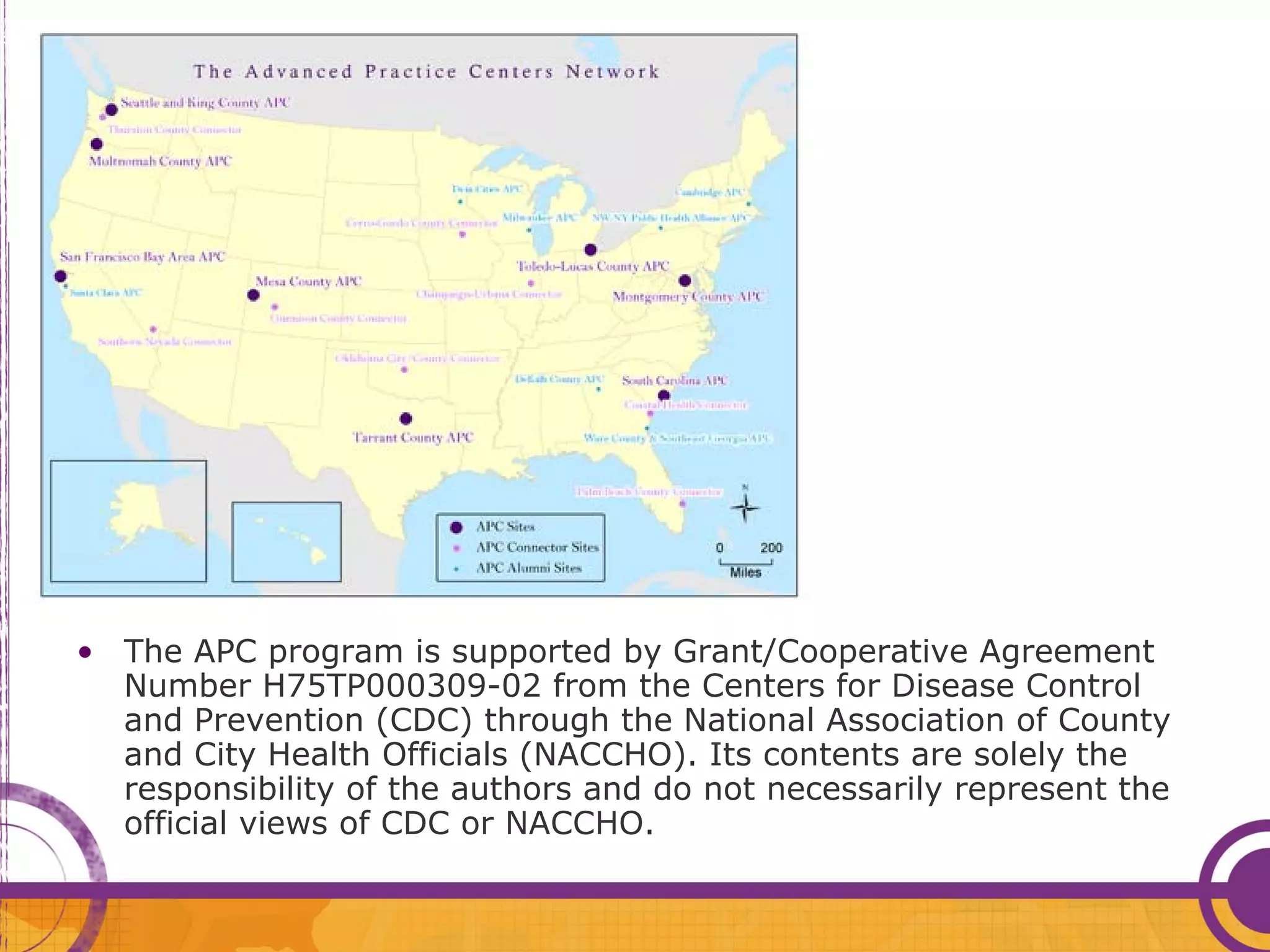
• The APC program is supported by Grant/Cooperative Agreement
  Number H75TP000309-02 from the Centers for Disease Control
  and Prevention (CDC) through the National Association of County
  and City Health Officials (NACCHO). Its contents are solely the
  responsibility of the authors and do not necessarily represent the
  official views of CDC or NACCHO.
Innovative Tools and Resources

• All APC products are FREE of charge.
• Many of the products are available in
  PDF format; others may need to be
  ordered from the NACCHO Bookstore.
• Most products are CUSTOMIZABLE to
  fit the needs and identities of local
  communities.
         Visit apc.naccho.org
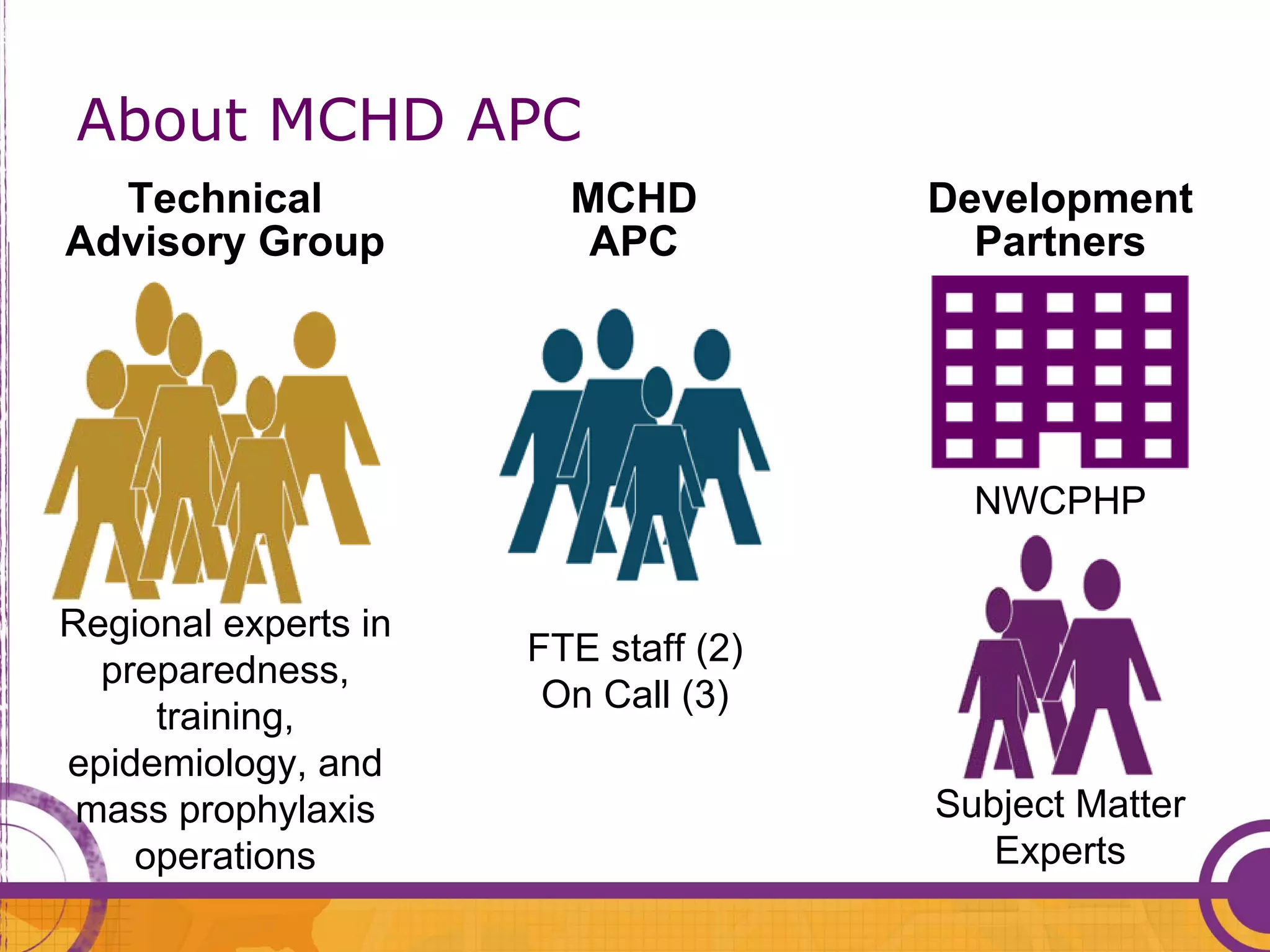
About MCHD APC
  Technical             MCHD          Development
Advisory Group           APC            Partners


                                        NWCPHP


Regional experts in
                      FTE staff (2)
  preparedness,
                       On Call (3)
     training,
epidemiology, and
 mass prophylaxis                     Subject Matter
    operations                           Experts
Who Are You?

• Local health department
• State health department
• Federal agency
• Academia
• Community-based organization
• Hospital/healthcare
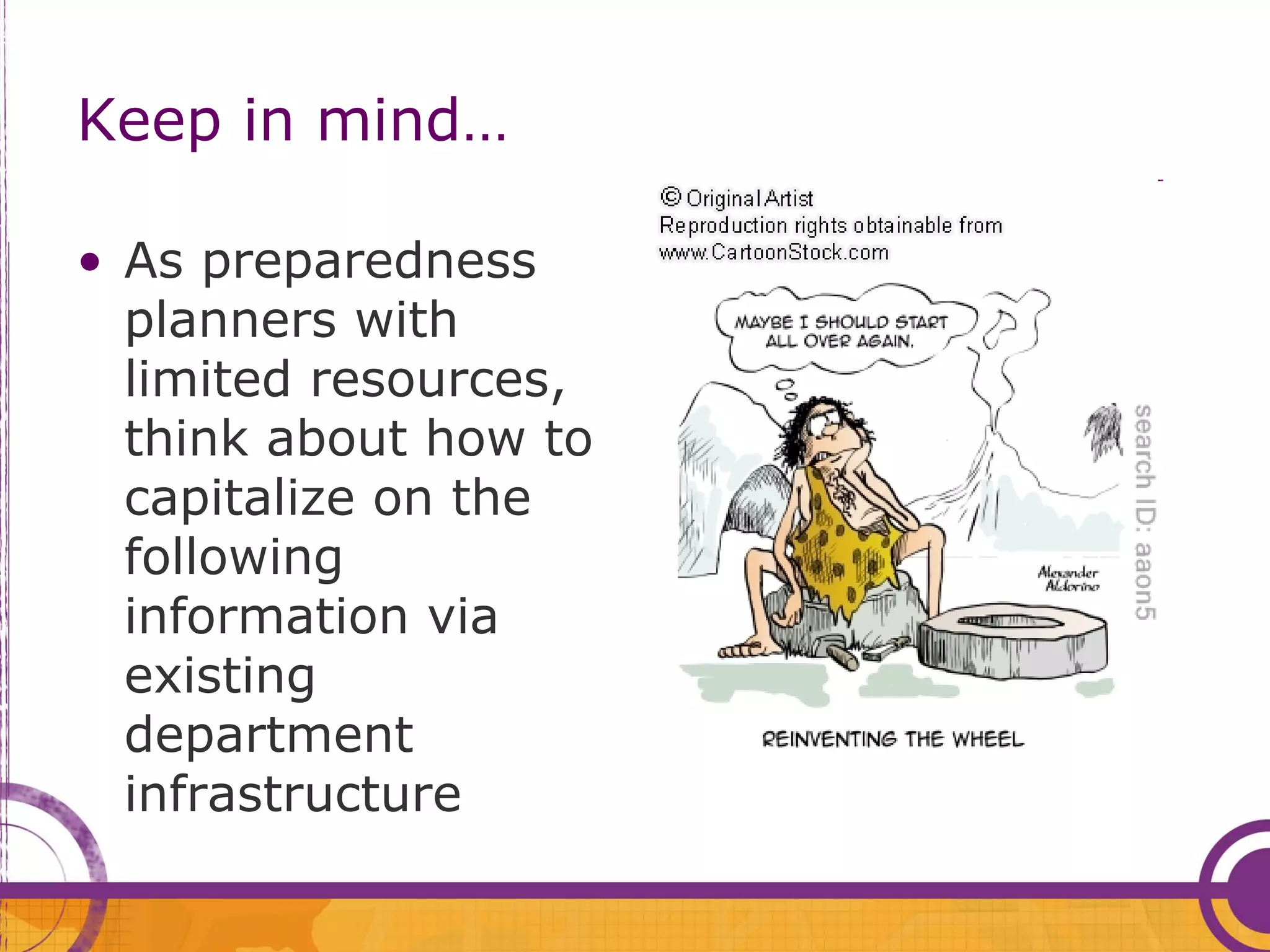
Keep in mind…

• As preparedness
  planners with
  limited resources,
  think about how to
  capitalize on the
  following
  information via
  existing
  department
  infrastructure
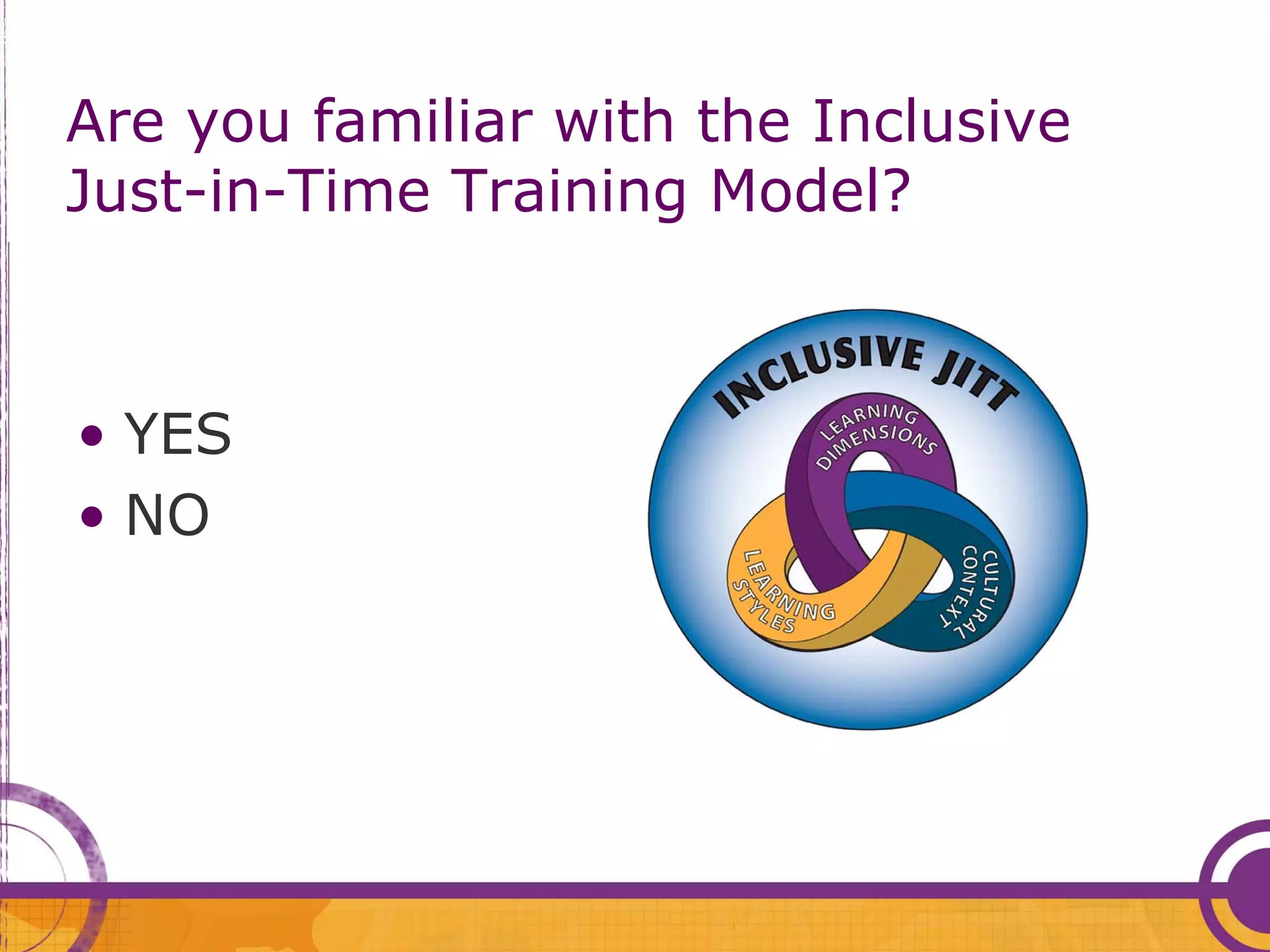
Are you familiar with the Inclusive
Just-in-Time Training Model?


• YES
• NO
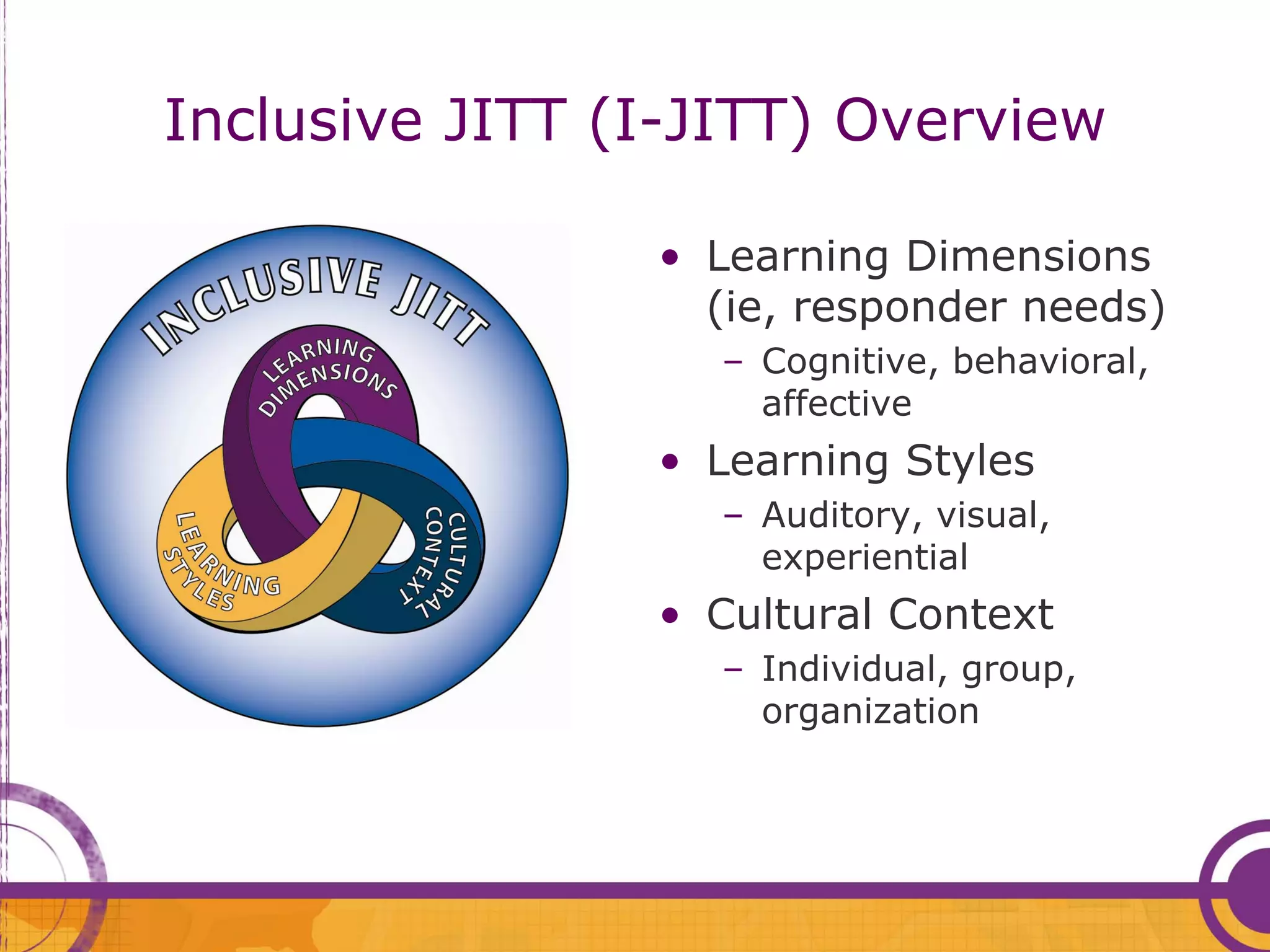
Inclusive JITT (I-JITT) Overview

                • Learning Dimensions
                  (ie, responder needs)
                  – Cognitive, behavioral,
                    affective
                • Learning Styles
                  – Auditory, visual,
                    experiential
                • Cultural Context
                  – Individual, group,
                    organization
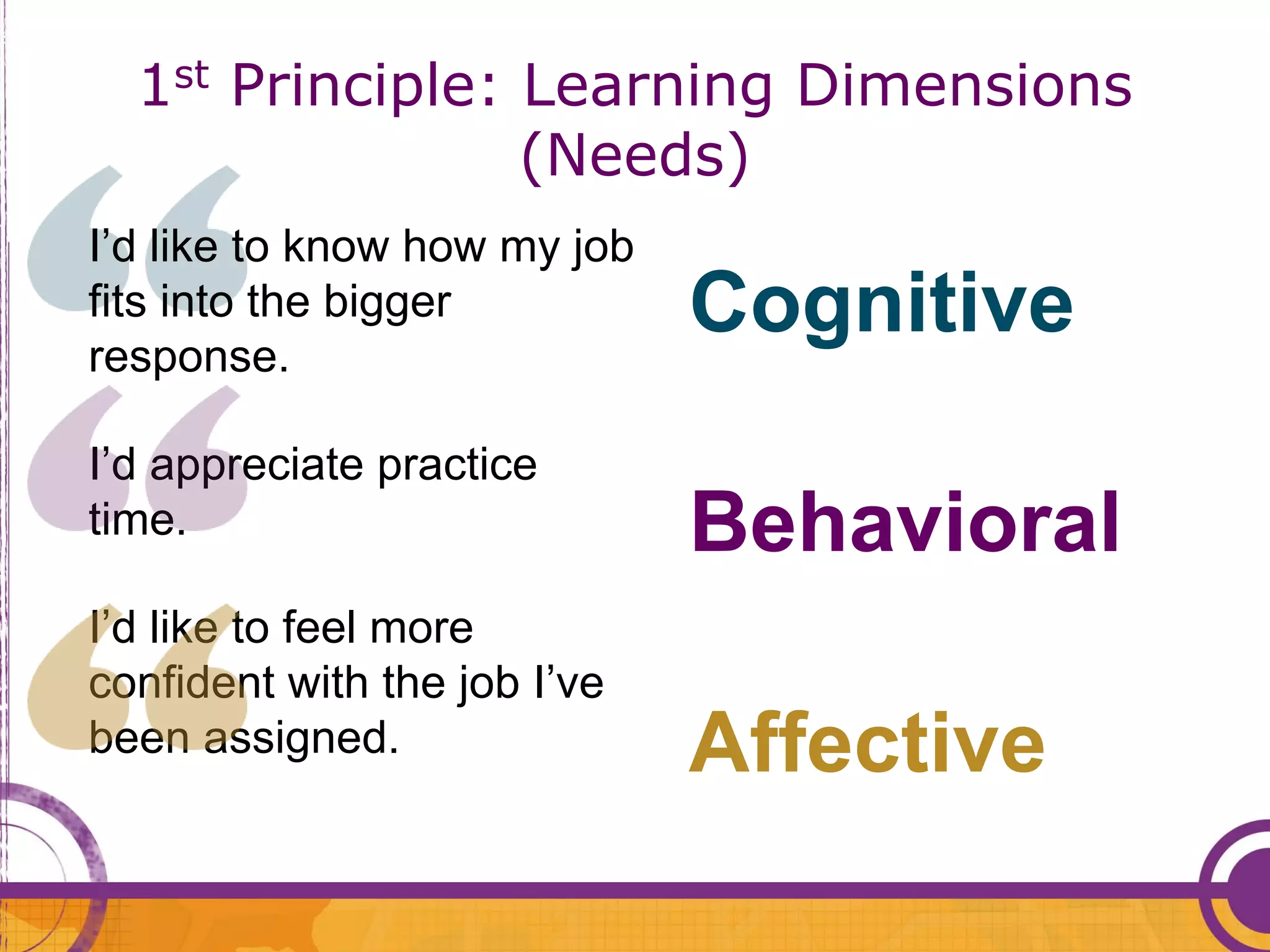
1st Principle: Learning Dimensions
                 (Needs)
I’d like to know how my job
fits into the bigger
response.
                              Cognitive
I’d appreciate practice
time.                         Behavioral
I’d like to feel more
confident with the job I’ve
been assigned.                Affective
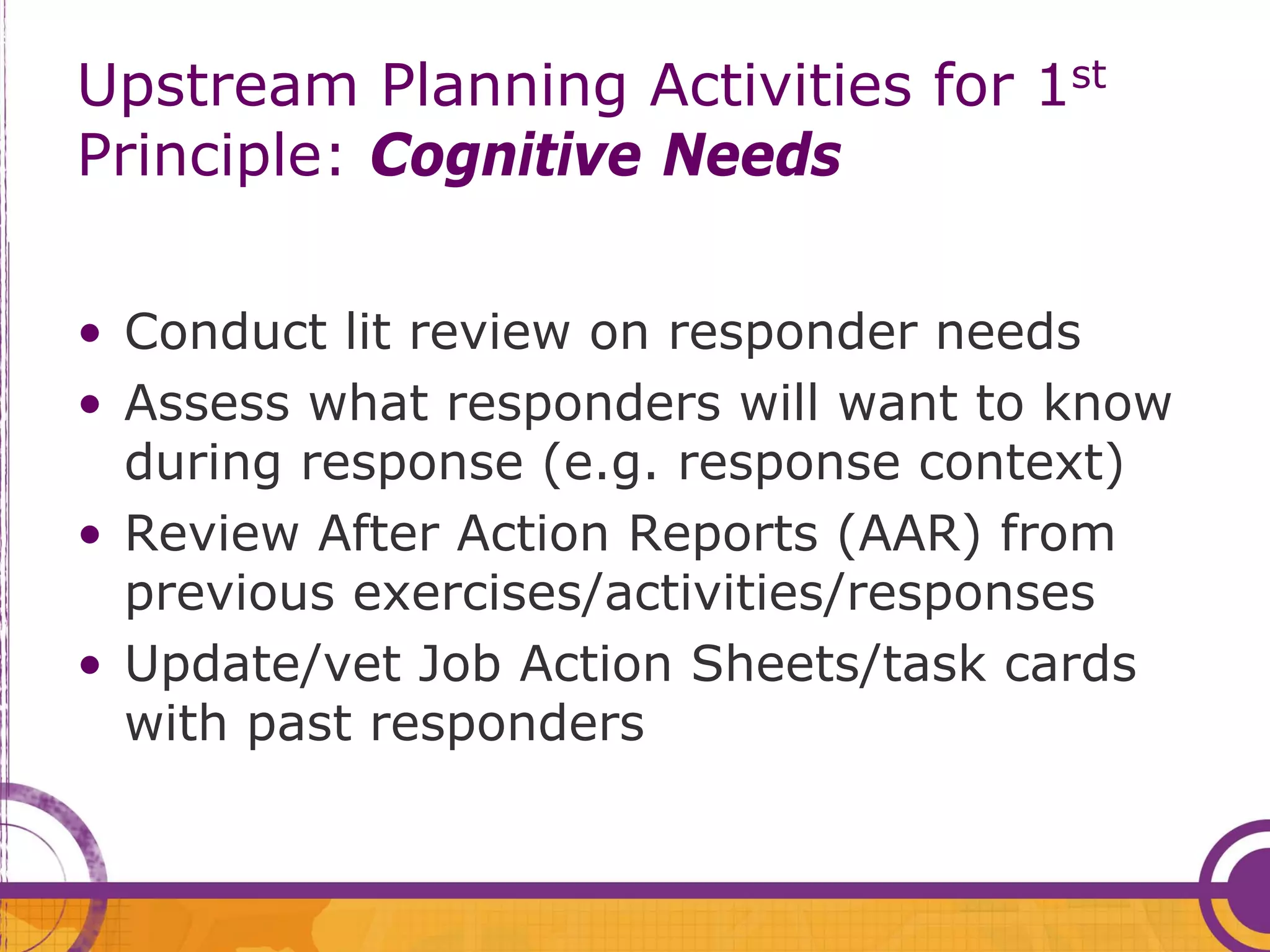
Upstream Planning Activities for 1st
Principle: Cognitive Needs

• Conduct lit review on responder needs
• Assess what responders will want to know
  during response (e.g. response context)
• Review After Action Reports (AAR) from
  previous exercises/activities/responses
• Update/vet Job Action Sheets/task cards
  with past responders
Upstream Planning Activities for 1st
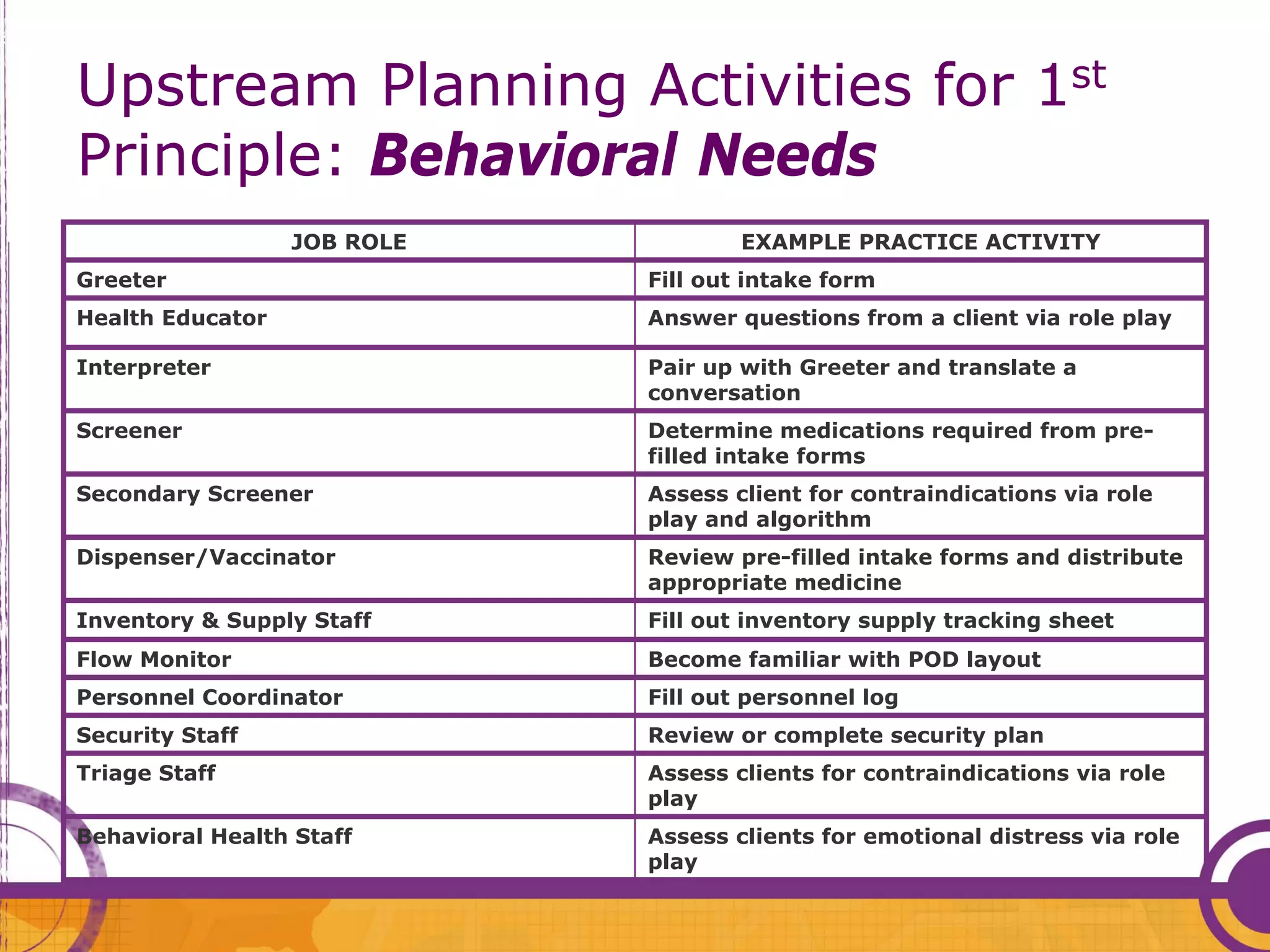
Principle: Behavioral Needs
                  JOB ROLE           EXAMPLE PRACTICE ACTIVITY
Greeter                      Fill out intake form
Health Educator              Answer questions from a client via role play

Interpreter                  Pair up with Greeter and translate a
                             conversation
Screener                     Determine medications required from pre-
                             filled intake forms
Secondary Screener           Assess client for contraindications via role
                             play and algorithm
Dispenser/Vaccinator         Review pre-filled intake forms and distribute
                             appropriate medicine
Inventory & Supply Staff     Fill out inventory supply tracking sheet
Flow Monitor                 Become familiar with POD layout
Personnel Coordinator        Fill out personnel log
Security Staff               Review or complete security plan
Triage Staff                 Assess clients for contraindications via role
                             play
Behavioral Health Staff      Assess clients for emotional distress via role
                             play
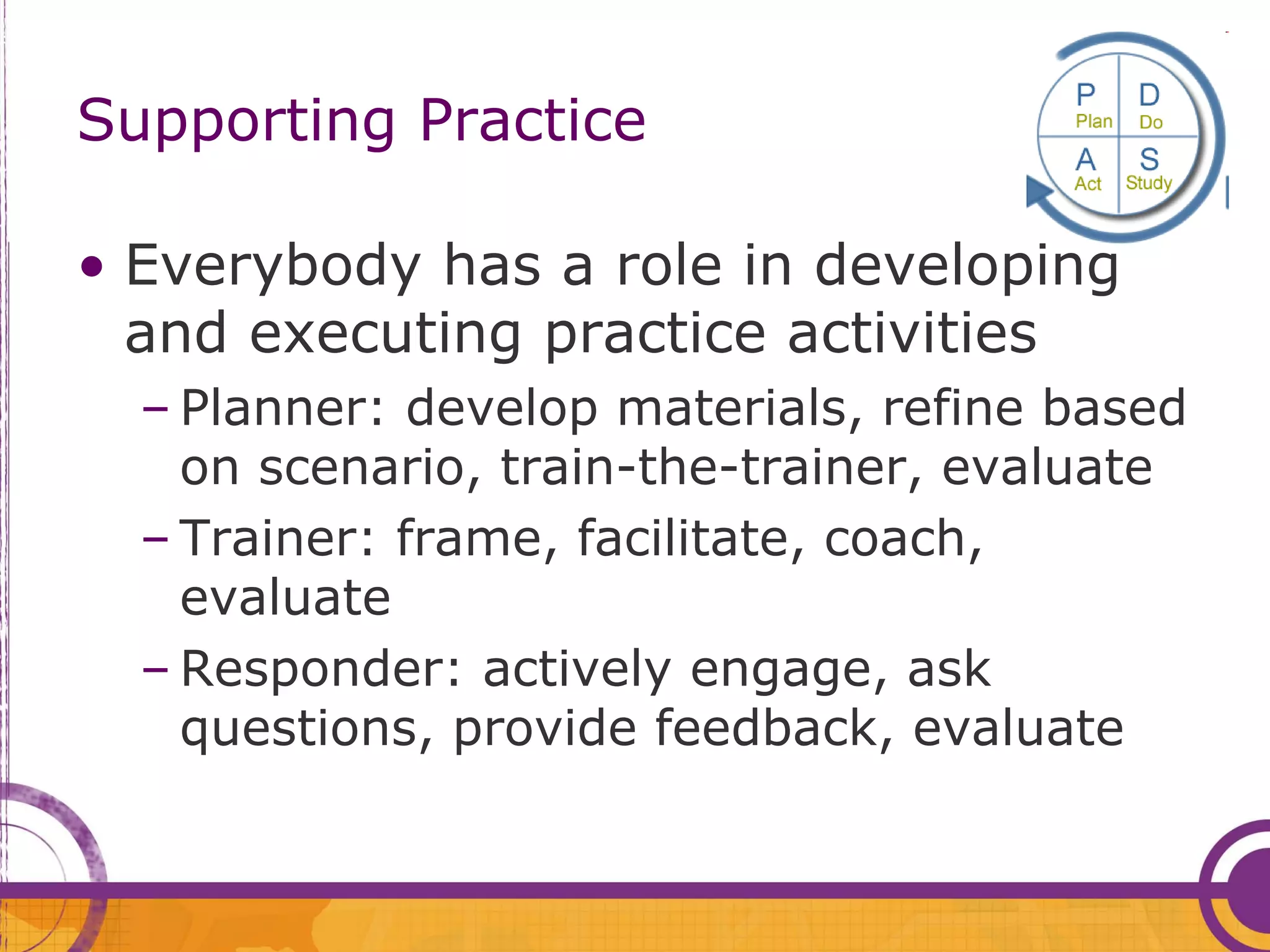
Supporting Practice

• Everybody has a role in developing
  and executing practice activities
  – Planner: develop materials, refine based
    on scenario, train-the-trainer, evaluate
  – Trainer: frame, facilitate, coach,
    evaluate
  – Responder: actively engage, ask
    questions, provide feedback, evaluate
Do you provide an opportunity for
practice in your JITT program?


• YES
• NO
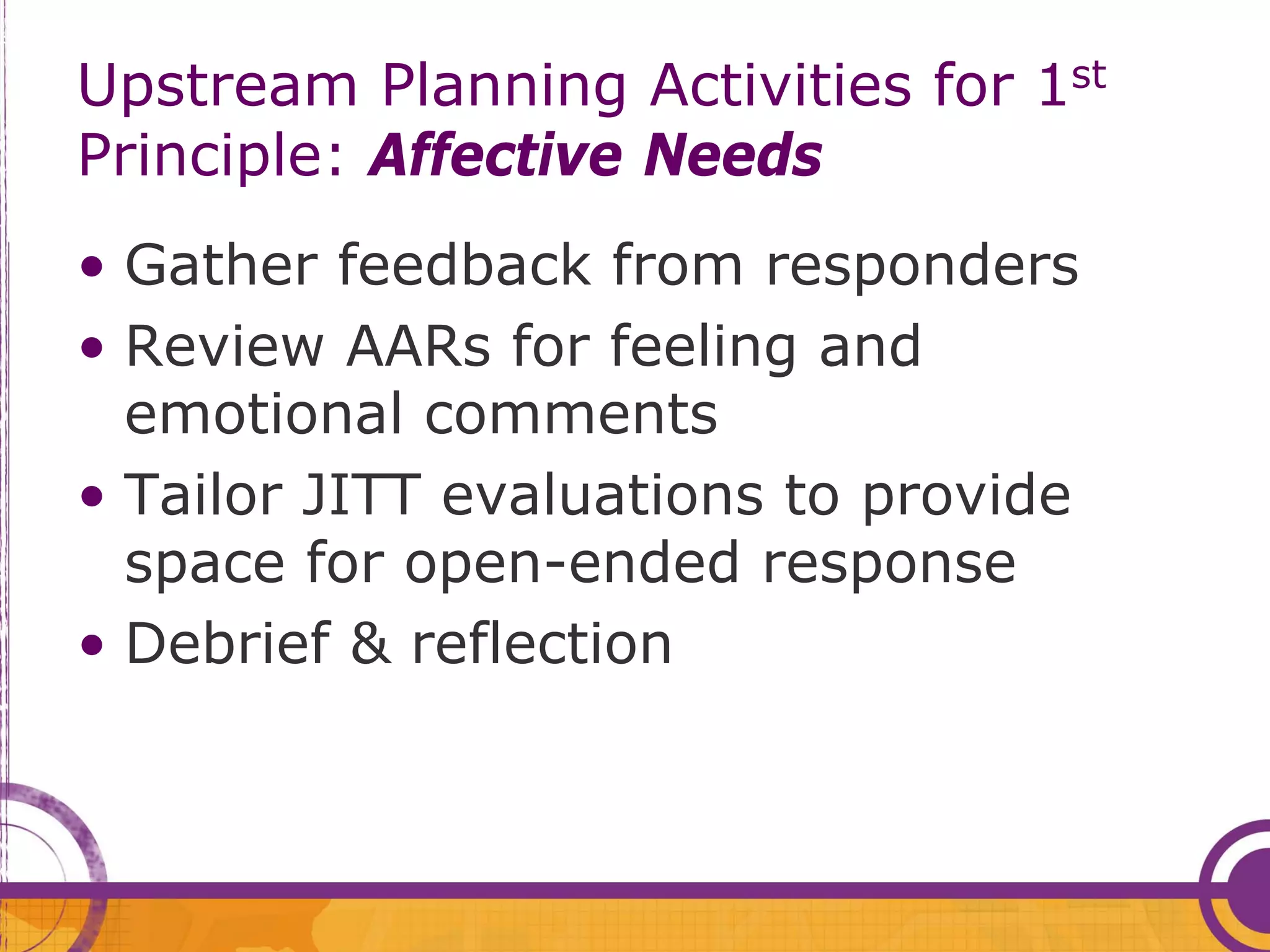
Upstream Planning Activities for 1st
Principle: Affective Needs
• Gather feedback from responders
• Review AARs for feeling and
  emotional comments
• Tailor JITT evaluations to provide
  space for open-ended response
• Debrief & reflection
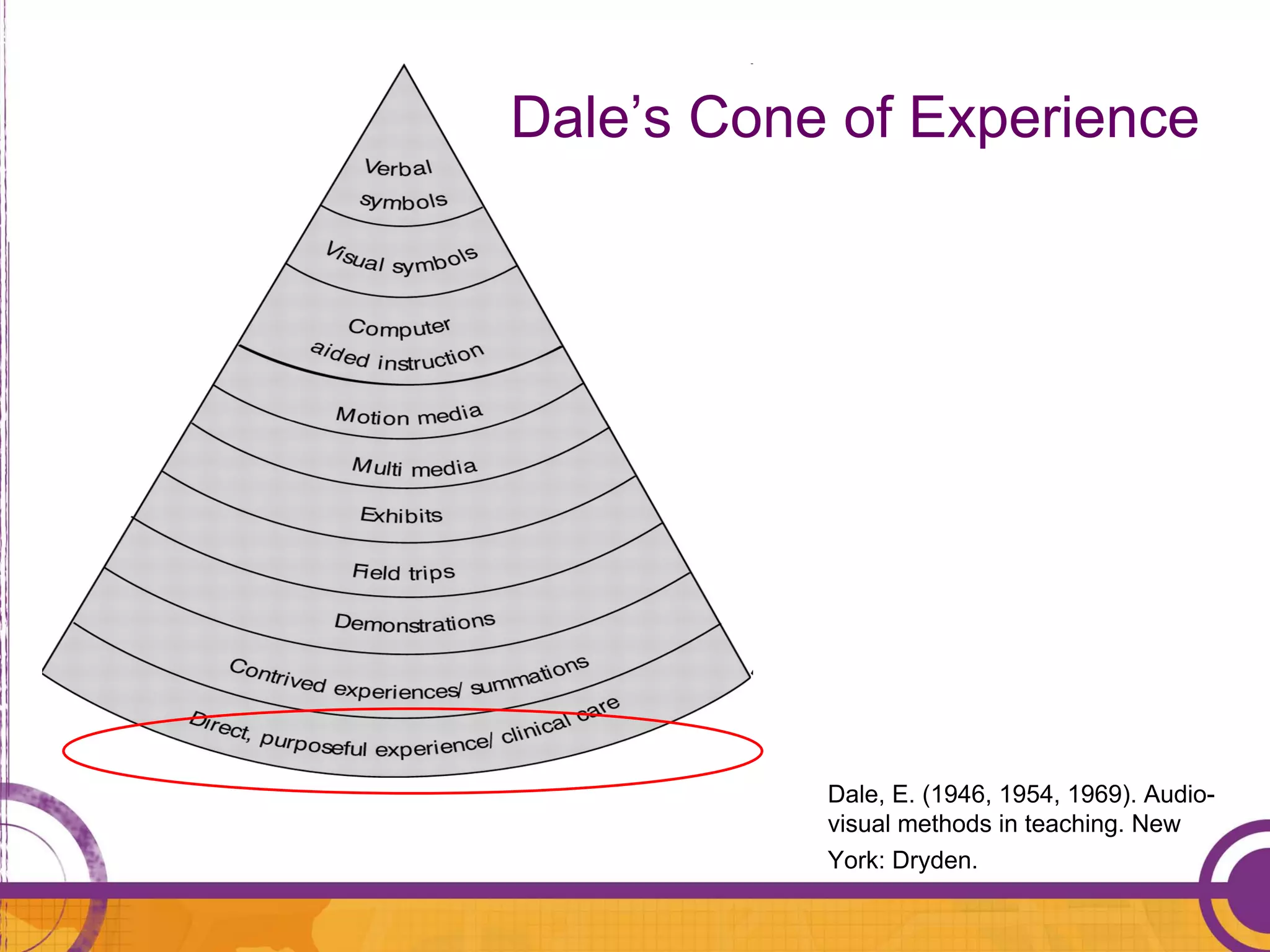
Dale’s Cone of Experience


           Dale, E. (1946, 1954, 1969). Audio-
           visual methods in teaching. New
           York: Dryden.
Upstream Planning Activities for 2nd
Principle: Learning Styles
• Gap analysis of current JITT program
• Survey responders to assess learning
  style preferences
• Comparative analysis of JITT
  program and above assessment
• Determine how to adjust JITT
  program to meet responder learning
  style preferences
A Local Perspective

• “By direct or indirect association, the news
  about any serious incident or disease
  outbreak can negatively and unjustly
  affect members of a community…As we
  increase our capacity for emergency
  preparedness, it is essential that we are
  sensitive to the cultural implications of our
  role as promoters of health in all
  communities.” – Lillian Shirley, MCHD
  Director
Upstream Planning Activities for
Cultural Context
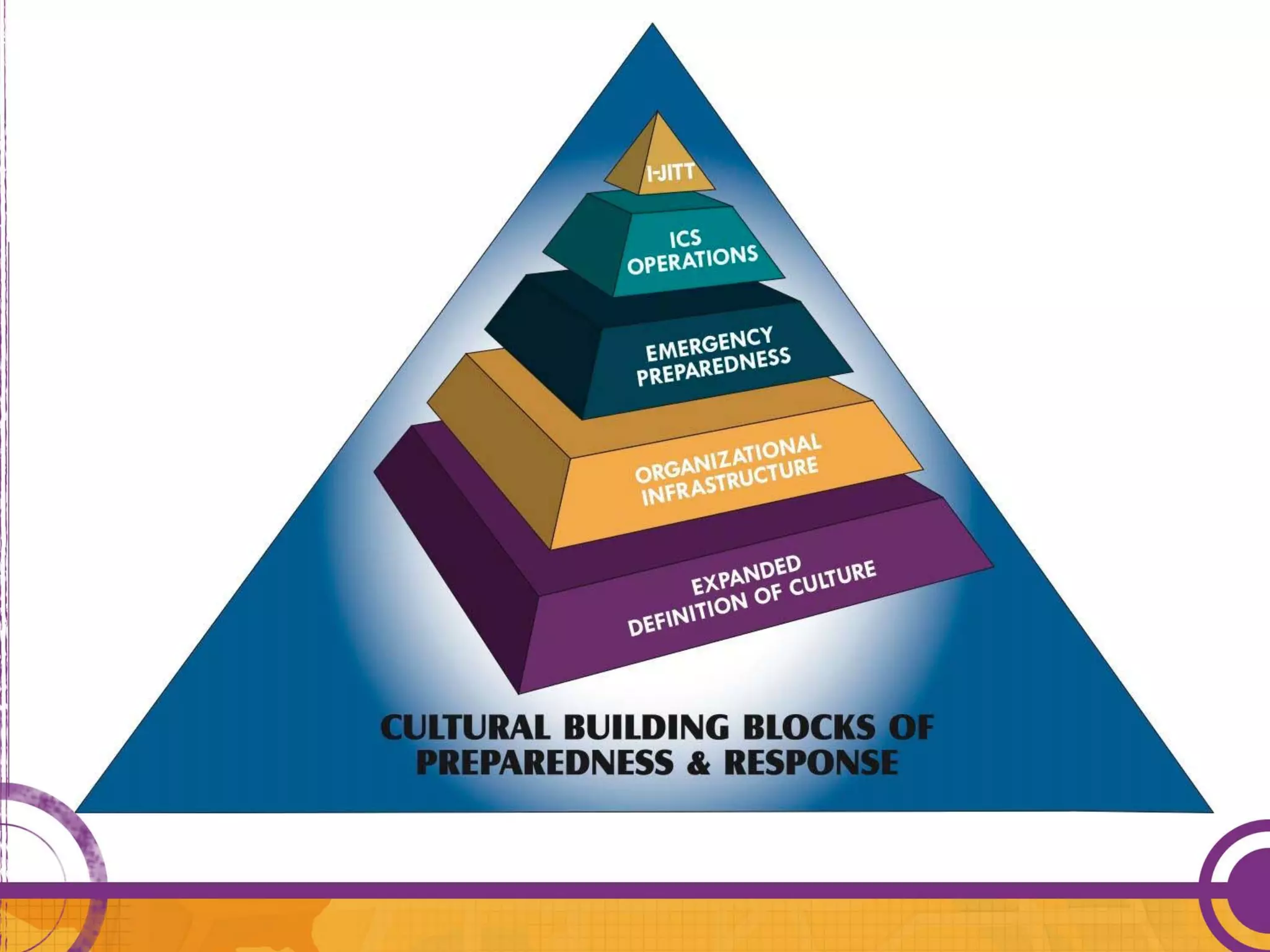
  • Strengthen infrastructure for understanding &
    addressing difference, diversity and inequities
    in the public health workplace
  • Adopt an expanded view of culture beyond
    “vulnerable/at-risk populations”
  • Provide ongoing opportunities and training
    around cultural competency for public health
    staff
     • Determine how to connect generic cultural
       competency training connects to skill set of
       responders
  • Leverage existing relationships between
    community organizations and LHD
Public Health Meets Incident
     Command System
Are you familiar with the I-JITT
toolkits?
   1. YES
   2. NO
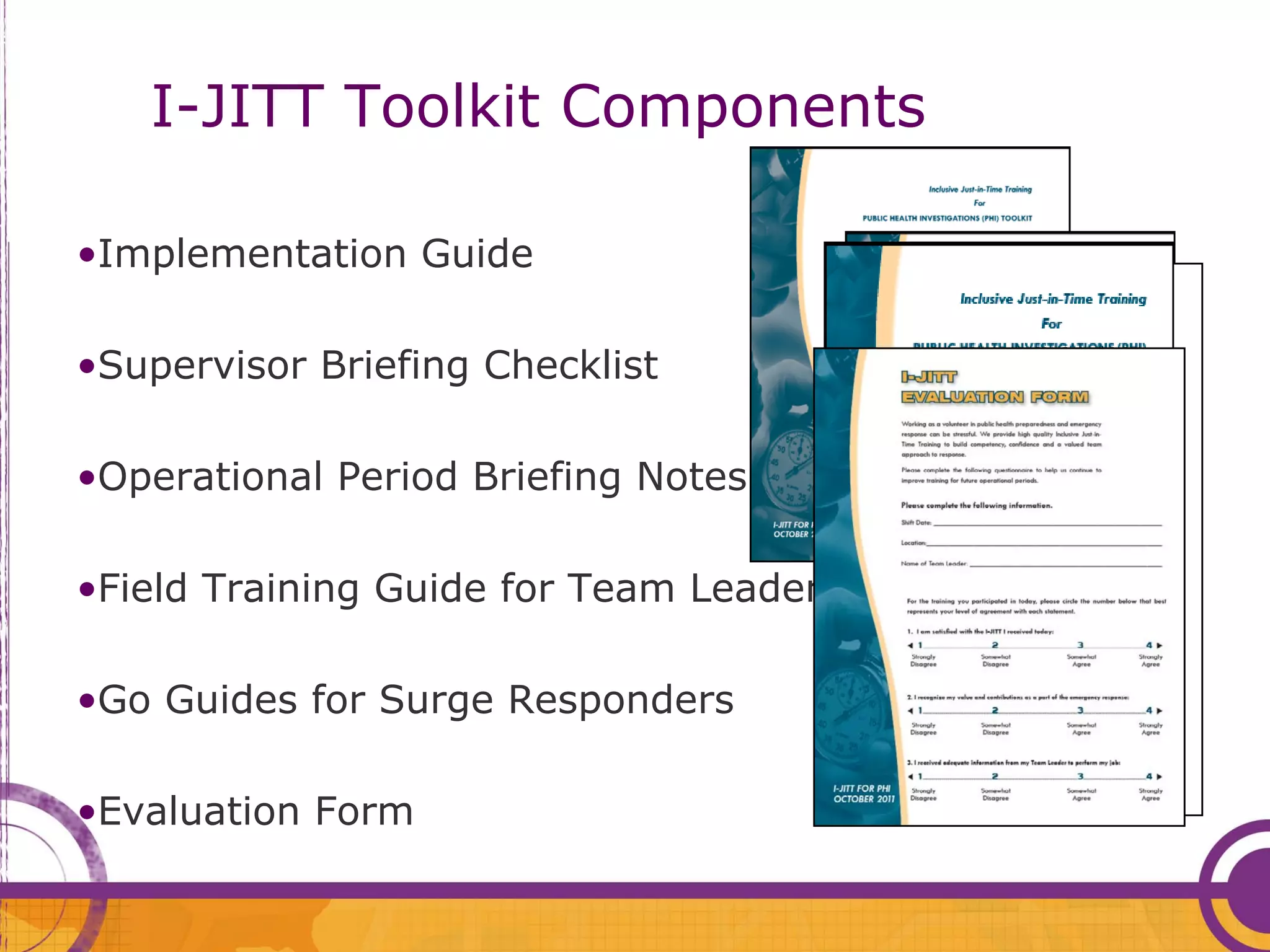
I-JITT Toolkit Components

•Implementation Guide

•Supervisor Briefing Checklist

•Operational Period Briefing Notes Page

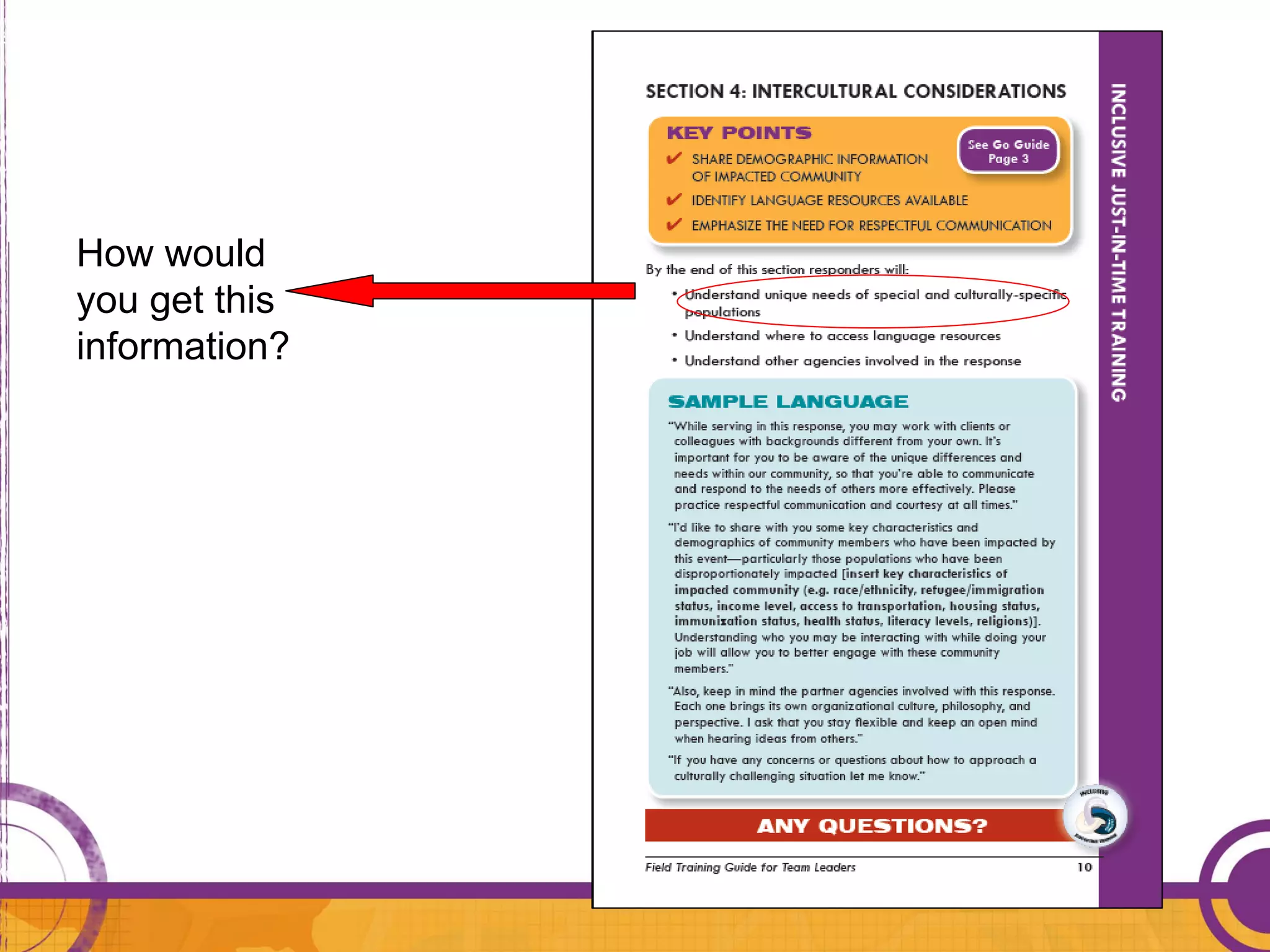
•Field Training Guide for Team Leaders

•Go Guides for Surge Responders

•Evaluation Form
How would
you get this
information?
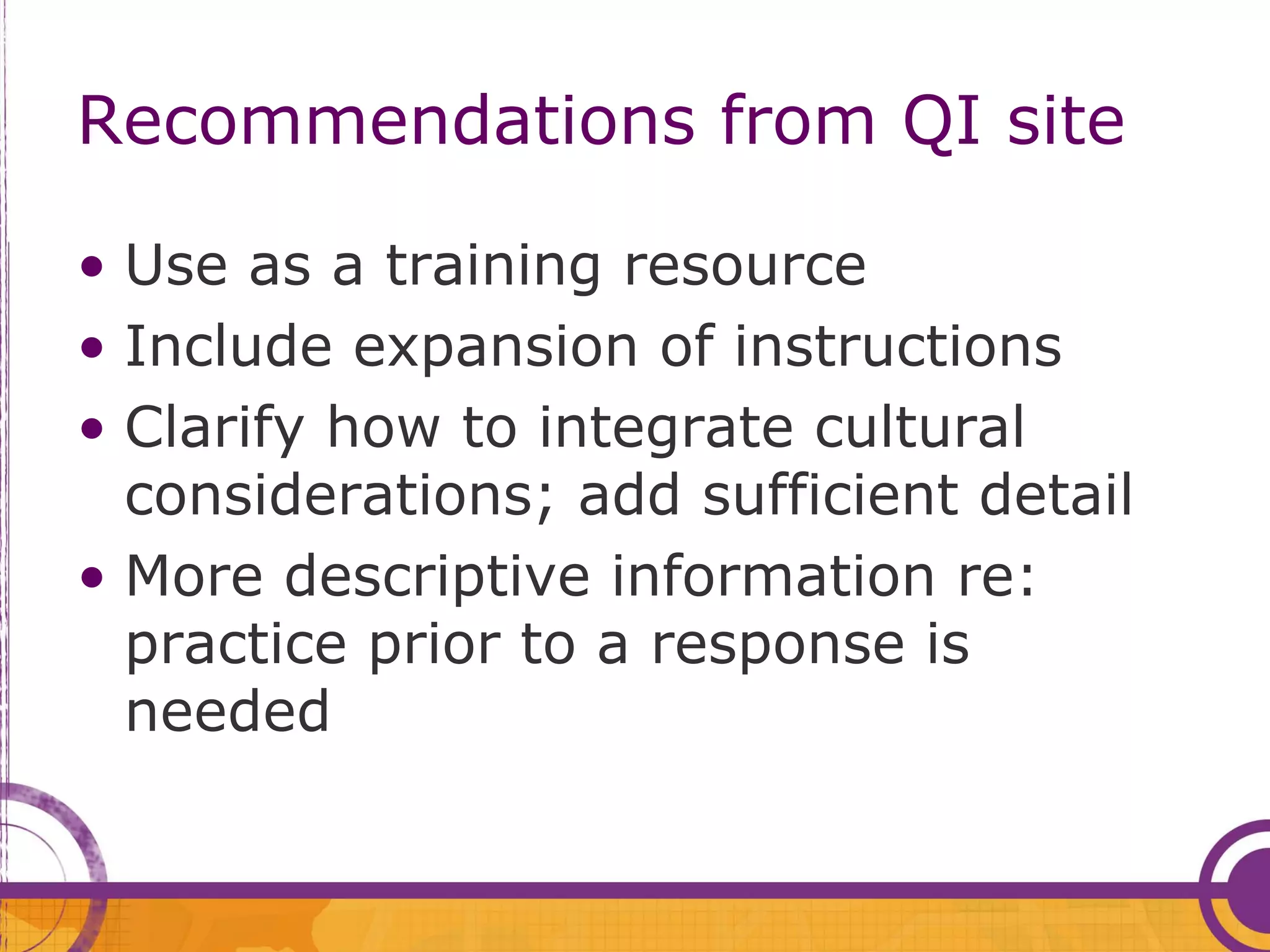
Recommendations from QI site

• Use as a training resource
• Include expansion of instructions
• Clarify how to integrate cultural
  considerations; add sufficient detail
• More descriptive information re:
  practice prior to a response is
  needed
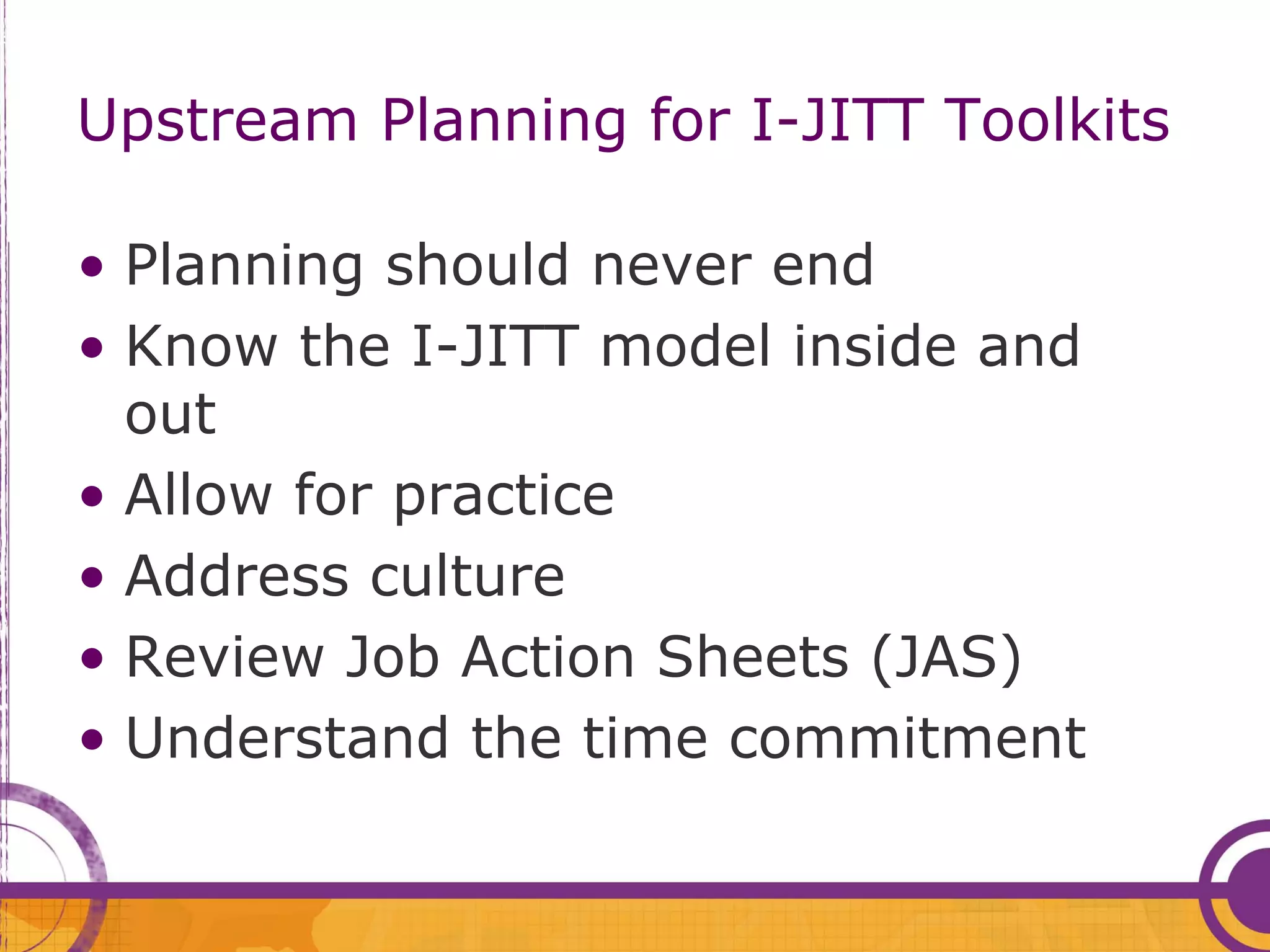
Upstream Planning for I-JITT Toolkits

• Planning should never end
• Know the I-JITT model inside and
  out
• Allow for practice
• Address culture
• Review Job Action Sheets (JAS)
• Understand the time commitment
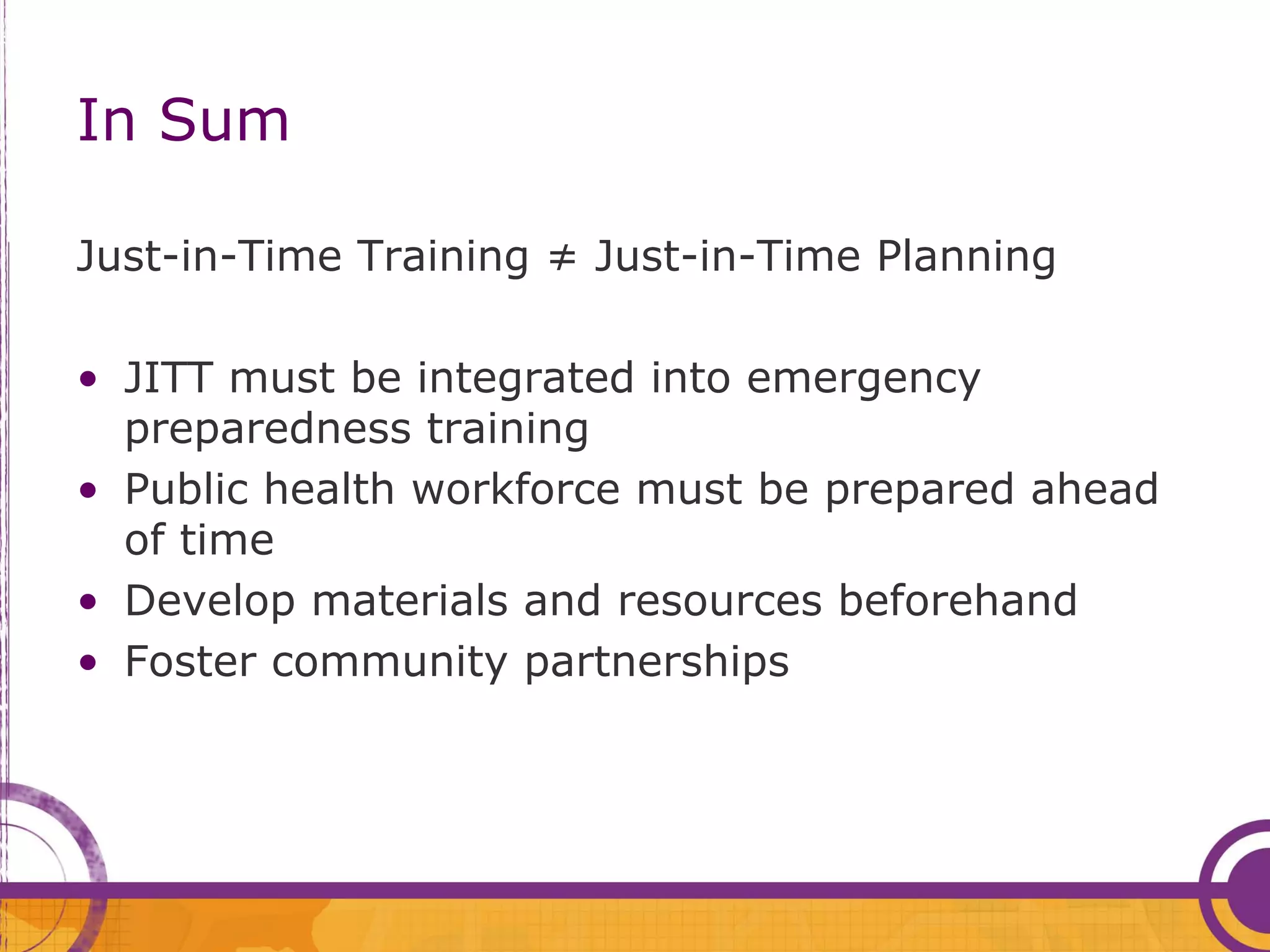
In Sum

Just-in-Time Training ≠ Just-in-Time Planning

• JITT must be integrated into emergency
  preparedness training
• Public health workforce must be prepared ahead
  of time
• Develop materials and resources beforehand
• Foster community partnerships
Moving forward with MCHD APC

• APC Advancements
• Public Health Preparedness Summit
  (Anaheim, CA; February 2012)
• Integrated Training Summit
  (Nashville, TN; May 2012)
• Future Webinars
  – Pocket translator/pictograms
  – Quality improvement
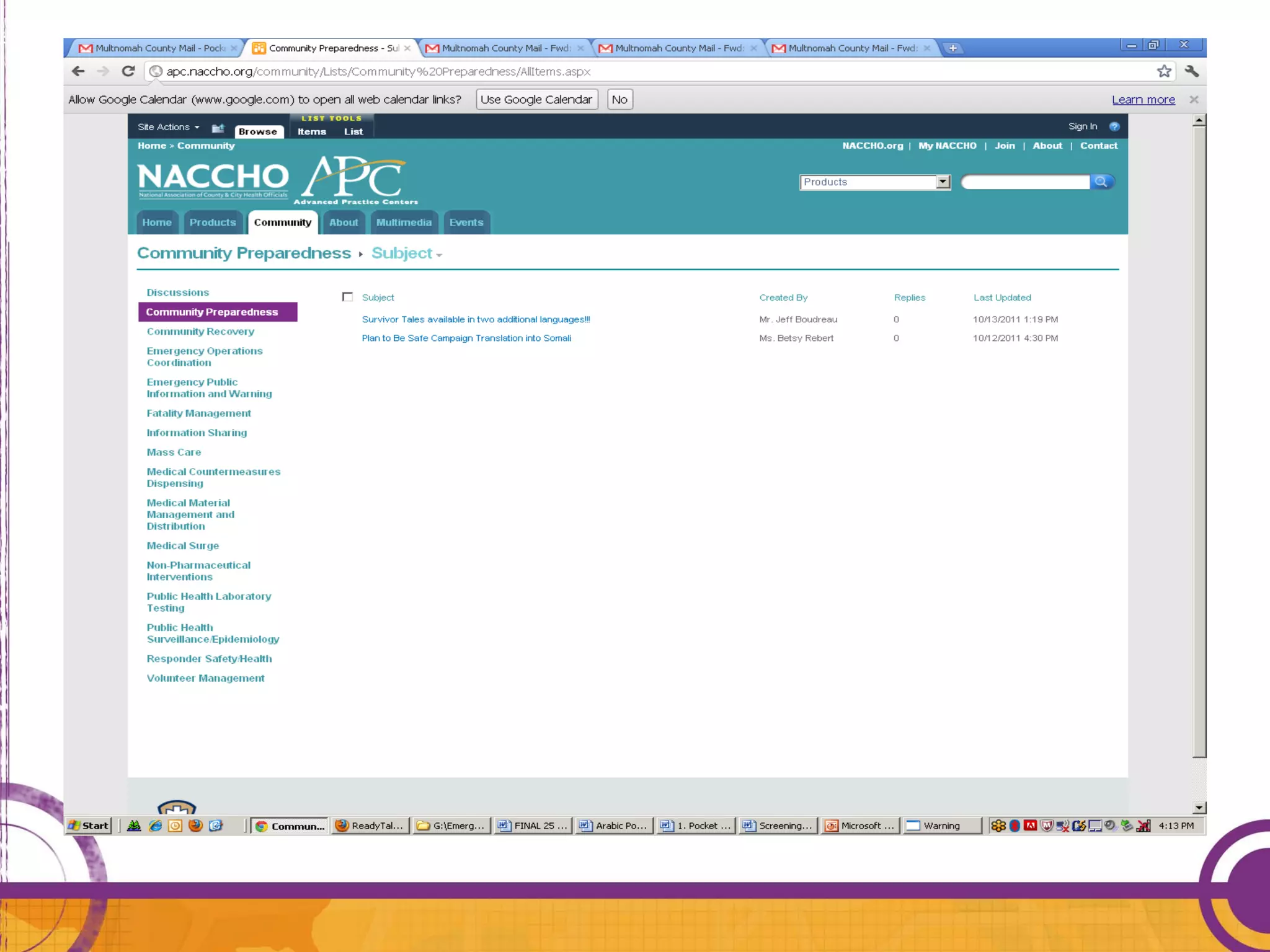
• Community of Practice
For Questions/Comments:

Aron Stephens, MPH
Aron.stephens@multco.us
503.988.3663 x23325

Beth McGinnis, MPH
Beth.mcginnis@multco.us
503.988.3663 x23325
Thank you!

Upstream Planning for Inclusive Just-in-Time Training (I-JITT))

  • 1.
    Upstream Planning for InclusiveJust-in-Time Training (I-JITT) Aron Stephens, MPH Beth McGinnis, MPH Multnomah County Health Department (Portland, OR) November 15, 2011
  • 2.
    Learning Objectives • UnderstandInclusive Just-in-Time Training (I-JITT) Model • Aware of planning considerations related to I-JITT model and each principle • Knowledgeable of I-JITT toolkit (& how to plan for its use)
  • 3.
    What is anAdvanced Practice Center? • An APC serves the public health community by providing tools and resources, educational materials, trainings and technical assistance to help public health practitioners address local preparedness challenges.
  • 4.
    • The APCprogram is supported by Grant/Cooperative Agreement Number H75TP000309-02 from the Centers for Disease Control and Prevention (CDC) through the National Association of County and City Health Officials (NACCHO). Its contents are solely the responsibility of the authors and do not necessarily represent the official views of CDC or NACCHO.
  • 5.
    Innovative Tools andResources • All APC products are FREE of charge. • Many of the products are available in PDF format; others may need to be ordered from the NACCHO Bookstore. • Most products are CUSTOMIZABLE to fit the needs and identities of local communities. Visit apc.naccho.org
  • 6.
    About MCHD APC Technical MCHD Development Advisory Group APC Partners NWCPHP Regional experts in FTE staff (2) preparedness, On Call (3) training, epidemiology, and mass prophylaxis Subject Matter operations Experts
  • 7.
    Who Are You? •Local health department • State health department • Federal agency • Academia • Community-based organization • Hospital/healthcare
  • 8.
    Keep in mind… •As preparedness planners with limited resources, think about how to capitalize on the following information via existing department infrastructure
  • 9.
    Are you familiarwith the Inclusive Just-in-Time Training Model? • YES • NO
  • 10.
    Inclusive JITT (I-JITT)Overview • Learning Dimensions (ie, responder needs) – Cognitive, behavioral, affective • Learning Styles – Auditory, visual, experiential • Cultural Context – Individual, group, organization
  • 11.
    1st Principle: LearningDimensions (Needs) I’d like to know how my job fits into the bigger response. Cognitive I’d appreciate practice time. Behavioral I’d like to feel more confident with the job I’ve been assigned. Affective
  • 12.
    Upstream Planning Activitiesfor 1st Principle: Cognitive Needs • Conduct lit review on responder needs • Assess what responders will want to know during response (e.g. response context) • Review After Action Reports (AAR) from previous exercises/activities/responses • Update/vet Job Action Sheets/task cards with past responders
  • 13.
    Upstream Planning Activitiesfor 1st Principle: Behavioral Needs JOB ROLE EXAMPLE PRACTICE ACTIVITY Greeter Fill out intake form Health Educator Answer questions from a client via role play Interpreter Pair up with Greeter and translate a conversation Screener Determine medications required from pre- filled intake forms Secondary Screener Assess client for contraindications via role play and algorithm Dispenser/Vaccinator Review pre-filled intake forms and distribute appropriate medicine Inventory & Supply Staff Fill out inventory supply tracking sheet Flow Monitor Become familiar with POD layout Personnel Coordinator Fill out personnel log Security Staff Review or complete security plan Triage Staff Assess clients for contraindications via role play Behavioral Health Staff Assess clients for emotional distress via role play
  • 14.
    Supporting Practice • Everybodyhas a role in developing and executing practice activities – Planner: develop materials, refine based on scenario, train-the-trainer, evaluate – Trainer: frame, facilitate, coach, evaluate – Responder: actively engage, ask questions, provide feedback, evaluate
  • 15.
    Do you providean opportunity for practice in your JITT program? • YES • NO
  • 16.
    Upstream Planning Activitiesfor 1st Principle: Affective Needs • Gather feedback from responders • Review AARs for feeling and emotional comments • Tailor JITT evaluations to provide space for open-ended response • Debrief & reflection
  • 17.
    Dale’s Cone ofExperience Dale, E. (1946, 1954, 1969). Audio- visual methods in teaching. New York: Dryden.
  • 18.
    Upstream Planning Activitiesfor 2nd Principle: Learning Styles • Gap analysis of current JITT program • Survey responders to assess learning style preferences • Comparative analysis of JITT program and above assessment • Determine how to adjust JITT program to meet responder learning style preferences
  • 19.
    A Local Perspective •“By direct or indirect association, the news about any serious incident or disease outbreak can negatively and unjustly affect members of a community…As we increase our capacity for emergency preparedness, it is essential that we are sensitive to the cultural implications of our role as promoters of health in all communities.” – Lillian Shirley, MCHD Director
  • 21.
    Upstream Planning Activitiesfor Cultural Context • Strengthen infrastructure for understanding & addressing difference, diversity and inequities in the public health workplace • Adopt an expanded view of culture beyond “vulnerable/at-risk populations” • Provide ongoing opportunities and training around cultural competency for public health staff • Determine how to connect generic cultural competency training connects to skill set of responders • Leverage existing relationships between community organizations and LHD
  • 22.
    Public Health MeetsIncident Command System
  • 23.
    Are you familiarwith the I-JITT toolkits? 1. YES 2. NO
  • 24.
    I-JITT Toolkit Components •ImplementationGuide •Supervisor Briefing Checklist •Operational Period Briefing Notes Page •Field Training Guide for Team Leaders •Go Guides for Surge Responders •Evaluation Form
  • 25.
    How would you getthis information?
  • 26.
    Recommendations from QIsite • Use as a training resource • Include expansion of instructions • Clarify how to integrate cultural considerations; add sufficient detail • More descriptive information re: practice prior to a response is needed
  • 27.
    Upstream Planning forI-JITT Toolkits • Planning should never end • Know the I-JITT model inside and out • Allow for practice • Address culture • Review Job Action Sheets (JAS) • Understand the time commitment
  • 28.
    In Sum Just-in-Time Training≠ Just-in-Time Planning • JITT must be integrated into emergency preparedness training • Public health workforce must be prepared ahead of time • Develop materials and resources beforehand • Foster community partnerships
  • 29.
    Moving forward withMCHD APC • APC Advancements • Public Health Preparedness Summit (Anaheim, CA; February 2012) • Integrated Training Summit (Nashville, TN; May 2012) • Future Webinars – Pocket translator/pictograms – Quality improvement • Community of Practice
  • 31.
    For Questions/Comments: Aron Stephens,MPH Aron.stephens@multco.us 503.988.3663 x23325 Beth McGinnis, MPH Beth.mcginnis@multco.us 503.988.3663 x23325
  • 32.