By: Anthony P. Carnevale, Neil Ridley, Ban Cheah,
Jeff Strohl, and Kathryn Peltier Campbell
June 13, 2019
Overview
• Downsizing: Once the powerhouse of the
industrial economy, manufacturing today plays a
smaller role in an economy dominated by
services—about 7 million manufacturing jobs
disappeared from the US workforce between 1979
and 2017.
• Upskilling: Manufacturing increasingly requires
workers with education beyond a high school
diploma—today, 56% of workers in the industry
have postsecondary education.
• Industry transformation: Automation,
globalization, and the growth of a networked
economy have contributed to these changes.
2
Three trends have altered the
manufacturing industry
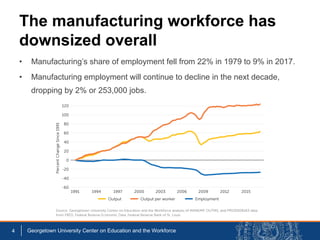
• Automation: The industry now has fewer workers, but more robots,
so output per worker has increased from $293,000 in 1979 to
$485,000 in 2017. Total manufacturing output has grown by more
than 60% since 1991.
• Globalization: Manufacturing job losses have accelerated as
international competition has increased. Since the 1960s,
international trade has more than tripled as a share of GDP, rising
from about 10% to almost one third of the economy.
• Networked economy: Growth of a more integrated, global
economy with an expanded role for business-to-business services
increased domestic outsourcing.
3 Georgetown University Center on Education and the Workforce
• Manufacturing’s share of employment fell from 22% in 1979 to 9% in 2017.
• Manufacturing employment will continue to decline in the next decade,
dropping by 2% or 253,000 jobs.
4 Georgetown University Center on Education and the Workforce
The manufacturing workforce has
downsized overall
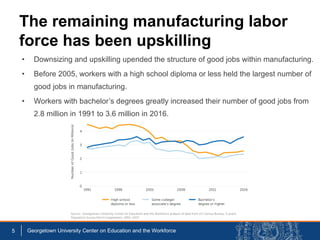
• Downsizing and upskilling upended the structure of good jobs within manufacturing.
• Before 2005, workers with a high school diploma or less held the largest number of
good jobs in manufacturing.
• Workers with bachelor’s degrees greatly increased their number of good jobs from
2.8 million in 1991 to 3.6 million in 2016.
5 Georgetown University Center on Education and the Workforce
The remaining manufacturing labor
force has been upskilling
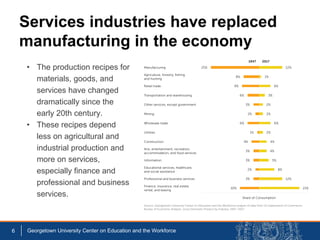
Services industries have replaced
manufacturing in the economy
6 Georgetown University Center on Education and the Workforce
• The production recipes for
materials, goods, and
services have changed
dramatically since the
early 20th century.
• These recipes depend
less on agricultural and
industrial production and
more on services,
especially finance and
professional and business
services.
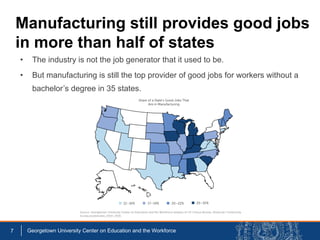
• The industry is not the job generator that it used to be.
• But manufacturing is still the top provider of good jobs for workers without a
bachelor’s degree in 35 states.
7 Georgetown University Center on Education and the Workforce
Manufacturing still provides good jobs
in more than half of states
Policy Recommendations
• Support research and technology
development that enables firms to develop
innovative products and better processes.
• Bolster the ability of small- and medium-sized
manufacturers to compete in a global
marketplace.
• Build the manufacturing workforce of the
future by rethinking career and technical
education and apprenticeship programs.
• Improve existing worker transition programs
to provide comprehensive support for workers
who lose their jobs.
8
9
cew.georgetown.edu/Manufacturing
More Information
cew@georgetown.edu
Facebook.com/
GeorgetownCEW
linkedin.com/company/
georgetowncew
@GeorgetownCEW Slideshare.net/
CEWGeorgetown
YouTube.com/
CEWGeorgetown

Upskilling and Downsizing in American Manufacturing

  • 1.
    By: Anthony P.Carnevale, Neil Ridley, Ban Cheah, Jeff Strohl, and Kathryn Peltier Campbell June 13, 2019
  • 2.
    Overview • Downsizing: Oncethe powerhouse of the industrial economy, manufacturing today plays a smaller role in an economy dominated by services—about 7 million manufacturing jobs disappeared from the US workforce between 1979 and 2017. • Upskilling: Manufacturing increasingly requires workers with education beyond a high school diploma—today, 56% of workers in the industry have postsecondary education. • Industry transformation: Automation, globalization, and the growth of a networked economy have contributed to these changes. 2
  • 3.
    Three trends havealtered the manufacturing industry • Automation: The industry now has fewer workers, but more robots, so output per worker has increased from $293,000 in 1979 to $485,000 in 2017. Total manufacturing output has grown by more than 60% since 1991. • Globalization: Manufacturing job losses have accelerated as international competition has increased. Since the 1960s, international trade has more than tripled as a share of GDP, rising from about 10% to almost one third of the economy. • Networked economy: Growth of a more integrated, global economy with an expanded role for business-to-business services increased domestic outsourcing. 3 Georgetown University Center on Education and the Workforce
  • 4.
    • Manufacturing’s shareof employment fell from 22% in 1979 to 9% in 2017. • Manufacturing employment will continue to decline in the next decade, dropping by 2% or 253,000 jobs. 4 Georgetown University Center on Education and the Workforce The manufacturing workforce has downsized overall
  • 5.
    • Downsizing andupskilling upended the structure of good jobs within manufacturing. • Before 2005, workers with a high school diploma or less held the largest number of good jobs in manufacturing. • Workers with bachelor’s degrees greatly increased their number of good jobs from 2.8 million in 1991 to 3.6 million in 2016. 5 Georgetown University Center on Education and the Workforce The remaining manufacturing labor force has been upskilling
  • 6.
    Services industries havereplaced manufacturing in the economy 6 Georgetown University Center on Education and the Workforce • The production recipes for materials, goods, and services have changed dramatically since the early 20th century. • These recipes depend less on agricultural and industrial production and more on services, especially finance and professional and business services.
  • 7.
    • The industryis not the job generator that it used to be. • But manufacturing is still the top provider of good jobs for workers without a bachelor’s degree in 35 states. 7 Georgetown University Center on Education and the Workforce Manufacturing still provides good jobs in more than half of states
  • 8.
    Policy Recommendations • Supportresearch and technology development that enables firms to develop innovative products and better processes. • Bolster the ability of small- and medium-sized manufacturers to compete in a global marketplace. • Build the manufacturing workforce of the future by rethinking career and technical education and apprenticeship programs. • Improve existing worker transition programs to provide comprehensive support for workers who lose their jobs. 8
  • 9.