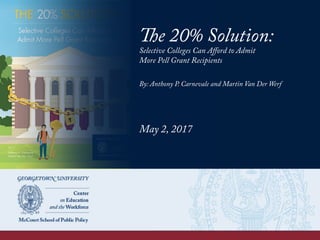
The 20% Solution:
Selective Colleges Can Afford to Admit
More Pell Grant Recipients
By: Anthony P. Carnevale and Martin Van Der Werf
May 2, 2017
Overview
•  There is a class divide in higher education.
•  The Pell Grant was created as a solution to income inequality.
•  A majority of Pell Grant recipients attend open-access colleges with low graduation
rates (49%).
•  Highly-qualified Pell Grant students are, for the most part, not attending selective
colleges, which have much higher graduation rates (82%).
•  The nation’s most elite universities could enroll more low-income students without
significantly hurting their graduation rates or budgets.
•  Requiring a minimum enrollment standard of 20 percent Pell Grant recipients
could be a solution.
Who receives a Pell Grant?
•  A majority of Pell Grant recipients are women (62%)
Georgetown	
  University	
  Center	
  on	
  Educa5on	
  and	
  the	
  Workforce	
  analysis	
  of	
  data	
  from	
  Educa5onal	
  Longitudinal	
  Study	
  of	
  2002,	
  third	
  followup	
  
(2012),	
  and	
  the	
  NCES-­‐Barron’s	
  Admissions	
  Compe55veness	
  Index	
  Data	
  Files:	
  1972,	
  1982,	
  1992,	
  2004,	
  2008,	
  2014.	
  
Who receives a Pell Grant? (cont.)
•  Nearly three-quarters of Pell
Grant recipients are from
families making less than
$30,000 per year.
•  67 percent of Pell Grant
recipients attend public two-
year and four-year colleges, and
18 percent attend for-profit
colleges.
Georgetown	
  University	
  Center	
  on	
  Educa5on	
  and	
  the	
  Workforce	
  analysis	
  of	
  data	
  from	
  the	
  
Na5onal	
  Center	
  for	
  Educa5on	
  Sta5s5cs	
  and	
  the	
  Na5onal	
  Postsecondary	
  Student	
  Aid	
  Study	
  
Many qualified Pell Grant recipients do not attend
selective colleges
Of the 150,000 Pell
Grant recipients with
SAT/ACT scores at or
above the median on
SAT (1120), more than
half (86,000) do not
attend selective
universities.
Georgetown	
  University	
  Center	
  on	
  Educa5on	
  and	
  the	
  Workforce	
  analysis	
  of	
  data	
  from	
  Educa5onal	
  Longitudinal	
  Study	
  of	
  2002,	
  
third	
  follow-­‐up	
  (2012),	
  and	
  the	
  NCES-­‐Barron’s	
  Admissions	
  Compe55veness	
  Index	
  Data	
  Files:	
  1972,	
  1982,	
  1992,	
  2004,	
  2008,	
  
2014.	
  	
  
Pell Grant recipients graduate at higher rates at
selective colleges than at open-access colleges
•  Seventy-eight percent of Pell recipients who attend selective colleges graduate,
compared to only 48 percent at open-access colleges.
Georgetown	
  University	
  Center	
  on	
  Educa5on	
  and	
  the	
  
Workforce	
  analysis	
  of	
  restricted	
  use	
  Educa5onal	
  
Longitudinal	
  Study	
  data,	
  2002	
  (2012	
  update).	
  
Private colleges tend to have the lowest
number of Pell Grant recipients
•  Sixty-nine of the 79 most selective colleges and universities that have less than 20
percent Pell Grant recipients are private.
•  If every college was required to have at least 20 percent Pell Grant recipients, more
than 72,000 more Pell students would have to be admitted to 346 colleges and
universities.
•  More than half of the Pell Grant recipients would be added to selective colleges.
Selective colleges can afford to admit
more Pell Grant recipients
•  Sixty-nine of the most selective private colleges ran average budget surpluses of
$139 million over the last four years but admitted fewer than 20 percent Pell Grant
recipients.
•  To meet a threshold of 20 percent Pell Grant recipients, the selective colleges that
would have to add the most Pell students are the University of Wisconsin-Madison
(1,467) and Penn State University (1,357).The private selective universities that
would have to add the most students are Boston University (1,046) and
Washington University in St. Louis (975).
•  A small number of highly-selective colleges have student bodies in which more
than 20 percent are Pell Grant recipients, including Columbia University (21%) and
the University of California at Berkeley (31%).
Conclusion
•  Mandating a certain percentage of Pell Grant recipients at all colleges could
equalize opportunity in higher education.
•  The most selective colleges have the smallest proportion of low-income
students.The median Pell Grant recipient enrollment is only 14 percent.
•  Only 6 percent of the 5,500 colleges and universities in America would
have to change their student mix to meet the 20 percent threshold.
For more information:
See the full report at: cew.georgetown.edu/Pell20
	
  
Email Us | cewgeorgetown@georgetown.edu
Follow Us on Twitter | @GeorgetownCEW
Find Us on Facebook | Facebook.com/GeorgetownCEW
Follow Us on LinkedIn | linkedin.com/company/georgetowncew

The 20% Solution: Selective Colleges Can Afford to Admit More Pell Grant Recipients

  • 1.
    The 20% Solution: SelectiveColleges Can Afford to Admit More Pell Grant Recipients By: Anthony P. Carnevale and Martin Van Der Werf May 2, 2017
  • 2.
    Overview •  There isa class divide in higher education. •  The Pell Grant was created as a solution to income inequality. •  A majority of Pell Grant recipients attend open-access colleges with low graduation rates (49%). •  Highly-qualified Pell Grant students are, for the most part, not attending selective colleges, which have much higher graduation rates (82%). •  The nation’s most elite universities could enroll more low-income students without significantly hurting their graduation rates or budgets. •  Requiring a minimum enrollment standard of 20 percent Pell Grant recipients could be a solution.
  • 3.
    Who receives aPell Grant? •  A majority of Pell Grant recipients are women (62%) Georgetown  University  Center  on  Educa5on  and  the  Workforce  analysis  of  data  from  Educa5onal  Longitudinal  Study  of  2002,  third  followup   (2012),  and  the  NCES-­‐Barron’s  Admissions  Compe55veness  Index  Data  Files:  1972,  1982,  1992,  2004,  2008,  2014.  
  • 4.
    Who receives aPell Grant? (cont.) •  Nearly three-quarters of Pell Grant recipients are from families making less than $30,000 per year. •  67 percent of Pell Grant recipients attend public two- year and four-year colleges, and 18 percent attend for-profit colleges. Georgetown  University  Center  on  Educa5on  and  the  Workforce  analysis  of  data  from  the   Na5onal  Center  for  Educa5on  Sta5s5cs  and  the  Na5onal  Postsecondary  Student  Aid  Study  
  • 5.
    Many qualified PellGrant recipients do not attend selective colleges Of the 150,000 Pell Grant recipients with SAT/ACT scores at or above the median on SAT (1120), more than half (86,000) do not attend selective universities. Georgetown  University  Center  on  Educa5on  and  the  Workforce  analysis  of  data  from  Educa5onal  Longitudinal  Study  of  2002,   third  follow-­‐up  (2012),  and  the  NCES-­‐Barron’s  Admissions  Compe55veness  Index  Data  Files:  1972,  1982,  1992,  2004,  2008,   2014.    
  • 6.
    Pell Grant recipientsgraduate at higher rates at selective colleges than at open-access colleges •  Seventy-eight percent of Pell recipients who attend selective colleges graduate, compared to only 48 percent at open-access colleges. Georgetown  University  Center  on  Educa5on  and  the   Workforce  analysis  of  restricted  use  Educa5onal   Longitudinal  Study  data,  2002  (2012  update).  
  • 7.
    Private colleges tendto have the lowest number of Pell Grant recipients •  Sixty-nine of the 79 most selective colleges and universities that have less than 20 percent Pell Grant recipients are private. •  If every college was required to have at least 20 percent Pell Grant recipients, more than 72,000 more Pell students would have to be admitted to 346 colleges and universities. •  More than half of the Pell Grant recipients would be added to selective colleges.
  • 8.
    Selective colleges canafford to admit more Pell Grant recipients •  Sixty-nine of the most selective private colleges ran average budget surpluses of $139 million over the last four years but admitted fewer than 20 percent Pell Grant recipients. •  To meet a threshold of 20 percent Pell Grant recipients, the selective colleges that would have to add the most Pell students are the University of Wisconsin-Madison (1,467) and Penn State University (1,357).The private selective universities that would have to add the most students are Boston University (1,046) and Washington University in St. Louis (975). •  A small number of highly-selective colleges have student bodies in which more than 20 percent are Pell Grant recipients, including Columbia University (21%) and the University of California at Berkeley (31%).
  • 9.
    Conclusion •  Mandating acertain percentage of Pell Grant recipients at all colleges could equalize opportunity in higher education. •  The most selective colleges have the smallest proportion of low-income students.The median Pell Grant recipient enrollment is only 14 percent. •  Only 6 percent of the 5,500 colleges and universities in America would have to change their student mix to meet the 20 percent threshold.
  • 10.
    For more information: Seethe full report at: cew.georgetown.edu/Pell20   Email Us | cewgeorgetown@georgetown.edu Follow Us on Twitter | @GeorgetownCEW Find Us on Facebook | Facebook.com/GeorgetownCEW Follow Us on LinkedIn | linkedin.com/company/georgetowncew