Department of Human Anatomy KNMU
MUSCLES AND TOPOGRAPHY
OF THE UPPER AND LOWER
LIMBS
Slide-lecture for students of the 6 Faculty of Medicine
Lector – associate professor Zharova Nataliya
2015
•
1.
2.
3.
4.
5.
6.
7.
8.
9.
10.
11.
12.
13.
PLAN
Muscles of the upper limb.
Muscles and topography of the shoulder girdle.
Muscles and topography of the upper arm.
Muscles and topography of the forearm.
Muscles and topography of the hand.
Fasciae of the upper limb.
The synovial bursae of the upper limb.
The muscles of the lower limb.
Muscles and topography of the pelvic girdle.
Muscles and topography of the thigh.
Muscles and topography of the leg.
Muscles and topography of the foot.
The synovial bursae of the lower limb.
MUSCLES OF THE UPPER LIMB
The muscles of the upper limb can be classified into the muscles of the
shoulder joint, the muscles of the arm, the muscles of the forearm and the
muscles of the hand.
Muscles of the Shoulder joint
The Dorsal group The Ventral group
1.The deltoid muscle
2.The supraspinatus muscle
3.The infraspinatus muscle
4.The teres minor muscle
5. The teres major muscle
1.The subscapular muscle
The axillary cavity
•
•
•
•
•
•
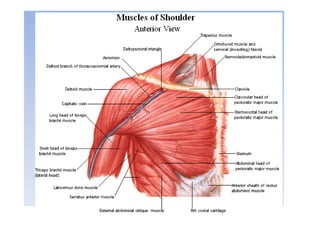
Walls. The axillary cavity has four
walls formed by the following
muscles:
anterior — pectoralis major and
minor;
posterior — subscapularis, teres
major, and latissimus dorsi;
medial — serratus anterior;
lateral — short head of the
biceps brachii, coracobrachialis,
and humerus.
On the posterior wall are 2
openings:
quadrangular opening bounded
by the teres major (below),
subscapularis (above), long
head of the triceps brachii
(medially), and humerus
(laterally);
triangular opening bounded by
the teres major (below),
subscapularis (above), and long
head of the triceps brachii
(laterally).
Triangles of the anterior
wall of the axillary cavity.
•
•
•
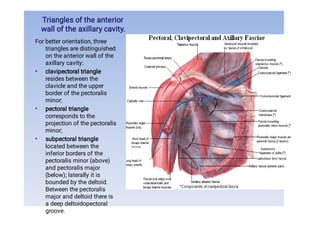
For better orientation, three
triangles are distinguished
on the anterior wall of the
axillary cavity:
clavipectoral triangle
resides between the
clavicle and the upper
border of the pectoralis
minor;
pectoral triangle
corresponds to the
projection of the pectoralis
minor;
subpectoral triangle
located between the
inferior borders of the
pectoralis minor (above)
and pectoralis major
(below); laterally it is
bounded by the deltoid.
Between the pectoralis
major and deltoid there is
a deep deltoidopectoral
groove.
Muscles of the Upper Arm
The muscles of the upper arm are concerned with the movements at the
shoulder and elbow joints on the frontal axis and, therefore, are situated on the
anterior (two flexors) and posterior (two extensors) surfaces of the upper arm
and attach to the bones of the forearm.
Anterior muscles
of the Upper Arm
(flexors)
Posterior muscles of the Upper Arm
(extensors)
1.The biceps brachii muscle
2.The coracobrachial muscle
1.The triceps brachii muscle
2.Elbow’s muscle
The topography of the upper arm
•
•
•
Radial canal is located behind the humerus. It is bounded by
the radial groove of the humerus in the front and by the triceps
brachii in the back. The canal has a spiral path. The radial canal
begins on the medial surface of the arm between the medial
and lateral heads of the triceps brachii and exits on the lateral
surface of the arm between the brachialis and brachio-radialis.
The canal gives passage to the radial nerve and a. profunda
brachii.
Medial bicipital groove lies medially between the biceps brachii
and brachialis; it transmits the main neurovascular bundle of
the upper arm.
Lateral bicipital groove resides laterally between the biceps
brachii and brachialis; it gives passage to the cephalic vein.
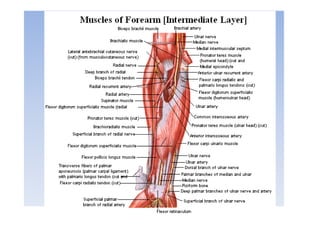
Muscles of the Forearm
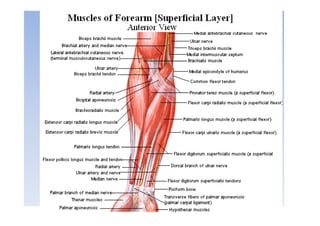
The muscles of the forearm are separated into two groups according to position
and function: the anterior group is composed of flexors and pronators, the
posterior group is composed of extensors and supinator.
Each group consists of a superficial and deep layers.
The Anterior group, Superficial layer
(flexors)
The Anterior Group,
Deep layer (flexors)
1. The round pronator muscle
2.The radial flexor of the wrist
3.The long palmar muscle
4.The ulnar flexor of the wrist
5.The superficial flexor of the fingers
6.The long flexors of the thumb
7.The deep flexor of the fingers
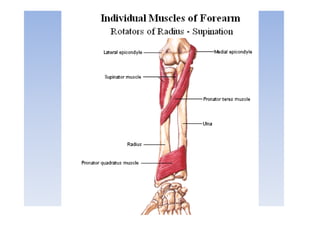
8.The square pronator muscle
The Posterior group
The muscles of the posterior group of the forearm are divided into two
subgroups: radial and ulnar. The first occupies the anterolateral surface of the
forearm, while the second occupies the posterior surface and is formed by the
superficial and deep layers.
The Posterior Radial Group The Posterior Ulnar group
1.The brachioradial muscle
2.The long radial extensor of the wrist 3.
The short radial extensor of the wrist
Superficial layer
4.The common extensor of the fingers
5.The extensor of the little finger
6.The ulnar extensor of the wrist
Deep layer
7. The supinator muscle
8. The long abductor of the thumb
9. The short extensor of the thumb
10. The long extensor of the thumb
11. The extensor of the index
The
topography
of the
forearm
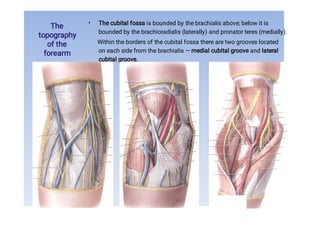
• The cubital fossa is bounded by the brachialis above; below it is
bounded by the brachioradialis (laterally) and pronator teres (medially).
Within the borders of the cubital fossa there are two grooves located
on each side from the brachialis — medial cubital groove and lateral
cubital groove.
The topography of the forearm
•
•
•
The ulnar groove of the forearm lies
between the flexor carpi ulnaris and
flexor digitorum superficialis.
It transmits the ulnar nerve, artery,
and vein.
The median groove of the forearm
resides in the lower part of the
forearm between the flexor carpi
radialis and flexor digitorum
superficialis.
It contains the median nerve.
The radial groove runs between
the flexor carpi radialis and
brachioradialis. It transmits the
radial artery, vein, and nerve.
Muscles of the Hand
The Thenar muscles of
theHand
The Hypothenar muscles
of the Hand
Muscles of the Hollow of
the Hand
1.The short abductor of
the thumb
2.The short flexor of the
thumb
3.The opponens muscle
of the thumb
4.The adductor muscle of
the thumb
1.The short palmar
muscle
2.The abductor of the
little finger
3.The short flexor of the
little finger
4.The opponens muscle
of the little finger
1.The lumbrical (worm-
like) muscles
2. The interossei muscles
The palmar interossei
muscles
- The dorsal interossei
muscles
-
-
The topography of the hand
•
•
The carpal canal is located in the region of the carpus underneath the flexor
retinaculum. It gives passage to the tendons of the flexor digitorum
superficialis, flexor digitorum profundus, flexor pollicis longus, and the
median nerve.
On both sides from the carpal canal, the flexor retinaculum splits and forms
another two canals — the radial carpal canal and ulnar carpal.
The radial carpal canal gives passage to the tendon of the flexor carpi
radialis, while the ulnar carpal canal transmits the ulnar artery, vein, and
nerve.
The fibrous sheaths of the digits of the hand are formed by the dense fibrous
lamina, which fuse with the bones. As a result, osteofibrous canals are
formed, which contain tendons of the flexors covered by the synovial sheath.
Each fibrous sheath consists of the anular part and cruciform part, the less
dense cruciform part is situated in the joint region.
Six canals on the dorsal surface of the wrist joint are counted from the radial to
the ulnar border and transmit following tendons:
1.
2.
3.
4.
5.
6.
the first canal transmits the
tendons of the m. abductor
pollicis longus and m.
extensor pollicis brevis;
the second canal transmits
the tendons of the m.m.
extensor carpi radialis
longus and brevis;
the third canal transmits the
tendon of the m. extensor
pollicis longus, and crosses
the preceding canal
obliquely;
the fourth canal transmits
the tendons of the m.
extensor digitorum and m.
extensor indicis;
the fifth canal transmits the
tendon of the m. extensor
digiti minimi;
the sixth canal transmits the
tendon of the m. extensor
carpi ulnaris.
FASCIAE OF THE UPPER LIMB
•
•
•
•
•
•
•
•
•
•
1. The deltoid fascia
2. The supraspinous fascia
3. The infraspinous fascia
4. The brachial fascia
5. The antebrachial fascia
6. The palmar aponeurosis
7. The deep palmar fascia
8. The dorsal fascia of the hand
9. flexor retinaculum
10.extensor retinaculum
THE SYNOVIAL BURSAE OF THE UPPER LIMB
1.
2.
3.
4.
5.
6.
7.
subdeltoid bursa resides between the deltoid and greater
tubercle of the humerus;
subacromial bursa lies under the acromion of the scapula;
subcutaneous acromial bursa lies superficially under the skin
in the region of the acromion of the scapula;
subtendinous bursa of subscapularis is located near the
attachment point of the subscapularis; the bursa
communicates with the cavity of the shoulder joint;
subtendinous bursa of latissimus dorsi resides under the
tendon near the point of attachment of the muscle on the
humerus; there is also another small bursa under the tendon
of the teres major. In the region of the elbow joint the
following bursae are found:
bicipitoradial bursa resides between the tendon of the biceps
brachii and the tuberosity of the radius;
subcutaneous olecranon bursa wide, lies under the skin of
the olecranon.
• Clinical applications. The inflammatory diseases of the synovial
bursae (bursitis) can be acute or chronic. In acute bursitis, pus can
accumulate in the bursa, which requires surgical intervention. Chronic
bursitis (gygroma) is often an occupational disease. In the shoulder
girdle area, inflammatory processes are most common in the
subcutaneous acromial bursa and in the subdeltoid bursa (among
porters). In the region of the elbow joint, the subcutaneous olecranon
bursa may become inflamed (among tanners and etchers).

upper limb muscle anatomy.pdf

  • 1.
    Department of HumanAnatomy KNMU MUSCLES AND TOPOGRAPHY OF THE UPPER AND LOWER LIMBS Slide-lecture for students of the 6 Faculty of Medicine Lector – associate professor Zharova Nataliya 2015
  • 2.
    • 1. 2. 3. 4. 5. 6. 7. 8. 9. 10. 11. 12. 13. PLAN Muscles of theupper limb. Muscles and topography of the shoulder girdle. Muscles and topography of the upper arm. Muscles and topography of the forearm. Muscles and topography of the hand. Fasciae of the upper limb. The synovial bursae of the upper limb. The muscles of the lower limb. Muscles and topography of the pelvic girdle. Muscles and topography of the thigh. Muscles and topography of the leg. Muscles and topography of the foot. The synovial bursae of the lower limb.
  • 3.
    MUSCLES OF THEUPPER LIMB The muscles of the upper limb can be classified into the muscles of the shoulder joint, the muscles of the arm, the muscles of the forearm and the muscles of the hand. Muscles of the Shoulder joint The Dorsal group The Ventral group 1.The deltoid muscle 2.The supraspinatus muscle 3.The infraspinatus muscle 4.The teres minor muscle 5. The teres major muscle 1.The subscapular muscle
  • 8.
    The axillary cavity • • • • • • Walls.The axillary cavity has four walls formed by the following muscles: anterior — pectoralis major and minor; posterior — subscapularis, teres major, and latissimus dorsi; medial — serratus anterior; lateral — short head of the biceps brachii, coracobrachialis, and humerus. On the posterior wall are 2 openings: quadrangular opening bounded by the teres major (below), subscapularis (above), long head of the triceps brachii (medially), and humerus (laterally); triangular opening bounded by the teres major (below), subscapularis (above), and long head of the triceps brachii (laterally).
  • 9.
    Triangles of theanterior wall of the axillary cavity. • • • For better orientation, three triangles are distinguished on the anterior wall of the axillary cavity: clavipectoral triangle resides between the clavicle and the upper border of the pectoralis minor; pectoral triangle corresponds to the projection of the pectoralis minor; subpectoral triangle located between the inferior borders of the pectoralis minor (above) and pectoralis major (below); laterally it is bounded by the deltoid. Between the pectoralis major and deltoid there is a deep deltoidopectoral groove.
  • 10.
    Muscles of theUpper Arm The muscles of the upper arm are concerned with the movements at the shoulder and elbow joints on the frontal axis and, therefore, are situated on the anterior (two flexors) and posterior (two extensors) surfaces of the upper arm and attach to the bones of the forearm. Anterior muscles of the Upper Arm (flexors) Posterior muscles of the Upper Arm (extensors) 1.The biceps brachii muscle 2.The coracobrachial muscle 1.The triceps brachii muscle 2.Elbow’s muscle
  • 14.
    The topography ofthe upper arm • • • Radial canal is located behind the humerus. It is bounded by the radial groove of the humerus in the front and by the triceps brachii in the back. The canal has a spiral path. The radial canal begins on the medial surface of the arm between the medial and lateral heads of the triceps brachii and exits on the lateral surface of the arm between the brachialis and brachio-radialis. The canal gives passage to the radial nerve and a. profunda brachii. Medial bicipital groove lies medially between the biceps brachii and brachialis; it transmits the main neurovascular bundle of the upper arm. Lateral bicipital groove resides laterally between the biceps brachii and brachialis; it gives passage to the cephalic vein.
  • 15.
    Muscles of theForearm The muscles of the forearm are separated into two groups according to position and function: the anterior group is composed of flexors and pronators, the posterior group is composed of extensors and supinator. Each group consists of a superficial and deep layers. The Anterior group, Superficial layer (flexors) The Anterior Group, Deep layer (flexors) 1. The round pronator muscle 2.The radial flexor of the wrist 3.The long palmar muscle 4.The ulnar flexor of the wrist 5.The superficial flexor of the fingers 6.The long flexors of the thumb 7.The deep flexor of the fingers 8.The square pronator muscle
  • 20.
    The Posterior group Themuscles of the posterior group of the forearm are divided into two subgroups: radial and ulnar. The first occupies the anterolateral surface of the forearm, while the second occupies the posterior surface and is formed by the superficial and deep layers. The Posterior Radial Group The Posterior Ulnar group 1.The brachioradial muscle 2.The long radial extensor of the wrist 3. The short radial extensor of the wrist Superficial layer 4.The common extensor of the fingers 5.The extensor of the little finger 6.The ulnar extensor of the wrist Deep layer 7. The supinator muscle 8. The long abductor of the thumb 9. The short extensor of the thumb 10. The long extensor of the thumb 11. The extensor of the index
  • 24.
    The topography of the forearm • Thecubital fossa is bounded by the brachialis above; below it is bounded by the brachioradialis (laterally) and pronator teres (medially). Within the borders of the cubital fossa there are two grooves located on each side from the brachialis — medial cubital groove and lateral cubital groove.
  • 25.
    The topography ofthe forearm • • • The ulnar groove of the forearm lies between the flexor carpi ulnaris and flexor digitorum superficialis. It transmits the ulnar nerve, artery, and vein. The median groove of the forearm resides in the lower part of the forearm between the flexor carpi radialis and flexor digitorum superficialis. It contains the median nerve. The radial groove runs between the flexor carpi radialis and brachioradialis. It transmits the radial artery, vein, and nerve.
  • 26.
    Muscles of theHand The Thenar muscles of theHand The Hypothenar muscles of the Hand Muscles of the Hollow of the Hand 1.The short abductor of the thumb 2.The short flexor of the thumb 3.The opponens muscle of the thumb 4.The adductor muscle of the thumb 1.The short palmar muscle 2.The abductor of the little finger 3.The short flexor of the little finger 4.The opponens muscle of the little finger 1.The lumbrical (worm- like) muscles 2. The interossei muscles The palmar interossei muscles - The dorsal interossei muscles - -
  • 30.
    The topography ofthe hand • • The carpal canal is located in the region of the carpus underneath the flexor retinaculum. It gives passage to the tendons of the flexor digitorum superficialis, flexor digitorum profundus, flexor pollicis longus, and the median nerve. On both sides from the carpal canal, the flexor retinaculum splits and forms another two canals — the radial carpal canal and ulnar carpal. The radial carpal canal gives passage to the tendon of the flexor carpi radialis, while the ulnar carpal canal transmits the ulnar artery, vein, and nerve. The fibrous sheaths of the digits of the hand are formed by the dense fibrous lamina, which fuse with the bones. As a result, osteofibrous canals are formed, which contain tendons of the flexors covered by the synovial sheath. Each fibrous sheath consists of the anular part and cruciform part, the less dense cruciform part is situated in the joint region.
  • 31.
    Six canals onthe dorsal surface of the wrist joint are counted from the radial to the ulnar border and transmit following tendons: 1. 2. 3. 4. 5. 6. the first canal transmits the tendons of the m. abductor pollicis longus and m. extensor pollicis brevis; the second canal transmits the tendons of the m.m. extensor carpi radialis longus and brevis; the third canal transmits the tendon of the m. extensor pollicis longus, and crosses the preceding canal obliquely; the fourth canal transmits the tendons of the m. extensor digitorum and m. extensor indicis; the fifth canal transmits the tendon of the m. extensor digiti minimi; the sixth canal transmits the tendon of the m. extensor carpi ulnaris.
  • 32.
    FASCIAE OF THEUPPER LIMB • • • • • • • • • • 1. The deltoid fascia 2. The supraspinous fascia 3. The infraspinous fascia 4. The brachial fascia 5. The antebrachial fascia 6. The palmar aponeurosis 7. The deep palmar fascia 8. The dorsal fascia of the hand 9. flexor retinaculum 10.extensor retinaculum
  • 33.
    THE SYNOVIAL BURSAEOF THE UPPER LIMB 1. 2. 3. 4. 5. 6. 7. subdeltoid bursa resides between the deltoid and greater tubercle of the humerus; subacromial bursa lies under the acromion of the scapula; subcutaneous acromial bursa lies superficially under the skin in the region of the acromion of the scapula; subtendinous bursa of subscapularis is located near the attachment point of the subscapularis; the bursa communicates with the cavity of the shoulder joint; subtendinous bursa of latissimus dorsi resides under the tendon near the point of attachment of the muscle on the humerus; there is also another small bursa under the tendon of the teres major. In the region of the elbow joint the following bursae are found: bicipitoradial bursa resides between the tendon of the biceps brachii and the tuberosity of the radius; subcutaneous olecranon bursa wide, lies under the skin of the olecranon.
  • 36.
    • Clinical applications.The inflammatory diseases of the synovial bursae (bursitis) can be acute or chronic. In acute bursitis, pus can accumulate in the bursa, which requires surgical intervention. Chronic bursitis (gygroma) is often an occupational disease. In the shoulder girdle area, inflammatory processes are most common in the subcutaneous acromial bursa and in the subdeltoid bursa (among porters). In the region of the elbow joint, the subcutaneous olecranon bursa may become inflamed (among tanners and etchers).