© 3GPP 2020
3GPP Webinar – April 2020 1
Update on progress made at
CT#87-e meeting
Lionel Morand, 3GPP TSG CT Chair
© 3GPP 2020
3GPP Webinar – April 2020 2
Agenda
Brief Introduction of the 3GPP
About TSG CT
Rel-16: From where we were
Rel-16: To where we are
Q/A session
© 3GPP 2020
3GPP Webinar – April 2020 3
Brief 3GPP Introduction
From 3G to 5G, providing a complete system description for mobile telecommunications, including
hooks for non-radio access to the core network, and for interworking with non-3GPP networks.
3
© 3GPP 2020
3GPP Webinar – April 2020 4
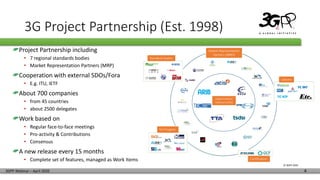
Market Representation
Partners (MRPs)
Organizational
Partners (OPs)
3G Project Partnership (Est. 1998)
Project Partnership including
• 7 regional standards bodies
• Market Representation Partners (MRP)
Cooperation with external SDOs/Fora
• E.g. ITU, IETF
About 700 companies
• from 45 countries
• about 2500 delegates
Work based on
• Regular face-to-face meetings
• Pro-activity & Contributions
• Consensus
A new release every 15 months
• Complete set of features, managed as Work Items Certification
Standards bodies
5G Projects
TC INT
TC SCP Etc.
Liaisons
© 3GPP 2020
3GPP Webinar – April 2020 5
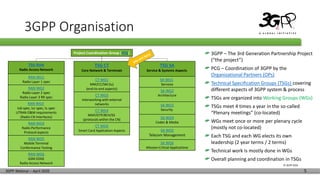
TSG RAN
Radio Access Network
RAN WG1
Radio Layer 1 spec
RAN WG2
Radio Layer 2 spec
Radio Layer 3 RR spec
RAN WG3
lub spec, lur spec, lu spec
UTRAN O&M requirements
(Radio CN Interfaces)
RAN WG4
Radio Performance
Protocol aspects
RAN WG5
Mobile Terminal
Conformance Testing
RAN WG6
GSM EDGE
Radio Access Network
TSG SA
Service & Systems Aspects
SA WG1
Services
SA WG2
Architecture
SA WG3
Security
SA WG4
Codec & Media
SA WG5
Telecom Management
SA WG6
Mission-Critical Applications
TSG CT
Core Network & Terminals
CT WG1
MM/CC/SM (lu)
(end-to-end aspects)
CT WG3
Interworking with external
networks
CT WG4
MAP/GTP/BCH/SS
(protocols within the CN)
CT WG6
Smart Card Application Aspects
Project Coordination Group (PCG)
3GPP Organisation
3GPP – The 3rd Generation Partnership Project
(“the project”)
PCG – Coordination of 3GPP by the
Organizational Partners (OPs)
Technical Specification Groups (TSGs) covering
different aspects of 3GPP system & process
TSGs are organized into Working Groups (WGs)
TSGs meet 4 times a year in the so-called
“Plenary meetings” (co-located)
WGs meet once or more per plenary cycle
(mostly not co-located)
Each TSG and each WG elects its own
leadership (2 year terms / 2 terms)
Technical work is mostly done in WGs
Overall planning and coordination in TSGs
© 3GPP 2020
3GPP Webinar – April 2020 6
About TSG CT
From circuit-switched network to IP-based system
From mobile terminal to any device…
From a telco-centric network to a flexible service enabler platform…
6
© 3GPP 2020
3GPP Webinar – April 2020 7
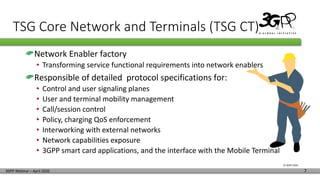
TSG Core Network and Terminals (TSG CT)
Network Enabler factory
• Transforming service functional requirements into network enablers
Responsible of detailed protocol specifications for:
• Control and user signaling planes
• User and terminal mobility management
• Call/session control
• Policy, charging QoS enforcement
• Interworking with external networks
• Network capabilities exposure
• 3GPP smart card applications, and the interface with the Mobile Terminal
© 3GPP 2020
3GPP Webinar – April 2020 8
Rel-16: From where we were…
8
© 3GPP 2020
3GPP Webinar – April 2020 9
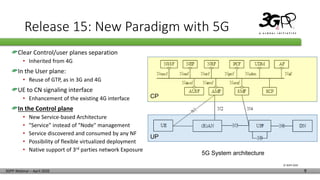
Release 15: New Paradigm with 5G
Clear Control/user planes separation
• Inherited from 4G
In the User plane:
• Reuse of GTP, as in 3G and 4G
UE to CN signaling interface
• Enhancement of the existing 4G interface
In the Control plane
• New Service-based Architecture
• "Service" instead of "Node" management
• Service discovered and consumed by any NF
• Possibility of flexible virtualized deployment
• Native support of 3rd parties network Exposure
CP
UP
5G System architecture
© 3GPP 2020
3GPP Webinar – April 2020 10
Release 15: A major achievement
Aim: Provide a flexible platfom
• Virtualization, Cloud-friendly
• Programmable, stateless, scalable
• Ease the introduction of any new feature/service
Main Decision: Define RESTful APIs
• Use of HTTP/2 as transport protocol
• API Design based on the REpresentational State Transfer (REST) principles
• JavaScript Object Notation (JSON) as a data format
• OpenAPI as the interface definition language
• Standardized versioning mechanism
• Basic overload control mechanism
© 3GPP 2020
3GPP Webinar – April 2020 11
Release 15: Not limited to SBA
Evolution of the 4G Core to support 5G access networks (NSA)
Interaction between the 5G CN and IMS
Support of Mobile Communication System for Railways
Standardized northbound API for M2M service
Enhancement of existing services
• Mission critical services
• Cellular IoT
• V2X
• Etc.
Maintenance of existing protocol specifications
© 3GPP 2020
3GPP Webinar – April 2020 12
Rel-16: To where we are
12
© 3GPP 2020
3GPP Webinar – April 2020 13
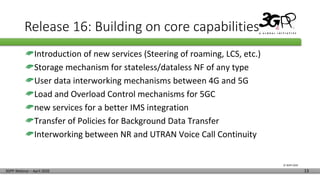
Release 16: Building on core capabilities
Introduction of new services (Steering of roaming, LCS, etc.)
Storage mechanism for stateless/dataless NF of any type
User data interworking mechanisms between 4G and 5G
Load and Overload Control mechanisms for 5GC
new services for a better IMS integration
Transfer of Policies for Background Data Transfer
Interworking between NR and UTRAN Voice Call Continuity
© 3GPP 2020
3GPP Webinar – April 2020 14
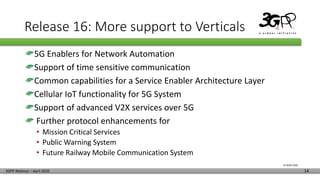
Release 16: More support to Verticals
5G Enablers for Network Automation
Support of time sensitive communication
Common capabilities for a Service Enabler Architecture Layer
Cellular IoT functionality for 5G System
Support of advanced V2X services over 5G
Further protocol enhancements for
• Mission Critical Services
• Public Warning System
• Future Railway Mobile Communication System
© 3GPP 2020
3GPP Webinar – April 2020 15
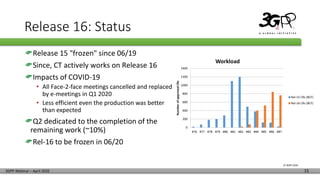
Release 16: Status
Release 15 "frozen" since 06/19
Since, CT actively works on Release 16
Impacts of COVID-19
• All Face-2-face meetings cancelled and replaced
by e-meetings in Q1 2020
• Less efficient even the production was better
than expected
Q2 dedicated to the completion of the
remaining work (~10%)
Rel-16 to be frozen in 06/20
0
200
400
600
800
1000
1200
1400
#76 #77 #78 #79 #80 #81 #82 #83 #84 #85 #86 #87
NumberofapprovedCRs
Workload
Rel-15 CRs (BCF)
Rel-16 CRs (BCF)
© 3GPP 2020
3GPP Webinar – April 2020 16
Links
About 3GPP https://www.3gpp.org/about-3gpp/about-3gpp
3GPP News http://www.3gpp.org/news-events
Release 15 Overview http://www.3gpp.org/DynaReport/21915.htm
Release 16 Overview (draft) http://www.3gpp.org/DynaReport/21916.htm
© 3GPP 2020
3GPP Webinar – April 2020 17
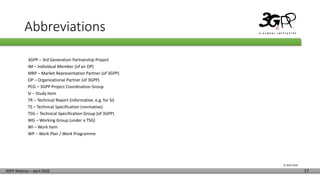
Abbreviations
3GPP – 3rd Generation Partnership Project
IM – Individual Member (of an OP)
MRP – Market Representation Partner (of 3GPP)
OP – Organizational Partner (of 3GPP)
PCG – 3GPP Project Coordination Group
SI – Study Item
TR – Technical Report (informative, e.g. for SI)
TS – Technical Specification (normative)
TSG – Technical Specification Group (of 3GPP)
WG – Working Group (under a TSG)
WI – Work Item
WP – Work Plan / Work Programme
© 3GPP 2020
3GPP Webinar – April 2020 18
Questions ???
© 3GPP 2020
3GPP Webinar – April 2020 19
Thank you!

Update on progress made at CT#87-e meeting

  • 1.
    © 3GPP 2020 3GPPWebinar – April 2020 1 Update on progress made at CT#87-e meeting Lionel Morand, 3GPP TSG CT Chair
  • 2.
    © 3GPP 2020 3GPPWebinar – April 2020 2 Agenda Brief Introduction of the 3GPP About TSG CT Rel-16: From where we were Rel-16: To where we are Q/A session
  • 3.
    © 3GPP 2020 3GPPWebinar – April 2020 3 Brief 3GPP Introduction From 3G to 5G, providing a complete system description for mobile telecommunications, including hooks for non-radio access to the core network, and for interworking with non-3GPP networks. 3
  • 4.
    © 3GPP 2020 3GPPWebinar – April 2020 4 Market Representation Partners (MRPs) Organizational Partners (OPs) 3G Project Partnership (Est. 1998) Project Partnership including • 7 regional standards bodies • Market Representation Partners (MRP) Cooperation with external SDOs/Fora • E.g. ITU, IETF About 700 companies • from 45 countries • about 2500 delegates Work based on • Regular face-to-face meetings • Pro-activity & Contributions • Consensus A new release every 15 months • Complete set of features, managed as Work Items Certification Standards bodies 5G Projects TC INT TC SCP Etc. Liaisons
  • 5.
    © 3GPP 2020 3GPPWebinar – April 2020 5 TSG RAN Radio Access Network RAN WG1 Radio Layer 1 spec RAN WG2 Radio Layer 2 spec Radio Layer 3 RR spec RAN WG3 lub spec, lur spec, lu spec UTRAN O&M requirements (Radio CN Interfaces) RAN WG4 Radio Performance Protocol aspects RAN WG5 Mobile Terminal Conformance Testing RAN WG6 GSM EDGE Radio Access Network TSG SA Service & Systems Aspects SA WG1 Services SA WG2 Architecture SA WG3 Security SA WG4 Codec & Media SA WG5 Telecom Management SA WG6 Mission-Critical Applications TSG CT Core Network & Terminals CT WG1 MM/CC/SM (lu) (end-to-end aspects) CT WG3 Interworking with external networks CT WG4 MAP/GTP/BCH/SS (protocols within the CN) CT WG6 Smart Card Application Aspects Project Coordination Group (PCG) 3GPP Organisation 3GPP – The 3rd Generation Partnership Project (“the project”) PCG – Coordination of 3GPP by the Organizational Partners (OPs) Technical Specification Groups (TSGs) covering different aspects of 3GPP system & process TSGs are organized into Working Groups (WGs) TSGs meet 4 times a year in the so-called “Plenary meetings” (co-located) WGs meet once or more per plenary cycle (mostly not co-located) Each TSG and each WG elects its own leadership (2 year terms / 2 terms) Technical work is mostly done in WGs Overall planning and coordination in TSGs
  • 6.
    © 3GPP 2020 3GPPWebinar – April 2020 6 About TSG CT From circuit-switched network to IP-based system From mobile terminal to any device… From a telco-centric network to a flexible service enabler platform… 6
  • 7.
    © 3GPP 2020 3GPPWebinar – April 2020 7 TSG Core Network and Terminals (TSG CT) Network Enabler factory • Transforming service functional requirements into network enablers Responsible of detailed protocol specifications for: • Control and user signaling planes • User and terminal mobility management • Call/session control • Policy, charging QoS enforcement • Interworking with external networks • Network capabilities exposure • 3GPP smart card applications, and the interface with the Mobile Terminal
  • 8.
    © 3GPP 2020 3GPPWebinar – April 2020 8 Rel-16: From where we were… 8
  • 9.
    © 3GPP 2020 3GPPWebinar – April 2020 9 Release 15: New Paradigm with 5G Clear Control/user planes separation • Inherited from 4G In the User plane: • Reuse of GTP, as in 3G and 4G UE to CN signaling interface • Enhancement of the existing 4G interface In the Control plane • New Service-based Architecture • "Service" instead of "Node" management • Service discovered and consumed by any NF • Possibility of flexible virtualized deployment • Native support of 3rd parties network Exposure CP UP 5G System architecture
  • 10.
    © 3GPP 2020 3GPPWebinar – April 2020 10 Release 15: A major achievement Aim: Provide a flexible platfom • Virtualization, Cloud-friendly • Programmable, stateless, scalable • Ease the introduction of any new feature/service Main Decision: Define RESTful APIs • Use of HTTP/2 as transport protocol • API Design based on the REpresentational State Transfer (REST) principles • JavaScript Object Notation (JSON) as a data format • OpenAPI as the interface definition language • Standardized versioning mechanism • Basic overload control mechanism
  • 11.
    © 3GPP 2020 3GPPWebinar – April 2020 11 Release 15: Not limited to SBA Evolution of the 4G Core to support 5G access networks (NSA) Interaction between the 5G CN and IMS Support of Mobile Communication System for Railways Standardized northbound API for M2M service Enhancement of existing services • Mission critical services • Cellular IoT • V2X • Etc. Maintenance of existing protocol specifications
  • 12.
    © 3GPP 2020 3GPPWebinar – April 2020 12 Rel-16: To where we are 12
  • 13.
    © 3GPP 2020 3GPPWebinar – April 2020 13 Release 16: Building on core capabilities Introduction of new services (Steering of roaming, LCS, etc.) Storage mechanism for stateless/dataless NF of any type User data interworking mechanisms between 4G and 5G Load and Overload Control mechanisms for 5GC new services for a better IMS integration Transfer of Policies for Background Data Transfer Interworking between NR and UTRAN Voice Call Continuity
  • 14.
    © 3GPP 2020 3GPPWebinar – April 2020 14 Release 16: More support to Verticals 5G Enablers for Network Automation Support of time sensitive communication Common capabilities for a Service Enabler Architecture Layer Cellular IoT functionality for 5G System Support of advanced V2X services over 5G Further protocol enhancements for • Mission Critical Services • Public Warning System • Future Railway Mobile Communication System
  • 15.
    © 3GPP 2020 3GPPWebinar – April 2020 15 Release 16: Status Release 15 "frozen" since 06/19 Since, CT actively works on Release 16 Impacts of COVID-19 • All Face-2-face meetings cancelled and replaced by e-meetings in Q1 2020 • Less efficient even the production was better than expected Q2 dedicated to the completion of the remaining work (~10%) Rel-16 to be frozen in 06/20 0 200 400 600 800 1000 1200 1400 #76 #77 #78 #79 #80 #81 #82 #83 #84 #85 #86 #87 NumberofapprovedCRs Workload Rel-15 CRs (BCF) Rel-16 CRs (BCF)
  • 16.
    © 3GPP 2020 3GPPWebinar – April 2020 16 Links About 3GPP https://www.3gpp.org/about-3gpp/about-3gpp 3GPP News http://www.3gpp.org/news-events Release 15 Overview http://www.3gpp.org/DynaReport/21915.htm Release 16 Overview (draft) http://www.3gpp.org/DynaReport/21916.htm
  • 17.
    © 3GPP 2020 3GPPWebinar – April 2020 17 Abbreviations 3GPP – 3rd Generation Partnership Project IM – Individual Member (of an OP) MRP – Market Representation Partner (of 3GPP) OP – Organizational Partner (of 3GPP) PCG – 3GPP Project Coordination Group SI – Study Item TR – Technical Report (informative, e.g. for SI) TS – Technical Specification (normative) TSG – Technical Specification Group (of 3GPP) WG – Working Group (under a TSG) WI – Work Item WP – Work Plan / Work Programme
  • 18.
    © 3GPP 2020 3GPPWebinar – April 2020 18 Questions ???
  • 19.
    © 3GPP 2020 3GPPWebinar – April 2020 19 Thank you!