UPCT
Sulfuric Acid (DCDA)
Yash Suryakant Shimpi-190110105064
The Properties of Sulfuric Acid
◦ Chemical Name- Sulfuric Acid
◦ Molecular Formula- 𝐻2𝑆𝑂4
◦ Molecular Weight- 98.07 gm/mole
◦ Appearance- Colourless to dark brown, oily liquid
◦ Odour- Odourless
◦ Melting point- 10 ˚
C
◦ Boiling point- 337 ˚
C
◦ Density- 1.84 g/ml at 20 ˚
C
DCDA Process
◦ The process can be divided into 3-processes :
1. Burning of Sulfur in presence of excess of air.
2. Oxidation of 𝑆𝑂2 gas into 𝑆𝑂3 gas.
3. Hydration of Sulfur trioxide.
Raw materials
◦ Following raw material are used in DCDA process.
1) 𝑆𝑂2 gas is obtained from various sources like,
a) Sulphur burning
b) Pyrites roasting containing 40- 45 % sulfur
c) Metal sulfide roasting and smelting
d) Sulfuric acid regeneration
e) Metal sulfate roasting
f) Combustion of 𝐻2𝑆 or other Sulfur-Containing gases
g) Other processes.
Raw materials
2) Catalyst : For oxidation of 𝑆𝑂2 into 𝑆𝑂3 , vanadium pentoxide dispersed on porous carrier in pellet form is
used. Previously Platinum was widely used. Previously Platinum was widely used, but it has several
disadvantages like less conversion ratio (𝑆𝑂2and 𝑆𝑂3), poisonous, fragile, rapid heat deactivation and high
initial investment, arsenic impurities. But, vanadium pentoxide is used as catalyst, because it has higher
conversion ratio, less poisonous and initial low investment. Vanadium pentoxide is regenerated by following
process:
1). Oxidation of 𝑆𝑂2 into 𝑆𝑂3 by 𝑉 5+
2 𝑆𝑂2 + 4𝑉 5+
+ 2 𝑂 2−
2 𝑆𝑂3 + 4 𝑉 4+
2). Oxidation of 4 𝑉 4+
back into 𝑉 5+
by oxygen (catalyst regeneration)
4 𝑉 4++ 𝑂2 4 𝑉 5+ + 2 𝑂 2−
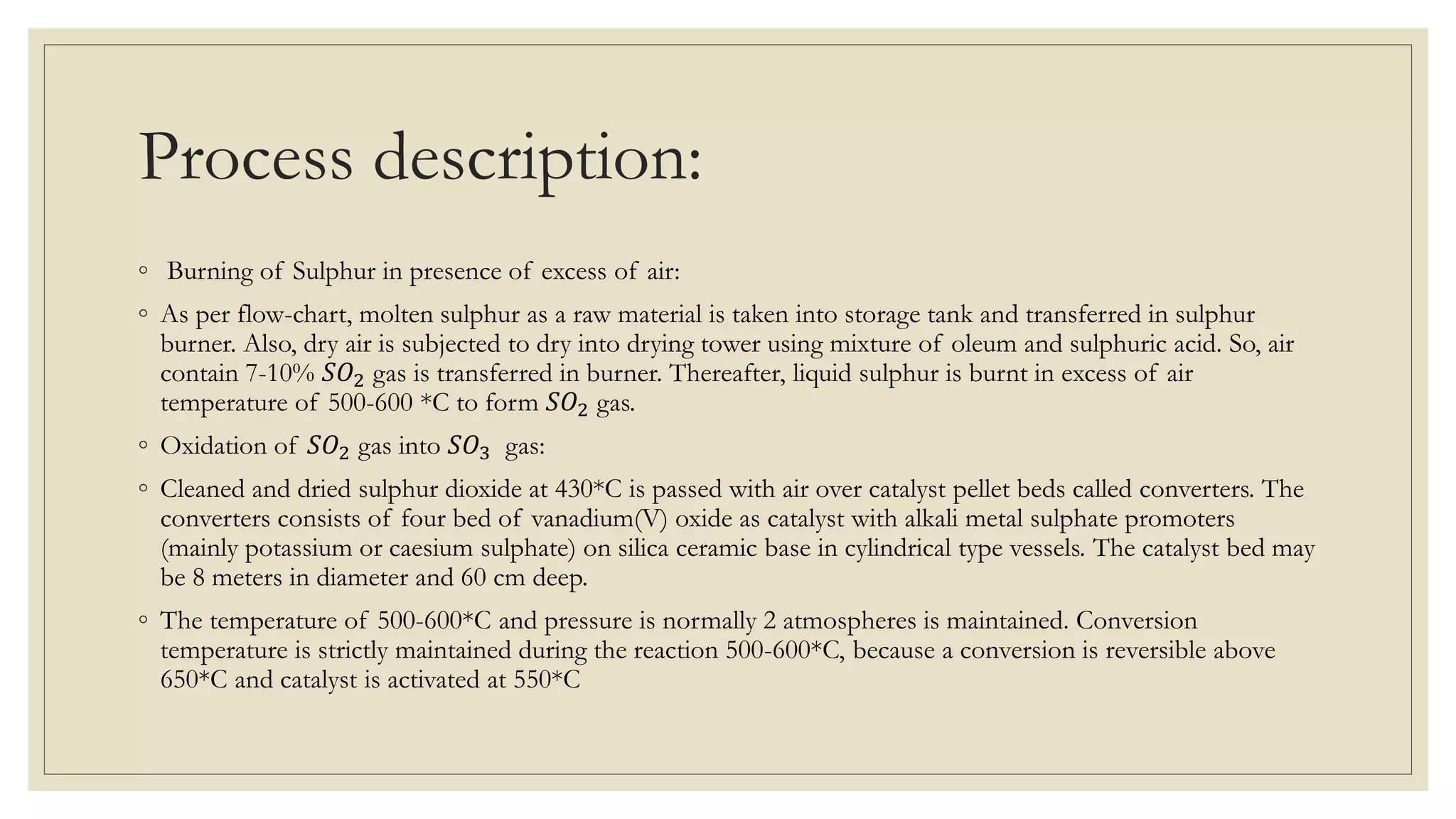
Process description:
◦ Burning of Sulphur in presence of excess of air:
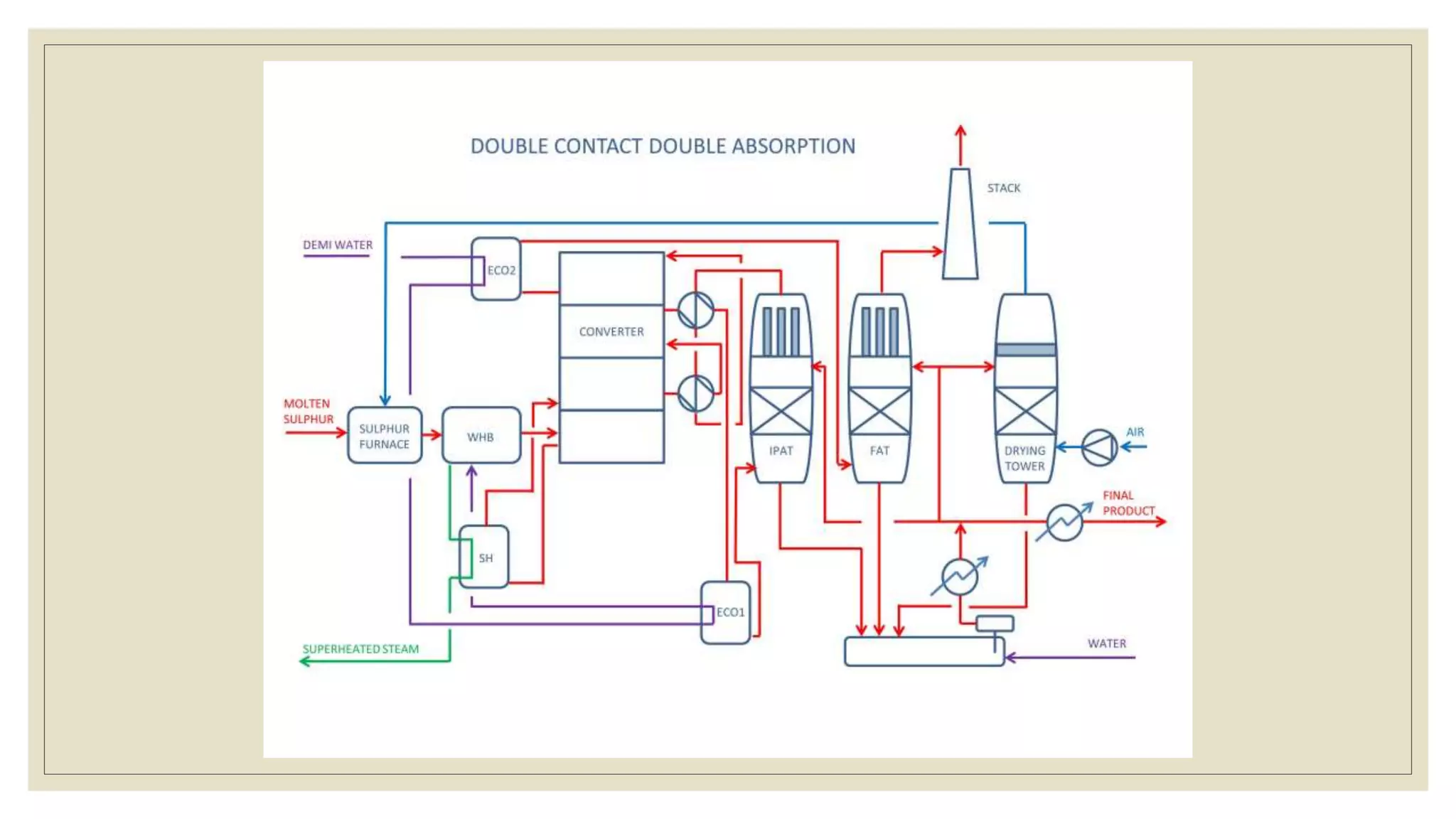
◦ As per flow-chart, molten sulphur as a raw material is taken into storage tank and transferred in sulphur
burner. Also, dry air is subjected to dry into drying tower using mixture of oleum and sulphuric acid. So, air
contain 7-10% 𝑆𝑂2 gas is transferred in burner. Thereafter, liquid sulphur is burnt in excess of air
temperature of 500-600 *C to form 𝑆𝑂2 gas.
◦ Oxidation of 𝑆𝑂2 gas into 𝑆𝑂3 gas:
◦ Cleaned and dried sulphur dioxide at 430*C is passed with air over catalyst pellet beds called converters. The
converters consists of four bed of vanadium(V) oxide as catalyst with alkali metal sulphate promoters
(mainly potassium or caesium sulphate) on silica ceramic base in cylindrical type vessels. The catalyst bed may
be 8 meters in diameter and 60 cm deep.
◦ The temperature of 500-600*C and pressure is normally 2 atmospheres is maintained. Conversion
temperature is strictly maintained during the reaction 500-600*C, because a conversion is reversible above
650*C and catalyst is activated at 550*C
Process description
◦ Hydration of Sulphur trioxide gas:
◦ Hot Sulphur trioxide gas is cooled up to 150*C by repeated heat exchanges. The cooled gas is then absorbed
column filled with oleum and thereafter 97% Sulfuric acid. The acid strength can be adjusted by controlling
the streams of 𝐻2𝑆𝑂4 to give acid of 91 to 100% 𝐻2𝑆𝑂4 with various amounts of added 𝑆𝑂3 and water. The
conversion of sulphur to acid is over 99.5%.
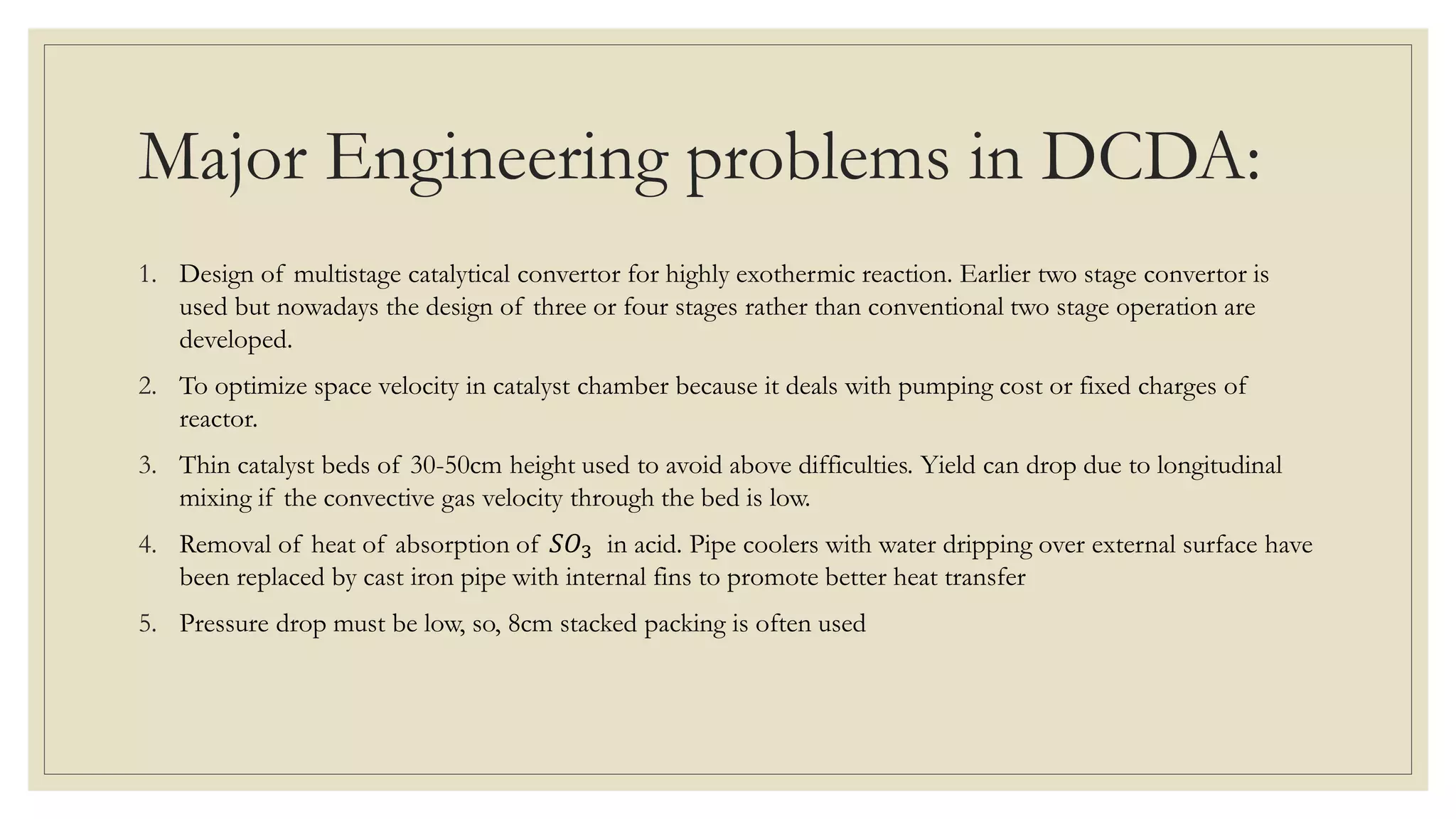
Major Engineering problems in DCDA:
1. Design of multistage catalytical convertor for highly exothermic reaction. Earlier two stage convertor is
used but nowadays the design of three or four stages rather than conventional two stage operation are
developed.
2. To optimize space velocity in catalyst chamber because it deals with pumping cost or fixed charges of
reactor.
3. Thin catalyst beds of 30-50cm height used to avoid above difficulties. Yield can drop due to longitudinal
mixing if the convective gas velocity through the bed is low.
4. Removal of heat of absorption of 𝑆𝑂3 in acid. Pipe coolers with water dripping over external surface have
been replaced by cast iron pipe with internal fins to promote better heat transfer
5. Pressure drop must be low, so, 8cm stacked packing is often used
Uses
1. The largest single use is in fertilizer industry.
2. Mostly in production of phosphoric acid, which in turn used to manufacture fertilizer such as triple
superphosphate, mono and diammonium phosphates
3. Used for producing superphosphate and ammonium sulfate.
4. In manufacture of explosives, detergents and plastics
5. In production of dyes and pharmaceuticals.
UPCT- sulfuric acid DCDA Method

UPCT- sulfuric acid DCDA Method

  • 1.
    UPCT Sulfuric Acid (DCDA) YashSuryakant Shimpi-190110105064
  • 2.
    The Properties ofSulfuric Acid ◦ Chemical Name- Sulfuric Acid ◦ Molecular Formula- 𝐻2𝑆𝑂4 ◦ Molecular Weight- 98.07 gm/mole ◦ Appearance- Colourless to dark brown, oily liquid ◦ Odour- Odourless ◦ Melting point- 10 ˚ C ◦ Boiling point- 337 ˚ C ◦ Density- 1.84 g/ml at 20 ˚ C
  • 3.
    DCDA Process ◦ Theprocess can be divided into 3-processes : 1. Burning of Sulfur in presence of excess of air. 2. Oxidation of 𝑆𝑂2 gas into 𝑆𝑂3 gas. 3. Hydration of Sulfur trioxide.
  • 4.
    Raw materials ◦ Followingraw material are used in DCDA process. 1) 𝑆𝑂2 gas is obtained from various sources like, a) Sulphur burning b) Pyrites roasting containing 40- 45 % sulfur c) Metal sulfide roasting and smelting d) Sulfuric acid regeneration e) Metal sulfate roasting f) Combustion of 𝐻2𝑆 or other Sulfur-Containing gases g) Other processes.
  • 5.
    Raw materials 2) Catalyst: For oxidation of 𝑆𝑂2 into 𝑆𝑂3 , vanadium pentoxide dispersed on porous carrier in pellet form is used. Previously Platinum was widely used. Previously Platinum was widely used, but it has several disadvantages like less conversion ratio (𝑆𝑂2and 𝑆𝑂3), poisonous, fragile, rapid heat deactivation and high initial investment, arsenic impurities. But, vanadium pentoxide is used as catalyst, because it has higher conversion ratio, less poisonous and initial low investment. Vanadium pentoxide is regenerated by following process: 1). Oxidation of 𝑆𝑂2 into 𝑆𝑂3 by 𝑉 5+ 2 𝑆𝑂2 + 4𝑉 5+ + 2 𝑂 2− 2 𝑆𝑂3 + 4 𝑉 4+ 2). Oxidation of 4 𝑉 4+ back into 𝑉 5+ by oxygen (catalyst regeneration) 4 𝑉 4++ 𝑂2 4 𝑉 5+ + 2 𝑂 2−
  • 7.
    Process description: ◦ Burningof Sulphur in presence of excess of air: ◦ As per flow-chart, molten sulphur as a raw material is taken into storage tank and transferred in sulphur burner. Also, dry air is subjected to dry into drying tower using mixture of oleum and sulphuric acid. So, air contain 7-10% 𝑆𝑂2 gas is transferred in burner. Thereafter, liquid sulphur is burnt in excess of air temperature of 500-600 *C to form 𝑆𝑂2 gas. ◦ Oxidation of 𝑆𝑂2 gas into 𝑆𝑂3 gas: ◦ Cleaned and dried sulphur dioxide at 430*C is passed with air over catalyst pellet beds called converters. The converters consists of four bed of vanadium(V) oxide as catalyst with alkali metal sulphate promoters (mainly potassium or caesium sulphate) on silica ceramic base in cylindrical type vessels. The catalyst bed may be 8 meters in diameter and 60 cm deep. ◦ The temperature of 500-600*C and pressure is normally 2 atmospheres is maintained. Conversion temperature is strictly maintained during the reaction 500-600*C, because a conversion is reversible above 650*C and catalyst is activated at 550*C
  • 8.
    Process description ◦ Hydrationof Sulphur trioxide gas: ◦ Hot Sulphur trioxide gas is cooled up to 150*C by repeated heat exchanges. The cooled gas is then absorbed column filled with oleum and thereafter 97% Sulfuric acid. The acid strength can be adjusted by controlling the streams of 𝐻2𝑆𝑂4 to give acid of 91 to 100% 𝐻2𝑆𝑂4 with various amounts of added 𝑆𝑂3 and water. The conversion of sulphur to acid is over 99.5%.
  • 9.
    Major Engineering problemsin DCDA: 1. Design of multistage catalytical convertor for highly exothermic reaction. Earlier two stage convertor is used but nowadays the design of three or four stages rather than conventional two stage operation are developed. 2. To optimize space velocity in catalyst chamber because it deals with pumping cost or fixed charges of reactor. 3. Thin catalyst beds of 30-50cm height used to avoid above difficulties. Yield can drop due to longitudinal mixing if the convective gas velocity through the bed is low. 4. Removal of heat of absorption of 𝑆𝑂3 in acid. Pipe coolers with water dripping over external surface have been replaced by cast iron pipe with internal fins to promote better heat transfer 5. Pressure drop must be low, so, 8cm stacked packing is often used
  • 10.
    Uses 1. The largestsingle use is in fertilizer industry. 2. Mostly in production of phosphoric acid, which in turn used to manufacture fertilizer such as triple superphosphate, mono and diammonium phosphates 3. Used for producing superphosphate and ammonium sulfate. 4. In manufacture of explosives, detergents and plastics 5. In production of dyes and pharmaceuticals.