UNTIL DAWN
Aspects of the Game
• Interactive drama survival horror adventure video
game.
• Play as/control many different characters who
have been made to look as realistic/like the actor
who voices them.
• The choices you make will affect how the game
plays out, eg who dies, when/how they die, and
what ending the game will have aka the butterfly
effect, eg, locating a weapon in an earlier chapter
may allow the player to pick it up down the line
when a chase scene leads back to the same
room.
Aspects of the Game
• The game begins with a therapy session with
Dr. Hill (Peter Stormare), who poses a question
to his patient; these sessions will come up in
following chapters and will affect what
contents of the game that will be shown, it
uses first person and breaking the forth wall.
• The decisions you make will actually change
the characteristic and personality of each
character.
Postmodernity
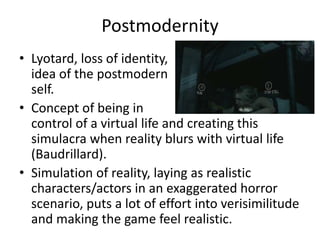
• Lyotard, loss of identity,
idea of the postmodern
self.
• Concept of being in
control of a virtual life and creating this
simulacra when reality blurs with virtual life
(Baudrillard).
• Simulation of reality, laying as realistic
characters/actors in an exaggerated horror
scenario, puts a lot of effort into verisimilitude
and making the game feel realistic.
Postmodernity
• Declining of meta narratives, once the villain
in the game is revealed you then play as the
antihero, there is no clear definition who is
good or bad in the game.
• Meta discourse as the player is figuring out
how they want the narrative to go by choosing
what to do, who to kill, what movement to
make etc.
• Elements of nudity
• for nudity’s sake.
• Strong critical awareness of our actions and
how the game is played.
• This sort of critical awareness that results
from our engagement with metafictional
media and narrative forms links to Linda
Hutcheon’s discussion of postmodernism in
The Politics of Postmodernism who defines the
postmodern text, ultimately, as a form of
‘paradoxically complicitous critique’.

Until dawn

  • 1.
  • 2.
    Aspects of theGame • Interactive drama survival horror adventure video game. • Play as/control many different characters who have been made to look as realistic/like the actor who voices them. • The choices you make will affect how the game plays out, eg who dies, when/how they die, and what ending the game will have aka the butterfly effect, eg, locating a weapon in an earlier chapter may allow the player to pick it up down the line when a chase scene leads back to the same room.
  • 3.
    Aspects of theGame • The game begins with a therapy session with Dr. Hill (Peter Stormare), who poses a question to his patient; these sessions will come up in following chapters and will affect what contents of the game that will be shown, it uses first person and breaking the forth wall. • The decisions you make will actually change the characteristic and personality of each character.
  • 4.
    Postmodernity • Lyotard, lossof identity, idea of the postmodern self. • Concept of being in control of a virtual life and creating this simulacra when reality blurs with virtual life (Baudrillard). • Simulation of reality, laying as realistic characters/actors in an exaggerated horror scenario, puts a lot of effort into verisimilitude and making the game feel realistic.
  • 5.
    Postmodernity • Declining ofmeta narratives, once the villain in the game is revealed you then play as the antihero, there is no clear definition who is good or bad in the game. • Meta discourse as the player is figuring out how they want the narrative to go by choosing what to do, who to kill, what movement to make etc. • Elements of nudity • for nudity’s sake.
  • 6.
    • Strong criticalawareness of our actions and how the game is played. • This sort of critical awareness that results from our engagement with metafictional media and narrative forms links to Linda Hutcheon’s discussion of postmodernism in The Politics of Postmodernism who defines the postmodern text, ultimately, as a form of ‘paradoxically complicitous critique’.