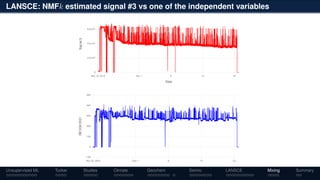
The document discusses the advantages of unsupervised machine learning (ML) in feature extraction compared to supervised ML, emphasizing its capability to uncover hidden features in data without prior categorization. It describes various applications of unsupervised ML, such as data analytics, model diagnostics, and physics-informed machine learning, leveraging tensor decomposition methods like nonnegative matrix and tensor factorization. Additionally, it outlines the limitations of supervised ML methods and the significance of using tensors for multi-dimensional data analysis.


![Tucker Tensor Factorization (3D case): Tucker-3
≈
X
[K, M, N]
G
[k, m, n]
H
[k, K]
W
[n, N]
V
[m, M]
X ≈ G ⊗ H ⊗ W ⊗ V
Unsupervised ML Tucker Studies Climate Geochem Seimic LANSCE Mixing Summary](https://image.slidesharecdn.com/vesselinov2019unsupervisedmachinelearningmethodsforfeatureextractionla-ur-19-21450-190305222741/85/Unsupervised-machine-learning-methods-for-feature-extraction-33-320.jpg)
![Tucker Tensor Decomposition: Feature extraction
≈
X
[K, M, N]
G
[k, m, n]
H
[k, K]
W
[n, N]
V
[m, M]
X ≈ G ⊗ H ⊗ W ⊗ V
Unsupervised ML Tucker Studies Climate Geochem Seimic LANSCE Mixing Summary](https://image.slidesharecdn.com/vesselinov2019unsupervisedmachinelearningmethodsforfeatureextractionla-ur-19-21450-190305222741/85/Unsupervised-machine-learning-methods-for-feature-extraction-34-320.jpg)

![Tucker Tensor Decomposition: Tucker-2 (three possible alternatives)
≈
X
[K, M, N]
G
[k, M, n]
H
[k, K]
W
[n, N]
X ≈ G ⊗ H ⊗ W
Unsupervised ML Tucker Studies Climate Geochem Seimic LANSCE Mixing Summary](https://image.slidesharecdn.com/vesselinov2019unsupervisedmachinelearningmethodsforfeatureextractionla-ur-19-21450-190305222741/85/Unsupervised-machine-learning-methods-for-feature-extraction-36-320.jpg)
![Tucker Tensor Decomposition: Tucker-1 (three possible alternatives)
≈
X
[K, M, N]
G
[k, M, N]
H
[k, K]
X ≈ G ⊗ H
Unsupervised ML Tucker Studies Climate Geochem Seimic LANSCE Mixing Summary](https://image.slidesharecdn.com/vesselinov2019unsupervisedmachinelearningmethodsforfeatureextractionla-ur-19-21450-190305222741/85/Unsupervised-machine-learning-methods-for-feature-extraction-37-320.jpg)
![Tucker Tensor Factorization (3D case): Tucker-3
≈
X
[K, M, N]
G
[k, m, n]
H
[k, K]
W
[n, N]
V
[m, M]
X ≈ G ⊗ H ⊗ W ⊗ V
Unsupervised ML Tucker Studies Climate Geochem Seimic LANSCE Mixing Summary](https://image.slidesharecdn.com/vesselinov2019unsupervisedmachinelearningmethodsforfeatureextractionla-ur-19-21450-190305222741/85/Unsupervised-machine-learning-methods-for-feature-extraction-38-320.jpg)
![Tucker Tensor Decomposition: Feature extraction
Tucker decomposition is achieved through minimization
Nonnegativity and sparsity constraints help the feature extraction
Optimal number of features [k, m, n] is estimated through k-means clustering of
a series minimization solutions with random initial guesses
≈
X
[K, M, N]
G
[k, m, n]
H
[k, K]
W
[n, N]
V
[m, M]
Unsupervised ML Tucker Studies Climate Geochem Seimic LANSCE Mixing Summary](https://image.slidesharecdn.com/vesselinov2019unsupervisedmachinelearningmethodsforfeatureextractionla-ur-19-21450-190305222741/85/Unsupervised-machine-learning-methods-for-feature-extraction-39-320.jpg)


![Climate model of Europe: air temperature
fluctuations in the air temperature [◦
C]
(424 × 412 × 365)
(columns × rows × days)
NTFk extracts spatial and temporal
footprints of dominant features:
storm signal
winter seasonal signal
summer seasonal signal
....
Data compression: ∼ 4GB → ∼ 0.5MB
Compression ratio: ∼ 8000
Unsupervised ML Tucker Studies Climate Geochem Seimic LANSCE Mixing Summary](https://image.slidesharecdn.com/vesselinov2019unsupervisedmachinelearningmethodsforfeatureextractionla-ur-19-21450-190305222741/85/Unsupervised-machine-learning-methods-for-feature-extraction-55-320.jpg)


![Climate model of Europe: water-table depth
fluctuations in the water-table depth [m]
(424 × 412 × 365)
(columns × rows × days)
NTFk extracts spatial and temporal
footprints of dominant signals
spring snowmelt signal
summer rainfall signal
seasonal signal
....
Unsupervised ML Tucker Studies Climate Geochem Seimic LANSCE Mixing Summary](https://image.slidesharecdn.com/vesselinov2019unsupervisedmachinelearningmethodsforfeatureextractionla-ur-19-21450-190305222741/85/Unsupervised-machine-learning-methods-for-feature-extraction-58-320.jpg)