Unlocking Financial Statements Online Seminar Day 5 July 23, 2010
Beyond the Basics Understanding Financial Statements
Income Statement Sales or revenues Cost of goods sold Gross profit Sales, general and administrative Operating profit Other income/expenses Interest Income taxes Net income or profit Understanding Financial Statements
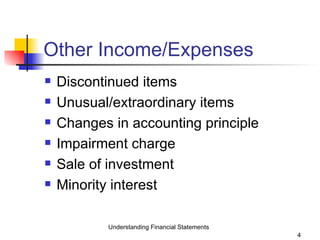
Other Income/Expenses Discontinued items Unusual/extraordinary items Changes in accounting principle Impairment charge Sale of investment Minority interest Understanding Financial Statements
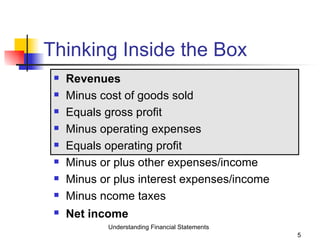
Thinking Inside the Box Revenues Minus cost of goods sold Equals gross profit Minus operating expenses  Equals operating profit Minus or plus other expenses/income Minus or plus interest expenses/income Minus ncome taxes  Net income   Understanding Financial Statements
Earnings Per Share Basic earnings per share (Bloomberg) Diluted earnings per share (Wall Street Journal, fully diluted) Understanding Financial Statements
Balance Sheet It balances Assets = Liabilities + Shareholders’ Equity Understanding Financial Statements
Cash Flows From operations From investing From financing  Understanding Financial Statements
Free Cash Flow  Several ways to calculate it Companies create their own models Gross way to do it: Cash from operating activities Minus capital expenditures Equals free cash flow Understanding Financial Statements
A Basic Look at the Numbers Look at changes in amounts year to year, especially revenues and expenses Look at numbers that are significantly larger or smaller than the previous period Look at the trend line for sales/revenues, operating income and net income. Calculate percentage change for each.  Look at the trend for cash flow Look at the trend for free cash flow Tie the numbers to the footnotes Understanding Financial Statements
The Next Step Calculate percentage change year-to-year or over several years … Especially for large numbers that are significantly larger or smaller than the previous period … Especially for sales/revenues, operating income, net income, cash and free cash.  Understanding Financial Statements
Identify trends Identify what causes changes in totals on financial statements Easier to compare percentages than raw numbers Easier to compare companies Easier to compare companies with industry averages Common Size Understanding Financial Statements
Common Size Analysis For Income Statement, divide all entries by revenue For Cash Flows, divide all entries by the total increase or decrease of cash inflows for the year (add cash from operating, investing and financing) Understanding Financial Statements
Comparable Statements Often have to restructure Income Statement to the in-the-box format we discussed Typical problems come from items we would consider Other Income/Expenses Understanding Financial Statements
Trends in Margins How have Cost of Goods Sold and Sales, General and Administrative changed? What does that mean for Gross Margins and Operating Margins? Value of using Basis Points Understanding Financial Statements
Ratio Analysis Takes your analysis to yet another level Finance types especially fond of ratios Understanding Financial Statements
Common Size, Ratios These techniques let you drill below the surface and start developing a more complete picture of the company’s performance Strengths Weaknesses  Strategic effectiveness Understanding Financial Statements

Unlocking Financial Statements - Day 5

  • 1.
    Unlocking Financial StatementsOnline Seminar Day 5 July 23, 2010
  • 2.
    Beyond the BasicsUnderstanding Financial Statements
  • 3.
    Income Statement Salesor revenues Cost of goods sold Gross profit Sales, general and administrative Operating profit Other income/expenses Interest Income taxes Net income or profit Understanding Financial Statements
  • 4.
    Other Income/Expenses Discontinueditems Unusual/extraordinary items Changes in accounting principle Impairment charge Sale of investment Minority interest Understanding Financial Statements
  • 5.
    Thinking Inside theBox Revenues Minus cost of goods sold Equals gross profit Minus operating expenses Equals operating profit Minus or plus other expenses/income Minus or plus interest expenses/income Minus ncome taxes Net income Understanding Financial Statements
  • 6.
    Earnings Per ShareBasic earnings per share (Bloomberg) Diluted earnings per share (Wall Street Journal, fully diluted) Understanding Financial Statements
  • 7.
    Balance Sheet Itbalances Assets = Liabilities + Shareholders’ Equity Understanding Financial Statements
  • 8.
    Cash Flows Fromoperations From investing From financing Understanding Financial Statements
  • 9.
    Free Cash Flow Several ways to calculate it Companies create their own models Gross way to do it: Cash from operating activities Minus capital expenditures Equals free cash flow Understanding Financial Statements
  • 10.
    A Basic Lookat the Numbers Look at changes in amounts year to year, especially revenues and expenses Look at numbers that are significantly larger or smaller than the previous period Look at the trend line for sales/revenues, operating income and net income. Calculate percentage change for each. Look at the trend for cash flow Look at the trend for free cash flow Tie the numbers to the footnotes Understanding Financial Statements
  • 11.
    The Next StepCalculate percentage change year-to-year or over several years … Especially for large numbers that are significantly larger or smaller than the previous period … Especially for sales/revenues, operating income, net income, cash and free cash. Understanding Financial Statements
  • 12.
    Identify trends Identifywhat causes changes in totals on financial statements Easier to compare percentages than raw numbers Easier to compare companies Easier to compare companies with industry averages Common Size Understanding Financial Statements
  • 13.
    Common Size AnalysisFor Income Statement, divide all entries by revenue For Cash Flows, divide all entries by the total increase or decrease of cash inflows for the year (add cash from operating, investing and financing) Understanding Financial Statements
  • 14.
    Comparable Statements Oftenhave to restructure Income Statement to the in-the-box format we discussed Typical problems come from items we would consider Other Income/Expenses Understanding Financial Statements
  • 15.
    Trends in MarginsHow have Cost of Goods Sold and Sales, General and Administrative changed? What does that mean for Gross Margins and Operating Margins? Value of using Basis Points Understanding Financial Statements
  • 16.
    Ratio Analysis Takesyour analysis to yet another level Finance types especially fond of ratios Understanding Financial Statements
  • 17.
    Common Size, RatiosThese techniques let you drill below the surface and start developing a more complete picture of the company’s performance Strengths Weaknesses Strategic effectiveness Understanding Financial Statements