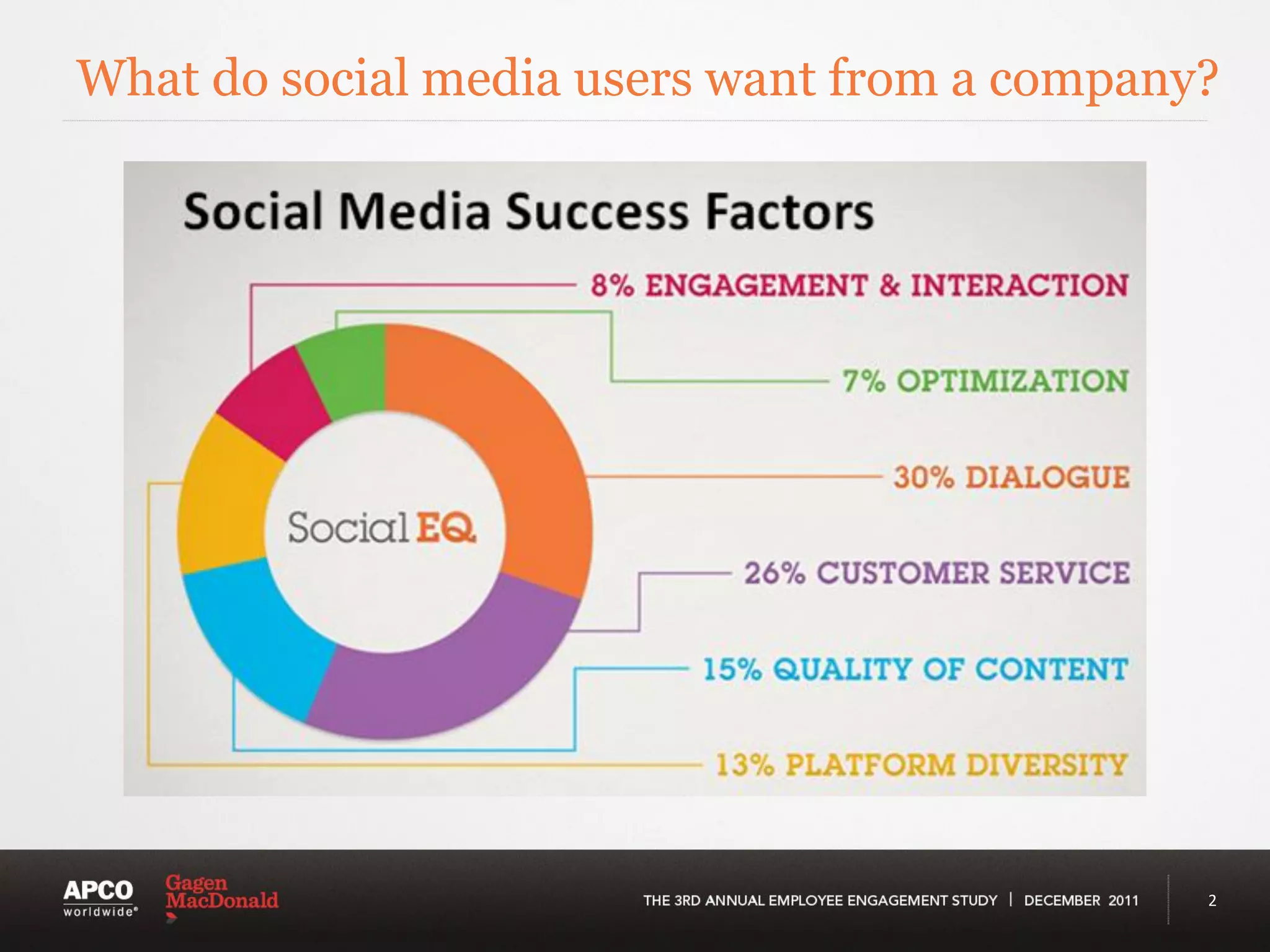
What do social media users want from a company?


                                              2
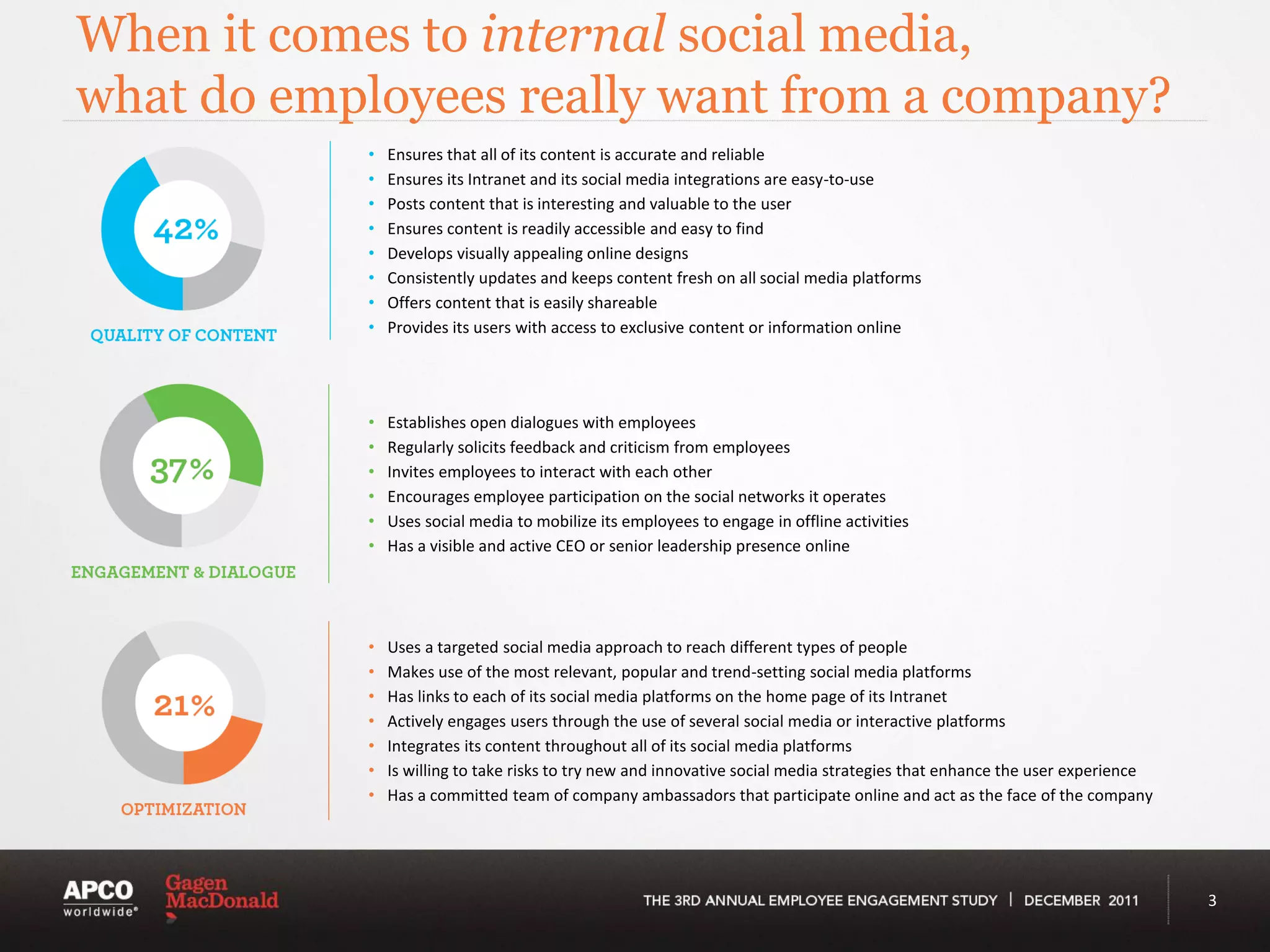
When it comes to internal social media,
what do employees really want from a company?
           •   Ensures that all of its content is accurate and reliable
           •   Ensures its Intranet and its social media integrations are easy-to-use
           •   Posts content that is interesting and valuable to the user
           •   Ensures content is readily accessible and easy to find
           •   Develops visually appealing online designs
           •   Consistently updates and keeps content fresh on all social media platforms
           •   Offers content that is easily shareable
           •   Provides its users with access to exclusive content or information online


           •   Establishes open dialogues with employees
           •   Regularly solicits feedback and criticism from employees
           •   Invites employees to interact with each other
           •   Encourages employee participation on the social networks it operates
           •   Uses social media to mobilize its employees to engage in offline activities
           •   Has a visible and active CEO or senior leadership presence online


           •   Uses a targeted social media approach to reach different types of people
           •   Makes use of the most relevant, popular and trend-setting social media platforms
           •   Has links to each of its social media platforms on the home page of its Intranet
           •   Actively engages users through the use of several social media or interactive platforms
           •   Integrates its content throughout all of its social media platforms
           •   Is willing to take risks to try new and innovative social media strategies that enhance the user experience
           •   Has a committed team of company ambassadors that participate online and act as the face of the company


                                                                                                                             3
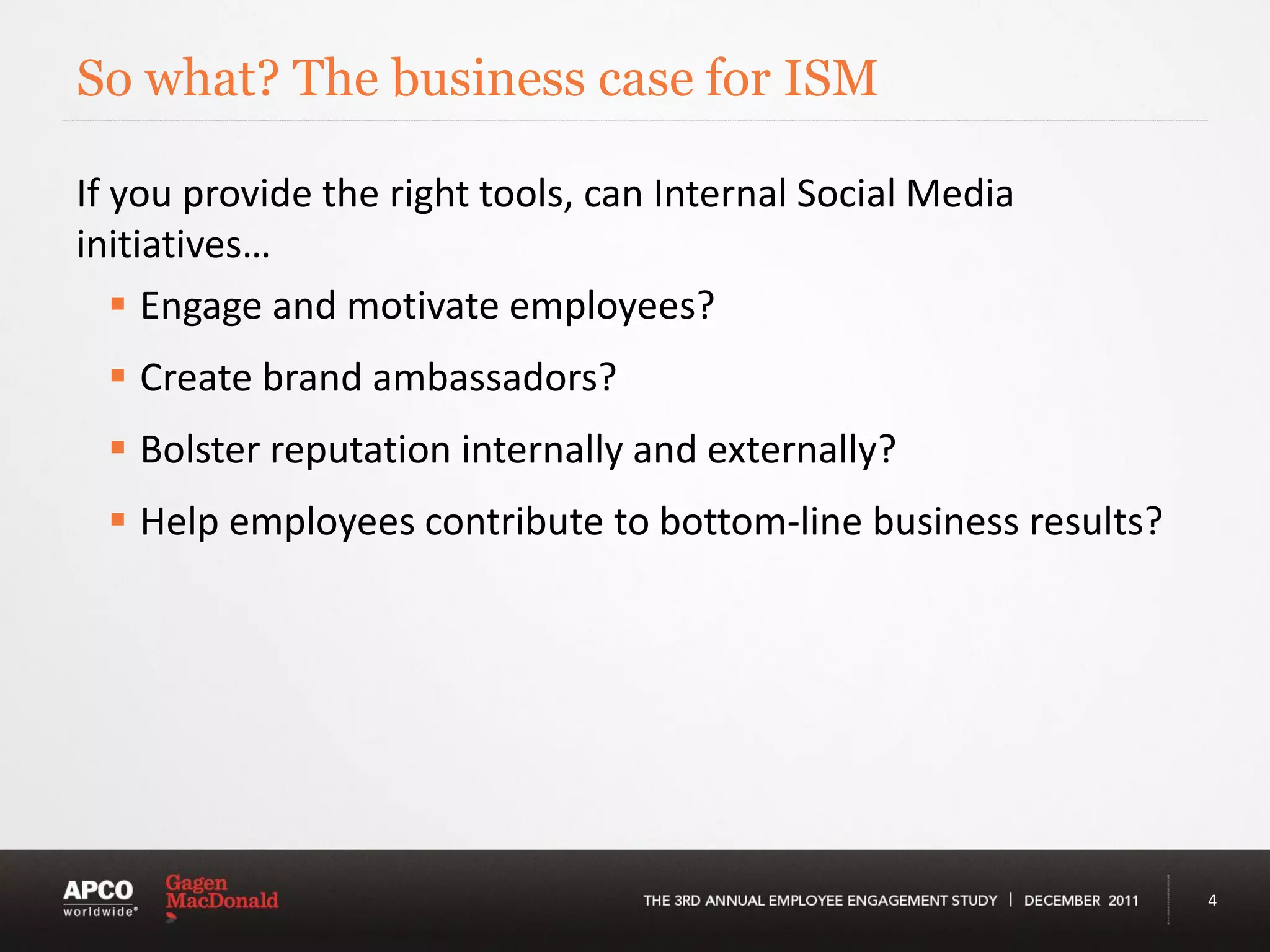
So what? The business case for ISM

If you provide the right tools, can Internal Social Media
initiatives…
    Engage and motivate employees?
  Create brand ambassadors?
  Bolster reputation internally and externally?
  Help employees contribute to bottom-line business results?


                                                                4
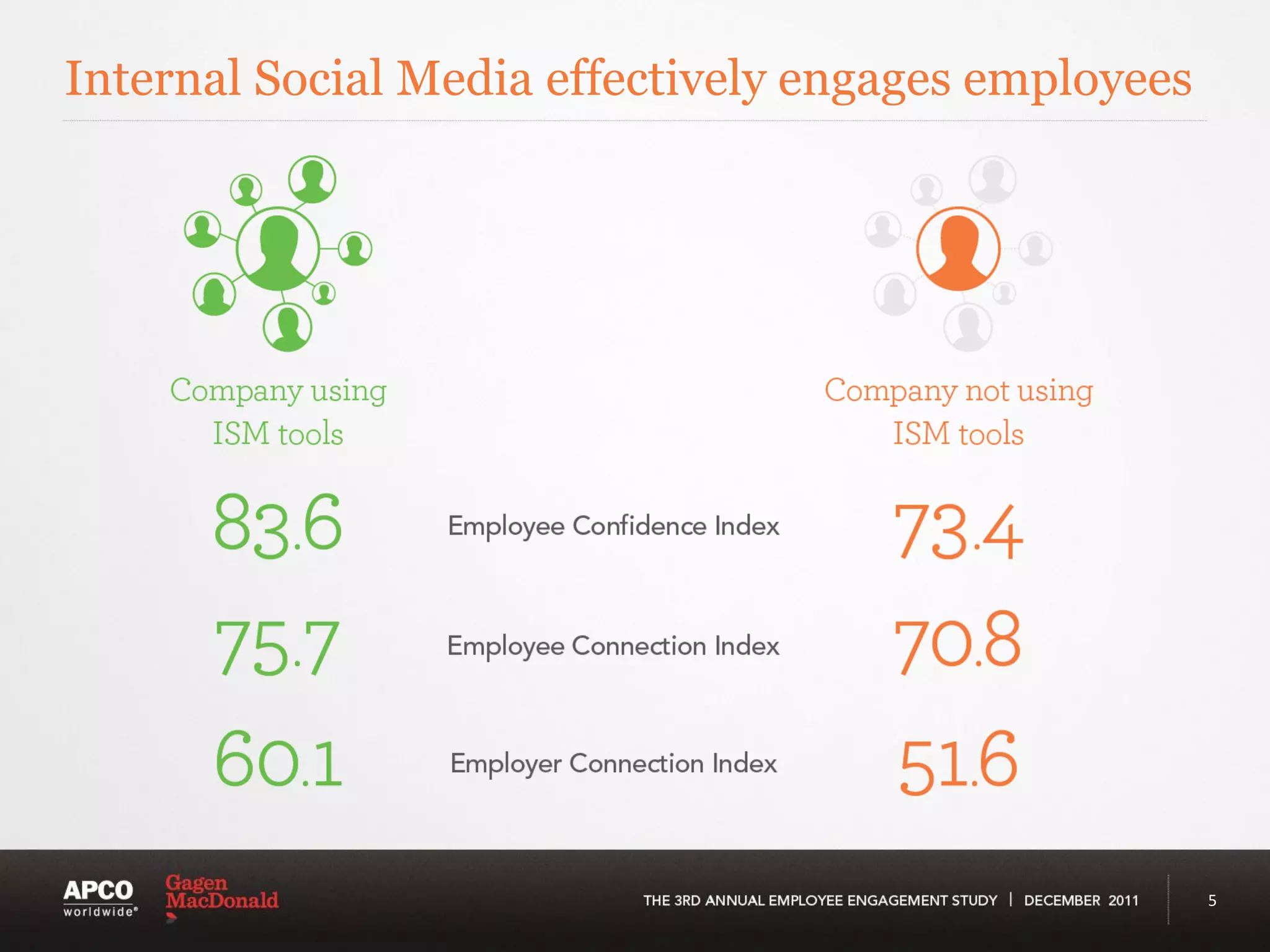
Internal Social Media effectively engages employees


                                                      5
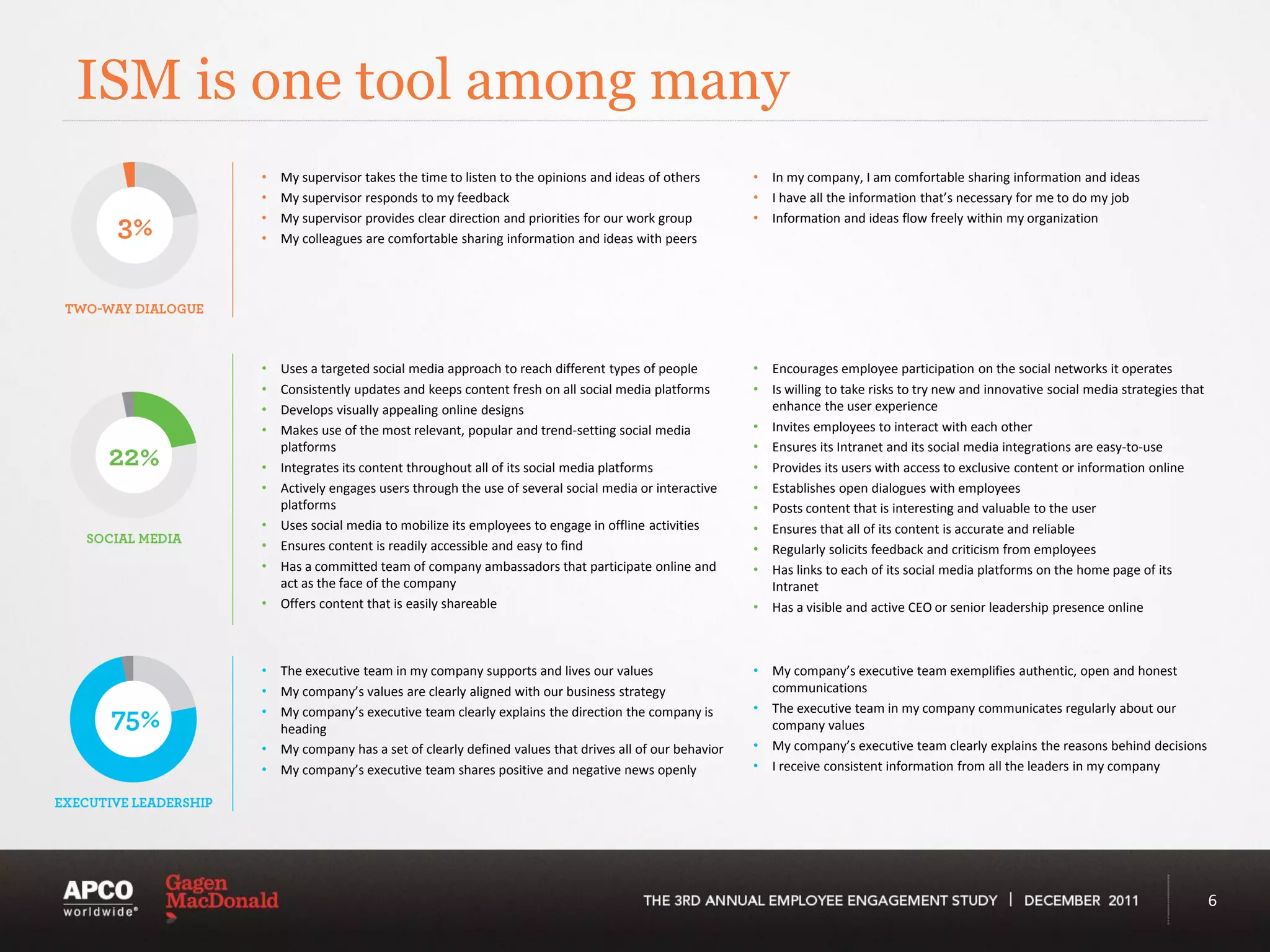
ISM is one tool among many
      •   My supervisor takes the time to listen to the opinions and ideas of others      • In my company, I am comfortable sharing information and ideas
      •   My supervisor responds to my feedback                                           • I have all the information that’s necessary for me to do my job
      •   My supervisor provides clear direction and priorities for our work group        • Information and ideas flow freely within my organization
      •   My colleagues are comfortable sharing information and ideas with peers


      •   Uses a targeted social media approach to reach different types of people        • Encourages employee participation on the social networks it operates
      •   Consistently updates and keeps content fresh on all social media platforms      • Is willing to take risks to try new and innovative social media strategies that
      •   Develops visually appealing online designs                                        enhance the user experience
      •   Makes use of the most relevant, popular and trend-setting social media          • Invites employees to interact with each other
          platforms                                                                       • Ensures its Intranet and its social media integrations are easy-to-use
      •   Integrates its content throughout all of its social media platforms             • Provides its users with access to exclusive content or information online
      •   Actively engages users through the use of several social media or interactive   • Establishes open dialogues with employees
          platforms                                                                       • Posts content that is interesting and valuable to the user
      •   Uses social media to mobilize its employees to engage in offline activities     • Ensures that all of its content is accurate and reliable
      •   Ensures content is readily accessible and easy to find                          • Regularly solicits feedback and criticism from employees
      •   Has a committed team of company ambassadors that participate online and         • Has links to each of its social media platforms on the home page of its
          act as the face of the company                                                    Intranet
      •   Offers content that is easily shareable                                         • Has a visible and active CEO or senior leadership presence online


      • The executive team in my company supports and lives our values                    • My company’s executive team exemplifies authentic, open and honest
      • My company’s values are clearly aligned with our business strategy                  communications
      • My company’s executive team clearly explains the direction the company is         • The executive team in my company communicates regularly about our
        heading                                                                             company values
      • My company has a set of clearly defined values that drives all of our behavior    • My company’s executive team clearly explains the reasons behind decisions
      • My company’s executive team shares positive and negative news openly              • I receive consistent information from all the leaders in my company


                                                                                                                                                                              6
The investigation
       APCO Worldwide and Gagen MacDonald jointly
   sponsored an online survey among U.S. adults who have
         been employed full-time at least one year
         at a company with at least 500 employees.

  The purpose of the study is to determine the state of the
     U.S. workplace as viewed by America’s workforce.

   This year’s study explored employment-related issues
  and how companies communicate with their employees,
    with a particular focus on the use and prevalence of
                  internal social media (ISM)
                       in the workplace.


                                                              7
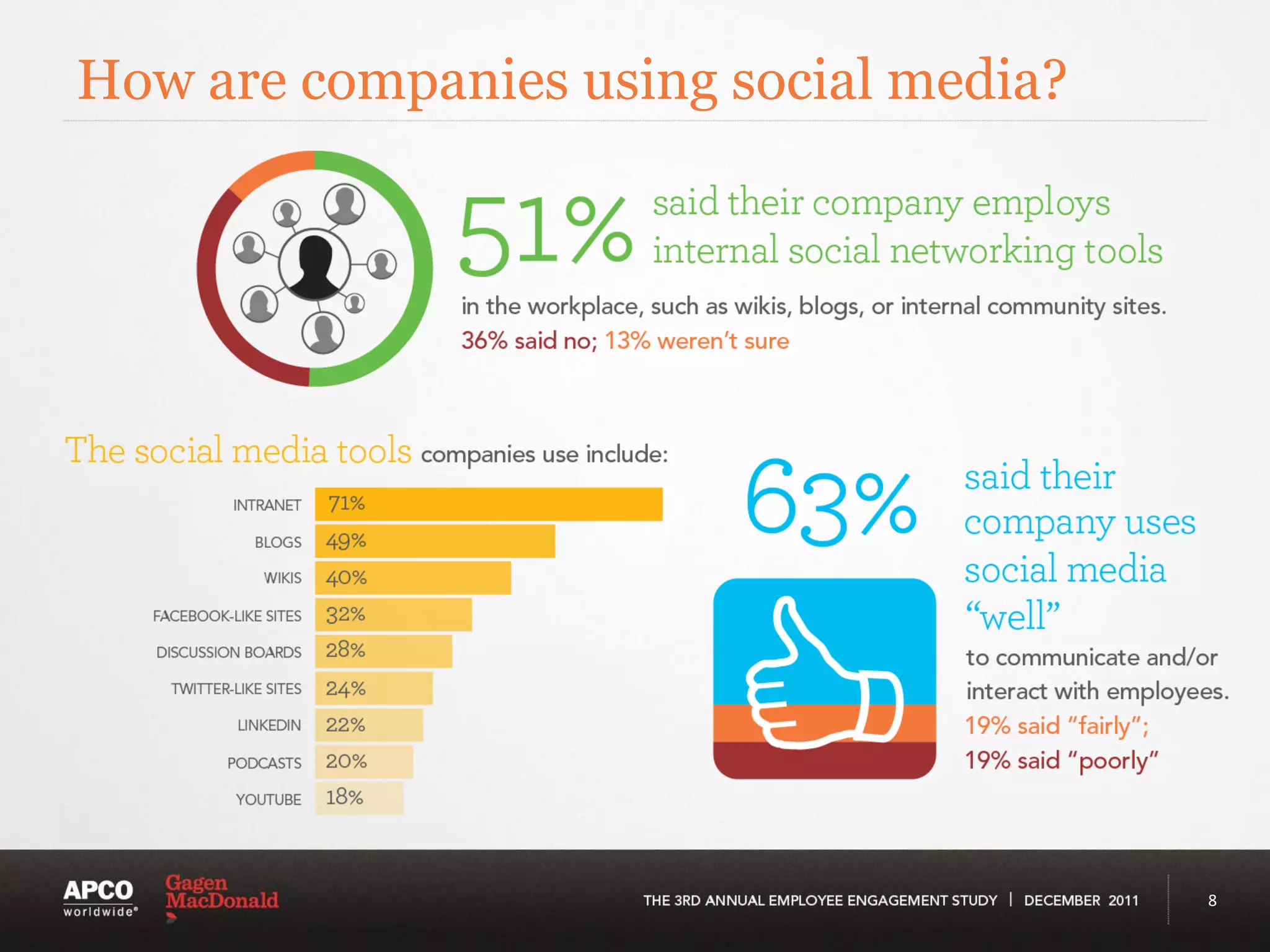
How are companies using social media?


                                        8
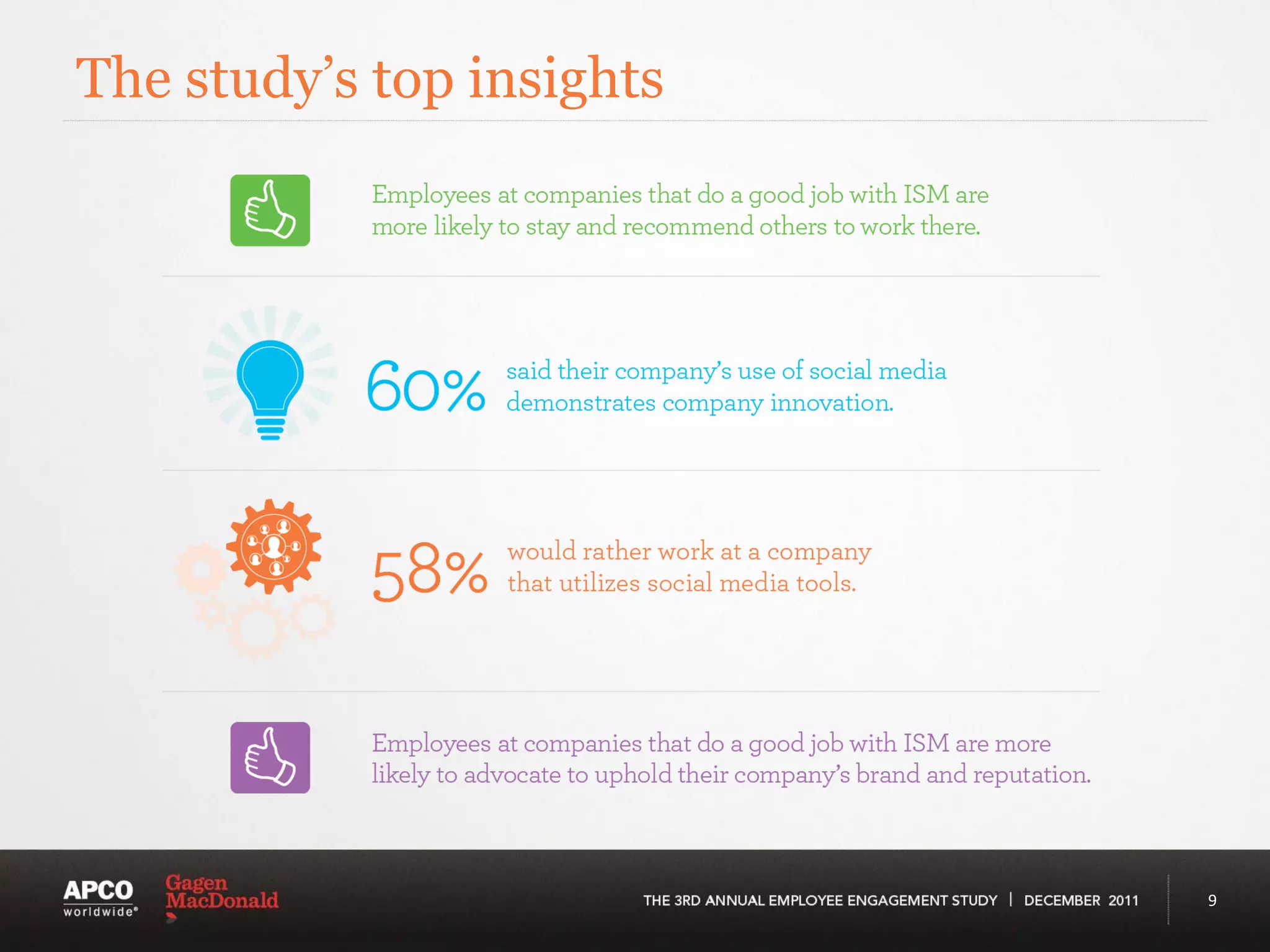
The study’s top insights


                           9
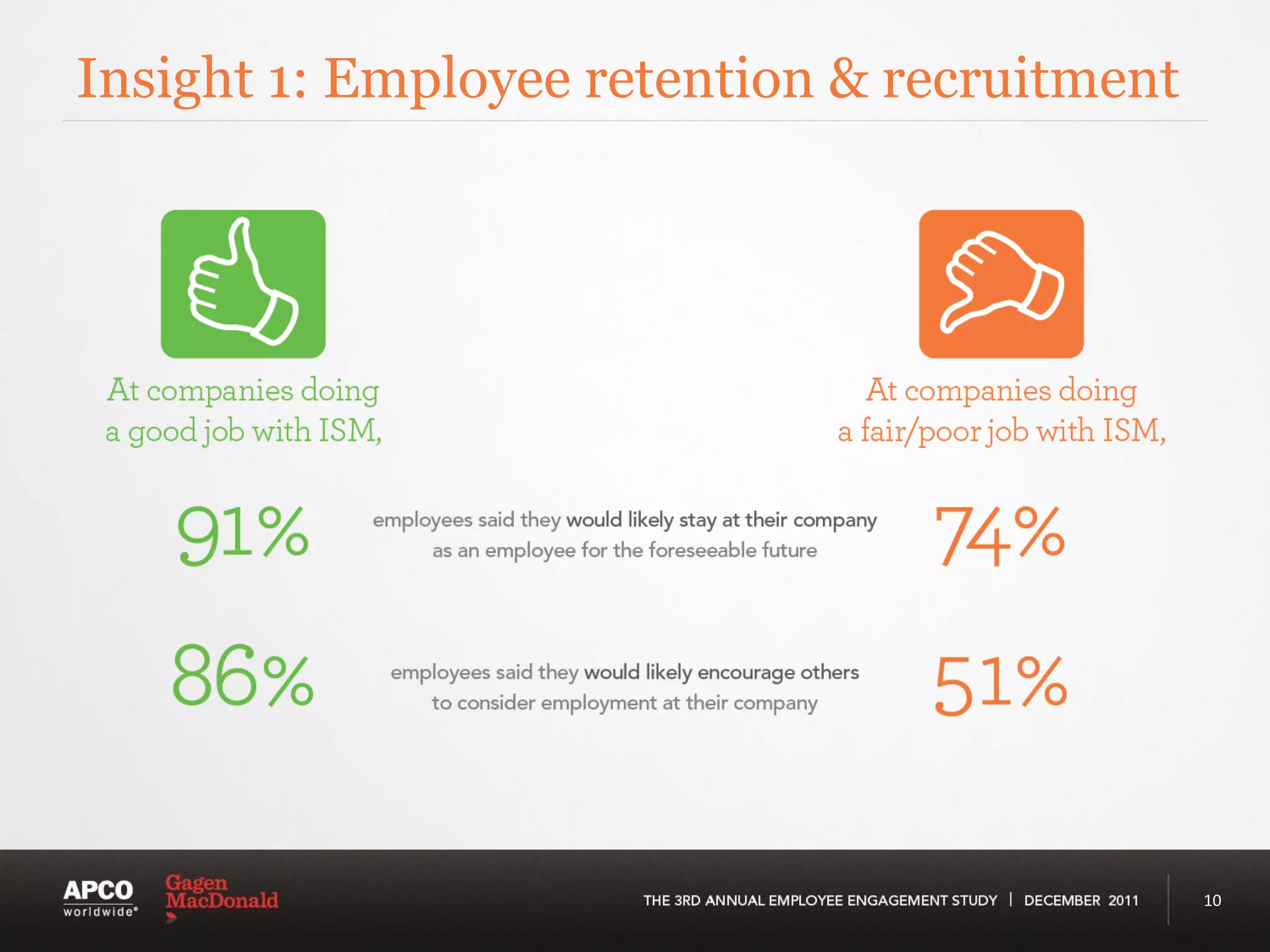
Insight 1: Employee retention & recruitment


                                              10
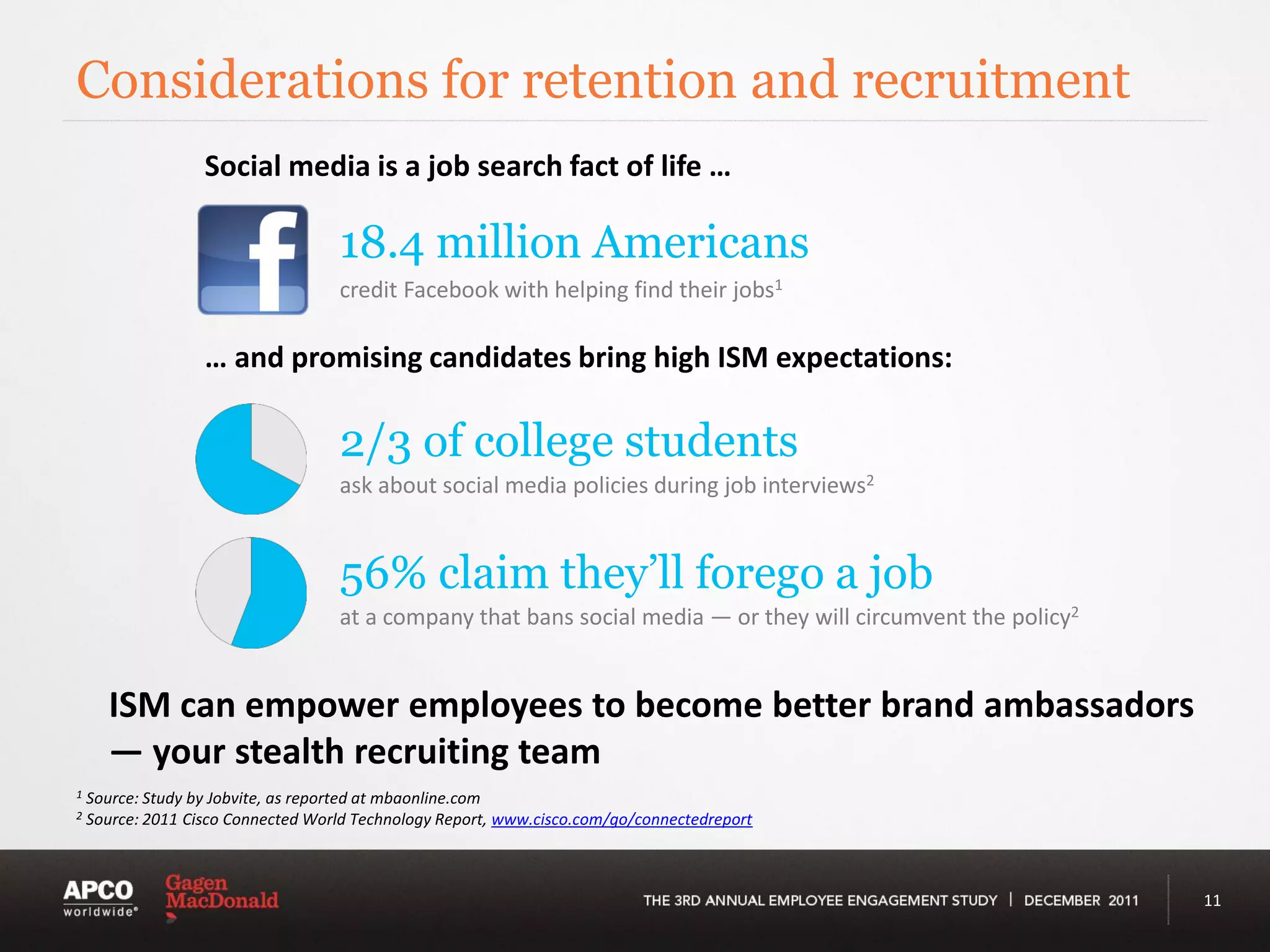
Considerations for retention and recruitment
                   Social media is a job search fact of life …

                                    18.4 million Americans
                                    credit Facebook with helping find their jobs1

                   … and promising candidates bring high ISM expectations:

                                    2/3 of college students
                                    ask about social media policies during job interviews2


                                    56% claim they’ll forego a job
                                    at a company that bans social media — or they will circumvent the policy2


      ISM can empower employees to become better brand ambassadors
      — your stealth recruiting team
1   Source: Study by Jobvite, as reported at mbaonline.com
2   Source: 2011 Cisco Connected World Technology Report, www.cisco.com/go/connectedreport


                                                                                                                11
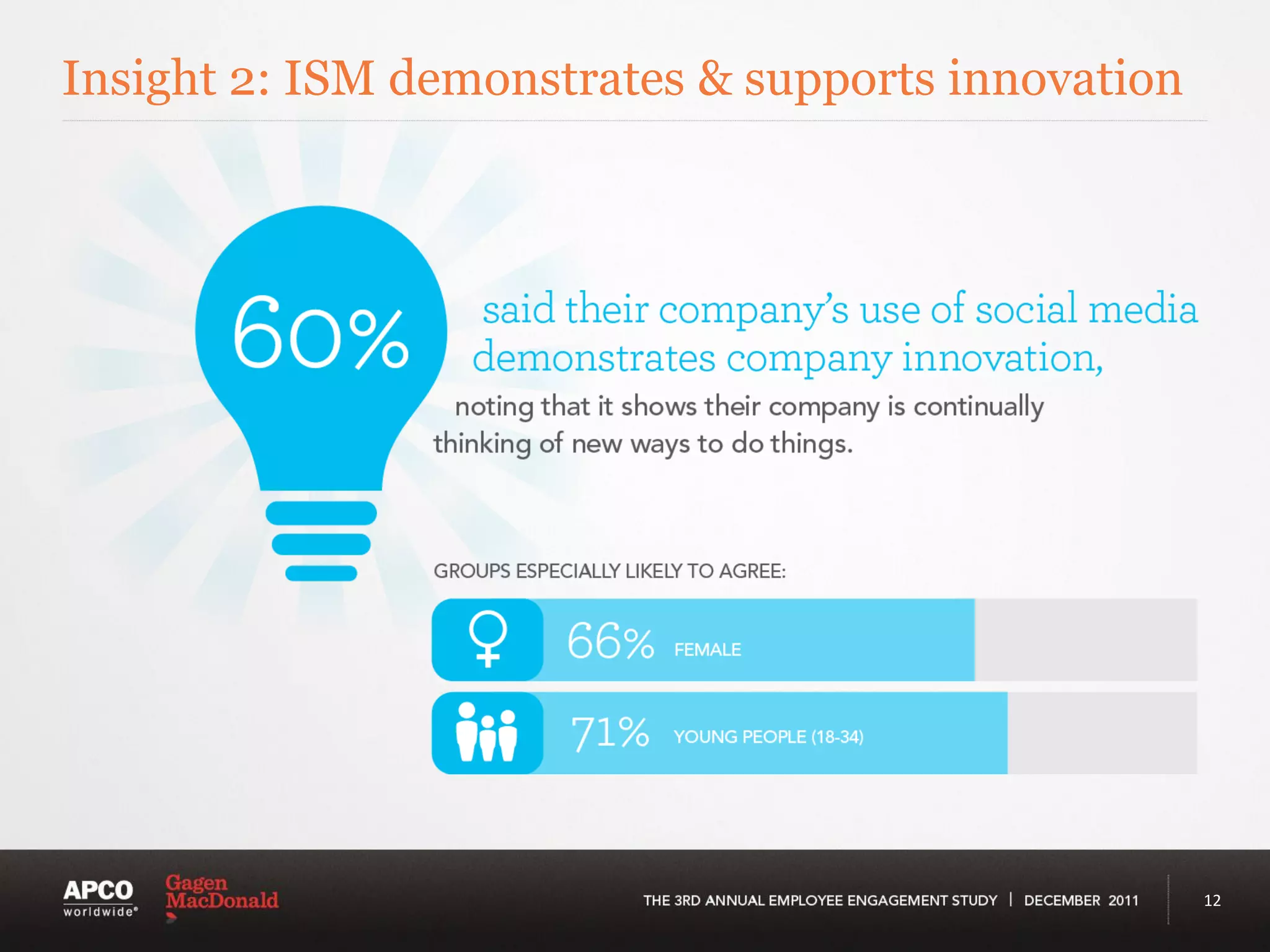
Insight 2: ISM demonstrates & supports innovation


                                                    12
Considerations for innovation


• ISM can help drive new discoveries, but alone is not
  a panacea for innovation
• Tailor innovation tools to your innovators – the way employees
  engage ISM depends on industry, function and demographics


                                                                   13
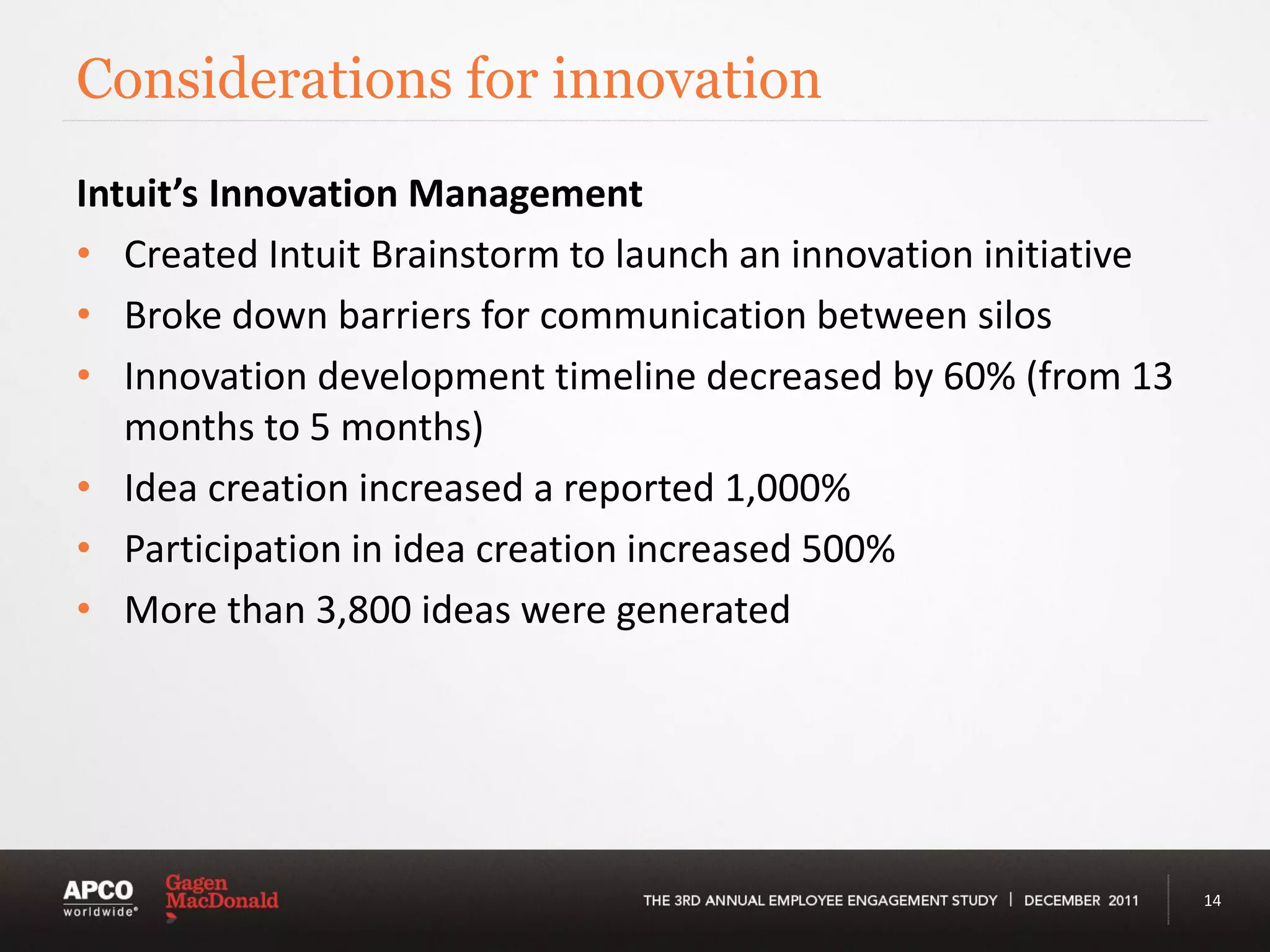
Considerations for innovation
Intuit’s Innovation Management
• Created Intuit Brainstorm to launch an innovation initiative
• Broke down barriers for communication between silos
• Innovation development timeline decreased by 60% (from 13
   months to 5 months)
• Idea creation increased a reported 1,000%
• Participation in idea creation increased 500%
• More than 3,800 ideas were generated


                                                                 14
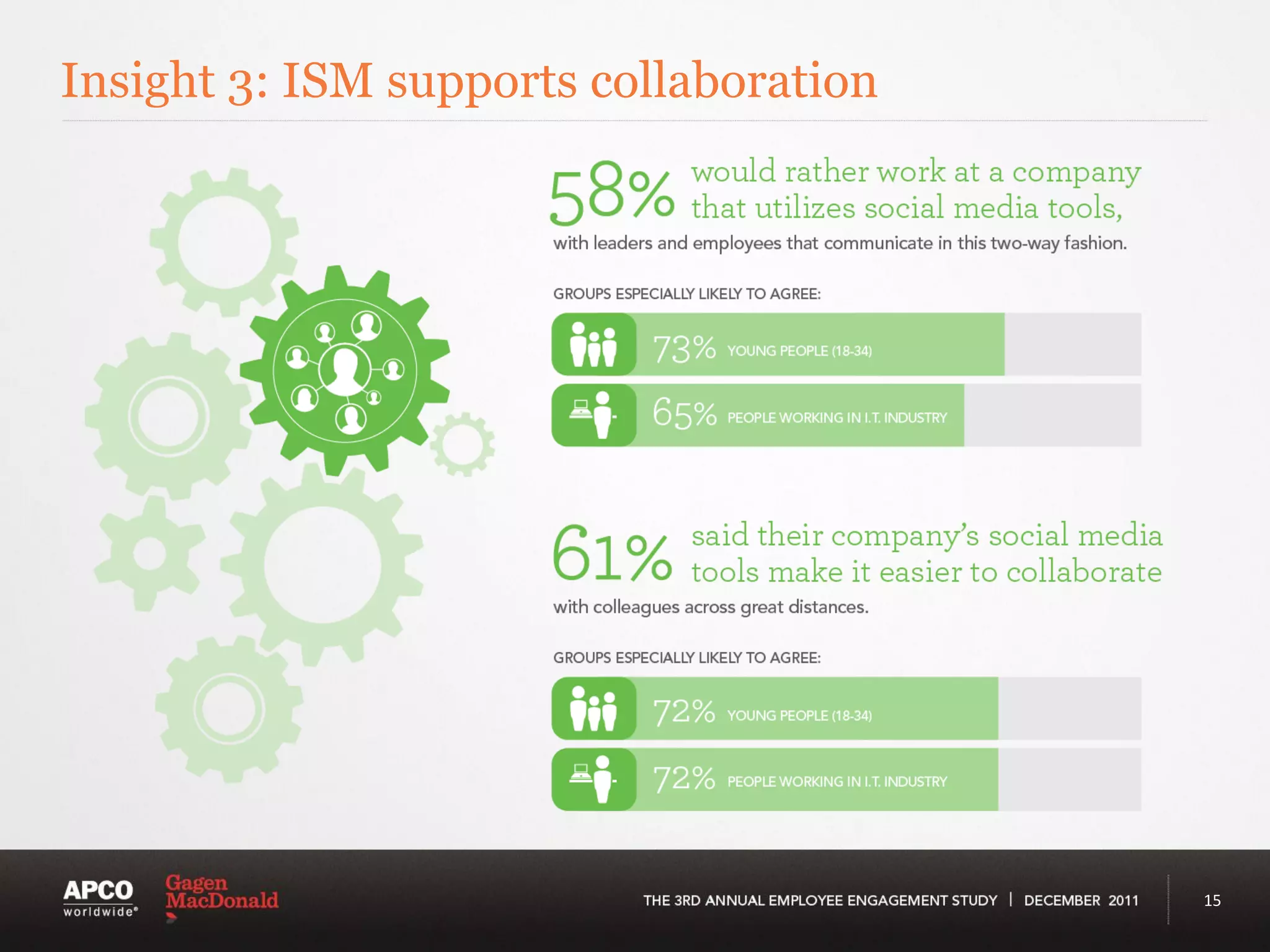
Insight 3: ISM supports collaboration


                                        15
Considerations for collaboration


To foster collaboration, you need to balance fears with
potential opportunities
• The enterprise cost of not finding information is extremely high

• Fostering a culture of reciprocal trust is essential


                                                                     16
Considerations for collaboration


Wells Fargo taps into the “Wisdom of Crowds”
• Only pilots ISM tools after business lines identify a specific need
• ISM tools have helped break down hierarchical, organizational and
  geographic boundaries
• Employees report ISM tools eliminate duplicate efforts and make meetings
  shorter — and the company feel smaller


                                                                             17
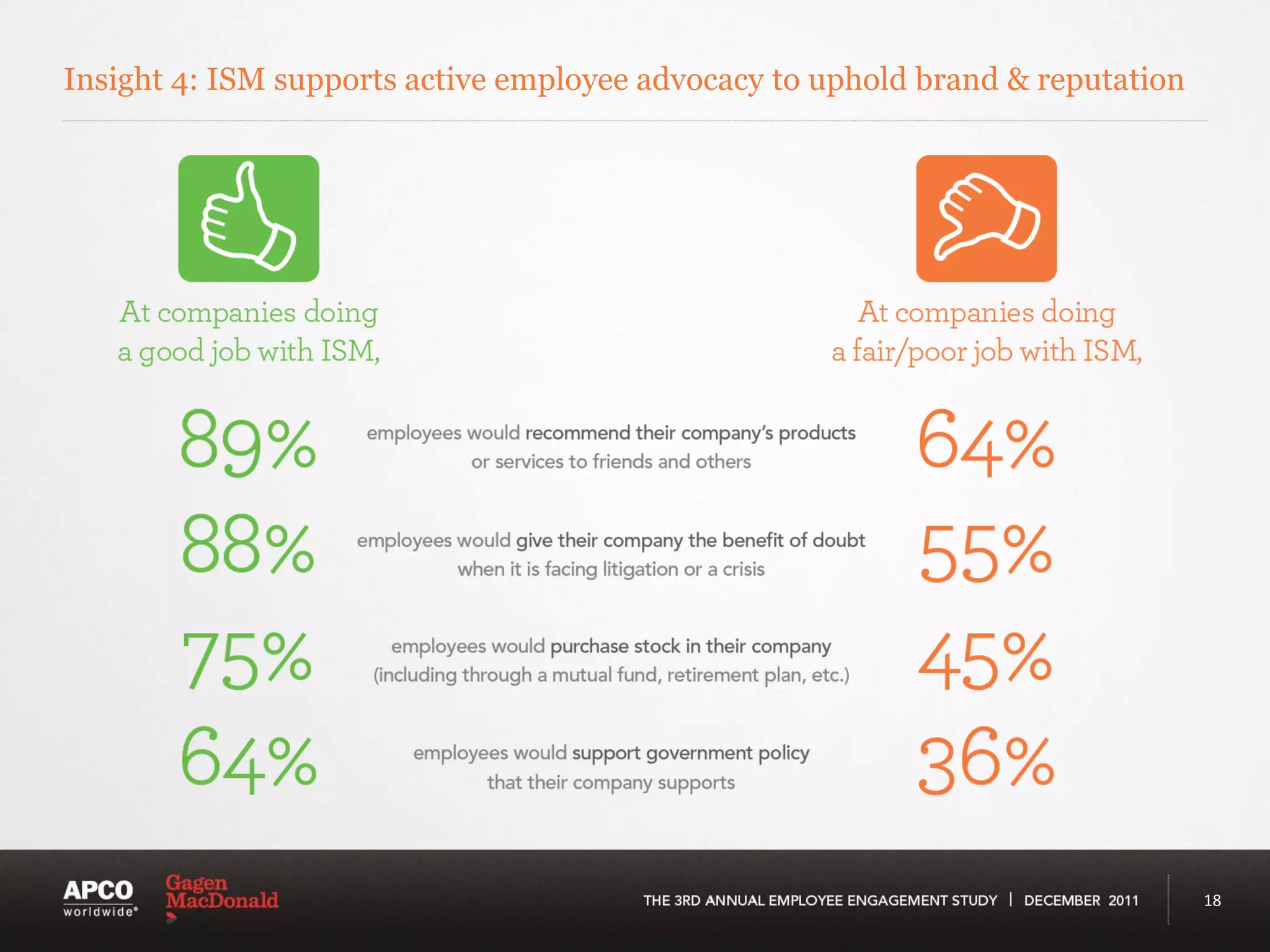
Insight 4: ISM supports active employee advocacy to uphold brand & reputation


                                                                                18
Considerations for employee advocacy
Just like other employee engagement channels, ISM must
support employee buy-in and effective communication flow
• Leaders need to know the role of ISM in company advocacy —
  and how to use it
• ISM should reinforce dialogue up, down, and across the
  company
• Employees should consider ISM an open and honest arena
• Employees should consider themselves ISM co-creators
ISM strategy and Social EQ: social media cascades from internal
to external channels


                                                                  19
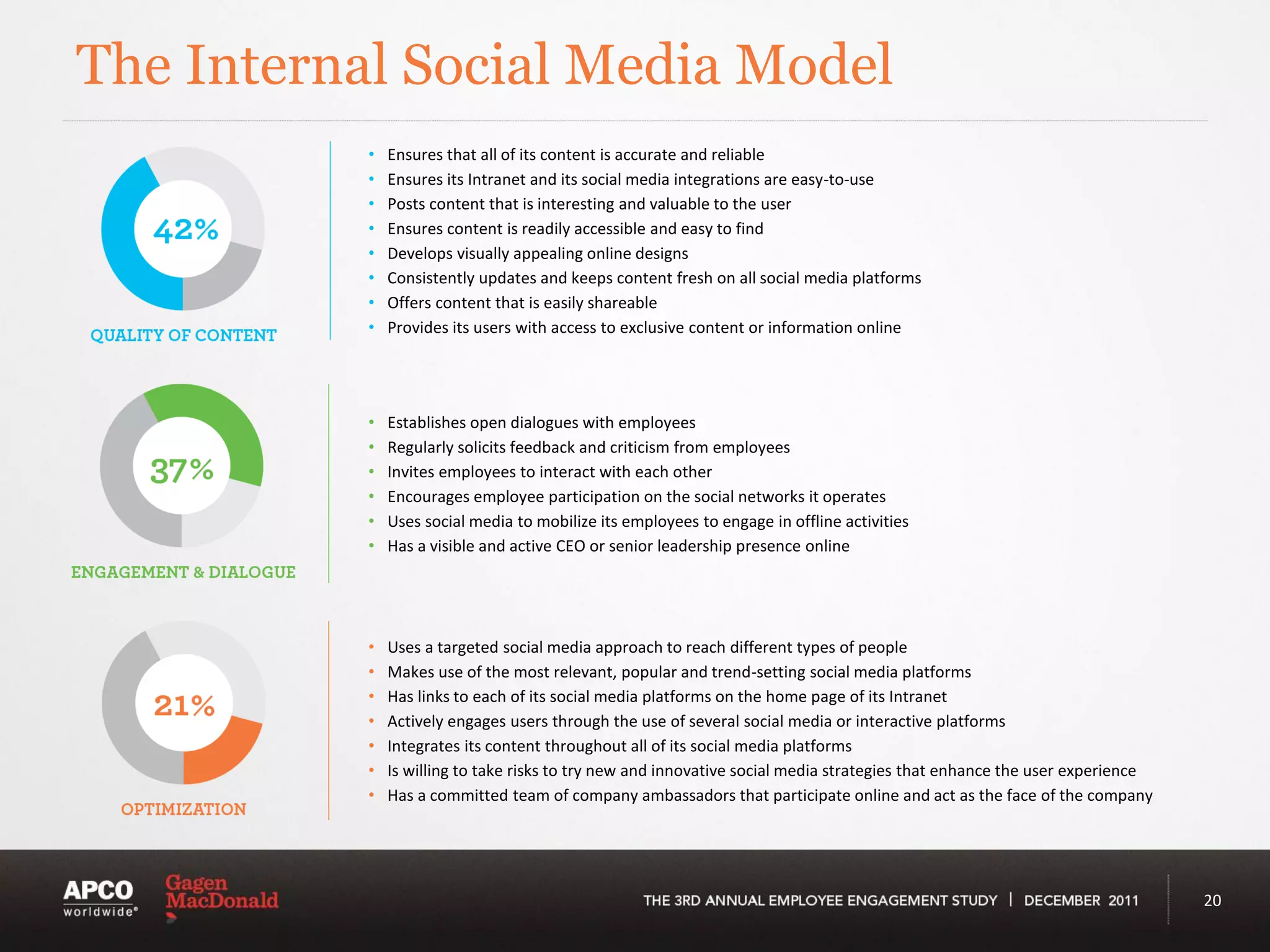
The Internal Social Media Model
           •   Ensures that all of its content is accurate and reliable
           •   Ensures its Intranet and its social media integrations are easy-to-use
           •   Posts content that is interesting and valuable to the user
           •   Ensures content is readily accessible and easy to find
           •   Develops visually appealing online designs
           •   Consistently updates and keeps content fresh on all social media platforms
           •   Offers content that is easily shareable
           •   Provides its users with access to exclusive content or information online


           •   Establishes open dialogues with employees
           •   Regularly solicits feedback and criticism from employees
           •   Invites employees to interact with each other
           •   Encourages employee participation on the social networks it operates
           •   Uses social media to mobilize its employees to engage in offline activities
           •   Has a visible and active CEO or senior leadership presence online


           •   Uses a targeted social media approach to reach different types of people
           •   Makes use of the most relevant, popular and trend-setting social media platforms
           •   Has links to each of its social media platforms on the home page of its Intranet
           •   Actively engages users through the use of several social media or interactive platforms
           •   Integrates its content throughout all of its social media platforms
           •   Is willing to take risks to try new and innovative social media strategies that enhance the user experience
           •   Has a committed team of company ambassadors that participate online and act as the face of the company


                                                                                                                             20
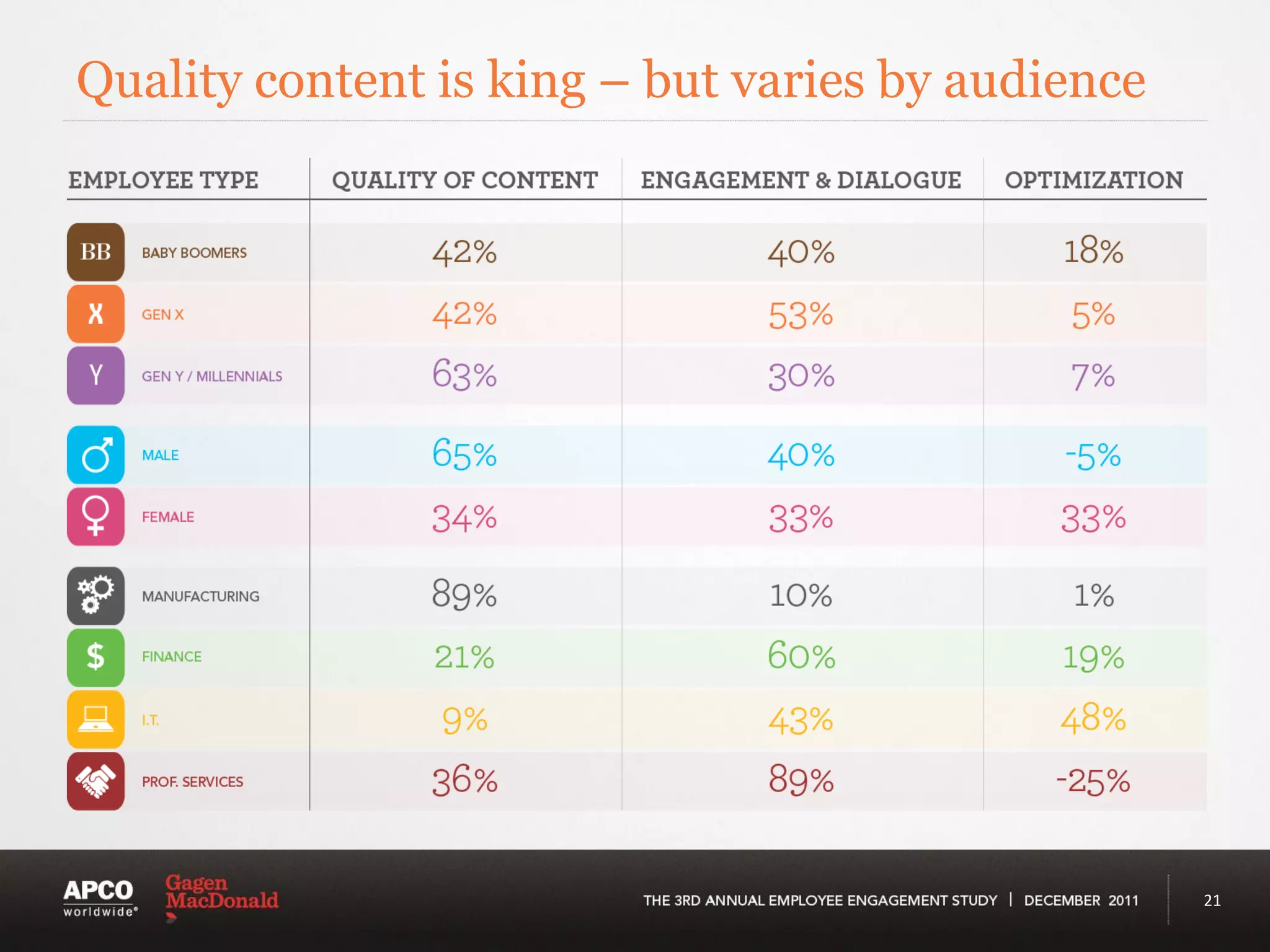
Quality content is king – but varies by audience


                                                   21
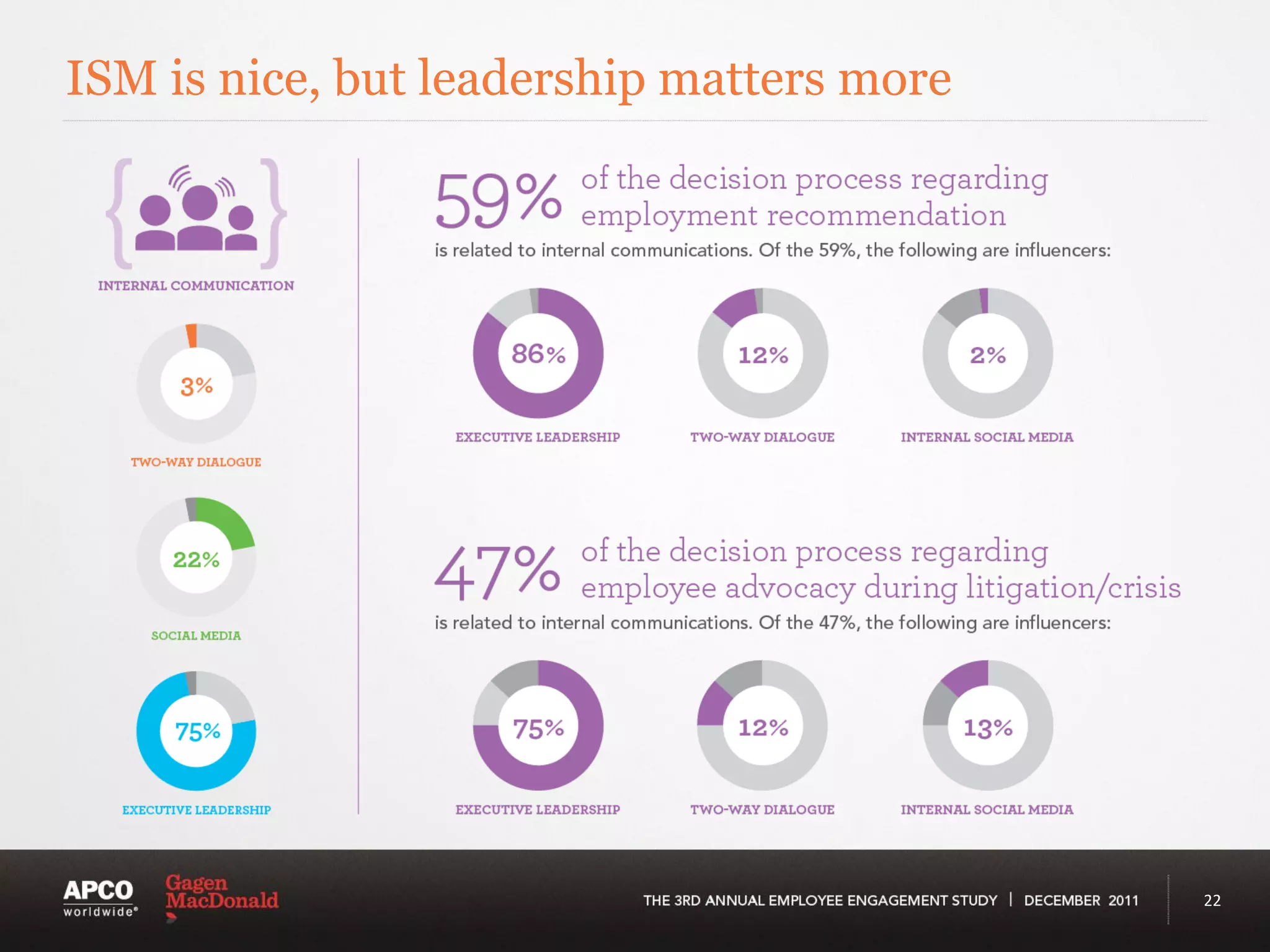
ISM is nice, but leadership matters more


                                           22
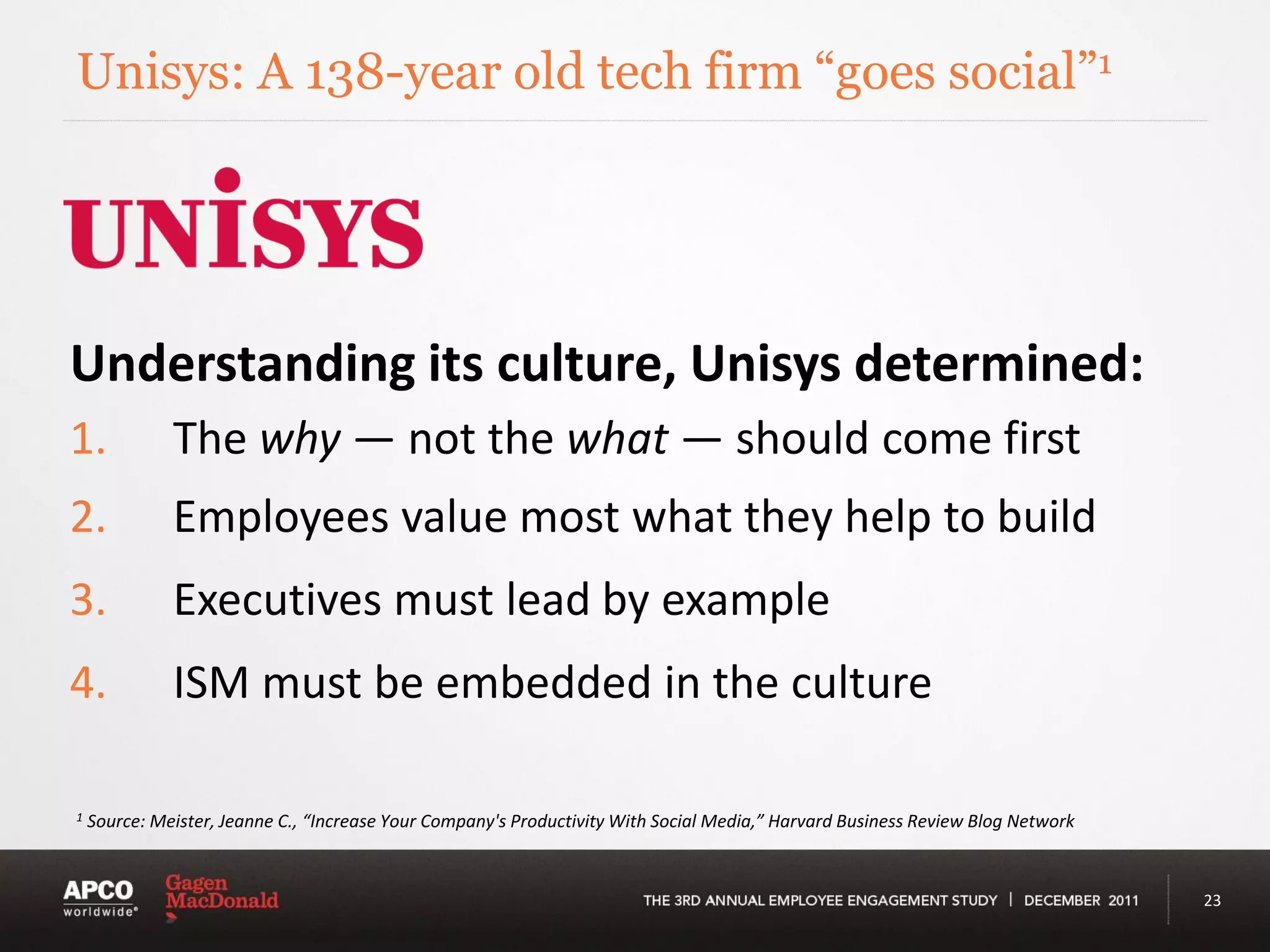
Unisys: A 138-year old tech firm “goes social”1


Understanding its culture, Unisys determined:
1.            The why — not the what — should come first
2.            Employees value most what they help to build
3.            Executives must lead by example
4.            ISM must be embedded in the culture

1   Source: Meister, Jeanne C., “Increase Your Company's Productivity With Social Media,” Harvard Business Review Blog Network


                                                                                                                                 23
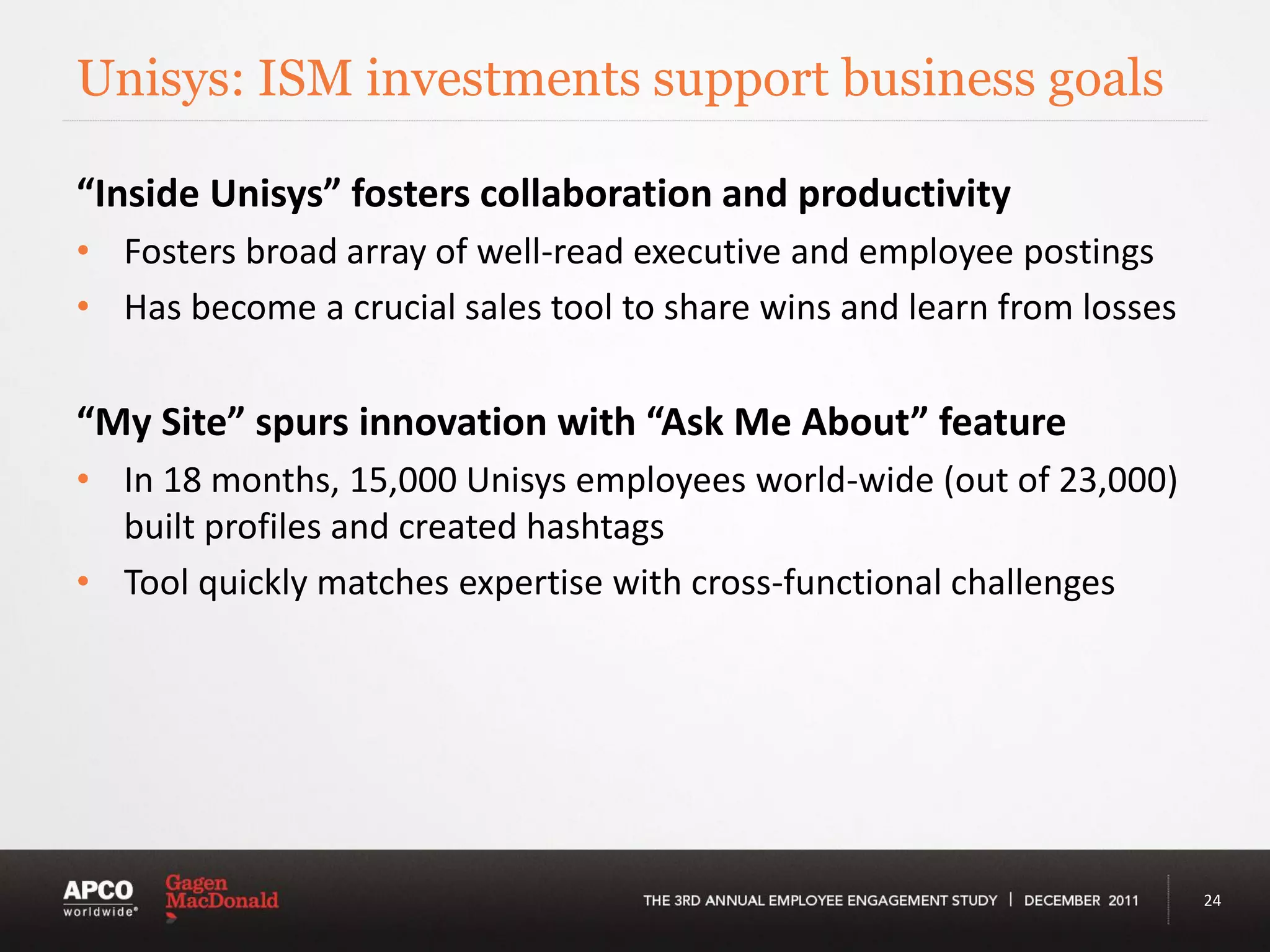
Unisys: ISM investments support business goals

“Inside Unisys” fosters collaboration and productivity
• Fosters broad array of well-read executive and employee postings
• Has become a crucial sales tool to share wins and learn from losses

“My Site” spurs innovation with “Ask Me About” feature
• In 18 months, 15,000 Unisys employees world-wide (out of 23,000)
  built profiles and created hashtags
• Tool quickly matches expertise with cross-functional challenges


                                                                        24
Three key lessons


1. An ISM strategy should be built from within —
   informed by its culture, driven by distinct business
   needs, and embraced by early adopters
2. Executives and leaders should not only align around
   strategy, but embody the change they envision
3. Social media guidelines are good, but training for
   social media literacy makes them sustainable


                                                          25
What steps should you take next?
1. Diagnose
   – What business dilemma you’re solving for
   – How employees currently engage social media and your Intranet

2. Mindset for Design
   – Understand all your fears and limitations: cultural, psychological, legal,
     financial and technical
   – Align leaders around business goals and practical limits

3. Establish Guiding Principles
   – Determine cultural stance
   – Develop social media guidelines and metrics for success


                                                                                  26
What steps should you take next?
4. Implement Sustainably
  – Choose only the ISM tools (wikis, chat, blogs, microblogs, etc.) that are
    relevant to your culture and business challenge
  – Train for across-the-enterprise social media literacy

5. Measure and Adjust
  – Use surveys, ISM diagnostics and agreed-to metrics to determine use
    patterns and enterprise value
  – Keep what works, tweak what doesn’t


                                                                                27
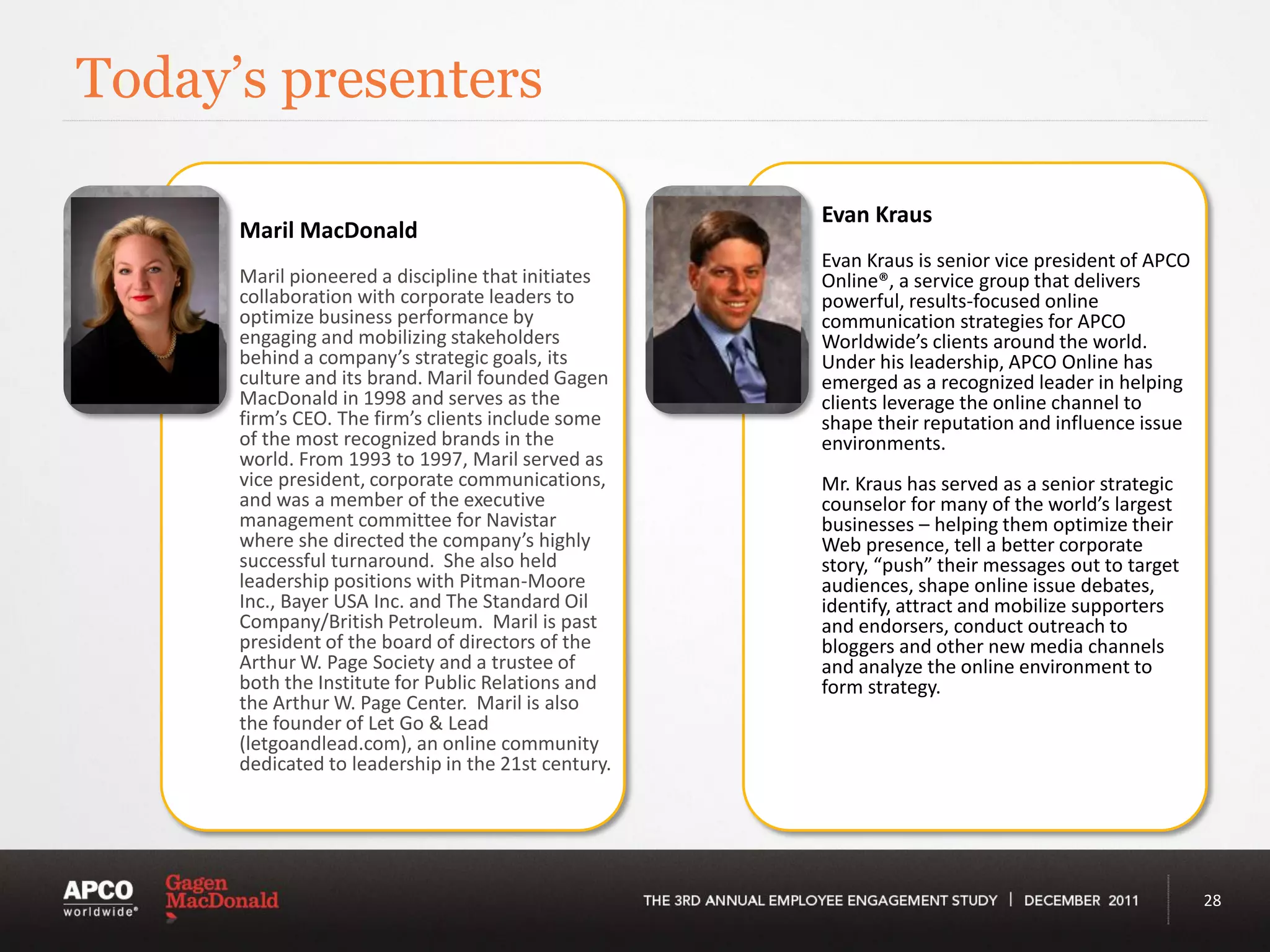
Today’s presenters

                                                     Evan Kraus
      Maril MacDonald
                                                     Evan Kraus is senior vice president of APCO
      Maril pioneered a discipline that initiates    Online®, a service group that delivers
      collaboration with corporate leaders to        powerful, results-focused online
      optimize business performance by               communication strategies for APCO
      engaging and mobilizing stakeholders           Worldwide’s clients around the world.
      behind a company’s strategic goals, its        Under his leadership, APCO Online has
      culture and its brand. Maril founded Gagen     emerged as a recognized leader in helping
      MacDonald in 1998 and serves as the            clients leverage the online channel to
      firm’s CEO. The firm’s clients include some    shape their reputation and influence issue
      of the most recognized brands in the           environments.
      world. From 1993 to 1997, Maril served as
      vice president, corporate communications,      Mr. Kraus has served as a senior strategic
      and was a member of the executive              counselor for many of the world’s largest
      management committee for Navistar              businesses – helping them optimize their
      where she directed the company’s highly        Web presence, tell a better corporate
      successful turnaround. She also held           story, “push” their messages out to target
      leadership positions with Pitman-Moore         audiences, shape online issue debates,
      Inc., Bayer USA Inc. and The Standard Oil      identify, attract and mobilize supporters
      Company/British Petroleum. Maril is past       and endorsers, conduct outreach to
      president of the board of directors of the     bloggers and other new media channels
      Arthur W. Page Society and a trustee of        and analyze the online environment to
      both the Institute for Public Relations and    form strategy.
      the Arthur W. Page Center. Maril is also
      the founder of Let Go & Lead
      (letgoandlead.com), an online community
      dedicated to leadership in the 21st century.


                                                                                                   28
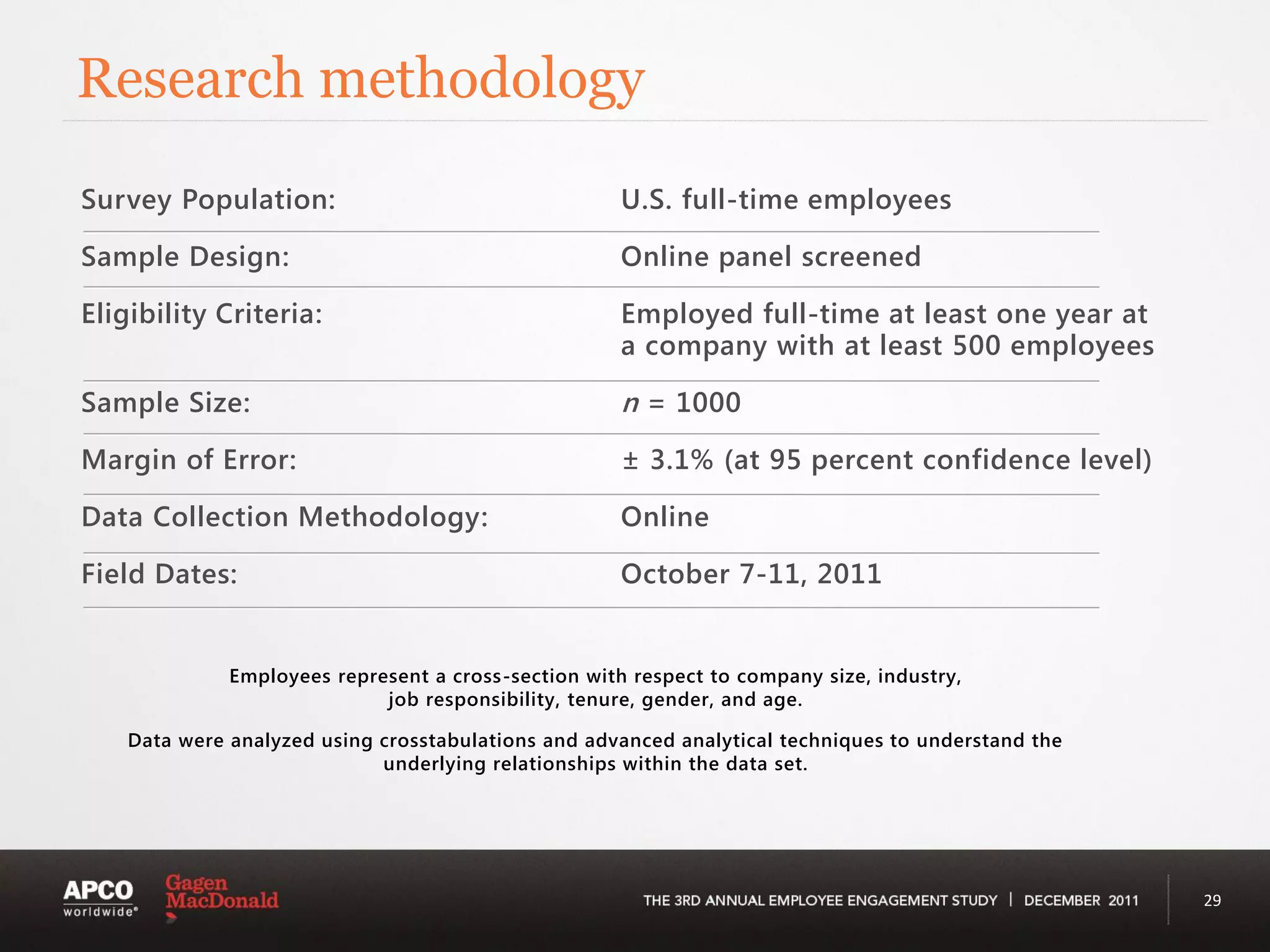
Research methodology
Survey Population:                                    U.S. full-time employees

Sample Design:                                        Online panel screened

Eligibility Criteria:                                 Employed full-time at least one year at
                                                      a company with at least 500 employees

Sample Size:                                          n = 1000
Margin of Error:                                      ± 3.1% (at 95 percent confidence level)

Data Collection Methodology:                          Online

Field Dates:                                          October 7-11, 2011


              Employees represent a cross-section with respect to company size, industry,
                             job responsibility, tenure, gender, and age.

    Data were analyzed using crosstabulations and advanced analytical techniques to understand the
                             underlying relationships within the data set.


                                                                                                     29

Unleashing the Power of Internal Social Media

  • 2.
    What do socialmedia users want from a company? 2
  • 3.
    When it comesto internal social media, what do employees really want from a company? • Ensures that all of its content is accurate and reliable • Ensures its Intranet and its social media integrations are easy-to-use • Posts content that is interesting and valuable to the user • Ensures content is readily accessible and easy to find • Develops visually appealing online designs • Consistently updates and keeps content fresh on all social media platforms • Offers content that is easily shareable • Provides its users with access to exclusive content or information online • Establishes open dialogues with employees • Regularly solicits feedback and criticism from employees • Invites employees to interact with each other • Encourages employee participation on the social networks it operates • Uses social media to mobilize its employees to engage in offline activities • Has a visible and active CEO or senior leadership presence online • Uses a targeted social media approach to reach different types of people • Makes use of the most relevant, popular and trend-setting social media platforms • Has links to each of its social media platforms on the home page of its Intranet • Actively engages users through the use of several social media or interactive platforms • Integrates its content throughout all of its social media platforms • Is willing to take risks to try new and innovative social media strategies that enhance the user experience • Has a committed team of company ambassadors that participate online and act as the face of the company 3
  • 4.
    So what? Thebusiness case for ISM If you provide the right tools, can Internal Social Media initiatives…  Engage and motivate employees?  Create brand ambassadors?  Bolster reputation internally and externally?  Help employees contribute to bottom-line business results? 4
  • 5.
    Internal Social Mediaeffectively engages employees 5
  • 6.
    ISM is onetool among many • My supervisor takes the time to listen to the opinions and ideas of others • In my company, I am comfortable sharing information and ideas • My supervisor responds to my feedback • I have all the information that’s necessary for me to do my job • My supervisor provides clear direction and priorities for our work group • Information and ideas flow freely within my organization • My colleagues are comfortable sharing information and ideas with peers • Uses a targeted social media approach to reach different types of people • Encourages employee participation on the social networks it operates • Consistently updates and keeps content fresh on all social media platforms • Is willing to take risks to try new and innovative social media strategies that • Develops visually appealing online designs enhance the user experience • Makes use of the most relevant, popular and trend-setting social media • Invites employees to interact with each other platforms • Ensures its Intranet and its social media integrations are easy-to-use • Integrates its content throughout all of its social media platforms • Provides its users with access to exclusive content or information online • Actively engages users through the use of several social media or interactive • Establishes open dialogues with employees platforms • Posts content that is interesting and valuable to the user • Uses social media to mobilize its employees to engage in offline activities • Ensures that all of its content is accurate and reliable • Ensures content is readily accessible and easy to find • Regularly solicits feedback and criticism from employees • Has a committed team of company ambassadors that participate online and • Has links to each of its social media platforms on the home page of its act as the face of the company Intranet • Offers content that is easily shareable • Has a visible and active CEO or senior leadership presence online • The executive team in my company supports and lives our values • My company’s executive team exemplifies authentic, open and honest • My company’s values are clearly aligned with our business strategy communications • My company’s executive team clearly explains the direction the company is • The executive team in my company communicates regularly about our heading company values • My company has a set of clearly defined values that drives all of our behavior • My company’s executive team clearly explains the reasons behind decisions • My company’s executive team shares positive and negative news openly • I receive consistent information from all the leaders in my company 6
  • 7.
    The investigation APCO Worldwide and Gagen MacDonald jointly sponsored an online survey among U.S. adults who have been employed full-time at least one year at a company with at least 500 employees. The purpose of the study is to determine the state of the U.S. workplace as viewed by America’s workforce. This year’s study explored employment-related issues and how companies communicate with their employees, with a particular focus on the use and prevalence of internal social media (ISM) in the workplace. 7
  • 8.
    How are companiesusing social media? 8
  • 9.
  • 10.
    Insight 1: Employeeretention & recruitment 10
  • 11.
    Considerations for retentionand recruitment Social media is a job search fact of life … 18.4 million Americans credit Facebook with helping find their jobs1 … and promising candidates bring high ISM expectations: 2/3 of college students ask about social media policies during job interviews2 56% claim they’ll forego a job at a company that bans social media — or they will circumvent the policy2 ISM can empower employees to become better brand ambassadors — your stealth recruiting team 1 Source: Study by Jobvite, as reported at mbaonline.com 2 Source: 2011 Cisco Connected World Technology Report, www.cisco.com/go/connectedreport 11
  • 12.
    Insight 2: ISMdemonstrates & supports innovation 12
  • 13.
    Considerations for innovation •ISM can help drive new discoveries, but alone is not a panacea for innovation • Tailor innovation tools to your innovators – the way employees engage ISM depends on industry, function and demographics 13
  • 14.
    Considerations for innovation Intuit’sInnovation Management • Created Intuit Brainstorm to launch an innovation initiative • Broke down barriers for communication between silos • Innovation development timeline decreased by 60% (from 13 months to 5 months) • Idea creation increased a reported 1,000% • Participation in idea creation increased 500% • More than 3,800 ideas were generated 14
  • 15.
    Insight 3: ISMsupports collaboration 15
  • 16.
    Considerations for collaboration Tofoster collaboration, you need to balance fears with potential opportunities • The enterprise cost of not finding information is extremely high • Fostering a culture of reciprocal trust is essential 16
  • 17.
    Considerations for collaboration WellsFargo taps into the “Wisdom of Crowds” • Only pilots ISM tools after business lines identify a specific need • ISM tools have helped break down hierarchical, organizational and geographic boundaries • Employees report ISM tools eliminate duplicate efforts and make meetings shorter — and the company feel smaller 17
  • 18.
    Insight 4: ISMsupports active employee advocacy to uphold brand & reputation 18
  • 19.
    Considerations for employeeadvocacy Just like other employee engagement channels, ISM must support employee buy-in and effective communication flow • Leaders need to know the role of ISM in company advocacy — and how to use it • ISM should reinforce dialogue up, down, and across the company • Employees should consider ISM an open and honest arena • Employees should consider themselves ISM co-creators ISM strategy and Social EQ: social media cascades from internal to external channels 19
  • 20.
    The Internal SocialMedia Model • Ensures that all of its content is accurate and reliable • Ensures its Intranet and its social media integrations are easy-to-use • Posts content that is interesting and valuable to the user • Ensures content is readily accessible and easy to find • Develops visually appealing online designs • Consistently updates and keeps content fresh on all social media platforms • Offers content that is easily shareable • Provides its users with access to exclusive content or information online • Establishes open dialogues with employees • Regularly solicits feedback and criticism from employees • Invites employees to interact with each other • Encourages employee participation on the social networks it operates • Uses social media to mobilize its employees to engage in offline activities • Has a visible and active CEO or senior leadership presence online • Uses a targeted social media approach to reach different types of people • Makes use of the most relevant, popular and trend-setting social media platforms • Has links to each of its social media platforms on the home page of its Intranet • Actively engages users through the use of several social media or interactive platforms • Integrates its content throughout all of its social media platforms • Is willing to take risks to try new and innovative social media strategies that enhance the user experience • Has a committed team of company ambassadors that participate online and act as the face of the company 20
  • 21.
    Quality content isking – but varies by audience 21
  • 22.
    ISM is nice,but leadership matters more 22
  • 23.
    Unisys: A 138-yearold tech firm “goes social”1 Understanding its culture, Unisys determined: 1. The why — not the what — should come first 2. Employees value most what they help to build 3. Executives must lead by example 4. ISM must be embedded in the culture 1 Source: Meister, Jeanne C., “Increase Your Company's Productivity With Social Media,” Harvard Business Review Blog Network 23
  • 24.
    Unisys: ISM investmentssupport business goals “Inside Unisys” fosters collaboration and productivity • Fosters broad array of well-read executive and employee postings • Has become a crucial sales tool to share wins and learn from losses “My Site” spurs innovation with “Ask Me About” feature • In 18 months, 15,000 Unisys employees world-wide (out of 23,000) built profiles and created hashtags • Tool quickly matches expertise with cross-functional challenges 24
  • 25.
    Three key lessons 1.An ISM strategy should be built from within — informed by its culture, driven by distinct business needs, and embraced by early adopters 2. Executives and leaders should not only align around strategy, but embody the change they envision 3. Social media guidelines are good, but training for social media literacy makes them sustainable 25
  • 26.
    What steps shouldyou take next? 1. Diagnose – What business dilemma you’re solving for – How employees currently engage social media and your Intranet 2. Mindset for Design – Understand all your fears and limitations: cultural, psychological, legal, financial and technical – Align leaders around business goals and practical limits 3. Establish Guiding Principles – Determine cultural stance – Develop social media guidelines and metrics for success 26
  • 27.
    What steps shouldyou take next? 4. Implement Sustainably – Choose only the ISM tools (wikis, chat, blogs, microblogs, etc.) that are relevant to your culture and business challenge – Train for across-the-enterprise social media literacy 5. Measure and Adjust – Use surveys, ISM diagnostics and agreed-to metrics to determine use patterns and enterprise value – Keep what works, tweak what doesn’t 27
  • 28.
    Today’s presenters Evan Kraus Maril MacDonald Evan Kraus is senior vice president of APCO Maril pioneered a discipline that initiates Online®, a service group that delivers collaboration with corporate leaders to powerful, results-focused online optimize business performance by communication strategies for APCO engaging and mobilizing stakeholders Worldwide’s clients around the world. behind a company’s strategic goals, its Under his leadership, APCO Online has culture and its brand. Maril founded Gagen emerged as a recognized leader in helping MacDonald in 1998 and serves as the clients leverage the online channel to firm’s CEO. The firm’s clients include some shape their reputation and influence issue of the most recognized brands in the environments. world. From 1993 to 1997, Maril served as vice president, corporate communications, Mr. Kraus has served as a senior strategic and was a member of the executive counselor for many of the world’s largest management committee for Navistar businesses – helping them optimize their where she directed the company’s highly Web presence, tell a better corporate successful turnaround. She also held story, “push” their messages out to target leadership positions with Pitman-Moore audiences, shape online issue debates, Inc., Bayer USA Inc. and The Standard Oil identify, attract and mobilize supporters Company/British Petroleum. Maril is past and endorsers, conduct outreach to president of the board of directors of the bloggers and other new media channels Arthur W. Page Society and a trustee of and analyze the online environment to both the Institute for Public Relations and form strategy. the Arthur W. Page Center. Maril is also the founder of Let Go & Lead (letgoandlead.com), an online community dedicated to leadership in the 21st century. 28
  • 29.
    Research methodology Survey Population: U.S. full-time employees Sample Design: Online panel screened Eligibility Criteria: Employed full-time at least one year at a company with at least 500 employees Sample Size: n = 1000 Margin of Error: ± 3.1% (at 95 percent confidence level) Data Collection Methodology: Online Field Dates: October 7-11, 2011 Employees represent a cross-section with respect to company size, industry, job responsibility, tenure, gender, and age. Data were analyzed using crosstabulations and advanced analytical techniques to understand the underlying relationships within the data set. 29