

“What Makes a Good Paragraph?”
“We have to be able
to understand it!”
“What can we do to make our
reader understand our writing?”
3 Things Make a
Good Paragraph:
“What do all of these
1.Unity
2.Coherence
3.Elaboration
Let’s Start with Unity…
“What does unity mean to
you?”
• When a paragraph
has unity, all the
sentences relate
directly to the main
idea.
• If there is a
sentence off topic
at all, this begins to
create confusion for
your reader.
Use only the most
important details!
LET’S SEE AN EXAMPLE…
Find the sentence in the paragraph that
destroys the unity and doesn’t belong.
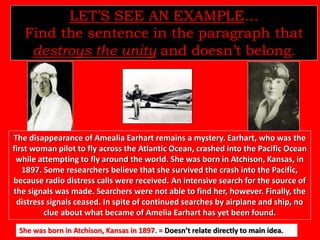
The disappearance of Amealia Earhart remains a mystery. Earhart, who was the
first woman pilot to fly across the Atlantic Ocean, crashed into the Pacific Ocean
while attempting to fly around the world. She was born in Atchison, Kansas, in
1897. Some researchers believe that she survived the crash into the Pacific,
because radio distress calls were received. An intensive search for the source of
the signals was made. Searchers were not able to find her, however. Finally, the
distress signals ceased. In spite of continued searches by airplane and ship, no
clue about what became of Amelia Earhart has yet been found.
She was born in Atchison, Kansas in 1897. = Doesn’t relate directly to main idea.
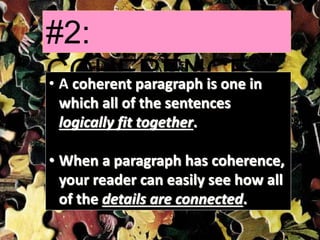
#2:
COHERENCE• A coherent paragraph is one in
which all of the sentences
logically fit together.
• When a paragraph has coherence,
your reader can easily see how all
of the details are connected.
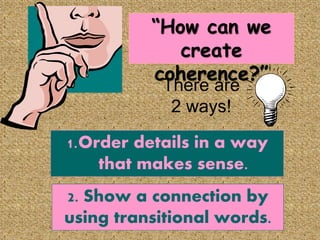
“How can we
create
coherence?”
There are
2 ways!
1.Order details in a way
that makes sense.
2. Show a connection by
using transitional words.
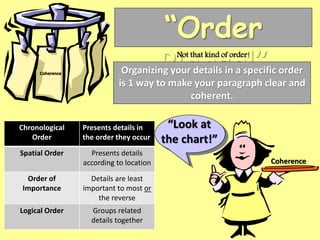
“Order
Please!”
Not that kind of order!
Coherence Organizing your details in a specific order
is 1 way to make your paragraph clear and
coherent.
“Look at
the chart!”
Coherence
Chronological
Order
Presents details in
the order they occur
Spatial Order Presents details
according to location
Order of
Importance
Details are least
important to most or
the reverse
Logical Order Groups related
details together
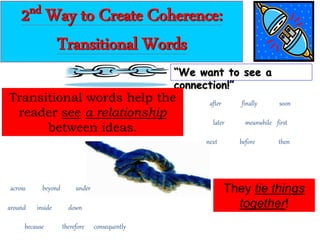
2nd Way to Create Coherence:
Transitional Words
“We want to see a
connection!”
Transitional words help the
reader see a relationship
between ideas.
They tie things
together!
after finally soon
later meanwhile first
next before then
across beyond under
around inside down
because therefore consequently
# 3: Elaboration
“Give us
more detail!
Elaboration means:
to add more detail,
so your reader can
get a clear picture of
what you mean!
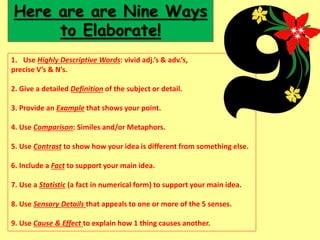
Here are are Nine Ways
to Elaborate!
1. Use Highly Descriptive Words: vivid adj.’s & adv.’s,
precise V’s & N’s.
2. Give a detailed Definition of the subject or detail.
3. Provide an Example that shows your point.
4. Use Comparison: Similes and/or Metaphors.
5. Use Contrast to show how your idea is different from something else.
6. Include a Fact to support your main idea.
7. Use a Statistic (a fact in numerical form) to support your main idea.
8. Use Sensory Details that appeals to one or more of the 5 senses.
9. Use Cause & Effect to explain how 1 thing causes another.
“Now we see what you’re talking about!”

Unity, coherence and elaboration

  • 1.
    “What Makes aGood Paragraph?” “We have to be able to understand it!” “What can we do to make our reader understand our writing?”
  • 2.
    3 Things Makea Good Paragraph: “What do all of these 1.Unity 2.Coherence 3.Elaboration
  • 3.
    Let’s Start withUnity… “What does unity mean to you?” • When a paragraph has unity, all the sentences relate directly to the main idea. • If there is a sentence off topic at all, this begins to create confusion for your reader. Use only the most important details!
  • 4.
    LET’S SEE ANEXAMPLE… Find the sentence in the paragraph that destroys the unity and doesn’t belong. The disappearance of Amealia Earhart remains a mystery. Earhart, who was the first woman pilot to fly across the Atlantic Ocean, crashed into the Pacific Ocean while attempting to fly around the world. She was born in Atchison, Kansas, in 1897. Some researchers believe that she survived the crash into the Pacific, because radio distress calls were received. An intensive search for the source of the signals was made. Searchers were not able to find her, however. Finally, the distress signals ceased. In spite of continued searches by airplane and ship, no clue about what became of Amelia Earhart has yet been found. She was born in Atchison, Kansas in 1897. = Doesn’t relate directly to main idea.
  • 5.
    #2: COHERENCE• A coherentparagraph is one in which all of the sentences logically fit together. • When a paragraph has coherence, your reader can easily see how all of the details are connected.
  • 6.
    “How can we create coherence?” Thereare 2 ways! 1.Order details in a way that makes sense. 2. Show a connection by using transitional words.
  • 7.
    “Order Please!” Not that kindof order! Coherence Organizing your details in a specific order is 1 way to make your paragraph clear and coherent. “Look at the chart!” Coherence Chronological Order Presents details in the order they occur Spatial Order Presents details according to location Order of Importance Details are least important to most or the reverse Logical Order Groups related details together
  • 8.
    2nd Way toCreate Coherence: Transitional Words “We want to see a connection!” Transitional words help the reader see a relationship between ideas. They tie things together! after finally soon later meanwhile first next before then across beyond under around inside down because therefore consequently
  • 9.
    # 3: Elaboration “Giveus more detail! Elaboration means: to add more detail, so your reader can get a clear picture of what you mean!
  • 10.
    Here are areNine Ways to Elaborate! 1. Use Highly Descriptive Words: vivid adj.’s & adv.’s, precise V’s & N’s. 2. Give a detailed Definition of the subject or detail. 3. Provide an Example that shows your point. 4. Use Comparison: Similes and/or Metaphors. 5. Use Contrast to show how your idea is different from something else. 6. Include a Fact to support your main idea. 7. Use a Statistic (a fact in numerical form) to support your main idea. 8. Use Sensory Details that appeals to one or more of the 5 senses. 9. Use Cause & Effect to explain how 1 thing causes another.
  • 11.
    “Now we seewhat you’re talking about!”