COHESION
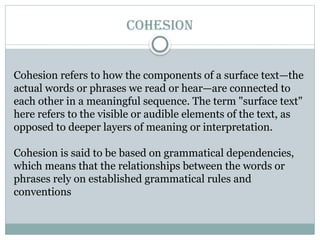
Cohesion refers tohow the components of a surface text—the
actual words or phrases we read or hear—are connected to
each other in a meaningful sequence. The term "surface text"
here refers to the visible or audible elements of the text, as
opposed to deeper layers of meaning or interpretation.
Cohesion is said to be based on grammatical dependencies,
which means that the relationships between the words or
phrases rely on established grammatical rules and
conventions
3.
Cohesion within smallerunits, such as phrases or sentences,
is easier to detect because the grammatical dependencies are
more apparent (e.g., between a determiner and a noun).
However, cohesion in longer stretches of text is more
significant for creating overall textual unity. This longer-
range cohesion often involves the reuse or modification of
earlier elements in the text.
4.
Halliday and Hasanorganize the linguistic devices that contribute to
cohesion into four major categories:
1- Reference: Refers to the way certain elements in a text (like pronouns or
determiners) point to something else in the text or the communicative
context.
Exophoric reference: Refers to something outside the text (in the external
situation), which does not contribute to textual cohesion.
Endophoric reference: Refers to something within the text itself and is key
to cohesion.
- Anaphora: Refers back to something mentioned earlier in the text (e.g.,
"John is here. He is happy.").
- Cataphora: Refers forward to something that will appear later in the text
(e.g., "He is happy. John just arrived.").
5.
2- Substitution andEllipsis:
- Substitution**: Replaces one item with another (e.g., "Do you want tea or coffee?" "I'll take
the coffee.").
- Ellipsis: Omits an element that can be inferred from the context (e.g., "Do you want tea?"
"No, I don’t [want tea]").
These two mechanisms create grammatical cohesion* where words or phrases in a sentence
are connected grammatically.
3- Lexical Cohesion: Involves the actual choice of words in a text and the semantic
relationships between them. Halliday and Hasan argue that lexical cohesion is harder to
analyze because it depends on context and the co-text. Types of lexical cohesion include:
- Hyponymy: The relationship between a general term and its specific instances (e.g.,
"flower" and "rose").
- Meronymy: The relationship between a whole and its parts (e.g., "car" and "wheel").
- Collocation: Words that frequently occur together (e.g., "make a decision" or "strong tea").
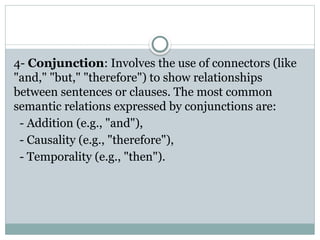
6.
4- Conjunction: Involvesthe use of connectors (like
"and," "but," "therefore") to show relationships
between sentences or clauses. The most common
semantic relations expressed by conjunctions are:
- Addition (e.g., "and"),
- Causality (e.g., "therefore"),
- Temporality (e.g., "then").
7.
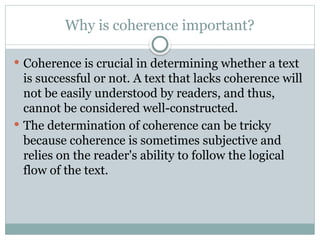
Why is coherenceimportant?
Coherence is crucial in determining whether a text
is successful or not. A text that lacks coherence will
not be easily understood by readers, and thus,
cannot be considered well-constructed.
The determination of coherence can be tricky
because coherence is sometimes subjective and
relies on the reader's ability to follow the logical
flow of the text.
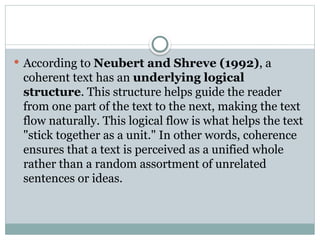
8.
According toNeubert and Shreve (1992), a
coherent text has an underlying logical
structure. This structure helps guide the reader
from one part of the text to the next, making the text
flow naturally. This logical flow is what helps the text
"stick together as a unit." In other words, coherence
ensures that a text is perceived as a unified whole
rather than a random assortment of unrelated
sentences or ideas.
9.
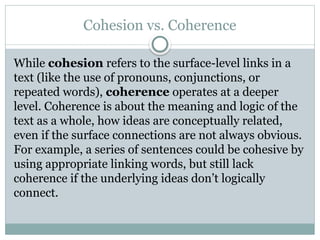
Cohesion vs. Coherence
Whilecohesion refers to the surface-level links in a
text (like the use of pronouns, conjunctions, or
repeated words), coherence operates at a deeper
level. Coherence is about the meaning and logic of the
text as a whole, how ideas are conceptually related,
even if the surface connections are not always obvious.
For example, a series of sentences could be cohesive by
using appropriate linking words, but still lack
coherence if the underlying ideas don’t logically
connect.
10.
How to achievecoherence in a text?
1- Clear Organization of Ideas
This can be seen in
a) Logical Structure: Organize your text in a logical
order that suits the type of text (e.g., chronological
order for a narrative, cause-effect order for an
argumentative text). Readers should be able to follow
the sequence of ideas effortlessly.
11.
B) Topic Sentences:Start each paragraph with a clear
topic sentence that signals the main idea of that
paragraph. This provides a guidepost for the reader
about what to expect in the following sentences.
12.
2- Logical ConnectionsBetween Ideas
a) Causality
It refers to a direct cause-and-effect relationship
between two events. In a causal relation, one event
creates the conditions that make the second event
occur.
Example:
"The wind knocked over the tree, and it crashed into
the house."
13.
B) Enablement
It meansthat one event creates the possibility for
another event to happen, but it doesn’t guarantee that
the second event will occur. It just makes it possible.
Example:
"The teacher unlocked the classroom door, allowing
the students to enter."
14.
C) Reason
It explainsthe rational basis for an event or action.
Unlike causality, where one event physically triggers
another, reason involves logical or justified outcomes
based on prior circumstances.
Example:
"John was late because he missed the bus."
15.
D) Purpose
It involvesevents planned in advance, where one
action is intentionally performed to achieve a specific
outcome.
Example:
"Sarah studied hard to pass the exam."
16.
E) Time
Time relationsrefer to the temporal sequence of events, where
one event occurs before, after, or simultaneously with another.
Example:
"After finishing her homework, Jane went to bed.“
Another example is in Chronological Order in narratives or
processes, use time markers (first, next, then, finally) to guide
the reader through a sequence of events.
Example:
"First, gather all the necessary ingredients. Then, preheat the
oven to 350°F."
17.
F) Compare andContrast
When comparing or contrasting ideas, make the
relationship between them explicit.
Example:
"While renewable energy is more sustainable, fossil
fuels are still widely used because of their low cost."
18.
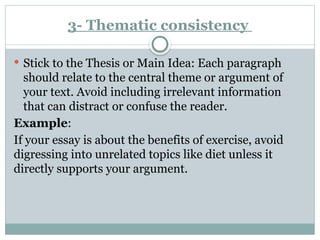
3- Thematic consistency
Stick to the Thesis or Main Idea: Each paragraph
should relate to the central theme or argument of
your text. Avoid including irrelevant information
that can distract or confuse the reader.
Example:
If your essay is about the benefits of exercise, avoid
digressing into unrelated topics like diet unless it
directly supports your argument.
![2- Substitution and Ellipsis:
- Substitution**: Replaces one item with another (e.g., "Do you want tea or coffee?" "I'll take
the coffee.").
- Ellipsis: Omits an element that can be inferred from the context (e.g., "Do you want tea?"
"No, I don’t [want tea]").
These two mechanisms create grammatical cohesion* where words or phrases in a sentence
are connected grammatically.
3- Lexical Cohesion: Involves the actual choice of words in a text and the semantic
relationships between them. Halliday and Hasan argue that lexical cohesion is harder to
analyze because it depends on context and the co-text. Types of lexical cohesion include:
- Hyponymy: The relationship between a general term and its specific instances (e.g.,
"flower" and "rose").
- Meronymy: The relationship between a whole and its parts (e.g., "car" and "wheel").
- Collocation: Words that frequently occur together (e.g., "make a decision" or "strong tea").](https://image.slidesharecdn.com/lecture4cohesioncoherence-250925110446-c892b7fd/85/presentation-on-text-analysis-cohesion-coherence-5-320.jpg)