megacities
on the move
     your guide to the future of
 sustainable urban mobility in 2040
Forum for the Future is the UK’s leading sustainable
 development NGO. We work internationally with
 government, business and public service providers,
 helping them to develop strategies to achieve
 success through sustainability, to deliver products
 and services which enhance people’s lives and are
 better for the environment, and to lead the way to
 a better world.
 www.forumforthefuture.org


Megacities on the Move has been led by      Forum for the Future Authors:                   Director, EMBARQ Turkey; Nancy Kete,            EMBARQ
Forum for the Future in partnership with    Ivana Gazibara, James Goodman and               former Director, EMBARQ; Clayton Lane,          The EMBARQ global network catalyses
EMBARQ and was funded by Vodafone           Peter Madden.                                   Acting Director, EMBARQ.                        environmentally and financially sustainable
and the FIA Foundation for the Automobile                                                                                                   transport solutions to improve quality of
and Society.                                Forum for the Future support team:              Special thanks also to the many people          life in cities. Since 2002, the network has
                                            Chris Dewey, Stephanie Draper, Rupert           who contributed to the project – through        grown to include five Centres for Sustainable
Date of publication:                        Fausset, Joy Green, Joe Hall, Ruth              interviews, workshops and peer reviews.         Transport, located in Mexico, Brazil, India,
November 2010                               Harwood, Clare Jenkinson, David Mason,                                                          Turkey and the Andean Region, that work
                                            Gustavo Montes de Oca, Nathalie Nathe,          For a full list please refer to the Appendix.   together with local transport authorities to
Registered office:                          Will Nitch-Smith, Kate O’Hagan, Hanna                                                           reduce pollution, improve public health,
Overseas House                              Plant, Francesca Rutherford, Ulrike Stein,      FIA Foundation                                  and create safe, accessible and attractive
19–23 Ironmonger Row                        Claire Wyatt.                                   The FIA Foundation is an independent            urban public spaces. www.embarq.org
London EC1V 3QN                                                                             UK registered charity which manages
                                            Special thanks to our partners:                 and supports an international programme
Company No. 2959712                         Sheila Watson, Director of Environment,         of activities promoting road safety,
VAT Reg. No. 6777475 70                     The FIA Foundation; Nicola Woodhead,            environmental protection and sustainable         Download
Charity No. 1040519                         Group Environment Manager, Vodafone;            mobility, as well as funding specialist
                                            Chris Burgess, Corporate Responsibility         motor sport safety research.                     All the Megacities on the Move
Design:                                     Director, Vodafone; Caroline Dewing,            www.fiafoundation.org                            resources at:
www.thomasmatthews.com                      Senior Manager, Communications Strategy,                                                         www.forumforthefuture.org/projects/
                                            Vodafone; Samaresh Parida, Director,            Vodafone                                         megacities-on-the-move
                                            Strategy, Vodafone Essar; Prema Shrikrishna,    Vodafone is one of the world’s largest mobile
                                            Manager – Corporate Responsibility,             communications companies by revenue
                                            Vodafone Essar; Tugba Unal, Corporate           with approximately 347 million proportionate    For more information on Megacities on
                                            Affairs, Vodafone Turkey; Prajna Rao,           customers as at 30 June 2010. Vodafone          the Move or to organise a workshop
                                            Urban Planner, EMBARQ (CST India);              currently has equity interests in over 30       please email Ivana Gazibara at:
                                            Madhav Pai, Director, EMBARQ India;             countries across five continents and over        megacitiesonthemove@forumforthefuture.
                                            Ahmet Birsel, Programme Manager,                40 partner networks worldwide. For more         org, or call +44 (0)20 7324 3673.
                                            EMBARQ (SUM Turkey); Sibel Bulay,               information, please visit www.vodafone.com


 Return to contents                                                                      about                                                                                    page 2
contents
1.                                     2.                                    3.                                         4.
overview                         p4    what’s your destination?              what can you do? six                       plan the future now
                                       four scenarios for urban              solutions for sustainable                  how to run a workshop
Foreword                         p5    mobility in 2040       p17            urban mobility          p36                using the scenarios  p49
How can you use this toolkit?    p7
                                       What are scenarios?             p18   1. Integrate, integrate, integrate   p38   Sample workshop agenda
What’s ahead?                                                                                                           and exercises               p50
Factors shaping the future       p8    How were the scenarios created? p18   2. Make the poor a priority          p40
                                                                                                                        Case study: Istanbul        p56
What can you do?                       Key variables: energy sources         3. Go beyond the car                 p41
Six solutions for sustainable          and global governance           p19                                              Case study: Mumbai          p60
urban mobility                   p11                                         4. Switch on to IT networks          p43
                                       The scenarios:                                                                   Appendix: Thank yous        p64
Scenario summaries               p12   Planned-opolis                  p20   5. ‘Refuel’ our vehicles             p45
                                       Sprawl-ville                    p24
Perspectives from our partners   p16   Renew-abad                      p28   6. Change people’s behaviour         p47
                                       Communi-city                    p32


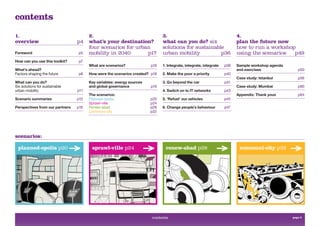
scenarios:

  planned-opolis p20                    sprawl-ville p24                      renew-abad p28                             communi-city p32


                                                                       contents                                                                  page 3
1. overview
megacities on the move
foreword – the future                                          Megacities on the Move, a collaboration
                                                               between Forum for the Future, the FIA
                                                                                                                      impacts of changing weather patterns.
                                                                                                                      Throughout human history we have built our

of the world is urban                                          Foundation, Vodafone and EMBARQ, can
                                                               help you find answers to these questions.
                                                               It is a toolkit designed to help governments,
                                                                                                                      major settlements on rivers, estuaries and
                                                                                                                      coasts. Sea level rise and more frequent and
                                                                                                                      intense storms and floods are just some of
                                                               companies and civil society organisations              the impacts cities will have to contend with.
How will people travel in the cities of the future?            understand the challenges of the future and
How will billions of city-dwellers access what                 start planning for sustainable city living.            It is clear that people must find sustainable
they need without putting intolerable strains                                                                         ways to live and travel in cities. We won’t
                                                               Humankind recently reached a historic                  survive without new thinking and more
on the planet? How can we plan now for more                    tipping point: for the first time more people           creative approaches. We will need
sustainable ways of life in a radically different world?       live in cities than outside them. This trend           completely new ways to produce and
                                                               is set to intensify. By 2040 two in three              deliver goods and services, consume
                                                               people on the planet will be city-dwellers.1           and move about. Cities are in many ways
                                                               There will be many more of us, as world                places of opportunity – hot-houses for
                                                               population grows by two billion, and far               economic, social and cultural innovation
                                                               more megacities, primarily in Asia, Africa             – so they are likely to be the places where
                                                               and Latin America.                                     we find new solutions to mobility.

                                                               The social, environmental and economic
                                                               implications of this will be enormous.
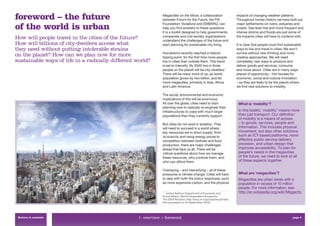
 Tokyo skyline                                                 All over the globe, cities need to start                What is ‘mobility’?
                                                               planning now to radically re-engineer their
                                                               infrastructures to cope with much larger                In this toolkit, ‘mobility’ means more
                                                               populations than they currently support.                than just transport. Our definition
                                                                                                                       of mobility is a means of access
                                                               But cities do not exist in isolation. They              – to goods, services, people and
                                                               will need to succeed in a world where                   information. This includes physical
                                                               key resources are in short supply: from                 movement, but also other solutions
                                                               oil scarcity and rising energy prices to                such as ICT-based platforms, more
                                                               competition between biofuels and food                   effective public service delivery
                                                               production, there are major challenges                  provision, and urban design that
                                                               ahead that face us all. There will be                   improves accessibility. To plan for
                                                               critical questions about how we manage                  people’s needs in the megacities
                                                               these resources, who controls them, and                 of the future, we need to look at all
                                                               who can afford them.                                    of these aspects together.

                                                               Overlaying – and intensifying – all of these
                                                               pressures is climate change. Cities will have           What are ‘megacities’?
                                                               to deal with both the policy responses, such            Megacities are urban areas with a
                                                               as more expensive carbon, and the physical              population in excess of 10 million
                                                                                                                       people. For more information, see:
                                                               1
                                                                 United Nations Department of Economic and             http://en.wikipedia.org/wiki/Megacity
                                                               Social Affairs, World Urbanization Prospects:
                                                               The 2009 Revision, http://esa.un.org/unpd/wup/index.
                                                               htm (accessed on 24 September, 2010).


 Return to contents                                1. overview > foreword                                                                                   page 5
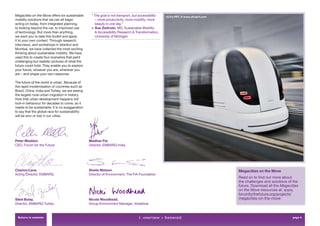
Megacities on the Move offers six sustainable     “ The goal is not transport, but accessibility   ULTra PRT, © www.ultraprt.com
mobility solutions that we can all begin            – more productivity, more mobility, more
acting on today, from integrated planning,          beauty in one day.”
to looking beyond the car, to improved use        > Sue Zielinski, MD, Sustainable Mobility
of technology. But more than anything,              & Accessibility Research & Transformation,
we want you to take this toolkit and apply          University of Michigan
it to your own context. Through research,
interviews, and workshops in Istanbul and
Mumbai, we have collected the most exciting
thinking about sustainable mobility. We have
used this to create four scenarios that paint
challenging but realistic pictures of what the
future could hold. They enable you to explore
your future, whoever you are, wherever you
are – and shape your own response.

The future of the world is urban. Because of
the rapid modernisation of countries such as
Brazil, China, India and Turkey, we are seeing
the largest rural-urban migration in history.
How that urban development happens will
lock-in behaviour for decades to come, so it
needs to be sustainable. It is no exaggeration
to say that the global race for sustainability
will be won or lost in our cities.


Peter Madden,                                    Madhav Pai,
CEO, Forum for the Future                        Director, EMBARQ India


Clayton Lane,                                    Sheila Watson,                                                                    Megacities on the Move
Acting Director, EMBARQ                          Director of Environment, The FIA Foundation
                                                                                                                                   Read on to find out more about
                                                                                                                                   the challenges and solutions of the
                                                                                                                                   future. Download all the Megacities
                                                                                                                                   on the Move resources at: www.
                                                                                                                                   forumforthefuture.org/projects/
Sibel Bulay,                                     Nicola Woodhead,                                                                  megacities-on-the-move
Director, EMBARQ Turkey                          Group Environment Manager, Vodafone


 Return to contents                                                               1. overview > foreword                                                          page 6
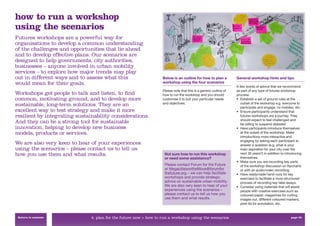
how can you                                                     1. Overview                                      4. Plan the future now: How to run
                                                                                                                 a workshop using the scenarios

use this toolkit?                                               You can use this section to introduce your
                                                                colleagues, business partners and clients
                                                                to the issues.
                                                                                                                 One of the best ways to get engaged in
                                                                                                                 the challenges you face is to organise
                                                                                                                 a workshop. This section gives specific
Megacities on the Move is designed to be a practical            2. What’s your destination? Four                 guidance on how to plan a workshop on
toolkit which can help public bodies, companies and             scenarios for urban mobility in 2040             the future of urban mobility, using the four
civil society organisations develop strategies which                                                             scenarios as a starting point to explore
                                                                Want to explore what the future may hold         issues relevant to you and develop a strategy
will enable people to live and travel more sustainably          and test your strategy? Our scenarios            and action plan. In May and June 2010
in the major cities of the 21st century. It aims to help        – Planned-opolis, Sprawl-ville, Renew-abad,      Forum for the Future ran similar workshops
you understand the key long-term issues better, apply           and Communi-city - are four possible visions     in Mumbai and Istanbul – you can see
                                                                of urban mobility in the world of 2040. They     the highlights from this process which may
them to your own thinking, and inspire innovative               can be a very effective tool for understanding   give you ideas for your own workshop.
solutions. The toolkit contains four sections and a set         how complex factors may play out and
of scenario animations.                                         shape very different futures, challenging        Scenario animations:
                                                                and inspiring organisations to plan for more     Bringing the future to life
                                                                effective solutions. They are designed to
                                                                strengthen strategy and policy, advocate         We have brought the scenarios to life in
                                                                long-term thinking and build collaborative       four short, vivid and compelling animations
                                                                visions for a sustainable future.                examining mobility challenges and solutions
                                                                                                                 as we follow a day in the life of an ordinary
                                                                3. What can you do? Six solutions                woman in each of the four worlds.
                                                                for sustainable urban mobility                   Animations give a snapshot of each scenario
                                                                                                                 and can be a very effective way of engaging
                                                                If you are motivated to bring innovation into    your audience in the subject.
                                                                your strategic planning, these are actions
                                                                you can take now to help create the
                                                                sustainable urban mobility systems of
                                                                the future. This section includes practical
                                                                examples of how these solutions are already
                                                                being put into practice around the world;
                                                                from integrated cities to intelligent traffic
                                                                systems, automotive technology, car-free
                                                                days and virtual meetings.


 Return to contents                       1. overview > how can you use this toolkit?                                                                 page 7
what’s ahead? factors shaping                                  what can we be more
                                                               certain about?
                                                                                                                    most of Europe and North America.
                                                                                                                    These changes will put increasing pressure

the future of urban mobility                                   Climate change
                                                                                                                    on mobility in cities, and make it more
                                                                                                                    difficult to ensure a growing and ageing
                                                                                                                    urban population can access affordable
                                                                                                                    mobility solutions – such as public transport
What does the future hold for large cities of the 21st         The scientific consensus is that climate              and other essential services.
century? We can be more or less certain about how              change is a reality and that it is extremely
certain factors will play out. What we are certain of          likely to be the result of human activity. We        “ In an optimistic scenario, cities will have
                                                               are already seeing the effects: we continue to         planned to create an urban environment
is that the responses to these factors will be critical        break temperature records; extreme weather             for people. They will make their planning
in determining the nature of mobility in our cities.           events are increasingly common; and the                and infrastructure investments based on
                                                               melting of Arctic ice may now be irreversible.         accessibility for people.”
                                                               Even if we manage to take early global action        > Nancy Kete, former Director, EMBARQ
                                                               to decarbonise our economies, the pollution
                                                               we emit now will stay in the atmosphere              Resource constraints
 São Paulo                                                     – unless deliberately removed by human
                                                               action – for decades.2                               This growing global population also has
                                                                                                                    an increasing taste for resource-intensive
                                                               Climate change will affect key aspects of            goods such as meat and cars. The result
                                                               our lives and will have profound impacts             is exploding global demand for water and
                                                               on our cities in particular. Heatwaves or            land for crops, livestock, domestic use
                                                               flash flooding, for example, will impact the           and biofuels; fossil fuels to power transport
                                                               comfort, cost and reliability of daily urban life.   or production; and minerals, metals and
                                                               But climate change will also affect the vast         forests for manufacturing.
                                                               areas, both near and far, that cities rely on
                                                               for supplies such as water, food or energy.          All of these resources are already heavily
                                                               Ultimately, climate change could affect cities’      exploited, and many face the possibility of
                                                               basic ability to function.                           severe depletion or even exhaustion in the
                                                                                                                    first half of the century. Scarcity will lead to
                                                               “ Climate change will change the game,               competition and high, volatile resource prices
                                                                 bringing forward ‘the first predictable             – it seems likely that the age of cheap oil
                                                                 industrial revolution’.”                           and cheap energy is over, for example. This
                                                               > Paul Dickinson, Executive Chairman,                will have a knock-on effect on the cost and
                                                                 Carbon Disclosure Project                          availability of transport and other goods and
                                                                                                                    services essential to everyday needs in cities.
                                                               Demographic trends                                   Urban societies can respond in different
                                                                                                                    ways: through technological innovation,
                                                               We can be reasonably certain about                   behaviour change, economic development,
                                                               population increases over the next 30                migration patterns and more.
                                                               years: from 6.8 billion people in 2010 to            2
                                                                                                                      Intergovernmental Panel on Climate Change, http://
                                                               approximately 8.8 billion in 2040.3 This             www.ipcc.ch/, The Royal Society, http://royalsociety.
                                                               growth won’t be evenly distributed: most             org/climate-change/.
                                                                                                                    3
                                                               of it will occur in the cities of Africa, China,       UN Department of Social and Economic Affairs,
                                                                                                                    World Population Prospects, 2008 revision: http://esa.
                                                               India and Latin America. China will also be          un.org/unpd/wpp2008/index.htm (accessed on 24
                                                               dealing with an ageing population, as will           September 2010).


 Return to contents                              1. overview > what’s ahead?                                                                                     page 8
what are we less certain about?


Energy supply and demand                          Global economy                                   Climate change responses
                                                                                                                                                     “ Governments make a lot of money on
It is highly uncertain how societies will         Economic growth creates a spiral of greater      The response to climate change is likely to
                                                                                                                                                       fuel duty, and this would be displaced
respond to the exploding demand yet               demand for mobility, and greater demand          deeply affect how cities of the future look,
                                                                                                                                                       by electrons if electric vehicles were
stagnating supply of energy, especially oil.      for goods and services. Providing more           feel and operate. The Megacities on the
                                                                                                                                                       mainstreamed – so there will have to
But it is clear the energy mix that’s in place    goods and services requires more transport,      Move scenarios all show a different balance
                                                                                                                                                       be a profound shift in terms of how
in 2040 will determine what types of mobility     support and staff; increased wealth allows       of measures to adapt to climate change and
                                                                                                                                                       governments generate income, and
systems we have in our cities. For example,       people to travel more and encourages more        reduce further emissions. For example, in the
                                                                                                                                                       structure tax and incentives.”
if there is a large-scale shift to renewable      expensive modes of transport such as the         carefully planned and centralised world of
                                                                                                                                                     > Tom Briggs, Vice President, Policy and
energy, this could favour electric, solar or      car; and growth in property prices leads to      Planned-opolis, streets are lined with carbon
                                                                                                                                                       Communications, BP Alternative Energy
hydrogen-powered vehicles. Or if energy           longer commutes.                                 scrubbers that suck carbon dioxide out of
is expensive and inaccessible to most, this                                                        the atmosphere, and neighbourhoods are
could favour mass transit over personal           We have come to take growth for granted,         designed from scratch to maximise natural         Social structures
motorised transport. People’s lifestyle           but could resource limitations or climate        cooling. In contrast, the cities of Sprawl-
choices, such as opting for virtual services      change bring the seemingly endless               ville are designed by the rich for the rich,      Traditionally, most societies have favoured
instead of travel, could directly affect energy   expansion cycle to an end? Or, might lifestyle   who effectively live in a city within the city,   the family as the core unit, often with
demand levels in cities too.                      changes alter how we think about growth          protected from the floods and heat to which        strong communities surrounding the family.
                                                  and wellbeing, affecting everything from         the poor are exposed.                             These communities were typically more
“ By 2040, the grid will be different: we         consumption patterns to modal choices?                                                             self-sufficient and had lower levels of
  will be burning electrons rather than                                                            Governance                                        mobility. Today, many cities are becoming
  hydrocarbons. Those electrons will              “ In places like Istanbul and Mumbai, with                                                         more atomised spaces, with a huge influx
  be greener, so there will be a lot more           large populations with rapid economic          There are big gaps in global governance           of diverse groups and more emphasis on
  renewable energy generation.”                     growth, it is absolutely key that they         systems on major issues including energy,         individuals. This could spell the decline
> Gordon Feller, Director of Urban                  focus on restraining growth in vehicle         food, water and climate change. If these are      of traditional community structures and
  Innovations at Cisco Systems                      use. It’s arguably the hardest and the         not improved, or if governance deteriorates,      an emergence of new types of community
                                                    most important challenge confronting           our countries and cities will be more             for the ‘urban age’ – more networked,
Resource use                                        these cities.”                                 vulnerable to external shocks. City-level         flexible, and mobile, but also more
                                                  > Dan Sperling, author of “Two Billion Cars:     governance is also critical, particularly when    temporary. Equally, there is a possibility
Mobility is essentially about the ability           Driving Towards Sustainability”                it comes to mobility – for example, to develop    that we might see a reassertion of traditional
to access goods, services, people and                                                              well-designed public transport systems,           community and family structures in the
information. Therefore the future response                                                         maintain order and support the integration        cities of the future, whether as a backlash
to resource scarcity will have a huge                                                              of various mobility networks.                     against too much individualism and social
impact on urban mobility and quality of life.                                                                                                        fragmentation, or as a result of resource and
If there is strategic investment in energy,                                                        It is highly uncertain how the quality,           climate constraints.
food and water supply infrastructure,                                                              effectiveness and structure of governance
for example, cities will be better able to                                                         systems will unfold. Different approaches
ensure their citizens can access essential                                                         to governance could profoundly affect
goods and services. If there are inadequate                                                        mobility in cities – from tightly controlled
responses to resource scarcity, life in                                                            and networked mobility systems on one end
megacities of the future will be tough,                                                            of the spectrum, to a chaotic proliferation
with rapid population growth but too few                                                           of mobility solutions in a world with poor
resources to meet people’s demands.                                                                governance on the other.


  Return to contents                                                            1. overview > what’s ahead?                                                                                page 9
Values                                               Business                                        Technological development                        Urban form

The 20th century was the age of the car. It          Future trends such as climate change            Technological change has reached an              Currently we are on a pathway to ever-
became a status symbol for those who had             impacts, resource constraints, technological    unprecedented speed, and this is likely to       increasing urban sprawl, and in some cases
it, and an aspiration for those who could not        innovation, or cost pressures on public         continue into the future – though innovation     megacities merging with neighbouring cities
afford it. In the age of rising middle classes       services, will present a number of risks        could also be stifled as a result of various      and towns. These mega-regions, formed
in emerging economies, demand for the car            and opportunities to businesses operating       economic or political factors, as in our         by megacities that stretch hundreds of
may explode – as we are already seeing in            in cities. The typical urban mobility           Sprawl-ville scenario. Many place faith in       kilometres – sometimes across state borders
markets such as China. Managed badly,                model is state-funded public transport          technology, and indeed new vehicle systems       – form vast belts of high population density
this could have detrimental impacts on the           systems, competing and combining with           do have the potential to reduce energy and       and economic power and create huge
quality of life in cities – from air pollution, to   privately owned cars and taxis running          carbon impacts dramatically, especially          challenges for governance and mobility.
congestion and road safety, to exacerbation          on public roads.                                from cars. However, it is much harder to
of climate impacts.                                                                                  predict what technological developments          However, this trend is not inevitable and
                                                     This could change in a number of different      we will have in 2040, and even how influential    it is possible to reverse it. For example,
However, future generations may have a               ways. There will almost certainly be            these will be compared to other factors, from    many urban planners and transport officials
different set of mobility preferences. Today’s       opportunities to provide digital alternatives   policy to behaviour change.                      today advocate replacing low density
children will have grown up with immersive           to physical mobility – from employment, to                                                       car-centric cities and zoned land use with
networking technology, and are likely to be          retail, to leisure. New business models could   Certainly, ICT-based innovation will be a        denser, integrated urban villages based
much more comfortable spending time in               emerge in personal mobility as well, such       prominent feature of our lives, particularly     around mixed land use, public transport
virtual spaces. There are already signs in           as today’s urban car clubs. Office spaces        in increasingly networked cities, where the      and walkability. Our scenarios reflect these
some cities that the popularity of the car           and the way we work could change, and           ability to be permanently connected could        different possibilities.
as a status symbol is declining, especially          private sector provision could extend           bring better access to goods, services and
as congestion problems get worse and                 further into areas traditionally addressed      other people with less need for physical         “ In the past 100 years, the automobile has
alternative status symbols (such as smart            by governments – from public transport          transport. Transport technology innovations        shaped the city rather than cities shaping
technology devices) emerge.                          to wider infrastructure.                        might include further changes in vehicle           the automobile. In the future the opposite
                                                                                                     design, propulsion systems and energy              will be the case: cities will start to shape
“ The UK government banned smoking                                                                   sources to address congestion, carbon              mobility.”
  in public places and nobody batted an                                                              emissions and safety. The most anticipated       > Chris Borroni-Bird, Director of Advanced
  eyelid. A generation ago, this would                                                               trend is for new electric vehicles, including      Technology Vehicle Concepts, GM
  have been unthinkable. At the moment,                                                              low carbon power-trains similar to electric
  mobility is different. There is no sense                                                           cars. Other possibilities include buses or
  that mobility causes harm. Indeed it is                                                            cars driven by locally produced hydrogen
  seen as a good thing if you can afford                                                             or biofuels.
  it. Maybe attitudes to travel will change
  like they did to smoking.”                                                                         “ The convergence between cities and other
> Ben Plowden, Director of Integrated                                                                  areas will grow as we start to spend time in
  Programme Delivery, Transport for London                                                             ‘virtual cities’.”
                                                                                                     > Guy Summers, R&D Collaboration
                                                                                                       Manager, Vodafone


                                                       Cyclist in Mumbai


  Return to contents                                                               1. overview > what’s ahead?                                                                              page 10
what can you do?
six solutions for
sustainable urban mobility
Looking 30 years into the future, the challenges
– and the solutions – can seem a long way off.
But everyone involved in urban mobility can take
action today, whether you are a government, city
authority, urban planner, transport provider, in
business or the public sector.

                                                                                                  High speed train


1. Integrate, integrate, integrate              3. Go beyond the car                            5. ‘Refuel’ our vehicles                                Want to see how this is happening
                                                                                                                                                        in the real world?
Transport, urban planning, business, public     Current growth rates in car ownership are       As oil becomes more scarce, expensive and
services, energy and food supply can no         simply unsustainable: there are already one     a security risk, we will need to implement              Please see section 3 for more details
longer be considered in isolation. Together,    billion cars in the world, projected to grow    greater energy efficiency measures, as                   and practical examples of how
we need to create integrated mobility           to two billion within a few decades.4 We        well as shift to powering our vehicles with             these six solutions are already being
systems that will provide people with choice,   need alternative ways of getting around,        renewable, low-carbon fuel sources. We will             designed, put into practice, or scaled
flexibility and seamless connectivity whether    and we need to design for people, not cars.     need significant investment in battery and               up around the world: from integrated
they are travelling from one place to another   We will need urban neighbourhoods with          fuel technology to seize this opportunity and           cities to intelligent traffic systems,
or accessing the things they need virtually.    the infrastructure to serve local communities   take alternative energy-powered vehicles                biofuels to battery technology,
                                                and dense developments that prevent further     to scale over the next few decades. Most                car-free days to travel-free virtual
2. Make the poor a priority                     sprawl, are easy to walk around, and provide    vehicle technology experts agree that                   meetings. Download it from:
                                                access to key goods and services.               advanced technologies also have enormous                www.forumforthefuture.org/projects/
Mobility systems must work for rich and                                                         potential to improve fuel efficiency.                    megacities-on-the-move
poor alike, to ensure everyone has access to    4. Switch on to IT networks
goods, services and job opportunities. Cities                                                   6. Change people’s behaviour
already have many people on lower incomes       There is enormous potential for information
and this trend will only increase. Tailored     technology to reduce the need for physical      Many of our future challenges are shaped by
mobility solutions must be designed to meet     movement by enabling urban dwellers to          people’s values, behaviour and preferences.
their needs.                                    access more and more services online. Using     We need to think about ways to influence
                                                IT networks to connect and coordinate cars      mass behaviour and social norms in positive
                                                and public transport can also help reduce       ways to promote low-carbon, healthier urban
                                                traffic congestion and accident risks.           lifestyles. Future leading cities will plan today
                                                                                                to influence lifestyles rather than simply
                                                                                                relying on additional road infrastructure and       4
                                                                                                                                                      Daniel Sperling and Deborah Gordon, Two Billion
                                                                                                modes of transport.                                 Cars, Oxford University Press, New York, 2009.


 Return to contents                                                        1. overview > what can you do?                                                                                     page 11
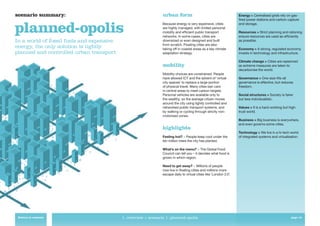
scenario summary:                                               urban form                                          Energy > Centralised grids rely on gas-
                                                                                                                    fired power stations and carbon capture


planned-opolis                                                  Because energy is very expensive, cities
                                                                are highly managed, with limited personal
                                                                mobility and efficient public transport
                                                                networks. In some cases, cities are
                                                                                                                    and storage.

                                                                                                                    Resources > Strict planning and rationing
                                                                                                                    ensure resources are used as efficiently
In a world of fossil fuels and expensive                        downsized or even designed and built                as possible.
                                                                from scratch. Floating cities are also
energy, the only solution is tightly                            taking off in coastal areas as a key climate        Economy > A strong, regulated economy
planned and controlled urban transport.                         adaptation strategy.                                invests in technology and infrastructure.

                                                                                                                    Climate change > Cities are replanned
                                                                mobility                                            as extreme measures are taken to
                                                                                                                    decarbonise the world.
                                                                Mobility choices are constrained. People
                                                                have allowed ICT and the advent of ‘virtual         Governance > One-size-fits-all
                                                                city spaces’ to replace a large portion             governance is effective, but reduces
                                                                of physical travel. Many cities ban cars            freedom.
                                                                in central areas to meet carbon targets.
                                                                Personal vehicles are available only to             Social structures > Society is fairer
                                                                the wealthy, so the average citizen moves           but less individualistic.
                                                                around the city using tightly controlled and
                                                                networked public transport systems, and             Values > It is a hard-working but high-
                                                                by walking or cycling through strictly non-         trust world.
                                                                motorised zones.
                                                                                                                    Business > Big business is everywhere,
                                                                                                                    and even governs some cities.
                                                                highlights
                                                                                                                    Technology > We live in a hi-tech world
                                                                Feeling hot? > People keep cool under the           of integrated systems and virtualisation.
                                                                ten million trees the city has planted.

                                                                What’s on the menu? > The Global Food
                                                                Council can tell you – it decides what food is
                                                                grown in which region.

                                                                Need to get away? > Millions of people
                                                                now live in floating cities and millions more
                                                                escape daily to virtual cities like ‘London 2.0’.


 Return to contents                        1. overview > scenario 1: planned-opolis                                                                     page 12
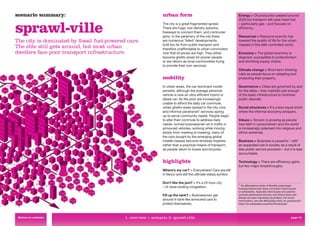
scenario summary:                                               urban form                                        Energy > Oil production peaked around
                                                                                                                  2030 but transport still uses fossil fuel


sprawl-ville                                                    The city is a great fragmented sprawl.
                                                                There are huge, low-density suburbs,
                                                                freeways to connect them, and commuter
                                                                jams. In the periphery of the city there
                                                                                                                  – particularly gas – and focuses on
                                                                                                                  efficiency.

                                                                                                                  Resources > Resource scarcity has
The city is dominated by fossil fuel-powered cars.              are numerous ‘failed’ developments,               lowered the quality of life for the urban
                                                                built too far from public transport and           masses in this elite-controlled world.
The elite still gets around, but most urban                     therefore unaffordable to urban commuters
dwellers face poor transport infrastructure.                    now that oil prices are high. They either         Economy > The global economy is
                                                                become ghetto areas for poorer people             stagnant, susceptible to protectionism
                                                                or are reborn as local communities trying         and shrinking supply chains.
                                                                to provide their own services.
                                                                                                                  Climate change > Short-term thinking
                                                                                                                  rules as people focus on adapting and
                                                                mobility                                          protecting their property.

                                                                In urban areas, the car-dominant model            Governance > Cities are governed by and
                                                                persists, although the average personal           for the elites – they maintain just enough
                                                                vehicle is now an ultra-efficient hybrid or        of the basic infrastructure to minimise
                                                                diesel car. As the poor are increasingly          public disorder.
                                                                unable to afford the daily car commute,
                                                                urban ghetto areas spread in the city core        Social structures > It’s a less equal world
                                                                and informal paratransit 5 services spring        where the informal economy prospers.
                                                                up to serve community needs. People begin
                                                                to alter their commute to address daily           Values > Tension is growing as people
                                                                needs: nomad businessmen sit in traffic in         lose faith in consumerism and the world
                                                                armoured vehicles, working while moving           is increasingly polarised into religious and
                                                                slowly from meeting to meeting; many of           ethnic extremes.
                                                                the cars bought by the emerging global
                                                                middle classes become driveway trophies           Business > Business is powerful – with
                                                                rather than a practical means of transport,       an expanded role in society as a result of
                                                                as people return to buses and bicycles.           less public service provision – but it is less
                                                                                                                  accountable.

                                                                highlights                                        Technology > There are efficiency gains
                                                                                                                  but few major breakthroughs.
                                                                Where’s my car? > Everywhere! Cars are still
                                                                in favour and still the ultimate status symbol.

                                                                Don’t like the jam? > It’s a 24-hour city         5
                                                                                                                     An alternative mode of flexible passenger
                                                                – of never-ending congestion.                     transportation that does not follow fixed routes
                                                                                                                  or schedules. Typically mini-buses are used to
                                                                Fill up the tank? > Businessmen get               provide paratransit service, but share taxis and
                                                                                                                  jitneys are also important providers. For more
                                                                around in tank-like armoured cars to              information, see the Wikipedia entry on paratransit:
                                                                protect themselves.                               http://en.wikipedia.org/wiki/Paratransit


 Return to contents                         1. overview > scenario 2: sprawl-ville                                                                           page 13
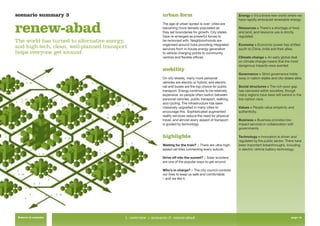
scenario summary 3                                            urban form                                       Energy > It’s a brave new world where we
                                                                                                               have rapidly embraced renewable energy.


renew-abad                                                    The age of urban sprawl is over: cities are
                                                              becoming more densely populated as
                                                              they set boundaries for growth. City states
                                                              have re-emerged as powerful forces to
                                                                                                               Resources > There’s a shortage of food
                                                                                                               and land, and resource use is strictly
                                                                                                               regulated.
The world has turned to alternative energy,                   be reckoned with. Neighbourhoods are
                                                              organised around hubs providing integrated       Economy > Economic power has shifted
and high-tech, clean, well-planned transport                  services from in-house energy generation         south to China, India and their allies.
helps everyone get around.                                    to vehicle charging points to community
                                                              centres and flexible offices.                      Climate change > An early global deal
                                                                                                               on climate change means that the most
                                                                                                               dangerous impacts were averted.
                                                              mobility
                                                                                                               Governance > Strict governance holds
                                                              On city streets, many more personal              sway in nation-states and city-states alike.
                                                              vehicles are electric or hybrid, and electric
                                                              rail and buses are the top choice for public     Social structures > The rich-poor gap
                                                              transport. Energy continues to be relatively     has narrowed within societies, though
                                                              expensive, so people often switch between        many regions have been left behind in the
                                                              personal vehicles, public transport, walking     low carbon race.
                                                              and cycling. The infrastructure has been
                                                              massively upgraded in many cities to             Values > People value simplicity and
                                                              encourage this. Sophisticated augmented          authenticity.
                                                              reality services reduce the need for physical
                                                              travel, and almost every aspect of transport     Business > Business provides low-
                                                              is guided by technology.                         impact services in collaboration with
                                                                                                               governments.

                                                              highlights                                       Technology > Innovation is driven and
                                                                                                               regulated by the public sector. There have
                                                              Waiting for the train? > There are ultra-high-   been important breakthroughs, including
                                                              speed rail links connecting every suburb.        in electric vehicle battery technology.

                                                              Drive off into the sunset? > Solar scooters
                                                              are one of the popular ways to get around.

                                                              Who’s in charge? > The city council controls
                                                              our lives to keep us safe and comfortable
                                                              – and we like it.


 Return to contents                        1. overview > scenario 3: renew-abad                                                                    page 14
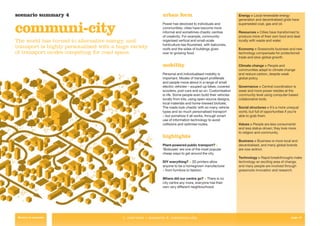
scenario summary 4                                            urban form                                       Energy > Local renewable energy
                                                                                                               generation and decentralised grids have


communi-city                                                  Power has devolved to individuals and
                                                              communities; cities have become more
                                                              informal and sometimes chaotic centres
                                                              of creativity. For example, community-
                                                                                                               superseded coal, gas and oil.

                                                                                                               Resources > Cities have transformed to
                                                                                                               produce more of their own food and deal
The world has turned to alternative energy, and               organised vertical and small-scale               locally with waste and water.
                                                              horticulture has flourished, with balconies,
transport is highly personalised with a huge variety          roofs and the sides of buildings given           Economy > Grassroots business and new
of transport modes competing for road space.                  over to growing food.                            technology compensate for protectionist
                                                                                                               trade and slow global growth.

                                                              mobility                                         Climate change > People and
                                                                                                               communities adapt to climate change
                                                              Personal and individualised mobility is          and reduce carbon, despite weak
                                                              important. Modes of transport proliferate        global policy.
                                                              and people move about in a range of small
                                                              electric vehicles – souped-up bikes, covered     Governance > Central coordination is
                                                              scooters, pod-cars and so on. Customisation      weak and more power resides at the
                                                              is rife. Some people even build their vehicles   community level using computer-based
                                                              locally from kits, using open-source designs,    collaborative tools.
                                                              local materials and home-brewed biofuels.
                                                              The roads look chaotic with so many vehicle      Social structures > It’s a more unequal
                                                              types and so much personalised transport         world, but full of opportunities if you’re
                                                              – but somehow it all works, through smart        able to grab them.
                                                              use of information technology to avoid
                                                              collisions and optimise routes.                  Values > People are less consumerist
                                                                                                               and less status-driven; they look more
                                                                                                               to religion and community.
                                                              highlights
                                                                                                               Business > Business is more local and
                                                              Plant-powered public transport? >                decentralised, and many global brands
                                                              ‘Biobuses’ are one of the most popular           are now extinct.
                                                              cheap ways to get around the city.
                                                                                                               Technology > Rapid breakthroughs make
                                                              DIY everything? > 3D printers allow              technology an exciting area of change,
                                                              anyone to be a homegrown manufacturer            and many people are involved through
                                                              – from furniture to fashion.                     grassroots innovation and research.

                                                              Where did our centre go? > There is no
                                                              city centre any more, everyone has their
                                                              own very different neighbourhood.


 Return to contents                       1. overview > scenario 4: communi-city                                                                   page 15
perspectives from our partners

Imagination in energy                              Transformation through technology                A vision for Istanbul, Mumbai –               Want to plan your own workshop?
                                                                                                    and megacities around the world
“It is our conviction that mobility is central     “Given the rate of change, our world will be                                                   Get a how-to guide for organising a
to the delivery of wider human benefits of          a very different place by 2040. Engineering      “Both Mumbai and Istanbul have grown          sustainable urban mobility workshop
economic development, social interaction           and technological innovations will transform     phenomenally in the past two decades,         and find out more about Istanbul
and freedom to explore our surroundings.           urban living – in particular the way we          both geographically and in population.        and Mumbai in section 4: Plan
However, we believe also that these positive       communicate and share information, as            With this growth as a given, the scenarios    your future now. Download it from:
benefits are entirely dependent on the              the convergence of internet and mobile           for both cities presented an elaborate        www.forumforthefuture.org/projects/
extent to which mobility is both safe and          technology becomes a reality. Expect             imagination of our world 30 years from        megacities-on-the-move
sustainable. The FIA Foundation’s work             mobile networks to extend beyond human           now, charted on the two crucial elements
– from promoting fuel efficiency in the world’s     communication; everything that could benefit      of our future in this world: fuel dominance
cars to working for the greatest possible          from a wireless network is likely to have one;   and governance structure.
safety on our roads – aims to ensure that it is.   and connectivity will combine with energy,
                                                   water management, transport and health           The future scenarios approach provides
The specific challenges in addressing an            as more services are delivered online.           a unique opportunity to plan for the long-
increasingly urban and intensively populated                                                        term and bring it into the present. EMBARQ
planet are complex. However, they centre           Vodafone has participated in Megacities          partnered with Forum for the Future on
around our ability to be efficient in our use       on the Move because we believe we have           workshops in Istanbul and Mumbai (read
of energy and imaginative in how we source         a role to play in shaping solutions for the      more about these in section 4 – Plan the
it. Of equal importance will be our capacity       future. This project builds upon the issues      future now).
to work together across the globe to find           identified in our Future Agenda project
common and coordinated solutions. Our              (www.futureagenda.org) and supports              We believe it is urgent to abandon many
global response has not been impressive            the work we have already done in other           of the current planning practices and
so far. To the extent that this is due to a lack   areas where we believe our products              move to less energy intensive options in
of information and shared understanding,           and services can help others make a              preparation for 2040. Our hope is that
our hope is that this study will cast some         difference, for example Carbon Connections       the scenarios exercise will catalyse not
useful light into that darkness.”                  (www.vodafone.com/carbonconnections).            only a discussion of transport and urban
                                                                                                    development in Istanbul and Mumbai, but
Sheila Watson                                      Although cities themselves have a                also contribute to the discussion of energy
Director of Environment, FIA Foundation            remarkable ability to innovate, it is difficult   policies nationally and around the world.”
                                                   for urban planners to keep up with the
                                                   pace of change. This project is a valuable       Sibel Bulay
                                                   resource for city authorities, businesses        Director, EMBARQ Turkey
                                                   and policy makers, to allow them to think
                                                   beyond traditional solutions and consider        Madhav Pai
                                                   different approaches.”                           Director, EMBARQ India

                                                   Nicola Woodhead                                  Clayton Lane
                                                   Group Environment Manager, Vodafone              Acting Director, EMBARQ


  Return to contents                                                   1. overview > perspectives from our partners                                                            page 16
2. what’s your
 destination?
  megacities on the move
four scenarios for
urban mobility in 2040
The future is likely to be dramatically different from
today. To get the future we want, we need to be better
at understanding what it might look like, what will
shape it, and what is already happening today that
could affect it.

what are scenarios?                                                                          how were the scenarios created?
Scenarios are explorations of alternative        • How might our mobility needs and          In order to create the scenarios, we went        Scenario planning
futures. They are a tool to challenge, inspire     aspirations change?                       through a number of key phases:
and support individuals and organisations        • How might sustainability challenges                                                        Based on the key factors and trends we
to plan ahead. Scenarios are designed to           such as resource constraints, climate     Why 2040?                                        then developed scenarios showing different
strengthen strategy and policy, advocate           change impacts and social (in)equality                                                     possible outcomes for mobility in cities in the
long-term thinking and build a collaborative       impact personal mobility in cities?       We chose to examine the future of mobility in    year 2040. Using these scenarios, we also
vision for a sustainable future.                 • What might be the modal mix of            2040 because urban infrastructure has a long     created outlines of city-specific scenarios for
                                                   transport solutions?                      life, so setting a 30 year timeline provides     Istanbul and Mumbai, suggesting what might
Scenarios are not predictions. We do not         • Which of our mobility needs might         enough time to plan for and deliver a new        happen locally in each city within the context
think that any one scenario is more likely         be met in ways other than transport       generation of sustainable mobility solutions.    of the global-level scenarios.
than the other, nor is our intention to            (e.g. through virtual services or urban
prescribe one scenario as ‘best case’ or           planning solutions)?                      Horizon-scanning research                        City workshops
‘worst case’. All scenarios should present
elements of a possible future, and present                                                   As part of this phase we undertook desk          We conducted 2-day workshops in Istanbul
a realistic combination of positive and                                                      research as well as structured interviews with   and Mumbai to validate the scenarios,
negative developments.                                                                       more than 40 experts involved in different       identify relevant challenges and opportunities
                                                                                             aspects of urban mobility from around the        for the local context, as well as short,
The Megacities on the Move scenarios                                                         world – including stakeholders in the two        medium and long-term solutions that could
are intended to present plausible future                                                     cities we had chosen to test the scenarios,      be implemented. In particular we asked
developments, describing the challenges                                                      Istanbul and Mumbai. Our aim was to identify     people to critique the scenarios, and tell us
and opportunities of personal mobility in                                                    current forces and uncertainties around          what they thought were the most plausible
large cities in 2040. Each scenario covers                                                   urban mobility, as well as get interviewees’     outcomes and trends.
a range of issues and addresses a number                                                     perspectives on key factors and trends
of critical questions, including:                                                            shaping the future of mobility.                  Partner workshops

                                                                                                                                              We also conducted workshops for the
                                                                                                                                              project partners in an effort to explore
                                                                                                                                              the implications of the scenarios for their
                                                                                                                                              organisations, and identify options for
                                                                                                                                              future strategy responses.


  Return to contents                               2. what’s your destination? > four scenarios for urban mobility in 2040                                                          page 18
key variables:                                                                                             Fossil fuels dominant


energy sources and
global governance
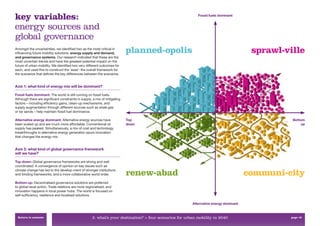
Amongst the uncertainties, we identified two as the most critical in
influencing future mobility solutions: energy supply and demand,            planned-opolis                                              sprawl-ville
and governance systems. Our research indicated that these are the
most uncertain trends and have the greatest potential impact on the
future of urban mobility. We identified two very different outcomes for
each, and used this to construct the ‘axes’: the overall framework for
the scenarios that defines the key differences between the scenarios.


Axis 1: what kind of energy mix will be dominant?

Fossil fuels dominant: The world is still running on fossil fuels.
Although there are significant constraints in supply, a mix of mitigating
factors – including efficiency gains, clean-up mechanisms, and
supply augmentation through different sources such as shale gas
or tar sands – help maintain fossil fuel dominance.

Alternative energy dominant: Alternative energy sources have               Top                                                                  Bottom
been scaled up and are much more affordable. Conventional oil              down                                                                      up
supply has peaked. Simultaneously, a mix of cost and technology
breakthroughs in alternative energy generation spurs innovation
that changes the energy mix.


Axis 2: what kind of global governance framework
will we have?

Top down: Global governance frameworks are strong and well
coordinated. A convergence of opinion on key issues such as
climate change has led to the develop-ment of stronger institutions
and binding frameworks, and a more collaborative world order.              renew-abad                                                 communi-city
Bottom up: Decentralised governance solutions are preferred
to global-level action. Trade relations are more regionalised, and
innovation happens in local power hubs. The world is focused on
self-sufficiency, resilience and localised solutions.

                                                                                                        Alternative energy dominant


 Return to contents                                 2. what’s your destination? > four scenarios for urban mobility in 2040                    page 19
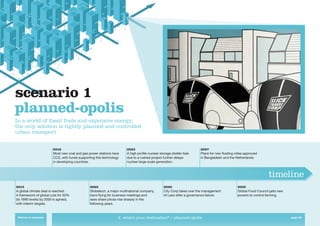
scenario 1
planned-opolis
In a world of fossil fuels and expensive energy,
the only solution is tightly planned and controlled
urban transport.


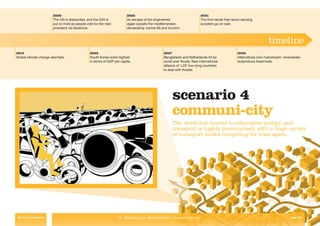
                        2018                                          2023                                          2027
                        Most new coal and gas power stations have     A high profile nuclear storage shelter leak    Plans for new floating cities approved
                        CCS, with funds supporting this technology    due to a rushed project further delays        in Bangladesh and the Netherlands.
                        in developing countries.                      nuclear large scale generation.


                                                                                                                                                               timeline
2015                                           2020                                           2025                                          2035
A global climate deal is reached.              Globetech, a major multinational company,      City Corp takes over the management           Global Food Council gets new
A framework of global cuts for 50%             bans flying for business meetings and           of Laos after a governance failure.           powers to control farming.
(to 1990 levels) by 2050 is agreed,            sees share prices rise sharply in the
with interim targets.                          following years.


 Return to contents                                              2. what’s your destination? > planned-opolis                                                              page 20
factors shaping mobility
Energy supply                                  Resource use                                The economy                                       Climate change responses

Centralised grids rely on gas-fired             Strict planning and rationing ensure        A strong, regulated economy                       Cities are replanned as extreme
power stations and carbon capture              resources are used as efficiently            invests in technology and                         measures are taken to decarbonise
and storage.                                   as possible.                                infrastructure.                                   the world.

A high carbon price makes energy very          There is strong reliance on technological   The economy in 2040 is quite strong, and          The world relies on geo-engineering. ‘Carbon
expensive, but a lack of viable alternatives   solutions and centralised planning to       global trade continues to grow, although it       scrubbers’ that take CO 2 directly out of
means fossil fuels – in particular shale gas   overcome resource shortages. Water is       is tightly regulated and sky-high oil prices      the air are a common sight on city streets.
and methane hydrates – still dominate.         commonly rationed. To maximise efficiency    restrict the sort of goods that can be            Many cities with high food risk have been
Investment has been focused on reducing        the ‘Global Food Council’ dictates what     traded. Import tariffs and subsidies have         deliberately downsized and populations
energy demand and increasing efficiency.        crops can be grown where in the world.      been reduced. The US, China and Russia            moved to new cities designed from scratch.
Nuclear energy has not scaled as expected,     Consumption of energy-intensive meat        dominate – the latter due to its land, oil,       Floating city technologies pioneered by the
held back by technical delays, escalating      is restricted. Tight monitoring of raw      coal and forest resources. Spending on            Dutch have spread to other rich city areas
costs and a shortage of skills. Very           materials such as metals, wood or paper,    technology and R&D, especially on energy          such as Hong Kong. Cities are re-engineered
efficient carbon capture and storage (CCS)      ensures that resources are reused           efficiency measures, is very high. Growth          for natural cooling – tree-planting, green
technology is necessary to keep carbon         and recycled. Biotechnology and             has allowed significant investment in new          roofs and natural ventilation are common.
emissions down.                                nanotechnology have helped engineers        infrastructure, including large urban projects.
                                               and scientists develop new materials                                                          Governance
                                               with exceptional physical properties.
                                                                                                                                             One-size-fits-all governance is
                                                                                                                                             effective but reduces freedoms.

                                                                                                                                             Global governance is well-coordinated and
                                                                                                                                             effective. There are agreements on climate
                                                                                                                                             change, displaced people and global
                                                                                                                                             agriculture. Global agreements are quickly
                                                                                                                                             implemented at a national level. Technology
                                                                                                                                             plays a significant role in supporting
                                                                                                                                             governance. Cities are often run by
                                                                                                                                             specialist, city-governing companies. These
                                                                                                                                             companies bid for very lucrative long-term
                                                                                                                                             contracts and may run dozens of major cities
                                                                                                                                             worldwide. This means that effective policies
                                                                                                                                             developed in one city can quickly spread
                                                                                                                                             around the world, but it also means that very
                                                                                                                                             different cities tend to be run in the same
                                                                                                                                             way, despite local differences. This leads to
                                                                                                                                             complaints about loss of national sovereignty
                                                                                                                                             and individual freedoms.


 Return to contents                                              2. what’s your destination? > planned-opolis                                                                    page 21
continued…
Social trends                                   Human values                                     The business landscape                         The role of technology

A fairer but less                               A hard-working but                               Big business is everywhere,                    A hi-tech world of integrated
individualistic society.                        high-trust world.                                and even governs some cities.                  systems and virtualisation.

Inequality between countries has decreased      People rely on new technology to solve           Big business is thriving in the globalised     Technology penetrates every aspect of life.
as the global economy has rebalanced.           problems. They are also, in general, very        economy, operating global brands, with         The natural environment is continuously
Inequality within countries has also            accepting of government or business              localised distribution and supply chains       monitored. Many people, especially the
decreased, though in most societies there       intervention in their lives, and look to large   due to the high price of oil. Business plays   young, live much of their lives through
is still a persistent underclass and elite.     institutions to provide security and stability   a major role in government and in people’s     avatars – online personas – working and
Individual freedoms have been eroded.           in an unpredictable world. There is a strong     lives. For example, City Corp is a global      forming relationships, learning, seeking
Societies tend to be less diverse than in       feeling of international solidarity.             firm that specialises in governing cities       advice and spending leisure time. This
the past. Civil society is less vibrant and                                                      (transport, energy, healthcare and so on)      means there is less need to travel. Smart
there is less protest and political violence.   The car is no longer seen as a status symbol     as efficiently as possible. It uses computer    technology is everywhere and helps to
                                                by many. Right across the world, people          models to design integrated systems that       integrate diverse systems, such as energy,
                                                are very willing to participate in coordinated   can be adjusted and applied to any large       food and waste. Most vehicles communicate
                                                mass transit systems. The 9-to-5 no longer       city in the world. More and more services      with each other, can drive themselves,
                                                exists since we are always ‘logged on’,          are delivered virtually.                       and use augmented reality technology.
                                                although we also work more. In some
                                                megacities, alienation and depression is
                                                a big issue due to much ‘virtualisation’,
                                                work fatigue, and the fragmentation of
                                                traditional social units. Special interest
                                                groups are popular among older people,
                                                calling for a renaissance of low-tech,
                                                face-to-face connectivity in cities.


 Return to contents                                                 2. what’s your destination? > planned-opolis                                                                  page 22
urban form                                        mobility
Huge urban regions are transformed                Demand for mobility is down, car
by system-planning, virtualisation                ownership has reduced and transport
and a generational divide.                        systems are highly integrated.

Megacity regions in some parts of the world       Transport in most cities is highly regulated.
house more than a hundred million people.         Some cities have become completely
Cities are tightly regulated and carefully        car-free, others only allow electric cars
planned. Many new cities have been created        and the majority have strict standards on
and slum-dwellers forcibly resettled. New         fuel economy for any internal combustion
suburbs have often been designed around           engine or hybrid vehicles. Car parks have
the electric bike, not the car, with narrow       disappeared from many urban areas,
streets that blend walking space with bike        replaced by houses or urban farms.
space. Cities are more formalised places          Commuters apply for a 15-minute travel slot
than they used to be. Informal activity, such     if they need to travel to work.
as unplanned building or unlicensed markets,
is not tolerated.                                 People are told when to travel and by
                                                  what mode. Small vehicles are likely to be
City form is heavily influenced by                 electric, using energy from centralised grids,
virtualisation, with a greater blending of        while larger vehicles such as coaches and
social classes and more people living urban       trucks are more likely to use liquid fuel. Car
lifestyles far away from the city. People can     ownership is low, though the rich are still
live in one city but be ‘resident’ in another     driving cars and paying the high price.
location of their choice, some of which only      Transport systems have evolved to be highly
exist in the virtual world, such as ‘London 2’.   integrated across the different modes,             Transport is treated by city governments as
Cities are governed increasingly as complex       including walking and cycling, inter-city travel   one part of a functioning urban system that
systems (integrating energy, transport, water,    and consequently also transport systems in         includes energy systems, water, waste, food,
waste and so on), to maximise efficient use        nearby cities. Any delays or breakdowns can        distribution and so on. City governments
of resources. Activity – movement of traffic       disrupt transport over huge areas. People          look for solutions that can integrate the
and people in particular – is continually         have ‘calorie cards’ that can be topped up         different subsystems most efficiently, for
tracked.                                          and spent on anything, including different         example combining public transport with
                                                  modes of transport, with a high-energy mode        freight transport or energy storage.
There is a significant generational gap            using more calories than a low-energy mode.
between younger and older people, as the                                                             The high prices of oil and carbon mean
young adapt more quickly to living their lives    Smart cars ensure that driving behaviour is        that all transport modes are expensive,
in virtual spaces. The over-60s dominate          smooth and safe and keeps traffic moving            except for walking and cycling. Along
the physical city, while younger people           as much as possible. In the most advanced          with the tight regulation of transport and
dominate the virtual city. This means that the    cities, mass transit and individual transit        advances in ICT this means that many
whole urban physical environment, including       become blurred: an individual can drive a car      people, particularly younger people, live
                                                  to a mass transit route and join a computer-       their lives online – working, shopping,
                                                  controlled convoy, effectively becoming a          consuming and socialising. As a result,
                                                  part of the mass transit and surrendering          personal mobility is reduced but freight
                                                  control of the vehicle, then leave the convoy      mobility (delivering products that were
                                                  again when convenient.                             ordered online) has increased.


  Return to contents                                                  2. what’s your destination? > planned-opolis                                  page 23
scenario 2
                                                                                                      sprawl-ville
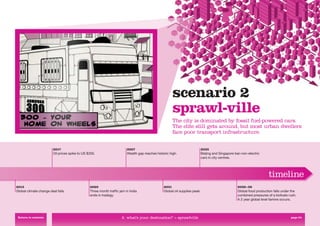
                                                                                                      The city is dominated by fossil fuel-powered cars.
                                                                                                      The elite still gets around, but most urban dwellers
                                                                                                      face poor transport infrastructure.


                        2017                                            2027                                            2035
                        Oil prices spike to US $200.                    Wealth gap reaches historic high.               Beijing and Singapore ban non-electric
                                                                                                                        cars in city centres.


                                                                                                                                                                   timeline
2015                                            2020                                            2031                                           2036–38
Global climate change deal fails.               Three month traffic jam in India                 Global oil supplies peak.                      Global food production falls under the
                                                ends in tradegy.                                                                               combined pressures of a biofuels rush.
                                                                                                                                               A 2 year global level famine occurs.


 Return to contents                                                  2. what’s your destination? > sprawlville                                                                   page 24
factors shaping mobility
Energy supply                                        Resource use                                       Climate change responses                         Governance

Oil production peaked around 2030                    Resource shortages – and the                       A focus on adaptation and protecting             A global shift towards more
but transport still uses fossil fuel                 ensuing scramble – have a direct                   assets in the short term.                        authoritarian power.
– particularly gas – and focuses                     impact on human development.
on efficiency.                                                                                           Climate impacts are occurring roughly in         Short-termism is the rule. There is little
                                                     The market is only now starting to realise         line with predictions, but the elites (nations   international collaboration on energy or
Electricity grids rely on fossil fuels – primarily   that oil supply has peaked. Biofuel crops          or groups) prefer to protect themselves          climate concerns. Emissions reduction
coal and natural gas – for over half of their        are big business, resulting in uncontrolled        rather than taking global action. Adaptation     targets exist in developed countries but are
energy, with nuclear and renewable energy            encroachment on both forest and croplands.         measures tend to be local and reactive, for      increasingly circumvented. Nation-states
providing the rest. With demand down                 As well as causing high food prices, this has      example building new sea walls after flooding     are becoming more authoritarian in the
due to energy efficiency and a shrinking              led to serious deforestation, in turn affecting    or abandoning dust-bowl agricultural regions.    face of fuel and food shocks, spawning a
economy, supply is generally more reliable           ecosystems and livelihoods of poor people.         Land and assets are exploited for short-term     number of violent changes of government.
than it has been in recent decades. Rapid            Add in the fact that water is in short supply,     profits and then abandoned when exhausted.        The European Union is intact but has not
advances in engine efficiency (forced by              and it is not surprising that there has been a     This tendency is amplified by the ability of      expanded further. Cities are governed by
regulation in developed countries) mean              significant increase in deaths from famine in       the rich to shield themselves from climate       and for elites, but this includes avoiding
that most vehicles still use oil-based fuels,        the last few decades. Home-grown food is           change impacts inside air-conditioned            unrest and keeping the wheels of business
despite the fact that in 2040 there are so           booming across the world, in cities as well        domes, malls and vehicles. Corporate action      turning, so basic transport infrastructure is
many more cars in the world than in 2010.            as rural areas and transport of water by road      is significant, trying to protect supply chains   maintained. Corruption has increased, with
Fuel comes from unconventional sources               and rail across vast distances to megacities       and markets. A new sector of the economy         the potential for profiteering from energy and
such as tar sands and gas-to-liquids, but            (for example from Cambodia to south China)         has emerged whose business is global             food issues.
an increasing proportion comes from                  is commonplace.                                    climate change response strategy.
biofuels. Vehicle use is expensive and
excludes poorer people from using their              The economy
cars regularly. Growth in electric vehicles
has been limited due to high costs of                Global stagnation, protectionism
developing the necessary new infrastructure.         and shrinking supply chains.

                                                     After a period of moderate growth up to the
                                                     early 2030s, the global economy, dominated
                                                     by China and the US, is now flat at best,
                                                     with some major economies including China
                                                     teetering on the edge of recession. The main
                                                     cause of this is the decline in oil supplies and
                                                     price shocks, but other resource constraints
                                                     have taken their toll. The economy is rapidly
                                                     becoming more protectionist, with bilateral
                                                     agreements and export bans proliferating.
                                                     The transport supply chain is still global but
                                                     reduced, with air travel shrunk by high fuel
                                                     prices, and increased shipping costs driving
                                                     shorter supply chains.


  Return to contents                                                        2. what’s your destination? > sprawlville                                                                        page 25
continued…
Social structures                              Human values                                       The business landscape                          The role of technology

A less equal world, where the informal         Polarisation of ideology and a                     Business is powerful – with an                  Efficiency gains but few
economy prospers.                              loss of faith in consumerism.                      expanded role in society as a result            major breakthroughs.
                                                                                                  of less public service provision –
This is an oligarch’s and black marketeer’s    The economic difficulties of the past decade        but it is also less accountable.                Technological developments have focused
world. Global middle class prosperity in the   have contributed to two notable trends. First                                                      on efficiency gains. This is most notable with
2020s proved a false dawn and inequality       is the polarisation of political attitudes, with   Business plays a central role in this           the internal combustion engine, but can
is up. Democratic institutions are on the      some sectors of society calling for predatory      world, stepping in when government or           also be seen with solar energy and a host
back foot and power goes to those who          energy policies or draconian austerity             communities fail, or even usurping power.       of others. For a long time there have been
grab resources and political influence. Oil     measures to allow a return to business as          Most of the largest and most powerful           no major breakthrough technologies that
companies retain their influence, much          usual, while others seize on the new crisis as     businesses in the world are privately owned.    have changed the world in the way the
as bankers did after the financial crisis of    a chance to reform capitalism and reverse          This makes them less accountable, which         internet did. Technology development tends
the 2010s, with the industry dominating        globalisation. The polarisation is particularly    they often counter with major philanthropy      to be driven most by corporate R&D and the
important cities such as Washington DC.        critical in the USA, where some states             and civic investment programmes. There          public, especially those with few resources,
The informal economy flourishes in the          threaten secession. Revolutionary Marxism          are huge opportunities for entrepreneurs.       struggle to access much of it.
face of high unemployment, taxes and           has returned as a major political force.           Expanding areas of business include: coal,
import costs, with local and home-grown        The second trend is a resurgence in ethnic         coal-to-liquids and gas-to-liquids, biofuels,
produce and even organic waste (as a           tension and a return to religion and traditional   urban gardening, warehousing (as just-in-
biofuels feedstock) traded both on the         values as people lose faith in consumerism.        time is rolled back), domestic service,
streets and the internet.                                                                         grid renewables, nuclear, military, security,
                                                                                                  and the scrapping or modifying of vehicles.
                                                                                                  On the other hand, airlines, international
                                                                                                  tourism, hotels, cars and luxury goods
                                                                                                  (except for top-end billionaire yachts, which
                                                                                                  remain popular with the “biofuel barons”)
                                                                                                  are all in decline.


 Return to contents                                                   2. what’s your destination? > sprawlville                                                                       page 26
urban form                                      mobility
Low density sprawl and fragmented               Cities are locked into car-use though
suburbs are the norm.                           congestion is rife, leading to a spate
                                                of innovative solutions.
The car-dominant urban model persists,
resulting in the growth of huge, low-density    Car ownership has grown hugely, especially
suburbs, freeways to connect them and           in middle-income countries such as India
commuter jams. In the periphery of the city     and China. Local politicians have responded
there are numerous ‘failed’ developments,       to the rise of new middle class car owners
built too far from public transport and         with road-building trophy projects. However,
therefore unaffordable to urban commuters       the latent demand before 2030 was such
now that oil prices are high. Since 2030, the   that new roads became congested
value of many of these new developments         immediately, and many of the new vehicles
has crashed, with too many residents            are only used sporadically. Vehicles are
unemployed or unable to afford the car          designed for occasional use, and build in
commute to their jobs. They either become       alternative functions while they are stationary,
ghetto areas for poorer people, and informal    such as storage or energy generation.
paratransit services spring up to service       Some are designed to attach to buildings
long commutes for those who were still          and act as extra living or storage space.
employed, or are reborn as local
communities try to provide their own            Rush hours spread as people move their
services. Many large cities have gone back      commute to escape the congestion. A
to being fractured towns with either derelict   new phenomenon is the nomad
or farm areas in between. For example,          businessman, who may spend much of
Detroit no longer exists, replaced by five       the day working online in a secure vehicle         The developed world has been at car            and toll roads. Many cities have built private
smaller cities. There is a lot of decaying,     while his driver takes him slowly through          saturation since the early 2010s. Travel has   member-only roads. In an economically
underused car infrastructure being              the jams to meetings. Vehicles providing           increased modestly but only where there        constrained world, new infrastructure
scavenged and repurposed. Successful            many of the services an office might                is room, which means via cycling, walking      projects are rare, and those that do exist
‘post-oil’ cities such as Amsterdam and         provide, such as IT help, refreshments,            and public transport expansion, all of which   find new ways of full price recovery.
Singapore are doing very well.                  toilets and meeting facilities, can be found       saw significantly increased investment in
                                                using location software. Some vehicles             the 2010–30 period. Traffic growth has
                                                are fitted with solar roofs to drive systems        been constrained as area-congestion and
                                                when stationary, though the impact                 other road charging schemes have spread,
                                                of smog on the performance of these                as have car clubs and bike hire. Electric
                                                products can be severe.                            vehicles are a common sight in city centres
                                                                                                   but have not hit the mainstream. Some
                                                Car parks have proliferated. Delhi boasts          cities, for example Shanghai, Beijing and
                                                the highest sky-park in the world, at              Singapore, have mandated them in the
                                                45 storeys, serviced by car-lifts. Other           city centres, mainly to control air quality.
                                                responses to congestion, from helicopters
                                                to straddling buses to underground freight         With power often concentrated with elites,
                                                solutions, are common.                             schemes to free up the roads – and even
                                                                                                   elevated walkways – for the wealthy are
                                                                                                   widespread, particularly congestion charging


 Return to contents                                                    2. what’s your destination? > sprawlville                                                                        page 27
2015                                          2022                                          2032
                       Binding global climate change pact            Car use and GDP growth                        US $1 billion Beijing Energy
                       signed. Strict carbon quotas and              are officially decoupled.                      Innovation Contest leads to
                       US $1 trillion mitigation fund.                                                             hydrogen cells breakthrough.


                                                                                                                                                                timeline
2013                                          2018                                          2025                                           2037
A second global recessionary cycle occurs,    ‘C8’ powerful world cities hold first          The EU bans fossil fuel powered automobiles,   China, Mexico and Turkey form resource
becuase of a resources crunch, and            summit and agree to form cyber armies.        with a 5 year phase out plan.                  coalition to secure global lithium supplies.
hardhitting natural disasters impacting
key economic hubs.


scenario 3
renew-abad
The world has turned to alternative energy and
high-tech, clean, well-planned transport helps
everyone get around.


 Return to contents                                              2. what’s your destination? > renew-abad                                                                       page 28
factors shaping mobility
Energy supply                                    Resource use                                     The economy                                     Climate change responses

A rapid transition to renewable                  Resource use is strictly regulated               Economic power has shifted.                     An early global deal on climate
energy brings the world to the                   in a world short of food and land.                                                               change means crisis can be averted.
edge of a new energy paradigm.                                                                    The cost of decarbonisation has caused
                                                 The shift to alternative energy in the 2030s     global disruption, and disposable incomes       Climate action emphasises mitigation – the
A high carbon price has pushed fossil fuel       caused resource grabs and land-use shifts,       are lower than in 2010. The global balance      community of states believes that the worst
prices up and stimulates investment in           affecting food production as a result. Food is   of power has shifted radically. China’s early   climate impacts can still be averted. The price
renewables, including concentrated solar         particularly scarce in Central Asia and Sub-     push on clean-tech brought huge growth          of carbon is very high, and there are personal
power, wind and wave. Because of the sharp       Saharan Africa. Agrichemical companies           dividends. India is also strong, particularly   carbon quotas in place in many countries.
transition to low carbon solutions, energy       are tightly regulated in these regions and       in terms of the hydrogen economy and
is still relatively expensive. Innovations       focus on biotech innovation to build yield and   IT. Brazil and Mexico compete over the          A climate change adaptation fund for low-
in advanced thin film solar cells make            climate resilience.                              leadership of a powerful Latin American bloc.   income countries has existed for decades.
decentralised generation easier, and some                                                         US and Russian influence is waning. Some         Some countries used it to pursue aggressive
countries set micro-generation targets for       Many governments impose biodiversity             European states with shrinking populations      low-carbon growth instead, sparking tension
households in an effort to reduce costs.         restrictions such as natural resource quotas,    have developed steady-state economies.          and resentment from the West. But others
                                                 offset obligations, and restrictions on the                                                      are forced to be more reactive, including
Nuclear energy and biofuels are                  use of virgin resources. In some countries,      Nimble emerging players in Asia, Latin          parts of South and Central Asia as well as
uncompetitive. The next wave of energy           for example, the lack of bees now means          America and Africa leapfrog to low-carbon       Sub-Saharan Africa, where low lying cities
innovation is happening with ubiquitous          that vehicles driving between cities are fitted   solutions. This includes hydrogen generation,   and drought prone regions have to invest
generation through vibration-based               with technology to artificially pollinate the     which gives these economies an edge when        massively in sea barriers, resilient crops
technology and mainstreaming of hydrogen         fields surrounding highways. Micro-food           it comes to emerging mobility technology,       and cooling urban green top.
fuel cell technology. Thanks to breakthroughs    production in urban areas is flourishing          and is beginning to disadvantage those who
in solar-powered electrolysis, several regions   as people utilise locally abundant food          made early investments in electrification.
in North Africa and Asia have transitioned       sources to address resource needs.
entirely to a hydrogen economy.

Personal mobility continues to be accessible,
but several countries have recently had
electricity outages as a result of electric
cars overloading the grid.


 Return to contents                                                    2. what’s your destination? > renew-abad                                                                        page 29
continued…
Governance                                    Social structures                                The business landscape                            The role of technology

Strict governance holds sway in               The rich-poor gap has narrowed but               Business provides low-impact                      Innovation is driven and regulated by
nation-states and city-states alike.          a generational gap has opened up.                services in collaboration with                    the public sector, with an important
                                                                                               governments.                                      breakthrough in battery technology.
Governance systems are unified and strong.     This is a world of greater social order and
Benign autocracies in a number of emerging    more equity within societies. Governments        The low carbon economy has created losers         Technological progress has been rapid and
markets have often been more successful       redistribute wealth. People seek to re-          such as big oil companies – and winners,          dominated by the public sector. Networking
than traditional Western democracies.         identify with their local communities, despite   such as renewable energy firms. Businesses         technology has been a great enabler
The global balance of power is concentrated   strong global governance and ubiquitous          operating in cities are forced by law to invest   of development, but has also allowed
between China and a handful of key allies,    web connectivity. Pockets of poverty and         in infrastructure and services. Those able to     governments to monitor citizens’ movements
including Mexico, Turkey and some             simmering resentment are growing in              partner with governments in delivering low-       and behaviour patterns more closely.
city states.                                  regions left behind in the low-carbon race.      carbon, resource efficient infrastructure are
                                              The ageing populations of China and Latin        best placed.                                      Technology investment is channelled towards
Governments impose stricter rules, and use    America cause intergenerational strife.                                                            achieving national goals and improving
increasingly sophisticated technology for                                                      New industry clusters have emerged                civic life. Countries invest in smart-grid
monitoring and enforcement. They often        Human values                                     to cater to the sustainable consumer’s            systems that optimise energy use. There
mandate where you live within the city, how                                                    increasing demand for integrated, low-            have been breakthroughs in battery
you travel, and how much energy you use.      People value simplicity                          carbon access to goods, services and              technology allowing electric vehicles to
Chips embedded in everyday objects ensure     and authenticity.                                information. Former food retailers have           scale up, with Asia as the key centre of
compliance. Crime rates have dropped                                                           partnered with construction companies and         innovation. Mobility efficiency is a priority,
and traffic regulation has improved, but       Lifestyles have become more sustainable          designers to provide integrated domestic          and all modes of transport are equipped
civil society organisations argue that the    and people define themselves through              asset management, delivering living spaces        with data storing and sharing capabilities.
democratic process is dead.                   low-carbon, green identities. Consumption        bundled with nutrition and water systems.
                                              is oriented towards ‘experience’ services,       Transport providers vie to offer the best
City-states again hold sway over wider        slower living and simplicity, which is just      ‘experience’ service, such as providing the
territories, as they did in medieval and      as well because there is less disposable         best food on the daily train or bus commute,
early modern Europe. The ‘C8’ powerful        income to spend on acquiring goods.              the best ICT solutions for virtual working,
conurbations – Cairo, Lagos, Los Angeles,                                                      and superior onboard entertainment.
Mumbai, Sao Paulo, Seoul, Shanghai and        ‘Quality of life’ means superior connectivity
Tokyo – hold an annual summit, and have       via integrated smart personal devices,
developed their own defence forces.           access to nature, and access to efficient,
                                              low-carbon lifestyle enablers, such as
                                              integrated work-travel-entertainment
                                              services.

                                              The desire to drive has diminished and
                                              previous generations’ obsession with the
                                              motor car seems strange and old-fashioned.


 Return to contents                                                 2. what’s your destination? > renew-abad                                                                        page 30
urban form                                       mobility
Cities are consolidating and                     A shift to mass transit reduces
moving towards polycentric                       congestion while alternative
models.                                          fuels reduce the impact of travel.

The age of urban sprawl is over. Cities          There has been a sharp change in the
are redensifying and setting growth              transport fuel mix: electric, hybrid and
boundaries in an effort to create more           – increasingly – hydrogen motors dominate.
efficient, polycentric forms. Former suburbs      Filling stations have been converted into
have emerged as new cities, smaller              ‘energy stations’, integrated service stops
in size but well-connected to megacities         that offer a multiplicity of fuels.
through ultra high-speed rail links.
Megacities continue to be important              Personal vehicles are attainable, but no
engines of growth and in the new city            longer as desirable. Car ownership is
states this is matched by political power.       stigmatised in many places – much like
                                                 smoking was in the 2000s. Personal
Neighbourhood-centric planning is the            vehicles are ultra-small, stackable electric
norm and people tend to live, play and work      pods and solar scooters that can be
in the same locality. Neighbourhoods are         programmed to drive themselves via an
organised around key mobility and energy         onboard journey planner, leaving the driver
nodes. These provide integrated services,        to have a meal or chat with friends. They      location-based applications that convey
from in-house energy generation to vehicle       are frequently interchanged with public        tailored information to users.
charging points, to community centres and        transport modes as well as cycling and
smart working hubs.                              walking, because urban centres are often       All this, combined with the proliferation of
                                                 non-motorised.                                 local food production and sophisticated
There are strict targets around waste                                                           underground freight pipelines, means
disposal and energy generation in buildings      People feel civic pride in using effective     congestion is an issue of the past in
– all monitored by smart meters. In shrinking,   public transport systems. In order to          most cities. The daily commute is tightly
post-industrial cities, unused inner-city land   maintain a degree of personal space,           controlled by government. There are often
is converted into intensive farmland. Inner-     personal rapid transit (PRT) is a popular      set times when you can commute to work
city slums have become ‘urbanised’ with          mode of choice: people can work or surf        and back; and some cities even mandate
affordable eco-housing and greater access        the net while travelling in individual         a residence radius within a certain distance
to transport and other infrastructure.           rail pods. The less privileged pile on         from work, impose commuter taxes, or
                                                 hydrogen-powered buses, although with a        subsidise low carbon mobility patterns
In megacities where overcrowding has             powerful range, dedicated corridors, and       (e.g. online shopping, cycling, non-motorised
become an issue, governments are                 sophisticated ICT services, these are a far    delivery services).
incentivising large-scale population             cry from the buses their parents used.
shifts to second- and third-tier cities,                                                        Key urban zones are now connected
which are experiencing rapid social and          Almost every aspect of transport is guided     by ultra high-speed trains, so mobility
economic growth.                                 by e-technology (e.g. sensing technologies     between regions remains high despite
                                                 and interactive services deployed to enable    the fact that flying is no longer available
                                                 information access, manage demand, etc.).      to the masses. Chinese railway systems
                                                 Daily commutes are optimised by always         encircle the globe, taking people vast
                                                 knowing what – and who – is around, through    distances on 300mph trains.


 Return to contents                                                    2. what’s your destination? > renew-abad                                 page 31
2020                                            2025                                             2031
                        The UN is disbanded, and the G20 is             An escape of bio engineered                      The first hands free neuro-sensing
                        put on hold as people vote for the next         algae carpets the mediterranean,                 scooters go on sale.
                        president via facebook.                         devastating marine life and tourism.


                                                                                                                                                                   timeline
2015                                            2022                                            2027                                            2035
Global climate change deal fails.               South Korea ranks highest                       Bangladesh and Netherlands hit by               Alternatives now mainstream: renewables
                                                in terms of GDP per capita.                     worst ever floods. New international             outproduce fossil fuels.
                                                                                                alliance of ‘L20’ low-lying countries
                                                                                                to deal with threats.


                                                                                                      scenario 4
                                                                                                      communi-city
                                                                                                      The world has turned to alternative energy, and
                                                                                                      transport is highly personalised, with a huge variety
                                                                                                      of transport modes competing for road space.


 Return to contents                                                2. what’s your destination? > communi-city                                                                    page 32
factors shaping mobility
Energy supply                                    Resource use                                       The economy                                     Climate change responses

Local renewable energy generation                Cities have transformed to produce                 Grassroots business and new                     People and communities adapt to
and decentralised grids have                     more of their own food and deal                    technology compensate for                       climate change and reduce carbon
superceded coal, gas and oil.                    locally with waste and water.                      protectionist trade and slow                    despite weak global policy.
                                                                                                    global growth.
Fossil fuel use is a thing of the past.          Food is expensive and demand for land                                                              There is no global climate change deal but,
Oil supplies have peaked and coal sits           is high. Large, privately owned and poorly         The world is a more fragmented place.           spurred on by climate disasters, individual
in the ground un-mined because the               regulated plankton and algae farms                 The lack of a global framework for climate      governments and companies proactively
alternatives are so much cheaper and work        dot coastlines in populated zones, all             change has led to protectionism, smaller        put money into technological development
better. The full spectrum of renewables          bioengineered. Community-organised                 markets and lower overall growth. On the        without waiting for a cap-and-trade system.
is being deployed at a local scale: solar,       vertical and small-scale horticulture has          other hand, energy is more accessible,          As a result, low carbon solutions have come
wind, wave and biomass, depending on             flourished in cities, with balconies, roofs and     cheaper and cleaner. Rapid, bottom-up           on stream quickly and overall emissions
local circumstances. Small-scale, local,         the sides of buildings given over to growing       technology development has boosted              are quite low. In this do-it-yourself world,
decentralised grids proliferate and many         food. Cities look and feel very different as       productivity. Winner countries are those with   people are adapting to climate change
businesses and individuals around the world      a result, though they are still reliant on their   large internal markets to drive growth, big     themselves, leading to some interesting new
have gone completely off-grid. Micro-nuclear     hinterland and imports to feed themselves.         cities and a highly educated knowledge-         ideas. Floating farms and flood-resistant
has proliferated too, with thousands of small    Urban aquaculture, using various bio-              based workforce. Brain enhancement              construction are now routine technologies
reactors dotted across the world. These have     engineered species, helps dispose of waste         breakthroughs in Korea have pushed that         for resisting climate shocks. The rich world
passive cooling systems, which continue to       and provide food. Cheap energy means cities        country to the top of the economic league,      is better able to afford these technologies
work even if power goes down, and operate        can afford desalination. Technologies for          but others are now copying and catching up.     for low-carbon adaptation. When poor
for up to 30 years without refuelling. Nuclear   water capture and saving are booming. Most                                                         countries experience natural disasters, there
proliferation has now eclipsed climate           houses and apartment blocks have their own                                                         is no global relief effort. This has lead to an
change as the number one security worry.         harvesting, recycling and purification plants.                                                      increase in violent outbursts against what is
                                                                                                                                                    perceived to be the rich world’s ‘climate debt’
                                                                                                                                                    and monopoly on life-saving technology.


 Return to contents                                                   2. what’s your destination? > communi-city                                                                         page 33
continued…
Governance                                       Social structures                                    The business landscape                              The role of technology

Central coordination is weak                     A more unequal world, but full                       Business is more decentralised and                  Rapid breakthroughs make
and more power resides at the                    of opportunity.                                      global businesses are less common.                  technology an exciting area of
community level using computer-                                                                                                                           change, and many people are
based collaborative tools.                       Inequality within and between societies              The model for the economy and commerce              involved through grassroots
                                                 is on the rise, and the process of reverse           is the internet: distributed, and bottom up;        innovation and research.
Multilateralism has disintegrated, because       globalisation has led to distinct winners and        with not too much power held in one place.
Global agreements and governance grew            losers. There are few mechanisms for wealth          The physical economy – primary, secondary           Innovation has flourished all over the globe.
increasingly complex, expensive and              redistribution, though social mobility is high       and tertiary – is very localised. Manufacturing     Bottom-up, multiple approaches have
unworkable. Politicians failed to realise that   and entrepreneurialism is strong. If you’ve          too is very local, often using nanotech,            led to rapid breakthroughs, and not just
international machinery could only go so         got a good idea you can build a successful           and made viable by very cheap renewable             in low-carbon technology. Bio and nano
far without cultural integration. Eventually,    business locally, but it is difficult to take it to   energy. Goods and services have become              technologies have also developed rapidly.
much of it fell apart to be replaced by a        scale.                                               more regionalised and culturally specific.           Some of the biggest breakthroughs are
network of bilateral, regional and peer-to-                                                           Products are made for local markets and,            happening where technologies – such
peer alliances. Some nations remain strong,      Human values                                         because of a lack of international standards        as bionics and ICT or bio and nanotech
but many have weakened or fragmented,                                                                 are difficult to trade internationally. One area     – converge. Neuro-sensing control via brain
replaced by regional and local governance.       People are less consumerist and                      where the world is still relatively globalised is   activity is being widely used in information
People are less willing to be told what to do.   status-driven and look more to                       in information technology. It is a networked        technology and more recently in transport.
Online crowd-sourcing is common in city          religion and community.                              world, with lots of virtualisation. However,        This R&D is no longer the preserve of major
development and in deciding what public                                                               even here a series of catastrophic viruses          companies and governments: open source
services should be provided. Many cities         Religious and cultural norms have become             have focused people on IT security rather           ICT and local manufacturing technologies
adopt a collaborative model of governance        more entrenched in many places. Elsewhere,           than speed of interaction, and increasing           mean that backstreet labs are a major source
with local participatory budgets. This has       people value the local and blend the                 distrust between nations means that some            of innovation.
worked very well in many areas, but in others    traditional with ultra-modern. In the US,            thirty governments have blocked access to
it has been hijacked and corrupted.              for example, anti-consumerist evangelical            the global internet.
                                                 Christianity holds sway. With Islam on the
                                                 rise in Africa and Asia, as well as vocal
                                                 nationalism in countries like China, many
                                                 consumers have turned to local trends
                                                 inspired by religious and cultural ideals,
                                                 and reject ‘Western’ style. It is a more
                                                 individualist world, with people wanting to
                                                 do things on their terms. Sometimes that
                                                 means collaborating with others through
                                                 communities and sometimes it means going
                                                 it alone.


 Return to contents                                                    2. what’s your destination? > communi-city                                                                            page 34
urban form                                         mobility
The city has become less formalised                Diverse modes of personalised
and more diverse and dynamic, with                 transport compete for space,
individuals and communities taking                 coordinating via automated
control over planning.                             technology.

Cities have greater significance and economic       Personal – and personalised – mobility is
clout than ever before. Non-urban regions          important. Modes of transport proliferate,
have to be either part of their hinterlands        from high-tech power-assisted bicycles
and spheres of influence or they suffer. The        to personal rapid transit pods to the very
informal settlements that encircle major           popular solar-scooter (an electric moped
cities have had a big influence on how they         with a wrap-around roof that both generates
function. They have been the source of much        electricity and shades the rider). Impact
innovation and creative energy. Cheap ICT,         prevention software and neuro-sensing
open source programmes and do-it-yourself          technologies keep the whole system
manufacturing such as 3-D printing have            moving and avoid too many collisions.
allowed ‘garage innovators’ to flourish. And        Customisation is ubiquitous. Some people
so the trend of informal settlements gradually     build their own vehicles and customise
gentrifying and coming to resemble the             them using locally designed and produced
formal city has gone into reverse. The whole       kits, open-source designs and scrap
city has become more informal, with crop-          materials. In some cases this can lead to
growing, temporary and creative use of             pollution problems and some vehicles look
space, self-planned settlements and open-          very unsafe.
source enabled mobility systems, and
multiple road users in multiple vehicle types,     Public transport systems persist but in
all to be found right across the urban area.       general have suffered through lack of
                                                   investment. Some have fallen into disrepair,
The sheer wealth of detailed information           even in wealthy cities. Those that remain
from networked tracking and monitoring             are often overcrowded and unreliable.
devices has caused a re-evaluation of some
basic design assumptions. For example,             The wealthy have taken to the skies in
some ‘safety features’ on streets have been        fan-driven personal flight vehicles such as
replaced by ‘hazards’ to increase safety by        the Heli-Hopper, Fly-lite and Jetson. One      households and communities, are the new
forcing people to pay attention.                   technology that is popping up everywhere       bestseller and are widely used to fuel family
                                                   is the biofuel-powered mini bus, which         or community-owned vehicles.
Much of urban design has shifted to a              is hugely adaptable in different urban
collaborative model with local participatory       environments, and can be powered by            With transport infrastructure at capacity,
budgets. Where this works, everything is very      food waste as well as locally-grown crops.     many people choose to work, learn and
tailored to the desires of the participants, for                                                  play in their local communities or use tele-
example with car-free family areas, or Segway      With production having peaked, and             presencing to access work, services and
lanes for the elderly.                             demand falling away rapidly, oil has been      leisure. The poorer sections of urban society
                                                   supplanted by third-generation, nano and       get around much as they have for decades
                                                   biotech enhanced biofuels, as well as cheap    – on foot and by bike, though many now
                                                   electricity. ‘Home-brew’ biofuel kits, for     build their own vehicles.


  Return to contents                                                   2. what’s your destination? > communi-city                                 page 35
3. what can
  you do?
 megacities on the move
solutions for sustainable
urban mobility
The future may seem difficult to predict, but there are
key ways in which you can begin to respond to ensure
you are taking the path you want. There are already
many urban mobility innovations, as the examples
below demonstrate. These innovations might not be
mainstream at the moment, but they are all real world
examples – some are concepts, others are at pilot
stage, and yet others fully implemented. We believe
they illustrate the ways in which city governments,
urban planners, transport providers and all other key
actors will have to respond in order to transition to
sustainable mobility systems.
We encourage you to think about the way that your
region, city or organisation can translate these six
key responses into your own work, and we hope that
the real-life examples will inspire you.


                                                                   Fukuoka Prefectural International Hall, © Emilio Ambasz & Associates


 Return to contents              3. what can you do? > solutions for sustainable urban mobility                                           page 37
1. integrate,
integrate, integrate
Transport, urban planning, business, public services,
energy and food supply can no longer be considered
in isolation. We need to create truly integrated systems
where people have choice, flexibility and seamless
connectivity. When people travel, they should be able
to connect much more smoothly and quickly between
different modes of transport. Increasingly, there
will also be a need to supplement this physical
connectivity with online connectivity: the ability to
check information before, and during, travel will
allow people to optimise their journeys, and perhaps
even substitute a degree of physical movement with
virtual access to lifestyle needs.


                             1.1 MIT CityCar System

                             A stackable, electric two-seater car designed
                             to be used as part of a mobility on-demand
                             system – similar to a bike-hire scheme
                             such as Vélib, where stacks of vehicles are
                             available for instant short-term hire at key
                             transport hubs such as train stations and
                             multiple other points around the city. Three
                             or four CityCars can fit in a standard parking
                             space. Future iterations could be integrated
                             with the urban energy supply system – stacks
                             of parked cars act as batteries that could
                             ‘smooth’ electricity demand in a city with      MIT CityCar System, © William Lark, Jr. – Smart Cities, MIT
                             lots of microgeneration such as solar roofs
                             or small-scale wind turbines.
                             http://cities.media.mit.edu/ (Go to Mobility
                             section, then select CityCar).


 Return to contents                 3. what can you do? > solutions for sustainable urban mobility                                         page 38
Straddling Bus, © Press Association                London Garden, © www.martenwallgren.com                                  Shweeb pedal-powered monorail,
                                                                                                                              © Shweeb


1.2 Straddling Bus                                 1.3 London Garden                                                        1.4 Shweeb pedal-powered monorail

An electric Bus Rapid Transit (BRT) system         An award-winning concept for car-free                                    Shweeb uses pedal-powered, highly
without the need for additional road space.        mobility in central London that integrates                               aerodynamic capsules that reduce drag and
The bus has two levels, the lower of which         bicycle, scooter and bus modes. A specially                              require less energy to propel at 20km/h than
is open and straddles the road, acting             designed semi-electric bicycle is available for                          you need to walk at 5km/h. The capsules
like a tunnel that cars can drive through.         hire and can be ridden as either a bicycle or                            travel along guiderails 6m above the ground
Passengers board the upper deck to a               an electric scooter. When ridden in bicycle                              that can be suspended above existing roads
maximium capacity of 300. The bus can              mode it generates and stores energy for the                              and walkways. A successful system would
either run on rails either side of the car lane,   scooter mode. It can also be folded up and                               potentially have positive effects on a city’s
or it can follow white lines using an auto-        used as a bus seat – in this case the energy                             health system by increasing general activity
pilot system. The bus is powered by relay          you generated and stored in your bike is                                 levels. There is also scope for some energy
charging and also charges at its stops. The        credited to you and used as a currency to                                generation. Shweeb has just received US
first system is due to be built in Beijing in       subsidise the cost of your journey. When not                             $1million in funding from Google’s Project
2011. http://www.chinahush.com/2010/07/31/         in use the bikes are stored on overhead racks                            10100 to build its first transit system for public
straddling-bus-a-cheaper-greener-and-              at bus stops where they generate further                                 use. http://shweeb.com/
faster-alternative-to-commute/                     energy via solar cells in their solid, hub less
                                                   wheels. http://martenwallgren.blogspot.
                                                   com/2009/06/winner-seymourpowell-award-
                                                   for.html


  Return to contents                                       3. what can you do? > solutions for sustainable urban mobility                                           page 39
2. make the poor a priority                                                                            Urban cable car                                 Ripple Effect, Naandi Container,
                                                                                                                                                       © courtesy of IDEO


Mobility systems must work for rich and poor alike,
to ensure no-one is shut off from goods, services
and employment opportunities. There are currently
4 billion people around the globe on low incomes.                                        6


Cities in particular have many low-income
communities – this trend will increase as much
of the world’s future population growth will be
occurring in Asian and African cities.
Everyone in the mobility sector will have to design
tailored mobility solutions that meet these people’s
needs.

    Chop ’N Drop bike, © Worldbike


                                                                                                     2.2 Medellin Metrocable                         2.3 Naandi Container

                                                                                                     Metrocable is an urban electric cable car       The design firm IDEO collaborated with
                                                         2.1 Chop’N Drop Worldbike                   system in Medellin, Colombia, that was          Acumen Fund, a non-profit global venture
                                                                                                     installed as a complementary transit system     fund, and the Naandi Foundation to design
                                                         Worldbike is an international network       to the Metro. It links poor hillside barrios    the Naandi container. The 20-liter water
                                                         of professionals in the bicycle industry,   directly to the city and the metro system,      vessel has smooth contours and handles
                                                         who work on creating affordable bike        vastly improving access as conventional         to be carried on the hip and includes an
                                                         transportation and income-generating        public transport could not negotiate the        optional wheel kit that allows it to be pulled
                                                         opportunities for the poor. The Chop‘N      steep hillsides. It has eased the commutes      on the ground. With the flat side of the vessel
                                                         Drop bike is an open-source design, which   of most of the inhabitants of the barrios and   down and the opening facing up users can
                                                         is shipped to small-scale manufacturing     has also revitalised some of the areas that     easily fill it with water. This design is more
                                                         facilities or skilled individuals in the    it passes through. http://www.medellininfo.     accessible for women, and encourages easy
                                                         developing world, who then construct the    com/metro/metrocable.html and http://           water handling and transport.
6
   WRI, The Next Four Billion: “Low-income” is defined    bike locally. http://worldbike.org/         thecityfix.com/up-up-and-away-in-a-cable-        http://www.rippleeffectglobal.com/naandi-
as earning less than $3,000 in local purchasing power.                                               car/                                            container/


    Return to contents                                          3. what can you do? > solutions for sustainable urban mobility                                                            page 40
3. go beyond the car                                                                         Vancouver


The current growth rates of personal vehicle ownership
are simply unsustainable in the future: there are
already 1 billion cars in the world, a figure which is
expected to grow to 2 billion within a few decades.                             7


To avoid cities becoming further congested and car-
dependent, it is critical that we design now for people,
not cars.
Architects and urban planners need to create mixed-
use urban neighbourhoods with the infrastructure
to serve local communities, dense developments in
cities that prevent further sprawl, and a high degree
of accessibility and walkability. These changes to the
urban form would almost certainly alter the daily
commute for many residents, encouraging less reliance
on cars. Cities should further encourage a shift away
from cars by promoting alternative modes of transport
and creating alternatives
to car ownership like
                               3.1 Vancouver’s downtown travel
flexible car renting.           plan: integrated travel planning
                                             and walkability

                                             This is an example of a broad approach
                                             to accessibility and mobility, recognising
                                             that most journeys involve multiple modes
                                             of transport. The system was treated as a
                                             whole and multiple design improvements
                                             included simple but systemically effective
                                             actions such as: the widening of pedestrian
                                             crossings, new cycle lanes on major roads
                                             and the provision of cycle racks on buses, as
                                             well as the implementation of technological
                                             improvements such as the Sky Train (an
7                                            automated light mass rapid transit system).
  Daniel Sperling and Deborah Gordon,
Two Billion Cars, Oxford University Press,   http://www.driversofchange.com/slimcity/
New York, 2009.                              urban-mobility/integrated-planning.php


    Return to contents                              3. what can you do? > solutions for sustainable urban mobility   page 41
Masdar City, © Masdar City, Abu Dhabi, United Arab Emirates                                     Sobi, © Socal Bicycles


3.2 The city as an organism                                                                     3.3 So Bi – Social Bicycle

A recent concept popularised by William                                                         This is an example of a system using
McDonough that is starting to influence                                                          geolocation and wireless networks for
urban design, particularly in new cities such                                                   seamless travel and access rather than
as Masdar. According to this concept,                                                           ownership. It uses ICT to enable a flexible,
cities have metabolisms analogous to                                                            lower cost and distributed version of a bike-
those of complex organisms in terms of                                                          share scheme: “SoBi will be the first public
nutrient and waste flows, and they should                                                        bike share system with the authorisation,
therefore mimic the dynamics of ecosystems                                                      tracking, and security systems attached to
if they are to be truly sustainable. Key                                                        the bicycle itself. SoBi uses GPS, mobile
principles include: total reuse of waste via                                                    communications, and a secure lock that
upcycling, recycling, composting and energy                                                     can attach to almost any bicycle and lock to
generation; maximisation of solar and wind                                                      any regular bike rack. The system does not
energy collection via passive design and                                                        require separate infrastructure and can be
microgeneration; multiplicity of landscape                                                      deployed at approximately one-third the cost
types which increase resilience and                                                             of existing systems. Administrators will be
liveability, such as mixed use developments,                                                    given powerful tools to manage demand and
walkable neighbourhoods, green roofs, inner                                                     map patterns of use. Users will enjoy door-
city parks and farms for biodiversity.                                                          to-door transportation and an interactive
http://www.mcdonough.com/writings/living_                                                       cycling experience that can track miles
city.htm                                                                                        travelled, calories burned, CO2 emissions
                                                                                                offset, and connections to other Social
                                                                                                Cyclists.” http://socialbicycles.com/


 Return to contents                                             3. what can you do? > solutions for sustainable urban mobility                  page 42
4. switch on to IT networks                                                          Nissan Eporo, © Nissan


There are two key ways that IT networks need to be
used to improve mobility systems: by substituting
physical movement with ICT-based solutions, and by
better connecting and integrating transport systems.
People are becoming increasingly comfortable accessing
services, information and social networks online.
Mobility providers will need to introduce IT
connectivity throughout urban mobility systems and
develop sophisticated, user-centred online platforms
so urban dwellers can access everything they need
to maintain and improve their daily quality of life.
In addition, transport systems will need to use
technology to lessen traffic congestion and accident
risks, for example interstate highways that feature
lanes for cars and trucks
controlled by computers.      4.1 Nissan Eporo Robot Car
Cars will change too:
leading companies are         Nissan has designed a collision-free, zero
                              carbon robot concept car. The design is
incorporating ICT into        biomimetic – the Eporo travels in a group
vehicles, and over the        of like-vehicles, mimicking the behavioural
next thirty years this        patterns of a school of fish in avoiding
                              obstacles without colliding with each other.
trend is likely to become     The technologies developed for Eporo are
much more mainstream.         not just useful for collision avoidance but
                                       also aim to improve the migration efficiency
                                       of a group of vehicles and contribute to
                                       an environmentally friendly and traffic
                                       jam-free driving environment. http://www.
                                       nissan-global.com/EN/NEWS/2009/_
                                       STORY/091001-01-e.html and
                                       http://www.greencarcongress.com/2009/10/
                                       nissan-to-show-eporo-robot-cars-
                                       collisionfree-driving-by-mimicking-fish-
                                       behavior.html


 Return to contents                           3. what can you do? > solutions for sustainable urban mobility   page 43
Intellidrive, © U.S. Department                  Media Pole on the U-street in Gangnam, Seoul.       DVE Immersion Room – 3D Room, © www.dvetelepresence.com
  of Transportation                                Source: Inews24 (South Korea)


4.2 Intellidrive                                 4.3 U-City Seoul                                    4.4 Telepresence

Intellidrive is a US initiative to develop       Seoul’s city-management is piloting a               High-end telepresence systems such as
transport connectivity. It aims to enable        project called Ubiquitous Seoul, or U-City          the DVE Immersion Room are now good
networked wireless real-time commun-             Seoul which offers real-time, location based        enough for people to feel like they are in
ications between vehicles, infrastructure,       services from multiple sensors around the           the same room, thanks to 3D high-
and drivers’ and passengers’ personal            city. Residents can use smart-phones to             definition live video. 3D presentations
devices. At the individual level this improves   check air quality, get traffic information or        can simultaneously be given, blurring the
safety via crash prevention and provides         reserve sports pitches at local parks. People       boundaries further between the real and
rich real-time information about routes,         with asthma can get pollution alerts. For           the virtual. http://www.dvetelepresence.com/
traffic and optimum drive speeds. At              mobility, there is a personal travel assistant
the system level, real-time information          app available that gives real-time transport
from thousands of vehicles will enable           information (such as when the next bus/train
transportation managers to optimise              will arrive), and also provides a travel planner,
the system for efficiency by adjusting            carbon calculator, and real-time router to
signalling, lane availability, etc.              enable “seamless travel”. http://www.time.
http://www.intellidriveusa.org/                  com/time/nation/article/0,8599,1916302-
                                                 1,00.html


  Return to contents                                     3. what can you do? > solutions for sustainable urban mobility                                          page 44
5. ‘refuel’ our vehicles                                                                     Better Place, © www.betterplace.com


We need to shift the way we power our vehicles from
petrol to renewable, low-carbon fuel sources. Oil is
one of the most threatened, and increasingly difficult
to access, resources in the world.
Even though we cannot say with certainty that we
will run out in the next thirty years, extracting and
delivering the remaining oil to market is becoming
increasingly difficult. Moreover, shortages and
                                            8


disruptions could occur for a number of other reasons,
from policy to terrorism, warfare and natural disasters.
The uncertainty over future energy supplies is, of
course, compounded by rising awareness of climate
change and the increasing possibility or regulation
that will shift the way we power the global economy.                                                                               5.1 Better Place – battery subscription
As oil becomes more scarce, expensive and a security
                                                                                                                                   Better Place has been set up to counter
risk, we need implement greater energy efficiency                                                                                   the two main obstacles to mass adoption
measures, and shift the way we power our vehicles                                                                                  of electric vehicles (i.e. cars that solely use
from petrol to renewable, low carbon fuel sources.                                                                                 batteries, as opposed to hybrids). Better
                                                                                                                                   Place stations allow you to switch a used
                                                                                                                                   battery in your car for a fully charged one in
Most vehicle technology experts agree that the potential                                                                           a few minutes, avoiding the need for hours
to improve fuel efficiency with advanced technologies                                                                               of recharging during a long journey. Better
is enormous. At the same time, the market for low-                                                                                 Place also allows you to subscribe to a
                                                                                                                                   battery service. This means that drivers don’t
carbon energy could treble to US $2.2 trillion by 2020.                              9
                                                                                                                                   have to pay to own the battery – which is
We need significant investment in battery and fuel                                                                                  usually the most expensive component of
                                                                                                                                   a fully electric vehicle. Better Place is due
technology to take alternative energy-powered vehicles                                                                             to launch commercially in 2011 in Denmark
to scale over the next few decades.                                                                                                and Israel, in partnership with Renault which
                                                                                                                                   has designed a switchable-battery electric
8
    Richard Heinberg, The Party’s Over, Peak Everything.                                                                           vehicle. http://www.betterplace.com/
9
   James Murray, HSBC predicts low-carbon
energy market will treble to $2.2. tn by 2020,
GreenBiz.com, 6 Sept 2010, http://www.businessgreen.
com/business-green/news/2269279/hsbc-predicts-
low-carbon-energy.


    Return to contents                                     3. what can you do? > solutions for sustainable urban mobility                                               page 45
RoboScooter, © Michael Chia-Liang Lin, MIT Media Lab, Smart Cities group                          Wood Chips storage lot – Used for Biofuel


5.2 MIT Roboscooter concept                                                                       5.3 Biofuels from waste

This is a folding electric scooter designed for                                                   First-generation biofuels from food crops
cities where scooters are a popular form of                                                       are unsustainable and are unlikely to have
transport (such as many developing world                                                          a significant long-term future. However,
cities). “RoboScooters serve as approximate                                                       second-generation biofuels from waste are in
functional equivalents of 50cc gasoline-                                                          development, such as cellulosic ethanol. This
powered scooters. They are, however, clean,                                                       can be distilled from plant waste headed for
silent, and occupy less parking space.                                                            landfill such as corn stalks, timber chippings,
They are also much simpler – consisting of                                                        even low-grade paper. It is estimated that
about 150 parts, compared to the 1,000 to                                                         cellulosic ethanol from these sources could
1,500 of an equivalent gasoline-powered                                                           provide a third of the USA’s transport fuel
scooter – which simplifies supply chains and                                                       requirements; there is also potential for
assembly processes, reduces vehicle costs,                                                        effective deployment in the developing world,
and simplifies maintenance.”                                                                       where most plant waste is currently burned.
http://cities.media.mit.edu/ (Go to Mobility                                                      http://www.scientificamerican.com/article.
section, then select Roboscooter).                                                                cfm?id=trash-based-biofuels


  Return to contents                                              3. what can you do? > solutions for sustainable urban mobility                   page 46
6. change people’s behaviour                                                 Electronic road pricing signage


Although planning and technology can do a lot to
improve mobility, many of our future challenges are
shaped by people’s values, behaviour and preferences.
As well as switching from cars to more low-carbon
vehicles, cities need to think about ways in which
mass behaviour and social norms can be influenced
to get people to think beyond their current patterns
of travel and ways of living.
In fact, because of increasing urbanisation, cities
need to be the key players in promoting low-carbon,
healthier lifestyles. The most effective governments
and businesses will engage in early planning to
influence lifestyles rather than simply relying on
additional road infrastructure and modes of transport.


                              6.1 Singapore congestion pricing

                              Singapore was an early and successful
                              pioneer of user charges to prevent urban
                              congestion. It began with a simple fee
                              system in 1975 that was upgraded in 1998
                              to a high tech system that charges motorists
                              at variable rates depending on the time
                              at which they drive within the city. Strong
                              investment in public transport provides an
                              alternative means for residents to move
                              about. The Singapore congestion pricing
                              system has inspired similar systems in
                              London, Oslo, Stockholm and Milan. http://
                              worldstreets.wordpress.com/2010/05/31/
                              density-without-tears-singapores-
                              transportation-secrets/


 Return to contents                3. what can you do? > solutions for sustainable urban mobility              page 47
Cyclists in Seoul                                                               Whipcar website, © Whipcar Ltd


6.2 No-driving days in Seoul                                                    6.3 Whip car – peer-to-peer car rental

No-driving days are used in many cities                                         Whip car is the world’s first peer-to-peer
around the world to check congestion. The                                       car rental service. Car owners can rent
system in Seoul is particularly notable as                                      out their own cars when they aren’t using
it is voluntary and popular: residents are                                      them. Users can search for and hire cars in
incentivised to sign up to it by benefits such                                   their neighbourhoods. This is a distributed
as insurance discounts, reduced–price                                           and flexible system that uses existing cars,
parking and tax-breaks. Participants agree                                      mediated by a trusted website with a ratings
not to drive on one business day per week,                                      system, and requires no additional physical
and compliance is monitored via RFID tags                                       infrastructure. http://www.whipcar.com/
attached to windscreens. The city benefits
from having approximately 10,000 fewer
vehicles on the road every day. http://www.
time.com/time/nation/article/0,8599,1916302-
1,00.html


 Return to contents                             3. what can you do? > solutions for sustainable urban mobility                 page 48
4. plan the
future now
megacities on the move
how to run a workshop
using the scenarios
Futures workshops are a powerful way for
organisations to develop a common understanding
of the challenges and opportunities that lie ahead
and to develop effective plans. Our scenarios are
designed to help governments, city authorities,
businesses – anyone involved in urban mobility
services – to explore how major trends may play
out in different ways and to assess what this                      Below is an outline for how to plan a           General workshop hints and tips
would mean for their goals.                                        workshop using the four scenarios
                                                                                                                   A few words of advice that we recommend
                                                                   Please note that this is a generic outline of   as part of any type of futures workshop
Workshops get people to talk and listen, to find                    how to run the workshop and you should          process:
common, motivating ground, and to develop more                     customise it to suit your particular needs      • Establish a set of ground rules at the
                                                                   and objectives.                                    outset of the workshop e.g. everyone to
sustainable, long-term solutions. They are an                                                                         participate and engage, no mobiles, etc.
excellent way to test strategy and make it more                                                                    • Ensure participants understand that
resilient by integrating sustainability considerations.                                                               futures workshops are a journey. They
                                                                                                                      should expect to feel challenged and
And they can be a strong tool for sustainable                                                                         be willing to suspend disbelief.
innovation, helping to develop new business                                                                        • Have participants introduce themselves
models, products or services.                                                                                         at the outset of the workshop. Make
                                                                                                                      introductions more interactive and
                                                                                                                      engaging by asking each participant to
We are also very keen to hear of your experiences                                                                     answer a question (e.g. what is your
using the scenarios – please contact us to tell us                                                                    main aspiration for your city over the
how you use them and what results.                                  Not sure how to run this workshop                 next 30 years?) in addition to introducing
                                                                    or need some assistance?                          themselves.
                                                                                                                   • Make sure you are recording key parts
                                                                    Please contact Forum for the Future               of the workshop discussion on flipcharts
                                                                    at MegacitiesontheMove@forumfor                   or with an audio/video recording.
                                                                    thefuture.org – we can help facilitate         • Have readymade hand-outs for key
                                                                    workshops and provide strategic                   exercises to facilitate a more structured
                                                                    advice on sustainable urban mobility.             process of recording key take-aways.
                                                                    We are also very keen to hear of your          • Consider using materials that will assist
                                                                    experiences using the scenarios –                 people with creative exercises such as
                                                                    please contact us to tell us how you              coloured paper, magazines for cutting
                                                                    use them and what results.                        images out, different coloured markers,
                                                                                                                      post-its for annotation, etc.


 Return to contents            4. plan for the future now > how to run a workshop using the scenarios                                                   page 50
sample agenda day one:
engaging with the scenarios


Plenary

• Introduction and framing.
• Plenary brainstorm exercise.


Introduction to scenarios

• Presentation of the scenarios.
• Plenary discussion to get initial reactions.


Scenario immersion exercise

• In groups, participants engage with the scenarios using a critical question
  and/or creative exercises.
• Scenario immersion exercises.

Sharing feedback

• Presentations of each group’s findings/conclusions and plenary discussion.


Wrap up

• Review what has been achieved in the first day.
• Discuss plan for day two.
• In groups, participants engage with the scenarios using a critical question
  and/or creative exercises.


  Return to contents                               4. plan for the future now > how to run a workshop using the scenarios   page 51
day one: example exercises


plenary brainstorm
Sample exercise: “What changes?”
(20 minutes)                                     scenario immersion
This exercise helps demonstrate how much         Sample exercise 1                               Sample exercise 2: “city sketch”
can change in a 30-year time period: that        (35 minutes)                                    (50 minutes)
2040 could be radically different from today,
that the future is uncertain and that we         The aim of this type of immersion exercise      The aim of this immersion exercise is to
should plan for a range of possibilities.        is for people to accept their scenario as a     get people closer to thinking about specific
• Going around the room, get each                possible future, and to get to know it well     mobility risks and opportunities by visualising
  participant to respond to the following        enough to respond to it creatively.             their ‘world’ in the form of a city street sketch.
  questions:                                     • Explain that you want participants to talk    • Groups to sketch out what a typical city
  > What’s changed in your city/in the              about one scenario in a small group.           scene would look like in their scenario
      world/in your organisation/etc. in the     • Break up into four smaller groups, and          in 2040.
      past 30 years?                                assign one scenario to each group;           • Include as much detail as possible,
  > Which of these developments were                ensure that each group has a good              annotating when necessary.
      expected? Which less so?                      representation of people from different      • Try to allocate tasks to everyone in
• Prompt people to respond to the question          backgrounds, if possible.                      the group.
  thinking about: How they socialise?            • Facilitators should be on hand to answer      • Think about a typical city street scene in
  How they work? How they communicate?              questions in groups, explain process, etc.     your scenario in 2040…
  How they move around?                          • Provide individual handouts of detailed         > How do people move around on the
• Have on hand examples of changes that             scenarios for each group to read, as well          street, and why?
  have happened over the past 30 years              as a pro-forma for groups to structure         > What kinds of shops are there, offices?
  to spark conversation in case people              discussion around and record key               > How are buildings used?
  are having trouble getting the brainstorm         comments on.                                   > What does the ‘street furniture’ look like
  going.                                         • Ask people:                                         (benches, trees, bus stops)?
                                                    > What they think about their scenario?
                                                    > How easy/hard is the scenario to
                                                       engage with?
                                                    > In this scenario, what sectors of the
                                                       population would be winners and
                                                       which would be losers?
                                                    > How successful would your                  In Mumbai and Istanbul, participants
                                                       organisation/city/country be in           were asked to develop scenarios for their
                                                       this scenario?                            respective cities as part of the immersion
                                                    > What sort of world is this for             process. Take a look at the Istanbul and
                                                       sustainability?                           Mumbai scenario examples for more detail.


 Return to contents                             4. plan for the future now > how to run a workshop using the scenarios                                page 52
sample agenda day two:
responding to the scenarios


morning
Introduction

• Review day one achievements.
• Go through agenda for day two.


Identifying challenges and opportunities

• Discuss and agree the most significant mobility challenges
  for your organisation/city/country.
• Discuss the best ways of providing people with access to
  essential goods, services and information in your scenario.

                                                           then
                                                          either


afternoon
Option 1 – strategic action planning                       afternoon
• Prioritising solutions:                                  Option 2 – product/service/business model innovation               end of day
  > Groups share their primary challenges
     and solutions in plenary.                             • Business model generation                                        Review workshop and wrap up
  > Groups select the most attractive/                       > Groups to brainstorm potential new product/service/business
     critical solutions.                                       models for their scenario.                                     • Time for individuals to reflect on the process,
• Developing strategic action plan:                          > Groups to capture key elements of the value chain, and share     and actions to take away into their respective
  > Group discussion around key solutions,                     in plenary.                                                      organisations.
     and what would need to be done to                     • Test the innovations                                             • Opportunity for people to share their reflections.
     implement them fully.                                   > In groups, test each of the product/service/business models    • Wrap up, next steps.
• Present action plans:                                        by analysing whether they would work in all the scenarios
  > Groups present strategic action plans.                   > Identify the most ‘future proof’ innovation/elements
  > Plenary discussion to scrutinise                           of innovations.
     whether the action plan would work                      > Discuss next steps in implementation.
     in all scenarios.


 Return to contents                               4. plan for the future now > how to run a workshop using the scenarios                                                   page 53
day two: example exercises


morning                                              afternoon: option 1                            afternoon: option 2
Identifying challenges and                           Action planning                                Business model generation
opportunities (85 minutes)                           (50 minutes)                                   (1 hour)

This session is about explicitly identifying the     The final group work session in this type       Groups stay with their specific scenario.
risks and opportunities that have emerged            of workshop process involves getting           Put aside the current business strategy
out of group discussion during immersion             participants to the point where they have      for a moment and ask yourselves:
sessions. Most of this will have come up             identified a small number of sustainable        • If you were an entrepreneur in this
already, so it is a matter of getting it down        mobility solutions that would be robust           scenario and you wanted to set up a
on paper, plus teasing out more thinking.            in each of the four scenarios. In the             new fashion company (with global
• Urge people to think about mobility as             action planning session, they will begin          ambitions), what sort of company
   a means of access – to social capital,            to identify the high-level actions that will      would this be?
   to financial capital, information, etc. –          be needed to implement these solutions.        • Please describe this new company’s
   not just as transport.                            • Begin with a plenary discussion: for            business model (product, service,
• Ask them to write down each challenge                 the opportunities we came up with,             markets, supply chains etc).
   and opportunity on a post-it.                        what solutions could help us capitalise     • What would this company’s key assets
• Thinking about the challenges and                     on them?                                       be, what differentiated it and made it a
   opportunities encapsulated in your city           • Get people to identify 3–5                      commercial success?
   sketch, discuss the best ways in this                potential solutions.
   city of the future of providing access:           • Form working groups, one per                 Testing the innovations
   > to employment opportunities.                       proposed solution.                          (1 hour)
   > to goods and services.                          • For the solutions that have been
   > to friends and family.                             prioritised:                                In plenary, discuss the following:
   > for the urban poor.                                > What are the short term, medium term      • Is there anything in common between the
   > within environmental limits.                          and long term actions to implement          different business model innovations?
• Use the follow on session to share each                  the idea?                                • Is there one that could be successful in
   group’s risks and opportunities in plenary,          > What organisation needs to do what?          all four scenarios?
   cluster according to themes.                         > What further information is required?     • Alternatively, are there elements of each
• Prioritise three key opportunities based              > Other action planning e.g. different         – e.g. specific products/services – that
   on their applicability to each scenario.                actors, gateways, barriers etc?             could form part of a successful innovation
                                                                                                       process in each scenario?
                                                                                                    • What are the key next steps in shifting
                                                                                                       to the most interesting/viable business
                                                                                                       model ideas?


  Return to contents                               4. plan for the future now > how to run a workshop using the scenarios                           page 54
case studies from                                                  Mumbai


Istanbul and Mumbai
In order to test the mobility scenarios and explore
their application to different urban settings, we ran
workshops in two different cities: Mumbai and Istanbul.
These are two key global ‘megacities’, but they are
also rapidly growing, rapidly changing urban areas.
They are already experiencing all the positive and
negative effects of these changes, including severe
mobility challenges.


 Istanbul                                                        The aim of the workshops was to:               In advance, we developed outlines of what
                                                                                                                might be happening in Mumbai and in
                                                                 • Explore specific future challenges and        Istanbul if each scenario became reality.
                                                                   opportunities around mobility in the city.   We asked the participants to engage with
                                                                 • Generate innovative sustainable mobility     these in the workshop and develop visions
                                                                   ideas and solutions and explore means        of the future – based on their expert
                                                                   of implementing them.                        knowledge about their cities and the specific
                                                                 • Build collaborative networks between         mobility challenges they might face.
                                                                   experts working on mobility-related
                                                                   issues in the city.                          In order to get as holistic a perspective
                                                                 • Inspire enthusiasm and a desire for          as possible, the workshop audience was
                                                                   sustainable change.                          a varied mix of stakeholders engaged
                                                                 • Inspire a shift in existing strategy and     in different aspects of mobility: including
                                                                   contribute to promoting systemic             transport planners, architects,
                                                                   sustainable mobility solutions.              companies providing mobility solutions
                                                                                                                and campaigning organisations.

                                                                                                                There were very different results for each
                                                                                                                city. The Mumbai workshop led to an
                                                                                                                overall action plan focussed on transport
                                                                                                                and urban planning, whereas in Istanbul
                                                                                                                the participants decided they needed
                                                                                                                a more general campaign to promote
                                                                                                                sustainability in the city.


 Return to contents            4. plan for the future now > case studies from Istanbul and Mumbai                                                     page 55
case study: Istanbul
“The Megacities on the Move scenarios ignited a                 aspirations for Istanbul
powerful understanding of the need to change.                   In the workshop, the participants expressed       “Mobility for people, not vehicles”
Continuing with business as usual made Istanbul                 the following aspirations for Istanbul in 2040:   • Collaborative, human-centred urban
in 2040 a dismal place with severe limitations on                                                                   planning.
                                                                “One of the top five cities in the world”         • Planning takes into account factors
energy use.                                                     • A greener city, with lower emissions              such as accessibility and resource
                                                                  and healthier air.                                availability.
But there are interesting, more positive visions.               • A peaceful city.                                • More use of ICT solutions to reduce
Could Turkey become a big player in the energy                  • A stable population.                              physical movement.
                                                                • Sustainable lifestyles.                         • A world-leading, multi-modal public
markets by investment in alternatives? How could                • Strong safety nets for the poor.                  transport system.
this also create an awareness of sustainable living             • Infrastructure that keeps up with               • Shift away from fossil fuels.
among the citizens of Istanbul? We could build a                  population and demand.                          • Car-free city centre.
                                                                • Eco footprint going down, and bio               • More pedestrian- and cyclist-friendly
very liveable city with a great sense of community.”              capacity going up (i.e. the city produces         solutions.
                                                                  more and consumes less).                        • Better navigation systems to improve
> Sibel Bulay, Director, EMBARQ Turkey                                                                              road safety.


                                                                                                                  “ People will aspire to a more relaxed, less
                                                                                                                    stressful way of life – a slower lifestyle.
                                                                                                                    Less time at work and more time to spend
                                                                                                                    with family or on leisure pursuits. Less time
                                                                                                                    wasted commuting.”
                                                                                                                  > Haluk Gercek, Head of Transportation
                                                                                                                    Research Center, Istanbul Technical
                                                                                                                    University (ITÜ)


 Return to contents                    4. plan for the future now > case study: Istanbul                                                                page 56
Istanbul workshop – highlights from the scenarios


Planned-opolis                                                                                  Sprawl-ville

• Turkey’s economy is strong as a result of     • Turkey has a commitment to a 40%              • Turkey remains a major oil and gas           • Infrastructure favoured by the elites and
  its wealth in natural resources and             absolute cut in carbon emissions by             transport hub, but with volatile flows         powerful companies is cordoned off,
  strategic alliances with the Central Asian      2050, placing great pressure on                 and falling production levels.                 while other has become semi-derelict,
  Bloc. It is the key energy corridor             emissions from transport in Istanbul.         • Energy security is a concern and               unofficially colonised by migrants and
  between East and West. Istanbul’s               People have personal Energy Calorie             pipelines are now guarded by the military.     with major security problems. Many low-
  population growth has been restricted           Cards that regulate mobility and use            Turkey is finally, if belatedly, scaling        income workers are forced to relocate
  by availability of water and land. There        of fossil fuel.                                 up its wind power capabilities.                close to work sites in order to manage the
  has been planned resettling as a result,      • Polluters are heavily fined. Traffic is        • Istanbul has been weakened by lack of          commute. Roads are segregated, so that
  with the formation of new satellite cities.     automatically controlled by a smart             secure energy supply, there are periodic       the rich get access to high speed lanes,
  Informal settlements have been cleared          system, reducing congestion and                 supply disruptions and unrest on the           breeding resentment. Those who cannot
  and replaced by efficient tower blocks.          regulating flow. Companies have specific          streets as a result.                           afford this privilege are stuck in more
• Istanbul is experiencing severe water           travel slots for their employees.             • Power is in the hands of the few and           congested traffic on ground level – with
  shortages and there is a strong focus on      • Car use is restricted, forcing people onto      decisions are made by elites and in the        a mix of cars, buses, two-wheelers
  technologies that radically improve the         public transport networks. The third            interests of elites. For example, many         and pedestrians.
  efficiency of resource use and agriculture.      bridge is now reserved for public               buildings and developments owned
• A lot of money has also been spent              transport only, for example. There is also      by the wealthy truck in daily water
  on making Istanbul’s infrastructure more        much more sea-based public transport,           supplies while the poor are left to fend
  resistant to flooding and earthquakes.          including wind and solar powered ferries.       for themselves.
  Parts of the city have been cleared of        • There has been a massive uptake of            • The population of Istanbul grew rapidly
  settlements to provide water channels           virtual working as well as cycling,             up to around 2030 but then peaked
  and flood plains.                                because this helps add credit to your           and began to decline as migrants
• There is inequality in the city, but            calorie balance. All of this is facilitated     returned to their rural roots,
  everyone has benefitted from growth              by smartphones, which have become               disenchanted by overcrowding, resource
  and new investment. Business is more            a one-stop-shop for information,                scarcity and rising unemployment. The
  formalised, and closely involved in the         payment, and regulation enforcement.            formal economy is dominated by big
  running of the city. The ‘grey market’                                                          business and owes its power and
  has contracted.                                                                                 success as much to political influence
                                                                                                  as to legitimate profit.


 Return to contents                                             4. plan for the future now > case study: Istanbul                                                                 page 57
Istanbul workshop – highlights from the scenarios (cont…)


Renew-abad                                                                                       Communi-city

• Turkey has become a strong player in           • Emissions are no longer a problem, but        • Istanbul is a powerful and wealthy city,       • The whole city has become more
  wind and solar as well as a major energy         congestion is. Zoning is strict, with           influencing both the east and the west.           informal: there is more individual crop
  supplier for the EU, which it is now a           more and more localisation of housing           As a regional hub, it attracts international     growing and creative use of common
  part of.                                         and services within self-sufficient areas,       migrants and is becoming more diverse,           space, and more chaos on the roads.
• Strong city governance has ensured               e.g. community farming towers, local            despite continuing migration from              • The city’s three bridges use shock-
  Istanbul has become a low-carbon city            multi-faith complexes.                          Turkey’s east.                                   absorbing energy collectors which
  by 2040. However, it is experiencing           • Services between neighbourhoods are           • Most planning and regulation is local and        restaurant owners and retailers on
  significant climate impacts, including            increasingly linked virtually, from virtual     community-based – except for matters of          the banks are using to power their
  extreme heat, increased seismic activity         museums to hospital check-ups. The city         National Security relevance, typically           businesses.
  and rising sea levels.                           government has mandated increased               related to climate adaptation, resource        • Turkey has become a centre for low-
• Comprehensive flood protection and               home-working to limit daily commuting.          use and basic infrastructure.                    carbon vehicle technology, in order to
  infrastructure retrofitting is taking place,   • The city is revitalising public transport,    • Energy supply is very diverse. Small             satisfy high levels of local demand within
  at great expense. Green cover is                 including the water ferry system – using        scale urban solar generation is big, for         fossil fuel constraints. Public transport
  increased, both at street level and across       high-speed catamarans and adding more           example, but needs to be supplemented            is used, but mainly with incomes below
  all city rooftops. People continue to have       routes. This is emerging as one of the          by large-scale wind and Concentrated             $3,000 in local purchasing power in the
  increasing lifestyle aspirations – including     most popular modes of public transport          Solar Power from other parts of the              city. Istanbulus otherwise prefer to have
  personal vehicle and home ownership,           • The third bridge has been                       country. There are many home-brewed              their own, customised personal mobility
  more space and more leisure time                 pedestrianised, and is being utilised by        biofuels.                                        solutions, from solar scooters to self-
  – which is causing social tension                small entrepreneurs as retail space.          • Climate change has destabilised                  driving luxury electropods.
  between the haves and have-nots.                                                                 less affluent areas of Turkey and this has     • People are very comfortable moving
• Istanbul has grown significantly over the                                                         increased the number of migrants arriving        between real and virtual spaces. They
  past three decades into a vast, crowded                                                          in Istanbul. There is huge pressure on key       socialise less in person, and some
  city-region, spreading farther and                                                               resources from a growing population.             increasingly shield themselves from
  farther as the rich migrate out in pursuit                                                     • To cope with the heat, large-scale               reality through virtual lives, retreating
  of more space and greenery. Turkey                                                               greening of the city has taken place.            from reality.
  is one of the world’s biggest markets                                                            For example, buildings must be painted
  for electric cars (mainly imported from                                                          white by law.
  China), and motorisation levels have                                                           • Society is more materialistic than
  caught up with Europe.                                                                           before. People are very self-reliant
                                                                                                   and entrepreneurial.


 Return to contents                                              4. plan for the future now > case study: Istanbul                                                                    page 58
Istanbul workshop – planning ahead


Key opportunities                                 Next steps                                     Key phases
                                                                                                                                               “ People are not really aware of the
The participants in Istanbul identified a          The participants felt that at this stage the   • Educate next generation and apply
                                                                                                                                                 danger. We have to educate even the
number of opportunities relevant to all           most important opportunity was to “raise         pressure on the system (a series
                                                                                                                                                 policy makers, as well as the people
the scenarios and vital for the promotion         awareness of climate change and the need         of politically binding agreements
                                                                                                                                                 on the streets.”
of sustainable mobility in the city.              for sustainable mobility, so that people are     on sustainability in the city).
                                                                                                                                               > Orhan Demir, Urban Planner, PlanOfis
                                                  more willing to change their behaviour.”       • People demand better, more sustainable
However, awareness raising was seen               They identified a plan for coordinating an        mobility solutions.
to have a number of cross-cutting                 awareness-raising campaign:                    • Politicians will have to act accordingly,
benefits, including:                                                                                creating a virtuous circle.
• Building a critical mass of support for         Strategic framework                            • Regulation.
   more sustainable living in Istanbul.           • Common awareness platform.
• Creating an environment for success,            • Multi-stakeholder partnership:
   encouraging government or business               government, investors, civil society,
   action.                                          business, etc.
• Offering a systemic approach to urban           • Emphasise social and economic
   lifestyles, rather than focusing specifically     opportunities of sustainability for
   on transport.                                    each stakeholder group.
                                                  • Create sustainable lifestyle pilots:
                                                    e.g. use the Princes Islands as a
                                                    demonstration for sustainable mobility.
                                                  • Lifelong learning sustainability.
                                                    programme integrated into school
                                                    curricula, television programming.
                                                  • Training for politicians.
                                                  • Creation of beneficial subsidies.
                                                  • Guidance and capacity-building
                                                    for NGOs.
                                                  • Monitoring group to oversee progress.


  Return to contents                                               4. plan for the future now > case study: Istanbul                                                             page 59
case study: Mumbai
“In Mumbai the suburban rail system is already                 aspirations for Mumbai
150% over capacity. We can see the challenges looming          In the workshop, the participants expressed     “A city that’s run for everyone”
ahead as the city’s population is predicted to grow            the following aspirations for Mumbai in 2040:   • Better accessibility, particularly for
from 22 million residents in 2001 to 38 million                                                                  the poor.
                                                               “A localised, liveable city”                    • Better community engagement.
residents by 2040.    10
                                                               • Vibrant local communities.                    • Enforced rights and regulations.
                                                               • A pleasant, stress free daily experience,     • Improved governance around land use
The scenarios prompted imaginative visions in response           with lots of open spaces.                       and transport planning, with a focus
to this – from a metro line towering at 150 feet over          • Better air quality.                             on holistic planning approaches that
                                                               • Better living conditions and                    address interconnected issues such
several tiers of elevated roads, to creative multi-use of        more accessibility.                             as transport and environment.
building space and more localised planning solutions.          • Less need to travel for the basics.
Many of the scenario responses highlighted the need            • More space for pedestrians and cyclists
                                                                 in the city.
for immediate action to shift to less energy intensive         • Improved transport capacity.
transport modes.”
> Madhav Pai, Director, EMBARQ India


                                                                                                               “ There is a lot that needs to be done to
                                                                                                                 make planning more democratic. There
                                                                                                                 is not much public discussion on what
                                                                                                                 people require or want. Only the powerful
                                                                                                                 builders decide what happens to the city.”
                                                                                                               > Aneerudha Paul, Director, Kamla Raheja
                                                                                                                 Vidyanidhi Institute of Architecture and
                                                                                                                 Environmental Studies


                                                                                                               10
                                                                                                                  Mumbai Metropolitan Regional Development
                                                                                                               Agency (MMRDA), Comprehensive Transport Study
                                                                                                               (CTS) for Mumbai Metropolitan Region (MMR): http://
                                                                                                               www.mmrdamumbai.org/compreh_transport_study.
                                                                                                               htm (accessed on 24 September, 2010).


 Return to contents                    4. plan for the future now > case study: Mumbai                                                                   page 60
Mumbai workshop – highlights from the scenarios


Planned-opolis                                                                                Sprawl-ville

• Mumbai is still an important urban area      • People tend to support change and            • Like many countries, India is forced        • There is an increase in street protests by
  in India, but the economy has not grown        intervention, however there is a vocal         to scramble for oil supplies on the           the masses of low-income rural migrants
  as anticipated and there are many more         minority that feels that Mumbai’s plural,      world market.                                 and newly disempowered middle classes
  rival cities.                                  democratic identity is being eroded.         • The city’s population is lower than           who face rising food and fuel prices,
• The management of the city is highly           India is still a powerful global player in     estimates predicted, as a result of           wage cuts and job insecurity.
  automated to minimise climate impact           technology research and development,           renewed economic hardship and fuel          • Rail and the metro remain the main
  and maximise efficiency. All buildings          with many technologies having originated       poverty, which has forced some                choice for mass transit, but maintenance
  have compulsory rainwater harvesting           in Mumbai.                                     migrants back to rural areas.                 cutbacks are resulting in rising problems
  requirements, for example, and electricity   • India’s Carbon Plan has driven a shift       • There are numerous ‘failed’                   with unreliability and a number of
  disruptions due to flooding mean periods        to widespread electrification and              developments on the outskirts of the          accidents. The bicycle has also returned
  of enforced rationing.                         energy efficiency measures.                    city, built too far from public transport     in large numbers.
• With tight controls on resources, it is      • Some historic parts of the city remain,        and therefore unaffordable to urban         • Mumbai is more resilient than many cities
  difficult to live off the informal economy     but much of Mumbai now looks very              commuters now that oil prices are high.       because of its strong IT sector that relies
  in the city. Mumbai’s population has           similar to other megacities in the world.    • Climate induced flooding events and           less on oil for production and transport.
  peaked at 20 million. Many slums have          Businesses have to provide transport for       heat waves in the city have increased,
  been cleared, especially when damaged          their employees, using ultra-efficient          but little official action is taken.
  by floods, and slum dwellers have been          buses, creating public private               • The rich rely on expanded police
  given aid packages to relocate to less         partnerships on rail networks, or enabling     forces and sophisticated IT to govern,
  vulnerable, or even newly build towns.         their employees to work in hubs close          and benefit from roads or lanes
• In Mumbai there has been an increase           to home.                                       reserved for paying customers and
  in the number of floating settlements        • Carbon constraints and the high oil price      many live in floating developments
  for the rich that offer a higher level of      mean that mean that car ownership has          connected by speedboats.
  security.                                      not grown as much as expected, but
                                                 people are content to rely on a high
                                                 degree of virtual mobility.


 Return to contents                                            4. plan for the future now > case study: Mumbai                                                                  page 61
Mumbai workshop – highlights from the scenarios (cont…)


Renew-abad                                                                                    Communi-city

• India is one of the global leaders in solar   • Urban agriculture is heavily subsidised     • As a global knowledge economy hub,            • Widespread urban agriculture and
  and hydrogen innovation and Mumbai              by the government to ensure adequate          Mumbai has fared better than many               aquaculture – bolstered by
  has a goal to become the first carbon-          levels of nutrition for the poor.             other Asian cities in this more                 neutraceuticals, genetic modification
  free city in the world.                       • Slums have been rehabilitated as              protectionist world.                            and other agricultural technologies –
• Growing energy demand is met through            urban eco-villages, with thriving cottage   • Micro-entrepreneurship and DIY                  allows food supply to keep up with
  decentralised generation, mandated by           industries. There has been a renaissance      flourishes, and has proved to be a driver       demand, but only very narrowly.
  policy: household-level anaerobic               of small, local retail formats in             of strong growth for Mumbai in an age         • Micro nuclear is the dominant energy
  digestion and micro-solar generation            pedestrianised zones.                         of fragmented globalisation. For example,       generation technology in Mumbai’s
  have gone to scale.                           • Mumbai’s streets continue to be               the city has been a leader in the scaling       neighbourhoods, though the wider
• A mega-project for desalination of sea          overcrowded after a huge uptake               up of solar scooter technology.                 Mumbai city region is also a leader in
  water is being implemented. On the              of locally produced personal electric       • The city continues to be an unequal             small-scale biomass conversion.
  city streets, Aquawallas distribute             pod vehicles – both in terms of               place, but there is greater social            • The less well-off build their vehicles
  harvested and filtered water packs to            personal ownership and on-demand              mobility than before. People are very           personally and customise them using
  daily commuters.                                rental services.                              self-reliant, and innovate rapidly in order     locally designed and produced kits,
• A recent wave of plant skyscrapers                                                            to maintain their livelihoods and generate      open source designs and old cars.
  increase green space and food                                                                 new opportunities.                              TATA has just released its millionth
  availability, reduce the urban heat effect,                                                 • The city is locally organised. Many local       Nano-er self-assembly kit.
  and help absorb runoff from rainwater.                                                        neighbourhoods have their own                 • The rich have gone increasingly virtual,
  Mumbai’s biggest challenge is its                                                             climate change adaptation strategies            preferring to avoid the tedious daily
  continued high population, which has                                                          – constructing floating farms, restoration       commute altogether.
  surpassed 22 million, as the city’s                                                           and expansion of mangroves, and
  dynamic economy makes it attractive                                                           creating flood-resistant construction.
  to immigrants.


 Return to contents                                             4. plan for the future now > case study: Mumbai                                                                 page 62
Mumbai workshop – planning ahead


Key opportunities and next steps                1. Localised urban planning                  2. Integrated transport solutions                          3. Innovation in energy
                                                                                                                                                        and transport technologies
The participants identified a number of          a) Launch a project to demonstrate the       a) A phased Bus Rapid Transit (BRT)11
key solutions and developed a high-level           benefits of localised/mixed use               implementation, which also                              a) Create a solid platform for future
action plan.                                       planning, looking at existing examples,      systematically segregates pedestrians,                     technologies – electric cars, hybrids,
                                                   analysing success factors, and               other non-motorised vehicles, and                          hydrogen fuel cell (e.g. address
                                                   implementing a pilot with a new              motorised vehicles.                                        battery challenges).
                                                   development in the city.                  b) Transport hubs where the different                      b) Implement a vehicle-sharing system.
                                                b) Identify and advocate new ways to do         nodes (including the metro, which will                  c) Identify solutions with highest potential
                                                   work in local neighbourhoods (e.g.           have been built by then) can meet.                         for uptake.
                                                   building small, localised working hubs,                                                              d) Identify potential barriers
                                                   mainstreaming remote working –                                                                          (e.g. IT platform availability).
                                                   currently not common practice).                                                                      e) Create partnerships to scale it up (VCs,
                                                c) Advocate the need for a cultural          11
                                                                                                 A public transportation system which uses buses to
                                                                                                                                                           corporations, NGOs, IT providers, etc.).
                                                   shift to more flexible working practices   provide faster, more efficient service, usually by making   f) Consumer advocacy campaign.
                                                   (e.g. corporate policies on flexi-         improvements in infrastructure, vehicles, or scheduling    g) Create demand management system.
                                                                                             such as having a dedicated lane for buses for example.
                                                   working, campaigns that highlight         For more information on BRT, see the Wikipedia entry:      h) Implement technology platform.
                                                   benefits of remote working, etc.).         http://en.wikipedia.org/wiki/Bus_rapid_transit.


“ The importance of early action is huge.
  We need to understand the problem, but
  also the advantages we have right now.
  Public transport and non-motorised travel
  are still very high in Mumbai. If we do not
  intervene now… THEN it’s going to be a
  big problem!”
> Anumita Roychowdhury,
  Associate Director, Centre for
  Science and Environment


 Return to contents                                             4. plan for the future now > case study: Mumbai                                                                              page 63
appendix: thank yous
Special thanks to the    Neera Adarkar, Architect, Rachana        Dilek Çol, Urban Planner, Istanbul           Craig Goodfellow, Project Director
following people for     Sansad Academy of Architecture           Metropolitan Municipality, Transport         for Fuels and Lubricants, Ricardo
                                                                  Planning Directorate                         Consulting Engineers
their contributions to   Uma Adusumili, Chief Planner,
the project – through    Mumbai Metropolitan Regional             Naveen Chopra, Director – Enterprise &       Dave Greenwood, Project Director,
                         Development Agency                       Carrier Business, Vodafone Essar Limited     Technology, Ricardo Consulting
interviews, workshops                                                                                          Engineers
and peer reviews:        Rishi Aggarwal, Research Fellow,         Susan Claris, Associate Director, Arup
                         Observer Research Foundation                                                          Engin Güvenç, Executive Director,
                                                                  Madhvendra Das, Head, Public                 Turkish Business Council for
                         Dr. Jillian Anable, Co-transport Topic   Relations, Vodafone Essar                    Sustainable Development
                         Leader, UK Energy Research Centre
                                                                  Ashok Datar, Head, Mumbai                    Dr. Murat Güvenç, Professor, Bilgi
                         Greg Archer, Director, Low Carbon        Environmental Social Network                 University
                         Vehicle Partnership
                                                                  Orhan Demir, Urban Planner,                  Salvador Herrera, CEO, Centro de
                         Ceren Ayas, Freshwater Programme         Plan Ofis Ltd                                 Transporte Sustentable de México
                         Officer, WWF Turkey
                                                                  Paul Dickinson, Executive Chairman,          Mustafa Ilicali, Transportation Advisor,
                         Ela Babalik, Professor, Faculty of       Carbon Disclosure Project                    Istanbul Metropolitan Municipality
                         Architecture, Middle East Technical
                         University in Ankara                     Selim Dundar, Bahcesehir University          Mine�Izmirli, Environmental Advocacy
                                                                                                               Coordinator, TEMA
                         Sudhir Badami, Independent transport     Pinar Erbayik, Club Correspondent,
                         & urban analyst                          Turkey’s Touring and Automobile              Ajit K Jindal, Head Engineer,
                                                                  Association                                  Tata Motors
                         David Begg, Publisher, Transport Times
                                                                  Necip Ertas, Transportation Director,        Stephen Joseph, Director, Transport
                         Chris Borroni-Bird, Director of          Istanbul Metropolitan Municipality           2000
                         Advanced Technology Vehicle Concepts,
                         General Motors                           Govindraj Ethiraj, former Editor-in-Chief,   Hadi Karadeniz, Deputy Director,
                                                                  Bloomberg UTV                                Istanbul Metropolitan Municipality,
                         Thomas C. Briggs, Vice President,                                                     Transport Planning Directorate
                         Policy, BP Alternative Energy, and       Gordon Feller, Director of Urban
                         Head of Transport Energy Policy, BP      Innovations, Cisco Systems                   Aslıhan Karayama, Health & Safety,
                                                                                                               Vodafone
                         Isa Cerrah, Istanbul Metropolitan        Dr. Haluk Gerçek, Professor, Istanbul
                         Municipality, Transport Coordination     Technical University                         Dilem Kaya, Product Development
                         Directorate                                                                           Engineer, Ford Otosan
                                                                  Swati Ghangurde, Head, Business
                                                                  Relations, British Council                   Emre Kaynak, TNT Express Turkey


 Return to contents                    4. plan for the future now > appendix: thank yous                                                        page 64
appendix: thank yous (cont…)


Sonali Kelkar, Mumbai Environmental        Ben Plowden, Director of Integrated          Dr. Gereon Uerz, Project Director
Social Network                             Programme Delivery, Transport for            – Future Affairs, Group Research,
                                           London                                       Volkswagen
Hadas Keren, Architect, Penoyre
& Prasad                                   VG Prasad, Head – Fully Built Vehicles,      Kevser Ustundag, Professor,
                                           Tata Motors                                  Architectural Faculty, Mimar Sinan
Dr. Tansel Korkmaz, Professor, Istanbul                                                 Fine Art University
Bilgi University                           Manjula Rao, Head Programmes
                                           (West India), British Council                Ömer Yıldız, CEO, Istanbul Metropolitan
Shanti Krishnan, Deputy Secretary,                                                      Municipality
Western India Automobile Association       Philip Rode, Executive Director, Urban
                                           Age Programme, London School of              Sue Zielinski, MD, Sustainable
Mehmet Kutukcuoglu, Architect,             Economics and Political Science              Mobility & Accessibility Research &
Teget Architecture                                                                      Transformation, University of Michigan
                                           Anumita Roychowdhury, Associate
Binoy Mascarenhas, Urban Planner,          Director, Centre for Science and             Alper Zümrüt, External Affairs
EMBARQ (CST India)                         Environment, New Delhi                       Coordinator, Turkish Petrol Industry
                                                                                        Association
David Mayes, Director for Strategic        PC Seghal, Managing Director, Mumbai
Planning and Sustainability,               Railways Vikas Corporation
Melbourne Council
                                           Prasad Shetty, Architect, Collective
Erhan Öncü, Transport Planner,             Research Initiatives Trust
Transportation Research and
Planning Ltd                               Dan Sperling, Author of ‘Two Billion
                                           Cars: Driving Towards Sustainability’;
Dr. Pınar Özuyar, Manager, Center for      Director, Institute of Transportation
Energy, Environment and Economy,           Studies, UC Davis University of California
Özyegin University
      ˘
                                           Murat Suyabatmaz, Founder, Turkish
Tim Papandreou, Assistant Deputy           Bicycle Association
Director, San Francisco Municipal
Transportation Agency                      Guy Summers, R&D Collaboration
                                           Manager, Vodafone
Shirish Patel, Head, Shirish Patel &
Associates Consultants Private Limited     Mehmet Toker, R&D Director, Ford
                                           Motor Company
Aneerudha Paul, Director, Kamla Raheja
Vidyanidhi Institute of Architecture and   Ernest Tollerson, Director, Policy
Environmental Studies                      and Media Relations, Metropolitan
                                           Transportation Authority


 Return to contents

Mega Cities Full Report

  • 1.
    megacities on the move your guide to the future of sustainable urban mobility in 2040
  • 2.
    Forum for theFuture is the UK’s leading sustainable development NGO. We work internationally with government, business and public service providers, helping them to develop strategies to achieve success through sustainability, to deliver products and services which enhance people’s lives and are better for the environment, and to lead the way to a better world. www.forumforthefuture.org Megacities on the Move has been led by Forum for the Future Authors: Director, EMBARQ Turkey; Nancy Kete, EMBARQ Forum for the Future in partnership with Ivana Gazibara, James Goodman and former Director, EMBARQ; Clayton Lane, The EMBARQ global network catalyses EMBARQ and was funded by Vodafone Peter Madden. Acting Director, EMBARQ. environmentally and financially sustainable and the FIA Foundation for the Automobile transport solutions to improve quality of and Society. Forum for the Future support team: Special thanks also to the many people life in cities. Since 2002, the network has Chris Dewey, Stephanie Draper, Rupert who contributed to the project – through grown to include five Centres for Sustainable Date of publication: Fausset, Joy Green, Joe Hall, Ruth interviews, workshops and peer reviews. Transport, located in Mexico, Brazil, India, November 2010 Harwood, Clare Jenkinson, David Mason, Turkey and the Andean Region, that work Gustavo Montes de Oca, Nathalie Nathe, For a full list please refer to the Appendix. together with local transport authorities to Registered office: Will Nitch-Smith, Kate O’Hagan, Hanna reduce pollution, improve public health, Overseas House Plant, Francesca Rutherford, Ulrike Stein, FIA Foundation and create safe, accessible and attractive 19–23 Ironmonger Row Claire Wyatt. The FIA Foundation is an independent urban public spaces. www.embarq.org London EC1V 3QN UK registered charity which manages Special thanks to our partners: and supports an international programme Company No. 2959712 Sheila Watson, Director of Environment, of activities promoting road safety, VAT Reg. No. 6777475 70 The FIA Foundation; Nicola Woodhead, environmental protection and sustainable Download Charity No. 1040519 Group Environment Manager, Vodafone; mobility, as well as funding specialist Chris Burgess, Corporate Responsibility motor sport safety research. All the Megacities on the Move Design: Director, Vodafone; Caroline Dewing, www.fiafoundation.org resources at: www.thomasmatthews.com Senior Manager, Communications Strategy, www.forumforthefuture.org/projects/ Vodafone; Samaresh Parida, Director, Vodafone megacities-on-the-move Strategy, Vodafone Essar; Prema Shrikrishna, Vodafone is one of the world’s largest mobile Manager – Corporate Responsibility, communications companies by revenue Vodafone Essar; Tugba Unal, Corporate with approximately 347 million proportionate For more information on Megacities on Affairs, Vodafone Turkey; Prajna Rao, customers as at 30 June 2010. Vodafone the Move or to organise a workshop Urban Planner, EMBARQ (CST India); currently has equity interests in over 30 please email Ivana Gazibara at: Madhav Pai, Director, EMBARQ India; countries across five continents and over megacitiesonthemove@forumforthefuture. Ahmet Birsel, Programme Manager, 40 partner networks worldwide. For more org, or call +44 (0)20 7324 3673. EMBARQ (SUM Turkey); Sibel Bulay, information, please visit www.vodafone.com Return to contents about page 2
  • 3.
    contents 1. 2. 3. 4. overview p4 what’s your destination? what can you do? six plan the future now four scenarios for urban solutions for sustainable how to run a workshop Foreword p5 mobility in 2040 p17 urban mobility p36 using the scenarios p49 How can you use this toolkit? p7 What are scenarios? p18 1. Integrate, integrate, integrate p38 Sample workshop agenda What’s ahead? and exercises p50 Factors shaping the future p8 How were the scenarios created? p18 2. Make the poor a priority p40 Case study: Istanbul p56 What can you do? Key variables: energy sources 3. Go beyond the car p41 Six solutions for sustainable and global governance p19 Case study: Mumbai p60 urban mobility p11 4. Switch on to IT networks p43 The scenarios: Appendix: Thank yous p64 Scenario summaries p12 Planned-opolis p20 5. ‘Refuel’ our vehicles p45 Sprawl-ville p24 Perspectives from our partners p16 Renew-abad p28 6. Change people’s behaviour p47 Communi-city p32 scenarios: planned-opolis p20 sprawl-ville p24 renew-abad p28 communi-city p32 contents page 3
  • 4.
  • 5.
    foreword – thefuture Megacities on the Move, a collaboration between Forum for the Future, the FIA impacts of changing weather patterns. Throughout human history we have built our of the world is urban Foundation, Vodafone and EMBARQ, can help you find answers to these questions. It is a toolkit designed to help governments, major settlements on rivers, estuaries and coasts. Sea level rise and more frequent and intense storms and floods are just some of companies and civil society organisations the impacts cities will have to contend with. How will people travel in the cities of the future? understand the challenges of the future and How will billions of city-dwellers access what start planning for sustainable city living. It is clear that people must find sustainable they need without putting intolerable strains ways to live and travel in cities. We won’t Humankind recently reached a historic survive without new thinking and more on the planet? How can we plan now for more tipping point: for the first time more people creative approaches. We will need sustainable ways of life in a radically different world? live in cities than outside them. This trend completely new ways to produce and is set to intensify. By 2040 two in three deliver goods and services, consume people on the planet will be city-dwellers.1 and move about. Cities are in many ways There will be many more of us, as world places of opportunity – hot-houses for population grows by two billion, and far economic, social and cultural innovation more megacities, primarily in Asia, Africa – so they are likely to be the places where and Latin America. we find new solutions to mobility. The social, environmental and economic implications of this will be enormous. Tokyo skyline All over the globe, cities need to start What is ‘mobility’? planning now to radically re-engineer their infrastructures to cope with much larger In this toolkit, ‘mobility’ means more populations than they currently support. than just transport. Our definition of mobility is a means of access But cities do not exist in isolation. They – to goods, services, people and will need to succeed in a world where information. This includes physical key resources are in short supply: from movement, but also other solutions oil scarcity and rising energy prices to such as ICT-based platforms, more competition between biofuels and food effective public service delivery production, there are major challenges provision, and urban design that ahead that face us all. There will be improves accessibility. To plan for critical questions about how we manage people’s needs in the megacities these resources, who controls them, and of the future, we need to look at all who can afford them. of these aspects together. Overlaying – and intensifying – all of these pressures is climate change. Cities will have What are ‘megacities’? to deal with both the policy responses, such Megacities are urban areas with a as more expensive carbon, and the physical population in excess of 10 million people. For more information, see: 1 United Nations Department of Economic and http://en.wikipedia.org/wiki/Megacity Social Affairs, World Urbanization Prospects: The 2009 Revision, http://esa.un.org/unpd/wup/index. htm (accessed on 24 September, 2010). Return to contents 1. overview > foreword page 5
  • 6.
    Megacities on theMove offers six sustainable “ The goal is not transport, but accessibility ULTra PRT, © www.ultraprt.com mobility solutions that we can all begin – more productivity, more mobility, more acting on today, from integrated planning, beauty in one day.” to looking beyond the car, to improved use > Sue Zielinski, MD, Sustainable Mobility of technology. But more than anything, & Accessibility Research & Transformation, we want you to take this toolkit and apply University of Michigan it to your own context. Through research, interviews, and workshops in Istanbul and Mumbai, we have collected the most exciting thinking about sustainable mobility. We have used this to create four scenarios that paint challenging but realistic pictures of what the future could hold. They enable you to explore your future, whoever you are, wherever you are – and shape your own response. The future of the world is urban. Because of the rapid modernisation of countries such as Brazil, China, India and Turkey, we are seeing the largest rural-urban migration in history. How that urban development happens will lock-in behaviour for decades to come, so it needs to be sustainable. It is no exaggeration to say that the global race for sustainability will be won or lost in our cities. Peter Madden, Madhav Pai, CEO, Forum for the Future Director, EMBARQ India Clayton Lane, Sheila Watson, Megacities on the Move Acting Director, EMBARQ Director of Environment, The FIA Foundation Read on to find out more about the challenges and solutions of the future. Download all the Megacities on the Move resources at: www. forumforthefuture.org/projects/ Sibel Bulay, Nicola Woodhead, megacities-on-the-move Director, EMBARQ Turkey Group Environment Manager, Vodafone Return to contents 1. overview > foreword page 6
  • 7.
    how can you 1. Overview 4. Plan the future now: How to run a workshop using the scenarios use this toolkit? You can use this section to introduce your colleagues, business partners and clients to the issues. One of the best ways to get engaged in the challenges you face is to organise a workshop. This section gives specific Megacities on the Move is designed to be a practical 2. What’s your destination? Four guidance on how to plan a workshop on toolkit which can help public bodies, companies and scenarios for urban mobility in 2040 the future of urban mobility, using the four civil society organisations develop strategies which scenarios as a starting point to explore Want to explore what the future may hold issues relevant to you and develop a strategy will enable people to live and travel more sustainably and test your strategy? Our scenarios and action plan. In May and June 2010 in the major cities of the 21st century. It aims to help – Planned-opolis, Sprawl-ville, Renew-abad, Forum for the Future ran similar workshops you understand the key long-term issues better, apply and Communi-city - are four possible visions in Mumbai and Istanbul – you can see of urban mobility in the world of 2040. They the highlights from this process which may them to your own thinking, and inspire innovative can be a very effective tool for understanding give you ideas for your own workshop. solutions. The toolkit contains four sections and a set how complex factors may play out and of scenario animations. shape very different futures, challenging Scenario animations: and inspiring organisations to plan for more Bringing the future to life effective solutions. They are designed to strengthen strategy and policy, advocate We have brought the scenarios to life in long-term thinking and build collaborative four short, vivid and compelling animations visions for a sustainable future. examining mobility challenges and solutions as we follow a day in the life of an ordinary 3. What can you do? Six solutions woman in each of the four worlds. for sustainable urban mobility Animations give a snapshot of each scenario and can be a very effective way of engaging If you are motivated to bring innovation into your audience in the subject. your strategic planning, these are actions you can take now to help create the sustainable urban mobility systems of the future. This section includes practical examples of how these solutions are already being put into practice around the world; from integrated cities to intelligent traffic systems, automotive technology, car-free days and virtual meetings. Return to contents 1. overview > how can you use this toolkit? page 7
  • 8.
    what’s ahead? factorsshaping what can we be more certain about? most of Europe and North America. These changes will put increasing pressure the future of urban mobility Climate change on mobility in cities, and make it more difficult to ensure a growing and ageing urban population can access affordable mobility solutions – such as public transport What does the future hold for large cities of the 21st The scientific consensus is that climate and other essential services. century? We can be more or less certain about how change is a reality and that it is extremely certain factors will play out. What we are certain of likely to be the result of human activity. We “ In an optimistic scenario, cities will have are already seeing the effects: we continue to planned to create an urban environment is that the responses to these factors will be critical break temperature records; extreme weather for people. They will make their planning in determining the nature of mobility in our cities. events are increasingly common; and the and infrastructure investments based on melting of Arctic ice may now be irreversible. accessibility for people.” Even if we manage to take early global action > Nancy Kete, former Director, EMBARQ to decarbonise our economies, the pollution we emit now will stay in the atmosphere Resource constraints São Paulo – unless deliberately removed by human action – for decades.2 This growing global population also has an increasing taste for resource-intensive Climate change will affect key aspects of goods such as meat and cars. The result our lives and will have profound impacts is exploding global demand for water and on our cities in particular. Heatwaves or land for crops, livestock, domestic use flash flooding, for example, will impact the and biofuels; fossil fuels to power transport comfort, cost and reliability of daily urban life. or production; and minerals, metals and But climate change will also affect the vast forests for manufacturing. areas, both near and far, that cities rely on for supplies such as water, food or energy. All of these resources are already heavily Ultimately, climate change could affect cities’ exploited, and many face the possibility of basic ability to function. severe depletion or even exhaustion in the first half of the century. Scarcity will lead to “ Climate change will change the game, competition and high, volatile resource prices bringing forward ‘the first predictable – it seems likely that the age of cheap oil industrial revolution’.” and cheap energy is over, for example. This > Paul Dickinson, Executive Chairman, will have a knock-on effect on the cost and Carbon Disclosure Project availability of transport and other goods and services essential to everyday needs in cities. Demographic trends Urban societies can respond in different ways: through technological innovation, We can be reasonably certain about behaviour change, economic development, population increases over the next 30 migration patterns and more. years: from 6.8 billion people in 2010 to 2 Intergovernmental Panel on Climate Change, http:// approximately 8.8 billion in 2040.3 This www.ipcc.ch/, The Royal Society, http://royalsociety. growth won’t be evenly distributed: most org/climate-change/. 3 of it will occur in the cities of Africa, China, UN Department of Social and Economic Affairs, World Population Prospects, 2008 revision: http://esa. India and Latin America. China will also be un.org/unpd/wpp2008/index.htm (accessed on 24 dealing with an ageing population, as will September 2010). Return to contents 1. overview > what’s ahead? page 8
  • 9.
    what are weless certain about? Energy supply and demand Global economy Climate change responses “ Governments make a lot of money on It is highly uncertain how societies will Economic growth creates a spiral of greater The response to climate change is likely to fuel duty, and this would be displaced respond to the exploding demand yet demand for mobility, and greater demand deeply affect how cities of the future look, by electrons if electric vehicles were stagnating supply of energy, especially oil. for goods and services. Providing more feel and operate. The Megacities on the mainstreamed – so there will have to But it is clear the energy mix that’s in place goods and services requires more transport, Move scenarios all show a different balance be a profound shift in terms of how in 2040 will determine what types of mobility support and staff; increased wealth allows of measures to adapt to climate change and governments generate income, and systems we have in our cities. For example, people to travel more and encourages more reduce further emissions. For example, in the structure tax and incentives.” if there is a large-scale shift to renewable expensive modes of transport such as the carefully planned and centralised world of > Tom Briggs, Vice President, Policy and energy, this could favour electric, solar or car; and growth in property prices leads to Planned-opolis, streets are lined with carbon Communications, BP Alternative Energy hydrogen-powered vehicles. Or if energy longer commutes. scrubbers that suck carbon dioxide out of is expensive and inaccessible to most, this the atmosphere, and neighbourhoods are could favour mass transit over personal We have come to take growth for granted, designed from scratch to maximise natural Social structures motorised transport. People’s lifestyle but could resource limitations or climate cooling. In contrast, the cities of Sprawl- choices, such as opting for virtual services change bring the seemingly endless ville are designed by the rich for the rich, Traditionally, most societies have favoured instead of travel, could directly affect energy expansion cycle to an end? Or, might lifestyle who effectively live in a city within the city, the family as the core unit, often with demand levels in cities too. changes alter how we think about growth protected from the floods and heat to which strong communities surrounding the family. and wellbeing, affecting everything from the poor are exposed. These communities were typically more “ By 2040, the grid will be different: we consumption patterns to modal choices? self-sufficient and had lower levels of will be burning electrons rather than Governance mobility. Today, many cities are becoming hydrocarbons. Those electrons will “ In places like Istanbul and Mumbai, with more atomised spaces, with a huge influx be greener, so there will be a lot more large populations with rapid economic There are big gaps in global governance of diverse groups and more emphasis on renewable energy generation.” growth, it is absolutely key that they systems on major issues including energy, individuals. This could spell the decline > Gordon Feller, Director of Urban focus on restraining growth in vehicle food, water and climate change. If these are of traditional community structures and Innovations at Cisco Systems use. It’s arguably the hardest and the not improved, or if governance deteriorates, an emergence of new types of community most important challenge confronting our countries and cities will be more for the ‘urban age’ – more networked, Resource use these cities.” vulnerable to external shocks. City-level flexible, and mobile, but also more > Dan Sperling, author of “Two Billion Cars: governance is also critical, particularly when temporary. Equally, there is a possibility Mobility is essentially about the ability Driving Towards Sustainability” it comes to mobility – for example, to develop that we might see a reassertion of traditional to access goods, services, people and well-designed public transport systems, community and family structures in the information. Therefore the future response maintain order and support the integration cities of the future, whether as a backlash to resource scarcity will have a huge of various mobility networks. against too much individualism and social impact on urban mobility and quality of life. fragmentation, or as a result of resource and If there is strategic investment in energy, It is highly uncertain how the quality, climate constraints. food and water supply infrastructure, effectiveness and structure of governance for example, cities will be better able to systems will unfold. Different approaches ensure their citizens can access essential to governance could profoundly affect goods and services. If there are inadequate mobility in cities – from tightly controlled responses to resource scarcity, life in and networked mobility systems on one end megacities of the future will be tough, of the spectrum, to a chaotic proliferation with rapid population growth but too few of mobility solutions in a world with poor resources to meet people’s demands. governance on the other. Return to contents 1. overview > what’s ahead? page 9
  • 10.
    Values Business Technological development Urban form The 20th century was the age of the car. It Future trends such as climate change Technological change has reached an Currently we are on a pathway to ever- became a status symbol for those who had impacts, resource constraints, technological unprecedented speed, and this is likely to increasing urban sprawl, and in some cases it, and an aspiration for those who could not innovation, or cost pressures on public continue into the future – though innovation megacities merging with neighbouring cities afford it. In the age of rising middle classes services, will present a number of risks could also be stifled as a result of various and towns. These mega-regions, formed in emerging economies, demand for the car and opportunities to businesses operating economic or political factors, as in our by megacities that stretch hundreds of may explode – as we are already seeing in in cities. The typical urban mobility Sprawl-ville scenario. Many place faith in kilometres – sometimes across state borders markets such as China. Managed badly, model is state-funded public transport technology, and indeed new vehicle systems – form vast belts of high population density this could have detrimental impacts on the systems, competing and combining with do have the potential to reduce energy and and economic power and create huge quality of life in cities – from air pollution, to privately owned cars and taxis running carbon impacts dramatically, especially challenges for governance and mobility. congestion and road safety, to exacerbation on public roads. from cars. However, it is much harder to of climate impacts. predict what technological developments However, this trend is not inevitable and This could change in a number of different we will have in 2040, and even how influential it is possible to reverse it. For example, However, future generations may have a ways. There will almost certainly be these will be compared to other factors, from many urban planners and transport officials different set of mobility preferences. Today’s opportunities to provide digital alternatives policy to behaviour change. today advocate replacing low density children will have grown up with immersive to physical mobility – from employment, to car-centric cities and zoned land use with networking technology, and are likely to be retail, to leisure. New business models could Certainly, ICT-based innovation will be a denser, integrated urban villages based much more comfortable spending time in emerge in personal mobility as well, such prominent feature of our lives, particularly around mixed land use, public transport virtual spaces. There are already signs in as today’s urban car clubs. Office spaces in increasingly networked cities, where the and walkability. Our scenarios reflect these some cities that the popularity of the car and the way we work could change, and ability to be permanently connected could different possibilities. as a status symbol is declining, especially private sector provision could extend bring better access to goods, services and as congestion problems get worse and further into areas traditionally addressed other people with less need for physical “ In the past 100 years, the automobile has alternative status symbols (such as smart by governments – from public transport transport. Transport technology innovations shaped the city rather than cities shaping technology devices) emerge. to wider infrastructure. might include further changes in vehicle the automobile. In the future the opposite design, propulsion systems and energy will be the case: cities will start to shape “ The UK government banned smoking sources to address congestion, carbon mobility.” in public places and nobody batted an emissions and safety. The most anticipated > Chris Borroni-Bird, Director of Advanced eyelid. A generation ago, this would trend is for new electric vehicles, including Technology Vehicle Concepts, GM have been unthinkable. At the moment, low carbon power-trains similar to electric mobility is different. There is no sense cars. Other possibilities include buses or that mobility causes harm. Indeed it is cars driven by locally produced hydrogen seen as a good thing if you can afford or biofuels. it. Maybe attitudes to travel will change like they did to smoking.” “ The convergence between cities and other > Ben Plowden, Director of Integrated areas will grow as we start to spend time in Programme Delivery, Transport for London ‘virtual cities’.” > Guy Summers, R&D Collaboration Manager, Vodafone Cyclist in Mumbai Return to contents 1. overview > what’s ahead? page 10
  • 11.
    what can youdo? six solutions for sustainable urban mobility Looking 30 years into the future, the challenges – and the solutions – can seem a long way off. But everyone involved in urban mobility can take action today, whether you are a government, city authority, urban planner, transport provider, in business or the public sector. High speed train 1. Integrate, integrate, integrate 3. Go beyond the car 5. ‘Refuel’ our vehicles Want to see how this is happening in the real world? Transport, urban planning, business, public Current growth rates in car ownership are As oil becomes more scarce, expensive and services, energy and food supply can no simply unsustainable: there are already one a security risk, we will need to implement Please see section 3 for more details longer be considered in isolation. Together, billion cars in the world, projected to grow greater energy efficiency measures, as and practical examples of how we need to create integrated mobility to two billion within a few decades.4 We well as shift to powering our vehicles with these six solutions are already being systems that will provide people with choice, need alternative ways of getting around, renewable, low-carbon fuel sources. We will designed, put into practice, or scaled flexibility and seamless connectivity whether and we need to design for people, not cars. need significant investment in battery and up around the world: from integrated they are travelling from one place to another We will need urban neighbourhoods with fuel technology to seize this opportunity and cities to intelligent traffic systems, or accessing the things they need virtually. the infrastructure to serve local communities take alternative energy-powered vehicles biofuels to battery technology, and dense developments that prevent further to scale over the next few decades. Most car-free days to travel-free virtual 2. Make the poor a priority sprawl, are easy to walk around, and provide vehicle technology experts agree that meetings. Download it from: access to key goods and services. advanced technologies also have enormous www.forumforthefuture.org/projects/ Mobility systems must work for rich and potential to improve fuel efficiency. megacities-on-the-move poor alike, to ensure everyone has access to 4. Switch on to IT networks goods, services and job opportunities. Cities 6. Change people’s behaviour already have many people on lower incomes There is enormous potential for information and this trend will only increase. Tailored technology to reduce the need for physical Many of our future challenges are shaped by mobility solutions must be designed to meet movement by enabling urban dwellers to people’s values, behaviour and preferences. their needs. access more and more services online. Using We need to think about ways to influence IT networks to connect and coordinate cars mass behaviour and social norms in positive and public transport can also help reduce ways to promote low-carbon, healthier urban traffic congestion and accident risks. lifestyles. Future leading cities will plan today to influence lifestyles rather than simply relying on additional road infrastructure and 4 Daniel Sperling and Deborah Gordon, Two Billion modes of transport. Cars, Oxford University Press, New York, 2009. Return to contents 1. overview > what can you do? page 11
  • 12.
    scenario summary: urban form Energy > Centralised grids rely on gas- fired power stations and carbon capture planned-opolis Because energy is very expensive, cities are highly managed, with limited personal mobility and efficient public transport networks. In some cases, cities are and storage. Resources > Strict planning and rationing ensure resources are used as efficiently In a world of fossil fuels and expensive downsized or even designed and built as possible. from scratch. Floating cities are also energy, the only solution is tightly taking off in coastal areas as a key climate Economy > A strong, regulated economy planned and controlled urban transport. adaptation strategy. invests in technology and infrastructure. Climate change > Cities are replanned mobility as extreme measures are taken to decarbonise the world. Mobility choices are constrained. People have allowed ICT and the advent of ‘virtual Governance > One-size-fits-all city spaces’ to replace a large portion governance is effective, but reduces of physical travel. Many cities ban cars freedom. in central areas to meet carbon targets. Personal vehicles are available only to Social structures > Society is fairer the wealthy, so the average citizen moves but less individualistic. around the city using tightly controlled and networked public transport systems, and Values > It is a hard-working but high- by walking or cycling through strictly non- trust world. motorised zones. Business > Big business is everywhere, and even governs some cities. highlights Technology > We live in a hi-tech world Feeling hot? > People keep cool under the of integrated systems and virtualisation. ten million trees the city has planted. What’s on the menu? > The Global Food Council can tell you – it decides what food is grown in which region. Need to get away? > Millions of people now live in floating cities and millions more escape daily to virtual cities like ‘London 2.0’. Return to contents 1. overview > scenario 1: planned-opolis page 12
  • 13.
    scenario summary: urban form Energy > Oil production peaked around 2030 but transport still uses fossil fuel sprawl-ville The city is a great fragmented sprawl. There are huge, low-density suburbs, freeways to connect them, and commuter jams. In the periphery of the city there – particularly gas – and focuses on efficiency. Resources > Resource scarcity has The city is dominated by fossil fuel-powered cars. are numerous ‘failed’ developments, lowered the quality of life for the urban built too far from public transport and masses in this elite-controlled world. The elite still gets around, but most urban therefore unaffordable to urban commuters dwellers face poor transport infrastructure. now that oil prices are high. They either Economy > The global economy is become ghetto areas for poorer people stagnant, susceptible to protectionism or are reborn as local communities trying and shrinking supply chains. to provide their own services. Climate change > Short-term thinking rules as people focus on adapting and mobility protecting their property. In urban areas, the car-dominant model Governance > Cities are governed by and persists, although the average personal for the elites – they maintain just enough vehicle is now an ultra-efficient hybrid or of the basic infrastructure to minimise diesel car. As the poor are increasingly public disorder. unable to afford the daily car commute, urban ghetto areas spread in the city core Social structures > It’s a less equal world and informal paratransit 5 services spring where the informal economy prospers. up to serve community needs. People begin to alter their commute to address daily Values > Tension is growing as people needs: nomad businessmen sit in traffic in lose faith in consumerism and the world armoured vehicles, working while moving is increasingly polarised into religious and slowly from meeting to meeting; many of ethnic extremes. the cars bought by the emerging global middle classes become driveway trophies Business > Business is powerful – with rather than a practical means of transport, an expanded role in society as a result of as people return to buses and bicycles. less public service provision – but it is less accountable. highlights Technology > There are efficiency gains but few major breakthroughs. Where’s my car? > Everywhere! Cars are still in favour and still the ultimate status symbol. Don’t like the jam? > It’s a 24-hour city 5 An alternative mode of flexible passenger – of never-ending congestion. transportation that does not follow fixed routes or schedules. Typically mini-buses are used to Fill up the tank? > Businessmen get provide paratransit service, but share taxis and jitneys are also important providers. For more around in tank-like armoured cars to information, see the Wikipedia entry on paratransit: protect themselves. http://en.wikipedia.org/wiki/Paratransit Return to contents 1. overview > scenario 2: sprawl-ville page 13
  • 14.
    scenario summary 3 urban form Energy > It’s a brave new world where we have rapidly embraced renewable energy. renew-abad The age of urban sprawl is over: cities are becoming more densely populated as they set boundaries for growth. City states have re-emerged as powerful forces to Resources > There’s a shortage of food and land, and resource use is strictly regulated. The world has turned to alternative energy, be reckoned with. Neighbourhoods are organised around hubs providing integrated Economy > Economic power has shifted and high-tech, clean, well-planned transport services from in-house energy generation south to China, India and their allies. helps everyone get around. to vehicle charging points to community centres and flexible offices. Climate change > An early global deal on climate change means that the most dangerous impacts were averted. mobility Governance > Strict governance holds On city streets, many more personal sway in nation-states and city-states alike. vehicles are electric or hybrid, and electric rail and buses are the top choice for public Social structures > The rich-poor gap transport. Energy continues to be relatively has narrowed within societies, though expensive, so people often switch between many regions have been left behind in the personal vehicles, public transport, walking low carbon race. and cycling. The infrastructure has been massively upgraded in many cities to Values > People value simplicity and encourage this. Sophisticated augmented authenticity. reality services reduce the need for physical travel, and almost every aspect of transport Business > Business provides low- is guided by technology. impact services in collaboration with governments. highlights Technology > Innovation is driven and regulated by the public sector. There have Waiting for the train? > There are ultra-high- been important breakthroughs, including speed rail links connecting every suburb. in electric vehicle battery technology. Drive off into the sunset? > Solar scooters are one of the popular ways to get around. Who’s in charge? > The city council controls our lives to keep us safe and comfortable – and we like it. Return to contents 1. overview > scenario 3: renew-abad page 14
  • 15.
    scenario summary 4 urban form Energy > Local renewable energy generation and decentralised grids have communi-city Power has devolved to individuals and communities; cities have become more informal and sometimes chaotic centres of creativity. For example, community- superseded coal, gas and oil. Resources > Cities have transformed to produce more of their own food and deal The world has turned to alternative energy, and organised vertical and small-scale locally with waste and water. horticulture has flourished, with balconies, transport is highly personalised with a huge variety roofs and the sides of buildings given Economy > Grassroots business and new of transport modes competing for road space. over to growing food. technology compensate for protectionist trade and slow global growth. mobility Climate change > People and communities adapt to climate change Personal and individualised mobility is and reduce carbon, despite weak important. Modes of transport proliferate global policy. and people move about in a range of small electric vehicles – souped-up bikes, covered Governance > Central coordination is scooters, pod-cars and so on. Customisation weak and more power resides at the is rife. Some people even build their vehicles community level using computer-based locally from kits, using open-source designs, collaborative tools. local materials and home-brewed biofuels. The roads look chaotic with so many vehicle Social structures > It’s a more unequal types and so much personalised transport world, but full of opportunities if you’re – but somehow it all works, through smart able to grab them. use of information technology to avoid collisions and optimise routes. Values > People are less consumerist and less status-driven; they look more to religion and community. highlights Business > Business is more local and Plant-powered public transport? > decentralised, and many global brands ‘Biobuses’ are one of the most popular are now extinct. cheap ways to get around the city. Technology > Rapid breakthroughs make DIY everything? > 3D printers allow technology an exciting area of change, anyone to be a homegrown manufacturer and many people are involved through – from furniture to fashion. grassroots innovation and research. Where did our centre go? > There is no city centre any more, everyone has their own very different neighbourhood. Return to contents 1. overview > scenario 4: communi-city page 15
  • 16.
    perspectives from ourpartners Imagination in energy Transformation through technology A vision for Istanbul, Mumbai – Want to plan your own workshop? and megacities around the world “It is our conviction that mobility is central “Given the rate of change, our world will be Get a how-to guide for organising a to the delivery of wider human benefits of a very different place by 2040. Engineering “Both Mumbai and Istanbul have grown sustainable urban mobility workshop economic development, social interaction and technological innovations will transform phenomenally in the past two decades, and find out more about Istanbul and freedom to explore our surroundings. urban living – in particular the way we both geographically and in population. and Mumbai in section 4: Plan However, we believe also that these positive communicate and share information, as With this growth as a given, the scenarios your future now. Download it from: benefits are entirely dependent on the the convergence of internet and mobile for both cities presented an elaborate www.forumforthefuture.org/projects/ extent to which mobility is both safe and technology becomes a reality. Expect imagination of our world 30 years from megacities-on-the-move sustainable. The FIA Foundation’s work mobile networks to extend beyond human now, charted on the two crucial elements – from promoting fuel efficiency in the world’s communication; everything that could benefit of our future in this world: fuel dominance cars to working for the greatest possible from a wireless network is likely to have one; and governance structure. safety on our roads – aims to ensure that it is. and connectivity will combine with energy, water management, transport and health The future scenarios approach provides The specific challenges in addressing an as more services are delivered online. a unique opportunity to plan for the long- increasingly urban and intensively populated term and bring it into the present. EMBARQ planet are complex. However, they centre Vodafone has participated in Megacities partnered with Forum for the Future on around our ability to be efficient in our use on the Move because we believe we have workshops in Istanbul and Mumbai (read of energy and imaginative in how we source a role to play in shaping solutions for the more about these in section 4 – Plan the it. Of equal importance will be our capacity future. This project builds upon the issues future now). to work together across the globe to find identified in our Future Agenda project common and coordinated solutions. Our (www.futureagenda.org) and supports We believe it is urgent to abandon many global response has not been impressive the work we have already done in other of the current planning practices and so far. To the extent that this is due to a lack areas where we believe our products move to less energy intensive options in of information and shared understanding, and services can help others make a preparation for 2040. Our hope is that our hope is that this study will cast some difference, for example Carbon Connections the scenarios exercise will catalyse not useful light into that darkness.” (www.vodafone.com/carbonconnections). only a discussion of transport and urban development in Istanbul and Mumbai, but Sheila Watson Although cities themselves have a also contribute to the discussion of energy Director of Environment, FIA Foundation remarkable ability to innovate, it is difficult policies nationally and around the world.” for urban planners to keep up with the pace of change. This project is a valuable Sibel Bulay resource for city authorities, businesses Director, EMBARQ Turkey and policy makers, to allow them to think beyond traditional solutions and consider Madhav Pai different approaches.” Director, EMBARQ India Nicola Woodhead Clayton Lane Group Environment Manager, Vodafone Acting Director, EMBARQ Return to contents 1. overview > perspectives from our partners page 16
  • 17.
    2. what’s your destination? megacities on the move
  • 18.
    four scenarios for urbanmobility in 2040 The future is likely to be dramatically different from today. To get the future we want, we need to be better at understanding what it might look like, what will shape it, and what is already happening today that could affect it. what are scenarios? how were the scenarios created? Scenarios are explorations of alternative • How might our mobility needs and In order to create the scenarios, we went Scenario planning futures. They are a tool to challenge, inspire aspirations change? through a number of key phases: and support individuals and organisations • How might sustainability challenges Based on the key factors and trends we to plan ahead. Scenarios are designed to such as resource constraints, climate Why 2040? then developed scenarios showing different strengthen strategy and policy, advocate change impacts and social (in)equality possible outcomes for mobility in cities in the long-term thinking and build a collaborative impact personal mobility in cities? We chose to examine the future of mobility in year 2040. Using these scenarios, we also vision for a sustainable future. • What might be the modal mix of 2040 because urban infrastructure has a long created outlines of city-specific scenarios for transport solutions? life, so setting a 30 year timeline provides Istanbul and Mumbai, suggesting what might Scenarios are not predictions. We do not • Which of our mobility needs might enough time to plan for and deliver a new happen locally in each city within the context think that any one scenario is more likely be met in ways other than transport generation of sustainable mobility solutions. of the global-level scenarios. than the other, nor is our intention to (e.g. through virtual services or urban prescribe one scenario as ‘best case’ or planning solutions)? Horizon-scanning research City workshops ‘worst case’. All scenarios should present elements of a possible future, and present As part of this phase we undertook desk We conducted 2-day workshops in Istanbul a realistic combination of positive and research as well as structured interviews with and Mumbai to validate the scenarios, negative developments. more than 40 experts involved in different identify relevant challenges and opportunities aspects of urban mobility from around the for the local context, as well as short, The Megacities on the Move scenarios world – including stakeholders in the two medium and long-term solutions that could are intended to present plausible future cities we had chosen to test the scenarios, be implemented. In particular we asked developments, describing the challenges Istanbul and Mumbai. Our aim was to identify people to critique the scenarios, and tell us and opportunities of personal mobility in current forces and uncertainties around what they thought were the most plausible large cities in 2040. Each scenario covers urban mobility, as well as get interviewees’ outcomes and trends. a range of issues and addresses a number perspectives on key factors and trends of critical questions, including: shaping the future of mobility. Partner workshops We also conducted workshops for the project partners in an effort to explore the implications of the scenarios for their organisations, and identify options for future strategy responses. Return to contents 2. what’s your destination? > four scenarios for urban mobility in 2040 page 18
  • 19.
    key variables: Fossil fuels dominant energy sources and global governance Amongst the uncertainties, we identified two as the most critical in influencing future mobility solutions: energy supply and demand, planned-opolis sprawl-ville and governance systems. Our research indicated that these are the most uncertain trends and have the greatest potential impact on the future of urban mobility. We identified two very different outcomes for each, and used this to construct the ‘axes’: the overall framework for the scenarios that defines the key differences between the scenarios. Axis 1: what kind of energy mix will be dominant? Fossil fuels dominant: The world is still running on fossil fuels. Although there are significant constraints in supply, a mix of mitigating factors – including efficiency gains, clean-up mechanisms, and supply augmentation through different sources such as shale gas or tar sands – help maintain fossil fuel dominance. Alternative energy dominant: Alternative energy sources have Top Bottom been scaled up and are much more affordable. Conventional oil down up supply has peaked. Simultaneously, a mix of cost and technology breakthroughs in alternative energy generation spurs innovation that changes the energy mix. Axis 2: what kind of global governance framework will we have? Top down: Global governance frameworks are strong and well coordinated. A convergence of opinion on key issues such as climate change has led to the develop-ment of stronger institutions and binding frameworks, and a more collaborative world order. renew-abad communi-city Bottom up: Decentralised governance solutions are preferred to global-level action. Trade relations are more regionalised, and innovation happens in local power hubs. The world is focused on self-sufficiency, resilience and localised solutions. Alternative energy dominant Return to contents 2. what’s your destination? > four scenarios for urban mobility in 2040 page 19
  • 20.
    scenario 1 planned-opolis In aworld of fossil fuels and expensive energy, the only solution is tightly planned and controlled urban transport. 2018 2023 2027 Most new coal and gas power stations have A high profile nuclear storage shelter leak Plans for new floating cities approved CCS, with funds supporting this technology due to a rushed project further delays in Bangladesh and the Netherlands. in developing countries. nuclear large scale generation. timeline 2015 2020 2025 2035 A global climate deal is reached. Globetech, a major multinational company, City Corp takes over the management Global Food Council gets new A framework of global cuts for 50% bans flying for business meetings and of Laos after a governance failure. powers to control farming. (to 1990 levels) by 2050 is agreed, sees share prices rise sharply in the with interim targets. following years. Return to contents 2. what’s your destination? > planned-opolis page 20
  • 21.
    factors shaping mobility Energysupply Resource use The economy Climate change responses Centralised grids rely on gas-fired Strict planning and rationing ensure A strong, regulated economy Cities are replanned as extreme power stations and carbon capture resources are used as efficiently invests in technology and measures are taken to decarbonise and storage. as possible. infrastructure. the world. A high carbon price makes energy very There is strong reliance on technological The economy in 2040 is quite strong, and The world relies on geo-engineering. ‘Carbon expensive, but a lack of viable alternatives solutions and centralised planning to global trade continues to grow, although it scrubbers’ that take CO 2 directly out of means fossil fuels – in particular shale gas overcome resource shortages. Water is is tightly regulated and sky-high oil prices the air are a common sight on city streets. and methane hydrates – still dominate. commonly rationed. To maximise efficiency restrict the sort of goods that can be Many cities with high food risk have been Investment has been focused on reducing the ‘Global Food Council’ dictates what traded. Import tariffs and subsidies have deliberately downsized and populations energy demand and increasing efficiency. crops can be grown where in the world. been reduced. The US, China and Russia moved to new cities designed from scratch. Nuclear energy has not scaled as expected, Consumption of energy-intensive meat dominate – the latter due to its land, oil, Floating city technologies pioneered by the held back by technical delays, escalating is restricted. Tight monitoring of raw coal and forest resources. Spending on Dutch have spread to other rich city areas costs and a shortage of skills. Very materials such as metals, wood or paper, technology and R&D, especially on energy such as Hong Kong. Cities are re-engineered efficient carbon capture and storage (CCS) ensures that resources are reused efficiency measures, is very high. Growth for natural cooling – tree-planting, green technology is necessary to keep carbon and recycled. Biotechnology and has allowed significant investment in new roofs and natural ventilation are common. emissions down. nanotechnology have helped engineers infrastructure, including large urban projects. and scientists develop new materials Governance with exceptional physical properties. One-size-fits-all governance is effective but reduces freedoms. Global governance is well-coordinated and effective. There are agreements on climate change, displaced people and global agriculture. Global agreements are quickly implemented at a national level. Technology plays a significant role in supporting governance. Cities are often run by specialist, city-governing companies. These companies bid for very lucrative long-term contracts and may run dozens of major cities worldwide. This means that effective policies developed in one city can quickly spread around the world, but it also means that very different cities tend to be run in the same way, despite local differences. This leads to complaints about loss of national sovereignty and individual freedoms. Return to contents 2. what’s your destination? > planned-opolis page 21
  • 22.
    continued… Social trends Human values The business landscape The role of technology A fairer but less A hard-working but Big business is everywhere, A hi-tech world of integrated individualistic society. high-trust world. and even governs some cities. systems and virtualisation. Inequality between countries has decreased People rely on new technology to solve Big business is thriving in the globalised Technology penetrates every aspect of life. as the global economy has rebalanced. problems. They are also, in general, very economy, operating global brands, with The natural environment is continuously Inequality within countries has also accepting of government or business localised distribution and supply chains monitored. Many people, especially the decreased, though in most societies there intervention in their lives, and look to large due to the high price of oil. Business plays young, live much of their lives through is still a persistent underclass and elite. institutions to provide security and stability a major role in government and in people’s avatars – online personas – working and Individual freedoms have been eroded. in an unpredictable world. There is a strong lives. For example, City Corp is a global forming relationships, learning, seeking Societies tend to be less diverse than in feeling of international solidarity. firm that specialises in governing cities advice and spending leisure time. This the past. Civil society is less vibrant and (transport, energy, healthcare and so on) means there is less need to travel. Smart there is less protest and political violence. The car is no longer seen as a status symbol as efficiently as possible. It uses computer technology is everywhere and helps to by many. Right across the world, people models to design integrated systems that integrate diverse systems, such as energy, are very willing to participate in coordinated can be adjusted and applied to any large food and waste. Most vehicles communicate mass transit systems. The 9-to-5 no longer city in the world. More and more services with each other, can drive themselves, exists since we are always ‘logged on’, are delivered virtually. and use augmented reality technology. although we also work more. In some megacities, alienation and depression is a big issue due to much ‘virtualisation’, work fatigue, and the fragmentation of traditional social units. Special interest groups are popular among older people, calling for a renaissance of low-tech, face-to-face connectivity in cities. Return to contents 2. what’s your destination? > planned-opolis page 22
  • 23.
    urban form mobility Huge urban regions are transformed Demand for mobility is down, car by system-planning, virtualisation ownership has reduced and transport and a generational divide. systems are highly integrated. Megacity regions in some parts of the world Transport in most cities is highly regulated. house more than a hundred million people. Some cities have become completely Cities are tightly regulated and carefully car-free, others only allow electric cars planned. Many new cities have been created and the majority have strict standards on and slum-dwellers forcibly resettled. New fuel economy for any internal combustion suburbs have often been designed around engine or hybrid vehicles. Car parks have the electric bike, not the car, with narrow disappeared from many urban areas, streets that blend walking space with bike replaced by houses or urban farms. space. Cities are more formalised places Commuters apply for a 15-minute travel slot than they used to be. Informal activity, such if they need to travel to work. as unplanned building or unlicensed markets, is not tolerated. People are told when to travel and by what mode. Small vehicles are likely to be City form is heavily influenced by electric, using energy from centralised grids, virtualisation, with a greater blending of while larger vehicles such as coaches and social classes and more people living urban trucks are more likely to use liquid fuel. Car lifestyles far away from the city. People can ownership is low, though the rich are still live in one city but be ‘resident’ in another driving cars and paying the high price. location of their choice, some of which only Transport systems have evolved to be highly exist in the virtual world, such as ‘London 2’. integrated across the different modes, Transport is treated by city governments as Cities are governed increasingly as complex including walking and cycling, inter-city travel one part of a functioning urban system that systems (integrating energy, transport, water, and consequently also transport systems in includes energy systems, water, waste, food, waste and so on), to maximise efficient use nearby cities. Any delays or breakdowns can distribution and so on. City governments of resources. Activity – movement of traffic disrupt transport over huge areas. People look for solutions that can integrate the and people in particular – is continually have ‘calorie cards’ that can be topped up different subsystems most efficiently, for tracked. and spent on anything, including different example combining public transport with modes of transport, with a high-energy mode freight transport or energy storage. There is a significant generational gap using more calories than a low-energy mode. between younger and older people, as the The high prices of oil and carbon mean young adapt more quickly to living their lives Smart cars ensure that driving behaviour is that all transport modes are expensive, in virtual spaces. The over-60s dominate smooth and safe and keeps traffic moving except for walking and cycling. Along the physical city, while younger people as much as possible. In the most advanced with the tight regulation of transport and dominate the virtual city. This means that the cities, mass transit and individual transit advances in ICT this means that many whole urban physical environment, including become blurred: an individual can drive a car people, particularly younger people, live to a mass transit route and join a computer- their lives online – working, shopping, controlled convoy, effectively becoming a consuming and socialising. As a result, part of the mass transit and surrendering personal mobility is reduced but freight control of the vehicle, then leave the convoy mobility (delivering products that were again when convenient. ordered online) has increased. Return to contents 2. what’s your destination? > planned-opolis page 23
  • 24.
    scenario 2 sprawl-ville The city is dominated by fossil fuel-powered cars. The elite still gets around, but most urban dwellers face poor transport infrastructure. 2017 2027 2035 Oil prices spike to US $200. Wealth gap reaches historic high. Beijing and Singapore ban non-electric cars in city centres. timeline 2015 2020 2031 2036–38 Global climate change deal fails. Three month traffic jam in India Global oil supplies peak. Global food production falls under the ends in tradegy. combined pressures of a biofuels rush. A 2 year global level famine occurs. Return to contents 2. what’s your destination? > sprawlville page 24
  • 25.
    factors shaping mobility Energysupply Resource use Climate change responses Governance Oil production peaked around 2030 Resource shortages – and the A focus on adaptation and protecting A global shift towards more but transport still uses fossil fuel ensuing scramble – have a direct assets in the short term. authoritarian power. – particularly gas – and focuses impact on human development. on efficiency. Climate impacts are occurring roughly in Short-termism is the rule. There is little The market is only now starting to realise line with predictions, but the elites (nations international collaboration on energy or Electricity grids rely on fossil fuels – primarily that oil supply has peaked. Biofuel crops or groups) prefer to protect themselves climate concerns. Emissions reduction coal and natural gas – for over half of their are big business, resulting in uncontrolled rather than taking global action. Adaptation targets exist in developed countries but are energy, with nuclear and renewable energy encroachment on both forest and croplands. measures tend to be local and reactive, for increasingly circumvented. Nation-states providing the rest. With demand down As well as causing high food prices, this has example building new sea walls after flooding are becoming more authoritarian in the due to energy efficiency and a shrinking led to serious deforestation, in turn affecting or abandoning dust-bowl agricultural regions. face of fuel and food shocks, spawning a economy, supply is generally more reliable ecosystems and livelihoods of poor people. Land and assets are exploited for short-term number of violent changes of government. than it has been in recent decades. Rapid Add in the fact that water is in short supply, profits and then abandoned when exhausted. The European Union is intact but has not advances in engine efficiency (forced by and it is not surprising that there has been a This tendency is amplified by the ability of expanded further. Cities are governed by regulation in developed countries) mean significant increase in deaths from famine in the rich to shield themselves from climate and for elites, but this includes avoiding that most vehicles still use oil-based fuels, the last few decades. Home-grown food is change impacts inside air-conditioned unrest and keeping the wheels of business despite the fact that in 2040 there are so booming across the world, in cities as well domes, malls and vehicles. Corporate action turning, so basic transport infrastructure is many more cars in the world than in 2010. as rural areas and transport of water by road is significant, trying to protect supply chains maintained. Corruption has increased, with Fuel comes from unconventional sources and rail across vast distances to megacities and markets. A new sector of the economy the potential for profiteering from energy and such as tar sands and gas-to-liquids, but (for example from Cambodia to south China) has emerged whose business is global food issues. an increasing proportion comes from is commonplace. climate change response strategy. biofuels. Vehicle use is expensive and excludes poorer people from using their The economy cars regularly. Growth in electric vehicles has been limited due to high costs of Global stagnation, protectionism developing the necessary new infrastructure. and shrinking supply chains. After a period of moderate growth up to the early 2030s, the global economy, dominated by China and the US, is now flat at best, with some major economies including China teetering on the edge of recession. The main cause of this is the decline in oil supplies and price shocks, but other resource constraints have taken their toll. The economy is rapidly becoming more protectionist, with bilateral agreements and export bans proliferating. The transport supply chain is still global but reduced, with air travel shrunk by high fuel prices, and increased shipping costs driving shorter supply chains. Return to contents 2. what’s your destination? > sprawlville page 25
  • 26.
    continued… Social structures Human values The business landscape The role of technology A less equal world, where the informal Polarisation of ideology and a Business is powerful – with an Efficiency gains but few economy prospers. loss of faith in consumerism. expanded role in society as a result major breakthroughs. of less public service provision – This is an oligarch’s and black marketeer’s The economic difficulties of the past decade but it is also less accountable. Technological developments have focused world. Global middle class prosperity in the have contributed to two notable trends. First on efficiency gains. This is most notable with 2020s proved a false dawn and inequality is the polarisation of political attitudes, with Business plays a central role in this the internal combustion engine, but can is up. Democratic institutions are on the some sectors of society calling for predatory world, stepping in when government or also be seen with solar energy and a host back foot and power goes to those who energy policies or draconian austerity communities fail, or even usurping power. of others. For a long time there have been grab resources and political influence. Oil measures to allow a return to business as Most of the largest and most powerful no major breakthrough technologies that companies retain their influence, much usual, while others seize on the new crisis as businesses in the world are privately owned. have changed the world in the way the as bankers did after the financial crisis of a chance to reform capitalism and reverse This makes them less accountable, which internet did. Technology development tends the 2010s, with the industry dominating globalisation. The polarisation is particularly they often counter with major philanthropy to be driven most by corporate R&D and the important cities such as Washington DC. critical in the USA, where some states and civic investment programmes. There public, especially those with few resources, The informal economy flourishes in the threaten secession. Revolutionary Marxism are huge opportunities for entrepreneurs. struggle to access much of it. face of high unemployment, taxes and has returned as a major political force. Expanding areas of business include: coal, import costs, with local and home-grown The second trend is a resurgence in ethnic coal-to-liquids and gas-to-liquids, biofuels, produce and even organic waste (as a tension and a return to religion and traditional urban gardening, warehousing (as just-in- biofuels feedstock) traded both on the values as people lose faith in consumerism. time is rolled back), domestic service, streets and the internet. grid renewables, nuclear, military, security, and the scrapping or modifying of vehicles. On the other hand, airlines, international tourism, hotels, cars and luxury goods (except for top-end billionaire yachts, which remain popular with the “biofuel barons”) are all in decline. Return to contents 2. what’s your destination? > sprawlville page 26
  • 27.
    urban form mobility Low density sprawl and fragmented Cities are locked into car-use though suburbs are the norm. congestion is rife, leading to a spate of innovative solutions. The car-dominant urban model persists, resulting in the growth of huge, low-density Car ownership has grown hugely, especially suburbs, freeways to connect them and in middle-income countries such as India commuter jams. In the periphery of the city and China. Local politicians have responded there are numerous ‘failed’ developments, to the rise of new middle class car owners built too far from public transport and with road-building trophy projects. However, therefore unaffordable to urban commuters the latent demand before 2030 was such now that oil prices are high. Since 2030, the that new roads became congested value of many of these new developments immediately, and many of the new vehicles has crashed, with too many residents are only used sporadically. Vehicles are unemployed or unable to afford the car designed for occasional use, and build in commute to their jobs. They either become alternative functions while they are stationary, ghetto areas for poorer people, and informal such as storage or energy generation. paratransit services spring up to service Some are designed to attach to buildings long commutes for those who were still and act as extra living or storage space. employed, or are reborn as local communities try to provide their own Rush hours spread as people move their services. Many large cities have gone back commute to escape the congestion. A to being fractured towns with either derelict new phenomenon is the nomad or farm areas in between. For example, businessman, who may spend much of Detroit no longer exists, replaced by five the day working online in a secure vehicle The developed world has been at car and toll roads. Many cities have built private smaller cities. There is a lot of decaying, while his driver takes him slowly through saturation since the early 2010s. Travel has member-only roads. In an economically underused car infrastructure being the jams to meetings. Vehicles providing increased modestly but only where there constrained world, new infrastructure scavenged and repurposed. Successful many of the services an office might is room, which means via cycling, walking projects are rare, and those that do exist ‘post-oil’ cities such as Amsterdam and provide, such as IT help, refreshments, and public transport expansion, all of which find new ways of full price recovery. Singapore are doing very well. toilets and meeting facilities, can be found saw significantly increased investment in using location software. Some vehicles the 2010–30 period. Traffic growth has are fitted with solar roofs to drive systems been constrained as area-congestion and when stationary, though the impact other road charging schemes have spread, of smog on the performance of these as have car clubs and bike hire. Electric products can be severe. vehicles are a common sight in city centres but have not hit the mainstream. Some Car parks have proliferated. Delhi boasts cities, for example Shanghai, Beijing and the highest sky-park in the world, at Singapore, have mandated them in the 45 storeys, serviced by car-lifts. Other city centres, mainly to control air quality. responses to congestion, from helicopters to straddling buses to underground freight With power often concentrated with elites, solutions, are common. schemes to free up the roads – and even elevated walkways – for the wealthy are widespread, particularly congestion charging Return to contents 2. what’s your destination? > sprawlville page 27
  • 28.
    2015 2022 2032 Binding global climate change pact Car use and GDP growth US $1 billion Beijing Energy signed. Strict carbon quotas and are officially decoupled. Innovation Contest leads to US $1 trillion mitigation fund. hydrogen cells breakthrough. timeline 2013 2018 2025 2037 A second global recessionary cycle occurs, ‘C8’ powerful world cities hold first The EU bans fossil fuel powered automobiles, China, Mexico and Turkey form resource becuase of a resources crunch, and summit and agree to form cyber armies. with a 5 year phase out plan. coalition to secure global lithium supplies. hardhitting natural disasters impacting key economic hubs. scenario 3 renew-abad The world has turned to alternative energy and high-tech, clean, well-planned transport helps everyone get around. Return to contents 2. what’s your destination? > renew-abad page 28
  • 29.
    factors shaping mobility Energysupply Resource use The economy Climate change responses A rapid transition to renewable Resource use is strictly regulated Economic power has shifted. An early global deal on climate energy brings the world to the in a world short of food and land. change means crisis can be averted. edge of a new energy paradigm. The cost of decarbonisation has caused The shift to alternative energy in the 2030s global disruption, and disposable incomes Climate action emphasises mitigation – the A high carbon price has pushed fossil fuel caused resource grabs and land-use shifts, are lower than in 2010. The global balance community of states believes that the worst prices up and stimulates investment in affecting food production as a result. Food is of power has shifted radically. China’s early climate impacts can still be averted. The price renewables, including concentrated solar particularly scarce in Central Asia and Sub- push on clean-tech brought huge growth of carbon is very high, and there are personal power, wind and wave. Because of the sharp Saharan Africa. Agrichemical companies dividends. India is also strong, particularly carbon quotas in place in many countries. transition to low carbon solutions, energy are tightly regulated in these regions and in terms of the hydrogen economy and is still relatively expensive. Innovations focus on biotech innovation to build yield and IT. Brazil and Mexico compete over the A climate change adaptation fund for low- in advanced thin film solar cells make climate resilience. leadership of a powerful Latin American bloc. income countries has existed for decades. decentralised generation easier, and some US and Russian influence is waning. Some Some countries used it to pursue aggressive countries set micro-generation targets for Many governments impose biodiversity European states with shrinking populations low-carbon growth instead, sparking tension households in an effort to reduce costs. restrictions such as natural resource quotas, have developed steady-state economies. and resentment from the West. But others offset obligations, and restrictions on the are forced to be more reactive, including Nuclear energy and biofuels are use of virgin resources. In some countries, Nimble emerging players in Asia, Latin parts of South and Central Asia as well as uncompetitive. The next wave of energy for example, the lack of bees now means America and Africa leapfrog to low-carbon Sub-Saharan Africa, where low lying cities innovation is happening with ubiquitous that vehicles driving between cities are fitted solutions. This includes hydrogen generation, and drought prone regions have to invest generation through vibration-based with technology to artificially pollinate the which gives these economies an edge when massively in sea barriers, resilient crops technology and mainstreaming of hydrogen fields surrounding highways. Micro-food it comes to emerging mobility technology, and cooling urban green top. fuel cell technology. Thanks to breakthroughs production in urban areas is flourishing and is beginning to disadvantage those who in solar-powered electrolysis, several regions as people utilise locally abundant food made early investments in electrification. in North Africa and Asia have transitioned sources to address resource needs. entirely to a hydrogen economy. Personal mobility continues to be accessible, but several countries have recently had electricity outages as a result of electric cars overloading the grid. Return to contents 2. what’s your destination? > renew-abad page 29
  • 30.
    continued… Governance Social structures The business landscape The role of technology Strict governance holds sway in The rich-poor gap has narrowed but Business provides low-impact Innovation is driven and regulated by nation-states and city-states alike. a generational gap has opened up. services in collaboration with the public sector, with an important governments. breakthrough in battery technology. Governance systems are unified and strong. This is a world of greater social order and Benign autocracies in a number of emerging more equity within societies. Governments The low carbon economy has created losers Technological progress has been rapid and markets have often been more successful redistribute wealth. People seek to re- such as big oil companies – and winners, dominated by the public sector. Networking than traditional Western democracies. identify with their local communities, despite such as renewable energy firms. Businesses technology has been a great enabler The global balance of power is concentrated strong global governance and ubiquitous operating in cities are forced by law to invest of development, but has also allowed between China and a handful of key allies, web connectivity. Pockets of poverty and in infrastructure and services. Those able to governments to monitor citizens’ movements including Mexico, Turkey and some simmering resentment are growing in partner with governments in delivering low- and behaviour patterns more closely. city states. regions left behind in the low-carbon race. carbon, resource efficient infrastructure are The ageing populations of China and Latin best placed. Technology investment is channelled towards Governments impose stricter rules, and use America cause intergenerational strife. achieving national goals and improving increasingly sophisticated technology for New industry clusters have emerged civic life. Countries invest in smart-grid monitoring and enforcement. They often Human values to cater to the sustainable consumer’s systems that optimise energy use. There mandate where you live within the city, how increasing demand for integrated, low- have been breakthroughs in battery you travel, and how much energy you use. People value simplicity carbon access to goods, services and technology allowing electric vehicles to Chips embedded in everyday objects ensure and authenticity. information. Former food retailers have scale up, with Asia as the key centre of compliance. Crime rates have dropped partnered with construction companies and innovation. Mobility efficiency is a priority, and traffic regulation has improved, but Lifestyles have become more sustainable designers to provide integrated domestic and all modes of transport are equipped civil society organisations argue that the and people define themselves through asset management, delivering living spaces with data storing and sharing capabilities. democratic process is dead. low-carbon, green identities. Consumption bundled with nutrition and water systems. is oriented towards ‘experience’ services, Transport providers vie to offer the best City-states again hold sway over wider slower living and simplicity, which is just ‘experience’ service, such as providing the territories, as they did in medieval and as well because there is less disposable best food on the daily train or bus commute, early modern Europe. The ‘C8’ powerful income to spend on acquiring goods. the best ICT solutions for virtual working, conurbations – Cairo, Lagos, Los Angeles, and superior onboard entertainment. Mumbai, Sao Paulo, Seoul, Shanghai and ‘Quality of life’ means superior connectivity Tokyo – hold an annual summit, and have via integrated smart personal devices, developed their own defence forces. access to nature, and access to efficient, low-carbon lifestyle enablers, such as integrated work-travel-entertainment services. The desire to drive has diminished and previous generations’ obsession with the motor car seems strange and old-fashioned. Return to contents 2. what’s your destination? > renew-abad page 30
  • 31.
    urban form mobility Cities are consolidating and A shift to mass transit reduces moving towards polycentric congestion while alternative models. fuels reduce the impact of travel. The age of urban sprawl is over. Cities There has been a sharp change in the are redensifying and setting growth transport fuel mix: electric, hybrid and boundaries in an effort to create more – increasingly – hydrogen motors dominate. efficient, polycentric forms. Former suburbs Filling stations have been converted into have emerged as new cities, smaller ‘energy stations’, integrated service stops in size but well-connected to megacities that offer a multiplicity of fuels. through ultra high-speed rail links. Megacities continue to be important Personal vehicles are attainable, but no engines of growth and in the new city longer as desirable. Car ownership is states this is matched by political power. stigmatised in many places – much like smoking was in the 2000s. Personal Neighbourhood-centric planning is the vehicles are ultra-small, stackable electric norm and people tend to live, play and work pods and solar scooters that can be in the same locality. Neighbourhoods are programmed to drive themselves via an organised around key mobility and energy onboard journey planner, leaving the driver nodes. These provide integrated services, to have a meal or chat with friends. They location-based applications that convey from in-house energy generation to vehicle are frequently interchanged with public tailored information to users. charging points, to community centres and transport modes as well as cycling and smart working hubs. walking, because urban centres are often All this, combined with the proliferation of non-motorised. local food production and sophisticated There are strict targets around waste underground freight pipelines, means disposal and energy generation in buildings People feel civic pride in using effective congestion is an issue of the past in – all monitored by smart meters. In shrinking, public transport systems. In order to most cities. The daily commute is tightly post-industrial cities, unused inner-city land maintain a degree of personal space, controlled by government. There are often is converted into intensive farmland. Inner- personal rapid transit (PRT) is a popular set times when you can commute to work city slums have become ‘urbanised’ with mode of choice: people can work or surf and back; and some cities even mandate affordable eco-housing and greater access the net while travelling in individual a residence radius within a certain distance to transport and other infrastructure. rail pods. The less privileged pile on from work, impose commuter taxes, or hydrogen-powered buses, although with a subsidise low carbon mobility patterns In megacities where overcrowding has powerful range, dedicated corridors, and (e.g. online shopping, cycling, non-motorised become an issue, governments are sophisticated ICT services, these are a far delivery services). incentivising large-scale population cry from the buses their parents used. shifts to second- and third-tier cities, Key urban zones are now connected which are experiencing rapid social and Almost every aspect of transport is guided by ultra high-speed trains, so mobility economic growth. by e-technology (e.g. sensing technologies between regions remains high despite and interactive services deployed to enable the fact that flying is no longer available information access, manage demand, etc.). to the masses. Chinese railway systems Daily commutes are optimised by always encircle the globe, taking people vast knowing what – and who – is around, through distances on 300mph trains. Return to contents 2. what’s your destination? > renew-abad page 31
  • 32.
    2020 2025 2031 The UN is disbanded, and the G20 is An escape of bio engineered The first hands free neuro-sensing put on hold as people vote for the next algae carpets the mediterranean, scooters go on sale. president via facebook. devastating marine life and tourism. timeline 2015 2022 2027 2035 Global climate change deal fails. South Korea ranks highest Bangladesh and Netherlands hit by Alternatives now mainstream: renewables in terms of GDP per capita. worst ever floods. New international outproduce fossil fuels. alliance of ‘L20’ low-lying countries to deal with threats. scenario 4 communi-city The world has turned to alternative energy, and transport is highly personalised, with a huge variety of transport modes competing for road space. Return to contents 2. what’s your destination? > communi-city page 32
  • 33.
    factors shaping mobility Energysupply Resource use The economy Climate change responses Local renewable energy generation Cities have transformed to produce Grassroots business and new People and communities adapt to and decentralised grids have more of their own food and deal technology compensate for climate change and reduce carbon superceded coal, gas and oil. locally with waste and water. protectionist trade and slow despite weak global policy. global growth. Fossil fuel use is a thing of the past. Food is expensive and demand for land There is no global climate change deal but, Oil supplies have peaked and coal sits is high. Large, privately owned and poorly The world is a more fragmented place. spurred on by climate disasters, individual in the ground un-mined because the regulated plankton and algae farms The lack of a global framework for climate governments and companies proactively alternatives are so much cheaper and work dot coastlines in populated zones, all change has led to protectionism, smaller put money into technological development better. The full spectrum of renewables bioengineered. Community-organised markets and lower overall growth. On the without waiting for a cap-and-trade system. is being deployed at a local scale: solar, vertical and small-scale horticulture has other hand, energy is more accessible, As a result, low carbon solutions have come wind, wave and biomass, depending on flourished in cities, with balconies, roofs and cheaper and cleaner. Rapid, bottom-up on stream quickly and overall emissions local circumstances. Small-scale, local, the sides of buildings given over to growing technology development has boosted are quite low. In this do-it-yourself world, decentralised grids proliferate and many food. Cities look and feel very different as productivity. Winner countries are those with people are adapting to climate change businesses and individuals around the world a result, though they are still reliant on their large internal markets to drive growth, big themselves, leading to some interesting new have gone completely off-grid. Micro-nuclear hinterland and imports to feed themselves. cities and a highly educated knowledge- ideas. Floating farms and flood-resistant has proliferated too, with thousands of small Urban aquaculture, using various bio- based workforce. Brain enhancement construction are now routine technologies reactors dotted across the world. These have engineered species, helps dispose of waste breakthroughs in Korea have pushed that for resisting climate shocks. The rich world passive cooling systems, which continue to and provide food. Cheap energy means cities country to the top of the economic league, is better able to afford these technologies work even if power goes down, and operate can afford desalination. Technologies for but others are now copying and catching up. for low-carbon adaptation. When poor for up to 30 years without refuelling. Nuclear water capture and saving are booming. Most countries experience natural disasters, there proliferation has now eclipsed climate houses and apartment blocks have their own is no global relief effort. This has lead to an change as the number one security worry. harvesting, recycling and purification plants. increase in violent outbursts against what is perceived to be the rich world’s ‘climate debt’ and monopoly on life-saving technology. Return to contents 2. what’s your destination? > communi-city page 33
  • 34.
    continued… Governance Social structures The business landscape The role of technology Central coordination is weak A more unequal world, but full Business is more decentralised and Rapid breakthroughs make and more power resides at the of opportunity. global businesses are less common. technology an exciting area of community level using computer- change, and many people are based collaborative tools. Inequality within and between societies The model for the economy and commerce involved through grassroots is on the rise, and the process of reverse is the internet: distributed, and bottom up; innovation and research. Multilateralism has disintegrated, because globalisation has led to distinct winners and with not too much power held in one place. Global agreements and governance grew losers. There are few mechanisms for wealth The physical economy – primary, secondary Innovation has flourished all over the globe. increasingly complex, expensive and redistribution, though social mobility is high and tertiary – is very localised. Manufacturing Bottom-up, multiple approaches have unworkable. Politicians failed to realise that and entrepreneurialism is strong. If you’ve too is very local, often using nanotech, led to rapid breakthroughs, and not just international machinery could only go so got a good idea you can build a successful and made viable by very cheap renewable in low-carbon technology. Bio and nano far without cultural integration. Eventually, business locally, but it is difficult to take it to energy. Goods and services have become technologies have also developed rapidly. much of it fell apart to be replaced by a scale. more regionalised and culturally specific. Some of the biggest breakthroughs are network of bilateral, regional and peer-to- Products are made for local markets and, happening where technologies – such peer alliances. Some nations remain strong, Human values because of a lack of international standards as bionics and ICT or bio and nanotech but many have weakened or fragmented, are difficult to trade internationally. One area – converge. Neuro-sensing control via brain replaced by regional and local governance. People are less consumerist and where the world is still relatively globalised is activity is being widely used in information People are less willing to be told what to do. status-driven and look more to in information technology. It is a networked technology and more recently in transport. Online crowd-sourcing is common in city religion and community. world, with lots of virtualisation. However, This R&D is no longer the preserve of major development and in deciding what public even here a series of catastrophic viruses companies and governments: open source services should be provided. Many cities Religious and cultural norms have become have focused people on IT security rather ICT and local manufacturing technologies adopt a collaborative model of governance more entrenched in many places. Elsewhere, than speed of interaction, and increasing mean that backstreet labs are a major source with local participatory budgets. This has people value the local and blend the distrust between nations means that some of innovation. worked very well in many areas, but in others traditional with ultra-modern. In the US, thirty governments have blocked access to it has been hijacked and corrupted. for example, anti-consumerist evangelical the global internet. Christianity holds sway. With Islam on the rise in Africa and Asia, as well as vocal nationalism in countries like China, many consumers have turned to local trends inspired by religious and cultural ideals, and reject ‘Western’ style. It is a more individualist world, with people wanting to do things on their terms. Sometimes that means collaborating with others through communities and sometimes it means going it alone. Return to contents 2. what’s your destination? > communi-city page 34
  • 35.
    urban form mobility The city has become less formalised Diverse modes of personalised and more diverse and dynamic, with transport compete for space, individuals and communities taking coordinating via automated control over planning. technology. Cities have greater significance and economic Personal – and personalised – mobility is clout than ever before. Non-urban regions important. Modes of transport proliferate, have to be either part of their hinterlands from high-tech power-assisted bicycles and spheres of influence or they suffer. The to personal rapid transit pods to the very informal settlements that encircle major popular solar-scooter (an electric moped cities have had a big influence on how they with a wrap-around roof that both generates function. They have been the source of much electricity and shades the rider). Impact innovation and creative energy. Cheap ICT, prevention software and neuro-sensing open source programmes and do-it-yourself technologies keep the whole system manufacturing such as 3-D printing have moving and avoid too many collisions. allowed ‘garage innovators’ to flourish. And Customisation is ubiquitous. Some people so the trend of informal settlements gradually build their own vehicles and customise gentrifying and coming to resemble the them using locally designed and produced formal city has gone into reverse. The whole kits, open-source designs and scrap city has become more informal, with crop- materials. In some cases this can lead to growing, temporary and creative use of pollution problems and some vehicles look space, self-planned settlements and open- very unsafe. source enabled mobility systems, and multiple road users in multiple vehicle types, Public transport systems persist but in all to be found right across the urban area. general have suffered through lack of investment. Some have fallen into disrepair, The sheer wealth of detailed information even in wealthy cities. Those that remain from networked tracking and monitoring are often overcrowded and unreliable. devices has caused a re-evaluation of some basic design assumptions. For example, The wealthy have taken to the skies in some ‘safety features’ on streets have been fan-driven personal flight vehicles such as replaced by ‘hazards’ to increase safety by the Heli-Hopper, Fly-lite and Jetson. One households and communities, are the new forcing people to pay attention. technology that is popping up everywhere bestseller and are widely used to fuel family is the biofuel-powered mini bus, which or community-owned vehicles. Much of urban design has shifted to a is hugely adaptable in different urban collaborative model with local participatory environments, and can be powered by With transport infrastructure at capacity, budgets. Where this works, everything is very food waste as well as locally-grown crops. many people choose to work, learn and tailored to the desires of the participants, for play in their local communities or use tele- example with car-free family areas, or Segway With production having peaked, and presencing to access work, services and lanes for the elderly. demand falling away rapidly, oil has been leisure. The poorer sections of urban society supplanted by third-generation, nano and get around much as they have for decades biotech enhanced biofuels, as well as cheap – on foot and by bike, though many now electricity. ‘Home-brew’ biofuel kits, for build their own vehicles. Return to contents 2. what’s your destination? > communi-city page 35
  • 36.
    3. what can you do? megacities on the move
  • 37.
    solutions for sustainable urbanmobility The future may seem difficult to predict, but there are key ways in which you can begin to respond to ensure you are taking the path you want. There are already many urban mobility innovations, as the examples below demonstrate. These innovations might not be mainstream at the moment, but they are all real world examples – some are concepts, others are at pilot stage, and yet others fully implemented. We believe they illustrate the ways in which city governments, urban planners, transport providers and all other key actors will have to respond in order to transition to sustainable mobility systems. We encourage you to think about the way that your region, city or organisation can translate these six key responses into your own work, and we hope that the real-life examples will inspire you. Fukuoka Prefectural International Hall, © Emilio Ambasz & Associates Return to contents 3. what can you do? > solutions for sustainable urban mobility page 37
  • 38.
    1. integrate, integrate, integrate Transport,urban planning, business, public services, energy and food supply can no longer be considered in isolation. We need to create truly integrated systems where people have choice, flexibility and seamless connectivity. When people travel, they should be able to connect much more smoothly and quickly between different modes of transport. Increasingly, there will also be a need to supplement this physical connectivity with online connectivity: the ability to check information before, and during, travel will allow people to optimise their journeys, and perhaps even substitute a degree of physical movement with virtual access to lifestyle needs. 1.1 MIT CityCar System A stackable, electric two-seater car designed to be used as part of a mobility on-demand system – similar to a bike-hire scheme such as Vélib, where stacks of vehicles are available for instant short-term hire at key transport hubs such as train stations and multiple other points around the city. Three or four CityCars can fit in a standard parking space. Future iterations could be integrated with the urban energy supply system – stacks of parked cars act as batteries that could ‘smooth’ electricity demand in a city with MIT CityCar System, © William Lark, Jr. – Smart Cities, MIT lots of microgeneration such as solar roofs or small-scale wind turbines. http://cities.media.mit.edu/ (Go to Mobility section, then select CityCar). Return to contents 3. what can you do? > solutions for sustainable urban mobility page 38
  • 39.
    Straddling Bus, ©Press Association London Garden, © www.martenwallgren.com Shweeb pedal-powered monorail, © Shweeb 1.2 Straddling Bus 1.3 London Garden 1.4 Shweeb pedal-powered monorail An electric Bus Rapid Transit (BRT) system An award-winning concept for car-free Shweeb uses pedal-powered, highly without the need for additional road space. mobility in central London that integrates aerodynamic capsules that reduce drag and The bus has two levels, the lower of which bicycle, scooter and bus modes. A specially require less energy to propel at 20km/h than is open and straddles the road, acting designed semi-electric bicycle is available for you need to walk at 5km/h. The capsules like a tunnel that cars can drive through. hire and can be ridden as either a bicycle or travel along guiderails 6m above the ground Passengers board the upper deck to a an electric scooter. When ridden in bicycle that can be suspended above existing roads maximium capacity of 300. The bus can mode it generates and stores energy for the and walkways. A successful system would either run on rails either side of the car lane, scooter mode. It can also be folded up and potentially have positive effects on a city’s or it can follow white lines using an auto- used as a bus seat – in this case the energy health system by increasing general activity pilot system. The bus is powered by relay you generated and stored in your bike is levels. There is also scope for some energy charging and also charges at its stops. The credited to you and used as a currency to generation. Shweeb has just received US first system is due to be built in Beijing in subsidise the cost of your journey. When not $1million in funding from Google’s Project 2011. http://www.chinahush.com/2010/07/31/ in use the bikes are stored on overhead racks 10100 to build its first transit system for public straddling-bus-a-cheaper-greener-and- at bus stops where they generate further use. http://shweeb.com/ faster-alternative-to-commute/ energy via solar cells in their solid, hub less wheels. http://martenwallgren.blogspot. com/2009/06/winner-seymourpowell-award- for.html Return to contents 3. what can you do? > solutions for sustainable urban mobility page 39
  • 40.
    2. make thepoor a priority Urban cable car Ripple Effect, Naandi Container, © courtesy of IDEO Mobility systems must work for rich and poor alike, to ensure no-one is shut off from goods, services and employment opportunities. There are currently 4 billion people around the globe on low incomes. 6 Cities in particular have many low-income communities – this trend will increase as much of the world’s future population growth will be occurring in Asian and African cities. Everyone in the mobility sector will have to design tailored mobility solutions that meet these people’s needs. Chop ’N Drop bike, © Worldbike 2.2 Medellin Metrocable 2.3 Naandi Container Metrocable is an urban electric cable car The design firm IDEO collaborated with 2.1 Chop’N Drop Worldbike system in Medellin, Colombia, that was Acumen Fund, a non-profit global venture installed as a complementary transit system fund, and the Naandi Foundation to design Worldbike is an international network to the Metro. It links poor hillside barrios the Naandi container. The 20-liter water of professionals in the bicycle industry, directly to the city and the metro system, vessel has smooth contours and handles who work on creating affordable bike vastly improving access as conventional to be carried on the hip and includes an transportation and income-generating public transport could not negotiate the optional wheel kit that allows it to be pulled opportunities for the poor. The Chop‘N steep hillsides. It has eased the commutes on the ground. With the flat side of the vessel Drop bike is an open-source design, which of most of the inhabitants of the barrios and down and the opening facing up users can is shipped to small-scale manufacturing has also revitalised some of the areas that easily fill it with water. This design is more facilities or skilled individuals in the it passes through. http://www.medellininfo. accessible for women, and encourages easy developing world, who then construct the com/metro/metrocable.html and http:// water handling and transport. 6 WRI, The Next Four Billion: “Low-income” is defined bike locally. http://worldbike.org/ thecityfix.com/up-up-and-away-in-a-cable- http://www.rippleeffectglobal.com/naandi- as earning less than $3,000 in local purchasing power. car/ container/ Return to contents 3. what can you do? > solutions for sustainable urban mobility page 40
  • 41.
    3. go beyondthe car Vancouver The current growth rates of personal vehicle ownership are simply unsustainable in the future: there are already 1 billion cars in the world, a figure which is expected to grow to 2 billion within a few decades. 7 To avoid cities becoming further congested and car- dependent, it is critical that we design now for people, not cars. Architects and urban planners need to create mixed- use urban neighbourhoods with the infrastructure to serve local communities, dense developments in cities that prevent further sprawl, and a high degree of accessibility and walkability. These changes to the urban form would almost certainly alter the daily commute for many residents, encouraging less reliance on cars. Cities should further encourage a shift away from cars by promoting alternative modes of transport and creating alternatives to car ownership like 3.1 Vancouver’s downtown travel flexible car renting. plan: integrated travel planning and walkability This is an example of a broad approach to accessibility and mobility, recognising that most journeys involve multiple modes of transport. The system was treated as a whole and multiple design improvements included simple but systemically effective actions such as: the widening of pedestrian crossings, new cycle lanes on major roads and the provision of cycle racks on buses, as well as the implementation of technological improvements such as the Sky Train (an 7 automated light mass rapid transit system). Daniel Sperling and Deborah Gordon, Two Billion Cars, Oxford University Press, http://www.driversofchange.com/slimcity/ New York, 2009. urban-mobility/integrated-planning.php Return to contents 3. what can you do? > solutions for sustainable urban mobility page 41
  • 42.
    Masdar City, ©Masdar City, Abu Dhabi, United Arab Emirates Sobi, © Socal Bicycles 3.2 The city as an organism 3.3 So Bi – Social Bicycle A recent concept popularised by William This is an example of a system using McDonough that is starting to influence geolocation and wireless networks for urban design, particularly in new cities such seamless travel and access rather than as Masdar. According to this concept, ownership. It uses ICT to enable a flexible, cities have metabolisms analogous to lower cost and distributed version of a bike- those of complex organisms in terms of share scheme: “SoBi will be the first public nutrient and waste flows, and they should bike share system with the authorisation, therefore mimic the dynamics of ecosystems tracking, and security systems attached to if they are to be truly sustainable. Key the bicycle itself. SoBi uses GPS, mobile principles include: total reuse of waste via communications, and a secure lock that upcycling, recycling, composting and energy can attach to almost any bicycle and lock to generation; maximisation of solar and wind any regular bike rack. The system does not energy collection via passive design and require separate infrastructure and can be microgeneration; multiplicity of landscape deployed at approximately one-third the cost types which increase resilience and of existing systems. Administrators will be liveability, such as mixed use developments, given powerful tools to manage demand and walkable neighbourhoods, green roofs, inner map patterns of use. Users will enjoy door- city parks and farms for biodiversity. to-door transportation and an interactive http://www.mcdonough.com/writings/living_ cycling experience that can track miles city.htm travelled, calories burned, CO2 emissions offset, and connections to other Social Cyclists.” http://socialbicycles.com/ Return to contents 3. what can you do? > solutions for sustainable urban mobility page 42
  • 43.
    4. switch onto IT networks Nissan Eporo, © Nissan There are two key ways that IT networks need to be used to improve mobility systems: by substituting physical movement with ICT-based solutions, and by better connecting and integrating transport systems. People are becoming increasingly comfortable accessing services, information and social networks online. Mobility providers will need to introduce IT connectivity throughout urban mobility systems and develop sophisticated, user-centred online platforms so urban dwellers can access everything they need to maintain and improve their daily quality of life. In addition, transport systems will need to use technology to lessen traffic congestion and accident risks, for example interstate highways that feature lanes for cars and trucks controlled by computers. 4.1 Nissan Eporo Robot Car Cars will change too: leading companies are Nissan has designed a collision-free, zero carbon robot concept car. The design is incorporating ICT into biomimetic – the Eporo travels in a group vehicles, and over the of like-vehicles, mimicking the behavioural next thirty years this patterns of a school of fish in avoiding obstacles without colliding with each other. trend is likely to become The technologies developed for Eporo are much more mainstream. not just useful for collision avoidance but also aim to improve the migration efficiency of a group of vehicles and contribute to an environmentally friendly and traffic jam-free driving environment. http://www. nissan-global.com/EN/NEWS/2009/_ STORY/091001-01-e.html and http://www.greencarcongress.com/2009/10/ nissan-to-show-eporo-robot-cars- collisionfree-driving-by-mimicking-fish- behavior.html Return to contents 3. what can you do? > solutions for sustainable urban mobility page 43
  • 44.
    Intellidrive, © U.S.Department Media Pole on the U-street in Gangnam, Seoul. DVE Immersion Room – 3D Room, © www.dvetelepresence.com of Transportation Source: Inews24 (South Korea) 4.2 Intellidrive 4.3 U-City Seoul 4.4 Telepresence Intellidrive is a US initiative to develop Seoul’s city-management is piloting a High-end telepresence systems such as transport connectivity. It aims to enable project called Ubiquitous Seoul, or U-City the DVE Immersion Room are now good networked wireless real-time commun- Seoul which offers real-time, location based enough for people to feel like they are in ications between vehicles, infrastructure, services from multiple sensors around the the same room, thanks to 3D high- and drivers’ and passengers’ personal city. Residents can use smart-phones to definition live video. 3D presentations devices. At the individual level this improves check air quality, get traffic information or can simultaneously be given, blurring the safety via crash prevention and provides reserve sports pitches at local parks. People boundaries further between the real and rich real-time information about routes, with asthma can get pollution alerts. For the virtual. http://www.dvetelepresence.com/ traffic and optimum drive speeds. At mobility, there is a personal travel assistant the system level, real-time information app available that gives real-time transport from thousands of vehicles will enable information (such as when the next bus/train transportation managers to optimise will arrive), and also provides a travel planner, the system for efficiency by adjusting carbon calculator, and real-time router to signalling, lane availability, etc. enable “seamless travel”. http://www.time. http://www.intellidriveusa.org/ com/time/nation/article/0,8599,1916302- 1,00.html Return to contents 3. what can you do? > solutions for sustainable urban mobility page 44
  • 45.
    5. ‘refuel’ ourvehicles Better Place, © www.betterplace.com We need to shift the way we power our vehicles from petrol to renewable, low-carbon fuel sources. Oil is one of the most threatened, and increasingly difficult to access, resources in the world. Even though we cannot say with certainty that we will run out in the next thirty years, extracting and delivering the remaining oil to market is becoming increasingly difficult. Moreover, shortages and 8 disruptions could occur for a number of other reasons, from policy to terrorism, warfare and natural disasters. The uncertainty over future energy supplies is, of course, compounded by rising awareness of climate change and the increasing possibility or regulation that will shift the way we power the global economy. 5.1 Better Place – battery subscription As oil becomes more scarce, expensive and a security Better Place has been set up to counter risk, we need implement greater energy efficiency the two main obstacles to mass adoption measures, and shift the way we power our vehicles of electric vehicles (i.e. cars that solely use from petrol to renewable, low carbon fuel sources. batteries, as opposed to hybrids). Better Place stations allow you to switch a used battery in your car for a fully charged one in Most vehicle technology experts agree that the potential a few minutes, avoiding the need for hours to improve fuel efficiency with advanced technologies of recharging during a long journey. Better is enormous. At the same time, the market for low- Place also allows you to subscribe to a battery service. This means that drivers don’t carbon energy could treble to US $2.2 trillion by 2020. 9 have to pay to own the battery – which is We need significant investment in battery and fuel usually the most expensive component of a fully electric vehicle. Better Place is due technology to take alternative energy-powered vehicles to launch commercially in 2011 in Denmark to scale over the next few decades. and Israel, in partnership with Renault which has designed a switchable-battery electric 8 Richard Heinberg, The Party’s Over, Peak Everything. vehicle. http://www.betterplace.com/ 9 James Murray, HSBC predicts low-carbon energy market will treble to $2.2. tn by 2020, GreenBiz.com, 6 Sept 2010, http://www.businessgreen. com/business-green/news/2269279/hsbc-predicts- low-carbon-energy. Return to contents 3. what can you do? > solutions for sustainable urban mobility page 45
  • 46.
    RoboScooter, © MichaelChia-Liang Lin, MIT Media Lab, Smart Cities group Wood Chips storage lot – Used for Biofuel 5.2 MIT Roboscooter concept 5.3 Biofuels from waste This is a folding electric scooter designed for First-generation biofuels from food crops cities where scooters are a popular form of are unsustainable and are unlikely to have transport (such as many developing world a significant long-term future. However, cities). “RoboScooters serve as approximate second-generation biofuels from waste are in functional equivalents of 50cc gasoline- development, such as cellulosic ethanol. This powered scooters. They are, however, clean, can be distilled from plant waste headed for silent, and occupy less parking space. landfill such as corn stalks, timber chippings, They are also much simpler – consisting of even low-grade paper. It is estimated that about 150 parts, compared to the 1,000 to cellulosic ethanol from these sources could 1,500 of an equivalent gasoline-powered provide a third of the USA’s transport fuel scooter – which simplifies supply chains and requirements; there is also potential for assembly processes, reduces vehicle costs, effective deployment in the developing world, and simplifies maintenance.” where most plant waste is currently burned. http://cities.media.mit.edu/ (Go to Mobility http://www.scientificamerican.com/article. section, then select Roboscooter). cfm?id=trash-based-biofuels Return to contents 3. what can you do? > solutions for sustainable urban mobility page 46
  • 47.
    6. change people’sbehaviour Electronic road pricing signage Although planning and technology can do a lot to improve mobility, many of our future challenges are shaped by people’s values, behaviour and preferences. As well as switching from cars to more low-carbon vehicles, cities need to think about ways in which mass behaviour and social norms can be influenced to get people to think beyond their current patterns of travel and ways of living. In fact, because of increasing urbanisation, cities need to be the key players in promoting low-carbon, healthier lifestyles. The most effective governments and businesses will engage in early planning to influence lifestyles rather than simply relying on additional road infrastructure and modes of transport. 6.1 Singapore congestion pricing Singapore was an early and successful pioneer of user charges to prevent urban congestion. It began with a simple fee system in 1975 that was upgraded in 1998 to a high tech system that charges motorists at variable rates depending on the time at which they drive within the city. Strong investment in public transport provides an alternative means for residents to move about. The Singapore congestion pricing system has inspired similar systems in London, Oslo, Stockholm and Milan. http:// worldstreets.wordpress.com/2010/05/31/ density-without-tears-singapores- transportation-secrets/ Return to contents 3. what can you do? > solutions for sustainable urban mobility page 47
  • 48.
    Cyclists in Seoul Whipcar website, © Whipcar Ltd 6.2 No-driving days in Seoul 6.3 Whip car – peer-to-peer car rental No-driving days are used in many cities Whip car is the world’s first peer-to-peer around the world to check congestion. The car rental service. Car owners can rent system in Seoul is particularly notable as out their own cars when they aren’t using it is voluntary and popular: residents are them. Users can search for and hire cars in incentivised to sign up to it by benefits such their neighbourhoods. This is a distributed as insurance discounts, reduced–price and flexible system that uses existing cars, parking and tax-breaks. Participants agree mediated by a trusted website with a ratings not to drive on one business day per week, system, and requires no additional physical and compliance is monitored via RFID tags infrastructure. http://www.whipcar.com/ attached to windscreens. The city benefits from having approximately 10,000 fewer vehicles on the road every day. http://www. time.com/time/nation/article/0,8599,1916302- 1,00.html Return to contents 3. what can you do? > solutions for sustainable urban mobility page 48
  • 49.
    4. plan the futurenow megacities on the move
  • 50.
    how to runa workshop using the scenarios Futures workshops are a powerful way for organisations to develop a common understanding of the challenges and opportunities that lie ahead and to develop effective plans. Our scenarios are designed to help governments, city authorities, businesses – anyone involved in urban mobility services – to explore how major trends may play out in different ways and to assess what this Below is an outline for how to plan a General workshop hints and tips would mean for their goals. workshop using the four scenarios A few words of advice that we recommend Please note that this is a generic outline of as part of any type of futures workshop Workshops get people to talk and listen, to find how to run the workshop and you should process: common, motivating ground, and to develop more customise it to suit your particular needs • Establish a set of ground rules at the and objectives. outset of the workshop e.g. everyone to sustainable, long-term solutions. They are an participate and engage, no mobiles, etc. excellent way to test strategy and make it more • Ensure participants understand that resilient by integrating sustainability considerations. futures workshops are a journey. They should expect to feel challenged and And they can be a strong tool for sustainable be willing to suspend disbelief. innovation, helping to develop new business • Have participants introduce themselves models, products or services. at the outset of the workshop. Make introductions more interactive and engaging by asking each participant to We are also very keen to hear of your experiences answer a question (e.g. what is your using the scenarios – please contact us to tell us main aspiration for your city over the how you use them and what results. Not sure how to run this workshop next 30 years?) in addition to introducing or need some assistance? themselves. • Make sure you are recording key parts Please contact Forum for the Future of the workshop discussion on flipcharts at MegacitiesontheMove@forumfor or with an audio/video recording. thefuture.org – we can help facilitate • Have readymade hand-outs for key workshops and provide strategic exercises to facilitate a more structured advice on sustainable urban mobility. process of recording key take-aways. We are also very keen to hear of your • Consider using materials that will assist experiences using the scenarios – people with creative exercises such as please contact us to tell us how you coloured paper, magazines for cutting use them and what results. images out, different coloured markers, post-its for annotation, etc. Return to contents 4. plan for the future now > how to run a workshop using the scenarios page 50
  • 51.
    sample agenda dayone: engaging with the scenarios Plenary • Introduction and framing. • Plenary brainstorm exercise. Introduction to scenarios • Presentation of the scenarios. • Plenary discussion to get initial reactions. Scenario immersion exercise • In groups, participants engage with the scenarios using a critical question and/or creative exercises. • Scenario immersion exercises. Sharing feedback • Presentations of each group’s findings/conclusions and plenary discussion. Wrap up • Review what has been achieved in the first day. • Discuss plan for day two. • In groups, participants engage with the scenarios using a critical question and/or creative exercises. Return to contents 4. plan for the future now > how to run a workshop using the scenarios page 51
  • 52.
    day one: exampleexercises plenary brainstorm Sample exercise: “What changes?” (20 minutes) scenario immersion This exercise helps demonstrate how much Sample exercise 1 Sample exercise 2: “city sketch” can change in a 30-year time period: that (35 minutes) (50 minutes) 2040 could be radically different from today, that the future is uncertain and that we The aim of this type of immersion exercise The aim of this immersion exercise is to should plan for a range of possibilities. is for people to accept their scenario as a get people closer to thinking about specific • Going around the room, get each possible future, and to get to know it well mobility risks and opportunities by visualising participant to respond to the following enough to respond to it creatively. their ‘world’ in the form of a city street sketch. questions: • Explain that you want participants to talk • Groups to sketch out what a typical city > What’s changed in your city/in the about one scenario in a small group. scene would look like in their scenario world/in your organisation/etc. in the • Break up into four smaller groups, and in 2040. past 30 years? assign one scenario to each group; • Include as much detail as possible, > Which of these developments were ensure that each group has a good annotating when necessary. expected? Which less so? representation of people from different • Try to allocate tasks to everyone in • Prompt people to respond to the question backgrounds, if possible. the group. thinking about: How they socialise? • Facilitators should be on hand to answer • Think about a typical city street scene in How they work? How they communicate? questions in groups, explain process, etc. your scenario in 2040… How they move around? • Provide individual handouts of detailed > How do people move around on the • Have on hand examples of changes that scenarios for each group to read, as well street, and why? have happened over the past 30 years as a pro-forma for groups to structure > What kinds of shops are there, offices? to spark conversation in case people discussion around and record key > How are buildings used? are having trouble getting the brainstorm comments on. > What does the ‘street furniture’ look like going. • Ask people: (benches, trees, bus stops)? > What they think about their scenario? > How easy/hard is the scenario to engage with? > In this scenario, what sectors of the population would be winners and which would be losers? > How successful would your In Mumbai and Istanbul, participants organisation/city/country be in were asked to develop scenarios for their this scenario? respective cities as part of the immersion > What sort of world is this for process. Take a look at the Istanbul and sustainability? Mumbai scenario examples for more detail. Return to contents 4. plan for the future now > how to run a workshop using the scenarios page 52
  • 53.
    sample agenda daytwo: responding to the scenarios morning Introduction • Review day one achievements. • Go through agenda for day two. Identifying challenges and opportunities • Discuss and agree the most significant mobility challenges for your organisation/city/country. • Discuss the best ways of providing people with access to essential goods, services and information in your scenario. then either afternoon Option 1 – strategic action planning afternoon • Prioritising solutions: Option 2 – product/service/business model innovation end of day > Groups share their primary challenges and solutions in plenary. • Business model generation Review workshop and wrap up > Groups select the most attractive/ > Groups to brainstorm potential new product/service/business critical solutions. models for their scenario. • Time for individuals to reflect on the process, • Developing strategic action plan: > Groups to capture key elements of the value chain, and share and actions to take away into their respective > Group discussion around key solutions, in plenary. organisations. and what would need to be done to • Test the innovations • Opportunity for people to share their reflections. implement them fully. > In groups, test each of the product/service/business models • Wrap up, next steps. • Present action plans: by analysing whether they would work in all the scenarios > Groups present strategic action plans. > Identify the most ‘future proof’ innovation/elements > Plenary discussion to scrutinise of innovations. whether the action plan would work > Discuss next steps in implementation. in all scenarios. Return to contents 4. plan for the future now > how to run a workshop using the scenarios page 53
  • 54.
    day two: exampleexercises morning afternoon: option 1 afternoon: option 2 Identifying challenges and Action planning Business model generation opportunities (85 minutes) (50 minutes) (1 hour) This session is about explicitly identifying the The final group work session in this type Groups stay with their specific scenario. risks and opportunities that have emerged of workshop process involves getting Put aside the current business strategy out of group discussion during immersion participants to the point where they have for a moment and ask yourselves: sessions. Most of this will have come up identified a small number of sustainable • If you were an entrepreneur in this already, so it is a matter of getting it down mobility solutions that would be robust scenario and you wanted to set up a on paper, plus teasing out more thinking. in each of the four scenarios. In the new fashion company (with global • Urge people to think about mobility as action planning session, they will begin ambitions), what sort of company a means of access – to social capital, to identify the high-level actions that will would this be? to financial capital, information, etc. – be needed to implement these solutions. • Please describe this new company’s not just as transport. • Begin with a plenary discussion: for business model (product, service, • Ask them to write down each challenge the opportunities we came up with, markets, supply chains etc). and opportunity on a post-it. what solutions could help us capitalise • What would this company’s key assets • Thinking about the challenges and on them? be, what differentiated it and made it a opportunities encapsulated in your city • Get people to identify 3–5 commercial success? sketch, discuss the best ways in this potential solutions. city of the future of providing access: • Form working groups, one per Testing the innovations > to employment opportunities. proposed solution. (1 hour) > to goods and services. • For the solutions that have been > to friends and family. prioritised: In plenary, discuss the following: > for the urban poor. > What are the short term, medium term • Is there anything in common between the > within environmental limits. and long term actions to implement different business model innovations? • Use the follow on session to share each the idea? • Is there one that could be successful in group’s risks and opportunities in plenary, > What organisation needs to do what? all four scenarios? cluster according to themes. > What further information is required? • Alternatively, are there elements of each • Prioritise three key opportunities based > Other action planning e.g. different – e.g. specific products/services – that on their applicability to each scenario. actors, gateways, barriers etc? could form part of a successful innovation process in each scenario? • What are the key next steps in shifting to the most interesting/viable business model ideas? Return to contents 4. plan for the future now > how to run a workshop using the scenarios page 54
  • 55.
    case studies from Mumbai Istanbul and Mumbai In order to test the mobility scenarios and explore their application to different urban settings, we ran workshops in two different cities: Mumbai and Istanbul. These are two key global ‘megacities’, but they are also rapidly growing, rapidly changing urban areas. They are already experiencing all the positive and negative effects of these changes, including severe mobility challenges. Istanbul The aim of the workshops was to: In advance, we developed outlines of what might be happening in Mumbai and in • Explore specific future challenges and Istanbul if each scenario became reality. opportunities around mobility in the city. We asked the participants to engage with • Generate innovative sustainable mobility these in the workshop and develop visions ideas and solutions and explore means of the future – based on their expert of implementing them. knowledge about their cities and the specific • Build collaborative networks between mobility challenges they might face. experts working on mobility-related issues in the city. In order to get as holistic a perspective • Inspire enthusiasm and a desire for as possible, the workshop audience was sustainable change. a varied mix of stakeholders engaged • Inspire a shift in existing strategy and in different aspects of mobility: including contribute to promoting systemic transport planners, architects, sustainable mobility solutions. companies providing mobility solutions and campaigning organisations. There were very different results for each city. The Mumbai workshop led to an overall action plan focussed on transport and urban planning, whereas in Istanbul the participants decided they needed a more general campaign to promote sustainability in the city. Return to contents 4. plan for the future now > case studies from Istanbul and Mumbai page 55
  • 56.
    case study: Istanbul “TheMegacities on the Move scenarios ignited a aspirations for Istanbul powerful understanding of the need to change. In the workshop, the participants expressed “Mobility for people, not vehicles” Continuing with business as usual made Istanbul the following aspirations for Istanbul in 2040: • Collaborative, human-centred urban in 2040 a dismal place with severe limitations on planning. “One of the top five cities in the world” • Planning takes into account factors energy use. • A greener city, with lower emissions such as accessibility and resource and healthier air. availability. But there are interesting, more positive visions. • A peaceful city. • More use of ICT solutions to reduce Could Turkey become a big player in the energy • A stable population. physical movement. • Sustainable lifestyles. • A world-leading, multi-modal public markets by investment in alternatives? How could • Strong safety nets for the poor. transport system. this also create an awareness of sustainable living • Infrastructure that keeps up with • Shift away from fossil fuels. among the citizens of Istanbul? We could build a population and demand. • Car-free city centre. • Eco footprint going down, and bio • More pedestrian- and cyclist-friendly very liveable city with a great sense of community.” capacity going up (i.e. the city produces solutions. more and consumes less). • Better navigation systems to improve > Sibel Bulay, Director, EMBARQ Turkey road safety. “ People will aspire to a more relaxed, less stressful way of life – a slower lifestyle. Less time at work and more time to spend with family or on leisure pursuits. Less time wasted commuting.” > Haluk Gercek, Head of Transportation Research Center, Istanbul Technical University (ITÜ) Return to contents 4. plan for the future now > case study: Istanbul page 56
  • 57.
    Istanbul workshop –highlights from the scenarios Planned-opolis Sprawl-ville • Turkey’s economy is strong as a result of • Turkey has a commitment to a 40% • Turkey remains a major oil and gas • Infrastructure favoured by the elites and its wealth in natural resources and absolute cut in carbon emissions by transport hub, but with volatile flows powerful companies is cordoned off, strategic alliances with the Central Asian 2050, placing great pressure on and falling production levels. while other has become semi-derelict, Bloc. It is the key energy corridor emissions from transport in Istanbul. • Energy security is a concern and unofficially colonised by migrants and between East and West. Istanbul’s People have personal Energy Calorie pipelines are now guarded by the military. with major security problems. Many low- population growth has been restricted Cards that regulate mobility and use Turkey is finally, if belatedly, scaling income workers are forced to relocate by availability of water and land. There of fossil fuel. up its wind power capabilities. close to work sites in order to manage the has been planned resettling as a result, • Polluters are heavily fined. Traffic is • Istanbul has been weakened by lack of commute. Roads are segregated, so that with the formation of new satellite cities. automatically controlled by a smart secure energy supply, there are periodic the rich get access to high speed lanes, Informal settlements have been cleared system, reducing congestion and supply disruptions and unrest on the breeding resentment. Those who cannot and replaced by efficient tower blocks. regulating flow. Companies have specific streets as a result. afford this privilege are stuck in more • Istanbul is experiencing severe water travel slots for their employees. • Power is in the hands of the few and congested traffic on ground level – with shortages and there is a strong focus on • Car use is restricted, forcing people onto decisions are made by elites and in the a mix of cars, buses, two-wheelers technologies that radically improve the public transport networks. The third interests of elites. For example, many and pedestrians. efficiency of resource use and agriculture. bridge is now reserved for public buildings and developments owned • A lot of money has also been spent transport only, for example. There is also by the wealthy truck in daily water on making Istanbul’s infrastructure more much more sea-based public transport, supplies while the poor are left to fend resistant to flooding and earthquakes. including wind and solar powered ferries. for themselves. Parts of the city have been cleared of • There has been a massive uptake of • The population of Istanbul grew rapidly settlements to provide water channels virtual working as well as cycling, up to around 2030 but then peaked and flood plains. because this helps add credit to your and began to decline as migrants • There is inequality in the city, but calorie balance. All of this is facilitated returned to their rural roots, everyone has benefitted from growth by smartphones, which have become disenchanted by overcrowding, resource and new investment. Business is more a one-stop-shop for information, scarcity and rising unemployment. The formalised, and closely involved in the payment, and regulation enforcement. formal economy is dominated by big running of the city. The ‘grey market’ business and owes its power and has contracted. success as much to political influence as to legitimate profit. Return to contents 4. plan for the future now > case study: Istanbul page 57
  • 58.
    Istanbul workshop –highlights from the scenarios (cont…) Renew-abad Communi-city • Turkey has become a strong player in • Emissions are no longer a problem, but • Istanbul is a powerful and wealthy city, • The whole city has become more wind and solar as well as a major energy congestion is. Zoning is strict, with influencing both the east and the west. informal: there is more individual crop supplier for the EU, which it is now a more and more localisation of housing As a regional hub, it attracts international growing and creative use of common part of. and services within self-sufficient areas, migrants and is becoming more diverse, space, and more chaos on the roads. • Strong city governance has ensured e.g. community farming towers, local despite continuing migration from • The city’s three bridges use shock- Istanbul has become a low-carbon city multi-faith complexes. Turkey’s east. absorbing energy collectors which by 2040. However, it is experiencing • Services between neighbourhoods are • Most planning and regulation is local and restaurant owners and retailers on significant climate impacts, including increasingly linked virtually, from virtual community-based – except for matters of the banks are using to power their extreme heat, increased seismic activity museums to hospital check-ups. The city National Security relevance, typically businesses. and rising sea levels. government has mandated increased related to climate adaptation, resource • Turkey has become a centre for low- • Comprehensive flood protection and home-working to limit daily commuting. use and basic infrastructure. carbon vehicle technology, in order to infrastructure retrofitting is taking place, • The city is revitalising public transport, • Energy supply is very diverse. Small satisfy high levels of local demand within at great expense. Green cover is including the water ferry system – using scale urban solar generation is big, for fossil fuel constraints. Public transport increased, both at street level and across high-speed catamarans and adding more example, but needs to be supplemented is used, but mainly with incomes below all city rooftops. People continue to have routes. This is emerging as one of the by large-scale wind and Concentrated $3,000 in local purchasing power in the increasing lifestyle aspirations – including most popular modes of public transport Solar Power from other parts of the city. Istanbulus otherwise prefer to have personal vehicle and home ownership, • The third bridge has been country. There are many home-brewed their own, customised personal mobility more space and more leisure time pedestrianised, and is being utilised by biofuels. solutions, from solar scooters to self- – which is causing social tension small entrepreneurs as retail space. • Climate change has destabilised driving luxury electropods. between the haves and have-nots. less affluent areas of Turkey and this has • People are very comfortable moving • Istanbul has grown significantly over the increased the number of migrants arriving between real and virtual spaces. They past three decades into a vast, crowded in Istanbul. There is huge pressure on key socialise less in person, and some city-region, spreading farther and resources from a growing population. increasingly shield themselves from farther as the rich migrate out in pursuit • To cope with the heat, large-scale reality through virtual lives, retreating of more space and greenery. Turkey greening of the city has taken place. from reality. is one of the world’s biggest markets For example, buildings must be painted for electric cars (mainly imported from white by law. China), and motorisation levels have • Society is more materialistic than caught up with Europe. before. People are very self-reliant and entrepreneurial. Return to contents 4. plan for the future now > case study: Istanbul page 58
  • 59.
    Istanbul workshop –planning ahead Key opportunities Next steps Key phases “ People are not really aware of the The participants in Istanbul identified a The participants felt that at this stage the • Educate next generation and apply danger. We have to educate even the number of opportunities relevant to all most important opportunity was to “raise pressure on the system (a series policy makers, as well as the people the scenarios and vital for the promotion awareness of climate change and the need of politically binding agreements on the streets.” of sustainable mobility in the city. for sustainable mobility, so that people are on sustainability in the city). > Orhan Demir, Urban Planner, PlanOfis more willing to change their behaviour.” • People demand better, more sustainable However, awareness raising was seen They identified a plan for coordinating an mobility solutions. to have a number of cross-cutting awareness-raising campaign: • Politicians will have to act accordingly, benefits, including: creating a virtuous circle. • Building a critical mass of support for Strategic framework • Regulation. more sustainable living in Istanbul. • Common awareness platform. • Creating an environment for success, • Multi-stakeholder partnership: encouraging government or business government, investors, civil society, action. business, etc. • Offering a systemic approach to urban • Emphasise social and economic lifestyles, rather than focusing specifically opportunities of sustainability for on transport. each stakeholder group. • Create sustainable lifestyle pilots: e.g. use the Princes Islands as a demonstration for sustainable mobility. • Lifelong learning sustainability. programme integrated into school curricula, television programming. • Training for politicians. • Creation of beneficial subsidies. • Guidance and capacity-building for NGOs. • Monitoring group to oversee progress. Return to contents 4. plan for the future now > case study: Istanbul page 59
  • 60.
    case study: Mumbai “InMumbai the suburban rail system is already aspirations for Mumbai 150% over capacity. We can see the challenges looming In the workshop, the participants expressed “A city that’s run for everyone” ahead as the city’s population is predicted to grow the following aspirations for Mumbai in 2040: • Better accessibility, particularly for from 22 million residents in 2001 to 38 million the poor. “A localised, liveable city” • Better community engagement. residents by 2040. 10 • Vibrant local communities. • Enforced rights and regulations. • A pleasant, stress free daily experience, • Improved governance around land use The scenarios prompted imaginative visions in response with lots of open spaces. and transport planning, with a focus to this – from a metro line towering at 150 feet over • Better air quality. on holistic planning approaches that • Better living conditions and address interconnected issues such several tiers of elevated roads, to creative multi-use of more accessibility. as transport and environment. building space and more localised planning solutions. • Less need to travel for the basics. Many of the scenario responses highlighted the need • More space for pedestrians and cyclists in the city. for immediate action to shift to less energy intensive • Improved transport capacity. transport modes.” > Madhav Pai, Director, EMBARQ India “ There is a lot that needs to be done to make planning more democratic. There is not much public discussion on what people require or want. Only the powerful builders decide what happens to the city.” > Aneerudha Paul, Director, Kamla Raheja Vidyanidhi Institute of Architecture and Environmental Studies 10 Mumbai Metropolitan Regional Development Agency (MMRDA), Comprehensive Transport Study (CTS) for Mumbai Metropolitan Region (MMR): http:// www.mmrdamumbai.org/compreh_transport_study. htm (accessed on 24 September, 2010). Return to contents 4. plan for the future now > case study: Mumbai page 60
  • 61.
    Mumbai workshop –highlights from the scenarios Planned-opolis Sprawl-ville • Mumbai is still an important urban area • People tend to support change and • Like many countries, India is forced • There is an increase in street protests by in India, but the economy has not grown intervention, however there is a vocal to scramble for oil supplies on the the masses of low-income rural migrants as anticipated and there are many more minority that feels that Mumbai’s plural, world market. and newly disempowered middle classes rival cities. democratic identity is being eroded. • The city’s population is lower than who face rising food and fuel prices, • The management of the city is highly India is still a powerful global player in estimates predicted, as a result of wage cuts and job insecurity. automated to minimise climate impact technology research and development, renewed economic hardship and fuel • Rail and the metro remain the main and maximise efficiency. All buildings with many technologies having originated poverty, which has forced some choice for mass transit, but maintenance have compulsory rainwater harvesting in Mumbai. migrants back to rural areas. cutbacks are resulting in rising problems requirements, for example, and electricity • India’s Carbon Plan has driven a shift • There are numerous ‘failed’ with unreliability and a number of disruptions due to flooding mean periods to widespread electrification and developments on the outskirts of the accidents. The bicycle has also returned of enforced rationing. energy efficiency measures. city, built too far from public transport in large numbers. • With tight controls on resources, it is • Some historic parts of the city remain, and therefore unaffordable to urban • Mumbai is more resilient than many cities difficult to live off the informal economy but much of Mumbai now looks very commuters now that oil prices are high. because of its strong IT sector that relies in the city. Mumbai’s population has similar to other megacities in the world. • Climate induced flooding events and less on oil for production and transport. peaked at 20 million. Many slums have Businesses have to provide transport for heat waves in the city have increased, been cleared, especially when damaged their employees, using ultra-efficient but little official action is taken. by floods, and slum dwellers have been buses, creating public private • The rich rely on expanded police given aid packages to relocate to less partnerships on rail networks, or enabling forces and sophisticated IT to govern, vulnerable, or even newly build towns. their employees to work in hubs close and benefit from roads or lanes • In Mumbai there has been an increase to home. reserved for paying customers and in the number of floating settlements • Carbon constraints and the high oil price many live in floating developments for the rich that offer a higher level of mean that mean that car ownership has connected by speedboats. security. not grown as much as expected, but people are content to rely on a high degree of virtual mobility. Return to contents 4. plan for the future now > case study: Mumbai page 61
  • 62.
    Mumbai workshop –highlights from the scenarios (cont…) Renew-abad Communi-city • India is one of the global leaders in solar • Urban agriculture is heavily subsidised • As a global knowledge economy hub, • Widespread urban agriculture and and hydrogen innovation and Mumbai by the government to ensure adequate Mumbai has fared better than many aquaculture – bolstered by has a goal to become the first carbon- levels of nutrition for the poor. other Asian cities in this more neutraceuticals, genetic modification free city in the world. • Slums have been rehabilitated as protectionist world. and other agricultural technologies – • Growing energy demand is met through urban eco-villages, with thriving cottage • Micro-entrepreneurship and DIY allows food supply to keep up with decentralised generation, mandated by industries. There has been a renaissance flourishes, and has proved to be a driver demand, but only very narrowly. policy: household-level anaerobic of small, local retail formats in of strong growth for Mumbai in an age • Micro nuclear is the dominant energy digestion and micro-solar generation pedestrianised zones. of fragmented globalisation. For example, generation technology in Mumbai’s have gone to scale. • Mumbai’s streets continue to be the city has been a leader in the scaling neighbourhoods, though the wider • A mega-project for desalination of sea overcrowded after a huge uptake up of solar scooter technology. Mumbai city region is also a leader in water is being implemented. On the of locally produced personal electric • The city continues to be an unequal small-scale biomass conversion. city streets, Aquawallas distribute pod vehicles – both in terms of place, but there is greater social • The less well-off build their vehicles harvested and filtered water packs to personal ownership and on-demand mobility than before. People are very personally and customise them using daily commuters. rental services. self-reliant, and innovate rapidly in order locally designed and produced kits, • A recent wave of plant skyscrapers to maintain their livelihoods and generate open source designs and old cars. increase green space and food new opportunities. TATA has just released its millionth availability, reduce the urban heat effect, • The city is locally organised. Many local Nano-er self-assembly kit. and help absorb runoff from rainwater. neighbourhoods have their own • The rich have gone increasingly virtual, Mumbai’s biggest challenge is its climate change adaptation strategies preferring to avoid the tedious daily continued high population, which has – constructing floating farms, restoration commute altogether. surpassed 22 million, as the city’s and expansion of mangroves, and dynamic economy makes it attractive creating flood-resistant construction. to immigrants. Return to contents 4. plan for the future now > case study: Mumbai page 62
  • 63.
    Mumbai workshop –planning ahead Key opportunities and next steps 1. Localised urban planning 2. Integrated transport solutions 3. Innovation in energy and transport technologies The participants identified a number of a) Launch a project to demonstrate the a) A phased Bus Rapid Transit (BRT)11 key solutions and developed a high-level benefits of localised/mixed use implementation, which also a) Create a solid platform for future action plan. planning, looking at existing examples, systematically segregates pedestrians, technologies – electric cars, hybrids, analysing success factors, and other non-motorised vehicles, and hydrogen fuel cell (e.g. address implementing a pilot with a new motorised vehicles. battery challenges). development in the city. b) Transport hubs where the different b) Implement a vehicle-sharing system. b) Identify and advocate new ways to do nodes (including the metro, which will c) Identify solutions with highest potential work in local neighbourhoods (e.g. have been built by then) can meet. for uptake. building small, localised working hubs, d) Identify potential barriers mainstreaming remote working – (e.g. IT platform availability). currently not common practice). e) Create partnerships to scale it up (VCs, c) Advocate the need for a cultural 11 A public transportation system which uses buses to corporations, NGOs, IT providers, etc.). shift to more flexible working practices provide faster, more efficient service, usually by making f) Consumer advocacy campaign. (e.g. corporate policies on flexi- improvements in infrastructure, vehicles, or scheduling g) Create demand management system. such as having a dedicated lane for buses for example. working, campaigns that highlight For more information on BRT, see the Wikipedia entry: h) Implement technology platform. benefits of remote working, etc.). http://en.wikipedia.org/wiki/Bus_rapid_transit. “ The importance of early action is huge. We need to understand the problem, but also the advantages we have right now. Public transport and non-motorised travel are still very high in Mumbai. If we do not intervene now… THEN it’s going to be a big problem!” > Anumita Roychowdhury, Associate Director, Centre for Science and Environment Return to contents 4. plan for the future now > case study: Mumbai page 63
  • 64.
    appendix: thank yous Specialthanks to the Neera Adarkar, Architect, Rachana Dilek Çol, Urban Planner, Istanbul Craig Goodfellow, Project Director following people for Sansad Academy of Architecture Metropolitan Municipality, Transport for Fuels and Lubricants, Ricardo Planning Directorate Consulting Engineers their contributions to Uma Adusumili, Chief Planner, the project – through Mumbai Metropolitan Regional Naveen Chopra, Director – Enterprise & Dave Greenwood, Project Director, Development Agency Carrier Business, Vodafone Essar Limited Technology, Ricardo Consulting interviews, workshops Engineers and peer reviews: Rishi Aggarwal, Research Fellow, Susan Claris, Associate Director, Arup Observer Research Foundation Engin Güvenç, Executive Director, Madhvendra Das, Head, Public Turkish Business Council for Dr. Jillian Anable, Co-transport Topic Relations, Vodafone Essar Sustainable Development Leader, UK Energy Research Centre Ashok Datar, Head, Mumbai Dr. Murat Güvenç, Professor, Bilgi Greg Archer, Director, Low Carbon Environmental Social Network University Vehicle Partnership Orhan Demir, Urban Planner, Salvador Herrera, CEO, Centro de Ceren Ayas, Freshwater Programme Plan Ofis Ltd Transporte Sustentable de México Officer, WWF Turkey Paul Dickinson, Executive Chairman, Mustafa Ilicali, Transportation Advisor, Ela Babalik, Professor, Faculty of Carbon Disclosure Project Istanbul Metropolitan Municipality Architecture, Middle East Technical University in Ankara Selim Dundar, Bahcesehir University Mine�Izmirli, Environmental Advocacy Coordinator, TEMA Sudhir Badami, Independent transport Pinar Erbayik, Club Correspondent, & urban analyst Turkey’s Touring and Automobile Ajit K Jindal, Head Engineer, Association Tata Motors David Begg, Publisher, Transport Times Necip Ertas, Transportation Director, Stephen Joseph, Director, Transport Chris Borroni-Bird, Director of Istanbul Metropolitan Municipality 2000 Advanced Technology Vehicle Concepts, General Motors Govindraj Ethiraj, former Editor-in-Chief, Hadi Karadeniz, Deputy Director, Bloomberg UTV Istanbul Metropolitan Municipality, Thomas C. Briggs, Vice President, Transport Planning Directorate Policy, BP Alternative Energy, and Gordon Feller, Director of Urban Head of Transport Energy Policy, BP Innovations, Cisco Systems Aslıhan Karayama, Health & Safety, Vodafone Isa Cerrah, Istanbul Metropolitan Dr. Haluk Gerçek, Professor, Istanbul Municipality, Transport Coordination Technical University Dilem Kaya, Product Development Directorate Engineer, Ford Otosan Swati Ghangurde, Head, Business Relations, British Council Emre Kaynak, TNT Express Turkey Return to contents 4. plan for the future now > appendix: thank yous page 64
  • 65.
    appendix: thank yous(cont…) Sonali Kelkar, Mumbai Environmental Ben Plowden, Director of Integrated Dr. Gereon Uerz, Project Director Social Network Programme Delivery, Transport for – Future Affairs, Group Research, London Volkswagen Hadas Keren, Architect, Penoyre & Prasad VG Prasad, Head – Fully Built Vehicles, Kevser Ustundag, Professor, Tata Motors Architectural Faculty, Mimar Sinan Dr. Tansel Korkmaz, Professor, Istanbul Fine Art University Bilgi University Manjula Rao, Head Programmes (West India), British Council Ömer Yıldız, CEO, Istanbul Metropolitan Shanti Krishnan, Deputy Secretary, Municipality Western India Automobile Association Philip Rode, Executive Director, Urban Age Programme, London School of Sue Zielinski, MD, Sustainable Mehmet Kutukcuoglu, Architect, Economics and Political Science Mobility & Accessibility Research & Teget Architecture Transformation, University of Michigan Anumita Roychowdhury, Associate Binoy Mascarenhas, Urban Planner, Director, Centre for Science and Alper Zümrüt, External Affairs EMBARQ (CST India) Environment, New Delhi Coordinator, Turkish Petrol Industry Association David Mayes, Director for Strategic PC Seghal, Managing Director, Mumbai Planning and Sustainability, Railways Vikas Corporation Melbourne Council Prasad Shetty, Architect, Collective Erhan Öncü, Transport Planner, Research Initiatives Trust Transportation Research and Planning Ltd Dan Sperling, Author of ‘Two Billion Cars: Driving Towards Sustainability’; Dr. Pınar Özuyar, Manager, Center for Director, Institute of Transportation Energy, Environment and Economy, Studies, UC Davis University of California Özyegin University ˘ Murat Suyabatmaz, Founder, Turkish Tim Papandreou, Assistant Deputy Bicycle Association Director, San Francisco Municipal Transportation Agency Guy Summers, R&D Collaboration Manager, Vodafone Shirish Patel, Head, Shirish Patel & Associates Consultants Private Limited Mehmet Toker, R&D Director, Ford Motor Company Aneerudha Paul, Director, Kamla Raheja Vidyanidhi Institute of Architecture and Ernest Tollerson, Director, Policy Environmental Studies and Media Relations, Metropolitan Transportation Authority Return to contents