Illustrations
We use quantitative mathematical models of physical systems to design and
analyze control systems. The dynamic behavior is generally described by
ordinary differential equations. We will consider a wide range of systems,
including mechanical, hydraulic, and electrical. Since most physical systems are
nonlinear, we will discuss linearization approximations, which allow us to use
Laplace transform methods.
We will then proceed to obtain the input–output relationship for components and
subsystems in the form of transfer functions. The transfer function blocks can be
organized into block diagrams or signal-flow graphs to graphically depict the
interconnections. Block diagrams (and signal-flow graphs) are very convenient
and natural tools for designing and analyzing complicated control systems
Chapter 2: Mathematical Models of Systems
Objectives
Illustrations
Introduction
Six Step Approach to Dynamic System Problems
• Define the system and its components
• Formulate the mathematical model and list the necessary
assumptions
• Write the differential equations describing the model
• Solve the equations for the desired output variables
• Examine the solutions and the assumptions
• If necessary, reanalyze or redesign the system
Illustrations
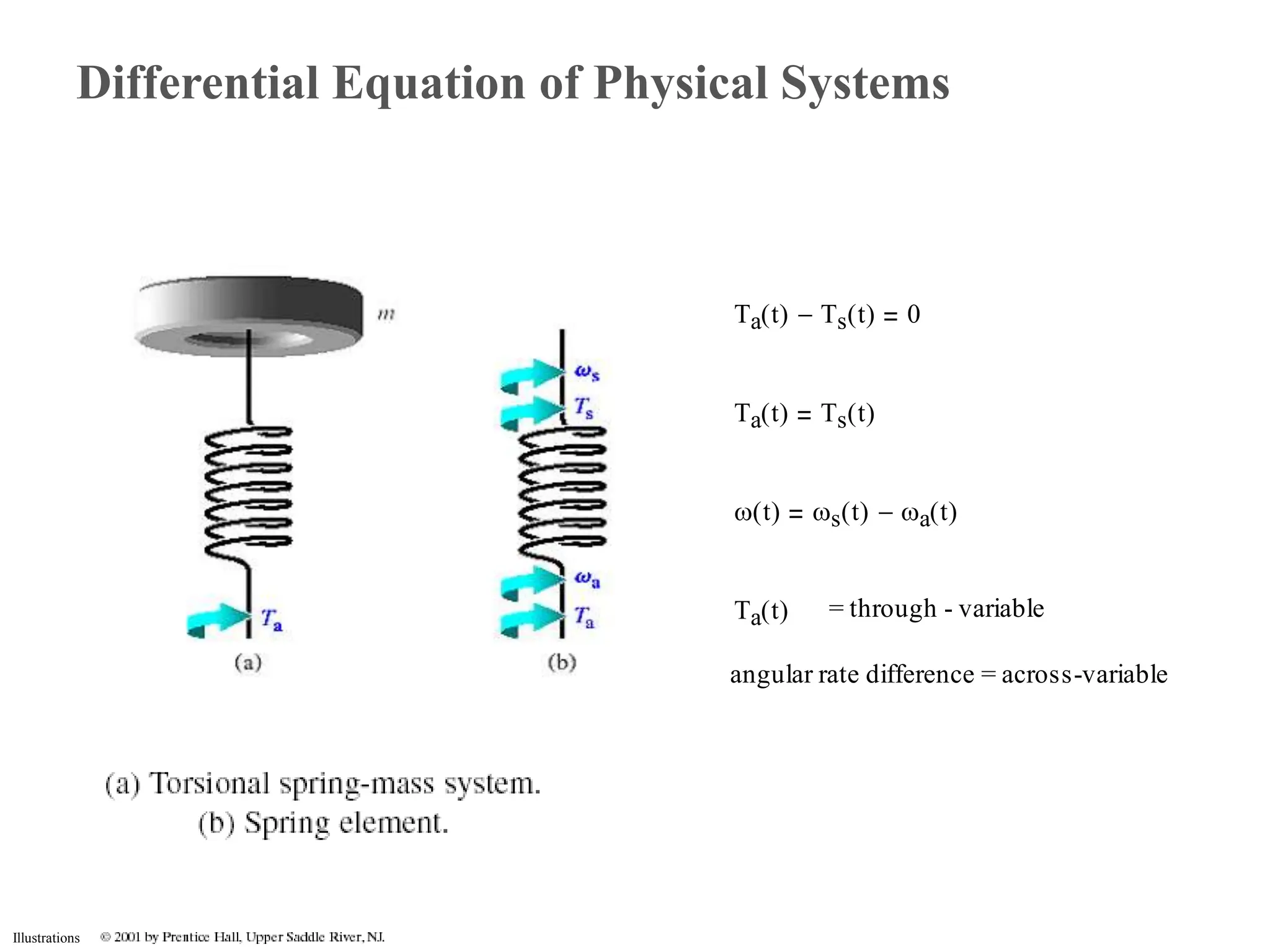
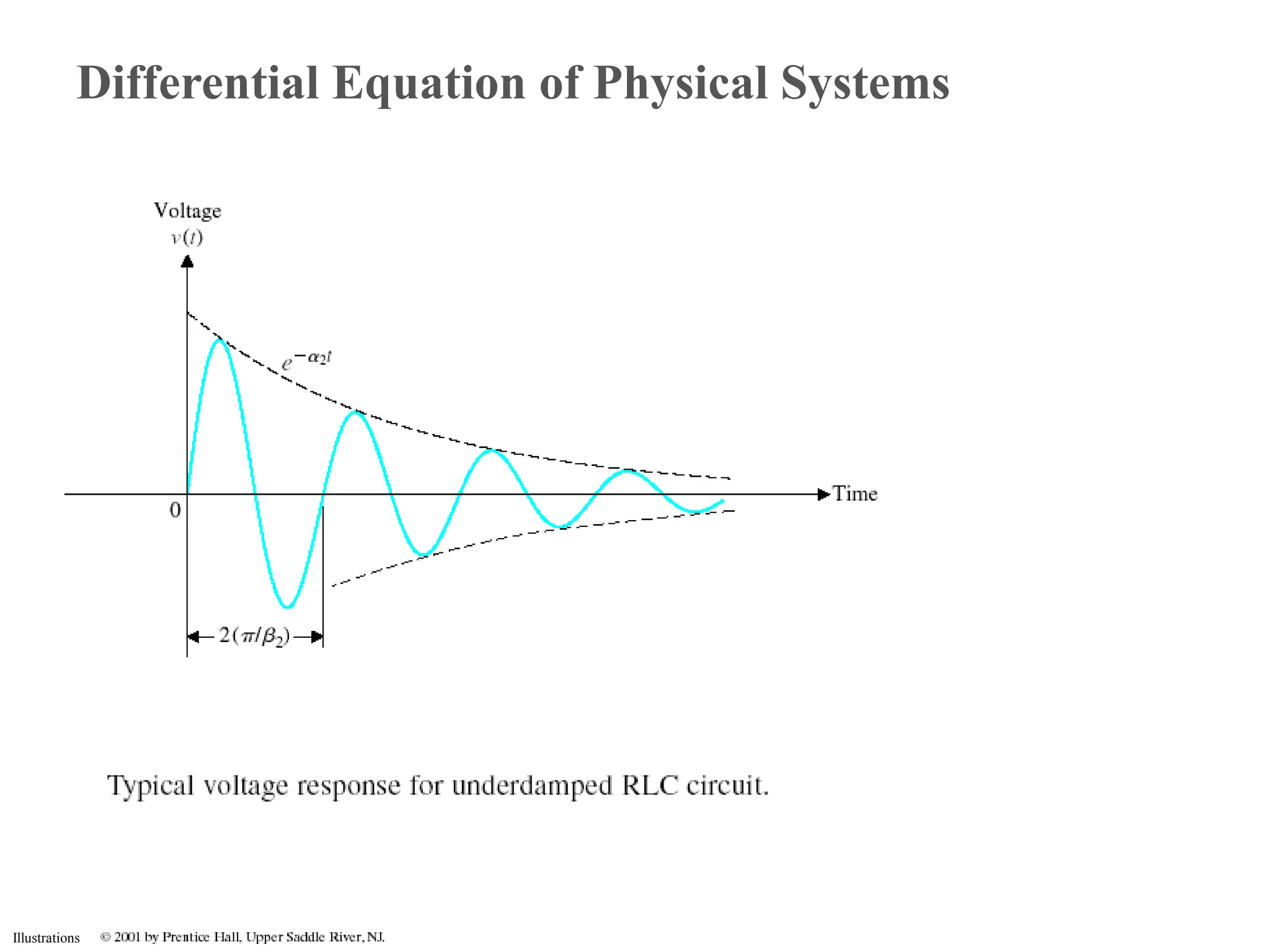
Differential Equation of Physical Systems
Ta t
( ) Ts t
( )
 0
Ta t
( ) Ts t
( )
 t
( ) s t
( ) a t
( )

Ta t
( ) = through - variable
angular rate difference = across-variable
Illustrations
Differential Equation of Physical Systems
v21 L
t
i
d
d
 E
1
2
L
 i
2

v21
1
k t
F
d
d
 E
1
2
F
2
k

21
1
k t
T
d
d
 E
1
2
T
2
k

P21 I
t
Q
d
d
 E
1
2
I
 Q
2

Electrical Inductance
Translational Spring
Rotational Spring
Fluid Inertia
Describing Equation Energy or Power
Illustrations
Differential Equation of Physical Systems
Electrical Capacitance
Translational Mass
Rotational Mass
Fluid Capacitance
Thermal Capacitance
i C
t
v21
d
d
 E
1
2
M
 v21
2

F M
t
v2
d
d
 E
1
2
M
 v2
2

T J
t
2
d
d
 E
1
2
J
 2
2

Q Cf
t
P21
d
d
 E
1
2
Cf
 P21
2

q Ct
t
T2
d
d
 E Ct T2

Illustrations
Differential Equation of Physical Systems
Electrical Resistance
Translational Damper
Rotational Damper
Fluid Resistance
Thermal Resistance
F b v21
 P b v21
2

i
1
R
v21
 P
1
R
v21
2

T b 21
 P b 21
2

Q
1
Rf
P21
 P
1
Rf
P21
2

q
1
Rt
T21
 P
1
Rt
T21

Illustrations
Differential Equation of Physical Systems
M
2
t
y t
( )
d
d
2
 b
t
y t
( )
d
d

 k y t
( )

 r t
( )
Illustrations
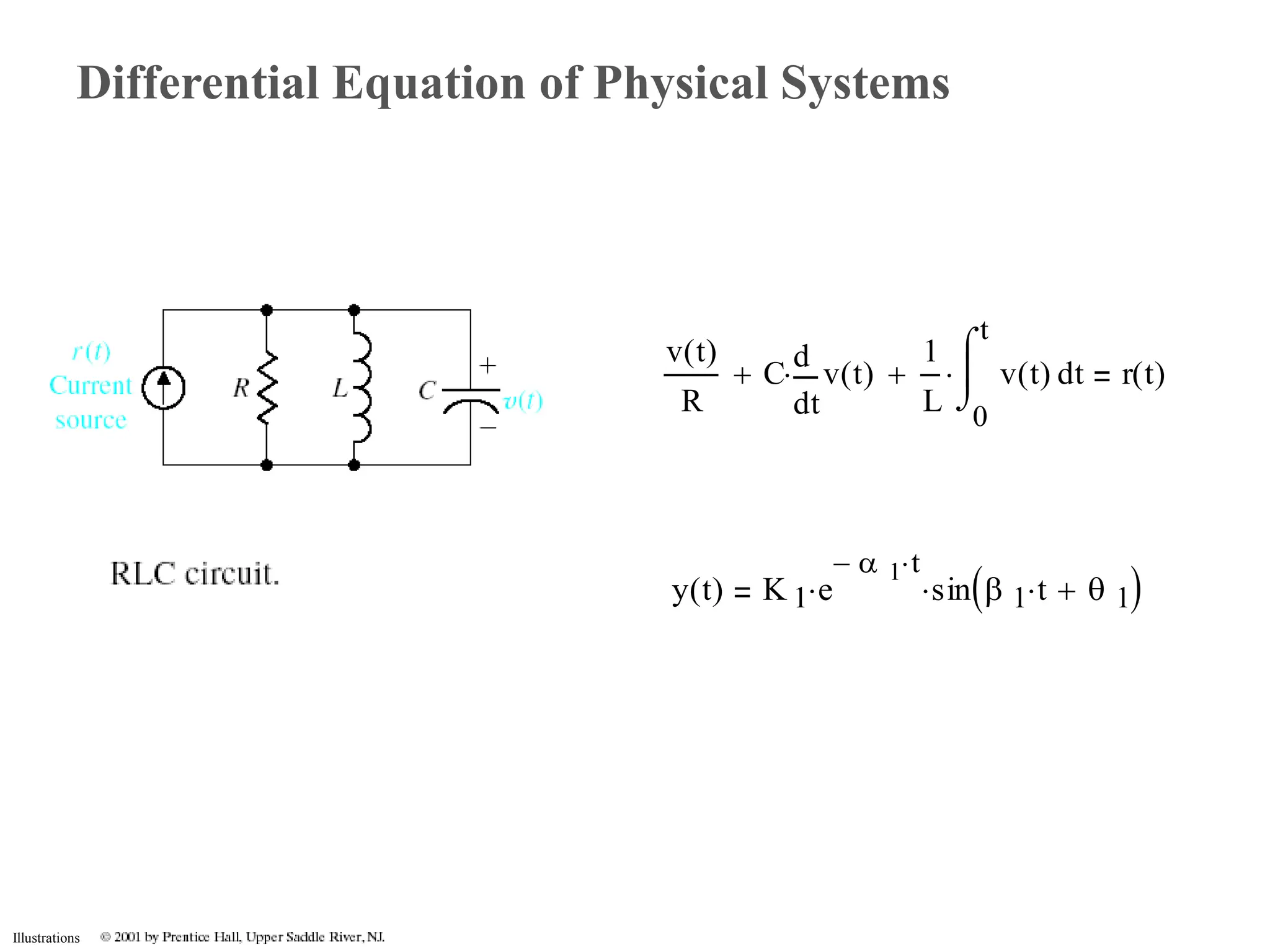
Differential Equation of Physical Systems
v t
( )
R
C
t
v t
( )
d
d


1
L 0
t
t
v t
( )



d

 r t
( )
y t
( ) K 1 e
 1
 t

 sin  1 t
  1

 

Illustrations
Differential Equation of Physical Systems
Illustrations
Differential Equation of Physical Systems
K2 1
 2 .5
 2 10
 2 2

y t
( ) K2 e
2
 t

 sin 2 t
 2

 


y1 t
( ) K2 e
2
 t


 y2 t
( ) K2
 e
2
 t



0 1 2 3 4 5 6 7
1
0
1
y t
( )
y1 t
( )
y2 t
( )
t
Illustrations
Linear Approximations
Illustrations
Linear Approximations
Linear Systems - Necessary condition
Principle of Superposition
Property of Homogeneity
Taylor Series
http://www.maths.abdn.ac.uk/%7Eigc/tch/ma2001/notes/node46.html
Illustrations
Linear Approximations – Example 2.1
M 200gm
 g 9.8
m
s
2
 L 100cm
 0 0rad
  

15
 
16
 


T0 M g
 L
 sin 0
 


T1 
  M g
 L
 sin 
 


T2 
  M g
 L
 cos 0
 
  0

 
 T0


4 3 2 1 0 1 2 3 4
10
5
0
5
10
T1 
( )
T2 
( )

Students are encouraged to investigate linear approximation accuracy for different values of 0
Illustrations
The Laplace Transform
Historical Perspective - Heaviside’s Operators
Origin of Operational Calculus (1887)
Illustrations
p
t
d
d
1
p 0
t
u
1



d
i
v
Z p
( )
Z p
( ) R L p


i
1
R L p


H t
( )

1
L p 1
R
L p









H t
( )

1
R
R
L
1
p

R
L






2
1
p
2


R
L






3
1
p
3
 .....









 H t
( )

1
p
n
H t
( )

t
n
n
i
1
R
R
L
t

R
L






2
t
2
2

R
L






3
t
3
3

 ..














 i
1
R
1 e
R
L






 t









Expanded in a power series
v = H(t)
Historical Perspective - Heaviside’s Operators
Origin of Operational Calculus (1887)
(*) Oliver Heaviside: Sage in Solitude, Paul J. Nahin, IEEE Press 1987.
Illustrations
The Laplace Transform
Definition
L f t
( )
( )
0

t
f t
( ) e
s
 t





d = F(s)
Here the complex frequency is s  j w


The Laplace Transform exists when
0

t
f t
( ) e
s
 t





d 

this means that the integral converges
Illustrations
The Laplace Transform
Determine the Laplace transform for the functions
a) f1 t
( ) 1
 for t 0

F1 s
( )
0

t
e
s
 t




d

=
1
s
 e
s t

( )


1
s
b) f2 t
( ) e
a t

( )

F2 s
( )
0

t
e
a t

( )

e
s t

( )





d
=
1
s 1

 e
s a

( ) t

[ ]

 F2 s
( )
1
s a

Illustrations
note that the initial condition is included in the transformation
sF(s) - f(0+)
=
L
t
f t
( )
d
d







s
0

t
f t
( ) e
s t

( )





d

-f(0+) +
=
0

t
f t
( ) s
 e
s t

( )



 





d

f t
( ) e
s t

( )


=
0

v
u



d
we obtain
v f t
( )
and
du s
 e
s t

( )

 dt

and, from which
dv df t
( )
u e
s t

( )

where
u v
 u
v



d

=
v
u



d
by the use of
L
t
f t
( )
d
d






0

t
t
f t
( ) e
s t

( )


d
d




d
Evaluate the laplace transform of the derivative of a function
The Laplace Transform
Illustrations
The Laplace Transform
Practical Example - Consider the circuit.
The KVL equation is
4 i t
( )
 2
t
i t
( )
d
d

 0 assume i(0+) = 5 A
Applying the Laplace Transform, we have
0

t
4 i t
( )
 2
t
i t
( )
d
d








e
s t

( )






d 0 4
0

t
i t
( ) e
s t

( )





d
 2
0

t
t
i t
( ) e
s t

( )


d
d




d

 0
4 I s
( )
 2 s I s
( )
 i 0
( )

( )

 0 4 I s
( )
 2 s
 I s
( )

 10
 0
transforming back to the time domain, with our present knowledge of
Laplace transform, we may say that
I s
( )
5
s 2


0 1 2
0
2
4
6
i t
( )
t
t 0 0.01
 2

( )

i t
( ) 5 e
2 t

( )



Illustrations
The Partial-Fraction Expansion (or Heaviside expansion theorem)
Suppose that
The partial fraction expansion indicates that F(s) consists of
a sum of terms, each of which is a factor of the denominator.
The values of K1 and K2 are determined by combining the
individual fractions by means of the lowest common
denominator and comparing the resultant numerator
coefficients with those of the coefficients of the numerator
before separation in different terms.
F s
( )
s z1

s p1

( ) s p2

( )

or
F s
( )
K1
s p1

K2
s p2


Evaluation of Ki in the manner just described requires the simultaneous solution of n equations.
An alternative method is to multiply both sides of the equation by (s + pi) then setting s= - pi, the
right-hand side is zero except for Ki so that
Ki
s pi

( ) s z1

( )

s p1

( ) s p2

( )

s = - pi
The Laplace Transform
Illustrations
The Laplace Transform
s -> 0
t -> infinite
Lim s F s
( )

( )
Lim f t
( )
( )
7. Final-value Theorem
s -> infinite
t -> 0
Lim s F s
( )

( )
Lim f t
( )
( ) f 0
( )
6. Initial-value Theorem
0

s
F s
( )



d
f t
( )
t
5. Frequency Integration
F s a

( )
f t
( ) e
a t

( )


4. Frequency shifting
s
F s
( )
d
d

t f t
( )

3. Frequency differentiation
f at
( )
2. Time scaling
1
a
F
s
a







f t T

( ) u t T

( )

1. Time delay
e
s T

( )

F s
( )

Property Time Domain Frequency Domain
Illustrations
Useful Transform Pairs
The Laplace Transform
Illustrations
The Laplace Transform
y s
( )
s
b
M







yo
 

s
2 b
M






s


k
M







s 2 
 n


 
s
2
2 
 n

 n
2

s1  n

 
 n 
2
1



n
k
M

b
2 k M


 
s2  n

 
 n 
2
1



Roots
Real
Real repeated
Imaginary (conjugates)
Complex (conjugates)
s1  n

 
 j n
 1 
2



s2  n

 
 j n
 1 
2



Consider the mass-spring-damper system
Y s
( )
Ms b

( ) yo

Ms
2
bs
 k

equation 2.21
Illustrations
The Laplace Transform
Illustrations
The Transfer Function of Linear Systems
V1 s
( ) R
1
Cs







I s
( )
 Z1 s
( ) R
Z2 s
( )
1
Cs
V2 s
( )
1
Cs






I s
( )

V2 s
( )
V1 s
( )
1
Cs
R
1
Cs

Z2 s
( )
Z1 s
( ) Z2 s
( )

Illustrations
The Transfer Function of Linear Systems
Example 2.2
2
t
y t
( )
d
d
2
4
t
y t
( )
d
d

 3 y t
( )

 2 r t
( )

Initial Conditions: Y 0
( ) 1
t
y 0
( )
d
d
0 r t
( ) 1
The Laplace transform yields:
s
2
Y s
( )
 s y 0
( )


  4 s Y s
( )
 y 0
( )

( )

 3Y s
( )
 2 R s
( )

Since R(s)=1/s and y(0)=1, we obtain:
Y s
( )
s 4

( )
s
2
4s
 3

 
2
s s
2
4s
 3

 


The partial fraction expansion yields:
Y s
( )
3
2
s 1

( )
1

2
s 3

( )









1

s 1

( )
1
3
s 3

( )










2
3
s

Therefore the transient response is:
y t
( )
3
2
e
t


1
2
e
3
 t









1
 e
t
 1
3
e
3
 t









2
3

The steady-state response is:

t
y t
( )
lim

2
3
Illustrations
The Transfer Function of Linear Systems
Illustrations
The Transfer Function of Linear Systems
Illustrations
The Transfer Function of Linear Systems
Illustrations
The Transfer Function of Linear Systems
Illustrations
 Kf if

Tm K1 Kf
 if t
( )
 ia t
( )

field controled motor - Lapalce Transform
Tm s
( ) K1 Kf
 Ia

  If s
( )

Vf s
( ) Rf Lf s


  If s
( )

Tm s
( ) TL s
( ) Td s
( )

TL s
( ) J s
2
  s
( )
 b s
  s
( )


rearranging equations
TL s
( ) Tm s
( ) Td s
( )

Tm s
( ) Km If s
( )

If s
( )
Vf s
( )
Rf Lf s


The Transfer Function of Linear Systems
Td s
( ) 0
 s
( )
Vf s
( )
Km
s J s
 b

( )
 Lf s
 Rf

 

Illustrations
The Transfer Function of Linear Systems
Illustrations
The Transfer Function of Linear Systems
Illustrations
The Transfer Function of Linear Systems
Illustrations
The Transfer Function of Linear Systems
Illustrations
The Transfer Function of Linear Systems
V2 s
( )
V1 s
( )
1

RCs
V2 s
( )
V1 s
( )
RCs

Illustrations
The Transfer Function of Linear Systems
V2 s
( )
V1 s
( )
R 2 R 1 C
 s
 1

 
R 1
V2 s
( )
V1 s
( )
R 1 C 1
 s
 1

 
 R 2 C 2
 s
 1

 
R 1 C 2
 s

Illustrations
The Transfer Function of Linear Systems
 s
( )
Vf s
( )
K m
s J s
 b

( )
 Lf s
 R f

 
 s
( )
Va s
( )
K m
s R a La s


  J s
 b

( ) K b K m



 


Illustrations
The Transfer Function of Linear Systems
Vo s
( )
Vc s
( )
K
Rc Rq







s c
 1

  s q
 1

 

c
Lc
Rc
q
Lq
Rq
For the unloaded case:
id 0 c q
0.05s c
 0.5s

V12 Vq V34 Vd
 s
( )
Vc s
( )
Km
s  s
 1

 

J
b m

( )
m = slope of linearized
torque-speed curve
(normally negative)
Illustrations
The Transfer Function of Linear Systems
Y s
( )
X s
( )
K
s Ms B

( )
K
A kx

kp
B b
A
2
kp







kx
x
g
d
d
kp
P
g
d
d
g g x P

( ) flow
A = area of piston
Gear Ratio = n = N1/N2
N2 L
 N1 m

L n m

L n m

Illustrations
The Transfer Function of Linear Systems
V2 s
( )
V1 s
( )
R2
R
R2
R1 R2

R2
R

max
V2 s
( ) ks 1 s
( ) 2 s
( )

 
V2 s
( ) ks error s
( )

ks
Vbattery
max
Illustrations
The Transfer Function of Linear Systems
V2 s
( ) Kt  s
( )
 Kt s
  s
( )

Kt constant
V2 s
( )
V1 s
( )
ka
s 
 1

Ro = output resistance
Co = output capacitance
 Ro Co
  1s

and is often negligible
for controller amplifier
Illustrations
The Transfer Function of Linear Systems
T s
( )
q s
( )
1
Ct s
 Q S

1
R








T To Te
 = temperature difference due to thermal process
Ct = thermal capacitance
= fluid flow rate = constant
= specific heat of water
= thermal resistance of insulation
= rate of heat flow of heating element
Q
S
Rt
q s
( )
xo t
( ) y t
( ) xin t
( )

Xo s
( )
Xin s
( )
s
2

s
2 b
M






s


k
M

For low frequency oscillations, where  n

Xo j 

 
Xin j 

 

2
k
M
Illustrations
The Transfer Function of Linear Systems
x r 

converts radial motion to linear motion
Illustrations
Block Diagram Models
Illustrations
Block Diagram Models
Illustrations
Block Diagram Models
Original Diagram Equivalent Diagram
Illustrations
Block Diagram Models
Original Diagram Equivalent Diagram
Illustrations
Block Diagram Models
Original Diagram Equivalent Diagram
Illustrations
Block Diagram Models
Illustrations
Block Diagram Models
Example 2.7
Illustrations
Block Diagram Models Example 2.7
Illustrations
Signal-Flow Graph Models
For complex systems, the block diagram method can become
difficult to complete. By using the signal-flow graph model, the
reduction procedure (used in the block diagram method) is not
necessary to determine the relationship between system variables.
Illustrations
Signal-Flow Graph Models
Y1 s
( ) G11 s
( ) R1 s
( )
 G12 s
( ) R2 s
( )


Y2 s
( ) G21 s
( ) R1 s
( )
 G22 s
( ) R2 s
( )


Illustrations
Signal-Flow Graph Models
a11 x1
 a12 x2

 r1
 x1
a21 x1
 a22 x2

 r2
 x2
Illustrations
Signal-Flow Graph Models
Example 2.8
Y s
( )
R s
( )
G1 G2
 G3
 G4
 1 L3
 L4

 


 
 G5 G6
 G7
 G8
 1 L1
 L2

 


 


1 L1
 L2
 L3
 L4
 L1 L3

 L1 L4

 L2 L3

 L2 L4


Illustrations
Signal-Flow Graph Models
Example 2.10
Y s
( )
R s
( )
G1 G2
 G3
 G4

1 G2 G3
 H 2

 G3 G4
 H 1

 G1 G2
 G3
 G4
 H 3


Illustrations
Signal-Flow Graph Models
Y s
( )
R s
( )
P1 P2 2

 P3


P1 G1 G2
 G3
 G4
 G5
 G6
 P2 G1 G2
 G7
 G6
 P3 G1 G2
 G3
 G4
 G8

 1 L1 L2
 L3
 L4
 L5
 L6
 L7
 L8

 
 L5 L7
 L5 L4

 L3 L4


 

1 3 1 2 1 L5
 1 G4 H4


Illustrations
Design Examples
Illustrations
Speed control of an electric traction motor.
Design Examples
Illustrations
Design Examples
Illustrations
Design Examples
Illustrations
Design Examples
Illustrations
Design Examples
Illustrations
The Simulation of Systems Using MATLAB
Illustrations
The Simulation of Systems Using MATLAB
Illustrations
The Simulation of Systems Using MATLAB
Illustrations
The Simulation of Systems Using MATLAB
Illustrations
The Simulation of Systems Using MATLAB
Illustrations
The Simulation of Systems Using MATLAB
Illustrations
The Simulation of Systems Using MATLAB
Illustrations
The Simulation of Systems Using MATLAB
Illustrations
The Simulation of Systems Using MATLAB
Illustrations
The Simulation of Systems Using MATLAB
Illustrations
The Simulation of Systems Using MATLAB
Illustrations
The Simulation of Systems Using MATLAB
Illustrations
The Simulation of Systems Using MATLAB
Illustrations
The Simulation of Systems Using MATLAB
Illustrations
The Simulation of Systems Using MATLAB
Illustrations
The Simulation of Systems Using MATLAB
Illustrations
error
The Simulation of Systems Using MATLAB
Sys1 = sysh2 / sysg4
Illustrations
The Simulation of Systems Using MATLAB
Illustrations
error
The Simulation of Systems Using MATLAB
Num4=[0.1];
Illustrations
The Simulation of Systems Using MATLAB
Illustrations
The Simulation of Systems Using MATLAB
Illustrations
Sequential Design Example: Disk Drive Read System
Illustrations
Sequential Design Example: Disk Drive Read System
Illustrations
=
Sequential Design Example: Disk Drive Read System
Illustrations
P2.11
Illustrations
1
L c s
 R c

Vc
Ic
K1
1
L q s
 R q

Vq
K2
K3
-Vb
+Vd
Km
Id
1
Ld La

  s
 R d R a

 

Tm
1
J s
 b

1
s

P2.11
Illustrations
Illustrations
http://www.jhu.edu/%7Esignals/sensitivity/index.htm
Illustrations
http://www.jhu.edu/%7Esignals/

chapter-2.ppt control system slide for students

  • 1.
    Illustrations We use quantitativemathematical models of physical systems to design and analyze control systems. The dynamic behavior is generally described by ordinary differential equations. We will consider a wide range of systems, including mechanical, hydraulic, and electrical. Since most physical systems are nonlinear, we will discuss linearization approximations, which allow us to use Laplace transform methods. We will then proceed to obtain the input–output relationship for components and subsystems in the form of transfer functions. The transfer function blocks can be organized into block diagrams or signal-flow graphs to graphically depict the interconnections. Block diagrams (and signal-flow graphs) are very convenient and natural tools for designing and analyzing complicated control systems Chapter 2: Mathematical Models of Systems Objectives
  • 2.
    Illustrations Introduction Six Step Approachto Dynamic System Problems • Define the system and its components • Formulate the mathematical model and list the necessary assumptions • Write the differential equations describing the model • Solve the equations for the desired output variables • Examine the solutions and the assumptions • If necessary, reanalyze or redesign the system
  • 3.
    Illustrations Differential Equation ofPhysical Systems Ta t ( ) Ts t ( )  0 Ta t ( ) Ts t ( )  t ( ) s t ( ) a t ( )  Ta t ( ) = through - variable angular rate difference = across-variable
  • 4.
    Illustrations Differential Equation ofPhysical Systems v21 L t i d d  E 1 2 L  i 2  v21 1 k t F d d  E 1 2 F 2 k  21 1 k t T d d  E 1 2 T 2 k  P21 I t Q d d  E 1 2 I  Q 2  Electrical Inductance Translational Spring Rotational Spring Fluid Inertia Describing Equation Energy or Power
  • 5.
    Illustrations Differential Equation ofPhysical Systems Electrical Capacitance Translational Mass Rotational Mass Fluid Capacitance Thermal Capacitance i C t v21 d d  E 1 2 M  v21 2  F M t v2 d d  E 1 2 M  v2 2  T J t 2 d d  E 1 2 J  2 2  Q Cf t P21 d d  E 1 2 Cf  P21 2  q Ct t T2 d d  E Ct T2 
  • 6.
    Illustrations Differential Equation ofPhysical Systems Electrical Resistance Translational Damper Rotational Damper Fluid Resistance Thermal Resistance F b v21  P b v21 2  i 1 R v21  P 1 R v21 2  T b 21  P b 21 2  Q 1 Rf P21  P 1 Rf P21 2  q 1 Rt T21  P 1 Rt T21 
  • 7.
    Illustrations Differential Equation ofPhysical Systems M 2 t y t ( ) d d 2  b t y t ( ) d d   k y t ( )   r t ( )
  • 8.
    Illustrations Differential Equation ofPhysical Systems v t ( ) R C t v t ( ) d d   1 L 0 t t v t ( )    d   r t ( ) y t ( ) K 1 e  1  t   sin  1 t   1    
  • 9.
  • 10.
    Illustrations Differential Equation ofPhysical Systems K2 1  2 .5  2 10  2 2  y t ( ) K2 e 2  t   sin 2 t  2      y1 t ( ) K2 e 2  t    y2 t ( ) K2  e 2  t    0 1 2 3 4 5 6 7 1 0 1 y t ( ) y1 t ( ) y2 t ( ) t
  • 11.
  • 12.
    Illustrations Linear Approximations Linear Systems- Necessary condition Principle of Superposition Property of Homogeneity Taylor Series http://www.maths.abdn.ac.uk/%7Eigc/tch/ma2001/notes/node46.html
  • 13.
    Illustrations Linear Approximations –Example 2.1 M 200gm  g 9.8 m s 2  L 100cm  0 0rad     15   16     T0 M g  L  sin 0     T1    M g  L  sin      T2    M g  L  cos 0     0     T0   4 3 2 1 0 1 2 3 4 10 5 0 5 10 T1  ( ) T2  ( )  Students are encouraged to investigate linear approximation accuracy for different values of 0
  • 14.
    Illustrations The Laplace Transform HistoricalPerspective - Heaviside’s Operators Origin of Operational Calculus (1887)
  • 15.
    Illustrations p t d d 1 p 0 t u 1    d i v Z p () Z p ( ) R L p   i 1 R L p   H t ( )  1 L p 1 R L p          H t ( )  1 R R L 1 p  R L       2 1 p 2   R L       3 1 p 3  .....           H t ( )  1 p n H t ( )  t n n i 1 R R L t  R L       2 t 2 2  R L       3 t 3 3   ..                i 1 R 1 e R L        t          Expanded in a power series v = H(t) Historical Perspective - Heaviside’s Operators Origin of Operational Calculus (1887) (*) Oliver Heaviside: Sage in Solitude, Paul J. Nahin, IEEE Press 1987.
  • 16.
    Illustrations The Laplace Transform Definition Lf t ( ) ( ) 0  t f t ( ) e s  t      d = F(s) Here the complex frequency is s  j w   The Laplace Transform exists when 0  t f t ( ) e s  t      d   this means that the integral converges
  • 17.
    Illustrations The Laplace Transform Determinethe Laplace transform for the functions a) f1 t ( ) 1  for t 0  F1 s ( ) 0  t e s  t     d  = 1 s  e s t  ( )   1 s b) f2 t ( ) e a t  ( )  F2 s ( ) 0  t e a t  ( )  e s t  ( )      d = 1 s 1   e s a  ( ) t  [ ]   F2 s ( ) 1 s a 
  • 18.
    Illustrations note that theinitial condition is included in the transformation sF(s) - f(0+) = L t f t ( ) d d        s 0  t f t ( ) e s t  ( )      d  -f(0+) + = 0  t f t ( ) s  e s t  ( )           d  f t ( ) e s t  ( )   = 0  v u    d we obtain v f t ( ) and du s  e s t  ( )   dt  and, from which dv df t ( ) u e s t  ( )  where u v  u v    d  = v u    d by the use of L t f t ( ) d d       0  t t f t ( ) e s t  ( )   d d     d Evaluate the laplace transform of the derivative of a function The Laplace Transform
  • 19.
    Illustrations The Laplace Transform PracticalExample - Consider the circuit. The KVL equation is 4 i t ( )  2 t i t ( ) d d   0 assume i(0+) = 5 A Applying the Laplace Transform, we have 0  t 4 i t ( )  2 t i t ( ) d d         e s t  ( )       d 0 4 0  t i t ( ) e s t  ( )      d  2 0  t t i t ( ) e s t  ( )   d d     d   0 4 I s ( )  2 s I s ( )  i 0 ( )  ( )   0 4 I s ( )  2 s  I s ( )   10  0 transforming back to the time domain, with our present knowledge of Laplace transform, we may say that I s ( ) 5 s 2   0 1 2 0 2 4 6 i t ( ) t t 0 0.01  2  ( )  i t ( ) 5 e 2 t  ( )   
  • 20.
    Illustrations The Partial-Fraction Expansion(or Heaviside expansion theorem) Suppose that The partial fraction expansion indicates that F(s) consists of a sum of terms, each of which is a factor of the denominator. The values of K1 and K2 are determined by combining the individual fractions by means of the lowest common denominator and comparing the resultant numerator coefficients with those of the coefficients of the numerator before separation in different terms. F s ( ) s z1  s p1  ( ) s p2  ( )  or F s ( ) K1 s p1  K2 s p2   Evaluation of Ki in the manner just described requires the simultaneous solution of n equations. An alternative method is to multiply both sides of the equation by (s + pi) then setting s= - pi, the right-hand side is zero except for Ki so that Ki s pi  ( ) s z1  ( )  s p1  ( ) s p2  ( )  s = - pi The Laplace Transform
  • 21.
    Illustrations The Laplace Transform s-> 0 t -> infinite Lim s F s ( )  ( ) Lim f t ( ) ( ) 7. Final-value Theorem s -> infinite t -> 0 Lim s F s ( )  ( ) Lim f t ( ) ( ) f 0 ( ) 6. Initial-value Theorem 0  s F s ( )    d f t ( ) t 5. Frequency Integration F s a  ( ) f t ( ) e a t  ( )   4. Frequency shifting s F s ( ) d d  t f t ( )  3. Frequency differentiation f at ( ) 2. Time scaling 1 a F s a        f t T  ( ) u t T  ( )  1. Time delay e s T  ( )  F s ( )  Property Time Domain Frequency Domain
  • 22.
  • 23.
    Illustrations The Laplace Transform ys ( ) s b M        yo    s 2 b M       s   k M        s 2   n     s 2 2   n   n 2  s1  n     n  2 1    n k M  b 2 k M     s2  n     n  2 1    Roots Real Real repeated Imaginary (conjugates) Complex (conjugates) s1  n     j n  1  2    s2  n     j n  1  2    Consider the mass-spring-damper system Y s ( ) Ms b  ( ) yo  Ms 2 bs  k  equation 2.21
  • 24.
  • 25.
    Illustrations The Transfer Functionof Linear Systems V1 s ( ) R 1 Cs        I s ( )  Z1 s ( ) R Z2 s ( ) 1 Cs V2 s ( ) 1 Cs       I s ( )  V2 s ( ) V1 s ( ) 1 Cs R 1 Cs  Z2 s ( ) Z1 s ( ) Z2 s ( ) 
  • 26.
    Illustrations The Transfer Functionof Linear Systems Example 2.2 2 t y t ( ) d d 2 4 t y t ( ) d d   3 y t ( )   2 r t ( )  Initial Conditions: Y 0 ( ) 1 t y 0 ( ) d d 0 r t ( ) 1 The Laplace transform yields: s 2 Y s ( )  s y 0 ( )     4 s Y s ( )  y 0 ( )  ( )   3Y s ( )  2 R s ( )  Since R(s)=1/s and y(0)=1, we obtain: Y s ( ) s 4  ( ) s 2 4s  3    2 s s 2 4s  3      The partial fraction expansion yields: Y s ( ) 3 2 s 1  ( ) 1  2 s 3  ( )          1  s 1  ( ) 1 3 s 3  ( )           2 3 s  Therefore the transient response is: y t ( ) 3 2 e t   1 2 e 3  t          1  e t  1 3 e 3  t          2 3  The steady-state response is:  t y t ( ) lim  2 3
  • 27.
  • 28.
  • 29.
  • 30.
  • 31.
    Illustrations  Kf if  TmK1 Kf  if t ( )  ia t ( )  field controled motor - Lapalce Transform Tm s ( ) K1 Kf  Ia    If s ( )  Vf s ( ) Rf Lf s     If s ( )  Tm s ( ) TL s ( ) Td s ( )  TL s ( ) J s 2   s ( )  b s   s ( )   rearranging equations TL s ( ) Tm s ( ) Td s ( )  Tm s ( ) Km If s ( )  If s ( ) Vf s ( ) Rf Lf s   The Transfer Function of Linear Systems Td s ( ) 0  s ( ) Vf s ( ) Km s J s  b  ( )  Lf s  Rf    
  • 32.
  • 33.
  • 34.
  • 35.
  • 36.
    Illustrations The Transfer Functionof Linear Systems V2 s ( ) V1 s ( ) 1  RCs V2 s ( ) V1 s ( ) RCs 
  • 37.
    Illustrations The Transfer Functionof Linear Systems V2 s ( ) V1 s ( ) R 2 R 1 C  s  1    R 1 V2 s ( ) V1 s ( ) R 1 C 1  s  1     R 2 C 2  s  1    R 1 C 2  s 
  • 38.
    Illustrations The Transfer Functionof Linear Systems  s ( ) Vf s ( ) K m s J s  b  ( )  Lf s  R f     s ( ) Va s ( ) K m s R a La s     J s  b  ( ) K b K m       
  • 39.
    Illustrations The Transfer Functionof Linear Systems Vo s ( ) Vc s ( ) K Rc Rq        s c  1    s q  1     c Lc Rc q Lq Rq For the unloaded case: id 0 c q 0.05s c  0.5s  V12 Vq V34 Vd  s ( ) Vc s ( ) Km s  s  1     J b m  ( ) m = slope of linearized torque-speed curve (normally negative)
  • 40.
    Illustrations The Transfer Functionof Linear Systems Y s ( ) X s ( ) K s Ms B  ( ) K A kx  kp B b A 2 kp        kx x g d d kp P g d d g g x P  ( ) flow A = area of piston Gear Ratio = n = N1/N2 N2 L  N1 m  L n m  L n m 
  • 41.
    Illustrations The Transfer Functionof Linear Systems V2 s ( ) V1 s ( ) R2 R R2 R1 R2  R2 R  max V2 s ( ) ks 1 s ( ) 2 s ( )    V2 s ( ) ks error s ( )  ks Vbattery max
  • 42.
    Illustrations The Transfer Functionof Linear Systems V2 s ( ) Kt  s ( )  Kt s   s ( )  Kt constant V2 s ( ) V1 s ( ) ka s   1  Ro = output resistance Co = output capacitance  Ro Co   1s  and is often negligible for controller amplifier
  • 43.
    Illustrations The Transfer Functionof Linear Systems T s ( ) q s ( ) 1 Ct s  Q S  1 R         T To Te  = temperature difference due to thermal process Ct = thermal capacitance = fluid flow rate = constant = specific heat of water = thermal resistance of insulation = rate of heat flow of heating element Q S Rt q s ( ) xo t ( ) y t ( ) xin t ( )  Xo s ( ) Xin s ( ) s 2  s 2 b M       s   k M  For low frequency oscillations, where  n  Xo j     Xin j      2 k M
  • 44.
    Illustrations The Transfer Functionof Linear Systems x r   converts radial motion to linear motion
  • 45.
  • 46.
  • 47.
    Illustrations Block Diagram Models OriginalDiagram Equivalent Diagram Original Diagram Equivalent Diagram
  • 48.
    Illustrations Block Diagram Models OriginalDiagram Equivalent Diagram Original Diagram Equivalent Diagram
  • 49.
    Illustrations Block Diagram Models OriginalDiagram Equivalent Diagram Original Diagram Equivalent Diagram
  • 50.
  • 51.
  • 52.
  • 53.
    Illustrations Signal-Flow Graph Models Forcomplex systems, the block diagram method can become difficult to complete. By using the signal-flow graph model, the reduction procedure (used in the block diagram method) is not necessary to determine the relationship between system variables.
  • 54.
    Illustrations Signal-Flow Graph Models Y1s ( ) G11 s ( ) R1 s ( )  G12 s ( ) R2 s ( )   Y2 s ( ) G21 s ( ) R1 s ( )  G22 s ( ) R2 s ( )  
  • 55.
    Illustrations Signal-Flow Graph Models a11x1  a12 x2   r1  x1 a21 x1  a22 x2   r2  x2
  • 56.
    Illustrations Signal-Flow Graph Models Example2.8 Y s ( ) R s ( ) G1 G2  G3  G4  1 L3  L4         G5 G6  G7  G8  1 L1  L2          1 L1  L2  L3  L4  L1 L3   L1 L4   L2 L3   L2 L4  
  • 57.
    Illustrations Signal-Flow Graph Models Example2.10 Y s ( ) R s ( ) G1 G2  G3  G4  1 G2 G3  H 2   G3 G4  H 1   G1 G2  G3  G4  H 3  
  • 58.
    Illustrations Signal-Flow Graph Models Ys ( ) R s ( ) P1 P2 2   P3   P1 G1 G2  G3  G4  G5  G6  P2 G1 G2  G7  G6  P3 G1 G2  G3  G4  G8   1 L1 L2  L3  L4  L5  L6  L7  L8     L5 L7  L5 L4   L3 L4      1 3 1 2 1 L5  1 G4 H4  
  • 59.
  • 60.
    Illustrations Speed control ofan electric traction motor. Design Examples
  • 61.
  • 62.
  • 63.
  • 64.
  • 65.
    Illustrations The Simulation ofSystems Using MATLAB
  • 66.
    Illustrations The Simulation ofSystems Using MATLAB
  • 67.
    Illustrations The Simulation ofSystems Using MATLAB
  • 68.
    Illustrations The Simulation ofSystems Using MATLAB
  • 69.
    Illustrations The Simulation ofSystems Using MATLAB
  • 70.
    Illustrations The Simulation ofSystems Using MATLAB
  • 71.
    Illustrations The Simulation ofSystems Using MATLAB
  • 72.
    Illustrations The Simulation ofSystems Using MATLAB
  • 73.
    Illustrations The Simulation ofSystems Using MATLAB
  • 74.
    Illustrations The Simulation ofSystems Using MATLAB
  • 75.
    Illustrations The Simulation ofSystems Using MATLAB
  • 76.
    Illustrations The Simulation ofSystems Using MATLAB
  • 77.
    Illustrations The Simulation ofSystems Using MATLAB
  • 78.
    Illustrations The Simulation ofSystems Using MATLAB
  • 79.
    Illustrations The Simulation ofSystems Using MATLAB
  • 80.
    Illustrations The Simulation ofSystems Using MATLAB
  • 81.
    Illustrations error The Simulation ofSystems Using MATLAB Sys1 = sysh2 / sysg4
  • 82.
    Illustrations The Simulation ofSystems Using MATLAB
  • 83.
    Illustrations error The Simulation ofSystems Using MATLAB Num4=[0.1];
  • 84.
    Illustrations The Simulation ofSystems Using MATLAB
  • 85.
    Illustrations The Simulation ofSystems Using MATLAB
  • 86.
  • 87.
  • 88.
  • 89.
  • 90.
    Illustrations 1 L c s R c  Vc Ic K1 1 L q s  R q  Vq K2 K3 -Vb +Vd Km Id 1 Ld La    s  R d R a     Tm 1 J s  b  1 s  P2.11
  • 91.
  • 92.
  • 93.