UNIT-1
MACHINERIES
HYDRAULIC LIFT
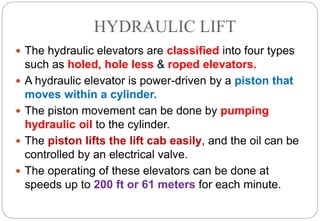
 The hydraulic elevators are classified into four types
such as holed, hole less & roped elevators.
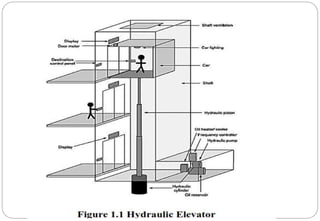
 A hydraulic elevator is power-driven by a piston that
moves within a cylinder.
 The piston movement can be done by pumping
hydraulic oil to the cylinder.
 The piston lifts the lift cab easily, and the oil can be
controlled by an electrical valve.
 The operating of these elevators can be done at
speeds up to 200 ft or 61 meters for each minute.
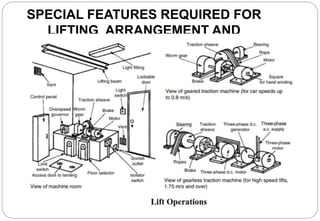
SPECIAL FEATURES REQUIRED FOR
LIFTING ARRANGEMENT AND
INSTALLATION
Uses of Travelators
 They used to increase customer density and thus
help boost sales
in buildings.
 used for commercial purposes.
 They ensure a smooth traffic flow.
 They help channel passenger flows.
 They have a high transportation capacity.
 They are open and convey people continuously.
 They ensure that all floor are frequented evenly.
 Travelators should be provided as a matter of
principle whenever
shopping or cabbage carts are to be transported.
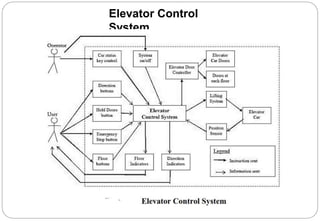
Elevator Control
System
Aims of the control system
• To bring the lift car to the correct floor.
• To minimize travel time.
• To maximize passenger comfort by providing a smooth
ride.
• To accelerate, decelerate and travel within safe speed
limits.
Types of elevator control systems
1- Single Automatic operation:
 First automated system w/o single call button on each
floor and single button for each floor inside car.
 Called if no one is using it.
 Passenger has exclusive use of the car until rip is
complete.
2- Selective collective operation
3- Group automatic operation
 For large buildings with many elevators which are
controlled with programmable microprocessors to
respond.
Elevator control system components:
The elevator as a control system has a number of
components. These can basically be divided into the
following:
1. Inputs.
2. Outputs.
3. Controllers.
Inputs, which include
A- Sensors:
1.Magnetic and/or photo electric
2. Infrared
3. Weight sensor (OverLoad Device)
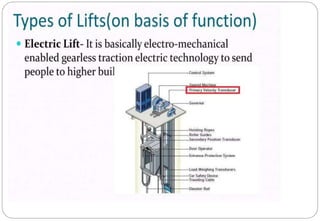
4. PVT (Primary Velocity Transducer)
B- Buttons:
1.Hall Buttons
2. Floor Request Buttons
3.Open Door Button
4.Emergency Stop Button
5.Emergency Bell Button
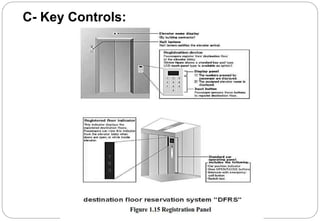
6. Registration panel
C- Key Controls:
Types of Tool room Machines
Grinding Machine
Milling Machines
Shaping Machine
Slotting Machine
Bandsaw Machine
Hacksaw Machine

UNIT-1-MACHINERIES.pptx

  • 1.
  • 19.
    HYDRAULIC LIFT  Thehydraulic elevators are classified into four types such as holed, hole less & roped elevators.  A hydraulic elevator is power-driven by a piston that moves within a cylinder.  The piston movement can be done by pumping hydraulic oil to the cylinder.  The piston lifts the lift cab easily, and the oil can be controlled by an electrical valve.  The operating of these elevators can be done at speeds up to 200 ft or 61 meters for each minute.
  • 54.
    SPECIAL FEATURES REQUIREDFOR LIFTING ARRANGEMENT AND INSTALLATION
  • 55.
    Uses of Travelators They used to increase customer density and thus help boost sales in buildings.  used for commercial purposes.  They ensure a smooth traffic flow.  They help channel passenger flows.  They have a high transportation capacity.  They are open and convey people continuously.  They ensure that all floor are frequented evenly.  Travelators should be provided as a matter of principle whenever shopping or cabbage carts are to be transported.
  • 56.
  • 57.
    Aims of thecontrol system • To bring the lift car to the correct floor. • To minimize travel time. • To maximize passenger comfort by providing a smooth ride. • To accelerate, decelerate and travel within safe speed limits. Types of elevator control systems 1- Single Automatic operation:  First automated system w/o single call button on each floor and single button for each floor inside car.  Called if no one is using it.  Passenger has exclusive use of the car until rip is complete. 2- Selective collective operation
  • 58.
    3- Group automaticoperation  For large buildings with many elevators which are controlled with programmable microprocessors to respond. Elevator control system components: The elevator as a control system has a number of components. These can basically be divided into the following: 1. Inputs. 2. Outputs. 3. Controllers.
  • 59.
    Inputs, which include A-Sensors: 1.Magnetic and/or photo electric 2. Infrared 3. Weight sensor (OverLoad Device) 4. PVT (Primary Velocity Transducer) B- Buttons: 1.Hall Buttons 2. Floor Request Buttons 3.Open Door Button 4.Emergency Stop Button 5.Emergency Bell Button 6. Registration panel
  • 60.
  • 62.
    Types of Toolroom Machines Grinding Machine Milling Machines Shaping Machine Slotting Machine Bandsaw Machine Hacksaw Machine