DISASTER PREPAREDNESS &
PLANNING
III YEAR B.Tech II SEM
COMPUTER SECIENCE ENGINEERING
J NARESH
Department of Civil Engineering
VIGNAN institute of Technology & Science
UNIT-5
DISASTER, ENVIRONMENT &
DEVELOPMENT
• Vulnerability to disaster due to construction of
dams, land use changes & urbanization.
• Impacts of construction of dams
• Generation of electricity.
• Supply water for irrigation, industrial & domestic
purposes.
• Control the effect of flood water.
• River navigation & recreational activities.
UNIT-5
DISASTER, ENVIRONMENT &
DEVELOPMENT
• Changes in water storage: aquifer depletion
• Changes in the continental runoff: reduce the
water flow in rivers, evaporation losses are high.
• Reservoir induced seismicity: (RIS)occurrence of
earthquakes in vicinity of reservoirs.
• Water pressure acting on the tectonic plates.
• Tiny cracks in the formed on the ground surface
reduces the ground stability.
UNIT-5
DISASTER, ENVIRONMENT &
DEVELOPMENT
• Impact of land use changes:
• DE vegetation, deforestation, construction of
commercial complex, urban expansion etc.
• Unplanned development in disaster prone regions.
• Blasting of rocks in hills & mountains.
• Urbanization.
UNIT-5
DISASTER, ENVIRONMENT &
DEVELOPMENT
• Impact of urbanization: vulnerability in urban
population.
• Rapid unplanned growth of cities.
• Changes in land use pattern.
• Location of infrastructure, business & housing.
• The risk of landslides & flooding.
• Construction in the riverine flood plains.
• Unsustainable land use.
Sustainable Development
• Large scale afforestation Programme.
• Investment in agricultural development.
• Implement special laws & regulations for different
areas of ecological environment.
• Sufficient measures to be taken to protect
environment.
• Control of soil erosion by afforestation &
construction of water conservancy projects.
• Prevention of desertification & dried-up lakes.
Sustainable Development
• To restore farmland government should give subsidy on
seeds.
• Protection of wild animals, wild plants.
• Designing of ecofriendly railway lines to protect
environment & wild life.
• Financial assistance may be provided to create
environmental consciousness among the students by
undertaking curriculum enrichment projects.
• Making environment integral part of school education.
• Sustainable utilization of natural resources.
Human ecology
Several disastrous episodes have focused attention upon air
pollution as a health hazard.
The episodes have always occurred under extraordinary
meteorological conditions and most of them were due to
“temperature inversion”.
1.Meuse Valley (Belgium) : The first episode of modern times
was Meuse valley. In December 1930, an anticyclone (high
pressure area) blanked Belgium, resulting in fog and
temperature inversion
Human ecology
Cause: for this disaster was because of thermal inversion,
various pollutants released from the industries in the city got
trapped in the valley.
•After careful consideration of all the gases and aerosols that
were discharged into the air, it was a mixture of Sulphur dioxide
and Sulphur trioxide, and other air pollutants fluorides, zinc
particles etc.
Effects: Abnormal weather caused to humans like cough, throat
irritation, shortness of breath and vomiting etc.. Many became ill
and around 60 people died.
Donora (USA)
It is a horse shaped valley with steeply rising hills. Anticyclone
weather conditions of no air movement, temperature
inversion and fog.
Cause: the pollutants discharged from industries into
atmosphere and due to the combined action of two or more
of the air contaminants namely Sulphur dioxide together with
oxidation products and particulate matter.
Effects: irritation of eyes, nose, throat, cough, headache,
vomiting and respiratory irritation. 6000 people became ill and
20persons died.
London(Themes Valley)
London situated in themes valley experienced its worst air
pollution episode due to fog. The “killer smog” began as a high
pressure area created a subsidence inversion in themes valley.
Cause: because of the extensive use of coal(Sulphur content
1.5%) as fuel, the particulate and Sulphur dioxide levels in the
atmosphere increased. The white fog became a black fog with
five times greater than normal time. The Sulphur dioxide
concentrations in the atmosphere during this episode was
about six times the usual level.
London(Themes Valley)
Effects: during this episode the high pressure area became
stationary. The air pollutants combined with fog resulted in zero
visibility.
The symptoms were cough, nasal discharge, sore throat,
irritation height and bronchi and sudden attack of vomiting. This
disaster caused 4000 deaths
Similar air pollution episodes(14 no's) experienced by London
but they are mild in nature
Later British Clean Air Act formed to take care of atmosphere.
Los Angles
Cause:
•Subsidence inversion is responsible for the air pollution in the
Los Angles. Los Angles has mountains which act as trap gases
released from thousands of automobiles as horizontal
movement is restricted by the mountains.
•Ozone is formed by the photo chemical reactions of oxides of
nitrogen and hydrocarbons (both are waste products from
automobiles)
•Due to temperature inversion photochemical smog is formed
Effects: irritation of eyes, nose, throat due to PAN(Peroxyl
Acetyl Nitrate). School children effected during days of air
pollutants.
New York has also had several episodes of air pollution which
have been responsible for excess death.
In November 1962 and 1963. The 1966 thanksgiving weekend
which resulted in 168 deaths.
Poza Rica (Mexico) is a natural gas processing and oil refining
town in Mexico.
Cause: an accident spillage of hydrogen sulphide gas for 25 to
30 minutes.
Effects: this incident caused the illness of 320 persons and 22
deaths
The symptoms were loss of sense of smell, cough, irritation
and severe headache.
Bhopal gas tragedy INDIA
This considered as worlds worst air pollution disaster.
Cause: from Union Carbide India Ltd. pesticide plant leakage
of methyl Isocyanate gas.
Effects: the symptoms are cough, severe eye irritation and a
feeling of suffocation, burning in the respiratory tract,
breathlessness, stomach pains and vomiting.
Reconstruction & Development Methods
• Post disaster activities: after the occurrence of a major
earthquake the post disaster activities are
• Quick assessment of damage caused.
• Search and rescue operations of the disaster trapped
victims.
• Emergency medical attention to save lives.
• Provide emergency basic needs.
• Proper supply of emergency relief material.
• Establishing communication links.
• Reconstruction of damaged infrastructure.
• Clearing of debris to allow easy access to vehicles
Strategies for Disaster Management Planning
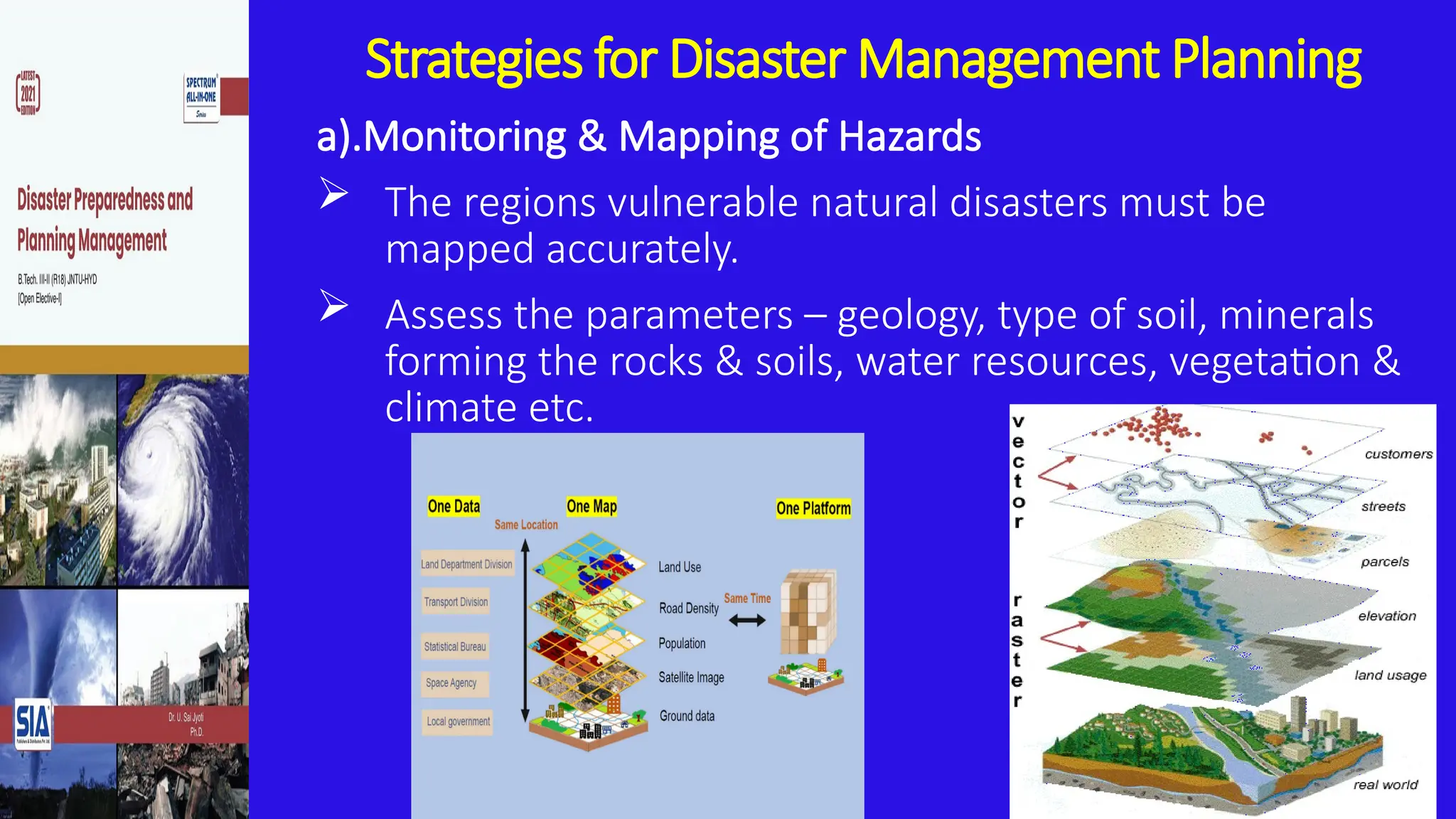
a).Monitoring & Mapping of Hazards
 The regions vulnerable natural disasters must be
mapped accurately.
 Assess the parameters – geology, type of soil, minerals
forming the rocks & soils, water resources, vegetation &
climate etc.
Strategies for Disaster Management Planning
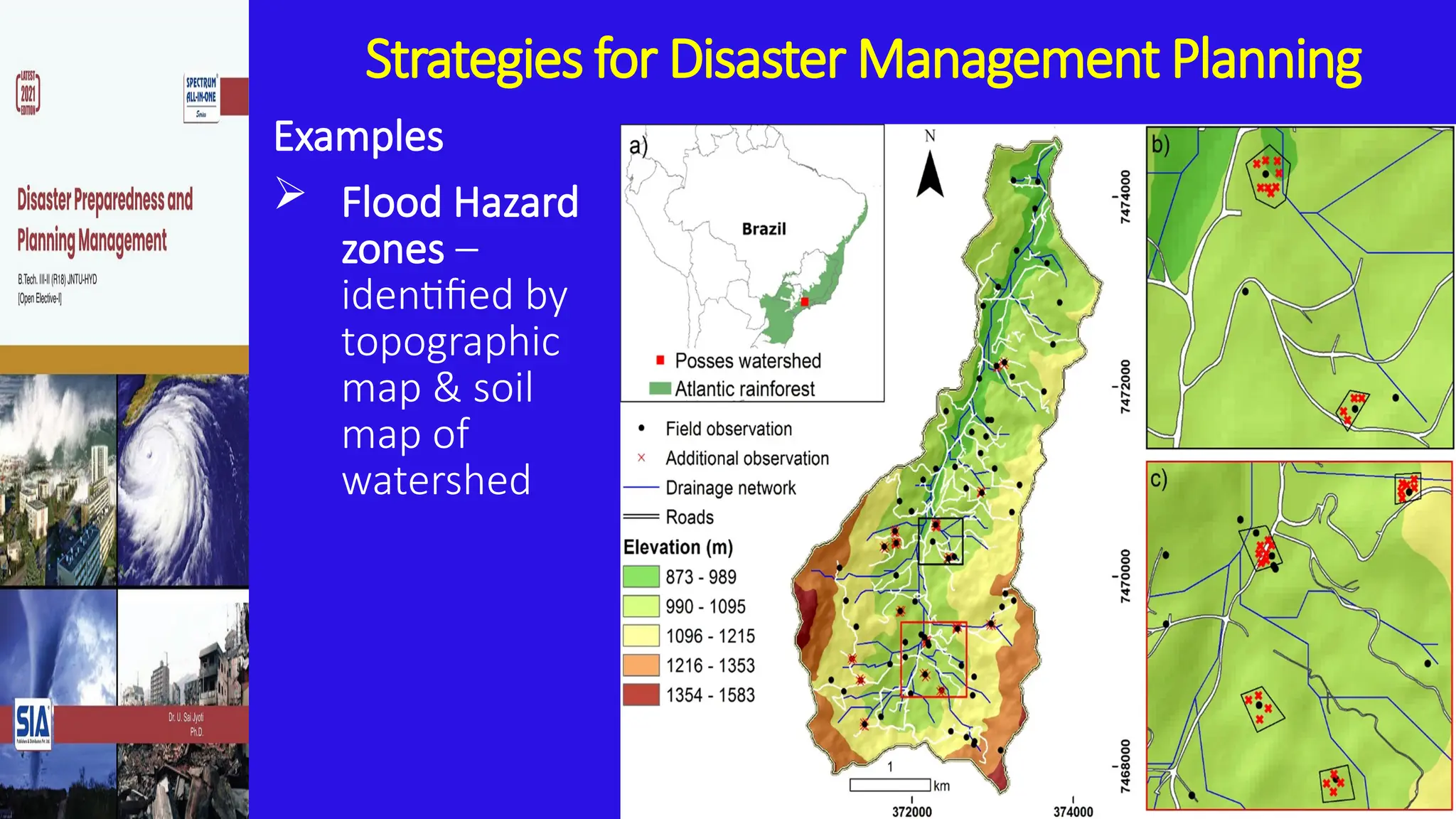
Examples
 Flood Hazard
zones –
identified by
topographic
map & soil
map of
watershed
Strategies for Disaster Management Planning
Examples
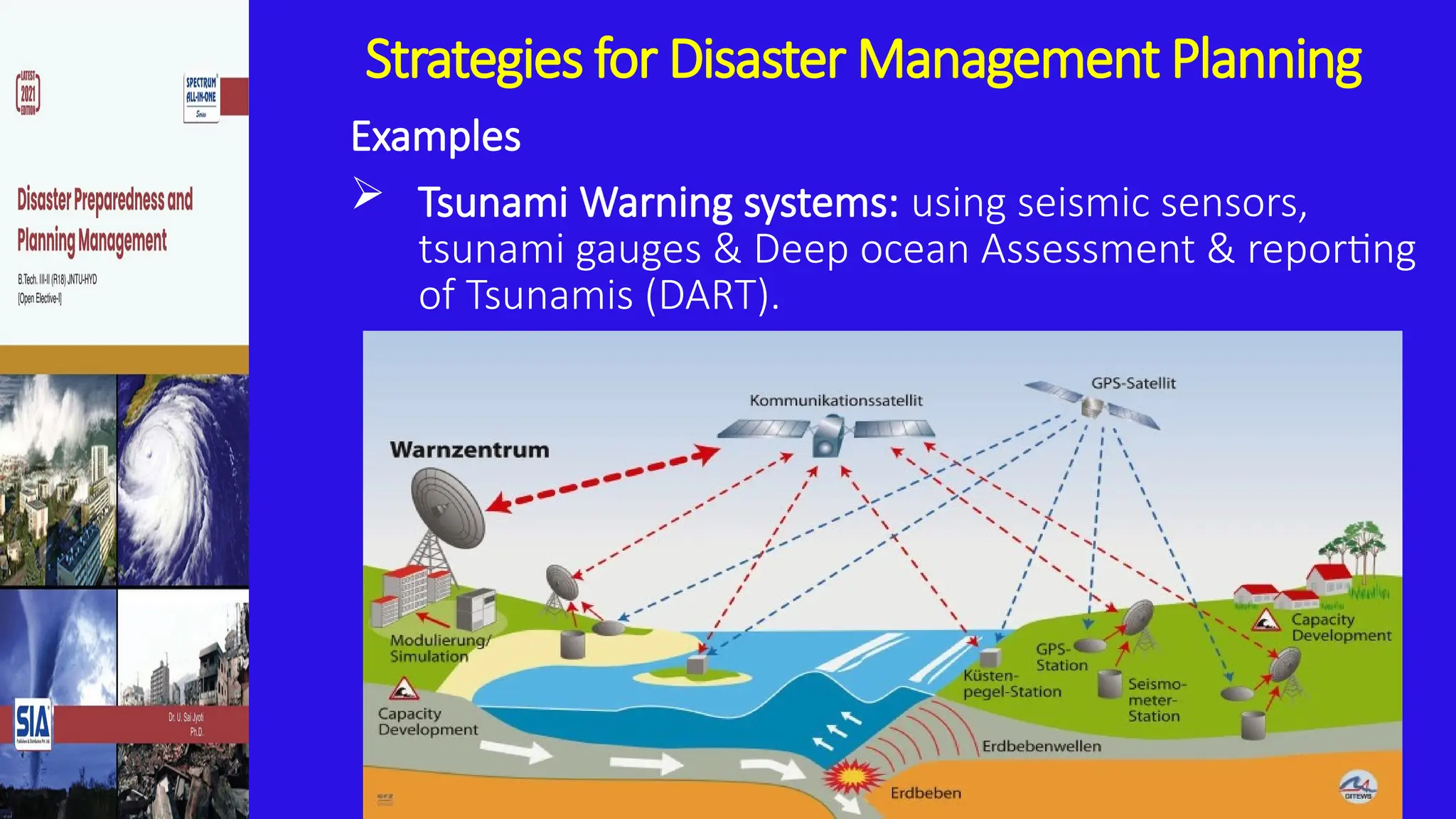
 Tsunami Warning systems: using seismic sensors,
tsunami gauges & Deep ocean Assessment & reporting
of Tsunamis (DART).
Strategies for Disaster Management Planning
b).Risk & Vulnerability Assessment
 Identification of risks involved & potential consequences
of hazards, its impact on life & property.
 The vulnerability indicators
 Improper design & building construction.
 Lack of awareness about impending danger.
 Insufficient preparedness.
 Giving least attention towards environmental management.
Strategies for Disaster Management Planning
c).Prediction & forecasting
i. Fractal method: fractals are used to predict hurricanes,
floods, earthquakes, volcanic eruptions, wildfires & land
slides.
 Fractal is a mathematical formula.
ii. Dilatancy theory: occurrence of earthquake can be predicted
based on the observations of rock samples.
 When the rocks are stressed , they began to expand due to
formation of micro cracks.
Strategies for Disaster Management Planning
c).Prediction & forecasting
iii. Scientific method of Disaster prediction: advanced
meteorological & satellite system is used to predict
hurricanes, tornadoes & cyclones.
 Avalanches, landslides & mudflows can be predicted by
following heavy snowfall & rainfall
iv. Animal behavior: behavior of animals, birds & insects change
before the occurrence of disaster.
 Rushing of buffaloes towards hills ahead of earthquake.
 Birds form their nests at higher height on trees – floods.
 Rolling of dogs on their bakcs on the snow – snow storm.
Strategies for Disaster Management Planning
d).Preparation of building guidelines
 The building codes are to improve the quality of new
constructions.
 A civil engineer may be involved in the following roles in
disaster management planning
 Policy makers & planning
 Structural engineer
 Geotechnical engineer
 Hydrological/irrigation engineer
 Environmental engineer/sanitary engineer.
 Building contractor etc.
 The above varied engineers use their knowledge &
experience to prevent & control unforeseen disasters
Strategies for Disaster Management Planning
e).Retrofitting of existing unsafe structures
 Modifications to the existing building is to prevent harm
from flooding, strong winds & earthquakes.
 Measures to make earthquake resistant buildings
 The steel used should be flexible.
 The base of the building should contain shock
absorbing rubber blocks.
 Fire proof materials should be used while constructing
buildings.
 Raising plinth level of building above the flood level.
 Seismic strengthening of beams, columns, connections
etc.
Strategies for Disaster Management Planning
f).Education on disasters
 Develop educational material on disaster risk reduction.
 Provide handbooks to public- prevention & response.
 Distribute posters & stickers to raise awareness.
 Use celebrities to relay information about risk reduction.
 Print articles & news letters about disaster mitigation.
THANK YOU

UNIT V_DPPM_PPT as per JNTUH syllabus...

  • 1.
    DISASTER PREPAREDNESS & PLANNING IIIYEAR B.Tech II SEM COMPUTER SECIENCE ENGINEERING J NARESH Department of Civil Engineering VIGNAN institute of Technology & Science
  • 2.
    UNIT-5 DISASTER, ENVIRONMENT & DEVELOPMENT •Vulnerability to disaster due to construction of dams, land use changes & urbanization. • Impacts of construction of dams • Generation of electricity. • Supply water for irrigation, industrial & domestic purposes. • Control the effect of flood water. • River navigation & recreational activities.
  • 3.
    UNIT-5 DISASTER, ENVIRONMENT & DEVELOPMENT •Changes in water storage: aquifer depletion • Changes in the continental runoff: reduce the water flow in rivers, evaporation losses are high. • Reservoir induced seismicity: (RIS)occurrence of earthquakes in vicinity of reservoirs. • Water pressure acting on the tectonic plates. • Tiny cracks in the formed on the ground surface reduces the ground stability.
  • 4.
    UNIT-5 DISASTER, ENVIRONMENT & DEVELOPMENT •Impact of land use changes: • DE vegetation, deforestation, construction of commercial complex, urban expansion etc. • Unplanned development in disaster prone regions. • Blasting of rocks in hills & mountains. • Urbanization.
  • 5.
    UNIT-5 DISASTER, ENVIRONMENT & DEVELOPMENT •Impact of urbanization: vulnerability in urban population. • Rapid unplanned growth of cities. • Changes in land use pattern. • Location of infrastructure, business & housing. • The risk of landslides & flooding. • Construction in the riverine flood plains. • Unsustainable land use.
  • 6.
    Sustainable Development • Largescale afforestation Programme. • Investment in agricultural development. • Implement special laws & regulations for different areas of ecological environment. • Sufficient measures to be taken to protect environment. • Control of soil erosion by afforestation & construction of water conservancy projects. • Prevention of desertification & dried-up lakes.
  • 7.
    Sustainable Development • Torestore farmland government should give subsidy on seeds. • Protection of wild animals, wild plants. • Designing of ecofriendly railway lines to protect environment & wild life. • Financial assistance may be provided to create environmental consciousness among the students by undertaking curriculum enrichment projects. • Making environment integral part of school education. • Sustainable utilization of natural resources.
  • 8.
    Human ecology Several disastrousepisodes have focused attention upon air pollution as a health hazard. The episodes have always occurred under extraordinary meteorological conditions and most of them were due to “temperature inversion”. 1.Meuse Valley (Belgium) : The first episode of modern times was Meuse valley. In December 1930, an anticyclone (high pressure area) blanked Belgium, resulting in fog and temperature inversion
  • 9.
    Human ecology Cause: forthis disaster was because of thermal inversion, various pollutants released from the industries in the city got trapped in the valley. •After careful consideration of all the gases and aerosols that were discharged into the air, it was a mixture of Sulphur dioxide and Sulphur trioxide, and other air pollutants fluorides, zinc particles etc. Effects: Abnormal weather caused to humans like cough, throat irritation, shortness of breath and vomiting etc.. Many became ill and around 60 people died.
  • 10.
    Donora (USA) It isa horse shaped valley with steeply rising hills. Anticyclone weather conditions of no air movement, temperature inversion and fog. Cause: the pollutants discharged from industries into atmosphere and due to the combined action of two or more of the air contaminants namely Sulphur dioxide together with oxidation products and particulate matter. Effects: irritation of eyes, nose, throat, cough, headache, vomiting and respiratory irritation. 6000 people became ill and 20persons died.
  • 11.
    London(Themes Valley) London situatedin themes valley experienced its worst air pollution episode due to fog. The “killer smog” began as a high pressure area created a subsidence inversion in themes valley. Cause: because of the extensive use of coal(Sulphur content 1.5%) as fuel, the particulate and Sulphur dioxide levels in the atmosphere increased. The white fog became a black fog with five times greater than normal time. The Sulphur dioxide concentrations in the atmosphere during this episode was about six times the usual level.
  • 12.
    London(Themes Valley) Effects: duringthis episode the high pressure area became stationary. The air pollutants combined with fog resulted in zero visibility. The symptoms were cough, nasal discharge, sore throat, irritation height and bronchi and sudden attack of vomiting. This disaster caused 4000 deaths Similar air pollution episodes(14 no's) experienced by London but they are mild in nature Later British Clean Air Act formed to take care of atmosphere.
  • 13.
    Los Angles Cause: •Subsidence inversionis responsible for the air pollution in the Los Angles. Los Angles has mountains which act as trap gases released from thousands of automobiles as horizontal movement is restricted by the mountains. •Ozone is formed by the photo chemical reactions of oxides of nitrogen and hydrocarbons (both are waste products from automobiles) •Due to temperature inversion photochemical smog is formed Effects: irritation of eyes, nose, throat due to PAN(Peroxyl Acetyl Nitrate). School children effected during days of air pollutants.
  • 14.
    New York hasalso had several episodes of air pollution which have been responsible for excess death. In November 1962 and 1963. The 1966 thanksgiving weekend which resulted in 168 deaths. Poza Rica (Mexico) is a natural gas processing and oil refining town in Mexico. Cause: an accident spillage of hydrogen sulphide gas for 25 to 30 minutes. Effects: this incident caused the illness of 320 persons and 22 deaths The symptoms were loss of sense of smell, cough, irritation and severe headache.
  • 15.
    Bhopal gas tragedyINDIA This considered as worlds worst air pollution disaster. Cause: from Union Carbide India Ltd. pesticide plant leakage of methyl Isocyanate gas. Effects: the symptoms are cough, severe eye irritation and a feeling of suffocation, burning in the respiratory tract, breathlessness, stomach pains and vomiting.
  • 16.
    Reconstruction & DevelopmentMethods • Post disaster activities: after the occurrence of a major earthquake the post disaster activities are • Quick assessment of damage caused. • Search and rescue operations of the disaster trapped victims. • Emergency medical attention to save lives. • Provide emergency basic needs. • Proper supply of emergency relief material. • Establishing communication links. • Reconstruction of damaged infrastructure. • Clearing of debris to allow easy access to vehicles
  • 17.
    Strategies for DisasterManagement Planning a).Monitoring & Mapping of Hazards  The regions vulnerable natural disasters must be mapped accurately.  Assess the parameters – geology, type of soil, minerals forming the rocks & soils, water resources, vegetation & climate etc.
  • 18.
    Strategies for DisasterManagement Planning Examples  Flood Hazard zones – identified by topographic map & soil map of watershed
  • 19.
    Strategies for DisasterManagement Planning Examples  Tsunami Warning systems: using seismic sensors, tsunami gauges & Deep ocean Assessment & reporting of Tsunamis (DART).
  • 20.
    Strategies for DisasterManagement Planning b).Risk & Vulnerability Assessment  Identification of risks involved & potential consequences of hazards, its impact on life & property.  The vulnerability indicators  Improper design & building construction.  Lack of awareness about impending danger.  Insufficient preparedness.  Giving least attention towards environmental management.
  • 21.
    Strategies for DisasterManagement Planning c).Prediction & forecasting i. Fractal method: fractals are used to predict hurricanes, floods, earthquakes, volcanic eruptions, wildfires & land slides.  Fractal is a mathematical formula. ii. Dilatancy theory: occurrence of earthquake can be predicted based on the observations of rock samples.  When the rocks are stressed , they began to expand due to formation of micro cracks.
  • 22.
    Strategies for DisasterManagement Planning c).Prediction & forecasting iii. Scientific method of Disaster prediction: advanced meteorological & satellite system is used to predict hurricanes, tornadoes & cyclones.  Avalanches, landslides & mudflows can be predicted by following heavy snowfall & rainfall iv. Animal behavior: behavior of animals, birds & insects change before the occurrence of disaster.  Rushing of buffaloes towards hills ahead of earthquake.  Birds form their nests at higher height on trees – floods.  Rolling of dogs on their bakcs on the snow – snow storm.
  • 23.
    Strategies for DisasterManagement Planning d).Preparation of building guidelines  The building codes are to improve the quality of new constructions.  A civil engineer may be involved in the following roles in disaster management planning  Policy makers & planning  Structural engineer  Geotechnical engineer  Hydrological/irrigation engineer  Environmental engineer/sanitary engineer.  Building contractor etc.  The above varied engineers use their knowledge & experience to prevent & control unforeseen disasters
  • 24.
    Strategies for DisasterManagement Planning e).Retrofitting of existing unsafe structures  Modifications to the existing building is to prevent harm from flooding, strong winds & earthquakes.  Measures to make earthquake resistant buildings  The steel used should be flexible.  The base of the building should contain shock absorbing rubber blocks.  Fire proof materials should be used while constructing buildings.  Raising plinth level of building above the flood level.  Seismic strengthening of beams, columns, connections etc.
  • 25.
    Strategies for DisasterManagement Planning f).Education on disasters  Develop educational material on disaster risk reduction.  Provide handbooks to public- prevention & response.  Distribute posters & stickers to raise awareness.  Use celebrities to relay information about risk reduction.  Print articles & news letters about disaster mitigation.
  • 26.