POETRY
UNIT PLAN
SHANNON DUNN
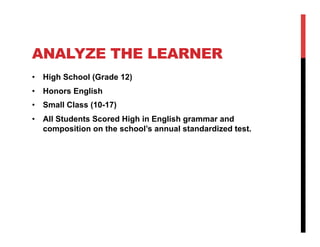
ANALYZE THE LEARNER
•  High School (Grade 12)
•  Honors English
•  Small Class (10-17)
•  All Students Scored High in English grammar and
composition on the school’s annual standardized test.
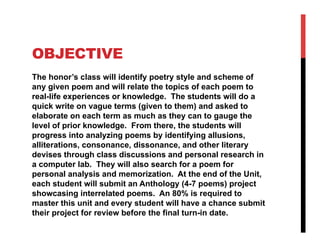
OBJECTIVE
The honor’s class will identify poetry style and scheme of
any given poem and will relate the topics of each poem to
real-life experiences or knowledge. The students will do a
quick write on vague terms (given to them) and asked to
elaborate on each term as much as they can to gauge the
level of prior knowledge. From there, the students will
progress into analyzing poems by identifying allusions,
alliterations, consonance, dissonance, and other literary
devises through class discussions and personal research in
a computer lab. They will also search for a poem for
personal analysis and memorization. At the end of the Unit,
each student will submit an Anthology (4-7 poems) project
showcasing interrelated poems. An 80% is required to
master this unit and every student will have a chance submit
their project for review before the final turn-in date.
LESSON ONE,
IDENTIFYING UNDERLYING
MEANINGS
•  Groups to anaylze
•  Terms to use
•  Present meaning (how structure and diction help)
•  Identify literary devises (how does this convey the
meaning)
•  Poetry shopping activity
LESSON TWO,
THEMES OF POETRY THROUGH
TIME
•  Groups to time period
•  Research
•  Submit 5 poems and 2 discussion questions
•  Class analysis
LESSON THREE,
LINKING TOPICAL POETRY
•  Individual topics (some students will have the same)
•  Search and submit 1 poem (no repeats)
•  Same topic students will group and discuss
•  Similarity/difference chart to compare poems
LESSON 4
ADVOCACY APPLICATION
•  Show current real-life advocacy poetry
•  Collaborate in groups to produce a poem to advocate for a
cause
LESSON 5
COMPILING AN ANTHOLOGY
•  Reference to short anthologies to learn structure
•  Create Wiki spaces to house anthology
•  Pick a topic and search poems
•  Analyze and reflect
•  Relate poems to each other
•  Submit for review
TECHNOLOGY
•  Computers
•  Overhead
•  Search engines
•  Wiki
•  Discussion boards
WORKS CITED
Poetryoutloud.org
Readwritethink.org
Teachingchannel.org
Poets.org
Poetryfoundation.org

Unit plan presentation

  • 1.
  • 2.
    ANALYZE THE LEARNER • High School (Grade 12) •  Honors English •  Small Class (10-17) •  All Students Scored High in English grammar and composition on the school’s annual standardized test.
  • 3.
    OBJECTIVE The honor’s classwill identify poetry style and scheme of any given poem and will relate the topics of each poem to real-life experiences or knowledge. The students will do a quick write on vague terms (given to them) and asked to elaborate on each term as much as they can to gauge the level of prior knowledge. From there, the students will progress into analyzing poems by identifying allusions, alliterations, consonance, dissonance, and other literary devises through class discussions and personal research in a computer lab. They will also search for a poem for personal analysis and memorization. At the end of the Unit, each student will submit an Anthology (4-7 poems) project showcasing interrelated poems. An 80% is required to master this unit and every student will have a chance submit their project for review before the final turn-in date.
  • 4.
    LESSON ONE, IDENTIFYING UNDERLYING MEANINGS • Groups to anaylze •  Terms to use •  Present meaning (how structure and diction help) •  Identify literary devises (how does this convey the meaning) •  Poetry shopping activity
  • 5.
    LESSON TWO, THEMES OFPOETRY THROUGH TIME •  Groups to time period •  Research •  Submit 5 poems and 2 discussion questions •  Class analysis
  • 6.
    LESSON THREE, LINKING TOPICALPOETRY •  Individual topics (some students will have the same) •  Search and submit 1 poem (no repeats) •  Same topic students will group and discuss •  Similarity/difference chart to compare poems
  • 7.
    LESSON 4 ADVOCACY APPLICATION • Show current real-life advocacy poetry •  Collaborate in groups to produce a poem to advocate for a cause
  • 8.
    LESSON 5 COMPILING ANANTHOLOGY •  Reference to short anthologies to learn structure •  Create Wiki spaces to house anthology •  Pick a topic and search poems •  Analyze and reflect •  Relate poems to each other •  Submit for review
  • 9.
    TECHNOLOGY •  Computers •  Overhead • Search engines •  Wiki •  Discussion boards
  • 10.