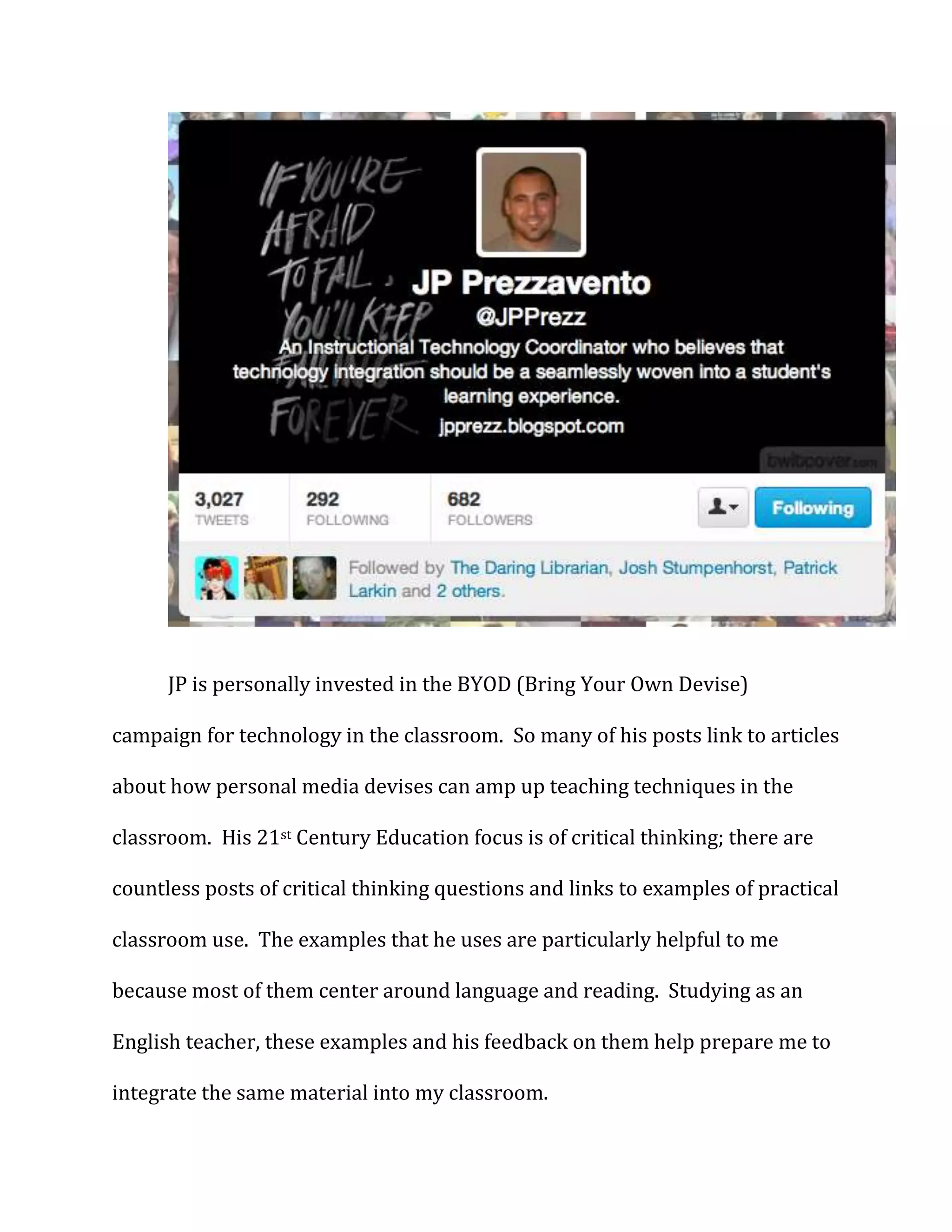
JP is personally invested in the BYOD (Bring Your Own Devise)
campaign for technology in the classroom. So many of his posts link to articles
about how personal media devises can amp up teaching techniques in the
classroom. His 21st Century Education focus is of critical thinking; there are
countless posts of critical thinking questions and links to examples of practical
classroom use. The examples that he uses are particularly helpful to me
because most of them center around language and reading. Studying as an
English teacher, these examples and his feedback on them help prepare me to
integrate the same material into my classroom.
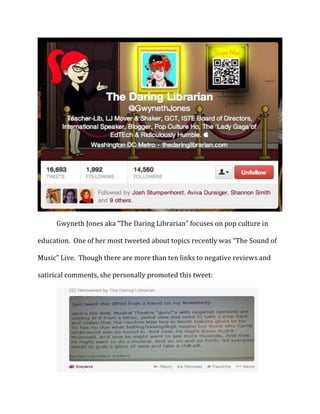
Gwyneth Jones aka “The Daring Librarian” focuses on pop culture in
education. One of her most tweeted about topics recently was “The Sound of
Music” Live. Though there are more than ten links to negative reviews and
satirical comments, she personally promoted this tweet:
Gwyneth’s twitter feed is full of helpful resources for reality. There are a lot of
biased notions, but for most arguments you can find heavy biases for each
side. Overall, she reaches to both sides of her topics to help students
understand conflicting viewpoints.

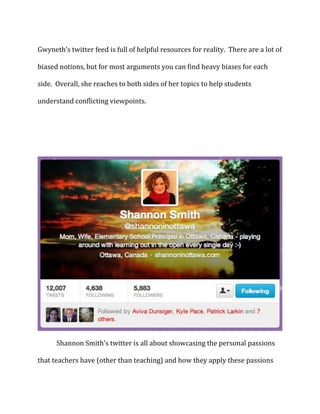
Shannon Smith’s twitter is all about showcasing the personal passions
that teachers have (other than teaching) and how they apply these passions
into their classrooms. So many posts are of local (to her) teachers talking,
performing, and expressing their passions. This is an amazing tool to grab
student interest or even inspire other teachers working on the same topic.
She also promotes online interactive education. The references to programs
like Makerbot infer that she is on board and excited for computer-based,
project-based learning.
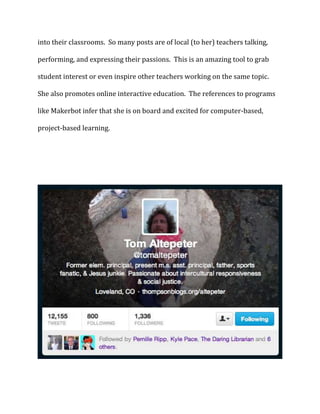
Tom Altepeter focuses on diversity and social justice. His posts outside
of the educational realm showcase a diverse life of football to rock climbing to
holidays to comedy. All of his educational posts are centered on racial
fairness and sensitivity and social justice. A lot of his diversity-oriented
material is based in comedy. Links to clips from “The Daily Show with John
Stewart” and “The Chappell Show” about racial sensitivity are very prominent
in his posts. Tom brings out the reality of racism in American society. His
posts are a constant reminder that giving weight to connotations of race is still
a huge problem in American society.
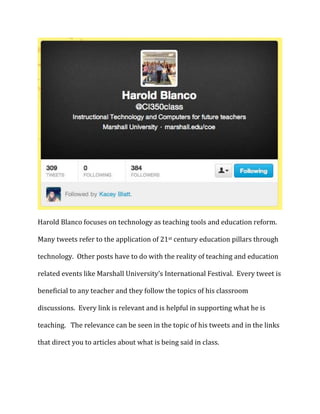
Harold Blanco focuses on technology as teaching tools and education reform.
Many tweets refer to the application of 21st century education pillars through
technology. Other posts have to do with the reality of teaching and education
related events like Marshall University’s International Festival. Every tweet is
beneficial to any teacher and they follow the topics of his classroom
discussions. Every link is relevant and is helpful in supporting what he is
teaching. The relevance can be seen in the topic of his tweets and in the links
that direct you to articles about what is being said in class.

Twitter

  • 1.
    JP is personallyinvested in the BYOD (Bring Your Own Devise) campaign for technology in the classroom. So many of his posts link to articles about how personal media devises can amp up teaching techniques in the classroom. His 21st Century Education focus is of critical thinking; there are countless posts of critical thinking questions and links to examples of practical classroom use. The examples that he uses are particularly helpful to me because most of them center around language and reading. Studying as an English teacher, these examples and his feedback on them help prepare me to integrate the same material into my classroom.
  • 2.
    Gwyneth Jones aka“The Daring Librarian” focuses on pop culture in education. One of her most tweeted about topics recently was “The Sound of Music” Live. Though there are more than ten links to negative reviews and satirical comments, she personally promoted this tweet:
  • 3.
    Gwyneth’s twitter feedis full of helpful resources for reality. There are a lot of biased notions, but for most arguments you can find heavy biases for each side. Overall, she reaches to both sides of her topics to help students understand conflicting viewpoints. Shannon Smith’s twitter is all about showcasing the personal passions that teachers have (other than teaching) and how they apply these passions
  • 4.
    into their classrooms.So many posts are of local (to her) teachers talking, performing, and expressing their passions. This is an amazing tool to grab student interest or even inspire other teachers working on the same topic. She also promotes online interactive education. The references to programs like Makerbot infer that she is on board and excited for computer-based, project-based learning.
  • 5.
    Tom Altepeter focuseson diversity and social justice. His posts outside of the educational realm showcase a diverse life of football to rock climbing to holidays to comedy. All of his educational posts are centered on racial fairness and sensitivity and social justice. A lot of his diversity-oriented material is based in comedy. Links to clips from “The Daily Show with John Stewart” and “The Chappell Show” about racial sensitivity are very prominent in his posts. Tom brings out the reality of racism in American society. His posts are a constant reminder that giving weight to connotations of race is still a huge problem in American society.
  • 6.
    Harold Blanco focuseson technology as teaching tools and education reform. Many tweets refer to the application of 21st century education pillars through technology. Other posts have to do with the reality of teaching and education related events like Marshall University’s International Festival. Every tweet is beneficial to any teacher and they follow the topics of his classroom discussions. Every link is relevant and is helpful in supporting what he is teaching. The relevance can be seen in the topic of his tweets and in the links that direct you to articles about what is being said in class.