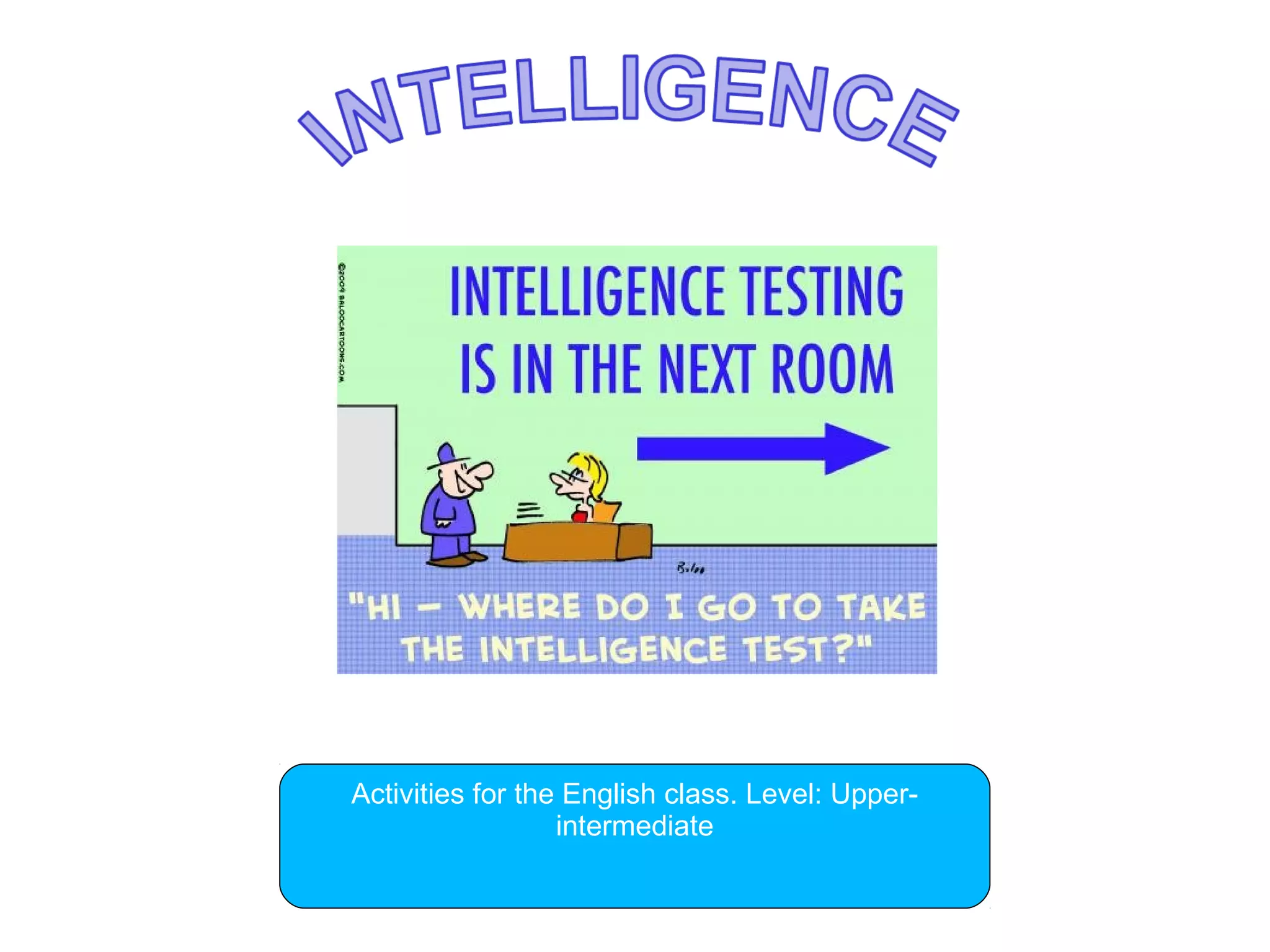
Activities for the English class. Level: Upper-
intermediate
In pairs, come up with a list of 3 intelligent
people.
1) Who are they?
2) Why did you choose them?
3) Why do you think they are intelligent?
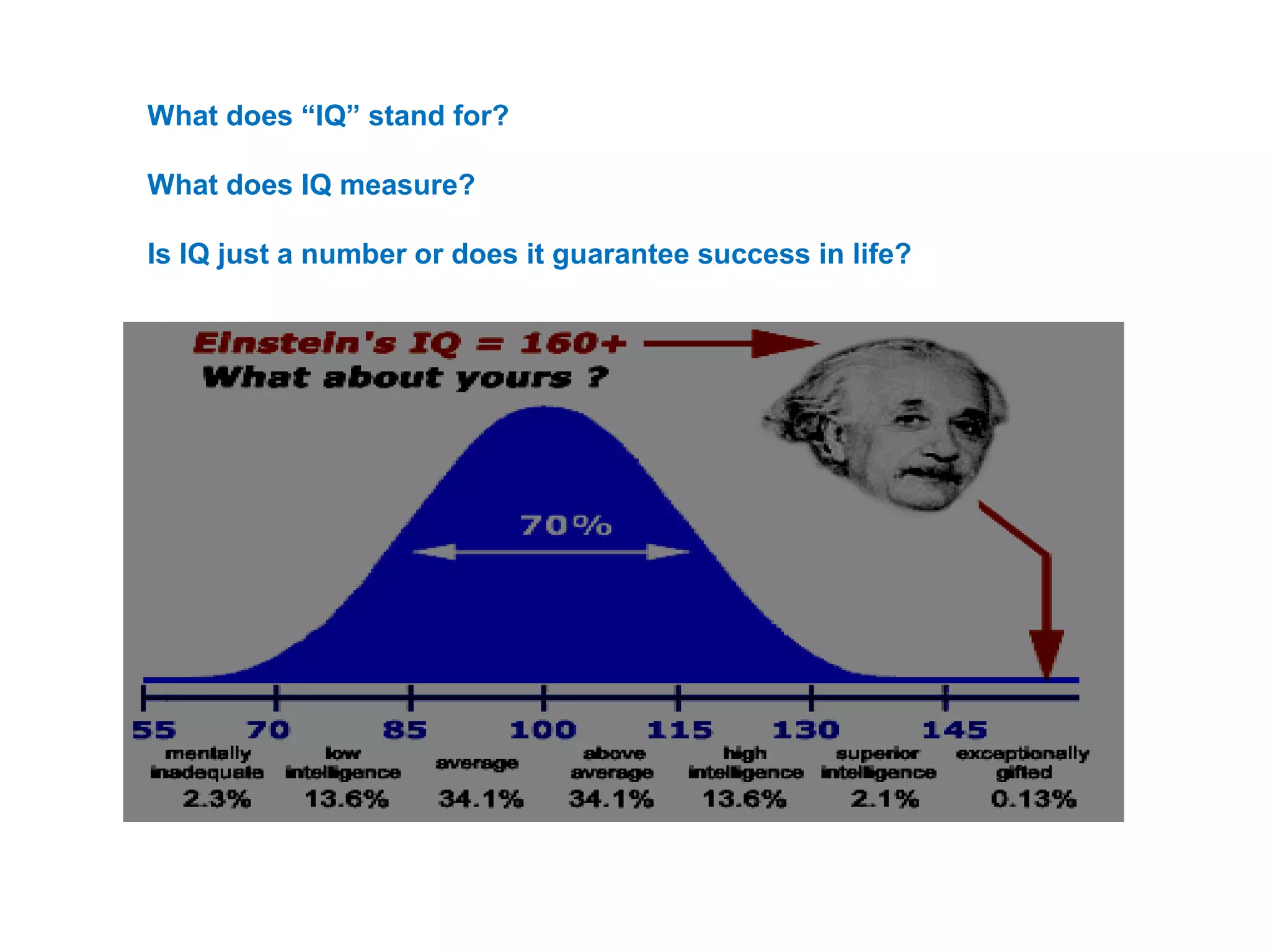
What does “IQ” stand for?
What does IQ measure?
Is IQ just a number or does it guarantee success in life?
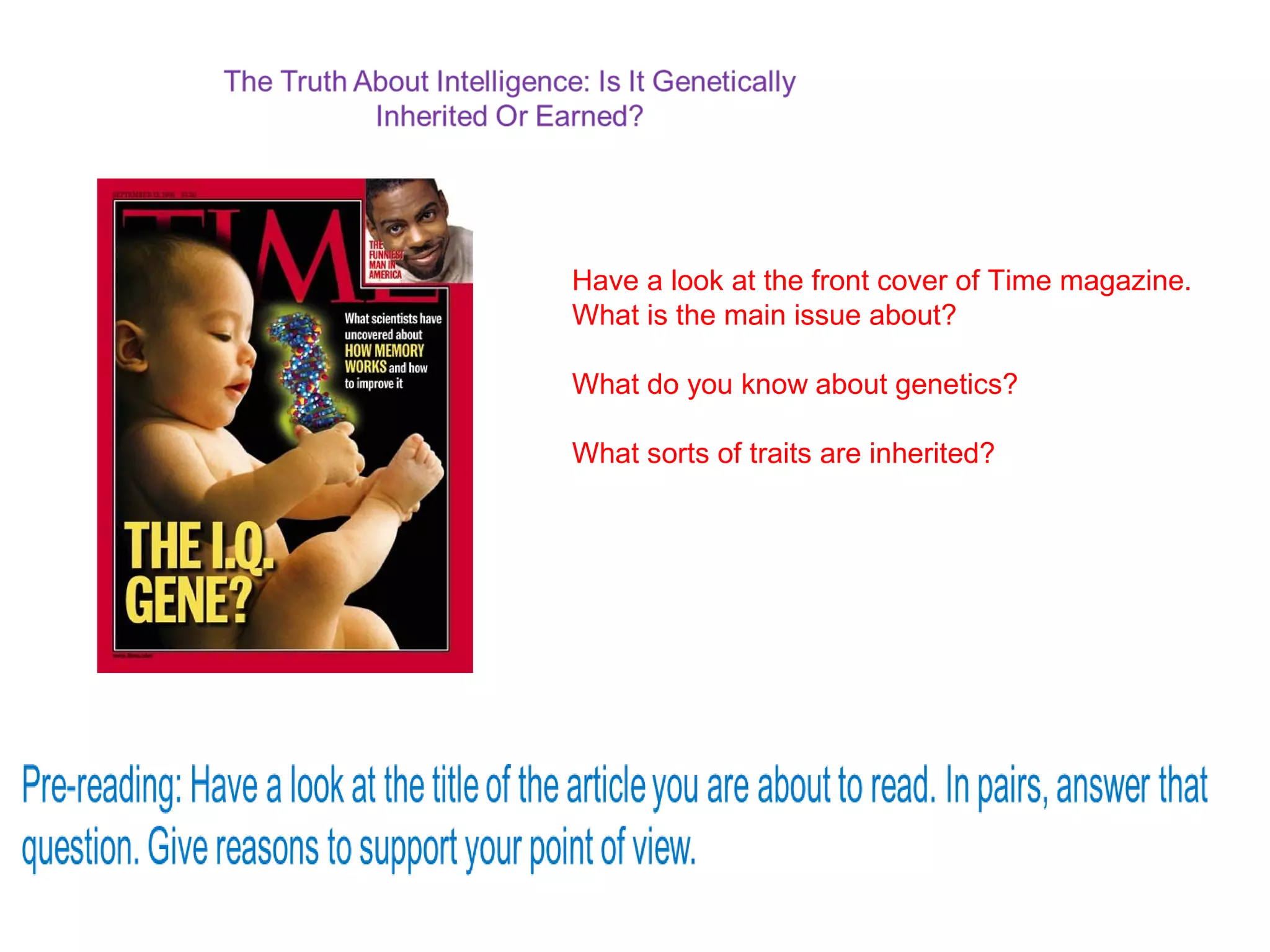
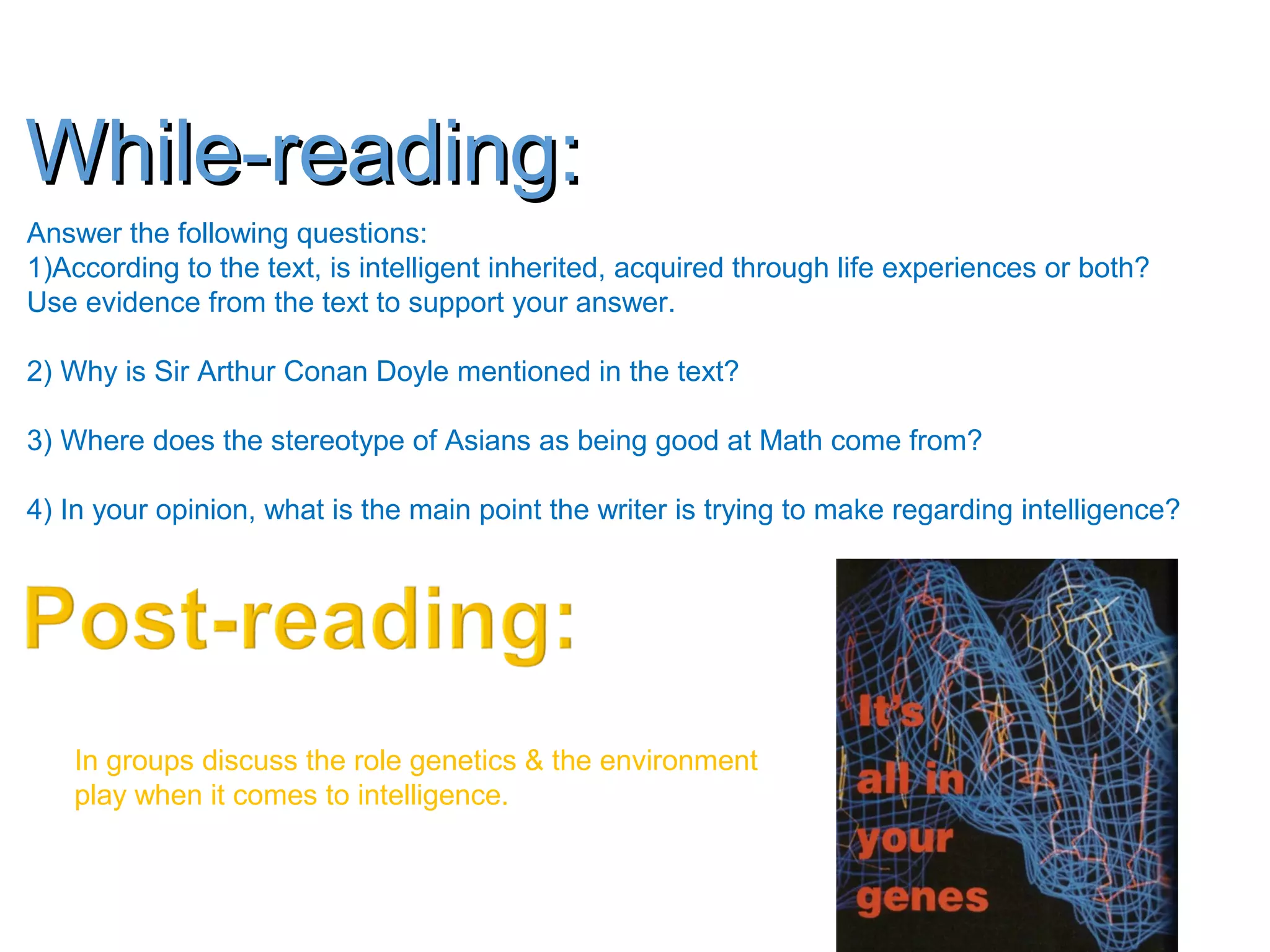
Have a look at the front cover of Time magazine.
What is the main issue about?
What do you know about genetics?
What sorts of traits are inherited?
The Truth About Intelligence: Is It Genetically
Inherited Or Earned?
According to the dictionary, intelligence is the
ability of acquiring and applying knowledge and
skills. However, it’s not that simple, since
intelligence is a notion that is often
misunderstood.
Some people believe that intelligence is the
knowledge you gain through education, while
others believe it has nothing to do with
education, but it is the sum of experiences you
gain throughout your life.
Once I was having a talk with an economics
professor about the US education system. The
main question I had for him was if the current
system provides us with necessary knowledge.
His response was that everything we learn
through books and school is useless until we
learn how to apply it.
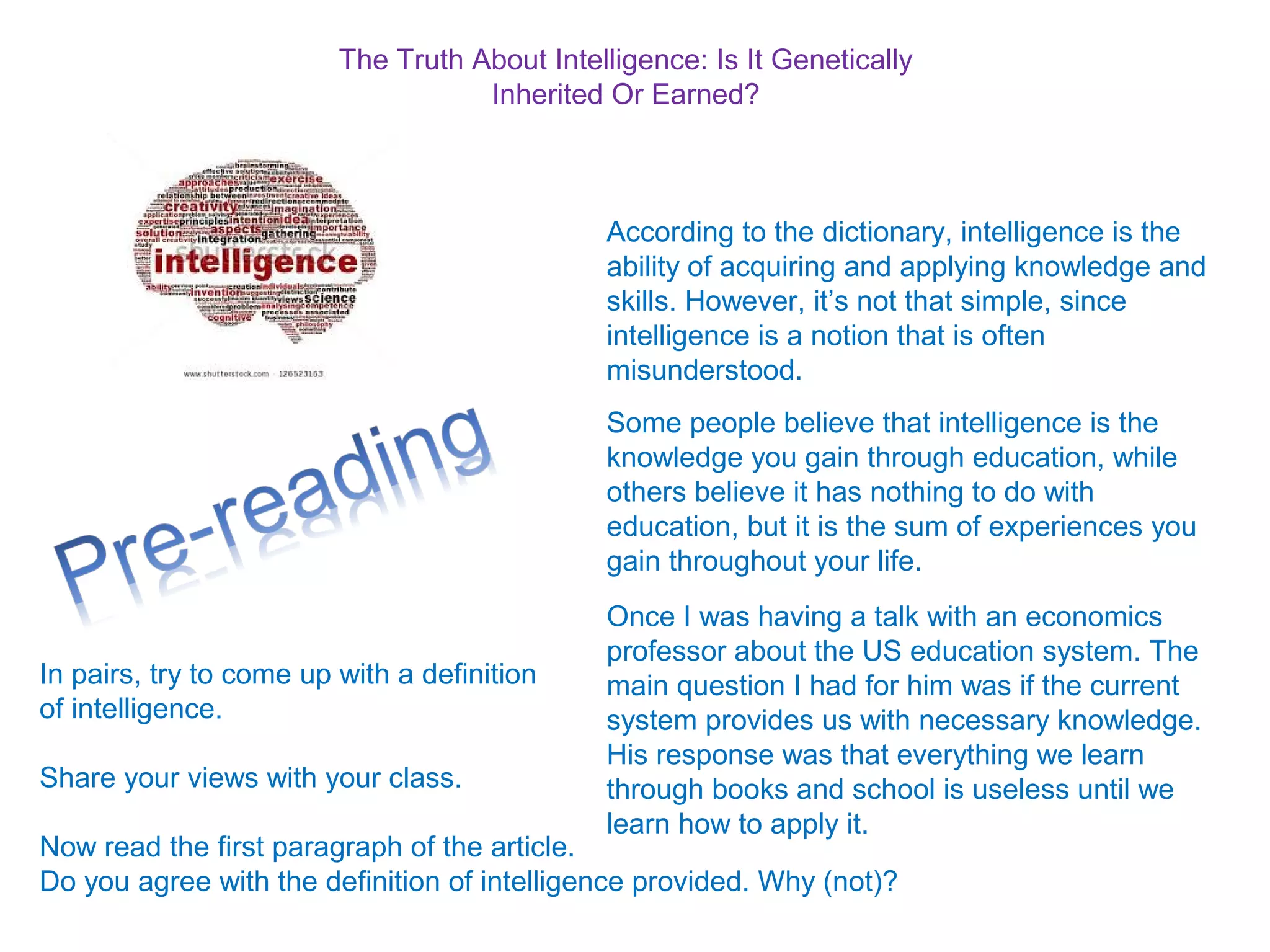
In pairs, try to come up with a definition
of intelligence.
Share your views with your class.
Now read the first paragraph of the article.
Do you agree with the definition of intelligence provided. Why (not)?
Therefore, we cannot say that everything we
read and learn is useless information since
sometimes it gives you a sense of how
everything is organized, from human body to
society.
We can conclude that intelligence is not only
knowledge and skills that you can apply, but it
also helps you to make sense of things that are
happening around you.
So is intelligence something you can inherit
through your family, or does your ethnicity
somehow affect it? Maybe it is something that
depends on you?
If you want to know what stands behind the
successful and intelligent people, I suggest you
read “Outliers” by Malcolm Gladwell. By the end
of it, you’ll be looking at success differently.
Do you inherent your intelligence through your
family? A study by psychologist Robert
Sternberg concluded that the skills and
knowledge you have are the result of your
family. However, it is not a genetic relation, but
rather, an educational one.
Children inherit practical intelligence, which is
the knowledge that comes from the way your
parents communicate with you. According to the
study, middle-class families spend more time
with their children than lower-class families.
During that time, they teach their children how
to speak and interact with other people, how to
treat them and how to solve social problems.
This establishes and develops self-esteem, a
quality that works in your favor for a lifetime.
Varying factors like parents working more than
one job, the amount of free time they can spend
with their children and relative location to quality
school districts affect children who come from
lower-class families. By that sense, family
background can have an influence on your
intelligence.
In order to analyze the relation between
ethnicity and intelligence, I’m going to refer
back to Gladwell’s “Outliers.” Have you ever
wondered where the stereotype of Asians being
good at math and science came from?
Gladwell explains it this way: “In many cultures
it is believed that whatever you do, the results
always depends on the fate or on God’s will.”
Thus, it implies that how much you work does
not affect the outcome.
On the other hand, most Asian
cultures believe that everything
depends on you and your hard
work. The harder you work, the
more you get, and if you do not
succeed, then you must not
have tried hard enough. So,
yes, your ethnicity does matter
for you to be a successful or
intelligent person.
Overall, the lesson to be
learned here is that you
shouldn’t let your intelligence
and/or lifestyle be the slave of
your genes. Everything
depends on you. Certain
aspects do affect this, but it is
only the attitude that injects
you with the drive to do or not
to do.
While-reading:While-reading:
Answer the following questions:
1)According to the text, is intelligent inherited, acquired through life experiences or both?
Use evidence from the text to support your answer.
2) Why is Sir Arthur Conan Doyle mentioned in the text?
3) Where does the stereotype of Asians as being good at Math come from?
4) In your opinion, what is the main point the writer is trying to make regarding intelligence?
In groups discuss the role genetics & the environment
play when it comes to intelligence.
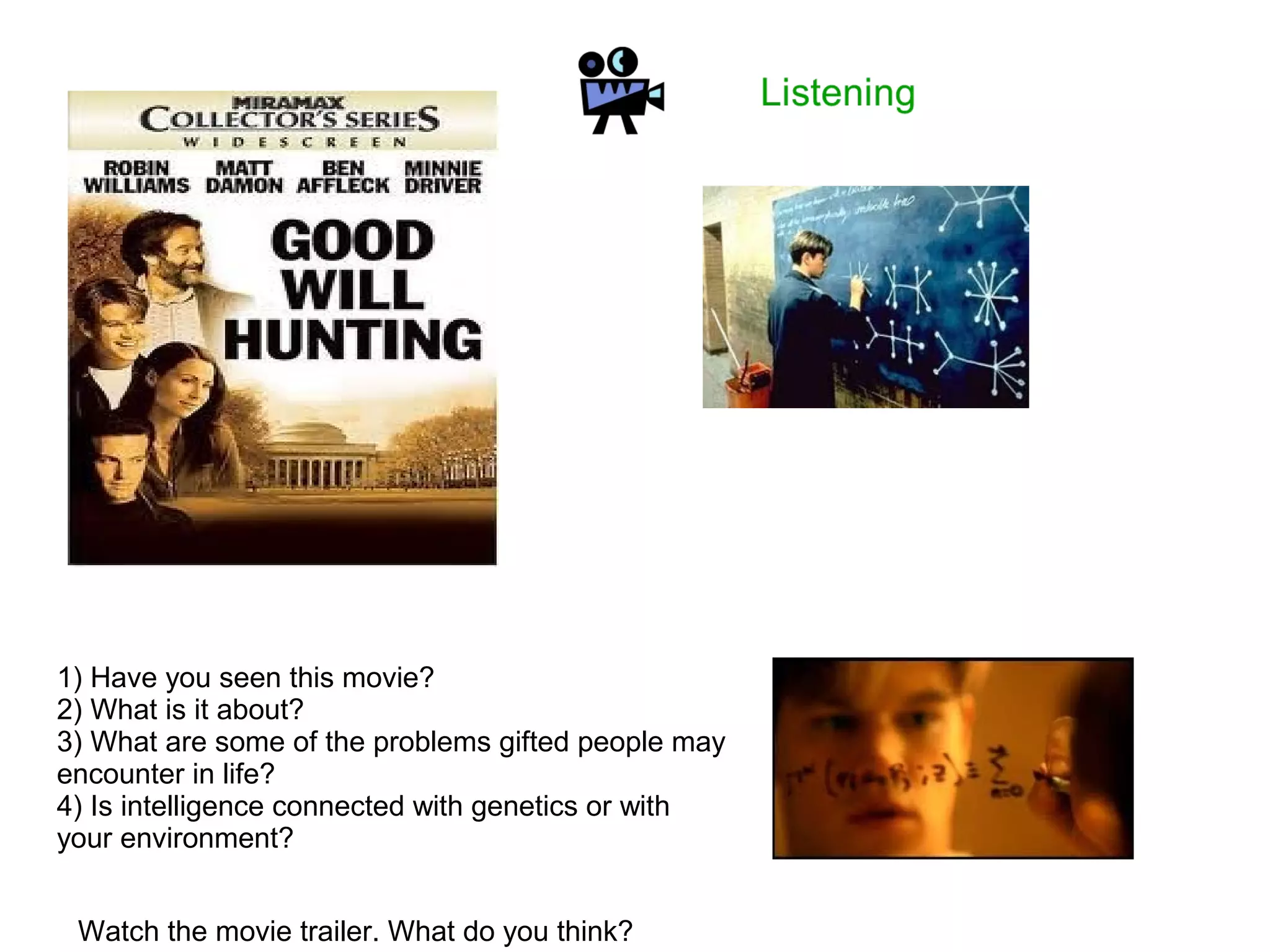
1) Have you seen this movie?
2) What is it about?
3) What are some of the problems gifted people may
encounter in life?
4) Is intelligence connected with genetics or with
your environment?
Watch the movie trailer. What do you think?
1) Have you seen this movie? What is it about?
2) Do you know who John Nash is?
3) Are you familiar with the mental disease of
Schizophrenia?
4) Do you believe that geniuses are prone to
developing mental diseases? Why?
Schizophrenia (pronounced / sk ts fr niə/ˌ ɪ ɵˈ ɛ or / sk ts fri niə/ˌ ɪ ɵˈ ː ) is a mental disorder characterized by a disintegration of thought
processes and of emotional responsiveness.[1] It most commonly manifests as auditory hallucinations, paranoid or bizarre delusions
or disorganized speech and thinking, and it is accompanied by significant social or occupational dysfunction
Watch the movie trailer. What do you think?Watch the movie trailer. What do you think?
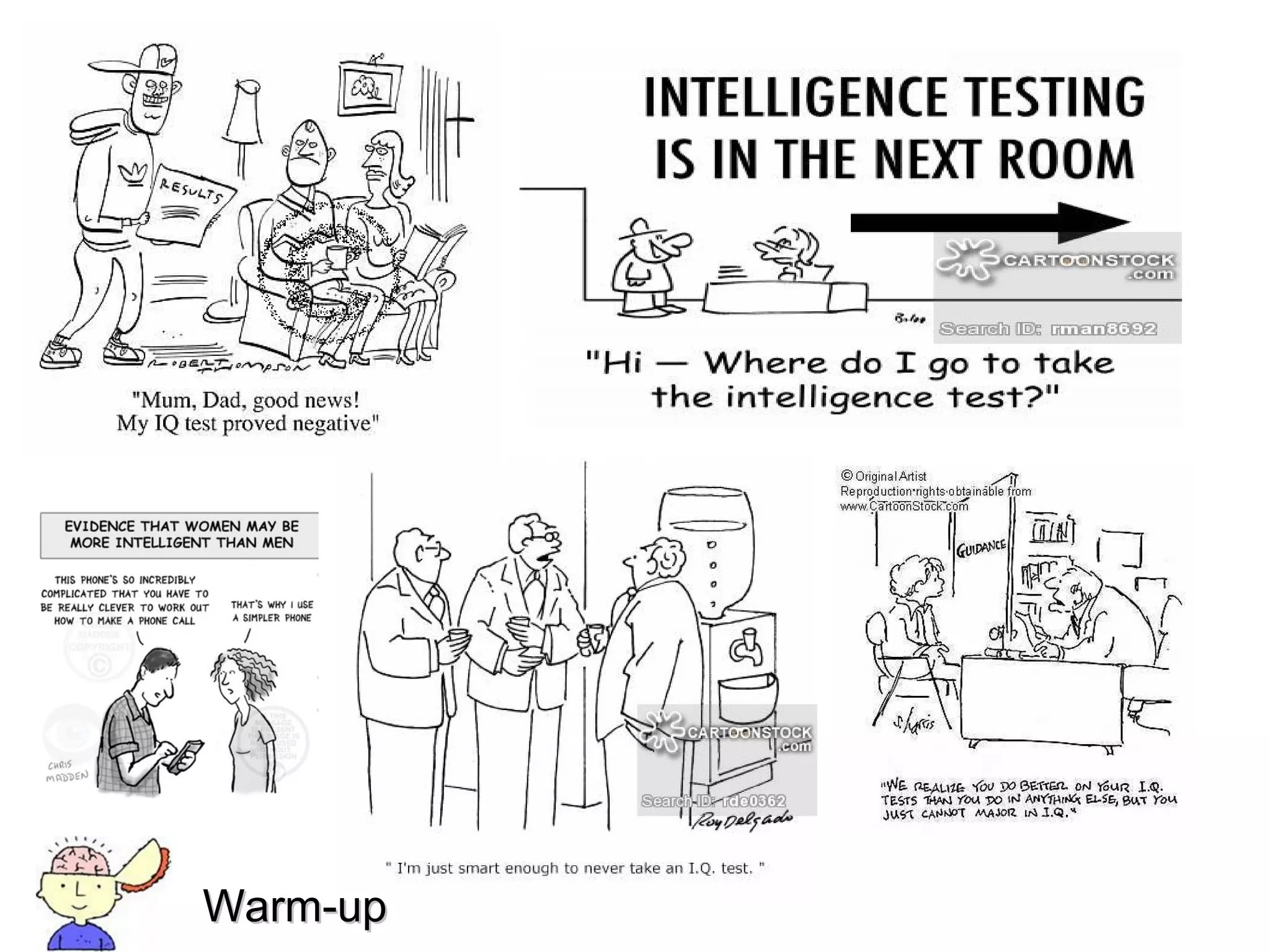
Warm-upWarm-up
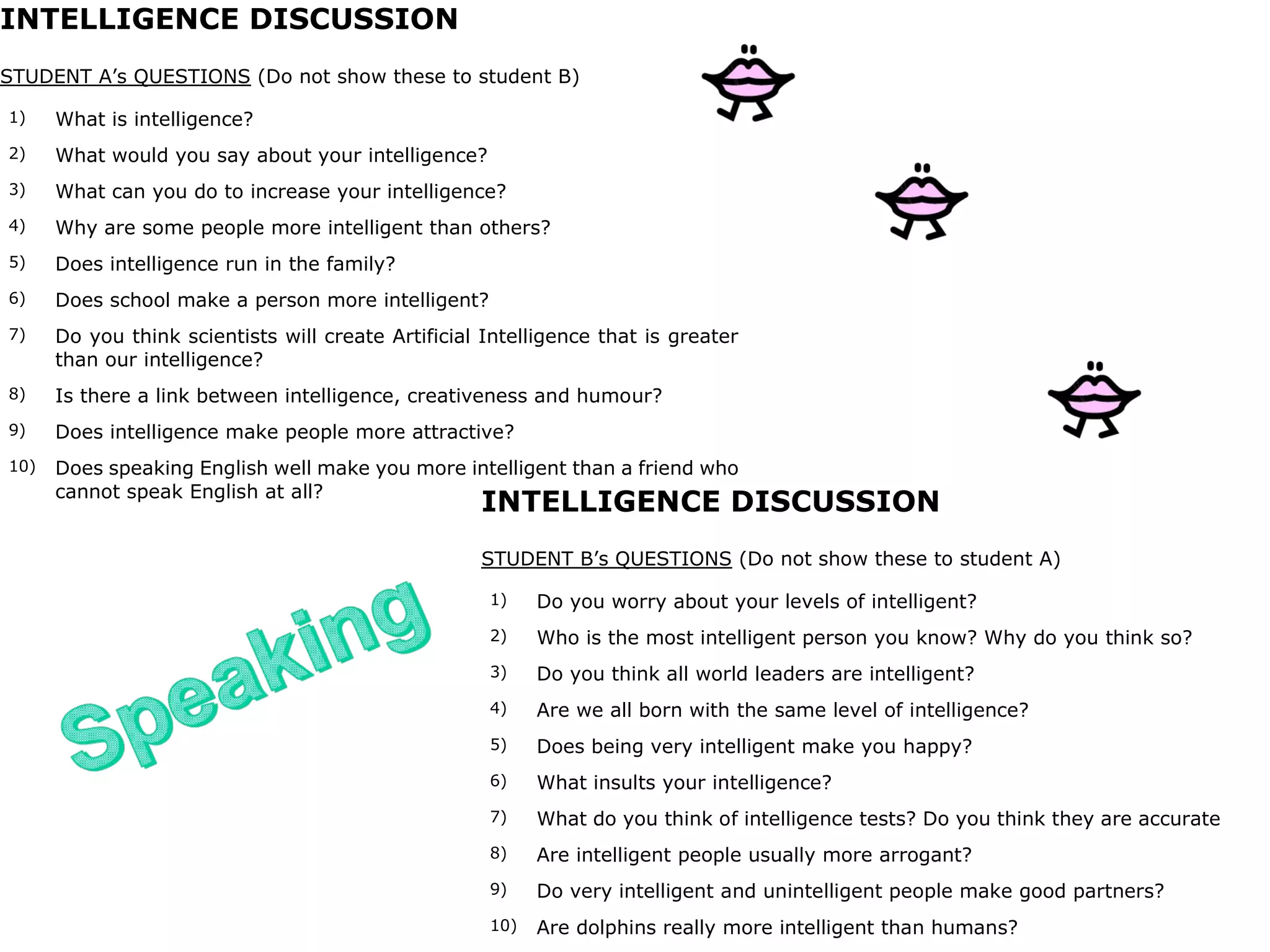
INTELLIGENCE DISCUSSION
STUDENT A’s QUESTIONS (Do not show these to student B)
1) What is intelligence?
2) What would you say about your intelligence?
3) What can you do to increase your intelligence?
4) Why are some people more intelligent than others?
5) Does intelligence run in the family?
6) Does school make a person more intelligent?
7) Do you think scientists will create Artificial Intelligence that is greater
than our intelligence?
8) Is there a link between intelligence, creativeness and humour?
9) Does intelligence make people more attractive?
10) Does speaking English well make you more intelligent than a friend who
cannot speak English at all?
INTELLIGENCE DISCUSSION
STUDENT B’s QUESTIONS (Do not show these to student A)
1) Do you worry about your levels of intelligent?
2) Who is the most intelligent person you know? Why do you think so?
3) Do you think all world leaders are intelligent?
4) Are we all born with the same level of intelligence?
5) Does being very intelligent make you happy?
6) What insults your intelligence?
7) What do you think of intelligence tests? Do you think they are accurate
8) Are intelligent people usually more arrogant?
9) Do very intelligent and unintelligent people make good partners?
10) Are dolphins really more intelligent than humans?
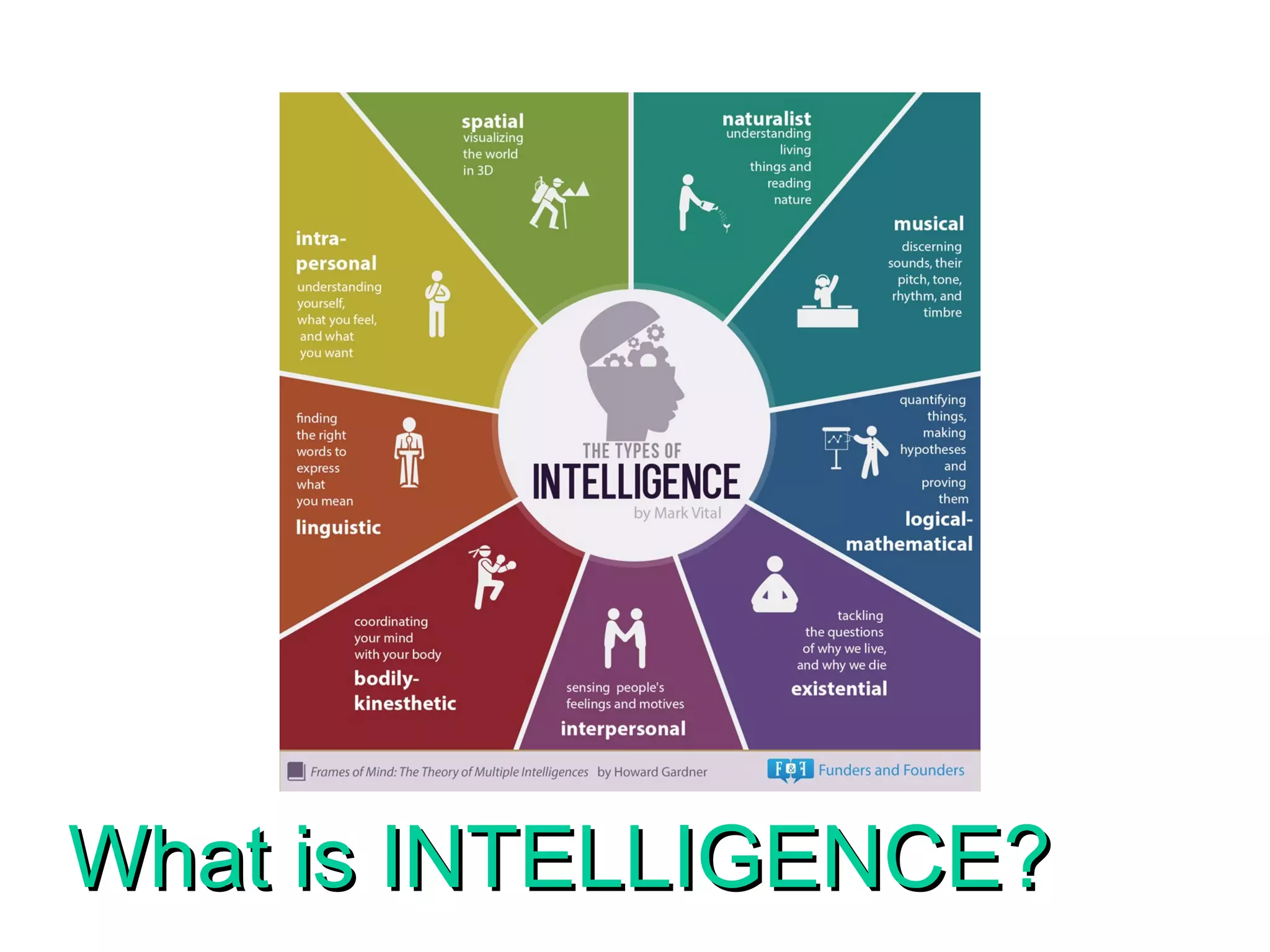
What is INTELLIGENCE?What is INTELLIGENCE?
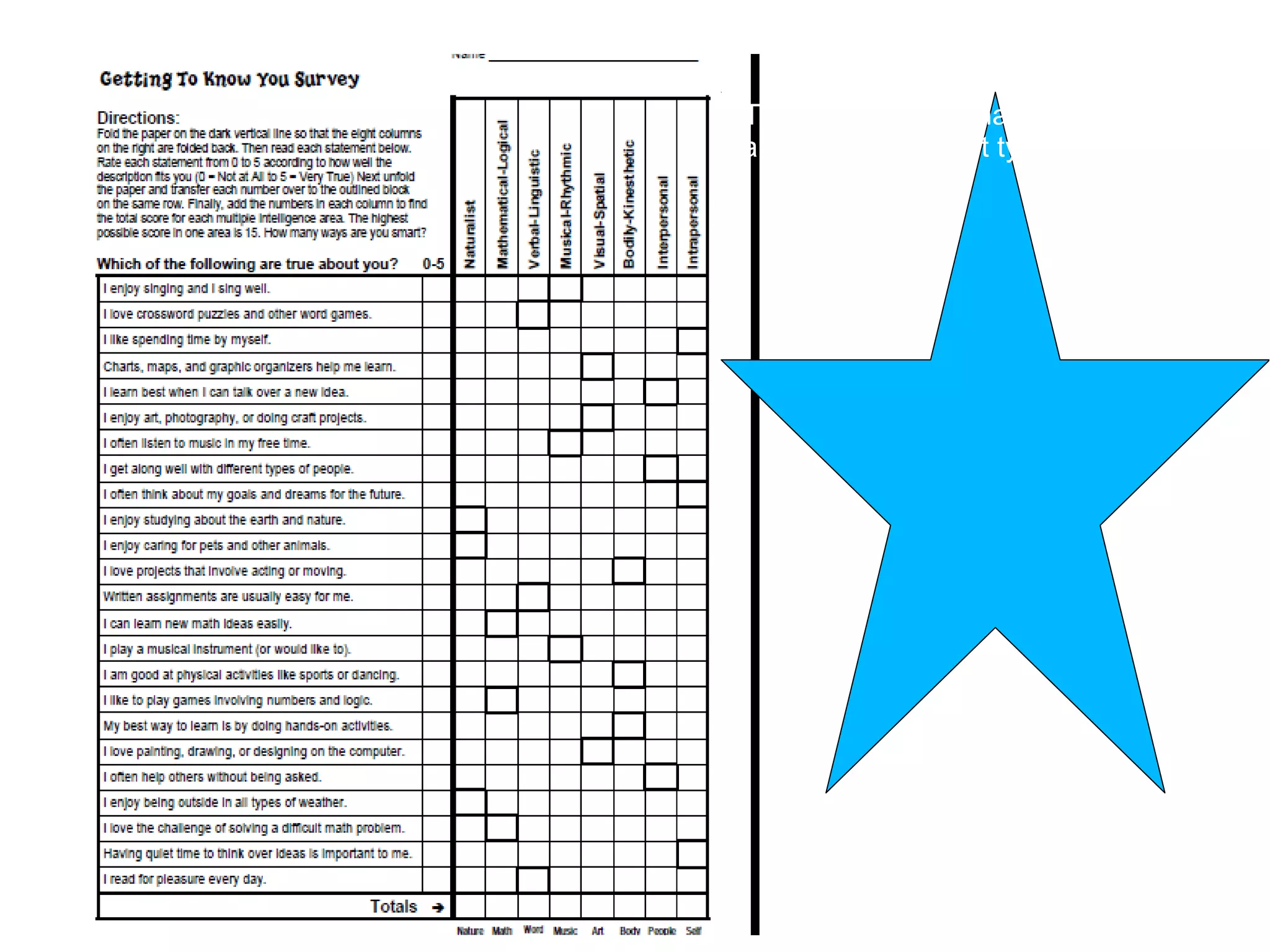
Take this questionnaire to find out more
about your different types of intelligence
A scientist said robots will be more intelligent than humans by 2029. The
scientist's name is Ray Kurzweil. He works for Google as Director of Engineering.
He is one of the world's leading experts on artificial intelligence (A.I.). Mr
Kurzweil believes computers will be able to learn from experiences, just like
humans. He also thinks they will be able to tell jokes and stories, and even flirt.
Kurzweil's 2029 prediction is a lot sooner than many people thought. The
scientist said that in 1999, many A.I. experts said it would be hundreds of years
before a computer was more intelligent than a human. He said that it would not
be long before computer intelligence is one billion times more powerful than the
human brain.
Mr Kurzweil joked that many years ago, people thought he was a little crazy for
predicting computers would be as intelligent as humans. His thinking has stayed
the same but everyone else has changed the way they think. He said: "My views
are not radical any more. I've actually stayed consistent. It's the rest of the
world that's changing its view." He highlighted examples of high-tech things we
use, see or read about every day. These things make us believe that computers
have intelligence. He said people think differently now: "Because the public has
seen things like Siri [the iPhone's voice-recognition technology] where you talk
to a computer; they've seen the Google self-driving cars."
READING: ARTIFICIAL INTELLIGENCE
Pre-reading: What do you understand by “artificial intelligence”?
Do you believe that robots will be eventually smarter than humans? Why (not)?
Quickly have a look at the text in red. What do you think the article is going to be about?
Now read the two paragraphs and check whether your predictions were ok.
Divide the class
into 2 groups:
For & Against
Each group
brainstorms
ideas to back up
their argument
Ask students to
provide
examples
Central Intelligence AgencyThe Work Of A
Nation. The Center of Intelligence.
CIA Personality Quiz Text
At the CIA, the challenges of today’s fast-paced
global changes present opportunities for
exceptional careers. Our intelligence mission is
the work of the nation — and our success
depends on a network of professionals around
the world.
What do you know about the
CIA?
In pairs, take this
questionnaire about some of
the most common myths
regarding this organization.
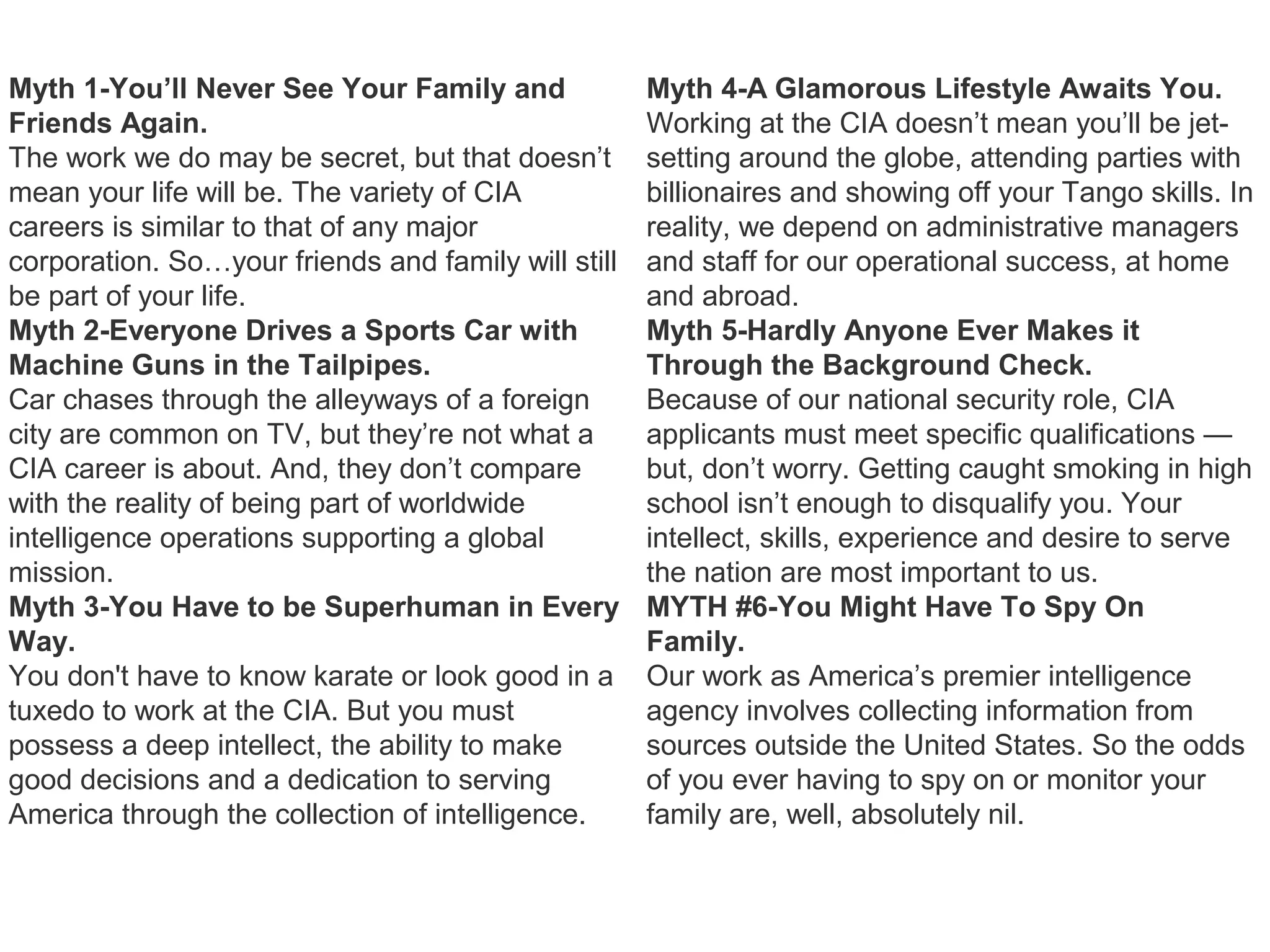
Myth 1-You’ll Never See Your Family and
Friends Again.
The work we do may be secret, but that doesn’t
mean your life will be. The variety of CIA
careers is similar to that of any major
corporation. So…your friends and family will still
be part of your life.
Myth 2-Everyone Drives a Sports Car with
Machine Guns in the Tailpipes.
Car chases through the alleyways of a foreign
city are common on TV, but they’re not what a
CIA career is about. And, they don’t compare
with the reality of being part of worldwide
intelligence operations supporting a global
mission.
Myth 3-You Have to be Superhuman in Every
Way.
You don't have to know karate or look good in a
tuxedo to work at the CIA. But you must
possess a deep intellect, the ability to make
good decisions and a dedication to serving
America through the collection of intelligence.
Myth 4-A Glamorous Lifestyle Awaits You.
Working at the CIA doesn’t mean you’ll be jet-
setting around the globe, attending parties with
billionaires and showing off your Tango skills. In
reality, we depend on administrative managers
and staff for our operational success, at home
and abroad.
Myth 5-Hardly Anyone Ever Makes it
Through the Background Check.
Because of our national security role, CIA
applicants must meet specific qualifications —
but, don’t worry. Getting caught smoking in high
school isn’t enough to disqualify you. Your
intellect, skills, experience and desire to serve
the nation are most important to us.
MYTH #6-You Might Have To Spy On
Family.
Our work as America’s premier intelligence
agency involves collecting information from
sources outside the United States. So the odds
of you ever having to spy on or monitor your
family are, well, absolutely nil.
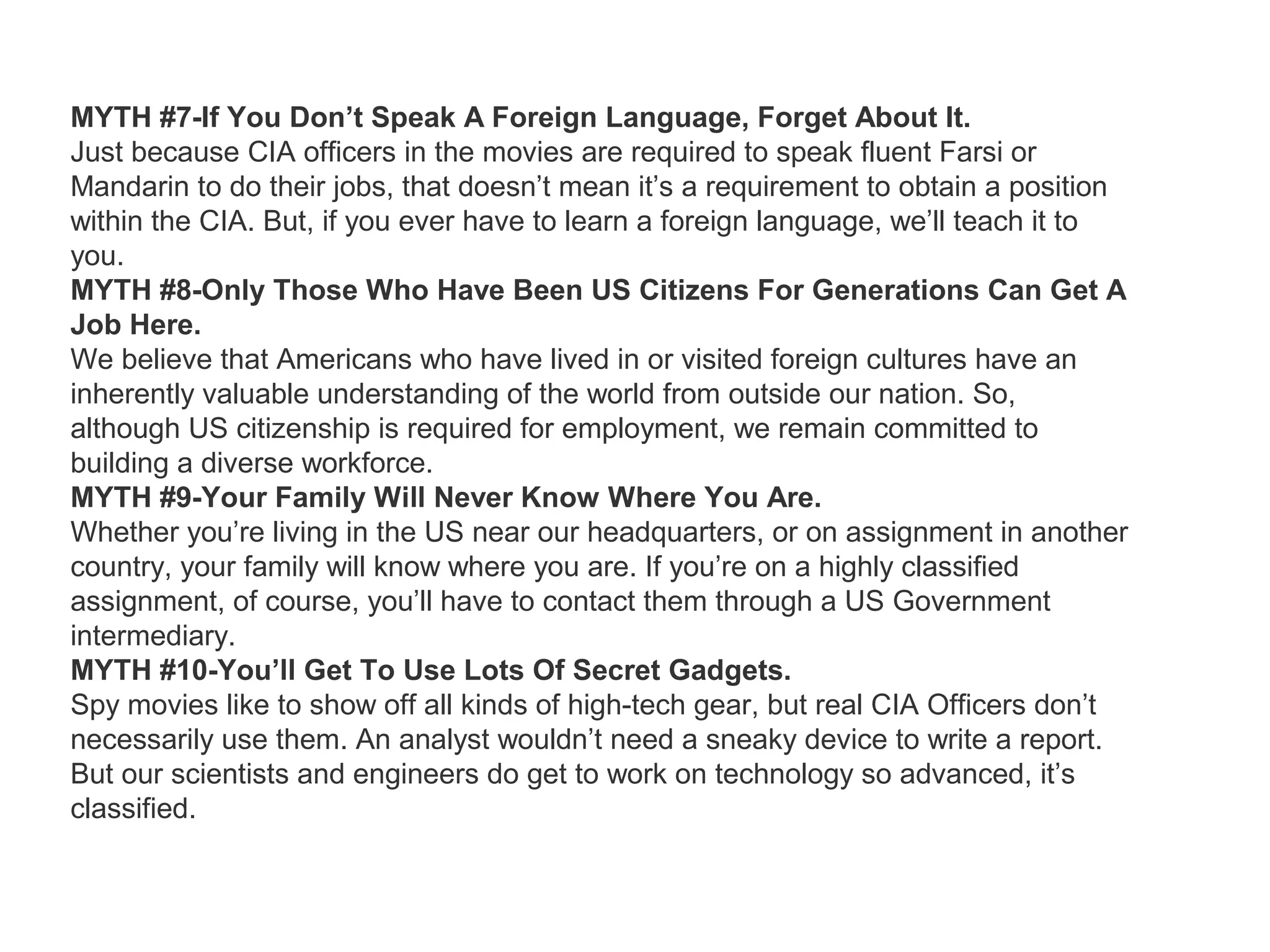
MYTH #7-If You Don’t Speak A Foreign Language, Forget About It.
Just because CIA officers in the movies are required to speak fluent Farsi or
Mandarin to do their jobs, that doesn’t mean it’s a requirement to obtain a position
within the CIA. But, if you ever have to learn a foreign language, we’ll teach it to
you.
MYTH #8-Only Those Who Have Been US Citizens For Generations Can Get A
Job Here.
We believe that Americans who have lived in or visited foreign cultures have an
inherently valuable understanding of the world from outside our nation. So,
although US citizenship is required for employment, we remain committed to
building a diverse workforce.
MYTH #9-Your Family Will Never Know Where You Are.
Whether you’re living in the US near our headquarters, or on assignment in another
country, your family will know where you are. If you’re on a highly classified
assignment, of course, you’ll have to contact them through a US Government
intermediary.
MYTH #10-You’ll Get To Use Lots Of Secret Gadgets.
Spy movies like to show off all kinds of high-tech gear, but real CIA Officers don’t
necessarily use them. An analyst wouldn’t need a sneaky device to write a report.
But our scientists and engineers do get to work on technology so advanced, it’s
classified.
Smarter Than You Lyrics
"Smarter Than You" was written by O'neill, Damian Stephen / Bradley, Michael / Doherty,
William Edward Martin.
Listen to the song and fill in the blanks
I'm a little …………………………(1)
Someone who …………………………..(2) it ………………(3)
I could be your ………………………(4) special
You could be my New York …………………….(5), my doll
I'm a little ……………………….(6) than you
………………………(7) than you, …………………(8) than you
Can't you …………………………(9) I'm …………………………..(10)?
I ………………………………(11) you, we ………………(12) a little
Find you ……………………………(13) by five past ten
I…………………(14) you and………..(15) you later
'Cause I want to …………(16) you again, you
again……………………………………(17)
Can't you see I'm………………………(18)?
Speaking:
1)What do you know about gifted children?
2)What are the signs to determine that a child may be gifted?
3)Can you think of examples of gifted children, like, for example, Mozart?
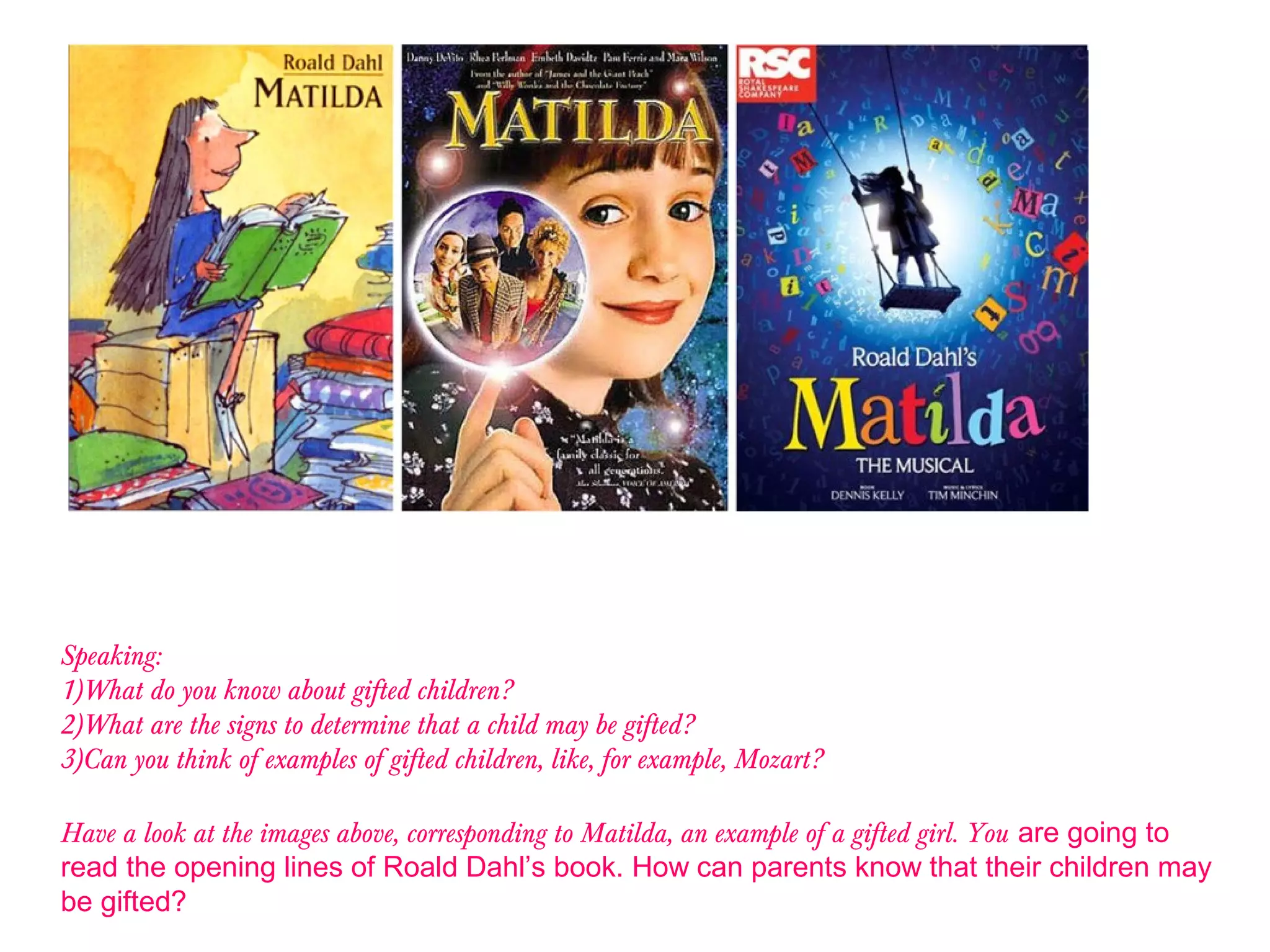
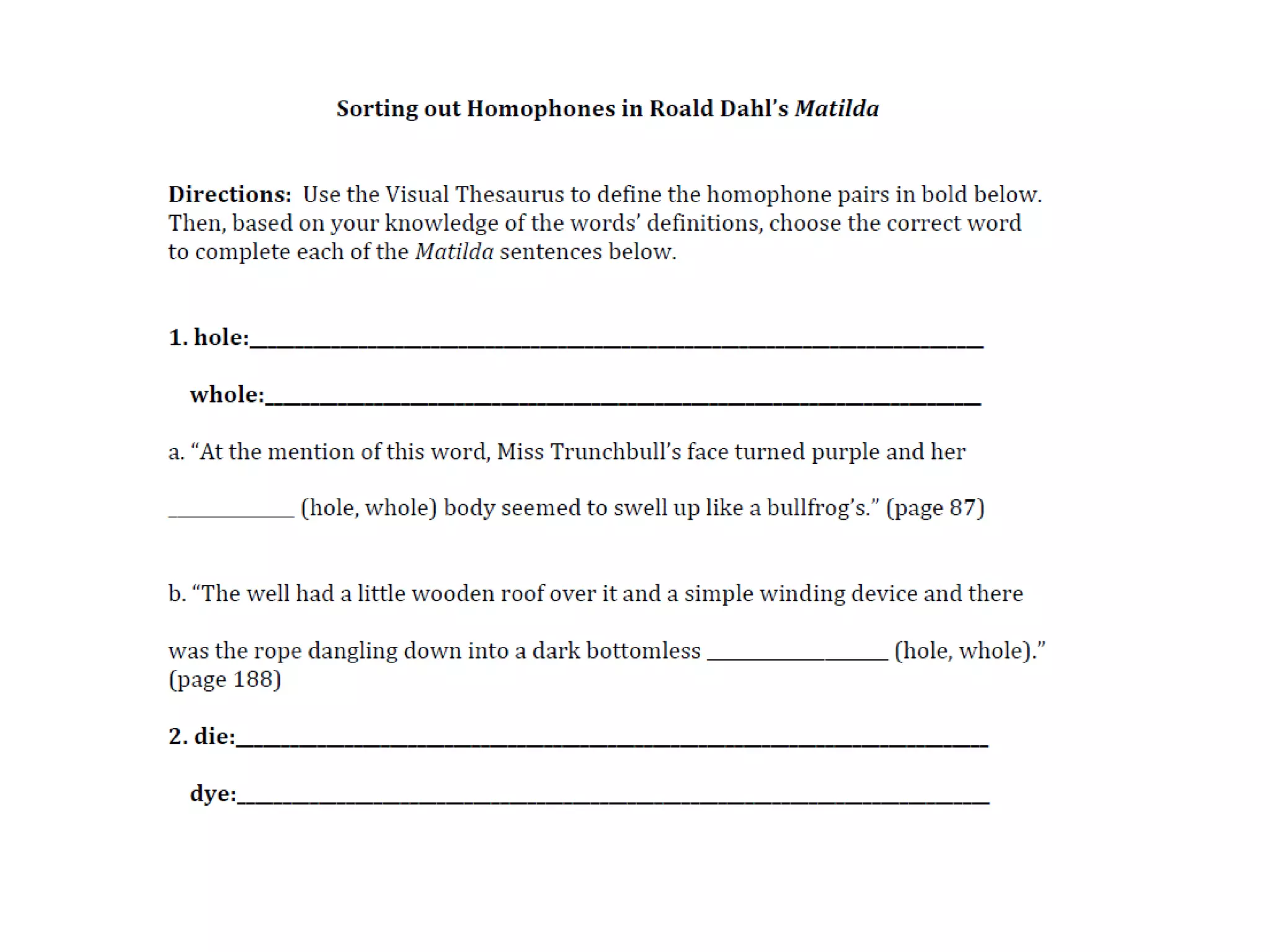
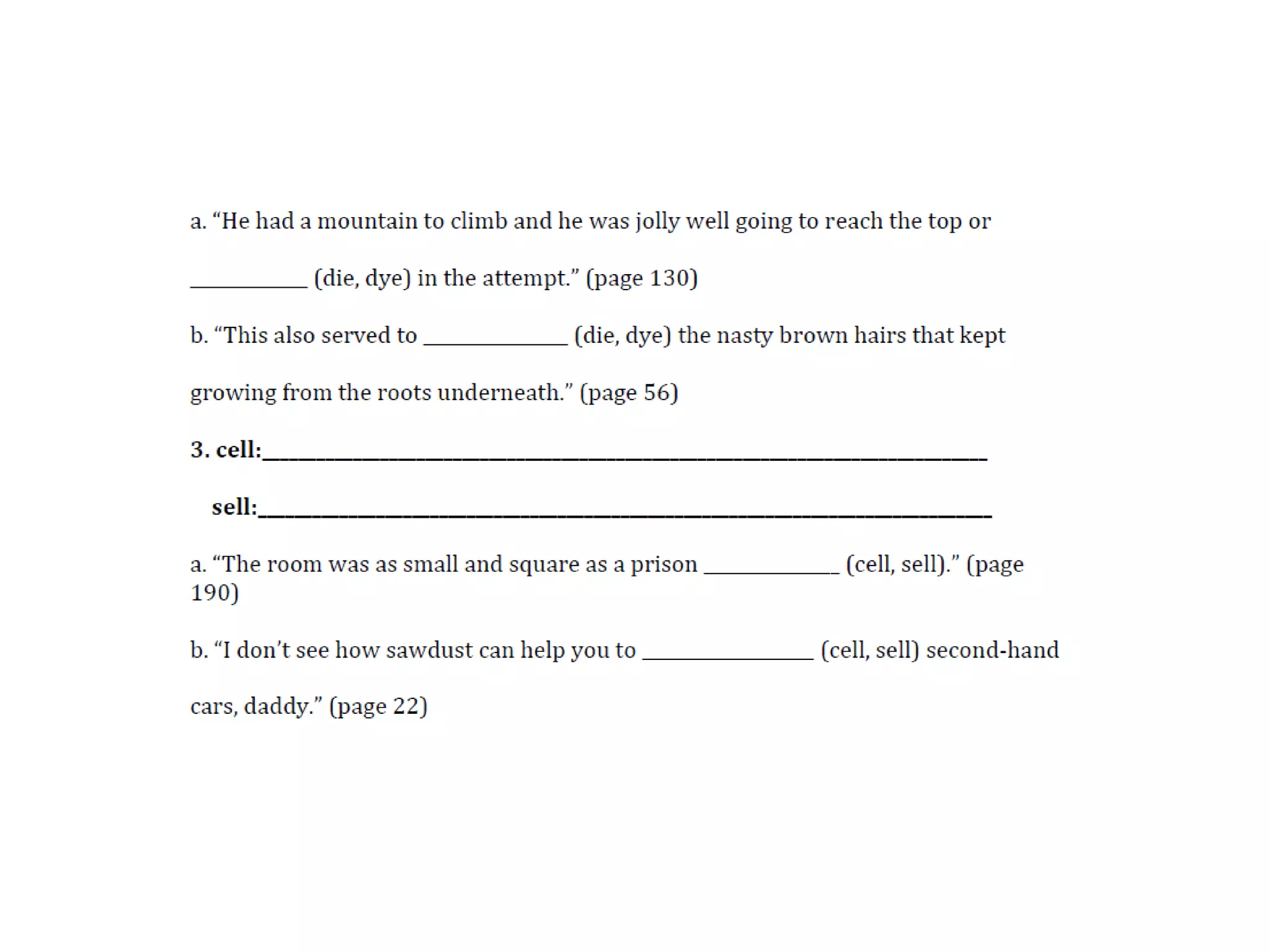
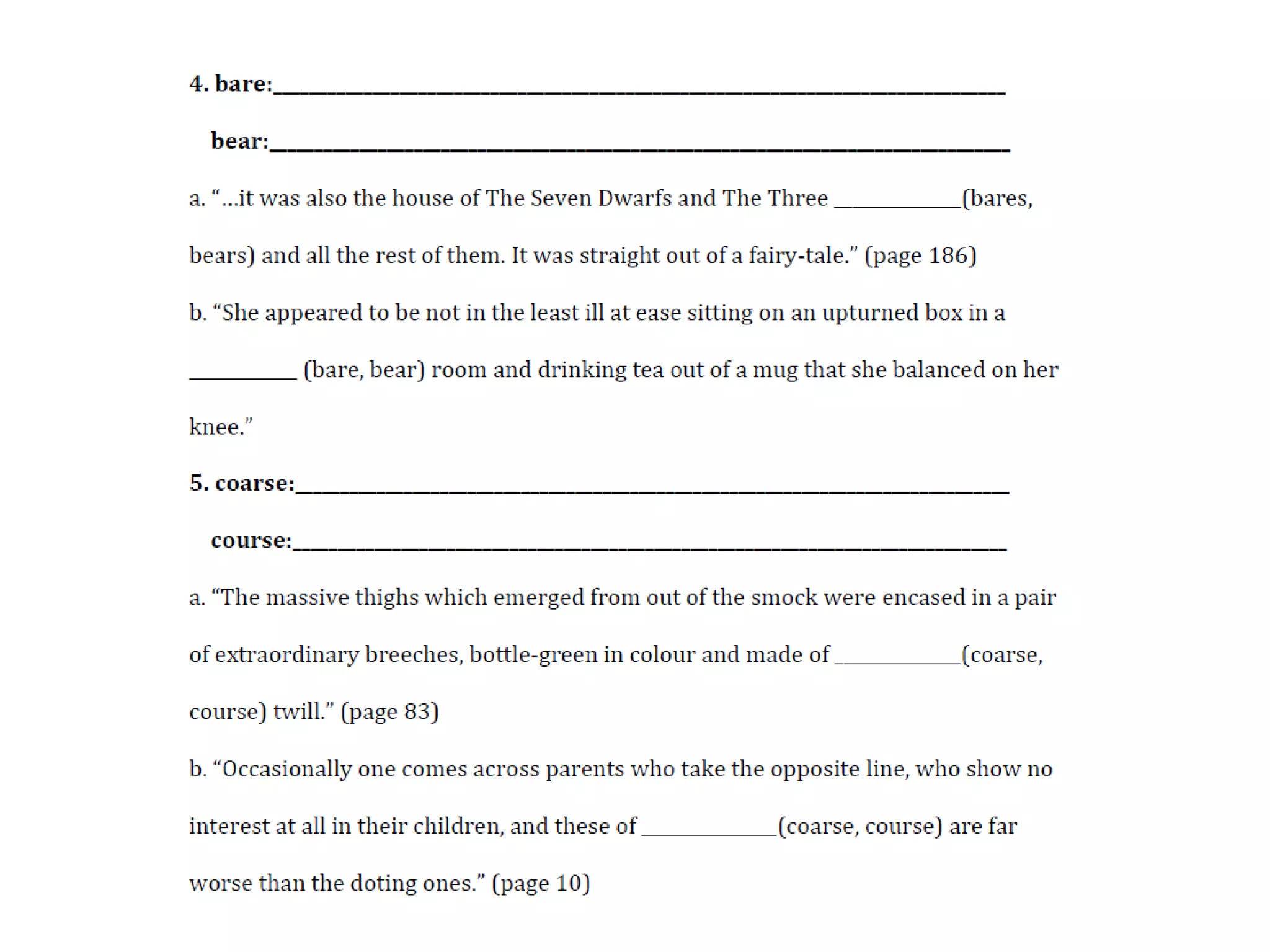
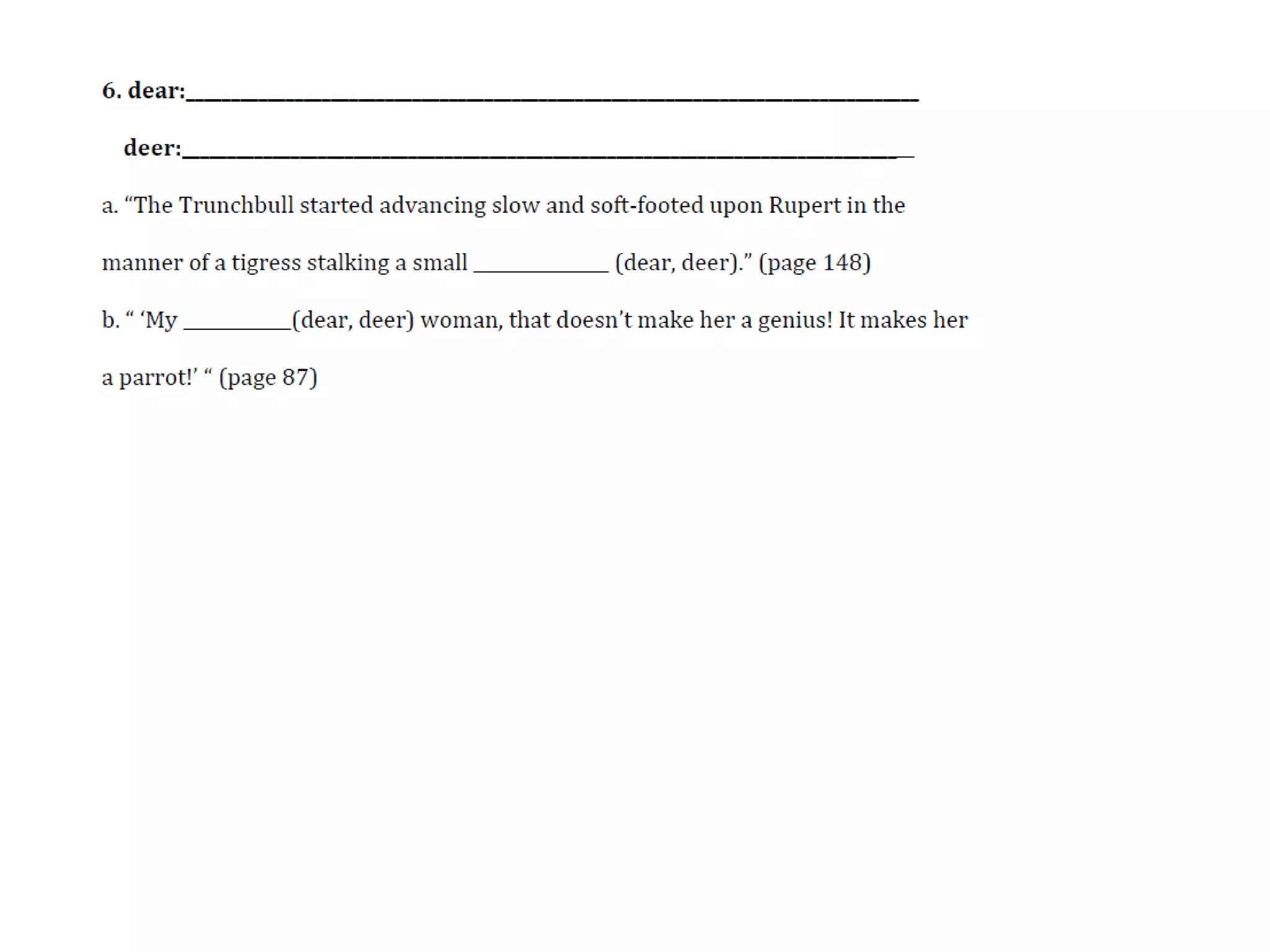
Have a look at the images above, corresponding to Matilda, an example of a gifted girl. You are going to
read the opening lines of Roald Dahl’s book. How can parents know that their children may
be gifted?
So begins the story of Matilda, an absolutely
brilliant child who unfortunately has parents who
take the opposite opinion. Matilda’s parents are
so wrapped up in their busy lives that they have
no time to notice the extraordinary abilities of
their daughter. Matilda teaches herself to read
at age three and continues to search
voraciously for more reading material. With the
help of the local librarian, she breezes through
the classics and reads novels of all kinds. She
travels the world through these novels and her
giftedness amazes and delights the librarian.
Through no help from her parents, Matilda is
able to pursue her passion for reading, getting
assistance from the librarian on her weekly
visits to the local library.
At age 5, Matilda enters school for the first time.
Of course, Matilda is placed in the bottom class
with other children her age and she has a very
young and very sweet teacher named Miss
Honey. The headmaster, however, is an awful
woman named Miss Trunchbull. “The
Trunchbull” is formidable in looks and in
attitude. She is mean, inconsiderate, and unfair
to the children of the school.
In school, Matilda is far more advanced than the
other children. She can read and do math well
beyond her years. Miss Honey shares evidence
of Matilda’s brilliance with Miss Trunchbull and
requests for Matilda to be advanced into a class
of older students. Miss Trunchbull will not listen
nor will she allow Matilda to skip any grades. It
becomes up to Miss Honey to challenge Matilda
as best she can in a classroom where Matilda’s
academic talents are far beyond her age-level
peers.
Matilda is lucky. With no support from her
parents, she receives help from the community
in which she lives. First, she is guided by the
community librarian. In the end, it is the teacher,
Miss Honey, who sees to it that Matilda reaches
her academic potential and that her social and
emotional needs are met.
SpeakingSpeaking
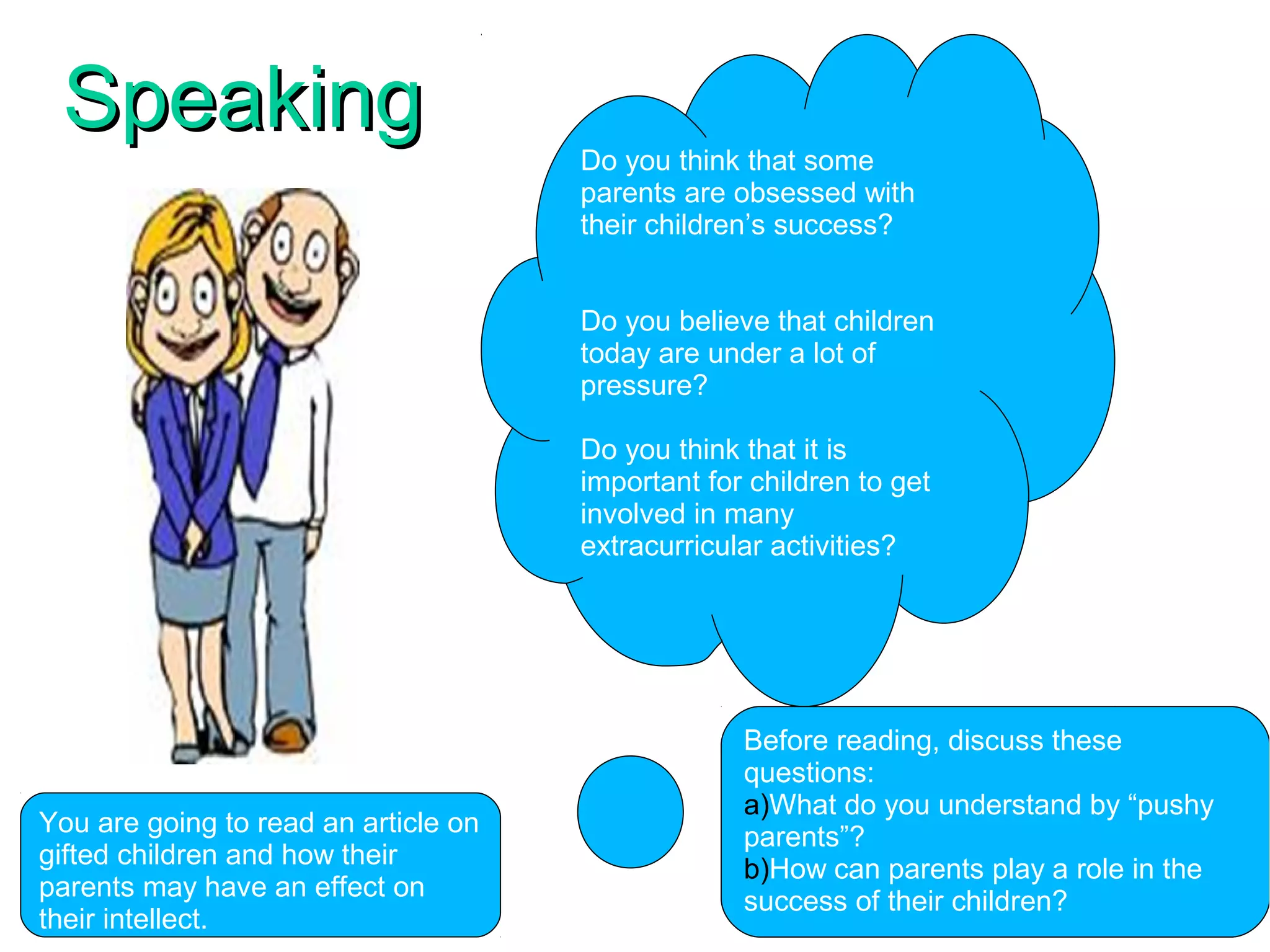
Do you think that some
parents are obsessed with
their children’s success?
Do you believe that children
today are under a lot of
pressure?
Do you think that it is
important for children to get
involved in many
extracurricular activities?
You are going to read an article on
gifted children and how their
parents may have an effect on
their intellect.
Before reading, discuss these
questions:
a)What do you understand by “pushy
parents”?
b)How can parents play a role in the
success of their children?
Behind every 'gifted' child is a pushy parent, says Cambridge academic Dr Clementine
Beauvais
IIs there really such a thing as 'gifted' children - or do they simply owe their talents to pushy
parents? Emma Higginbotham speaks to Dr Clementine Beauvais, who’s researching the
controversial issue.
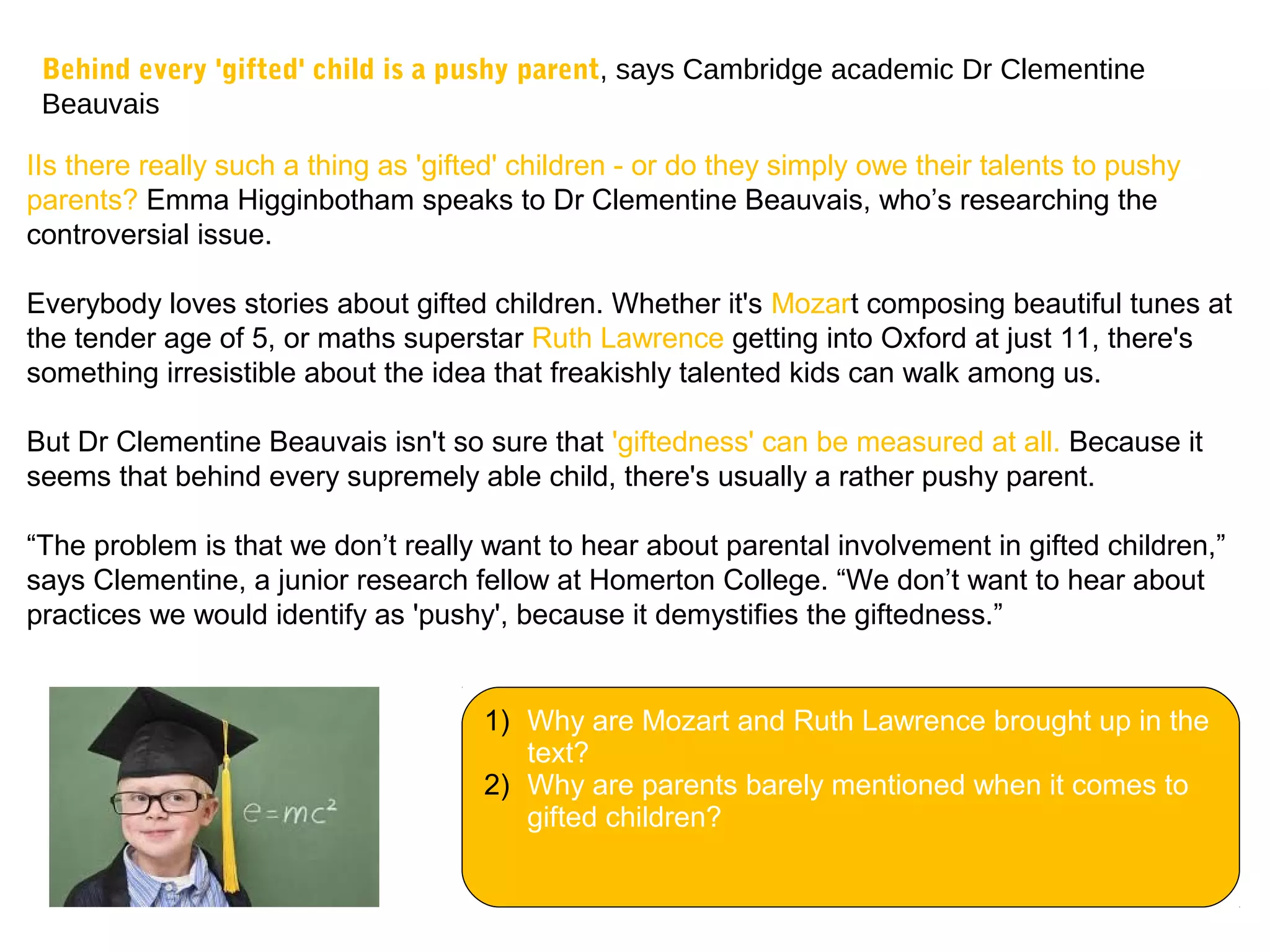
Everybody loves stories about gifted children. Whether it's Mozart composing beautiful tunes at
the tender age of 5, or maths superstar Ruth Lawrence getting into Oxford at just 11, there's
something irresistible about the idea that freakishly talented kids can walk among us.
But Dr Clementine Beauvais isn't so sure that 'giftedness' can be measured at all. Because it
seems that behind every supremely able child, there's usually a rather pushy parent.
“The problem is that we don’t really want to hear about parental involvement in gifted children,”
says Clementine, a junior research fellow at Homerton College. “We don’t want to hear about
practices we would identify as 'pushy', because it demystifies the giftedness.”
1) Why are Mozart and Ruth Lawrence brought up in the
text?
2) Why are parents barely mentioned when it comes to
gifted children?
Clementine will be discussing the issue on Thursday as part of the Festival of Ideas. And her
talk, ‘Gifted children – or pushy parents?’ will no doubt include the story of Ruth Lawrence.
Back in the 80s, the young maths whizz graduated with a starred first from Oxford (after two
rather than the usual three years) aged just 13. “But her father stopped working to home-school
her from when she was a tiny, tiny girl,” points out Clementine. “So here we’ve got an incredibly
supportive parent doing incredibly intensive parenting.
“Of course she is extraordinary, and no-one can deny that she arrived top of 500 candidates for
the entrance exam - it’s incredible. But she wasn’t just born with all that mathematical capacity.”
As for Mozart, “the completely supernaturally gifted child... Again, it’s not true. It’s not that he
wasn’t talented; by all measures his life was extraordinary. But it’s been evaluated that between
3 and 6 years old, he practised his piano for 3,500 hours! This is a tiny child! It didn’t come from
nowhere; when you’ve had that kind of training, something’s going to come out of it.
3) What is the relationship between supportive parents and gifted children?
4) Did Mozart’s intensive training affect his gift for playing the piano?
“Not just that, but his father was working towards a very specific aim: he wanted
to tour the children around Europe. I’m not saying he was a monster, not at all,
but again we have this incredibly controlling person investing himself entirely into
his children.”
The idea of 'giftedness' is, says Clementine, a relatively recent construct. “People
feel that it’s a measureable thing, and it’s something you possess or you don’t
possess. It’s only really in the 20th century that we start having that perception,
mainly through the development of IQ tests. I’m looking particularly at academic
giftedness, but giftedness in music, in sports, in arts, is also considered to be
something that children have or don’t have.
“And there’s a very commonly associated idea that you’re born gifted; it’s innate,”
she adds. “But the nature/nurture debate is very complicated. When you talk to
parents, a lot of them will say 'We could see that from an early age he was
particularly talented at this or that’. But the problem is that parents are very
unreliable narrators of their own child’s development!
5) Can intelligence be measured?
6) Briefly explain the nature/nurture debate when it comes to intelligence.
“It’s well known that there are a number of things that parents will encourage children to do
according to their socio-economic background. So if a child is born in a house full of books,
is it any surprise that they’ll want to read early on? The parents may tell you ‘But she wanted
to read!’, but yes of course, because she saw you reading all the time.”
This brings us on to the thorny issue that ‘gifted’ children almost always seem to come from
middle class backgrounds – thanks, perhaps, to a spot of pushy parenting.
According to Clementine, the “vast majority” of kids in gifted schemes - lunch clubs,
weekend activity groups for 'more able' children and the like – are middle class. “It’s very
socio-economically divided,” she says.
Yet that’s not the impression we get from child prodigies in fiction. Clementine says that
“classist” stories like Matilda and Billy Elliot, which portray young geniuses rising out of
nowhere from their poor backgrounds, “reinforce the notion that if you are more gifted than
your peers, you will always succeed, even if barely helped at all.
“But that’s just not true. When we say that, we’re avoiding the responsibility of actually
helping, first of all, ALL children - not only those who exhibit some kind of precocity gained
from their parental background - and secondly of trying harder to fight practices that will
always advantage some children over others, regardless of their talent. For example, things
that some parents can afford to give their children that others can’t, like private tutoring and
extra-curricular activities.”
Facebook
7) What is the relationship established between money and
gifted children?
8) What is the point the writer is trying to make when
mentioning Matilda & Billy Elliot?
So what is a pushy parent? According to Clementine, this is a recent construct too. “It's a
derogatory term; it’s one of those things that you don’t want to be called. No one’s ever defined it,
but if I say 'pushy parent' you know exactly what I mean!
“Generally it’s a number of characteristics: you’ll have a parent who is particularly intensive or
strict in their parenting practices; then you have the notion that a pushy parent will monopolise the
free time of the child to give them extra-curricular activities, or tutoring, or to take them to
museums; and there’s also the notion that a pushy parent will value a very competitive approach
to education.”
The concept first emerged in the 1960s when a population surge - plus more women going on to
degree-level education - meant there were fewer places at university.
“This led to a very growing, palpable anxiety on the part of the middle classes that their children
would not get into these universities,” she explains. “So this gave rise to basically an arms race,
trying to get their kid above other people. Because soon it became the case that you couldn’t just
have extraordinary marks, you had to have done violin, and founded a school in Kenya… So
parents were more and more engaged in preparing their child for entrance exams, and also
cultivating the spirit in their children that they needed to be competitive.”
But are they pushing their children because they genuinely want them to succeed? Or because it's
a reflection on them if they don't? “It’s really hard to make generalisations,” says Clementine.
“When we think about pushy parents we think about narcissistic parents; parents who have not
had the successes they wanted, and therefore want their children to have it.
9) What are the characteristics of a pushy parent?
And in the media, they’re always portrayed as self-interested monsters who’ve sacrificed the
childhoods of their children, who push them so much that they don’t care about their wellbeing.”
Yet studies have shown that however distasteful people may find it, pushy parenting seems to
work. “You have mothers saying ‘I asked the head of English for three years for my kid to be put in
the gifted scheme, and in the end he said ‘yes’, and I’m very conscious that it was my pushiness
that got her there. Also I wouldn’t put it down to the school that she got all these A stars at
GCSE'...”
What's more, adds Clementine, 'normal' parents witness this success, “so there’s a lot of
resentment there.”
As for the argument about the child's wellbeing, “often these parents will say 'If we make our child
less happy now [by pressuring them to succeed], we know that we’re investing in their future, and
they’ll be happier later because they’ll have more resources'.
“And empirically they’re not wrong. Children identified as gifted have a higher-than-average
chance of financial capital later in life – whether or not that’s a notion of happiness! Some even
suggest that they will be more happy and less susceptible to mental health problems.”
10) How do the media tend to portray pushy parents?
11) To what extent does this portrayal correspond with reality?
So it's unfair to demonise pushy parents, then? “I don’t really want to say,” smiles Clementine.
“I’m more interested in why we would demonise it. And I think it's because we cling to a very
romantic conception of the naturally intelligent, naturally extraordinary child, but we hate the notion
that there are people who ‘cheat the system’, so to speak, and create ‘fake’ gifted children.”
Clementine, who's 25, has done rather well herself: aside from her academic success, she's also
written 13 children's books (her latest, The Royal Babysitters, was published by Bloomsbury last
month). Were her parents pushy? “Er, yes,” she admits. “My mother was certainly what would be
qualified as a pushy parent, the kind who is always encouraging you to read above your reading
age; the kind who tells you that effort and discipline is important.
“I come from a very comfortable background and I went to good schools, so in a way I’m a very
typical example of how the education system functions to give success to people who come from
the right places. There is no mystery whatsoever in any success I might have had.
“It's almost too easy for some people, and there’s no reason to glorify people who arrive in a
position of power when they’ve come from backgrounds that are so ready to put them into those
positions of power.”
12) What’s the connection the writer makes between her parents
with pushy parents?
What’s really interesting is that the whole giftedness issue is very much a
UK and American obsession: “In Scandinavia, for example, the
education system is based on an ideal of equality - you’re trying to get
everyone to a similar kind of level, and it’s discouraged to identify
children as more able than others.
“But our education system constantly privileges people who are already
privileged, and constantly works towards the success of children who are
incredibly supported at home,” she adds. “And if you have parents who
are getting their children to compete with all the other children at the top,
then it widens the gap enormously towards the children who have not
had that privilege.
“So that’s really what I’m interested in,” concludes Clementine. “It
conceals the educational inequalities that are in-built in the system, and it
makes us almost feel better, because we feel ‘Oh well, gifted children will
rise to the top anyway, wherever they come from’, but actually that’s not
really what happens. And we don’t want to see that, because it’s not as
seductive.”
13) Why is the issue of giftedness an American and British
construct?
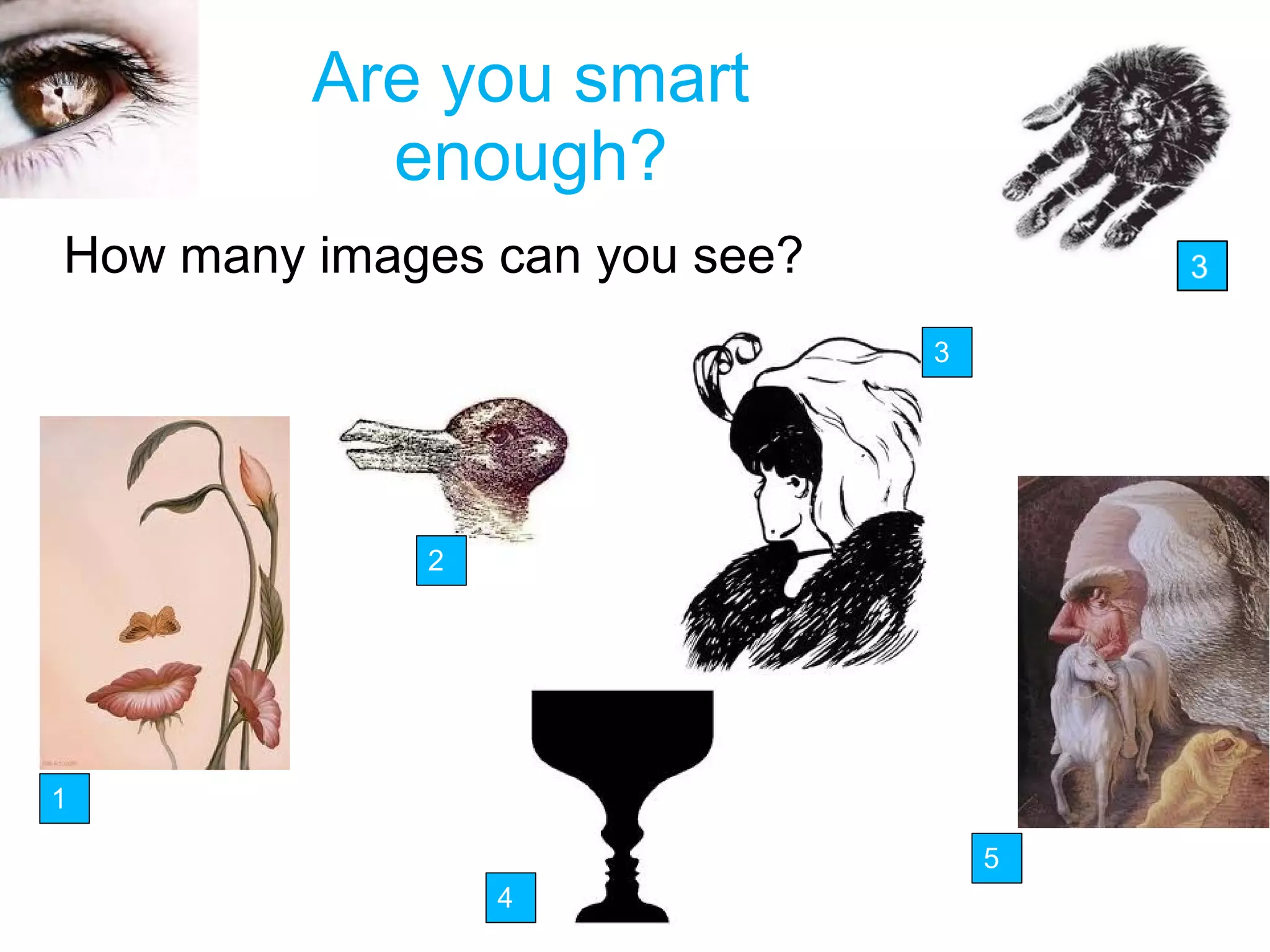
Are you smart
enough?
5
3
4
2
1
How many images can you see?
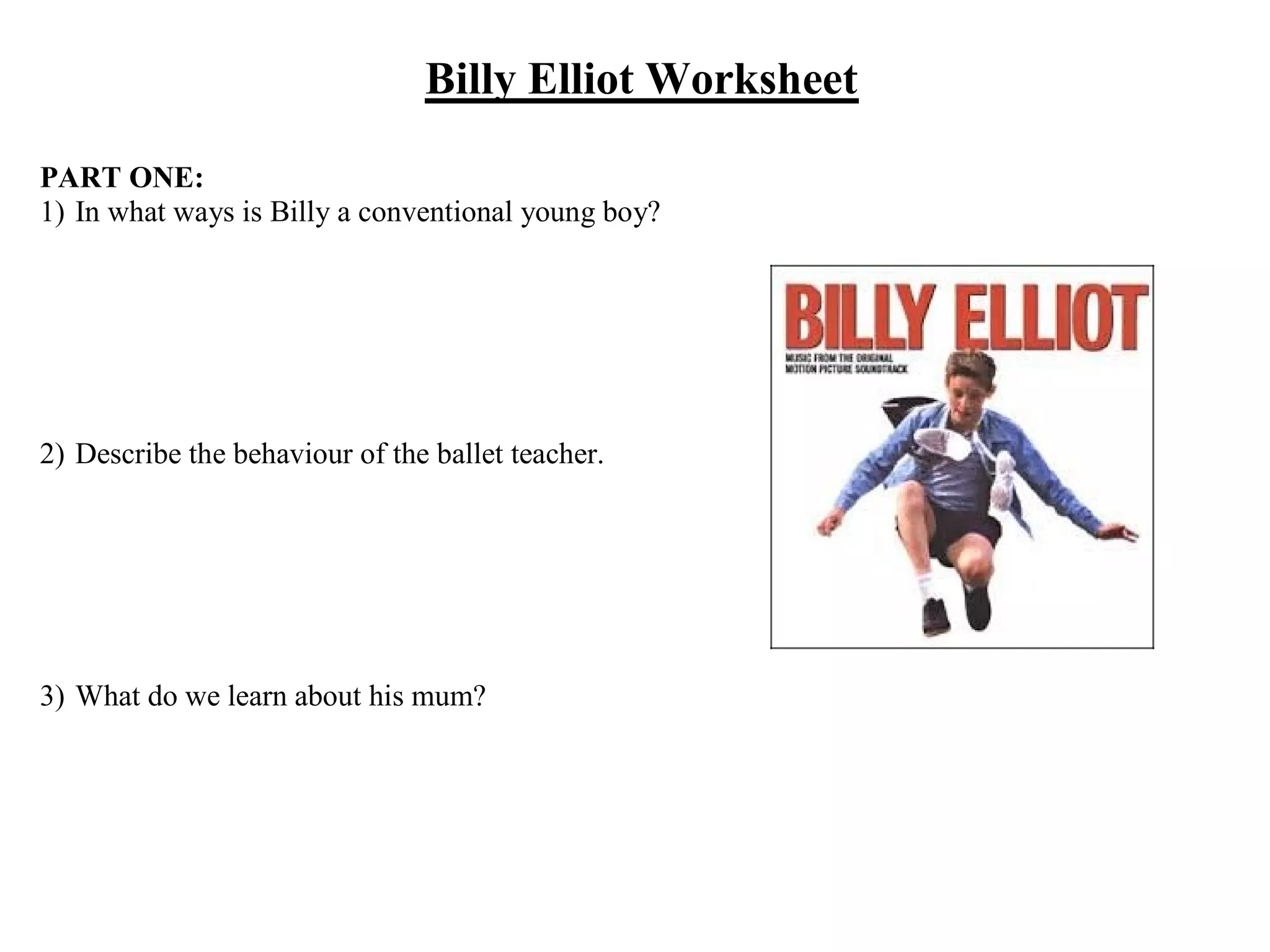
Billy Elliot Worksheet
PART ONE:
1) In what ways is Billy a conventional young boy?
2) Describe the behaviour of the ballet teacher.
3) What do we learn about his mum?
4) Billy and Debbie: Why is he hesitating about continuing to dance? How does Debbie try to
persuade him?
5) At home Billy hides the ballet shoes: what does his father tell him to be careful with?
7) Why does Billy go to the library?
8) Strike: Describe the scene. What are the men shouting? What do you think is happening? What
does Billy's dad learn?
9) Supermarket: describe and explain what happens in the supermarket between Tony and the man.
10) Billy and his dad: why is Billy's dad upset? How does Billy respond?
12) Describe Billy's social class and justify.
PART TWO:
Why do Billy and the teacher Mrs Wilkinson argue?
She reproaches him (FOR + Verb - ING / FOR NOT + Verb - ING)
Why do you think Billy is so upset? (Think of TWO reasons).
REASON ONE:
REASON TWO:
Mrs Wilkinson follows Billy into the toilets. How does he criticise her?
[ ] she is posh [ ] she is horrible to him [ ] she tells him what to do
[ ] she does it for her own benefit [ ] she is jealous of him [ ] she messed up her own life
Make sentences:
He accuses her (OF + Verb - ING / OF NOT + Verb - ING)
He criticises her (FOR + Verb + ING / FOR NOT + Verb – ING)
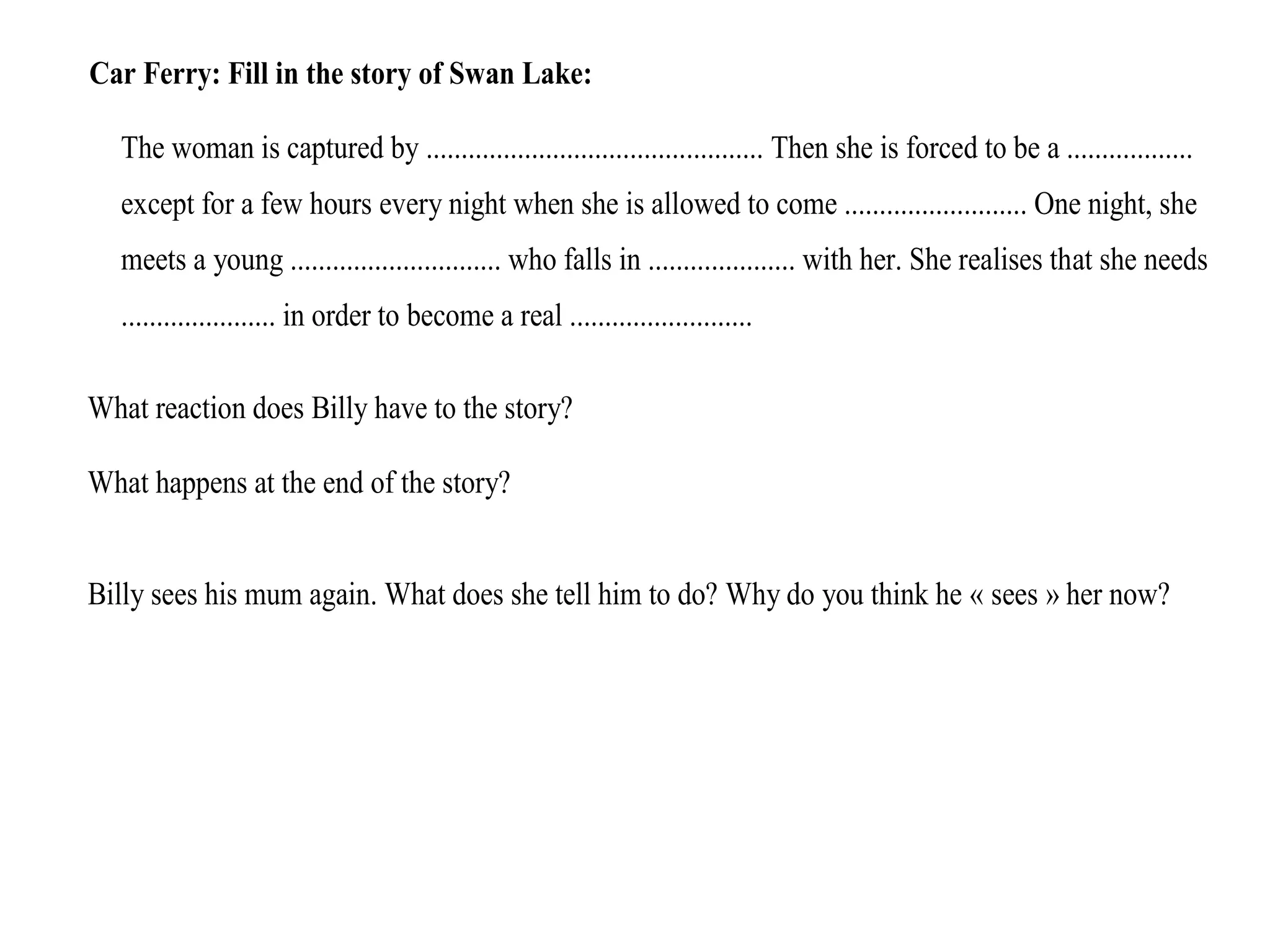
Car Ferry: Fill in the story of Swan Lake:
The woman is captured by ................................................ Then she is forced to be a ..................
except for a few hours every night when she is allowed to come .......................... One night, she
meets a young .............................. who falls in ..................... with her. She realises that she needs
...................... in order to become a real ..........................
What reaction does Billy have to the story?
What happens at the end of the story?
Billy sees his mum again. What does she tell him to do? Why do you think he « sees » her now?
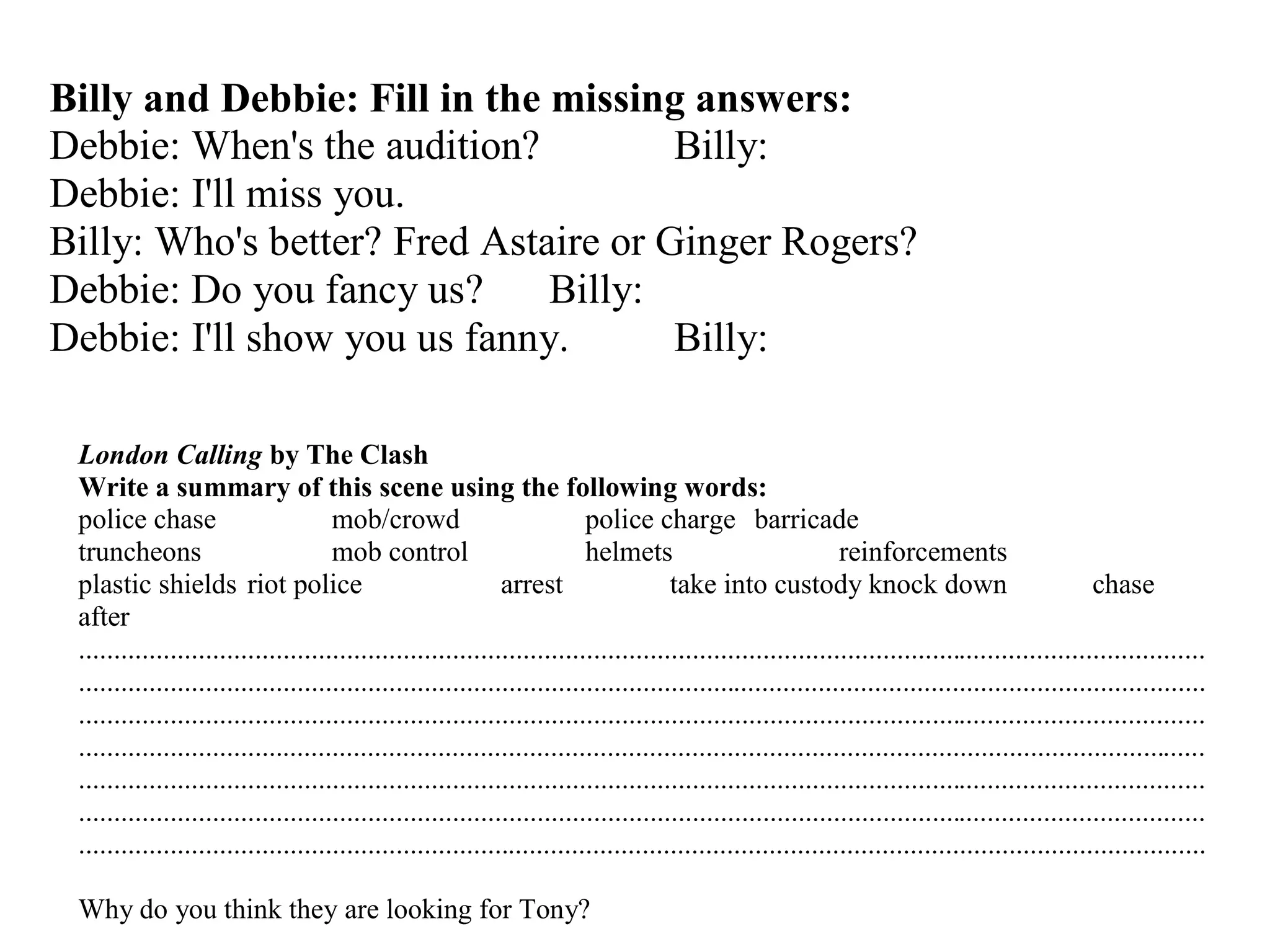
Billy and Debbie: Fill in the missing answers:
Debbie: When's the audition? Billy:
Debbie: I'll miss you.
Billy: Who's better? Fred Astaire or Ginger Rogers?
Debbie: Do you fancy us? Billy:
Debbie: I'll show you us fanny. Billy:
London Calling by The Clash
Write a summary of this scene using the following words:
police chase mob/crowd police charge barricade
truncheons mob control helmets reinforcements
plastic shields riot police arrest take into custody knock down chase
after
................................................................................................................................................................
................................................................................................................................................................
................................................................................................................................................................
................................................................................................................................................................
................................................................................................................................................................
................................................................................................................................................................
................................................................................................................................................................
Why do you think they are looking for Tony?
PART THREE: CONFRONTATION
Who does Billy ring? ......................................................................................................................
Who answers? .................................................................................................................................
What does he say? ...........................................................................................................................
What does the person do? .................................................................................................................
Why do you think Billy misses his audition? (Find TWO reasons)
a) ......................................................................................................................................................
b) .......................................................................................................................................................
The Teacher goes to Billy's house:
What accusations does Tony make against Mrs Wilkinson?
[ ] she doesn't know what they are going through at the moment
[ ] she is a snob [ ] she is trying to replace Billy's mum
[ ]Billy will look stupid [ ] it will turn him into a “poof”
[ ] he's only a kid
What does this dancing scene allow the viewer to understand about Billy?
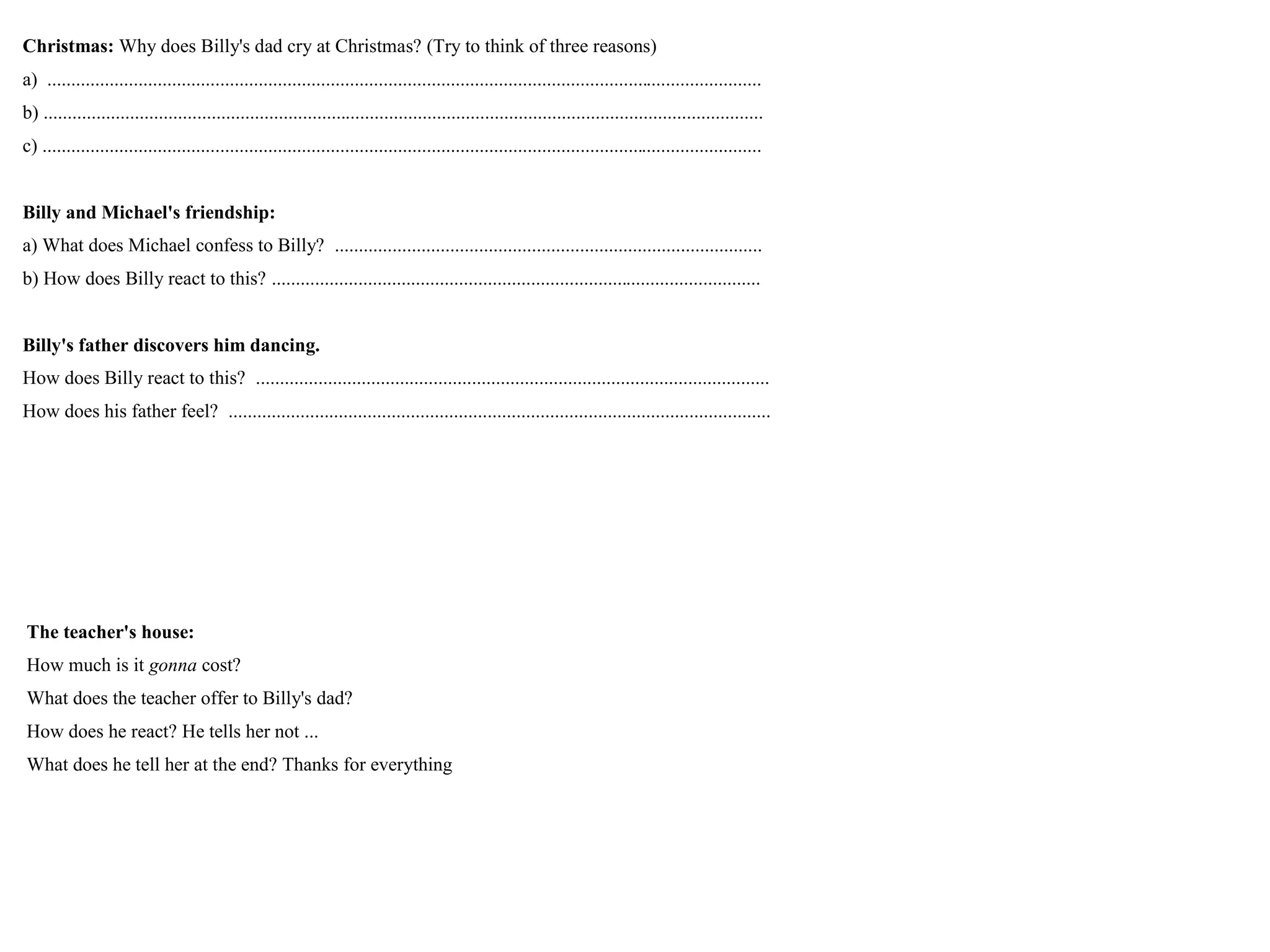
Christmas: Why does Billy's dad cry at Christmas? (Try to think of three reasons)
a) .....................................................................................................................................................
b) ......................................................................................................................................................
c) ......................................................................................................................................................
Billy and Michael's friendship:
a) What does Michael confess to Billy? .........................................................................................
b) How does Billy react to this? ......................................................................................................
Billy's father discovers him dancing.
How does Billy react to this? ...........................................................................................................
How does his father feel? .................................................................................................................
The teacher's house:
How much is it gonna cost?
What does the teacher offer to Billy's dad?
How does he react? He tells her not ...
What does he tell her at the end? Thanks for everything
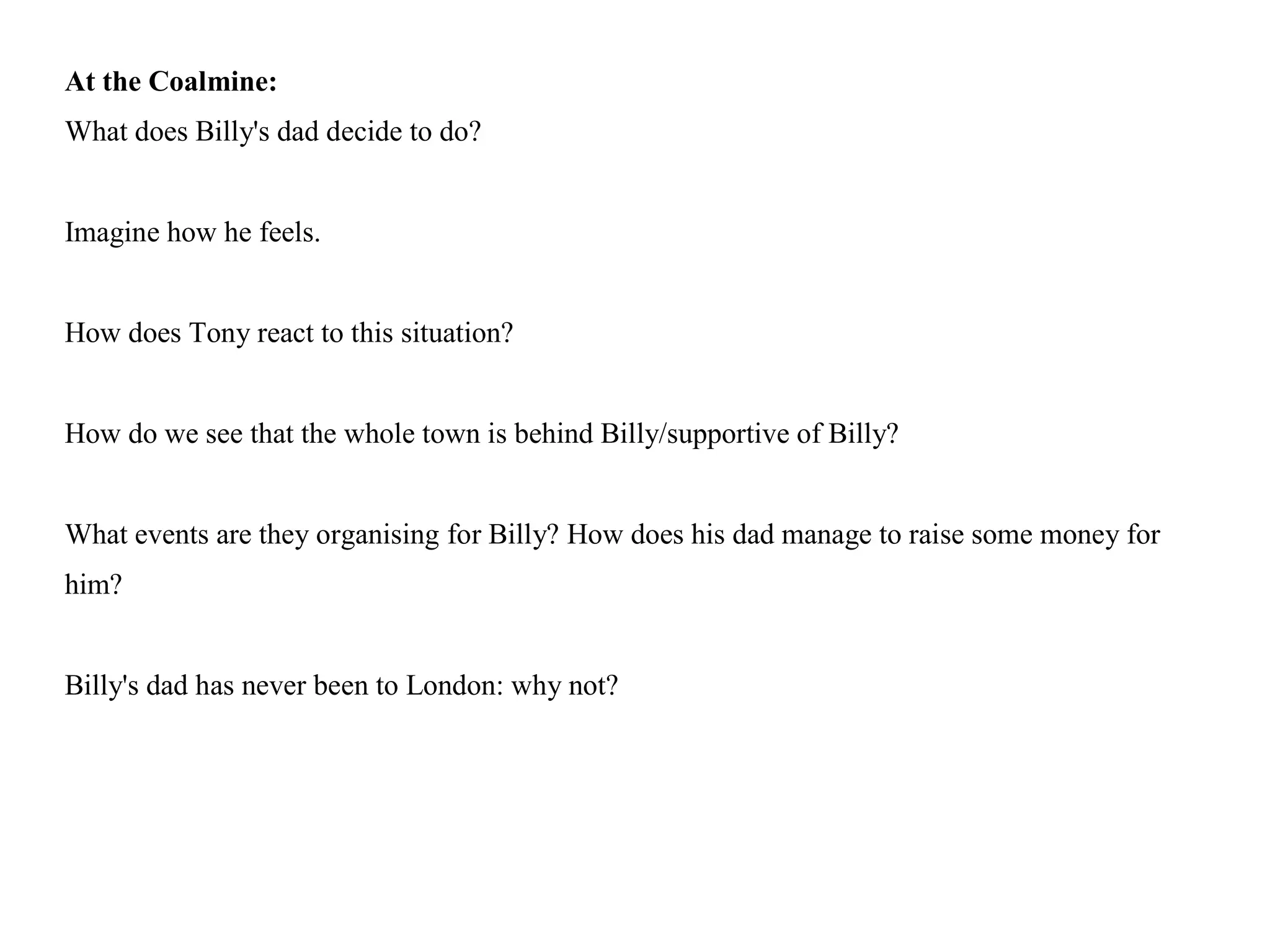
At the Coalmine:
What does Billy's dad decide to do?
Imagine how he feels.
How does Tony react to this situation?
How do we see that the whole town is behind Billy/supportive of Billy?
What events are they organising for Billy? How does his dad manage to raise some money for
him?
Billy's dad has never been to London: why not?
PART FOUR: THE ROYAL BALLET SCHOOL
Describe the setting of the Royal Ballet School and contrast it with Billy's home. Use contrast
words: WHEREAS, WHILE / WHILST, UNLIKE etc
................................................................................................................................................................
................................................................................................................................................................
................................................................................................................................................................
................................................................................................................................................................
................................................................................................................................................................
Use the following words:
posh magnificent luxurious marble pillars
winding staircases tall ceilings wrought iron staircases/banisters
upper class country mansion mirrors
How do you think Billy and his father feel in this situation? Why?
What does this show us about social class in Britain in the 1980s?
Make a list of all the things at the audition which destabilise/ put Billy off?
a)
b)
c)
d)
Interview: Write the responses:
Q. Why did you become interested in ballet?
Q. Are you a fan of ballet?
Q. Are you completely behind Billy?
Q. Would you like to ask any questions?
When the lady asks Billy what it feels like when he is dancing, what does he reply?
[ ] exciting [ ] you forget everything [ ] you come alive
[ ] good [ ] you disappear [ ] as if it's your birthday
[ ] on fire [ ] free [ ] change in your body
[ ] like electricity [ ] like gas
Waiting for the result:
a) What advice does his gran give him?
b) What does he say to his father when he opens the letter?
c) When his father goes to the Social Club, what does he learn?
Before he goes, Billy tells his father that he is scared and he asks if he can come back if he
doesn't like it.
What humorous reply does his father give:
Saying goodbye:
Name all the people Billy says goodbye to?
Compare and contrast his life with their lives?
FUTURE:Whathappensattheendofthefilm?To
a)Billy:
b)hisfriendMichael:
c)hisfamily:
https://www.youtube.com/watch?v=wiYqVnX22fw
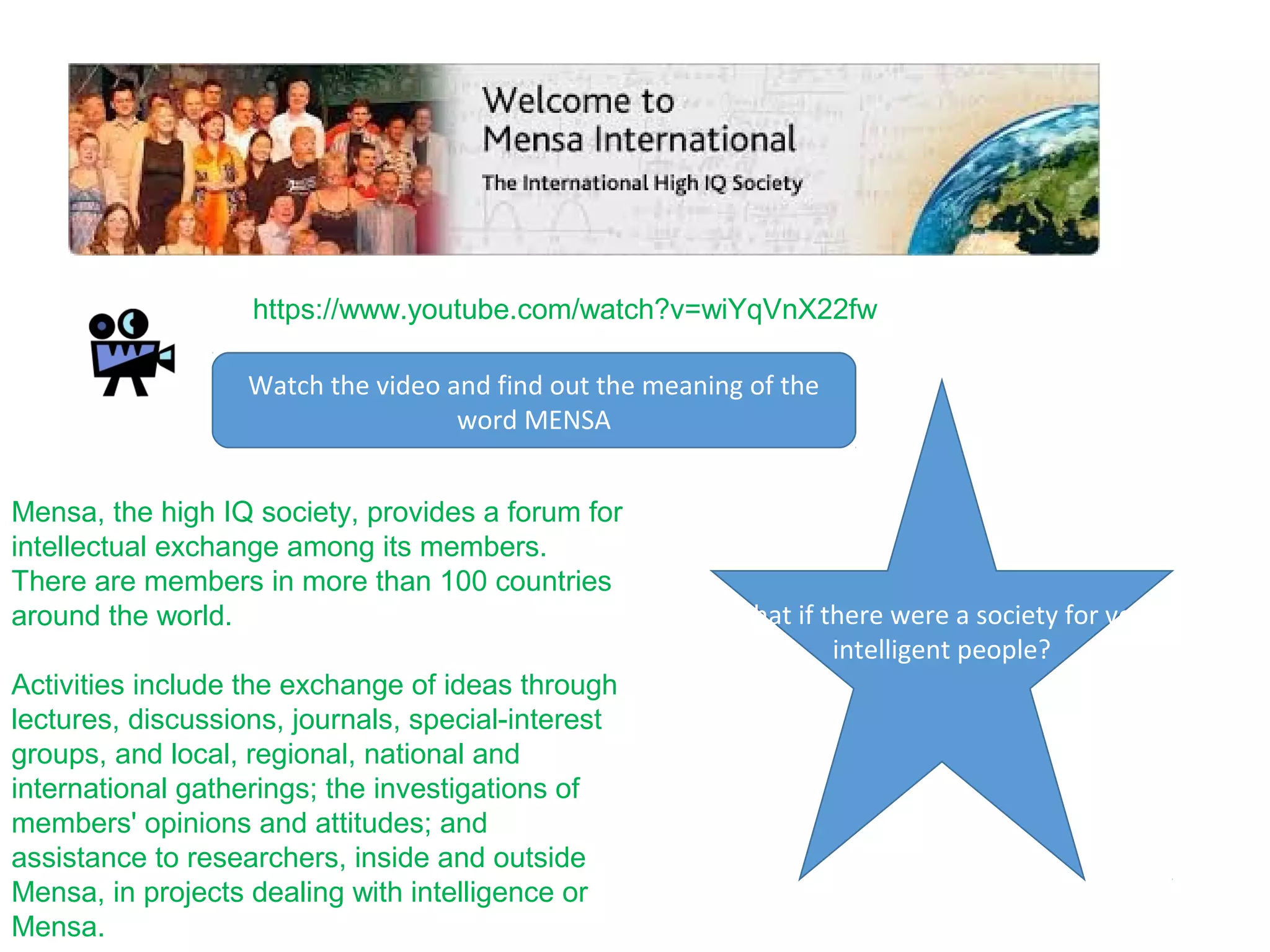
Mensa, the high IQ society, provides a forum for
intellectual exchange among its members.
There are members in more than 100 countries
around the world.
Activities include the exchange of ideas through
lectures, discussions, journals, special-interest
groups, and local, regional, national and
international gatherings; the investigations of
members' opinions and attitudes; and
assistance to researchers, inside and outside
Mensa, in projects dealing with intelligence or
Mensa.
What if there were a society for very
intelligent people?
Watch the video and find out the meaning of the
word MENSA
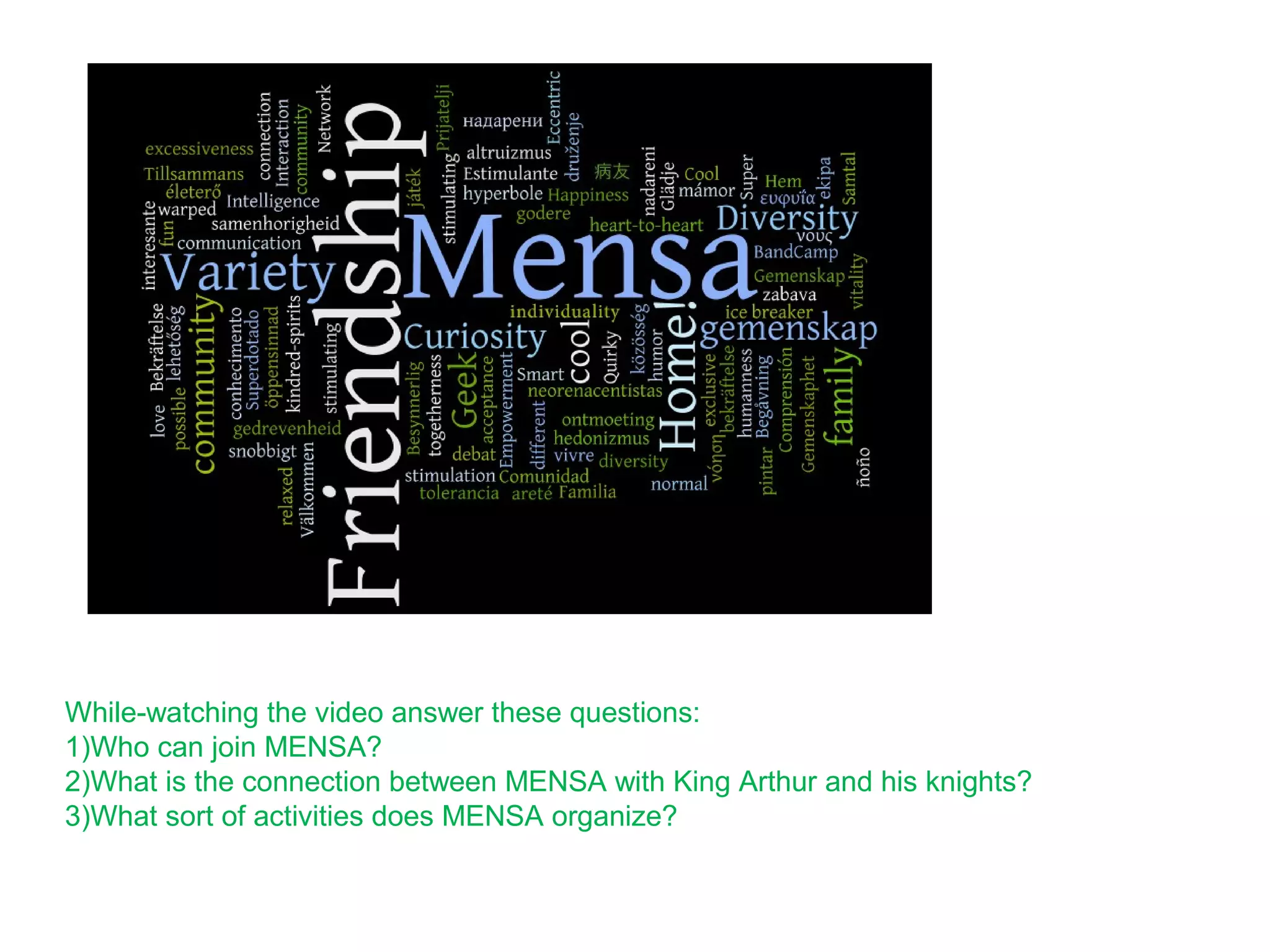
While-watching the video answer these questions:
1)Who can join MENSA?
2)What is the connection between MENSA with King Arthur and his knights?
3)What sort of activities does MENSA organize?

Unit on intelligence

  • 1.
    Activities for theEnglish class. Level: Upper- intermediate
  • 2.
    In pairs, comeup with a list of 3 intelligent people. 1) Who are they? 2) Why did you choose them? 3) Why do you think they are intelligent?
  • 4.
    What does “IQ”stand for? What does IQ measure? Is IQ just a number or does it guarantee success in life?
  • 5.
    Have a lookat the front cover of Time magazine. What is the main issue about? What do you know about genetics? What sorts of traits are inherited?
  • 6.
    The Truth AboutIntelligence: Is It Genetically Inherited Or Earned? According to the dictionary, intelligence is the ability of acquiring and applying knowledge and skills. However, it’s not that simple, since intelligence is a notion that is often misunderstood. Some people believe that intelligence is the knowledge you gain through education, while others believe it has nothing to do with education, but it is the sum of experiences you gain throughout your life. Once I was having a talk with an economics professor about the US education system. The main question I had for him was if the current system provides us with necessary knowledge. His response was that everything we learn through books and school is useless until we learn how to apply it. In pairs, try to come up with a definition of intelligence. Share your views with your class. Now read the first paragraph of the article. Do you agree with the definition of intelligence provided. Why (not)?
  • 7.
    Therefore, we cannotsay that everything we read and learn is useless information since sometimes it gives you a sense of how everything is organized, from human body to society. We can conclude that intelligence is not only knowledge and skills that you can apply, but it also helps you to make sense of things that are happening around you. So is intelligence something you can inherit through your family, or does your ethnicity somehow affect it? Maybe it is something that depends on you? If you want to know what stands behind the successful and intelligent people, I suggest you read “Outliers” by Malcolm Gladwell. By the end of it, you’ll be looking at success differently.
  • 8.
    Do you inherentyour intelligence through your family? A study by psychologist Robert Sternberg concluded that the skills and knowledge you have are the result of your family. However, it is not a genetic relation, but rather, an educational one. Children inherit practical intelligence, which is the knowledge that comes from the way your parents communicate with you. According to the study, middle-class families spend more time with their children than lower-class families. During that time, they teach their children how to speak and interact with other people, how to treat them and how to solve social problems. This establishes and develops self-esteem, a quality that works in your favor for a lifetime. Varying factors like parents working more than one job, the amount of free time they can spend with their children and relative location to quality school districts affect children who come from lower-class families. By that sense, family background can have an influence on your intelligence. In order to analyze the relation between ethnicity and intelligence, I’m going to refer back to Gladwell’s “Outliers.” Have you ever wondered where the stereotype of Asians being good at math and science came from? Gladwell explains it this way: “In many cultures it is believed that whatever you do, the results always depends on the fate or on God’s will.” Thus, it implies that how much you work does not affect the outcome. On the other hand, most Asian cultures believe that everything depends on you and your hard work. The harder you work, the more you get, and if you do not succeed, then you must not have tried hard enough. So, yes, your ethnicity does matter for you to be a successful or intelligent person. Overall, the lesson to be learned here is that you shouldn’t let your intelligence and/or lifestyle be the slave of your genes. Everything depends on you. Certain aspects do affect this, but it is only the attitude that injects you with the drive to do or not to do.
  • 9.
    While-reading:While-reading: Answer the followingquestions: 1)According to the text, is intelligent inherited, acquired through life experiences or both? Use evidence from the text to support your answer. 2) Why is Sir Arthur Conan Doyle mentioned in the text? 3) Where does the stereotype of Asians as being good at Math come from? 4) In your opinion, what is the main point the writer is trying to make regarding intelligence? In groups discuss the role genetics & the environment play when it comes to intelligence.
  • 10.
    1) Have youseen this movie? 2) What is it about? 3) What are some of the problems gifted people may encounter in life? 4) Is intelligence connected with genetics or with your environment? Watch the movie trailer. What do you think?
  • 11.
    1) Have youseen this movie? What is it about? 2) Do you know who John Nash is? 3) Are you familiar with the mental disease of Schizophrenia? 4) Do you believe that geniuses are prone to developing mental diseases? Why? Schizophrenia (pronounced / sk ts fr niə/ˌ ɪ ɵˈ ɛ or / sk ts fri niə/ˌ ɪ ɵˈ ː ) is a mental disorder characterized by a disintegration of thought processes and of emotional responsiveness.[1] It most commonly manifests as auditory hallucinations, paranoid or bizarre delusions or disorganized speech and thinking, and it is accompanied by significant social or occupational dysfunction Watch the movie trailer. What do you think?Watch the movie trailer. What do you think?
  • 15.
  • 16.
    INTELLIGENCE DISCUSSION STUDENT A’sQUESTIONS (Do not show these to student B) 1) What is intelligence? 2) What would you say about your intelligence? 3) What can you do to increase your intelligence? 4) Why are some people more intelligent than others? 5) Does intelligence run in the family? 6) Does school make a person more intelligent? 7) Do you think scientists will create Artificial Intelligence that is greater than our intelligence? 8) Is there a link between intelligence, creativeness and humour? 9) Does intelligence make people more attractive? 10) Does speaking English well make you more intelligent than a friend who cannot speak English at all? INTELLIGENCE DISCUSSION STUDENT B’s QUESTIONS (Do not show these to student A) 1) Do you worry about your levels of intelligent? 2) Who is the most intelligent person you know? Why do you think so? 3) Do you think all world leaders are intelligent? 4) Are we all born with the same level of intelligence? 5) Does being very intelligent make you happy? 6) What insults your intelligence? 7) What do you think of intelligence tests? Do you think they are accurate 8) Are intelligent people usually more arrogant? 9) Do very intelligent and unintelligent people make good partners? 10) Are dolphins really more intelligent than humans?
  • 17.
    What is INTELLIGENCE?Whatis INTELLIGENCE?
  • 18.
    Take this questionnaireto find out more about your different types of intelligence
  • 19.
    A scientist saidrobots will be more intelligent than humans by 2029. The scientist's name is Ray Kurzweil. He works for Google as Director of Engineering. He is one of the world's leading experts on artificial intelligence (A.I.). Mr Kurzweil believes computers will be able to learn from experiences, just like humans. He also thinks they will be able to tell jokes and stories, and even flirt. Kurzweil's 2029 prediction is a lot sooner than many people thought. The scientist said that in 1999, many A.I. experts said it would be hundreds of years before a computer was more intelligent than a human. He said that it would not be long before computer intelligence is one billion times more powerful than the human brain. Mr Kurzweil joked that many years ago, people thought he was a little crazy for predicting computers would be as intelligent as humans. His thinking has stayed the same but everyone else has changed the way they think. He said: "My views are not radical any more. I've actually stayed consistent. It's the rest of the world that's changing its view." He highlighted examples of high-tech things we use, see or read about every day. These things make us believe that computers have intelligence. He said people think differently now: "Because the public has seen things like Siri [the iPhone's voice-recognition technology] where you talk to a computer; they've seen the Google self-driving cars." READING: ARTIFICIAL INTELLIGENCE Pre-reading: What do you understand by “artificial intelligence”? Do you believe that robots will be eventually smarter than humans? Why (not)?
  • 20.
    Quickly have alook at the text in red. What do you think the article is going to be about? Now read the two paragraphs and check whether your predictions were ok. Divide the class into 2 groups: For & Against Each group brainstorms ideas to back up their argument Ask students to provide examples
  • 22.
    Central Intelligence AgencyTheWork Of A Nation. The Center of Intelligence. CIA Personality Quiz Text At the CIA, the challenges of today’s fast-paced global changes present opportunities for exceptional careers. Our intelligence mission is the work of the nation — and our success depends on a network of professionals around the world. What do you know about the CIA? In pairs, take this questionnaire about some of the most common myths regarding this organization.
  • 23.
    Myth 1-You’ll NeverSee Your Family and Friends Again. The work we do may be secret, but that doesn’t mean your life will be. The variety of CIA careers is similar to that of any major corporation. So…your friends and family will still be part of your life. Myth 2-Everyone Drives a Sports Car with Machine Guns in the Tailpipes. Car chases through the alleyways of a foreign city are common on TV, but they’re not what a CIA career is about. And, they don’t compare with the reality of being part of worldwide intelligence operations supporting a global mission. Myth 3-You Have to be Superhuman in Every Way. You don't have to know karate or look good in a tuxedo to work at the CIA. But you must possess a deep intellect, the ability to make good decisions and a dedication to serving America through the collection of intelligence. Myth 4-A Glamorous Lifestyle Awaits You. Working at the CIA doesn’t mean you’ll be jet- setting around the globe, attending parties with billionaires and showing off your Tango skills. In reality, we depend on administrative managers and staff for our operational success, at home and abroad. Myth 5-Hardly Anyone Ever Makes it Through the Background Check. Because of our national security role, CIA applicants must meet specific qualifications — but, don’t worry. Getting caught smoking in high school isn’t enough to disqualify you. Your intellect, skills, experience and desire to serve the nation are most important to us. MYTH #6-You Might Have To Spy On Family. Our work as America’s premier intelligence agency involves collecting information from sources outside the United States. So the odds of you ever having to spy on or monitor your family are, well, absolutely nil.
  • 24.
    MYTH #7-If YouDon’t Speak A Foreign Language, Forget About It. Just because CIA officers in the movies are required to speak fluent Farsi or Mandarin to do their jobs, that doesn’t mean it’s a requirement to obtain a position within the CIA. But, if you ever have to learn a foreign language, we’ll teach it to you. MYTH #8-Only Those Who Have Been US Citizens For Generations Can Get A Job Here. We believe that Americans who have lived in or visited foreign cultures have an inherently valuable understanding of the world from outside our nation. So, although US citizenship is required for employment, we remain committed to building a diverse workforce. MYTH #9-Your Family Will Never Know Where You Are. Whether you’re living in the US near our headquarters, or on assignment in another country, your family will know where you are. If you’re on a highly classified assignment, of course, you’ll have to contact them through a US Government intermediary. MYTH #10-You’ll Get To Use Lots Of Secret Gadgets. Spy movies like to show off all kinds of high-tech gear, but real CIA Officers don’t necessarily use them. An analyst wouldn’t need a sneaky device to write a report. But our scientists and engineers do get to work on technology so advanced, it’s classified.
  • 25.
    Smarter Than YouLyrics "Smarter Than You" was written by O'neill, Damian Stephen / Bradley, Michael / Doherty, William Edward Martin. Listen to the song and fill in the blanks I'm a little …………………………(1) Someone who …………………………..(2) it ………………(3) I could be your ………………………(4) special You could be my New York …………………….(5), my doll I'm a little ……………………….(6) than you ………………………(7) than you, …………………(8) than you Can't you …………………………(9) I'm …………………………..(10)? I ………………………………(11) you, we ………………(12) a little Find you ……………………………(13) by five past ten I…………………(14) you and………..(15) you later 'Cause I want to …………(16) you again, you again……………………………………(17) Can't you see I'm………………………(18)?
  • 26.
    Speaking: 1)What do youknow about gifted children? 2)What are the signs to determine that a child may be gifted? 3)Can you think of examples of gifted children, like, for example, Mozart? Have a look at the images above, corresponding to Matilda, an example of a gifted girl. You are going to read the opening lines of Roald Dahl’s book. How can parents know that their children may be gifted?
  • 27.
    So begins thestory of Matilda, an absolutely brilliant child who unfortunately has parents who take the opposite opinion. Matilda’s parents are so wrapped up in their busy lives that they have no time to notice the extraordinary abilities of their daughter. Matilda teaches herself to read at age three and continues to search voraciously for more reading material. With the help of the local librarian, she breezes through the classics and reads novels of all kinds. She travels the world through these novels and her giftedness amazes and delights the librarian. Through no help from her parents, Matilda is able to pursue her passion for reading, getting assistance from the librarian on her weekly visits to the local library. At age 5, Matilda enters school for the first time. Of course, Matilda is placed in the bottom class with other children her age and she has a very young and very sweet teacher named Miss Honey. The headmaster, however, is an awful woman named Miss Trunchbull. “The Trunchbull” is formidable in looks and in attitude. She is mean, inconsiderate, and unfair to the children of the school.
  • 28.
    In school, Matildais far more advanced than the other children. She can read and do math well beyond her years. Miss Honey shares evidence of Matilda’s brilliance with Miss Trunchbull and requests for Matilda to be advanced into a class of older students. Miss Trunchbull will not listen nor will she allow Matilda to skip any grades. It becomes up to Miss Honey to challenge Matilda as best she can in a classroom where Matilda’s academic talents are far beyond her age-level peers. Matilda is lucky. With no support from her parents, she receives help from the community in which she lives. First, she is guided by the community librarian. In the end, it is the teacher, Miss Honey, who sees to it that Matilda reaches her academic potential and that her social and emotional needs are met.
  • 33.
    SpeakingSpeaking Do you thinkthat some parents are obsessed with their children’s success? Do you believe that children today are under a lot of pressure? Do you think that it is important for children to get involved in many extracurricular activities? You are going to read an article on gifted children and how their parents may have an effect on their intellect. Before reading, discuss these questions: a)What do you understand by “pushy parents”? b)How can parents play a role in the success of their children?
  • 34.
    Behind every 'gifted'child is a pushy parent, says Cambridge academic Dr Clementine Beauvais IIs there really such a thing as 'gifted' children - or do they simply owe their talents to pushy parents? Emma Higginbotham speaks to Dr Clementine Beauvais, who’s researching the controversial issue. Everybody loves stories about gifted children. Whether it's Mozart composing beautiful tunes at the tender age of 5, or maths superstar Ruth Lawrence getting into Oxford at just 11, there's something irresistible about the idea that freakishly talented kids can walk among us. But Dr Clementine Beauvais isn't so sure that 'giftedness' can be measured at all. Because it seems that behind every supremely able child, there's usually a rather pushy parent. “The problem is that we don’t really want to hear about parental involvement in gifted children,” says Clementine, a junior research fellow at Homerton College. “We don’t want to hear about practices we would identify as 'pushy', because it demystifies the giftedness.” 1) Why are Mozart and Ruth Lawrence brought up in the text? 2) Why are parents barely mentioned when it comes to gifted children?
  • 35.
    Clementine will bediscussing the issue on Thursday as part of the Festival of Ideas. And her talk, ‘Gifted children – or pushy parents?’ will no doubt include the story of Ruth Lawrence. Back in the 80s, the young maths whizz graduated with a starred first from Oxford (after two rather than the usual three years) aged just 13. “But her father stopped working to home-school her from when she was a tiny, tiny girl,” points out Clementine. “So here we’ve got an incredibly supportive parent doing incredibly intensive parenting. “Of course she is extraordinary, and no-one can deny that she arrived top of 500 candidates for the entrance exam - it’s incredible. But she wasn’t just born with all that mathematical capacity.” As for Mozart, “the completely supernaturally gifted child... Again, it’s not true. It’s not that he wasn’t talented; by all measures his life was extraordinary. But it’s been evaluated that between 3 and 6 years old, he practised his piano for 3,500 hours! This is a tiny child! It didn’t come from nowhere; when you’ve had that kind of training, something’s going to come out of it. 3) What is the relationship between supportive parents and gifted children? 4) Did Mozart’s intensive training affect his gift for playing the piano?
  • 36.
    “Not just that,but his father was working towards a very specific aim: he wanted to tour the children around Europe. I’m not saying he was a monster, not at all, but again we have this incredibly controlling person investing himself entirely into his children.” The idea of 'giftedness' is, says Clementine, a relatively recent construct. “People feel that it’s a measureable thing, and it’s something you possess or you don’t possess. It’s only really in the 20th century that we start having that perception, mainly through the development of IQ tests. I’m looking particularly at academic giftedness, but giftedness in music, in sports, in arts, is also considered to be something that children have or don’t have. “And there’s a very commonly associated idea that you’re born gifted; it’s innate,” she adds. “But the nature/nurture debate is very complicated. When you talk to parents, a lot of them will say 'We could see that from an early age he was particularly talented at this or that’. But the problem is that parents are very unreliable narrators of their own child’s development! 5) Can intelligence be measured? 6) Briefly explain the nature/nurture debate when it comes to intelligence.
  • 37.
    “It’s well knownthat there are a number of things that parents will encourage children to do according to their socio-economic background. So if a child is born in a house full of books, is it any surprise that they’ll want to read early on? The parents may tell you ‘But she wanted to read!’, but yes of course, because she saw you reading all the time.” This brings us on to the thorny issue that ‘gifted’ children almost always seem to come from middle class backgrounds – thanks, perhaps, to a spot of pushy parenting. According to Clementine, the “vast majority” of kids in gifted schemes - lunch clubs, weekend activity groups for 'more able' children and the like – are middle class. “It’s very socio-economically divided,” she says. Yet that’s not the impression we get from child prodigies in fiction. Clementine says that “classist” stories like Matilda and Billy Elliot, which portray young geniuses rising out of nowhere from their poor backgrounds, “reinforce the notion that if you are more gifted than your peers, you will always succeed, even if barely helped at all. “But that’s just not true. When we say that, we’re avoiding the responsibility of actually helping, first of all, ALL children - not only those who exhibit some kind of precocity gained from their parental background - and secondly of trying harder to fight practices that will always advantage some children over others, regardless of their talent. For example, things that some parents can afford to give their children that others can’t, like private tutoring and extra-curricular activities.” Facebook 7) What is the relationship established between money and gifted children? 8) What is the point the writer is trying to make when mentioning Matilda & Billy Elliot?
  • 38.
    So what isa pushy parent? According to Clementine, this is a recent construct too. “It's a derogatory term; it’s one of those things that you don’t want to be called. No one’s ever defined it, but if I say 'pushy parent' you know exactly what I mean! “Generally it’s a number of characteristics: you’ll have a parent who is particularly intensive or strict in their parenting practices; then you have the notion that a pushy parent will monopolise the free time of the child to give them extra-curricular activities, or tutoring, or to take them to museums; and there’s also the notion that a pushy parent will value a very competitive approach to education.” The concept first emerged in the 1960s when a population surge - plus more women going on to degree-level education - meant there were fewer places at university. “This led to a very growing, palpable anxiety on the part of the middle classes that their children would not get into these universities,” she explains. “So this gave rise to basically an arms race, trying to get their kid above other people. Because soon it became the case that you couldn’t just have extraordinary marks, you had to have done violin, and founded a school in Kenya… So parents were more and more engaged in preparing their child for entrance exams, and also cultivating the spirit in their children that they needed to be competitive.” But are they pushing their children because they genuinely want them to succeed? Or because it's a reflection on them if they don't? “It’s really hard to make generalisations,” says Clementine. “When we think about pushy parents we think about narcissistic parents; parents who have not had the successes they wanted, and therefore want their children to have it. 9) What are the characteristics of a pushy parent?
  • 39.
    And in themedia, they’re always portrayed as self-interested monsters who’ve sacrificed the childhoods of their children, who push them so much that they don’t care about their wellbeing.” Yet studies have shown that however distasteful people may find it, pushy parenting seems to work. “You have mothers saying ‘I asked the head of English for three years for my kid to be put in the gifted scheme, and in the end he said ‘yes’, and I’m very conscious that it was my pushiness that got her there. Also I wouldn’t put it down to the school that she got all these A stars at GCSE'...” What's more, adds Clementine, 'normal' parents witness this success, “so there’s a lot of resentment there.” As for the argument about the child's wellbeing, “often these parents will say 'If we make our child less happy now [by pressuring them to succeed], we know that we’re investing in their future, and they’ll be happier later because they’ll have more resources'. “And empirically they’re not wrong. Children identified as gifted have a higher-than-average chance of financial capital later in life – whether or not that’s a notion of happiness! Some even suggest that they will be more happy and less susceptible to mental health problems.” 10) How do the media tend to portray pushy parents? 11) To what extent does this portrayal correspond with reality?
  • 40.
    So it's unfairto demonise pushy parents, then? “I don’t really want to say,” smiles Clementine. “I’m more interested in why we would demonise it. And I think it's because we cling to a very romantic conception of the naturally intelligent, naturally extraordinary child, but we hate the notion that there are people who ‘cheat the system’, so to speak, and create ‘fake’ gifted children.” Clementine, who's 25, has done rather well herself: aside from her academic success, she's also written 13 children's books (her latest, The Royal Babysitters, was published by Bloomsbury last month). Were her parents pushy? “Er, yes,” she admits. “My mother was certainly what would be qualified as a pushy parent, the kind who is always encouraging you to read above your reading age; the kind who tells you that effort and discipline is important. “I come from a very comfortable background and I went to good schools, so in a way I’m a very typical example of how the education system functions to give success to people who come from the right places. There is no mystery whatsoever in any success I might have had. “It's almost too easy for some people, and there’s no reason to glorify people who arrive in a position of power when they’ve come from backgrounds that are so ready to put them into those positions of power.” 12) What’s the connection the writer makes between her parents with pushy parents?
  • 41.
    What’s really interestingis that the whole giftedness issue is very much a UK and American obsession: “In Scandinavia, for example, the education system is based on an ideal of equality - you’re trying to get everyone to a similar kind of level, and it’s discouraged to identify children as more able than others. “But our education system constantly privileges people who are already privileged, and constantly works towards the success of children who are incredibly supported at home,” she adds. “And if you have parents who are getting their children to compete with all the other children at the top, then it widens the gap enormously towards the children who have not had that privilege. “So that’s really what I’m interested in,” concludes Clementine. “It conceals the educational inequalities that are in-built in the system, and it makes us almost feel better, because we feel ‘Oh well, gifted children will rise to the top anyway, wherever they come from’, but actually that’s not really what happens. And we don’t want to see that, because it’s not as seductive.” 13) Why is the issue of giftedness an American and British construct?
  • 42.
    Are you smart enough? 5 3 4 2 1 Howmany images can you see?
  • 43.
    Billy Elliot Worksheet PARTONE: 1) In what ways is Billy a conventional young boy? 2) Describe the behaviour of the ballet teacher. 3) What do we learn about his mum?
  • 44.
    4) Billy andDebbie: Why is he hesitating about continuing to dance? How does Debbie try to persuade him? 5) At home Billy hides the ballet shoes: what does his father tell him to be careful with? 7) Why does Billy go to the library? 8) Strike: Describe the scene. What are the men shouting? What do you think is happening? What does Billy's dad learn? 9) Supermarket: describe and explain what happens in the supermarket between Tony and the man.
  • 45.
    10) Billy andhis dad: why is Billy's dad upset? How does Billy respond? 12) Describe Billy's social class and justify.
  • 46.
    PART TWO: Why doBilly and the teacher Mrs Wilkinson argue? She reproaches him (FOR + Verb - ING / FOR NOT + Verb - ING) Why do you think Billy is so upset? (Think of TWO reasons). REASON ONE: REASON TWO: Mrs Wilkinson follows Billy into the toilets. How does he criticise her? [ ] she is posh [ ] she is horrible to him [ ] she tells him what to do [ ] she does it for her own benefit [ ] she is jealous of him [ ] she messed up her own life Make sentences: He accuses her (OF + Verb - ING / OF NOT + Verb - ING) He criticises her (FOR + Verb + ING / FOR NOT + Verb – ING)
  • 47.
    Car Ferry: Fillin the story of Swan Lake: The woman is captured by ................................................ Then she is forced to be a .................. except for a few hours every night when she is allowed to come .......................... One night, she meets a young .............................. who falls in ..................... with her. She realises that she needs ...................... in order to become a real .......................... What reaction does Billy have to the story? What happens at the end of the story? Billy sees his mum again. What does she tell him to do? Why do you think he « sees » her now?
  • 48.
    Billy and Debbie:Fill in the missing answers: Debbie: When's the audition? Billy: Debbie: I'll miss you. Billy: Who's better? Fred Astaire or Ginger Rogers? Debbie: Do you fancy us? Billy: Debbie: I'll show you us fanny. Billy: London Calling by The Clash Write a summary of this scene using the following words: police chase mob/crowd police charge barricade truncheons mob control helmets reinforcements plastic shields riot police arrest take into custody knock down chase after ................................................................................................................................................................ ................................................................................................................................................................ ................................................................................................................................................................ ................................................................................................................................................................ ................................................................................................................................................................ ................................................................................................................................................................ ................................................................................................................................................................ Why do you think they are looking for Tony?
  • 49.
    PART THREE: CONFRONTATION Whodoes Billy ring? ...................................................................................................................... Who answers? ................................................................................................................................. What does he say? ........................................................................................................................... What does the person do? ................................................................................................................. Why do you think Billy misses his audition? (Find TWO reasons) a) ...................................................................................................................................................... b) ....................................................................................................................................................... The Teacher goes to Billy's house: What accusations does Tony make against Mrs Wilkinson? [ ] she doesn't know what they are going through at the moment [ ] she is a snob [ ] she is trying to replace Billy's mum [ ]Billy will look stupid [ ] it will turn him into a “poof” [ ] he's only a kid What does this dancing scene allow the viewer to understand about Billy?
  • 50.
    Christmas: Why doesBilly's dad cry at Christmas? (Try to think of three reasons) a) ..................................................................................................................................................... b) ...................................................................................................................................................... c) ...................................................................................................................................................... Billy and Michael's friendship: a) What does Michael confess to Billy? ......................................................................................... b) How does Billy react to this? ...................................................................................................... Billy's father discovers him dancing. How does Billy react to this? ........................................................................................................... How does his father feel? ................................................................................................................. The teacher's house: How much is it gonna cost? What does the teacher offer to Billy's dad? How does he react? He tells her not ... What does he tell her at the end? Thanks for everything
  • 51.
    At the Coalmine: Whatdoes Billy's dad decide to do? Imagine how he feels. How does Tony react to this situation? How do we see that the whole town is behind Billy/supportive of Billy? What events are they organising for Billy? How does his dad manage to raise some money for him? Billy's dad has never been to London: why not?
  • 52.
    PART FOUR: THEROYAL BALLET SCHOOL Describe the setting of the Royal Ballet School and contrast it with Billy's home. Use contrast words: WHEREAS, WHILE / WHILST, UNLIKE etc ................................................................................................................................................................ ................................................................................................................................................................ ................................................................................................................................................................ ................................................................................................................................................................ ................................................................................................................................................................ Use the following words: posh magnificent luxurious marble pillars winding staircases tall ceilings wrought iron staircases/banisters upper class country mansion mirrors How do you think Billy and his father feel in this situation? Why? What does this show us about social class in Britain in the 1980s? Make a list of all the things at the audition which destabilise/ put Billy off? a) b) c) d)
  • 53.
    Interview: Write theresponses: Q. Why did you become interested in ballet? Q. Are you a fan of ballet? Q. Are you completely behind Billy? Q. Would you like to ask any questions? When the lady asks Billy what it feels like when he is dancing, what does he reply? [ ] exciting [ ] you forget everything [ ] you come alive [ ] good [ ] you disappear [ ] as if it's your birthday [ ] on fire [ ] free [ ] change in your body [ ] like electricity [ ] like gas Waiting for the result: a) What advice does his gran give him? b) What does he say to his father when he opens the letter? c) When his father goes to the Social Club, what does he learn? Before he goes, Billy tells his father that he is scared and he asks if he can come back if he doesn't like it. What humorous reply does his father give: Saying goodbye: Name all the people Billy says goodbye to? Compare and contrast his life with their lives?
  • 54.
  • 55.
    https://www.youtube.com/watch?v=wiYqVnX22fw Mensa, the highIQ society, provides a forum for intellectual exchange among its members. There are members in more than 100 countries around the world. Activities include the exchange of ideas through lectures, discussions, journals, special-interest groups, and local, regional, national and international gatherings; the investigations of members' opinions and attitudes; and assistance to researchers, inside and outside Mensa, in projects dealing with intelligence or Mensa. What if there were a society for very intelligent people? Watch the video and find out the meaning of the word MENSA
  • 56.
    While-watching the videoanswer these questions: 1)Who can join MENSA? 2)What is the connection between MENSA with King Arthur and his knights? 3)What sort of activities does MENSA organize?