Natural History of Disease
Burhan Uddin,
Karachi
2
Objectives
At the completion of this unit, the learners will be
able to:
1. Define the host, agent and environment terms.
2. Identify the concept of epidemiology and diseases
with the help of Epidemiological Triad.
3. Identify Epidemiological approach in community
setting.
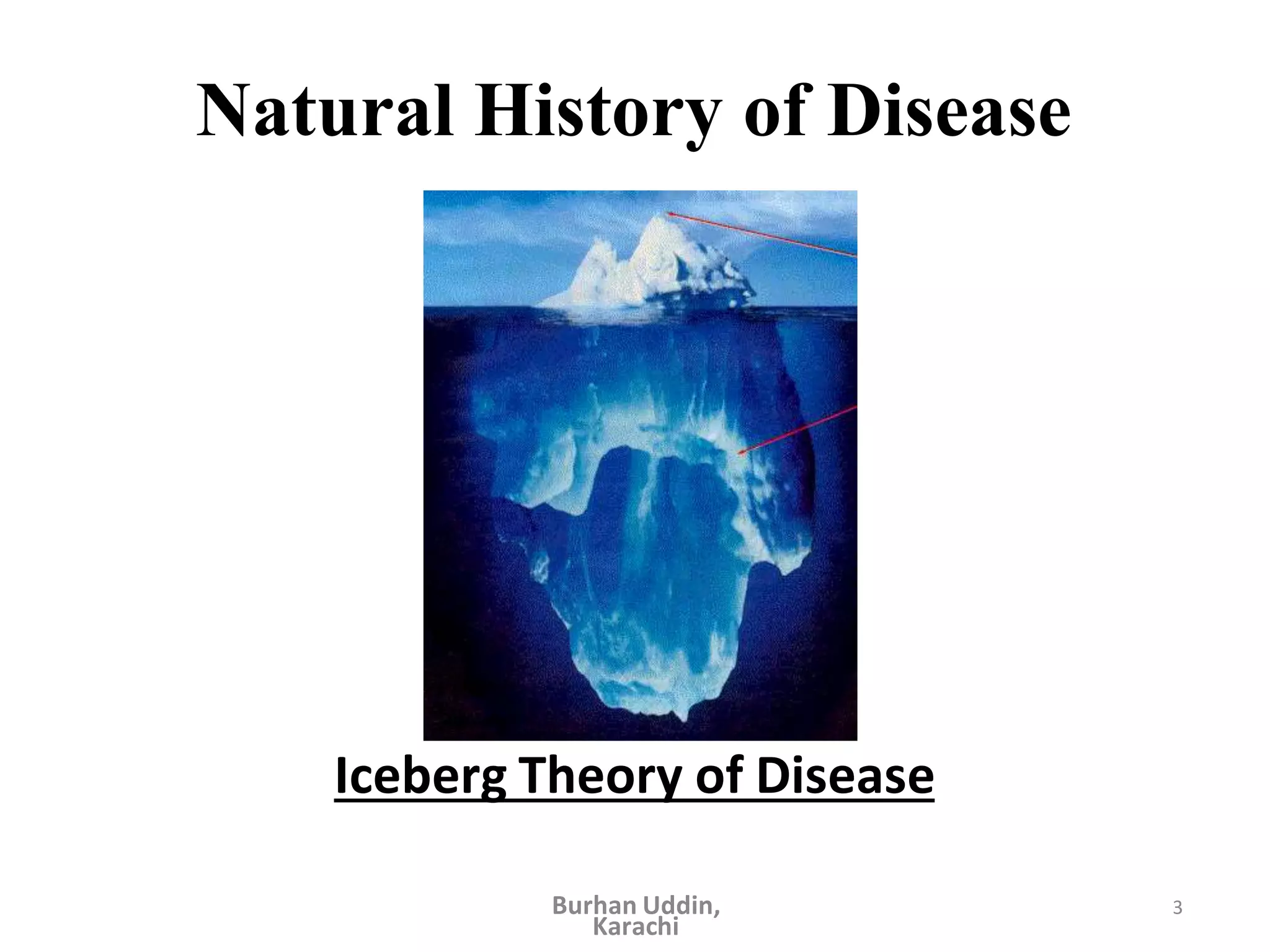
Natural History of Disease
Iceberg Theory of Disease
3
Burhan Uddin,
Karachi
4
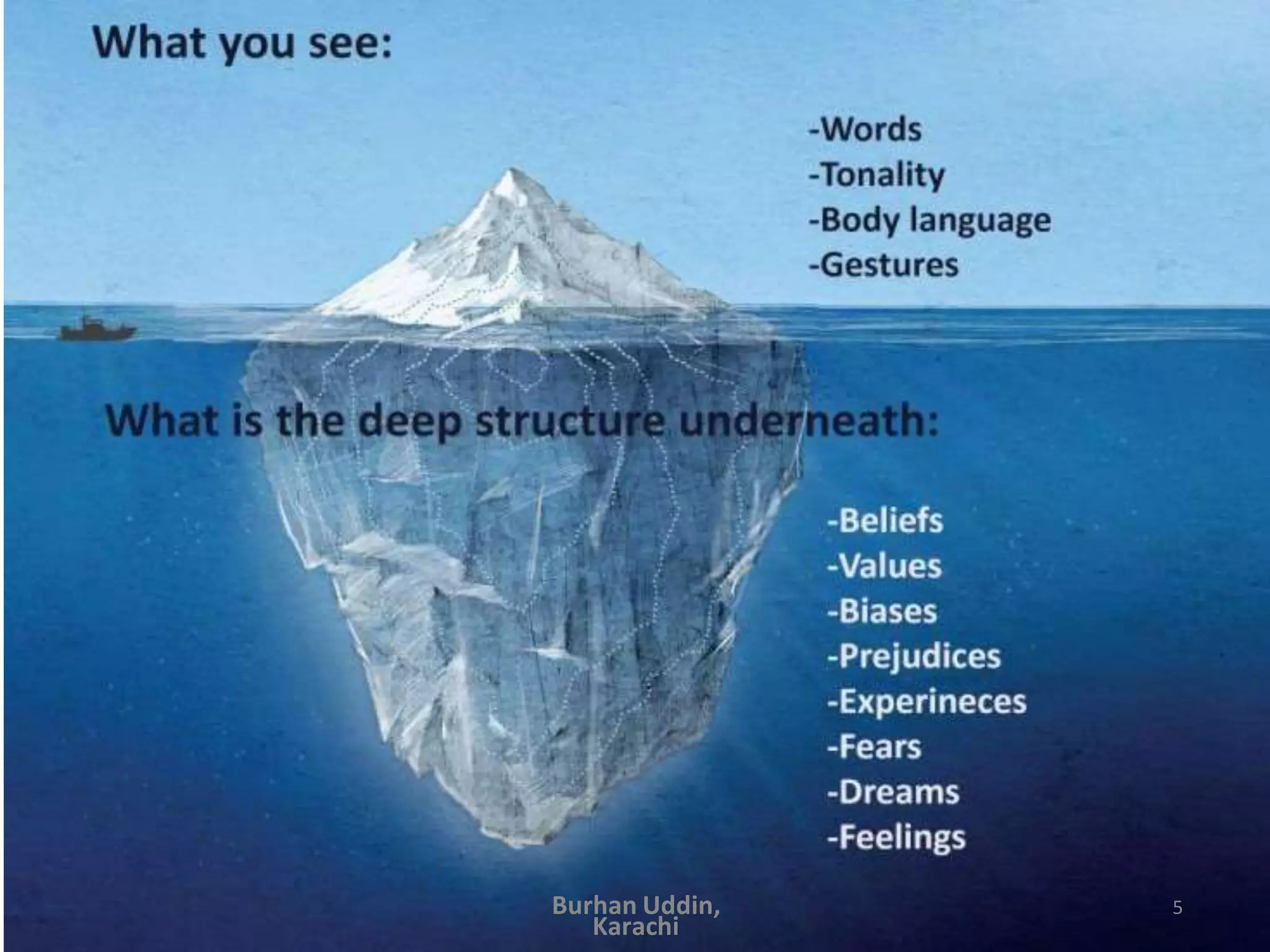
Iceberg Model / Theory
• The iceberg model is a systems thinking
tool designed to help an individual or
group discover the
– patterns of behavior,
– supporting structures, and
– mental models that underlie a particular
event.
Burhan Uddin,
Karachi
5
Burhan Uddin,
Karachi
6
Natural History of Disease
• The natural history of disease is the course a disease takes in
individual people from its pathological onset ("inception")
until its eventual resolution through complete recovery or
death.
• Natural history of disease refers to the progress of a disease
process in an individual over time, in the absence of
intervention.
• This is the continuous progression in an individual of the
disease from the moment of exposure to the causal agents.
Burhan Uddin,
Karachi
7
Natural History of Disease
• Reflect on the four major possible outcomes in an individual of
exposure to a causal agent.
– First, the exposure may have no visible effect.
– Second, there may be demonstrable damaging effect of the
exposure which may be repaired.
– Third, the effect may be an illness that is rapidly contained by
the body's defence mechanism.
– Finally, the illness may progress until it leads to continuing long
term problems, irreversible damage or death.
Burhan Uddin,
Karachi
8
Natural History of Disease
• The process begins with exposure.
• Without medical intervention, the process ends
with
– recovery,
– disability, or
– death
Burhan Uddin,
Karachi
9
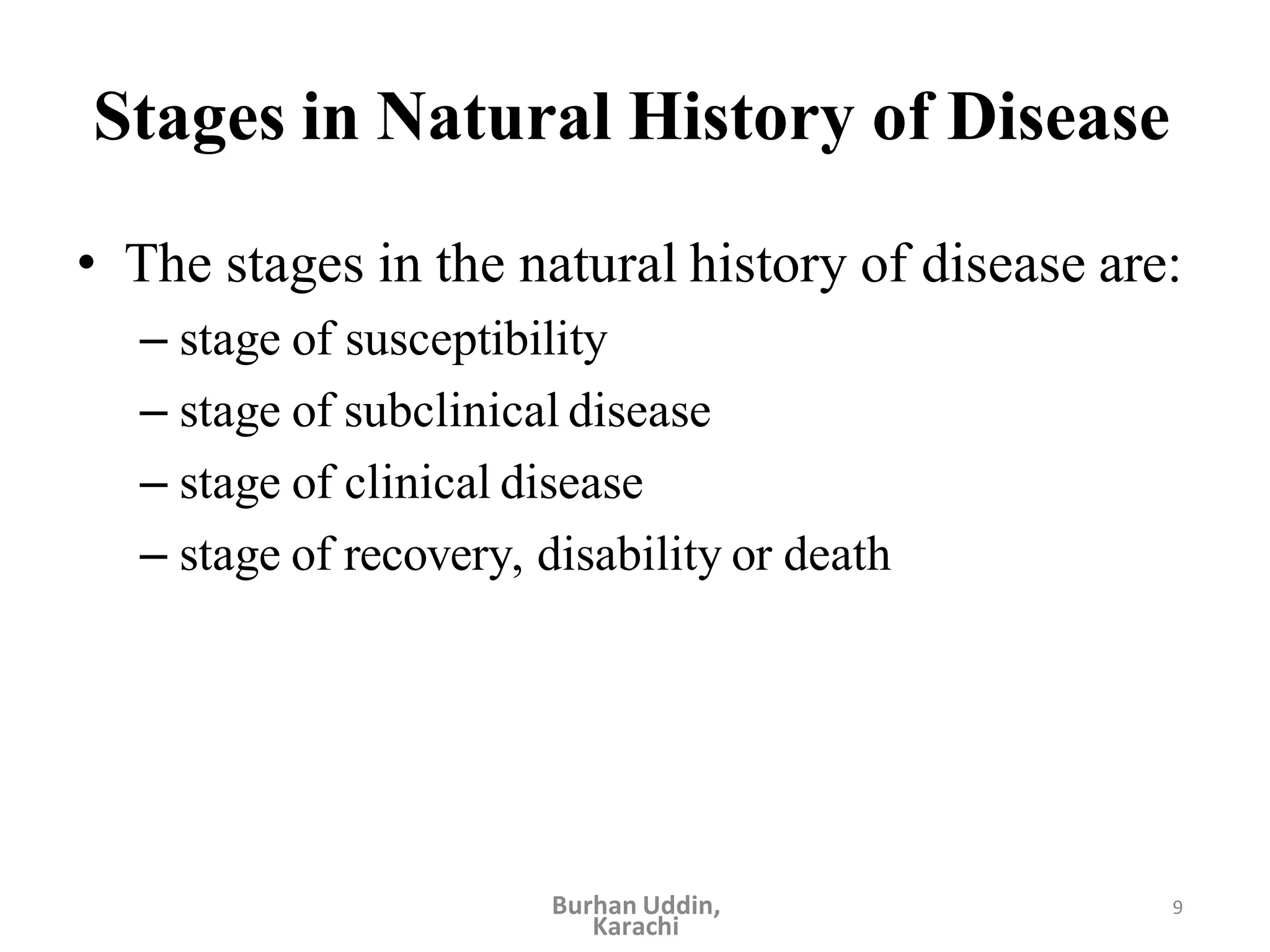
Stages in Natural History of Disease
• The stages in the natural history of disease are:
– stage of susceptibility
– stage of subclinical disease
– stage of clinical disease
– stage of recovery, disability or death
Burhan Uddin,
Karachi
10
Burhan Uddin,
Karachi
11
Burhan Uddin,
Karachi
12
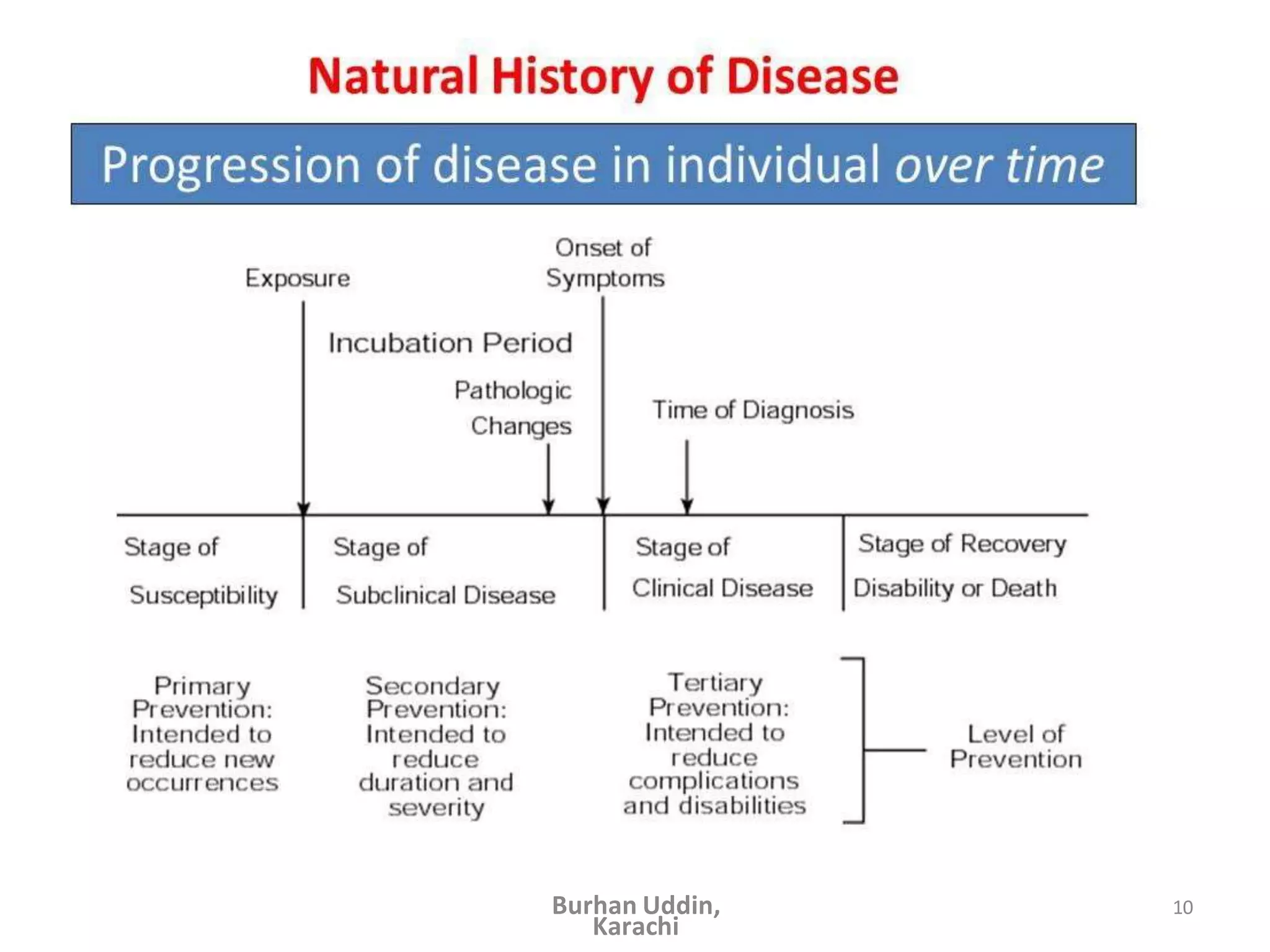
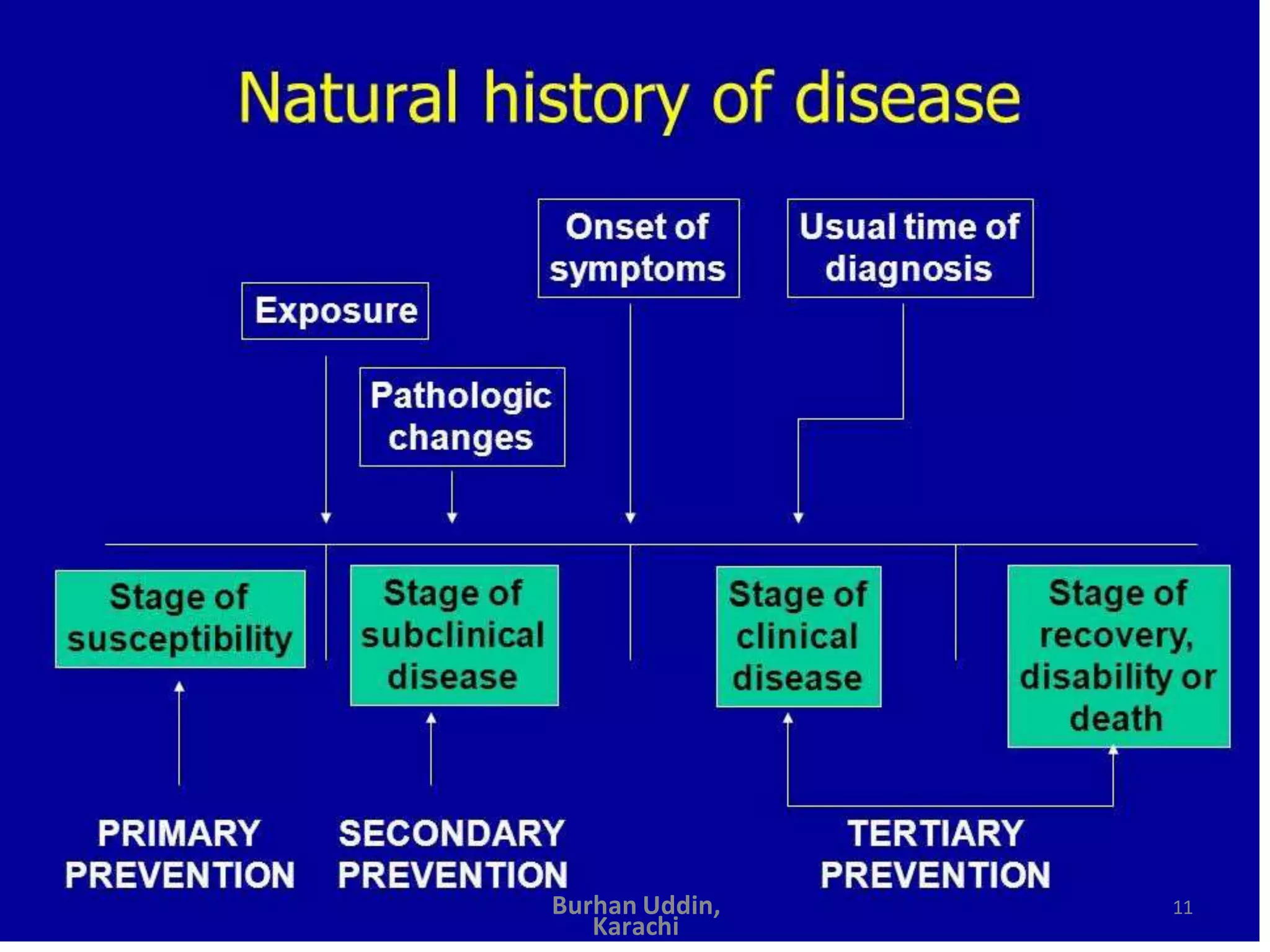
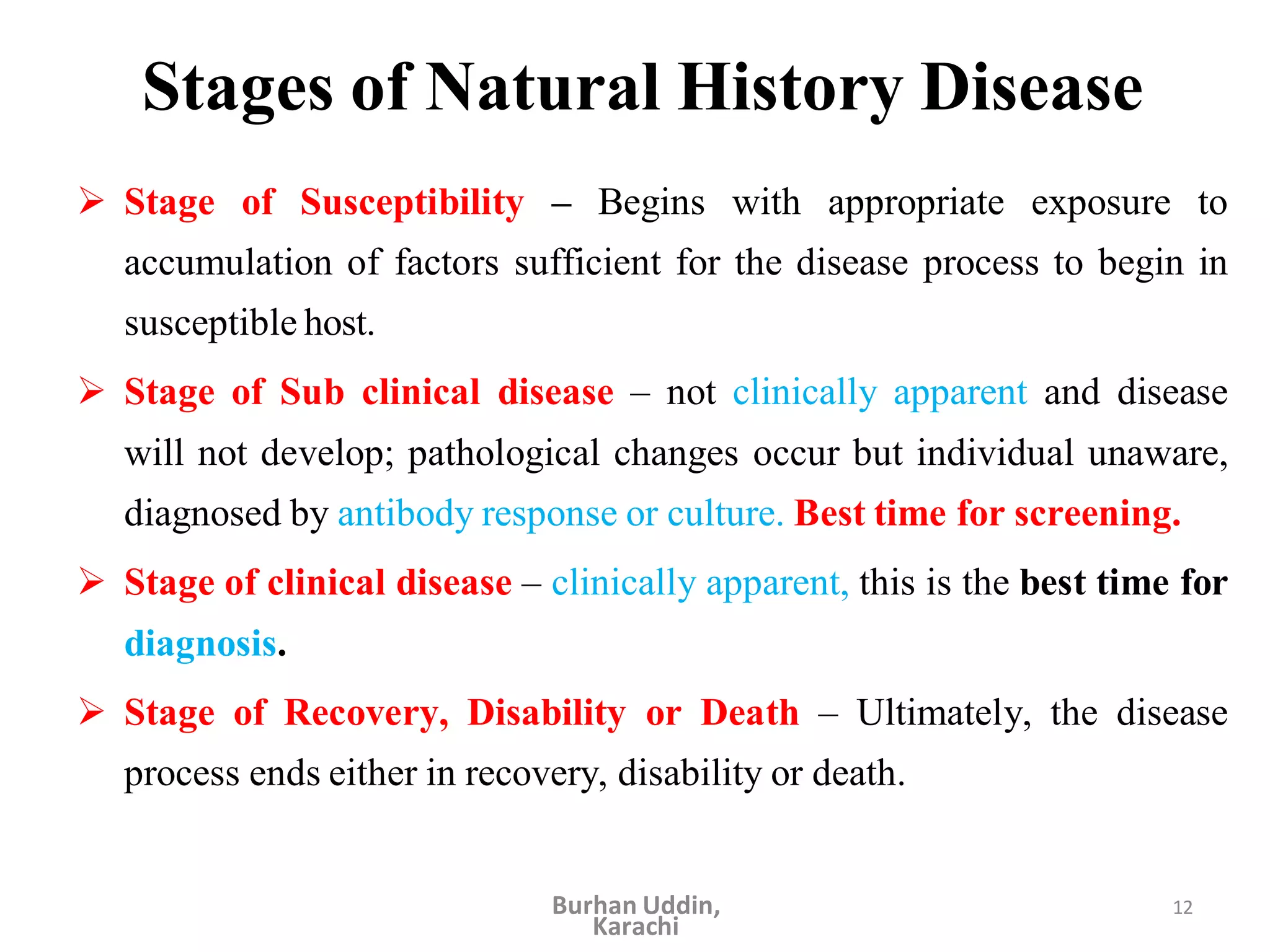
Stages of Natural History Disease
 Stage of Susceptibility – Begins with appropriate exposure to
accumulation of factors sufficient for the disease process to begin in
susceptible host.
 Stage of Sub clinical disease – not clinically apparent and disease
will not develop; pathological changes occur but individual unaware,
diagnosed by antibody response or culture. Best time for screening.
 Stage of clinical disease – clinically apparent, this is the best time for
diagnosis.
 Stage of Recovery, Disability or Death – Ultimately, the disease
process ends either in recovery, disability or death.
Burhan Uddin,
Karachi
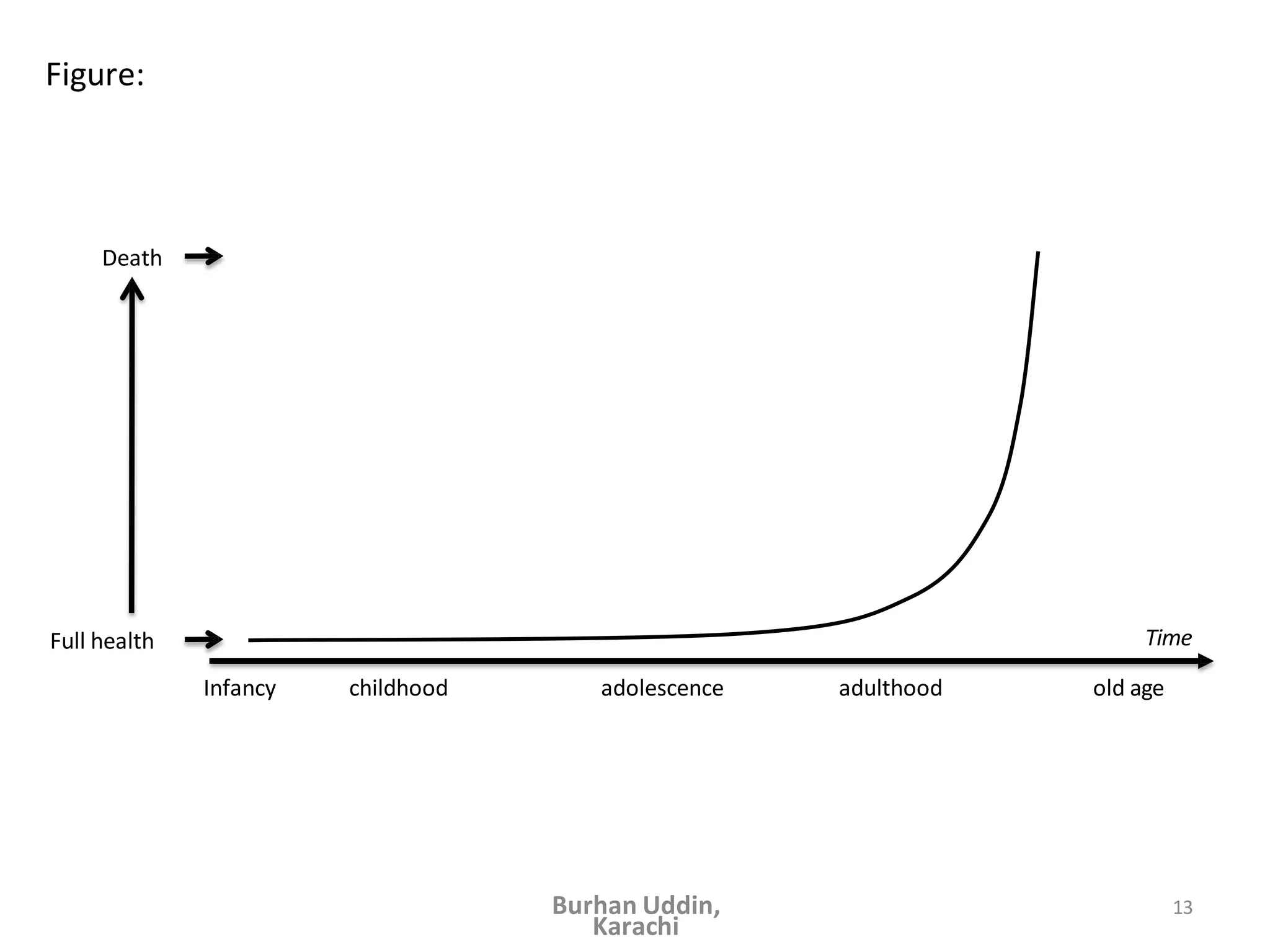
Figure:
Time
Infancy childhood adolescence adulthood old age
Full health
Death
13
Burhan Uddin,
Karachi
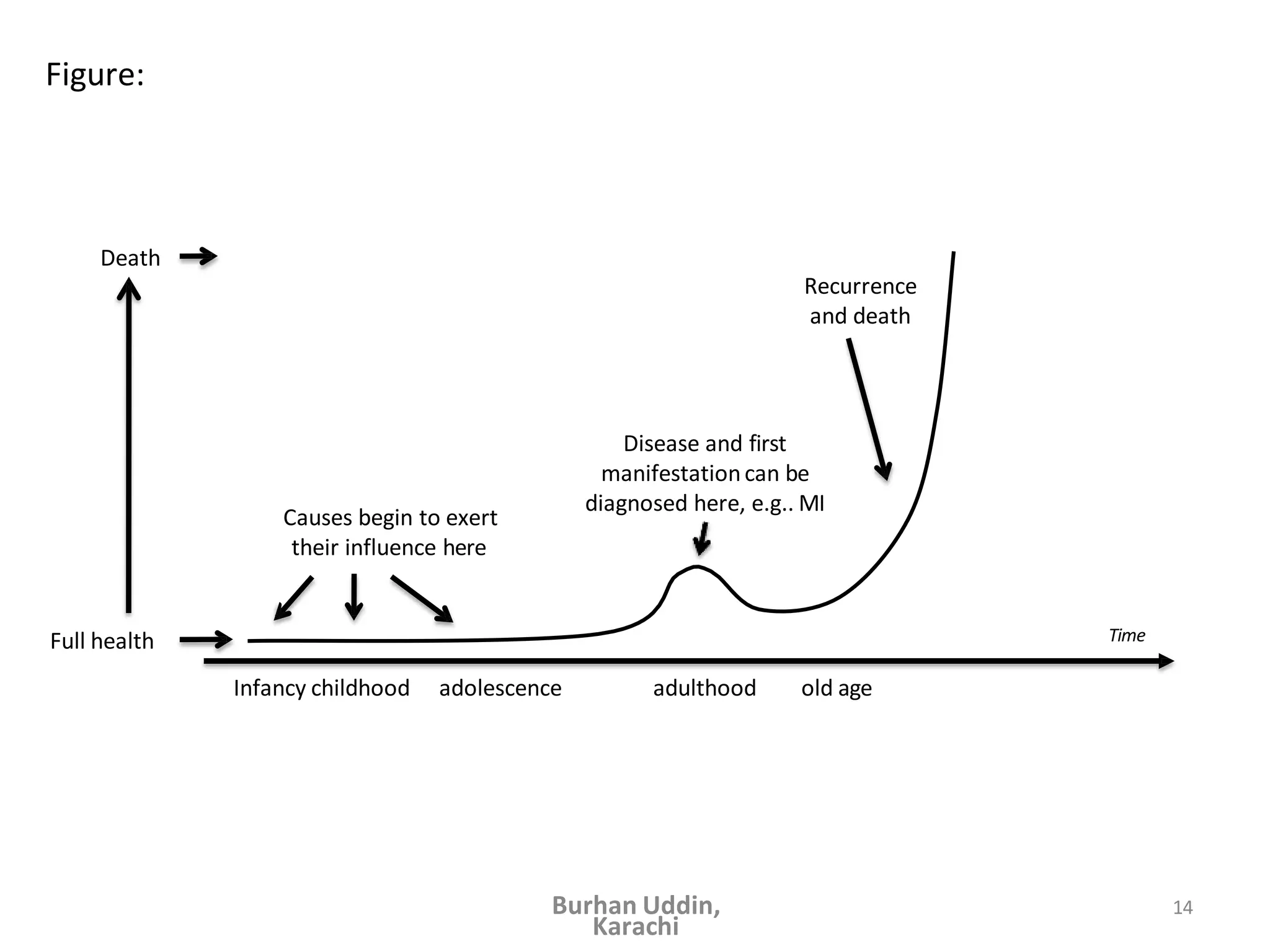
Figure:
Causes begin to exert
their influence here
Disease and first
manifestationcan be
diagnosed here, e.g.. MI
Time
Infancy childhood adolescence adulthood old age
Full health
Death
Recurrence
and death
14
Burhan Uddin,
Karachi
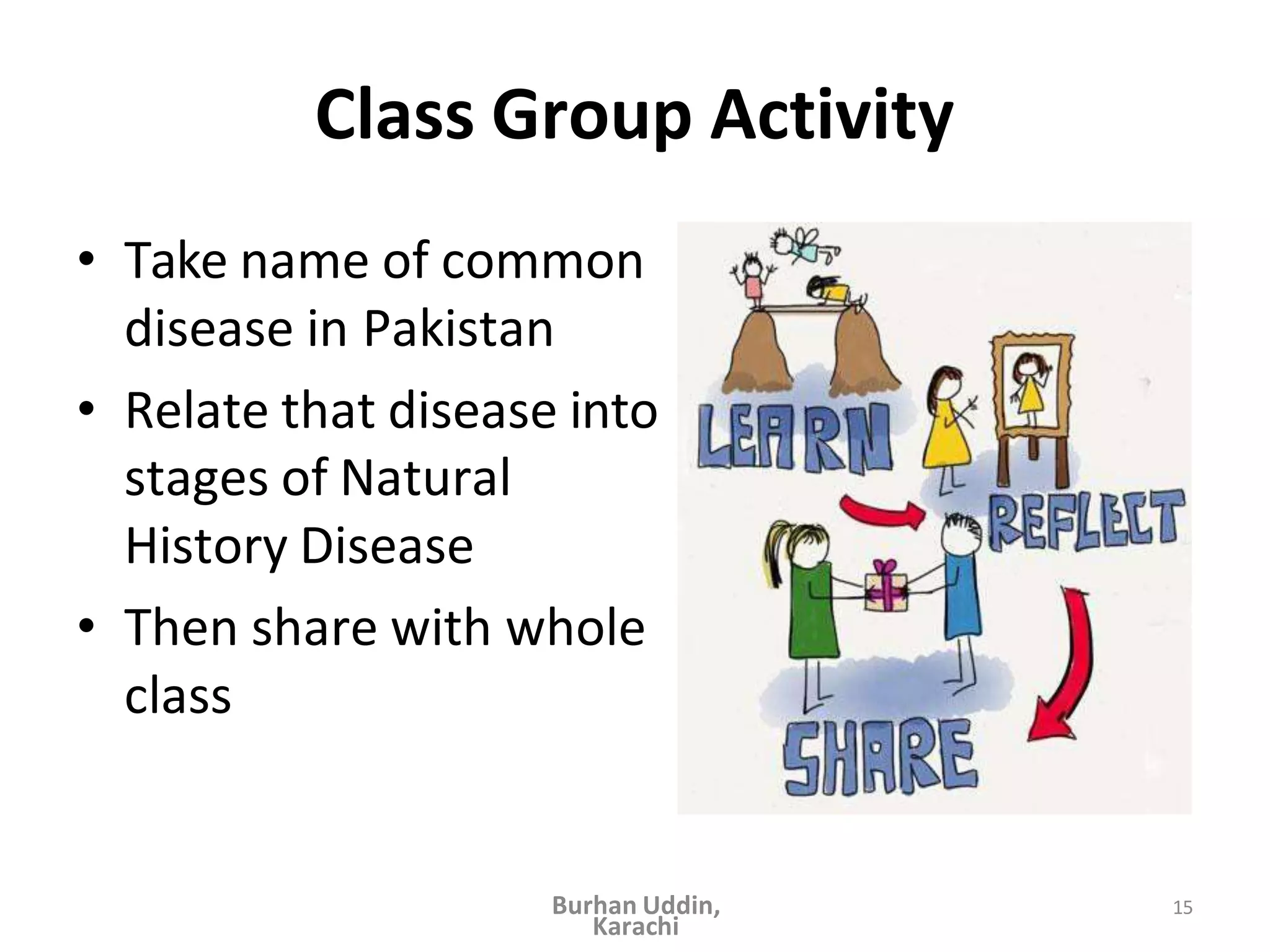
Class Group Activity
• Take name of common
disease in Pakistan
• Relate that disease into
stages of Natural
History Disease
• Then share with whole
class
15
Burhan Uddin,
Karachi
16
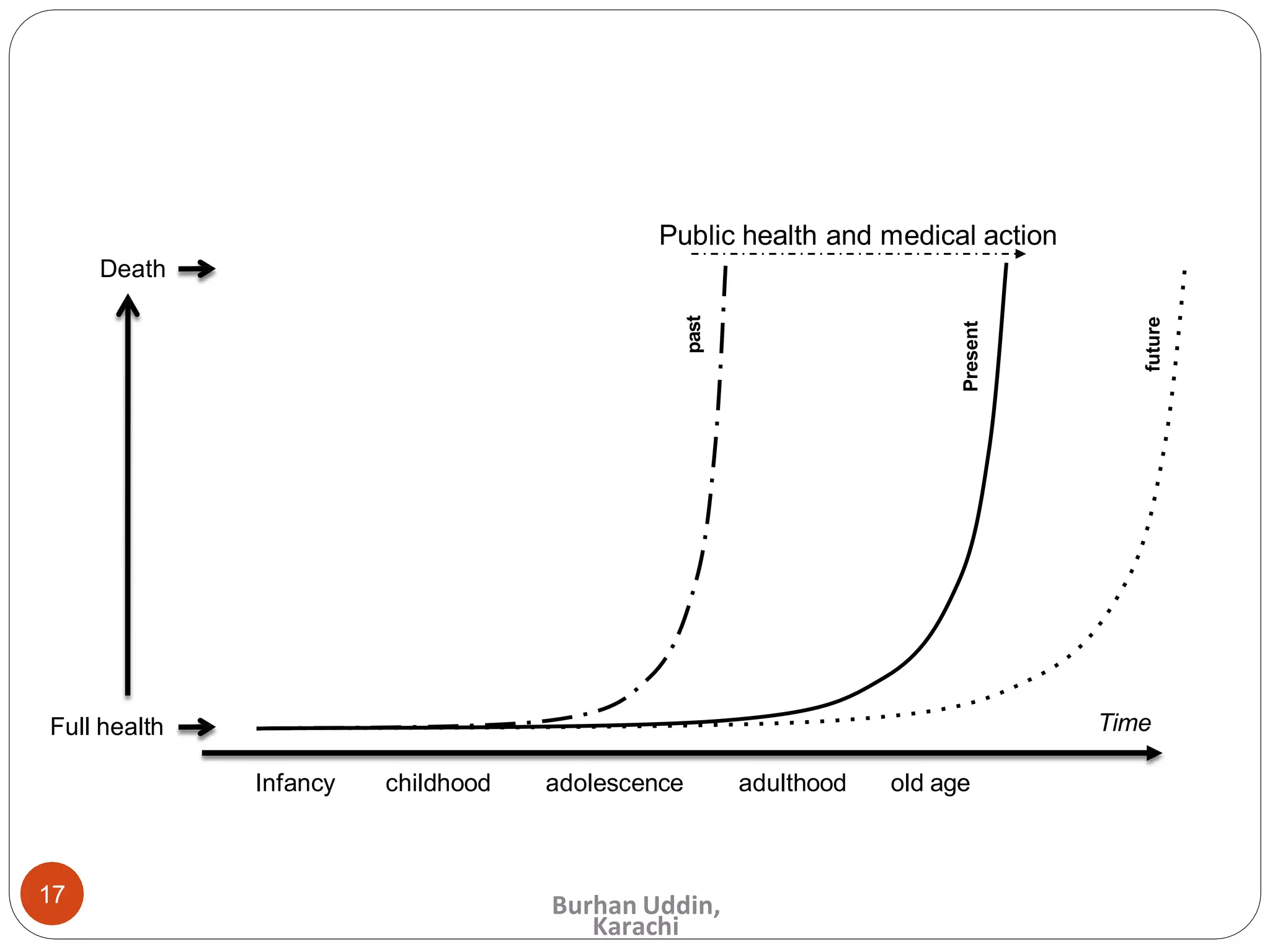
Applications of Natural History
⚫Natural history is vital for disease prevention policies.
⚫It underlies secondary prevention based on
screening
⚫It provides a rationale for all health care.
⚫Purpose of health care, including medicine, is to
influence the natural history of disease by reducing
and delaying ill-health.
⚫When achieved through purposeful actions by
societies the collective endeavour is public health.
Burhan Uddin,
Karachi
past
Present
future
Public health and medical action
Time
Infancy childhood adolescence adulthood old age
Full health
Death
17 Burhan Uddin,
Karachi
18
Population Pattern of Disease
(PPOD
confused with the changing pattern of disease
⚫ Natural history of disease should not be (but is)
in
populations.
⚫ The distribution of a disease across socio-economic
groups may change as it has for coronary heart
disease.
⚫ This is called as “Population pattern of disease”
⚫ Main measures of PPOD are the disease incidence
and prevalence.
Burhan Uddin,
Karachi
19
Disease Process
The aspects of disease process include
⚫Etiology
⚫ Pathogenesis
⚫ Morphologic changes
⚫ Clinical manifestations
⚫ Diagnosis
⚫Clinical course
Burhan Uddin,
Karachi
20
Burhan Uddin,
Karachi
21
Burhan Uddin,
Karachi
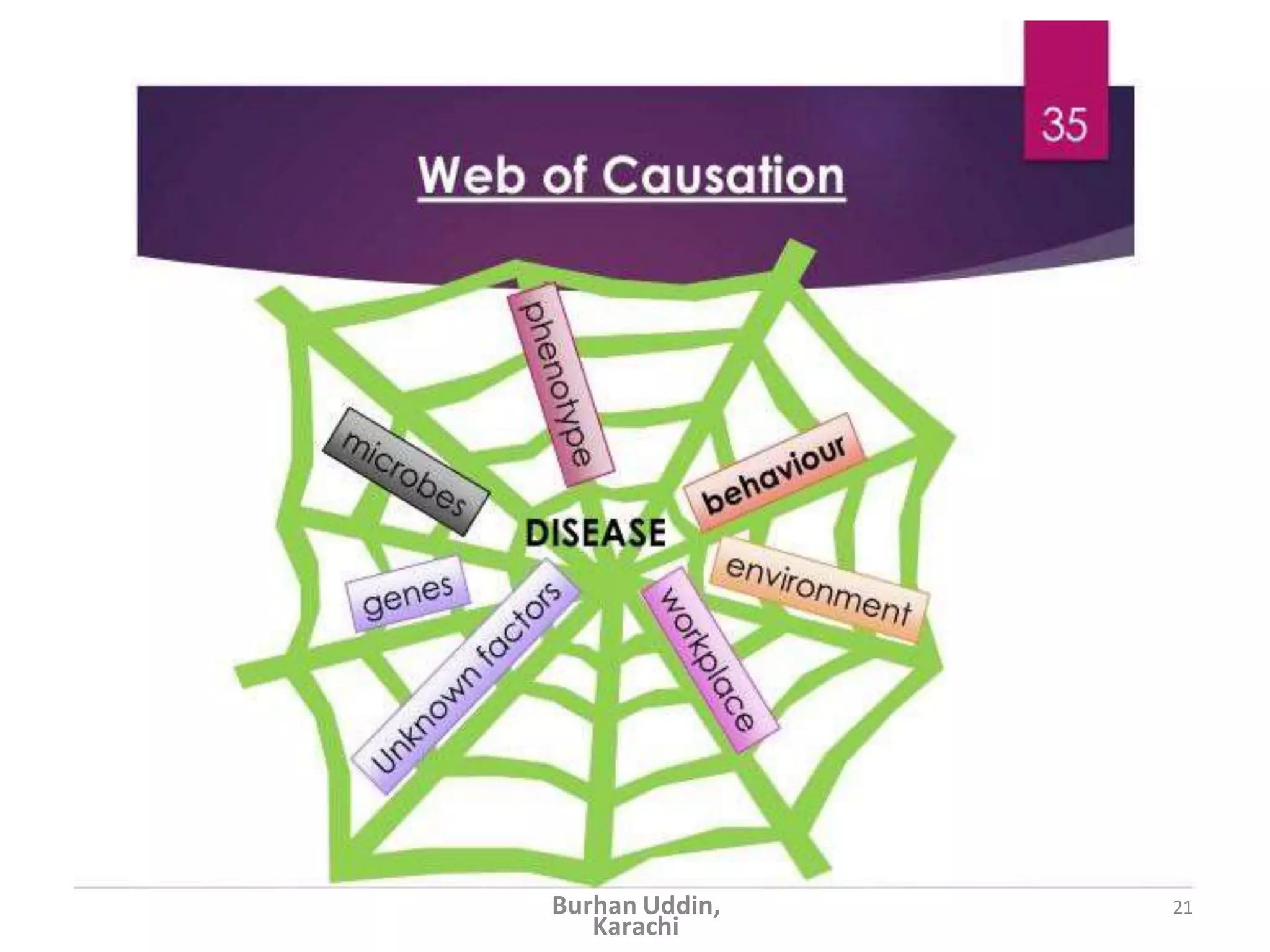
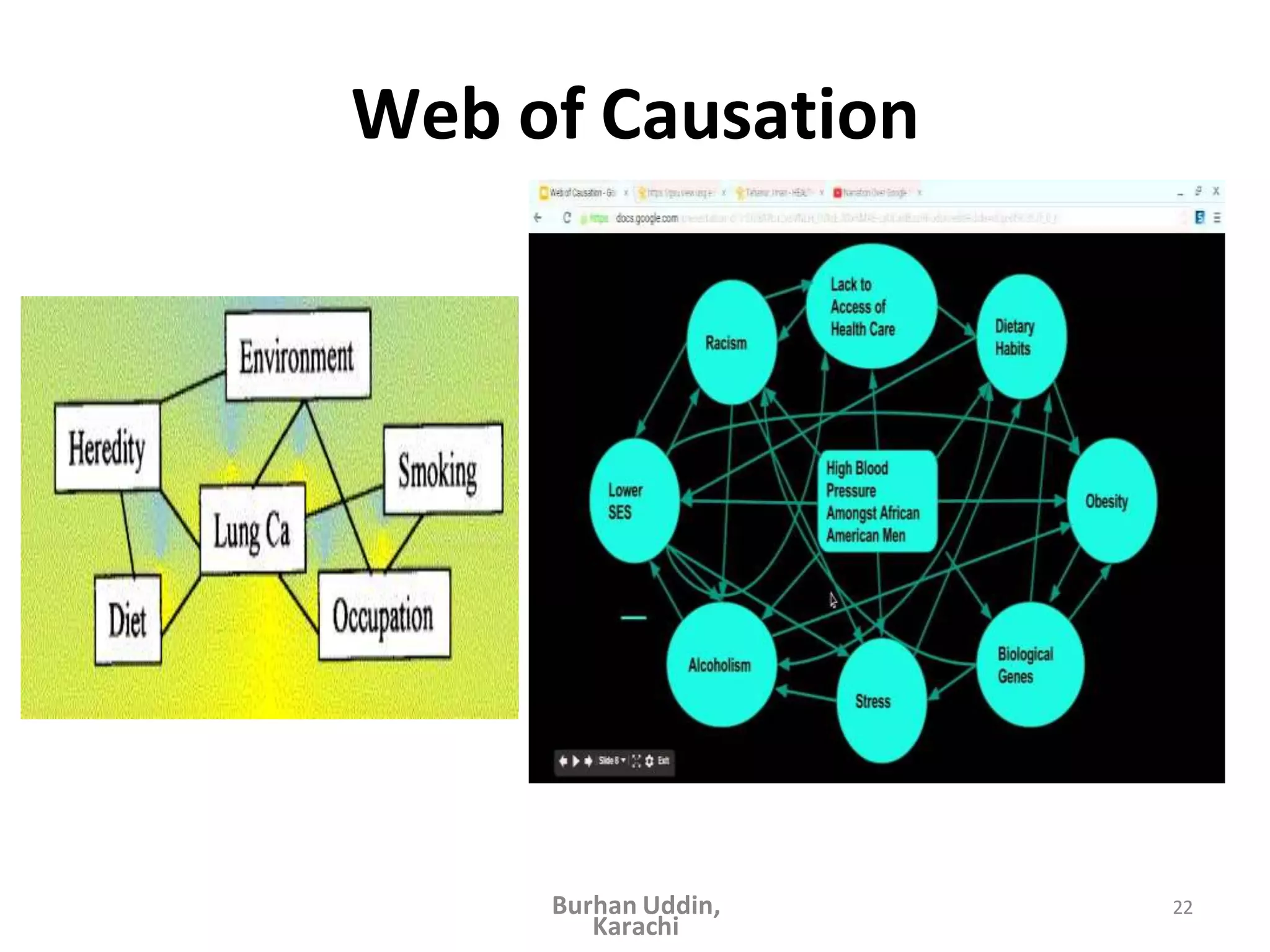
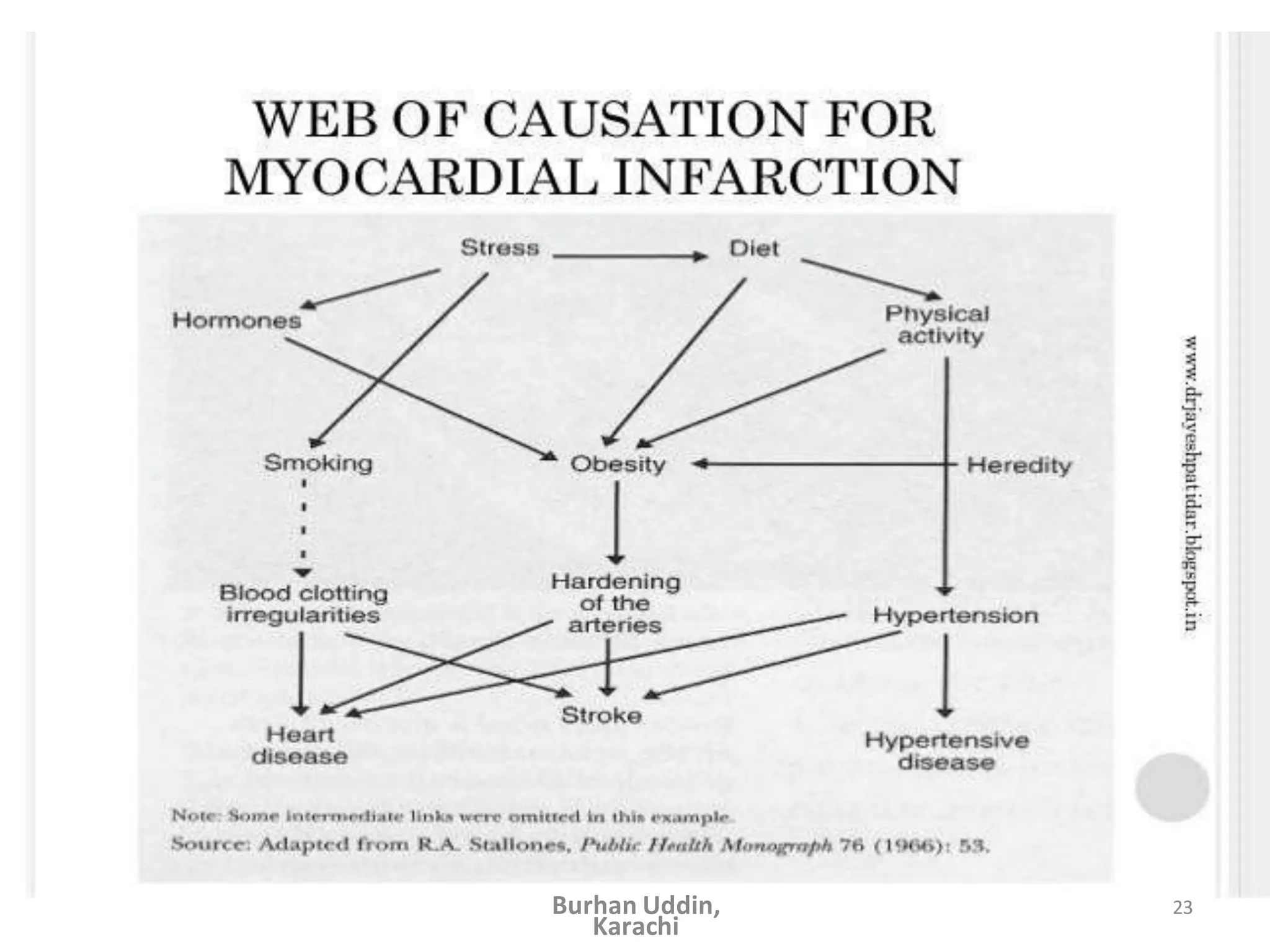
Web of Causation
22
Burhan Uddin,
Karachi
23
Burhan Uddin,
Karachi
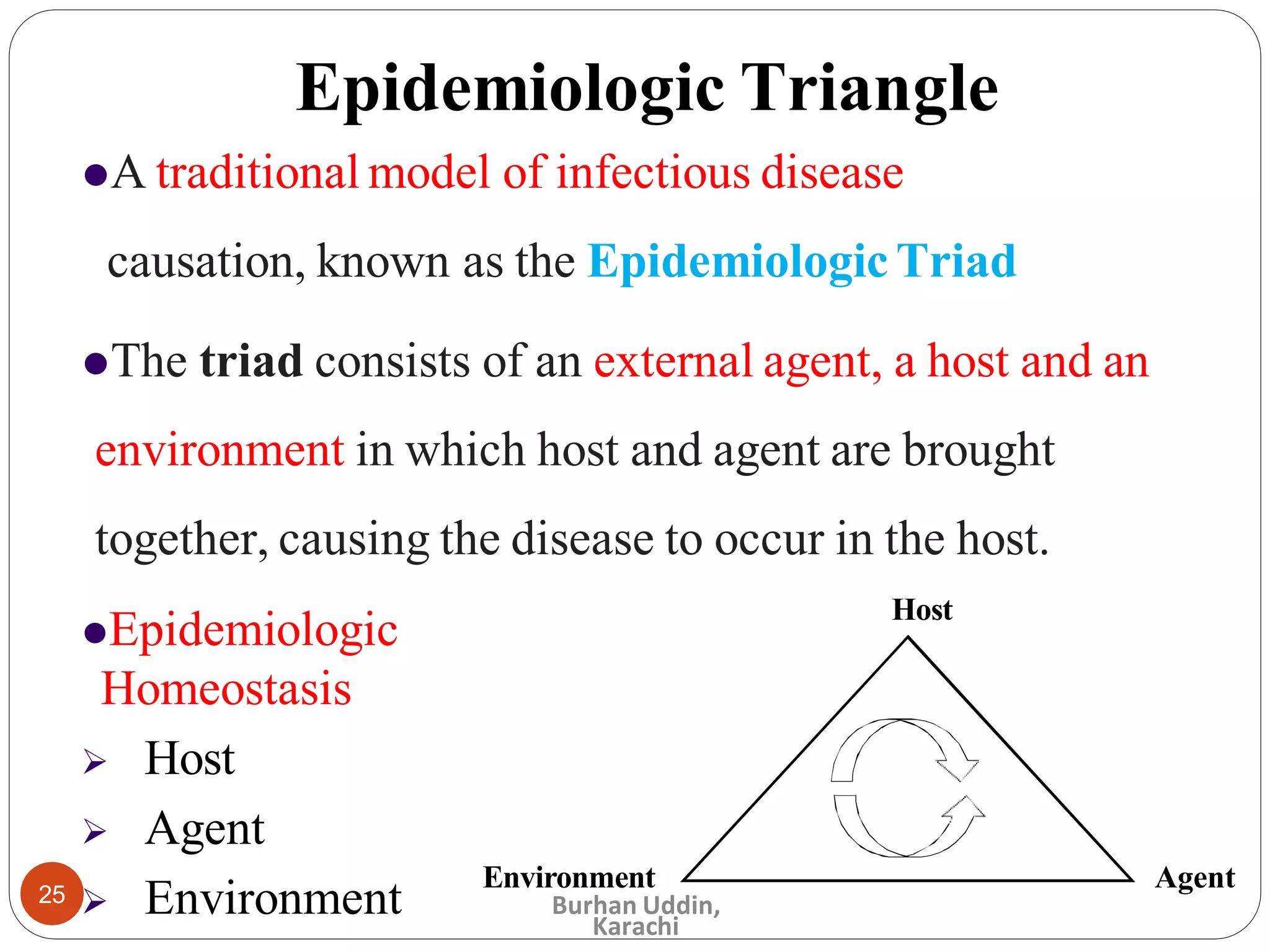
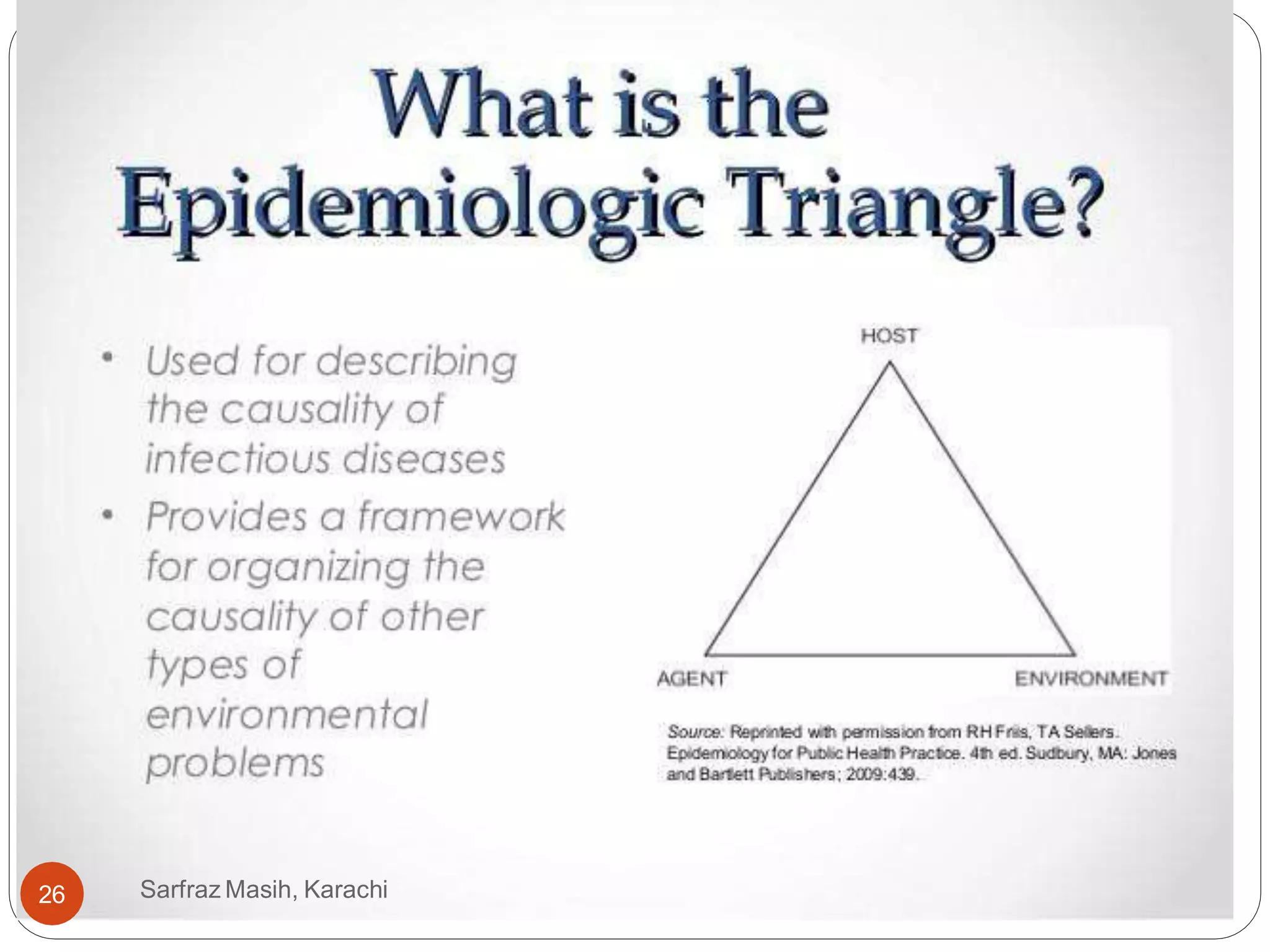
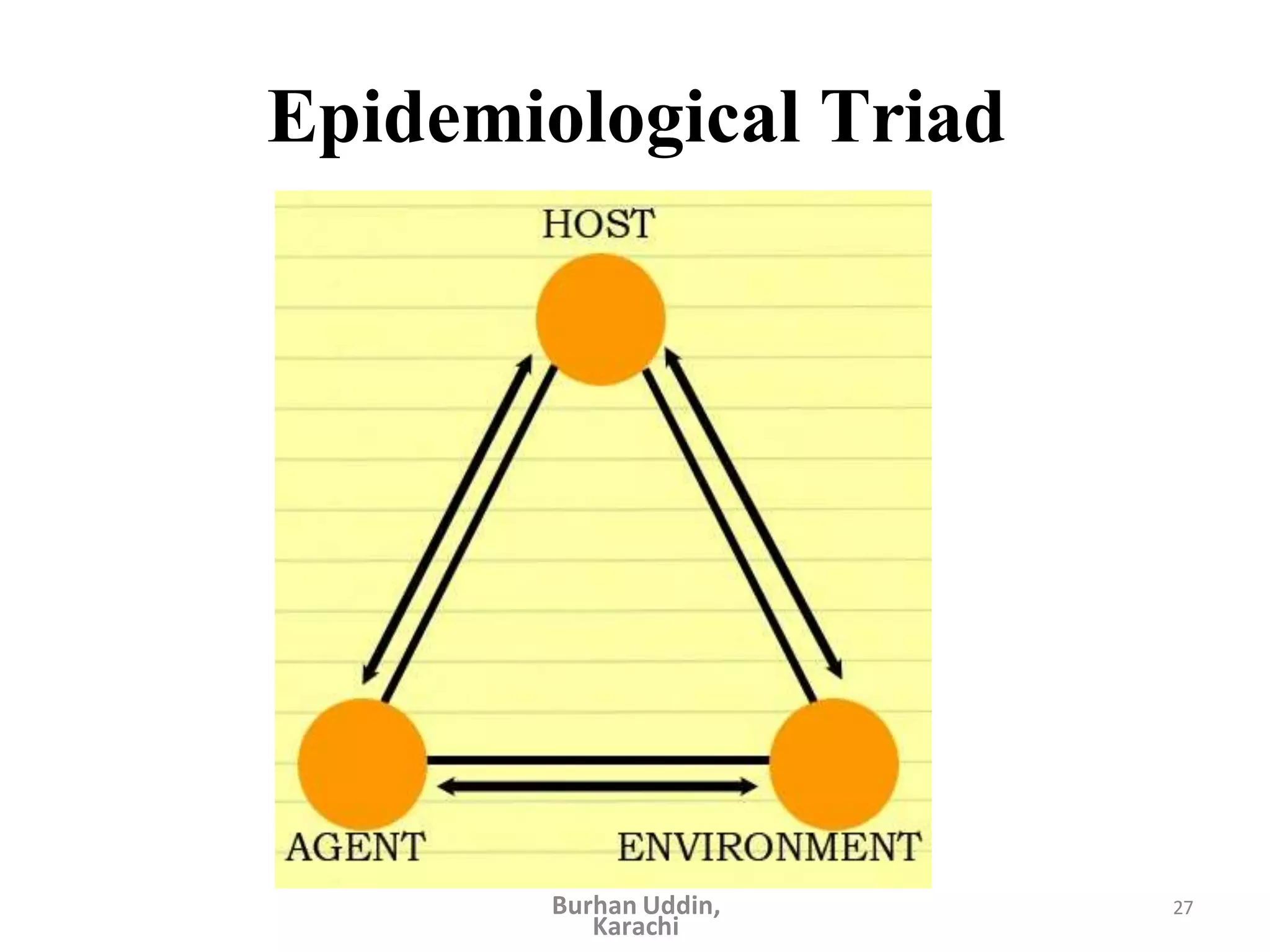
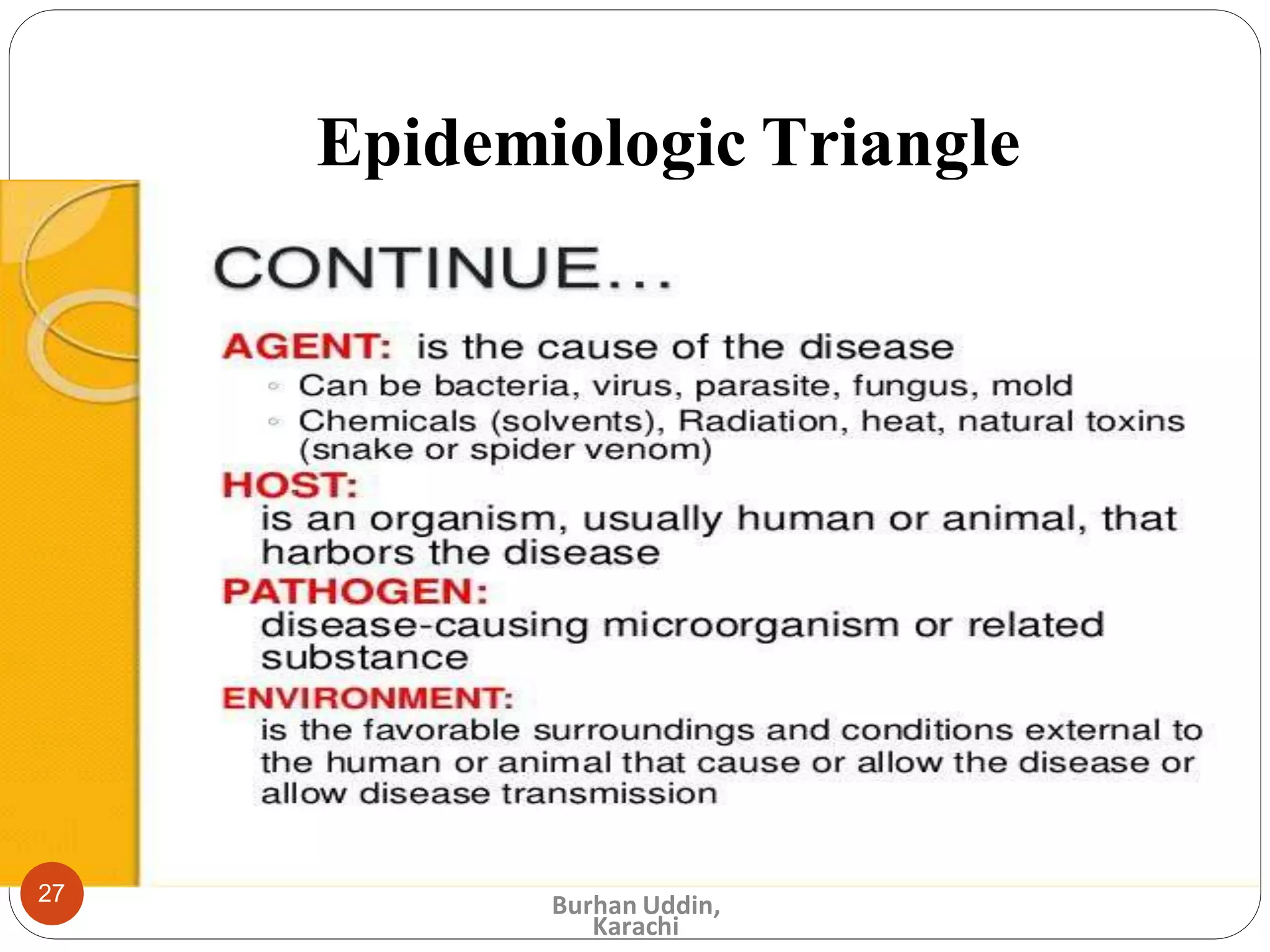
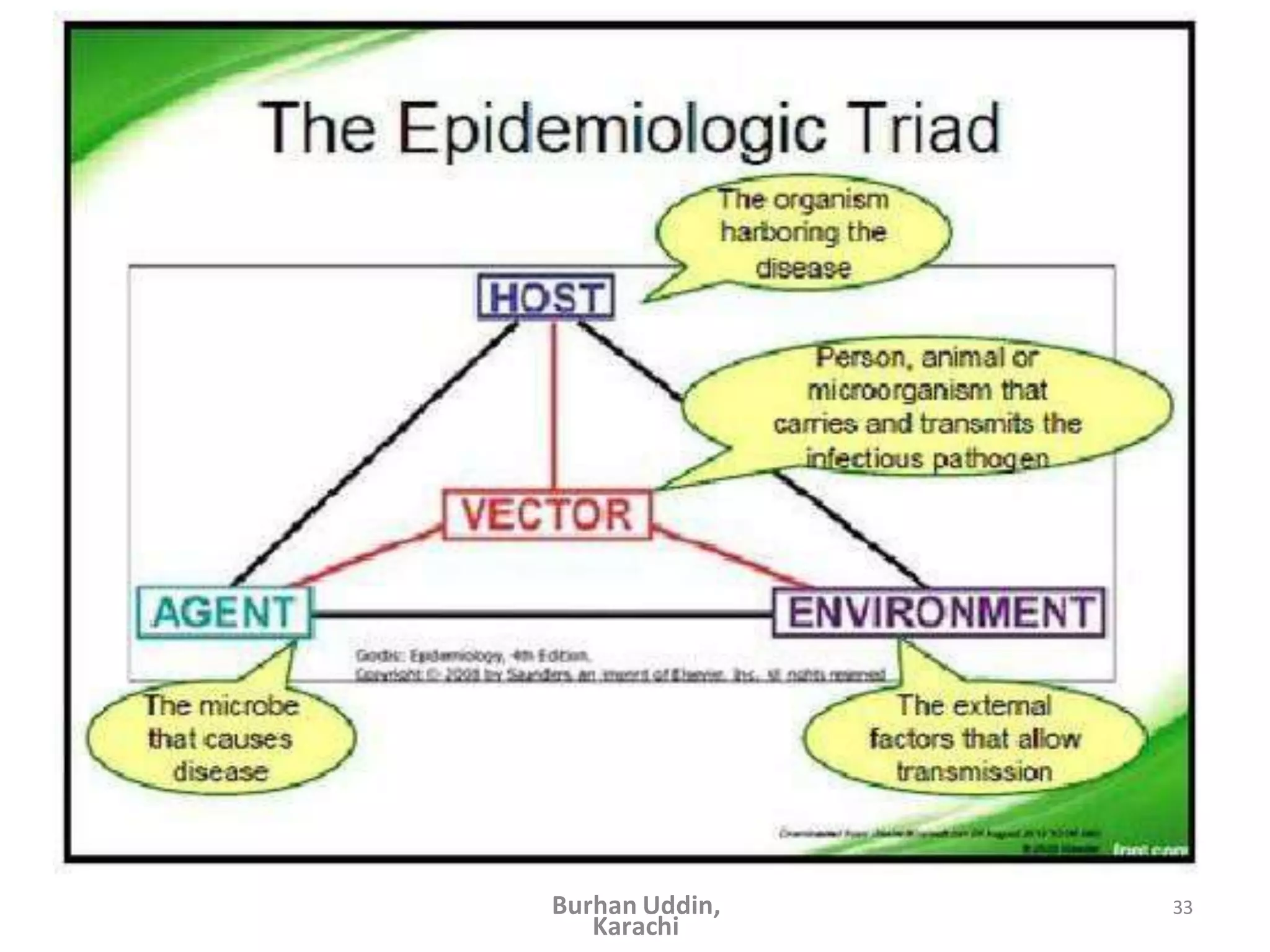
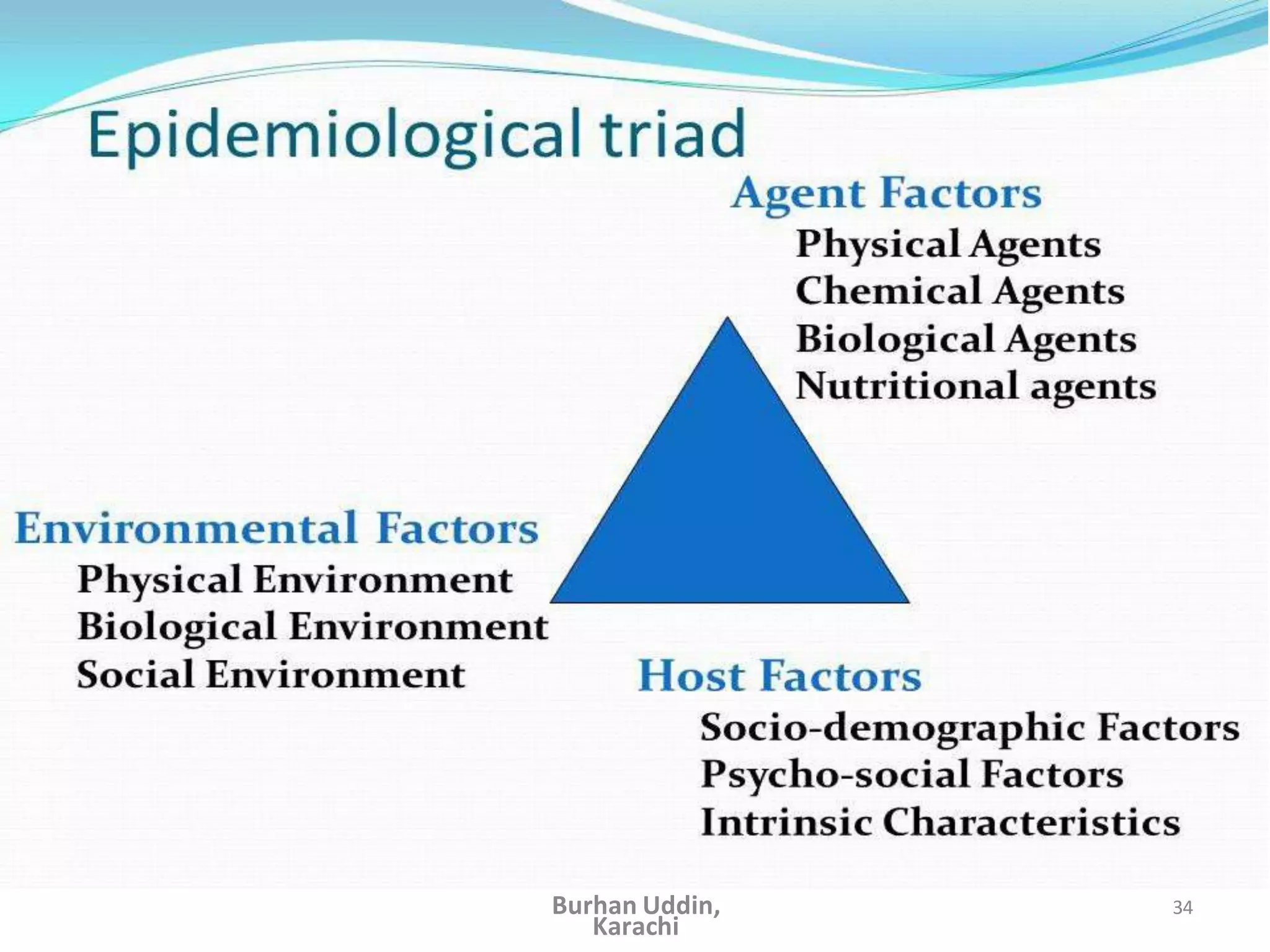
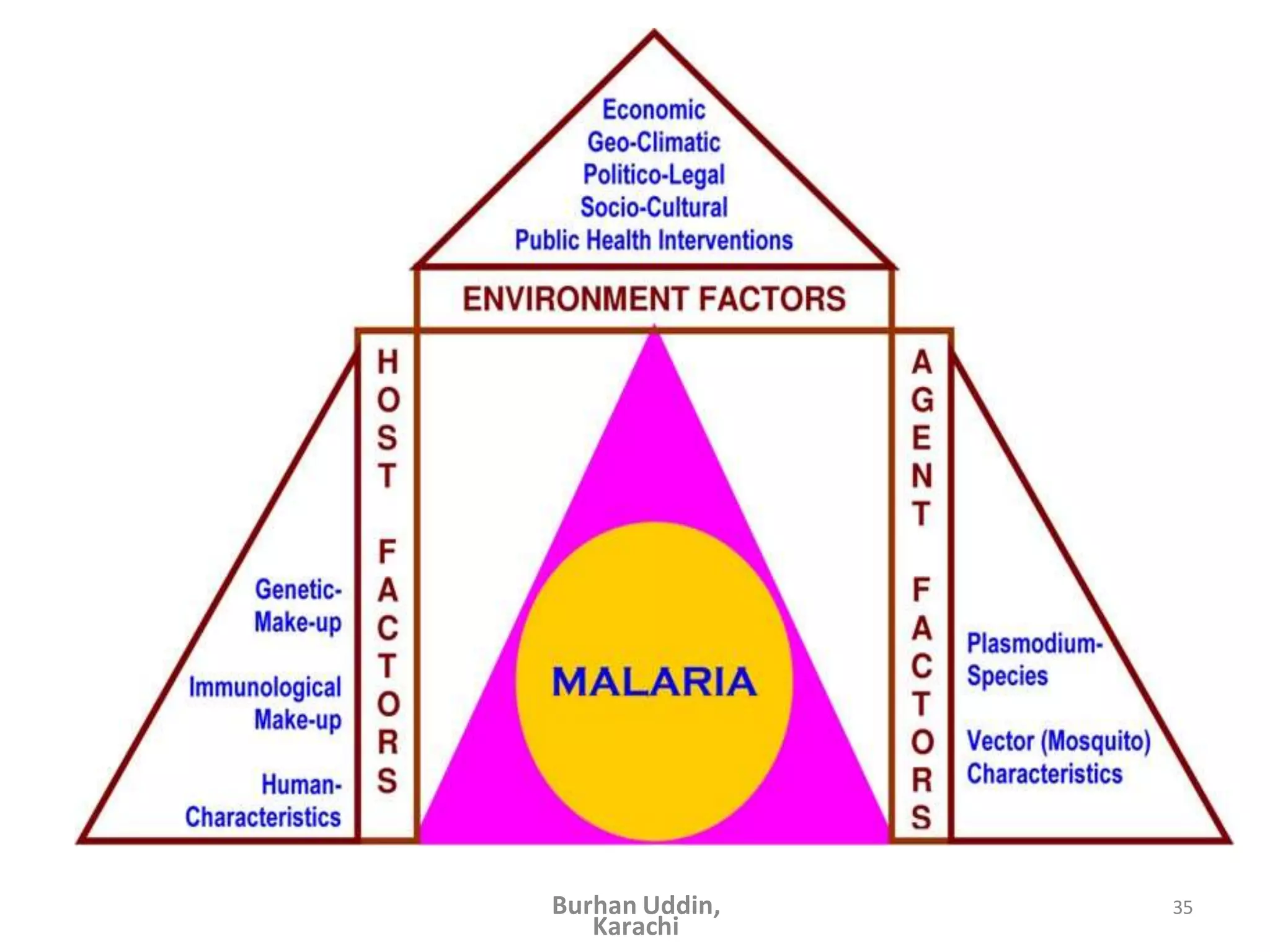
Epidemiologic Triangle
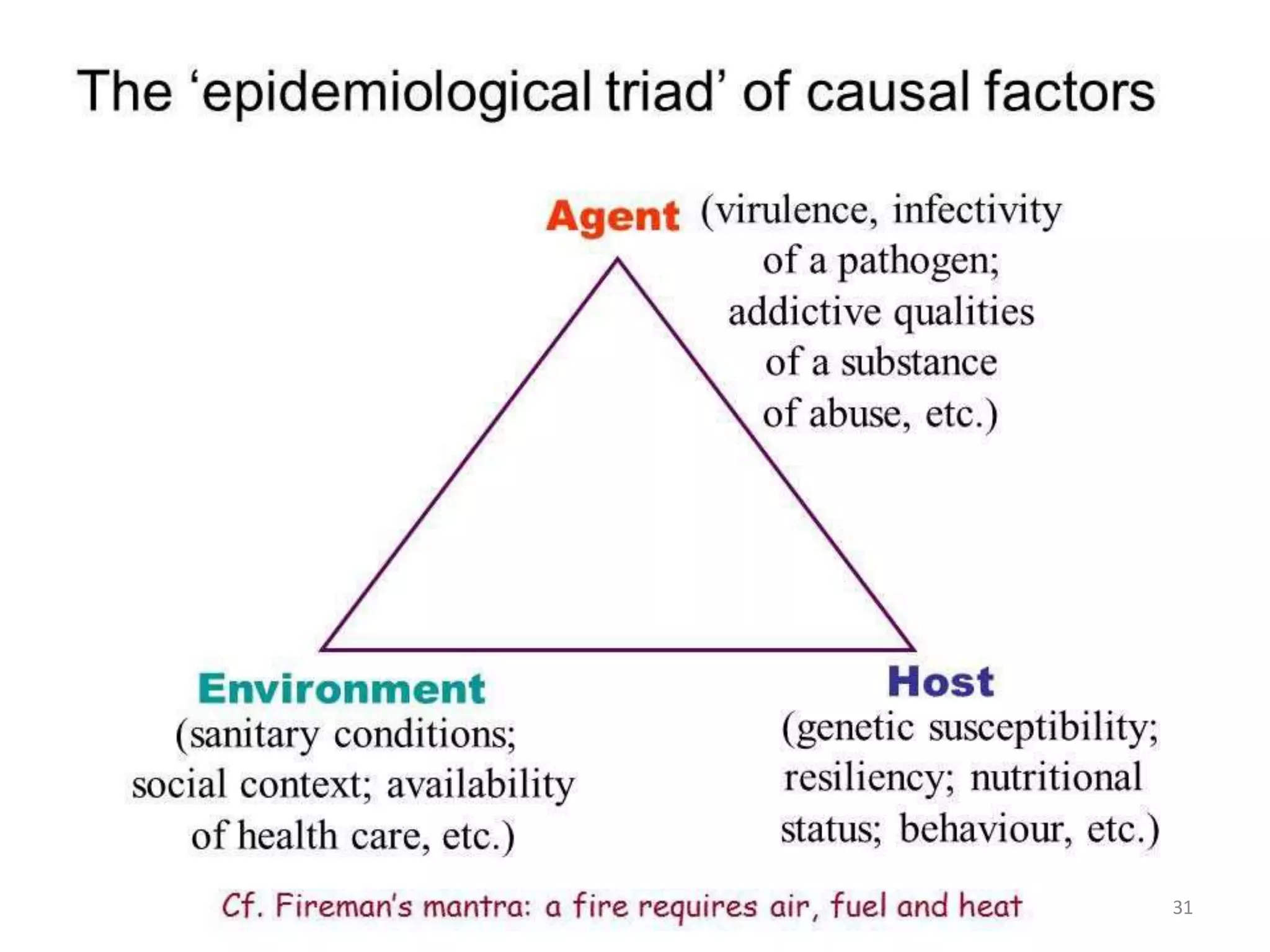
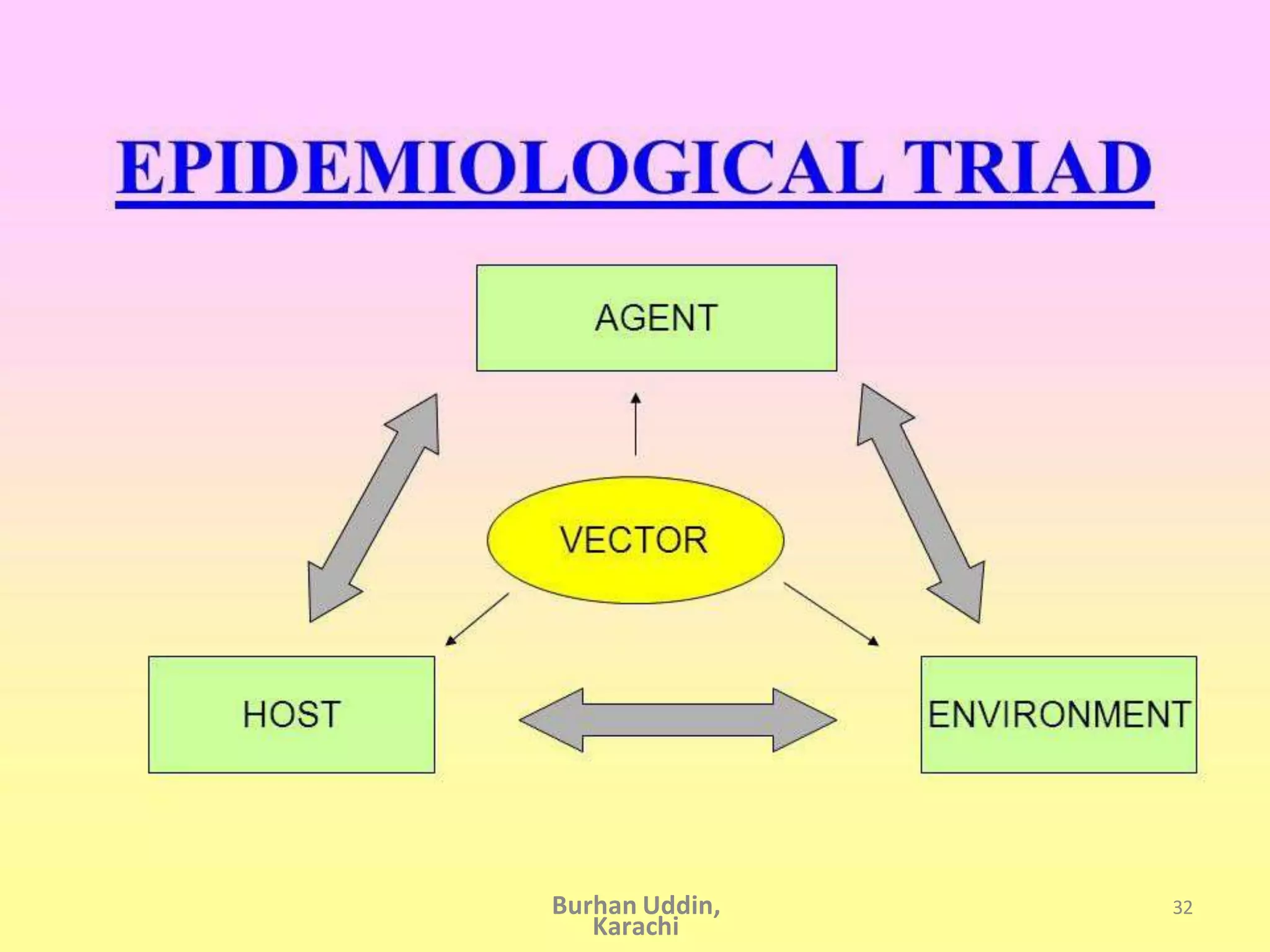
⚫A traditional model of infectious disease
causation, known as the Epidemiologic Triad
⚫The triad consists of an external agent, a host and an
environment in which host and agent are brought
together, causing the disease to occur in the host.
⚫Epidemiologic
Homeostasis
 Host
 Agent
 Environment
Host
Environment Agent
25 Burhan Uddin,
Karachi
Sarfraz Masih, Karachi
26
Epidemiological Triad
27
Burhan Uddin,
Karachi
Epidemiologic Triangle
27 Burhan Uddin,
Karachi
28 Burhan Uddin,
Karachi
29
Burhan Uddin,
Karachi
30
Burhan Uddin,
Karachi
31
32
Burhan Uddin,
Karachi
33
Burhan Uddin,
Karachi
34
Burhan Uddin,
Karachi
35
Burhan Uddin,
Karachi
36
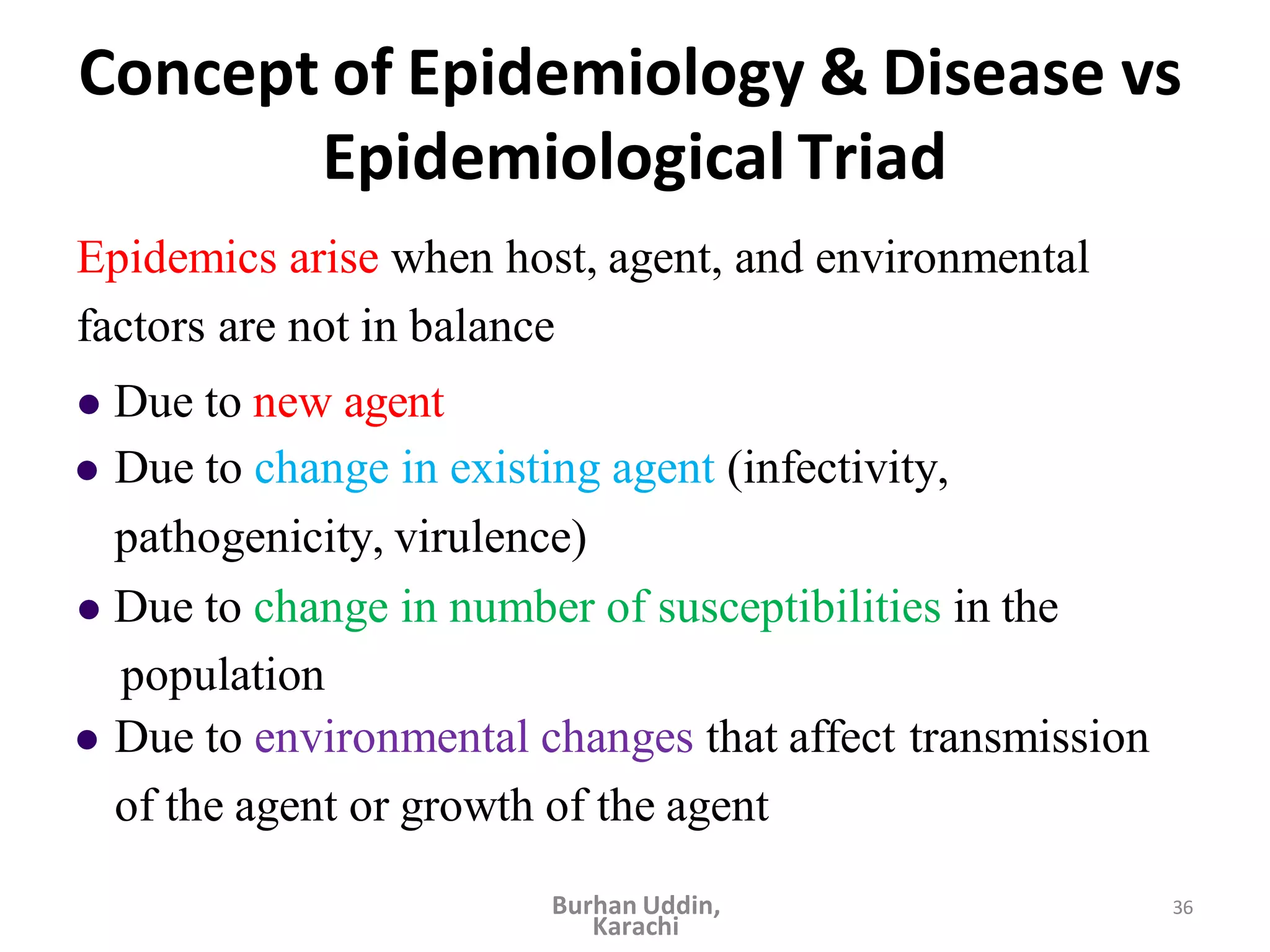
Concept of Epidemiology & Disease vs
Epidemiological Triad
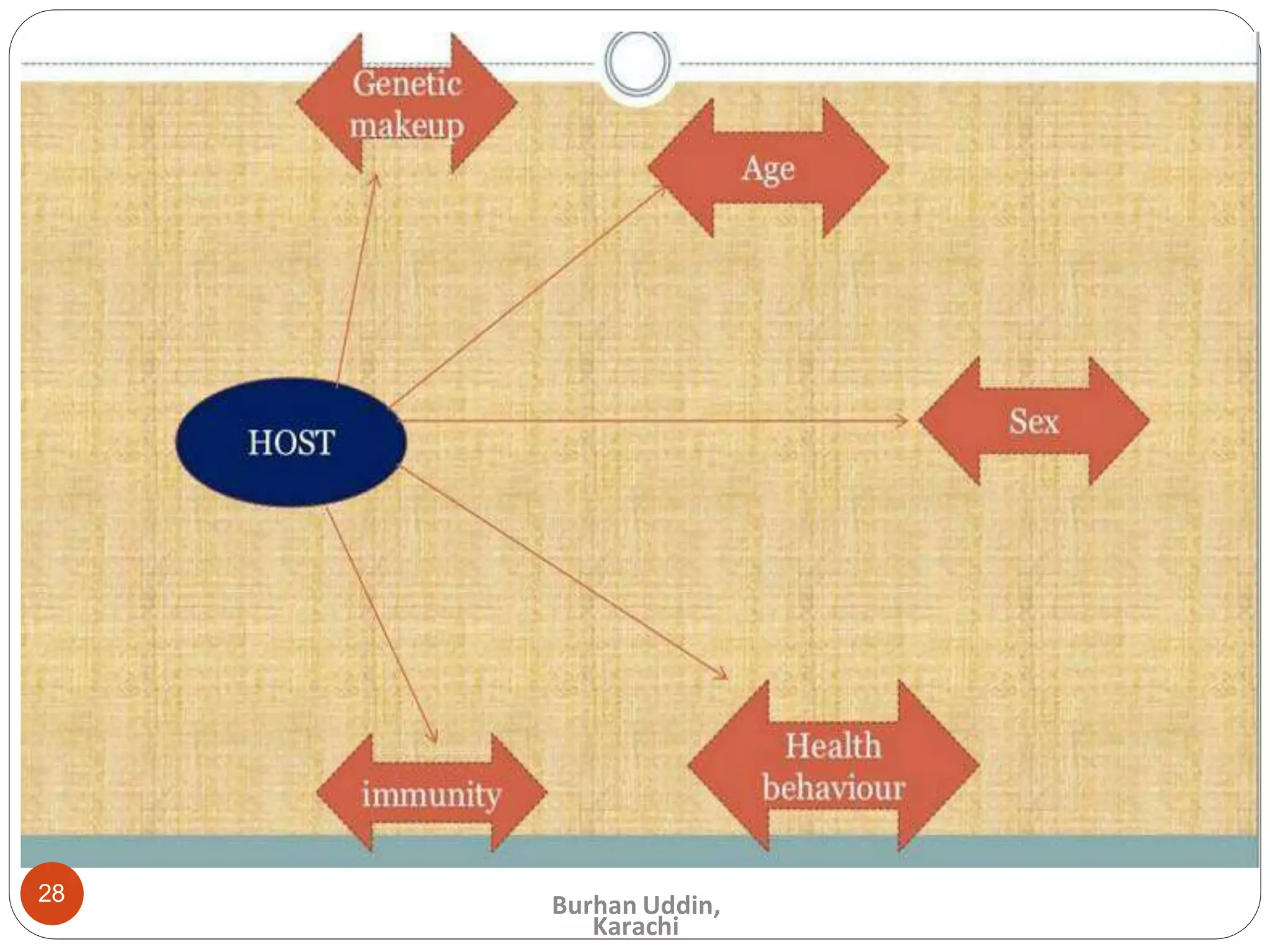
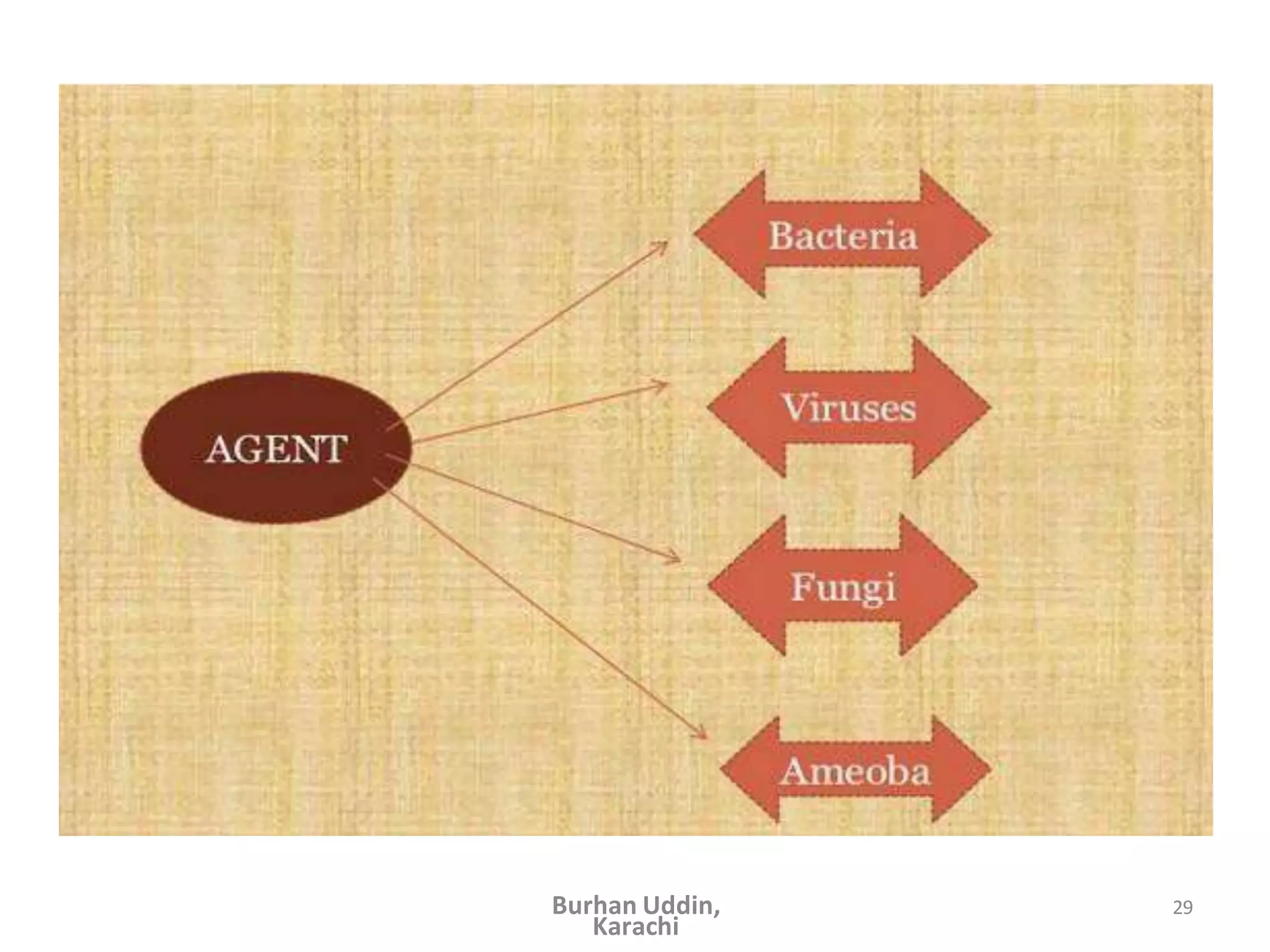
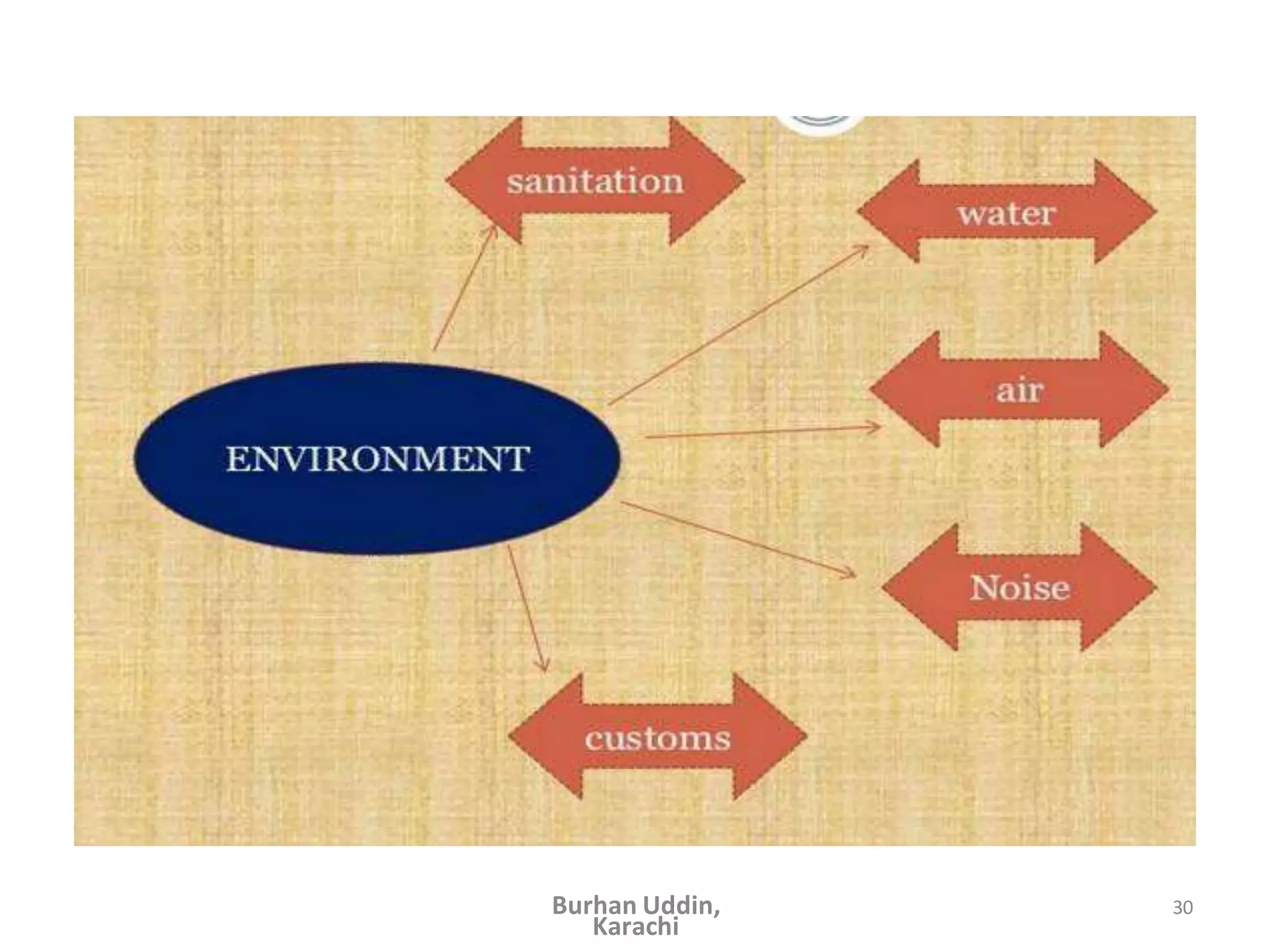
Epidemics arise when host, agent, and environmental
factors are not in balance
 Due to new agent
 Due to change in existing agent (infectivity,
pathogenicity, virulence)
 Due to change in number of susceptibilities in the
population
 Due to environmental changes that affect transmission
of the agent or growth of the agent
Burhan Uddin,
Karachi
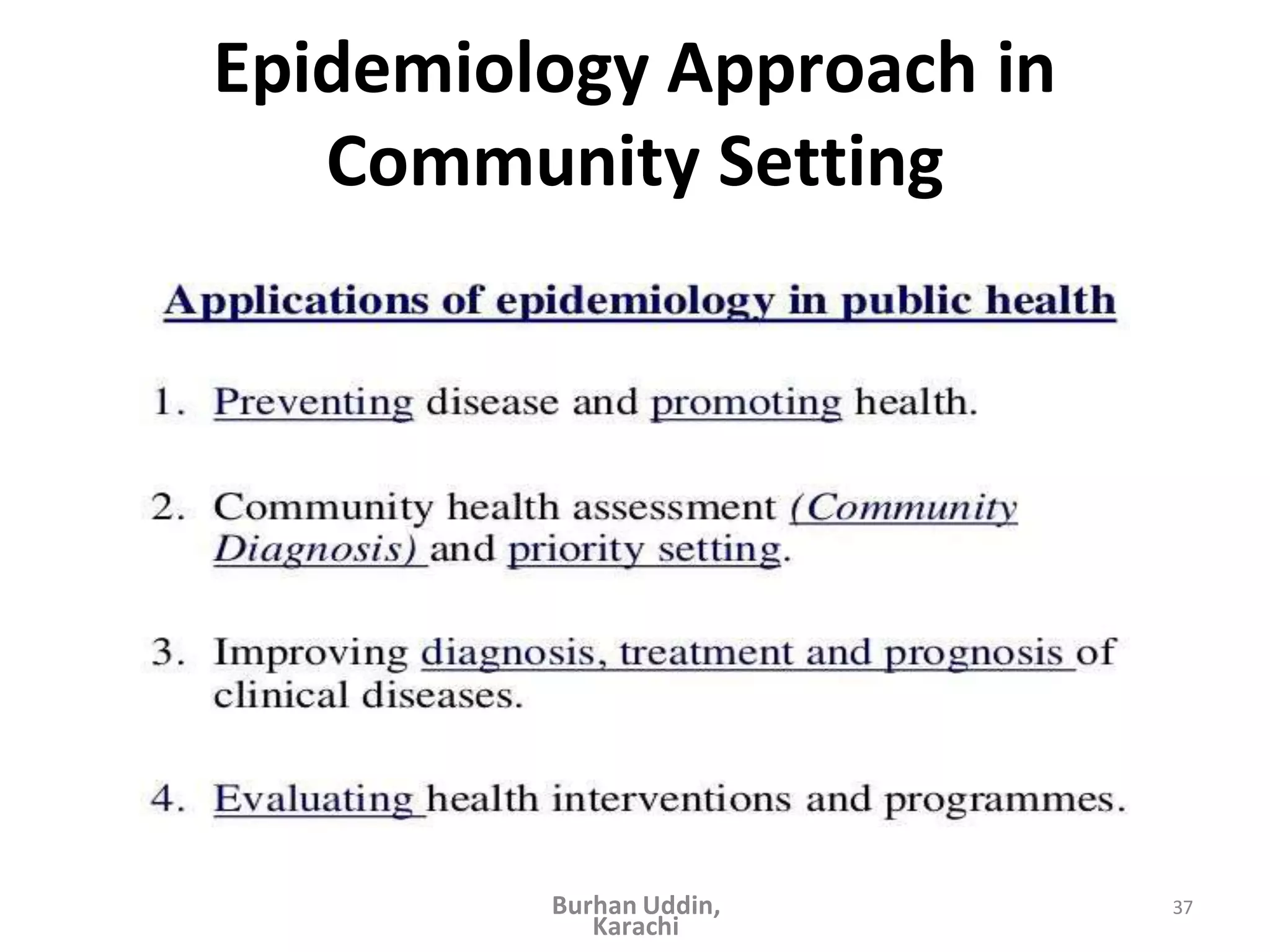
Epidemiology Approach in
Community Setting
37
Burhan Uddin,
Karachi
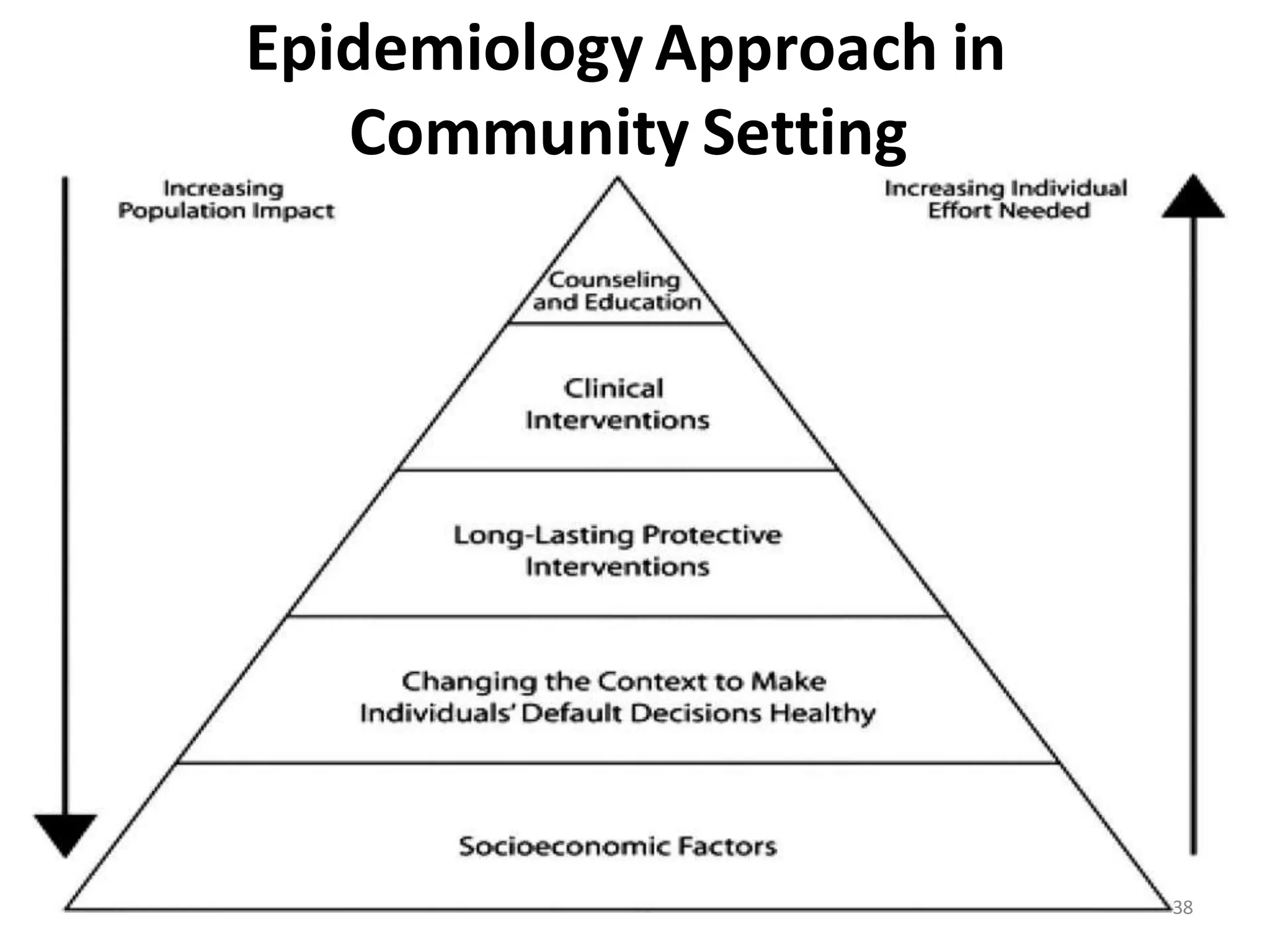
Epidemiology Approach in
Community Setting
38
Thank You
39
Burhan Uddin,
Karachi

UNIT III NATURAL HISTORY OF DISEASE PDF.pdf

  • 1.
  • 2.
    Burhan Uddin, Karachi 2 Objectives At thecompletion of this unit, the learners will be able to: 1. Define the host, agent and environment terms. 2. Identify the concept of epidemiology and diseases with the help of Epidemiological Triad. 3. Identify Epidemiological approach in community setting.
  • 3.
    Natural History ofDisease Iceberg Theory of Disease 3 Burhan Uddin, Karachi
  • 4.
    4 Iceberg Model /Theory • The iceberg model is a systems thinking tool designed to help an individual or group discover the – patterns of behavior, – supporting structures, and – mental models that underlie a particular event. Burhan Uddin, Karachi
  • 5.
  • 6.
    6 Natural History ofDisease • The natural history of disease is the course a disease takes in individual people from its pathological onset ("inception") until its eventual resolution through complete recovery or death. • Natural history of disease refers to the progress of a disease process in an individual over time, in the absence of intervention. • This is the continuous progression in an individual of the disease from the moment of exposure to the causal agents. Burhan Uddin, Karachi
  • 7.
    7 Natural History ofDisease • Reflect on the four major possible outcomes in an individual of exposure to a causal agent. – First, the exposure may have no visible effect. – Second, there may be demonstrable damaging effect of the exposure which may be repaired. – Third, the effect may be an illness that is rapidly contained by the body's defence mechanism. – Finally, the illness may progress until it leads to continuing long term problems, irreversible damage or death. Burhan Uddin, Karachi
  • 8.
    8 Natural History ofDisease • The process begins with exposure. • Without medical intervention, the process ends with – recovery, – disability, or – death Burhan Uddin, Karachi
  • 9.
    9 Stages in NaturalHistory of Disease • The stages in the natural history of disease are: – stage of susceptibility – stage of subclinical disease – stage of clinical disease – stage of recovery, disability or death Burhan Uddin, Karachi
  • 10.
  • 11.
  • 12.
    12 Stages of NaturalHistory Disease  Stage of Susceptibility – Begins with appropriate exposure to accumulation of factors sufficient for the disease process to begin in susceptible host.  Stage of Sub clinical disease – not clinically apparent and disease will not develop; pathological changes occur but individual unaware, diagnosed by antibody response or culture. Best time for screening.  Stage of clinical disease – clinically apparent, this is the best time for diagnosis.  Stage of Recovery, Disability or Death – Ultimately, the disease process ends either in recovery, disability or death. Burhan Uddin, Karachi
  • 13.
    Figure: Time Infancy childhood adolescenceadulthood old age Full health Death 13 Burhan Uddin, Karachi
  • 14.
    Figure: Causes begin toexert their influence here Disease and first manifestationcan be diagnosed here, e.g.. MI Time Infancy childhood adolescence adulthood old age Full health Death Recurrence and death 14 Burhan Uddin, Karachi
  • 15.
    Class Group Activity •Take name of common disease in Pakistan • Relate that disease into stages of Natural History Disease • Then share with whole class 15 Burhan Uddin, Karachi
  • 16.
    16 Applications of NaturalHistory ⚫Natural history is vital for disease prevention policies. ⚫It underlies secondary prevention based on screening ⚫It provides a rationale for all health care. ⚫Purpose of health care, including medicine, is to influence the natural history of disease by reducing and delaying ill-health. ⚫When achieved through purposeful actions by societies the collective endeavour is public health. Burhan Uddin, Karachi
  • 17.
    past Present future Public health andmedical action Time Infancy childhood adolescence adulthood old age Full health Death 17 Burhan Uddin, Karachi
  • 18.
    18 Population Pattern ofDisease (PPOD confused with the changing pattern of disease ⚫ Natural history of disease should not be (but is) in populations. ⚫ The distribution of a disease across socio-economic groups may change as it has for coronary heart disease. ⚫ This is called as “Population pattern of disease” ⚫ Main measures of PPOD are the disease incidence and prevalence. Burhan Uddin, Karachi
  • 19.
    19 Disease Process The aspectsof disease process include ⚫Etiology ⚫ Pathogenesis ⚫ Morphologic changes ⚫ Clinical manifestations ⚫ Diagnosis ⚫Clinical course Burhan Uddin, Karachi
  • 20.
  • 21.
  • 22.
  • 23.
  • 24.
    Epidemiologic Triangle ⚫A traditionalmodel of infectious disease causation, known as the Epidemiologic Triad ⚫The triad consists of an external agent, a host and an environment in which host and agent are brought together, causing the disease to occur in the host. ⚫Epidemiologic Homeostasis  Host  Agent  Environment Host Environment Agent 25 Burhan Uddin, Karachi
  • 25.
  • 26.
  • 27.
  • 28.
  • 29.
  • 30.
  • 31.
  • 32.
  • 33.
  • 34.
  • 35.
  • 36.
    36 Concept of Epidemiology& Disease vs Epidemiological Triad Epidemics arise when host, agent, and environmental factors are not in balance  Due to new agent  Due to change in existing agent (infectivity, pathogenicity, virulence)  Due to change in number of susceptibilities in the population  Due to environmental changes that affect transmission of the agent or growth of the agent Burhan Uddin, Karachi
  • 37.
    Epidemiology Approach in CommunitySetting 37 Burhan Uddin, Karachi
  • 38.
  • 39.