MBBS, MBA, PhD, LLB 
SENIOR FACULTY IMS, DAVV, INDORE
What is Green Hospital? 
A Green hospital is one which enhances patient well being, 
aids in curative process while utilizing natural resources in 
an efficient environment friendly manner. 
• The Green Hospital is defined as a hospital that has taken the initiative to do the one or more of 
the following: 
• choose an environmentally friendly site, 
• utilizes sustainable and efficient designs, 
• uses green building materials and products, 
• thinks green during construction and keeps the greening process going. 
• A Green Hospital is constructed around a facility that recycles, reuses materials, reduces waste, 
and produces cleaner air. 
• Reduce co2 generation 
• GOGREEN HOSPITAL
• The green hospital movement began years ago following the U.S. Green Building 
Council (USGBC)’s release of their Leadership in Energy and Environmental 
Design (LEED) standards for building construction. 
• Although initial cost to adopt green practices might be higher but they are the best 
investment in your facility. 
• Green hospitals have been shown to reduce long-term energy costs. 
• Moreover, green hospital design has been linked to better patient outcomes and staff 
retention 
• In the past few years, a number of newly constructed and renovated hospital buildings 
have strived for and received LEED certification.
Green Hospital promotes the following : 
•Sustainable building materials 
•Products free of mercury, latex, PVC 
•Energy and water conservation 
•Tools and resources for environmentally preferable 
purchasing 
•Greener cleaners 
•Integrated pest management 
•Waste Reduction and Recycling 
•Green Electronics 
•Managing pharmaceuticals 
•Environmentally Preferable Medical Waste Treatment 
and Disposal
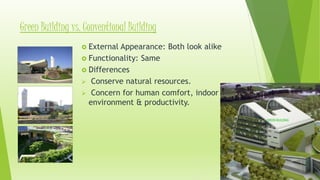
Green Building vs. Conventional Building 
 External Appearance: Both look alike 
 Functionality: Same 
 Differences 
 Conserve natural resources. 
 Concern for human comfort, indoor 
environment & productivity.
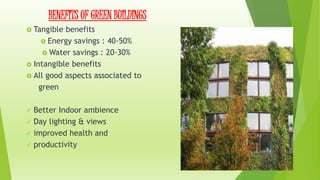
BENEFITS OF GREEN BUILDINGS 
 Tangible benefits 
 Energy savings : 40-50% 
 Water savings : 20-30% 
 Intangible benefits 
 All good aspects associated to 
green 
 Better Indoor ambience 
 Day lighting & views 
 improved health and 
 productivity
CAN A BUILDING HELP YOU CURE.? 
 Research shows patient recovery much faster 
 Connectivity to outside environment. 
 Better Daylight and Views. 
 Healing benefits for patients. 
 Better Indoor Air Quality 
 No sick building syndrome. 
 Regular CO2 monitoring. 
 Increased fresh air ventilation.
FOCUS AREAS FOR GREEN HOSPITAL DESIGN 
 Lighting 
 Indoor Air quality - Passive and Active measures 
 Green house keeping 
 Clean and Green interior building materials 
 Gardens and landscape 
 Waste management 
 disposal of pharmaceuticals 
 Sound reduction
SITE SELECTION 
What should we look out for? 
A virgin like location which puts the least pressure on the environment… 
•Clean Air 
•Clean Water 
•Clean soil 
•Bio diversity is not disturbed 
•Enhances Public Health by protecting wetlands, agricultural land and open 
spaces.
LIGHTING 
 Hospital design should maximize day 
light 
 optimize artificial lighting 
requirement 
 Light that enhances proper and true 
to life vision 
 Should be soothing to eyes
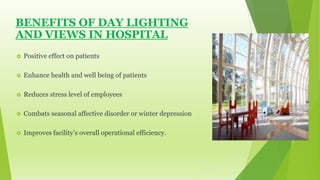
BENEFITS OF DAY LIGHTING 
AND VIEWS IN HOSPITAL 
 Positive effect on patients 
 Enhance health and well being of patients 
 Reduces stress level of employees 
 Combats seasonal affective disorder or winter depression 
 Improves facility’s overall operational efficiency.
RECCOMENDED LIGHTING 
LEVELS FOR HOSPITALS
DESIGN ASPECTS 
To enhance Natural lighting 
 Glazing facades 
 Translucent skylights with 
soothing colors 
 Transparent and operable 
opening to green courtyards 
 Ledge seating at windows.
INDOOR AIR QUALITY 
 Restoring and safeguarding Health is the main purpose of Health 
care facilities indoor environment quality is critical to Green 
Hospitals. 
DO’s for Good Indoor Environment 
• Use indoor species of plants which produces oxygen and reduces 
indoor pollutants from air. 
• Improve fresh air by providing courtyard spaces with native and 
adaptive plant species free from allergic effects.
OUTDOOR FRESH AIR REQUIREMENTS
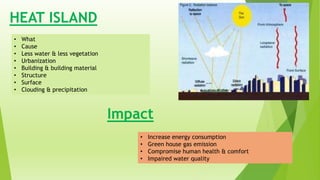
HEAT ISLAND 
• What 
• Cause 
• Less water & less vegetation 
• Urbanization 
• Building & building material 
• Structure 
• Surface 
• Clouding & precipitation 
Impact 
• Increase energy consumption 
• Green house gas emission 
• Compromise human health & comfort 
• Impaired water quality
Creating green roofs/ roof top 
gardens 
Use high- reflectant roofing 
Insulators 
Rapid Cooling Technology 
Optimum Air Conditioning 
MITIGATION OF HEAT ISLAND EFFECT
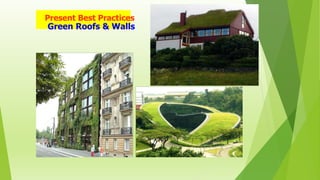
Present Best Practices 
Green Roofs & Walls
GREEN HOUSE KEEPING 
What is “Green Cleaning”? 
-Products and services that reduce the health and environmental 
impacts compared to similar products and services used for the 
same purpose. 
Not just chemicals, it includes various components such as: 
 Chemicals 
 Parking Space 
 Entrance Matting 
 Micro Fiber 
 Recycling and waste reduction 
 Water and Energy conservation 
 Liners 
 Procedures ,Training , Work loading and Scheduling 
 Communications 
 Recycle Programs/Waste Reduction/Conservation 
 Equipment and Custodial Hardware 
 Filters 
 Paper 
 Ice Melter 
 Pest Management
CLEAN AND GREEN INTERIOR BUILDING 
MATERIAL 
The Risk: 
Patients and staff are exposed to a host of pathogenic 
germs and toxins that enter the hospital through the 
medium of large number of infected patients. 
Green Practices: 
Ensure the property of repelling or resisting growth of the 
pathogenic germs and bacteria in interior surfaces. 
 Use Copper based interior material for touch surfaces in 
hospitals. 
 Use indoors or floorings that do not emit/absorb/release 
indoor pollutants such as VOC and dust.
Sick Building / Building Related Illnesses 
Normally contracted through water aerosols and confined spaces 
(Centrally Air-Conditioned Buildings) 
HVAC Ducting 
 Shower Heads 
 Cooling Towers 
Leads to a pneumonia like condition , Legionnaires Disease which 
is fatal since it is diagnosed and treated like pneumonia 
What does the Guide look out for? 
Among other things…. 
•Simpler plumbing designs 
•Insulating the ducts with hygroscopic material and renewal 
•Design of all tanks 
•Biocide regime
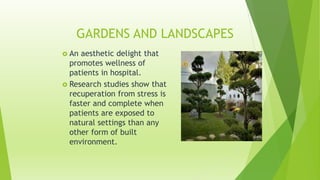
GARDENS AND LANDSCAPES 
 An aesthetic delight that 
promotes wellness of 
patients in hospital. 
 Research studies show that 
recuperation from stress is 
faster and complete when 
patients are exposed to 
natural settings than any 
other form of built 
environment.
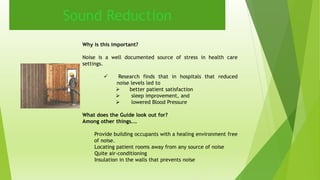
Sound Reduction 
Why is this important? 
Noise is a well documented source of stress in health care 
settings. 
 Research finds that in hospitals that reduced 
noise levels led to 
 better patient satisfaction 
 sleep improvement, and 
 lowered Blood Pressure 
What does the Guide look out for? 
Among other things…. 
Provide building occupants with a healing environment free 
of noise. 
Locating patient rooms away from any source of noise 
Quite air-conditioning 
Insulation in the walls that prevents noise
Indoor Chemical Contaminant 
Reduction 
Reduce and eliminate the use and improper 
disposal of chemical hazards and toxic 
materials within the health care facility to 
safeguard the health of building occupants. 
 Sanitary Sewer, 
 Hand Hygiene, 
 Sterilization, 
 High Level Disinfection, 
 Laboratory & Radiology
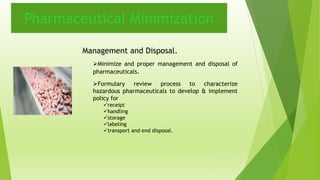
Pharmaceutical Minimization 
Management and Disposal. 
Minimize and proper management and disposal of 
pharmaceuticals. 
Formulary review process to characterize 
hazardous pharmaceuticals to develop & implement 
policy for 
receipt 
handling 
storage 
labeling 
transport and end disposal.
Regulated Medical Waste 
Reduction 
Facility policy for regulated medical waste 
disposal. 
Segregate all non medical waste before 
incineration. 
 Alternate method to treat Medical Waste
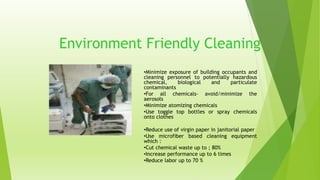
Environment Friendly Cleaning 
•Minimize exposure of building occupants and 
cleaning personnel to potentially hazardous 
chemical, biological and particulate 
contaminants 
•For all chemicals- avoid/minimize the 
aerosols 
•Minimize atomizing chemicals 
•Use toggle top bottles or spray chemicals 
onto clothes 
•Reduce use of virgin paper in janitorial paper 
•Use microfiber based cleaning equipment 
which : 
•Cut chemical waste up to ; 80% 
•Increase performance up to 6 times 
•Reduce labor up to 70 %
Providence Newberg Medical Centre, Oregon, 
USA,A Case Study 
 LEED NC Gold - First Gold Rated Green 
Hospital in the world. 
 Built-in area : 1,75,000 square feet 
 Actual benefits achieved :- 
 26 % energy savings 
 50 % reduction in water consumption for 
landscaping 
 Better indoor air quality 
 No sick building syndrome 
 100 % outside air; 100% exhaust 
 Reduction in floor-to-floor height 
 Reduced envelop cost 
 Heat reclaim system with VAV 
 Higher efficiency than conventional systems 
 Day Lighting 
 Healing benefits for patients 
 Patient recovery faster
Kohinoor Hospital, Mumbai 
 LEED NC Platinum - First Platinum 
Rated Green Hospital in India 
 Built-in area : 2,27,432 sq.ft 
 Benefits achieved : 
 35 % Energy Savings 
 Green Power from Wind Mills 
 Solar hot-water generation 
 Better Indoor Air Quality 
 Regular CO2 monitoring 
 Increased fresh air ventilation 
 No sick building syndrome 
 Day Lighting 
 Healing benefits for patients 
 Patient Recovery Faster
BENEFITS ACHIEVED BY GREEN 
HOSPITALS 
 Better Indoor air quality. 
 20-40% energy savings. 
 35-40% water savings. 
 Good day lighting. 
 No sick building syndrome. 
 Faster patient recovery.
List of few green hospital in India
References:- 
• Google 
• Wikipedia 
• Slideshare.com

Green hospital

  • 1.
    MBBS, MBA, PhD,LLB SENIOR FACULTY IMS, DAVV, INDORE
  • 2.
    What is GreenHospital? A Green hospital is one which enhances patient well being, aids in curative process while utilizing natural resources in an efficient environment friendly manner. • The Green Hospital is defined as a hospital that has taken the initiative to do the one or more of the following: • choose an environmentally friendly site, • utilizes sustainable and efficient designs, • uses green building materials and products, • thinks green during construction and keeps the greening process going. • A Green Hospital is constructed around a facility that recycles, reuses materials, reduces waste, and produces cleaner air. • Reduce co2 generation • GOGREEN HOSPITAL
  • 3.
    • The greenhospital movement began years ago following the U.S. Green Building Council (USGBC)’s release of their Leadership in Energy and Environmental Design (LEED) standards for building construction. • Although initial cost to adopt green practices might be higher but they are the best investment in your facility. • Green hospitals have been shown to reduce long-term energy costs. • Moreover, green hospital design has been linked to better patient outcomes and staff retention • In the past few years, a number of newly constructed and renovated hospital buildings have strived for and received LEED certification.
  • 4.
    Green Hospital promotesthe following : •Sustainable building materials •Products free of mercury, latex, PVC •Energy and water conservation •Tools and resources for environmentally preferable purchasing •Greener cleaners •Integrated pest management •Waste Reduction and Recycling •Green Electronics •Managing pharmaceuticals •Environmentally Preferable Medical Waste Treatment and Disposal
  • 6.
    Green Building vs.Conventional Building  External Appearance: Both look alike  Functionality: Same  Differences  Conserve natural resources.  Concern for human comfort, indoor environment & productivity.
  • 7.
    BENEFITS OF GREENBUILDINGS  Tangible benefits  Energy savings : 40-50%  Water savings : 20-30%  Intangible benefits  All good aspects associated to green  Better Indoor ambience  Day lighting & views  improved health and  productivity
  • 8.
    CAN A BUILDINGHELP YOU CURE.?  Research shows patient recovery much faster  Connectivity to outside environment.  Better Daylight and Views.  Healing benefits for patients.  Better Indoor Air Quality  No sick building syndrome.  Regular CO2 monitoring.  Increased fresh air ventilation.
  • 9.
    FOCUS AREAS FORGREEN HOSPITAL DESIGN  Lighting  Indoor Air quality - Passive and Active measures  Green house keeping  Clean and Green interior building materials  Gardens and landscape  Waste management  disposal of pharmaceuticals  Sound reduction
  • 10.
    SITE SELECTION Whatshould we look out for? A virgin like location which puts the least pressure on the environment… •Clean Air •Clean Water •Clean soil •Bio diversity is not disturbed •Enhances Public Health by protecting wetlands, agricultural land and open spaces.
  • 11.
    LIGHTING  Hospitaldesign should maximize day light  optimize artificial lighting requirement  Light that enhances proper and true to life vision  Should be soothing to eyes
  • 12.
    BENEFITS OF DAYLIGHTING AND VIEWS IN HOSPITAL  Positive effect on patients  Enhance health and well being of patients  Reduces stress level of employees  Combats seasonal affective disorder or winter depression  Improves facility’s overall operational efficiency.
  • 13.
  • 14.
    DESIGN ASPECTS Toenhance Natural lighting  Glazing facades  Translucent skylights with soothing colors  Transparent and operable opening to green courtyards  Ledge seating at windows.
  • 15.
    INDOOR AIR QUALITY  Restoring and safeguarding Health is the main purpose of Health care facilities indoor environment quality is critical to Green Hospitals. DO’s for Good Indoor Environment • Use indoor species of plants which produces oxygen and reduces indoor pollutants from air. • Improve fresh air by providing courtyard spaces with native and adaptive plant species free from allergic effects.
  • 16.
    OUTDOOR FRESH AIRREQUIREMENTS
  • 17.
    HEAT ISLAND •What • Cause • Less water & less vegetation • Urbanization • Building & building material • Structure • Surface • Clouding & precipitation Impact • Increase energy consumption • Green house gas emission • Compromise human health & comfort • Impaired water quality
  • 18.
    Creating green roofs/roof top gardens Use high- reflectant roofing Insulators Rapid Cooling Technology Optimum Air Conditioning MITIGATION OF HEAT ISLAND EFFECT
  • 19.
    Present Best Practices Green Roofs & Walls
  • 20.
    GREEN HOUSE KEEPING What is “Green Cleaning”? -Products and services that reduce the health and environmental impacts compared to similar products and services used for the same purpose. Not just chemicals, it includes various components such as:  Chemicals  Parking Space  Entrance Matting  Micro Fiber  Recycling and waste reduction  Water and Energy conservation  Liners  Procedures ,Training , Work loading and Scheduling  Communications  Recycle Programs/Waste Reduction/Conservation  Equipment and Custodial Hardware  Filters  Paper  Ice Melter  Pest Management
  • 21.
    CLEAN AND GREENINTERIOR BUILDING MATERIAL The Risk: Patients and staff are exposed to a host of pathogenic germs and toxins that enter the hospital through the medium of large number of infected patients. Green Practices: Ensure the property of repelling or resisting growth of the pathogenic germs and bacteria in interior surfaces.  Use Copper based interior material for touch surfaces in hospitals.  Use indoors or floorings that do not emit/absorb/release indoor pollutants such as VOC and dust.
  • 22.
    Sick Building /Building Related Illnesses Normally contracted through water aerosols and confined spaces (Centrally Air-Conditioned Buildings) HVAC Ducting  Shower Heads  Cooling Towers Leads to a pneumonia like condition , Legionnaires Disease which is fatal since it is diagnosed and treated like pneumonia What does the Guide look out for? Among other things…. •Simpler plumbing designs •Insulating the ducts with hygroscopic material and renewal •Design of all tanks •Biocide regime
  • 23.
    GARDENS AND LANDSCAPES  An aesthetic delight that promotes wellness of patients in hospital.  Research studies show that recuperation from stress is faster and complete when patients are exposed to natural settings than any other form of built environment.
  • 24.
    Sound Reduction Whyis this important? Noise is a well documented source of stress in health care settings.  Research finds that in hospitals that reduced noise levels led to  better patient satisfaction  sleep improvement, and  lowered Blood Pressure What does the Guide look out for? Among other things…. Provide building occupants with a healing environment free of noise. Locating patient rooms away from any source of noise Quite air-conditioning Insulation in the walls that prevents noise
  • 25.
    Indoor Chemical Contaminant Reduction Reduce and eliminate the use and improper disposal of chemical hazards and toxic materials within the health care facility to safeguard the health of building occupants.  Sanitary Sewer,  Hand Hygiene,  Sterilization,  High Level Disinfection,  Laboratory & Radiology
  • 26.
    Pharmaceutical Minimization Managementand Disposal. Minimize and proper management and disposal of pharmaceuticals. Formulary review process to characterize hazardous pharmaceuticals to develop & implement policy for receipt handling storage labeling transport and end disposal.
  • 27.
    Regulated Medical Waste Reduction Facility policy for regulated medical waste disposal. Segregate all non medical waste before incineration.  Alternate method to treat Medical Waste
  • 28.
    Environment Friendly Cleaning •Minimize exposure of building occupants and cleaning personnel to potentially hazardous chemical, biological and particulate contaminants •For all chemicals- avoid/minimize the aerosols •Minimize atomizing chemicals •Use toggle top bottles or spray chemicals onto clothes •Reduce use of virgin paper in janitorial paper •Use microfiber based cleaning equipment which : •Cut chemical waste up to ; 80% •Increase performance up to 6 times •Reduce labor up to 70 %
  • 29.
    Providence Newberg MedicalCentre, Oregon, USA,A Case Study  LEED NC Gold - First Gold Rated Green Hospital in the world.  Built-in area : 1,75,000 square feet  Actual benefits achieved :-  26 % energy savings  50 % reduction in water consumption for landscaping  Better indoor air quality  No sick building syndrome  100 % outside air; 100% exhaust  Reduction in floor-to-floor height  Reduced envelop cost  Heat reclaim system with VAV  Higher efficiency than conventional systems  Day Lighting  Healing benefits for patients  Patient recovery faster
  • 30.
    Kohinoor Hospital, Mumbai  LEED NC Platinum - First Platinum Rated Green Hospital in India  Built-in area : 2,27,432 sq.ft  Benefits achieved :  35 % Energy Savings  Green Power from Wind Mills  Solar hot-water generation  Better Indoor Air Quality  Regular CO2 monitoring  Increased fresh air ventilation  No sick building syndrome  Day Lighting  Healing benefits for patients  Patient Recovery Faster
  • 31.
    BENEFITS ACHIEVED BYGREEN HOSPITALS  Better Indoor air quality.  20-40% energy savings.  35-40% water savings.  Good day lighting.  No sick building syndrome.  Faster patient recovery.
  • 32.
    List of fewgreen hospital in India
  • 34.
    References:- • Google • Wikipedia • Slideshare.com