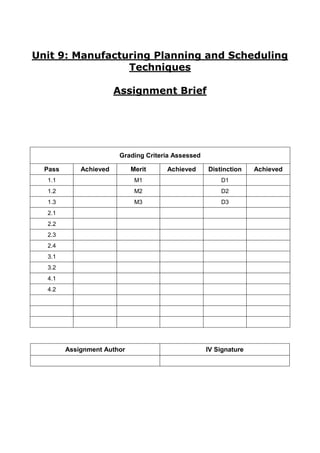
Unit 9: Manufacturing Planning and Scheduling
Techniques
Assignment Brief
Grading Criteria Assessed
Pass Achieved Merit Achieved Distinction Achieved
1.1 M1 D1
1.2 M2 D2
1.3 M3 D3
2.1
2.2
2.3
2.4
3.1
3.2
4.1
4.2
Assignment Author IV Signature
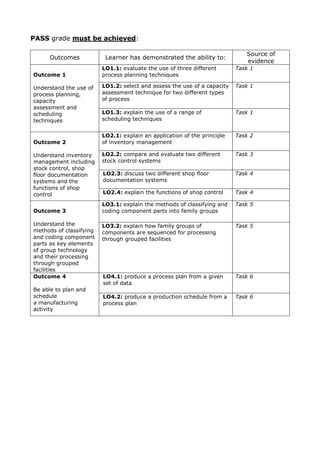
PASS grade must be achieved:
Outcomes Learner has demonstrated the ability to:
Source of
evidence
Outcome 1
Understand the use of
process planning,
capacity
assessment and
scheduling
techniques
LO1.1: evaluate the use of three different
process planning techniques
Task 1
LO1.2: select and assess the use of a capacity
assessment technique for two different types
of process
Task 1
LO1.3: explain the use of a range of
scheduling techniques
Task 1
Outcome 2
Understand inventory
management including
stock control, shop
floor documentation
systems and the
functions of shop
control
LO2.1: explain an application of the principle
of inventory management
Task 2
LO2.2: compare and evaluate two different
stock control systems
Task 3
LO2.3: discuss two different shop floor
documentation systems
Task 4
LO2.4: explain the functions of shop control Task 4
Outcome 3
Understand the
methods of classifying
and coding component
parts as key elements
of group technology
and their processing
through grouped
facilities
LO3.1: explain the methods of classifying and
coding component parts into family groups
Task 5
LO3.2: explain how family groups of
components are sequenced for processing
through grouped facilities
Task 5
Outcome 4
Be able to plan and
schedule
a manufacturing
activity
LO4.1: produce a process plan from a given
set of data
Task 6
LO4.2: produce a production schedule from a
process plan
Task 6
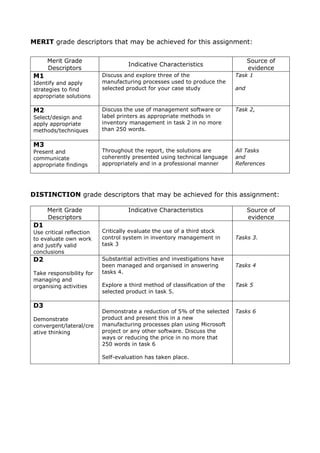
MERIT grade descriptors that may be achieved for this assignment:
Merit Grade
Descriptors
Indicative Characteristics
Source of
evidence
M1
Identify and apply
strategies to find
appropriate solutions
Discuss and explore three of the
manufacturing processes used to produce the
selected product for your case study
Task 1
and
M2
Select/design and
apply appropriate
methods/techniques
Discuss the use of management software or
label printers as appropriate methods in
inventory management in task 2 in no more
than 250 words.
Task 2,
M3
Present and
communicate
appropriate findings
Throughout the report, the solutions are
coherently presented using technical language
appropriately and in a professional manner
All Tasks
and
References
DISTINCTION grade descriptors that may be achieved for this assignment:
Merit Grade
Descriptors
Indicative Characteristics Source of
evidence
D1
Use critical reflection
to evaluate own work
and justify valid
conclusions
Critically evaluate the use of a third stock
control system in inventory management in
task 3
Tasks 3.
D2
Take responsibility for
managing and
organising activities
Substantial activities and investigations have
been managed and organised in answering
tasks 4.
Explore a third method of classification of the
selected product in task 5.
Tasks 4
Task 5
D3
Demonstrate
convergent/lateral/cre
ative thinking
Demonstrate a reduction of 5% of the selected
product and present this in a new
manufacturing processes plan using Microsoft
project or any other software. Discuss the
ways or reducing the price in no more that
250 words in task 6
Self-evaluation has taken place.
Tasks 6
Visit:
http://www.topengineeringsolutions.com/
for the solution
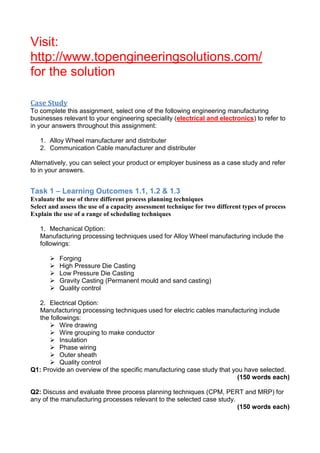
Case Study
To complete this assignment, select one of the following engineering manufacturing
businesses relevant to your engineering speciality (electrical and electronics) to refer to
in your answers throughout this assignment:
1. Alloy Wheel manufacturer and distributer
2. Communication Cable manufacturer and distributer
Alternatively, you can select your product or employer business as a case study and refer
to in your answers.
Task 1 – Learning Outcomes 1.1, 1.2 & 1.3
Evaluate the use of three different process planning techniques
Select and assess the use of a capacity assessment technique for two different types of process
Explain the use of a range of scheduling techniques
1. Mechanical Option:
Manufacturing processing techniques used for Alloy Wheel manufacturing include the
followings:
 Forging
 High Pressure Die Casting
 Low Pressure Die Casting
 Gravity Casting (Permanent mould and sand casting)
 Quality control
2. Electrical Option:
Manufacturing processing techniques used for electric cables manufacturing include
the followings:
 Wire drawing
 Wire grouping to make conductor
 Insulation
 Phase wiring
 Outer sheath
 Quality control
Q1: Provide an overview of the specific manufacturing case study that you have selected.
(150 words each)
Q2: Discuss and evaluate three process planning techniques (CPM, PERT and MRP) for
any of the manufacturing processes relevant to the selected case study.
(150 words each)
Q3: Discuss and assess the use of capacity assessment technique for two different
processes of the manufacturing processes relevant to the selected case study.
(150 words)
Q4: For one process of the selected manufacturing processes relevant to the selected
case study, discuss and explain the use of two scheduling techniques.
(150 words each)
Task 2 – Learning Outcome 2.1
Explain an application of the principle of inventory management
The process to oversee the constant flow of components or units of a product into and out
of an existing inventory is called Inventory Management. Discuss and explain how the
principles of inventory management are used in the selected product.
(200 words)
Task 3 – Learning Outcome 2.2
Compare and evaluate two different stock control systems
Two bin system and Kanban are two of many stock control systems used in inventory
management. Compare these two systems and evaluate the use of either of them in the
selected case study.
(250 words)
Task 4 – Learning Outcome 2.3 & 2.4
Discuss two different shop floor documentation systems
Explain the functions of shop control
Q1: Stock record, works order, job tickets and recording of finished quantities are few
examples of the documentation systems that are used in recording and controlling
components and product production and stocking in any manufacturing and distribution
industry. Discuss and explain the use of two of these documentation systems or any other
two that are relevant to your case study.
(150 words each)
Q2:; Scheduled release of work orders and data collection and feedback are two types of
shop control systems; explain how are they used in stocking and distributing the product of
your selected case study.
(150 words each)
Task 5 – Learning Outcome 3.2 & 3.2
Explain the methods of classifying and coding component parts into family groups
Explain how family groups of components are sequenced for processing through grouped
facilities
Q1: The processes of categorizing parts of your selected product into groups is called
classification; define and explain two methods that are used in classifying and coding the
parts of your selected product into family groups.
(250 words)
Q2: Parts of any product classified into groups and families according to their design,
geometrical shape, manufacturing processes and layout. Explain how are parts of your
selected product or your products grouped into family groups and how are these family
groups sequenced for processing through grouped families.
(250 words)
Task 6 – Learning Outcome 4.1 & 4.2
Produce a process plan from a given set of data
Produce a production schedule from a process plan
Q1: Using a computer software (Microsoft project) produce a process plan including the
identification of timing, completion dates, material required, equipment and tools required
and man power (labours, engineers and management) needed to produce a bundle of 100
units of your selected product. Explain the method of preparing your plan and how it is
evolved.
(150 words + project palns)
Q2: Provide screen shoots or print out of the Critical Path and the Gantt chart of the
process plan and provide costing table for producing 100 units of your selected product.
End of assessment brief

009 manufacturing planning_and_schudiling_techniques__13-14

  • 1.
    Unit 9: ManufacturingPlanning and Scheduling Techniques Assignment Brief Grading Criteria Assessed Pass Achieved Merit Achieved Distinction Achieved 1.1 M1 D1 1.2 M2 D2 1.3 M3 D3 2.1 2.2 2.3 2.4 3.1 3.2 4.1 4.2 Assignment Author IV Signature
  • 2.
    PASS grade mustbe achieved: Outcomes Learner has demonstrated the ability to: Source of evidence Outcome 1 Understand the use of process planning, capacity assessment and scheduling techniques LO1.1: evaluate the use of three different process planning techniques Task 1 LO1.2: select and assess the use of a capacity assessment technique for two different types of process Task 1 LO1.3: explain the use of a range of scheduling techniques Task 1 Outcome 2 Understand inventory management including stock control, shop floor documentation systems and the functions of shop control LO2.1: explain an application of the principle of inventory management Task 2 LO2.2: compare and evaluate two different stock control systems Task 3 LO2.3: discuss two different shop floor documentation systems Task 4 LO2.4: explain the functions of shop control Task 4 Outcome 3 Understand the methods of classifying and coding component parts as key elements of group technology and their processing through grouped facilities LO3.1: explain the methods of classifying and coding component parts into family groups Task 5 LO3.2: explain how family groups of components are sequenced for processing through grouped facilities Task 5 Outcome 4 Be able to plan and schedule a manufacturing activity LO4.1: produce a process plan from a given set of data Task 6 LO4.2: produce a production schedule from a process plan Task 6
  • 3.
    MERIT grade descriptorsthat may be achieved for this assignment: Merit Grade Descriptors Indicative Characteristics Source of evidence M1 Identify and apply strategies to find appropriate solutions Discuss and explore three of the manufacturing processes used to produce the selected product for your case study Task 1 and M2 Select/design and apply appropriate methods/techniques Discuss the use of management software or label printers as appropriate methods in inventory management in task 2 in no more than 250 words. Task 2, M3 Present and communicate appropriate findings Throughout the report, the solutions are coherently presented using technical language appropriately and in a professional manner All Tasks and References DISTINCTION grade descriptors that may be achieved for this assignment: Merit Grade Descriptors Indicative Characteristics Source of evidence D1 Use critical reflection to evaluate own work and justify valid conclusions Critically evaluate the use of a third stock control system in inventory management in task 3 Tasks 3. D2 Take responsibility for managing and organising activities Substantial activities and investigations have been managed and organised in answering tasks 4. Explore a third method of classification of the selected product in task 5. Tasks 4 Task 5 D3 Demonstrate convergent/lateral/cre ative thinking Demonstrate a reduction of 5% of the selected product and present this in a new manufacturing processes plan using Microsoft project or any other software. Discuss the ways or reducing the price in no more that 250 words in task 6 Self-evaluation has taken place. Tasks 6
  • 4.
    Visit: http://www.topengineeringsolutions.com/ for the solution CaseStudy To complete this assignment, select one of the following engineering manufacturing businesses relevant to your engineering speciality (electrical and electronics) to refer to in your answers throughout this assignment: 1. Alloy Wheel manufacturer and distributer 2. Communication Cable manufacturer and distributer Alternatively, you can select your product or employer business as a case study and refer to in your answers. Task 1 – Learning Outcomes 1.1, 1.2 & 1.3 Evaluate the use of three different process planning techniques Select and assess the use of a capacity assessment technique for two different types of process Explain the use of a range of scheduling techniques 1. Mechanical Option: Manufacturing processing techniques used for Alloy Wheel manufacturing include the followings:  Forging  High Pressure Die Casting  Low Pressure Die Casting  Gravity Casting (Permanent mould and sand casting)  Quality control 2. Electrical Option: Manufacturing processing techniques used for electric cables manufacturing include the followings:  Wire drawing  Wire grouping to make conductor  Insulation  Phase wiring  Outer sheath  Quality control Q1: Provide an overview of the specific manufacturing case study that you have selected. (150 words each) Q2: Discuss and evaluate three process planning techniques (CPM, PERT and MRP) for any of the manufacturing processes relevant to the selected case study. (150 words each)
  • 5.
    Q3: Discuss andassess the use of capacity assessment technique for two different processes of the manufacturing processes relevant to the selected case study. (150 words) Q4: For one process of the selected manufacturing processes relevant to the selected case study, discuss and explain the use of two scheduling techniques. (150 words each) Task 2 – Learning Outcome 2.1 Explain an application of the principle of inventory management The process to oversee the constant flow of components or units of a product into and out of an existing inventory is called Inventory Management. Discuss and explain how the principles of inventory management are used in the selected product. (200 words) Task 3 – Learning Outcome 2.2 Compare and evaluate two different stock control systems Two bin system and Kanban are two of many stock control systems used in inventory management. Compare these two systems and evaluate the use of either of them in the selected case study. (250 words) Task 4 – Learning Outcome 2.3 & 2.4 Discuss two different shop floor documentation systems Explain the functions of shop control Q1: Stock record, works order, job tickets and recording of finished quantities are few examples of the documentation systems that are used in recording and controlling components and product production and stocking in any manufacturing and distribution industry. Discuss and explain the use of two of these documentation systems or any other two that are relevant to your case study. (150 words each) Q2:; Scheduled release of work orders and data collection and feedback are two types of shop control systems; explain how are they used in stocking and distributing the product of your selected case study. (150 words each) Task 5 – Learning Outcome 3.2 & 3.2 Explain the methods of classifying and coding component parts into family groups Explain how family groups of components are sequenced for processing through grouped facilities
  • 6.
    Q1: The processesof categorizing parts of your selected product into groups is called classification; define and explain two methods that are used in classifying and coding the parts of your selected product into family groups. (250 words) Q2: Parts of any product classified into groups and families according to their design, geometrical shape, manufacturing processes and layout. Explain how are parts of your selected product or your products grouped into family groups and how are these family groups sequenced for processing through grouped families. (250 words) Task 6 – Learning Outcome 4.1 & 4.2 Produce a process plan from a given set of data Produce a production schedule from a process plan Q1: Using a computer software (Microsoft project) produce a process plan including the identification of timing, completion dates, material required, equipment and tools required and man power (labours, engineers and management) needed to produce a bundle of 100 units of your selected product. Explain the method of preparing your plan and how it is evolved. (150 words + project palns) Q2: Provide screen shoots or print out of the Critical Path and the Gantt chart of the process plan and provide costing table for producing 100 units of your selected product. End of assessment brief