Unit 7
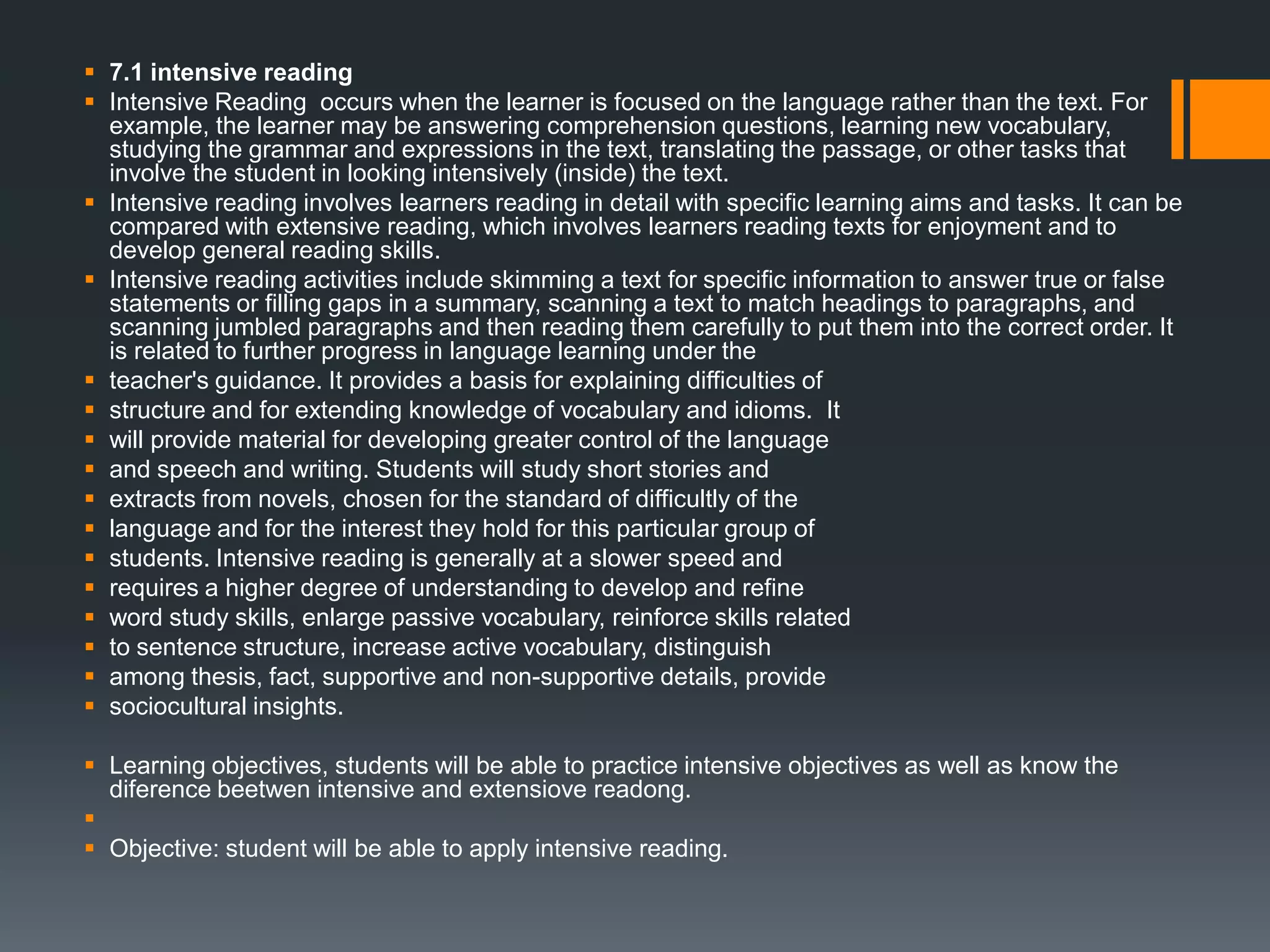
ď‚§ 7.1 intensive reading
ď‚§ Intensive Reading occurs when the learner is focused on the language rather than the text. For
example, the learner may be answering comprehension questions, learning new vocabulary,
studying the grammar and expressions in the text, translating the passage, or other tasks that
involve the student in looking intensively (inside) the text.
ď‚§ Intensive reading involves learners reading in detail with specific learning aims and tasks. It can be
compared with extensive reading, which involves learners reading texts for enjoyment and to
develop general reading skills.
ď‚§ Intensive reading activities include skimming a text for specific information to answer true or false
statements or filling gaps in a summary, scanning a text to match headings to paragraphs, and
scanning jumbled paragraphs and then reading them carefully to put them into the correct order. It
is related to further progress in language learning under the
ď‚§ teacher's guidance. It provides a basis for explaining difficulties of
ď‚§ structure and for extending knowledge of vocabulary and idioms. It
ď‚§ will provide material for developing greater control of the language
ď‚§ and speech and writing. Students will study short stories and
ď‚§ extracts from novels, chosen for the standard of difficultly of the
ď‚§ language and for the interest they hold for this particular group of
ď‚§ students. Intensive reading is generally at a slower speed and
ď‚§ requires a higher degree of understanding to develop and refine
ď‚§ word study skills, enlarge passive vocabulary, reinforce skills related
ď‚§ to sentence structure, increase active vocabulary, distinguish
ď‚§ among thesis, fact, supportive and non-supportive details, provide
ď‚§ sociocultural insights.
ď‚§ Learning objectives, students will be able to practice intensive objectives as well as know the
diference beetwen intensive and extensiove readong.
ď‚§
ď‚§ Objective: student will be able to apply intensive reading.
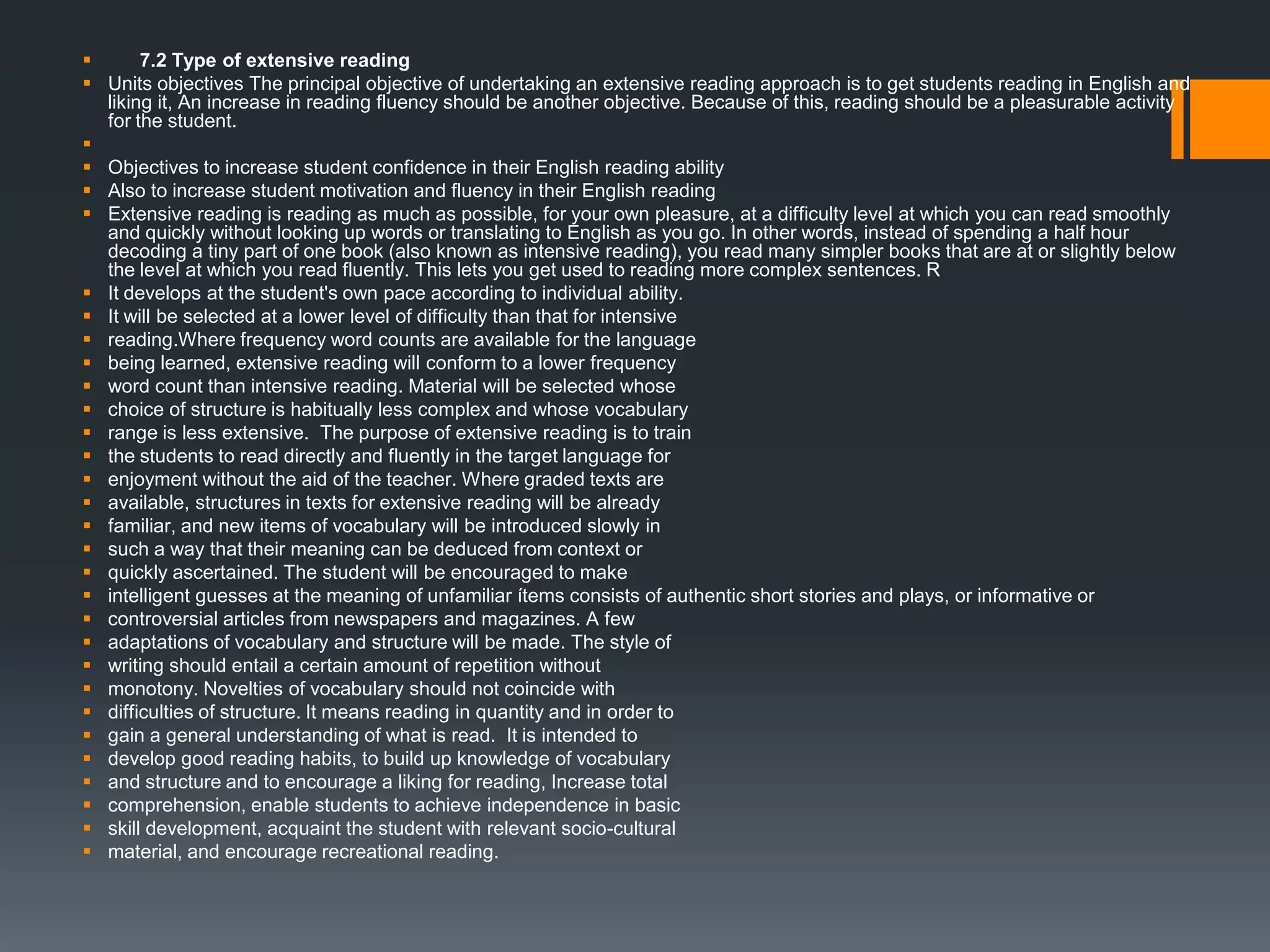
ď‚§ 7.2 Type of extensive reading
ď‚§ Units objectives The principal objective of undertaking an extensive reading approach is to get students reading in English and
liking it, An increase in reading fluency should be another objective. Because of this, reading should be a pleasurable activity
for the student.
ď‚§
ď‚§ Objectives to increase student confidence in their English reading ability
ď‚§ Also to increase student motivation and fluency in their English reading
ď‚§ Extensive reading is reading as much as possible, for your own pleasure, at a difficulty level at which you can read smoothly
and quickly without looking up words or translating to English as you go. In other words, instead of spending a half hour
decoding a tiny part of one book (also known as intensive reading), you read many simpler books that are at or slightly below
the level at which you read fluently. This lets you get used to reading more complex sentences. R
ď‚§ It develops at the student's own pace according to individual ability.
ď‚§ It will be selected at a lower level of difficulty than that for intensive
ď‚§ reading.Where frequency word counts are available for the language
ď‚§ being learned, extensive reading will conform to a lower frequency
ď‚§ word count than intensive reading. Material will be selected whose
ď‚§ choice of structure is habitually less complex and whose vocabulary
ď‚§ range is less extensive. The purpose of extensive reading is to train
ď‚§ the students to read directly and fluently in the target language for
ď‚§ enjoyment without the aid of the teacher. Where graded texts are
ď‚§ available, structures in texts for extensive reading will be already
ď‚§ familiar, and new items of vocabulary will be introduced slowly in
ď‚§ such a way that their meaning can be deduced from context or
ď‚§ quickly ascertained. The student will be encouraged to make
ď‚§ intelligent guesses at the meaning of unfamiliar Ă­tems consists of authentic short stories and plays, or informative or
ď‚§ controversial articles from newspapers and magazines. A few
ď‚§ adaptations of vocabulary and structure will be made. The style of
ď‚§ writing should entail a certain amount of repetition without
ď‚§ monotony. Novelties of vocabulary should not coincide with
ď‚§ difficulties of structure. It means reading in quantity and in order to
ď‚§ gain a general understanding of what is read. It is intended to
ď‚§ develop good reading habits, to build up knowledge of vocabulary
ď‚§ and structure and to encourage a liking for reading, Increase total
ď‚§ comprehension, enable students to achieve independence in basic
ď‚§ skill development, acquaint the student with relevant socio-cultural
ď‚§ material, and encourage recreational reading.
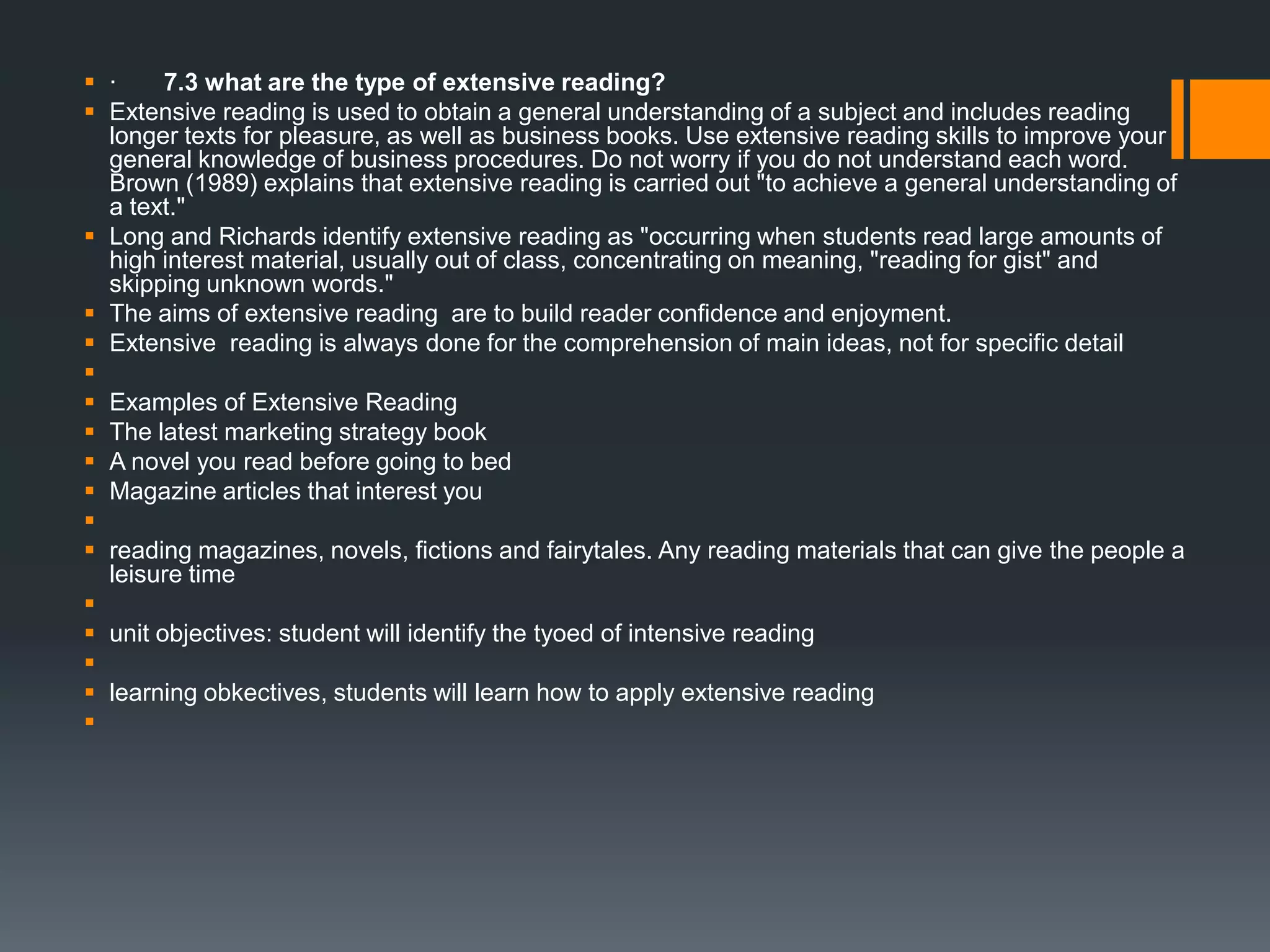
 · 7.3 what are the type of extensive reading?
ď‚§ Extensive reading is used to obtain a general understanding of a subject and includes reading
longer texts for pleasure, as well as business books. Use extensive reading skills to improve your
general knowledge of business procedures. Do not worry if you do not understand each word.
Brown (1989) explains that extensive reading is carried out "to achieve a general understanding of
a text."
ď‚§ Long and Richards identify extensive reading as "occurring when students read large amounts of
high interest material, usually out of class, concentrating on meaning, "reading for gist" and
skipping unknown words."
ď‚§ The aims of extensive reading are to build reader confidence and enjoyment.
ď‚§ Extensive reading is always done for the comprehension of main ideas, not for specific detail
ď‚§
ď‚§ Examples of Extensive Reading
ď‚§ The latest marketing strategy book
ď‚§ A novel you read before going to bed
ď‚§ Magazine articles that interest you
ď‚§
ď‚§ reading magazines, novels, fictions and fairytales. Any reading materials that can give the people a
leisure time
ď‚§
ď‚§ unit objectives: student will identify the tyoed of intensive reading
ď‚§
ď‚§ learning obkectives, students will learn how to apply extensive reading
ď‚§

Unit 7

  • 1.
  • 2.
    ď‚§ 7.1 intensivereading ď‚§ Intensive Reading occurs when the learner is focused on the language rather than the text. For example, the learner may be answering comprehension questions, learning new vocabulary, studying the grammar and expressions in the text, translating the passage, or other tasks that involve the student in looking intensively (inside) the text. ď‚§ Intensive reading involves learners reading in detail with specific learning aims and tasks. It can be compared with extensive reading, which involves learners reading texts for enjoyment and to develop general reading skills. ď‚§ Intensive reading activities include skimming a text for specific information to answer true or false statements or filling gaps in a summary, scanning a text to match headings to paragraphs, and scanning jumbled paragraphs and then reading them carefully to put them into the correct order. It is related to further progress in language learning under the ď‚§ teacher's guidance. It provides a basis for explaining difficulties of ď‚§ structure and for extending knowledge of vocabulary and idioms. It ď‚§ will provide material for developing greater control of the language ď‚§ and speech and writing. Students will study short stories and ď‚§ extracts from novels, chosen for the standard of difficultly of the ď‚§ language and for the interest they hold for this particular group of ď‚§ students. Intensive reading is generally at a slower speed and ď‚§ requires a higher degree of understanding to develop and refine ď‚§ word study skills, enlarge passive vocabulary, reinforce skills related ď‚§ to sentence structure, increase active vocabulary, distinguish ď‚§ among thesis, fact, supportive and non-supportive details, provide ď‚§ sociocultural insights. ď‚§ Learning objectives, students will be able to practice intensive objectives as well as know the diference beetwen intensive and extensiove readong. ď‚§ ď‚§ Objective: student will be able to apply intensive reading.
  • 3.
    ď‚§ 7.2 Typeof extensive reading ď‚§ Units objectives The principal objective of undertaking an extensive reading approach is to get students reading in English and liking it, An increase in reading fluency should be another objective. Because of this, reading should be a pleasurable activity for the student. ď‚§ ď‚§ Objectives to increase student confidence in their English reading ability ď‚§ Also to increase student motivation and fluency in their English reading ď‚§ Extensive reading is reading as much as possible, for your own pleasure, at a difficulty level at which you can read smoothly and quickly without looking up words or translating to English as you go. In other words, instead of spending a half hour decoding a tiny part of one book (also known as intensive reading), you read many simpler books that are at or slightly below the level at which you read fluently. This lets you get used to reading more complex sentences. R ď‚§ It develops at the student's own pace according to individual ability. ď‚§ It will be selected at a lower level of difficulty than that for intensive ď‚§ reading.Where frequency word counts are available for the language ď‚§ being learned, extensive reading will conform to a lower frequency ď‚§ word count than intensive reading. Material will be selected whose ď‚§ choice of structure is habitually less complex and whose vocabulary ď‚§ range is less extensive. The purpose of extensive reading is to train ď‚§ the students to read directly and fluently in the target language for ď‚§ enjoyment without the aid of the teacher. Where graded texts are ď‚§ available, structures in texts for extensive reading will be already ď‚§ familiar, and new items of vocabulary will be introduced slowly in ď‚§ such a way that their meaning can be deduced from context or ď‚§ quickly ascertained. The student will be encouraged to make ď‚§ intelligent guesses at the meaning of unfamiliar Ă­tems consists of authentic short stories and plays, or informative or ď‚§ controversial articles from newspapers and magazines. A few ď‚§ adaptations of vocabulary and structure will be made. The style of ď‚§ writing should entail a certain amount of repetition without ď‚§ monotony. Novelties of vocabulary should not coincide with ď‚§ difficulties of structure. It means reading in quantity and in order to ď‚§ gain a general understanding of what is read. It is intended to ď‚§ develop good reading habits, to build up knowledge of vocabulary ď‚§ and structure and to encourage a liking for reading, Increase total ď‚§ comprehension, enable students to achieve independence in basic ď‚§ skill development, acquaint the student with relevant socio-cultural ď‚§ material, and encourage recreational reading.
  • 4.
     · 7.3what are the type of extensive reading?  Extensive reading is used to obtain a general understanding of a subject and includes reading longer texts for pleasure, as well as business books. Use extensive reading skills to improve your general knowledge of business procedures. Do not worry if you do not understand each word. Brown (1989) explains that extensive reading is carried out "to achieve a general understanding of a text."  Long and Richards identify extensive reading as "occurring when students read large amounts of high interest material, usually out of class, concentrating on meaning, "reading for gist" and skipping unknown words."  The aims of extensive reading are to build reader confidence and enjoyment.  Extensive reading is always done for the comprehension of main ideas, not for specific detail   Examples of Extensive Reading  The latest marketing strategy book  A novel you read before going to bed  Magazine articles that interest you   reading magazines, novels, fictions and fairytales. Any reading materials that can give the people a leisure time   unit objectives: student will identify the tyoed of intensive reading   learning obkectives, students will learn how to apply extensive reading 