CONDITIONAL
SENTENCES
If Clause
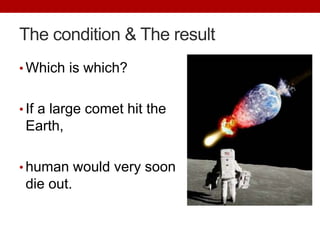
The condition & The result
• Which is which?
• If a large comet hit the
Earth,
• human would very soon
die out.
The Zero Conditional
• Something that is or was generally true
(It means “whenever”)
• If I eat fish, I get ill.
• If I didn’t eat my meals, Mum got cross.
• FORM
• If + present tense, present tense
• If + past tense, past tense
The Zero Conditional
• The imperative
• Tell her about the party if you see her.
• If he is here, tell me immediately.
• If you’re going out, buy me some milk.
The First Conditional
• Describes real or probable future situations
• If it rains, I won’t go out.
• If you’re going shopping, will you buy me some milk?
• If he’s had enough, he’ll stop.
• FORM
• If + present tense, will + infinitive
The First Conditional
• When and as soon as can replace if
• If I see her, I’ll tell her.
• When I see her, I’ll tell her
• As soon as I see her, I’ll tell her.
• Will can be replaced to show something is less certain
• If you out now,
you may/ might see her.
• If I pass my exam,
we can/could celebrate.
The Second Conditional
• Describes imaginary or unlikely situation
• If I knew, I’d tell you.
• If I won a lottery, I would travel around the world.
• If I were you, I’d apply for the job.
• If he were here, what do you think he’d do?
• FORM
• If + past tense, would + infinitive
• What would Jesus do?
The Second Conditional
• Would can be replaced  less certain
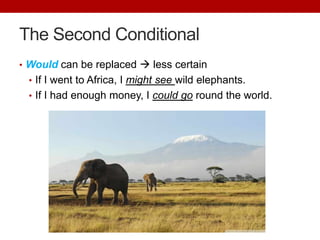
• If I went to Africa, I might see wild elephants.
• If I had enough money, I could go round the world.
Other points
• Conditions are not always stated.
• I’d love to meet your brother.
(if you let me)
• The choice often depends on the speaker’s view of the
situation
• Example:
Two people buy lottery tickets every week.
• A: If I win, I’ll give up my job.
• B: If I won, I’d move to the country.

Unit 6 Grammar (If Clause)

  • 1.
  • 2.
    The condition &The result • Which is which? • If a large comet hit the Earth, • human would very soon die out.
  • 3.
    The Zero Conditional •Something that is or was generally true (It means “whenever”) • If I eat fish, I get ill. • If I didn’t eat my meals, Mum got cross. • FORM • If + present tense, present tense • If + past tense, past tense
  • 4.
    The Zero Conditional •The imperative • Tell her about the party if you see her. • If he is here, tell me immediately. • If you’re going out, buy me some milk.
  • 5.
    The First Conditional •Describes real or probable future situations • If it rains, I won’t go out. • If you’re going shopping, will you buy me some milk? • If he’s had enough, he’ll stop. • FORM • If + present tense, will + infinitive
  • 6.
    The First Conditional •When and as soon as can replace if • If I see her, I’ll tell her. • When I see her, I’ll tell her • As soon as I see her, I’ll tell her. • Will can be replaced to show something is less certain • If you out now, you may/ might see her. • If I pass my exam, we can/could celebrate.
  • 7.
    The Second Conditional •Describes imaginary or unlikely situation • If I knew, I’d tell you. • If I won a lottery, I would travel around the world. • If I were you, I’d apply for the job. • If he were here, what do you think he’d do? • FORM • If + past tense, would + infinitive • What would Jesus do?
  • 8.
    The Second Conditional •Would can be replaced  less certain • If I went to Africa, I might see wild elephants. • If I had enough money, I could go round the world.
  • 9.
    Other points • Conditionsare not always stated. • I’d love to meet your brother. (if you let me) • The choice often depends on the speaker’s view of the situation • Example: Two people buy lottery tickets every week. • A: If I win, I’ll give up my job. • B: If I won, I’d move to the country.