DC Source
RC Circuits
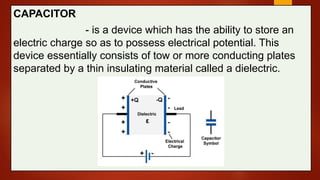
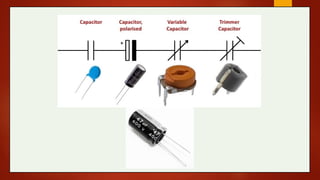
CAPACITOR
- is a device which has the ability to store an
electric charge so as to possess electrical potential. This
device essentially consists of tow or more conducting plates
separated by a thin insulating material called a dielectric.
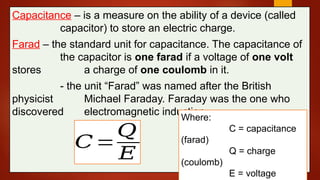
Capacitance – is a measure on the ability of a device (called
capacitor) to store an electric charge.
Farad – the standard unit for capacitance. The capacitance of
the capacitor is one farad if a voltage of one volt
stores a charge of one coulomb in it.
- the unit “Farad” was named after the British
physicist Michael Faraday. Faraday was the one who
discovered electromagnetic induction.
𝐶=
𝑄
𝐸
Where:
C = capacitance
(farad)
Q = charge
(coulomb)
E = voltage
DC Source
RC Circuits
The Time Constant of an RC Circuit
The time constant (tau or of an RC circuit is the time
required for the current to decay or fall down to 63.2 % of its
initial value to its steady – state value. This is also the time
required for the voltage across the capacitor to rise to 63.2 %
of its final value at steady – state.
𝜏=𝑅𝐶
*
Where:
C = capacitance
(farad)
Q = charge
(coulomb)
E = voltage
across
capacitor (volts)
i = current
(amperes)
RC – DC Circuit
KVL:
𝑬
𝑹
𝒕 =𝟎
𝒕 =𝟎
𝒊
+ 𝑬 𝑹 −
𝑪
General solution
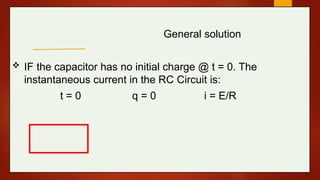
 IF the capacitor has no initial charge @ t = 0. The
instantaneous current in the RC Circuit is:
t = 0 q = 0 i = E/R
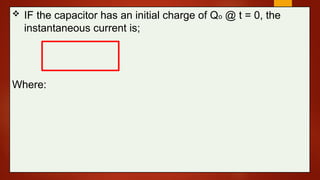
 IF the capacitor has an initial charge of Qo @ t = 0, the
instantaneous current is;
Where:
INSTANTANEOUS VOLTAGE DROP ACROSS THE
RESISTOR (Qo = 0)
INSTANTANEOUS VOLTAGE DROP ACROSS THE
CAPACITOR (Qo = 0)
@ t = 0 ; Ec = 0
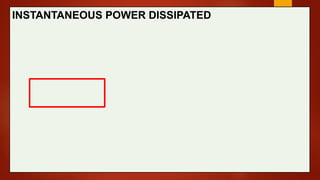
INSTANTANEOUS POWER DISSIPATED
INSTANTANEOUS CHARGE STORED BY CAPACITOR
KVL:
*
*
linear D.E.
General solution
@ t = 0; q = 0
@ t = 0; q = Qo
TRANSIENT DECAY
 Source Free
KVL:
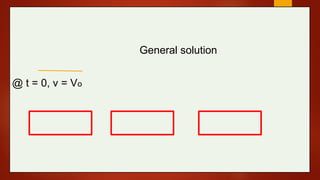
General solution
@ t = 0, v = Vo
ENERGY STORED
If the capacitor has no initial charge at t = 0, the
instantaneous current in the RC circuit is found by the formula,
If the capacitor has an initial charge Qo at t = 0, the
instantaneous current in the RC circuit is found by the formula,
𝒊=
𝑬
𝑹
𝒆
−
𝒕
𝑹𝑪
𝒊=
( 𝑬 ± 𝑬𝑪 )
𝑹
𝒆
−
𝒕
𝑹𝑪
Where:
= voltage across the capacitor if discharging
= voltage across the capacitor if charging
E = DC supply voltage
Qo = initial charge of the capacitor
SUMMARY: RC TRANSIENT CIRCUIT (DC CIRCUIT)
Instantaneous Voltage Drop
across Resistor (Qo = 0)
Instantaneous Voltage Drop
across Capacitor (Qo = 0)
𝑬 𝑹=𝑬𝒆
−𝒕
𝑹𝑪
𝑬𝑪 =𝑬(𝟏− 𝒆
−𝒕
𝑹𝑪
)
SUMMARY: RC TRANSIENT CIRCUIT (DC CIRCUIT)
Instantaneous Power Dissipated
across Resistor
Instantaneous Power
Dissipated across Capacitor
Total Instantaneous Power
Dissipated
𝑷𝑹=
𝑬
𝟐
𝑹
𝒆
−𝟐 𝒕
𝑹𝑪
𝑷 𝑪 =
𝑬
𝟐
𝑹
(𝒆
− 𝒕
𝑹𝑪
−𝒆
−𝟐 𝒕
𝑹𝑪
)
𝑷 𝑻 =
𝑬
𝟐
𝑹
𝒆
−𝒕
𝑹𝑪
SUMMARY: RC TRANSIENT CIRCUIT (DC CIRCUIT)
Instantaneous Charge Stored By
Capacitor (Qo = 0)
Instantaneous Charge Stored
By Capacitor (q = Qo)
𝒒=𝑪𝑬 (𝟏− 𝒆
−𝒕
𝑹𝑪
)
𝒒=𝑪𝑬 +(𝑸𝒐 − 𝑪𝑬 )𝒆
−𝒕
𝑹𝑪
SUMMARY: RL TRANSIENT CIRCUIT (DC CIRCUIT)
Time Constant
Transient Decay (Source Free)
𝒗=𝑽 𝒐 𝒆
− 𝒕
𝑹𝑪
𝜏=
1
𝑅𝐶
𝒊=𝑰𝒐 𝒆
−𝒕
𝑹𝑪
𝒒=𝑸𝒐 𝒆
−𝒕
𝑹𝑪
Ex. A 80 μF capacitor in series with a voltmeter of 10 kΩ
resistance is connected suddenly across a 100 V source. What
is the voltmeter reading after 0.4 sec?
Ans. 60.6 V
Solution:
Given: C = 80 μFR = 10 kΩE = 100 V
Voltmeter = ? @ t = 0.4 s
Ex. A 600 μF is charged to 400 V. It is then discharged through
a 2 kΩ resistor. Calculate the voltage across the capacitor
after 3 sec.
Ans. 32.834 V
Solution:
Given: C = 600 μF E = 400 V R = 2 kΩ
Ec = ? @ t = 3 sec
Ex. A 20 Ω resistance and 0.001 farad capacitance C are in
series. A direct current voltage E of 100 volts is applied across
the series circuit. Find the resulting current at t = 0.01 sec?
Ans. 3.03 A
Solution:
Given: R = 20 Ω C = 0.001 F E = 100 V
i = ? @ t = 0.01 sec
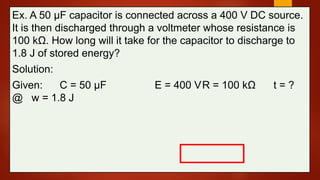
Ex. A 50 μF capacitor is connected across a 400 V DC source.
It is then discharged through a voltmeter whose resistance is
100 kΩ. How long will it take for the capacitor to discharge to
1.8 J of stored energy?
Solution:
Given: C = 50 μF E = 400 VR = 100 kΩ t = ?
@ w = 1.8 J
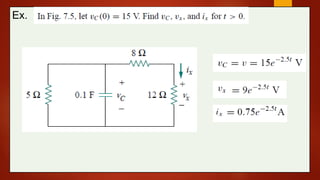
Ex.
Ans.
Solution:
@ t < 0 (before the switch is open)
Solution:
@ t > 0 (after the switch is open)
Solution:
Ex.
Ans.

Chapter 2 (Electrical Transient)DSDSDDSD.pptx

  • 1.
  • 2.
    CAPACITOR - is adevice which has the ability to store an electric charge so as to possess electrical potential. This device essentially consists of tow or more conducting plates separated by a thin insulating material called a dielectric.
  • 4.
    Capacitance – isa measure on the ability of a device (called capacitor) to store an electric charge. Farad – the standard unit for capacitance. The capacitance of the capacitor is one farad if a voltage of one volt stores a charge of one coulomb in it. - the unit “Farad” was named after the British physicist Michael Faraday. Faraday was the one who discovered electromagnetic induction. 𝐶= 𝑄 𝐸 Where: C = capacitance (farad) Q = charge (coulomb) E = voltage
  • 5.
  • 7.
    The Time Constantof an RC Circuit The time constant (tau or of an RC circuit is the time required for the current to decay or fall down to 63.2 % of its initial value to its steady – state value. This is also the time required for the voltage across the capacitor to rise to 63.2 % of its final value at steady – state. 𝜏=𝑅𝐶
  • 9.
    * Where: C = capacitance (farad) Q= charge (coulomb) E = voltage across capacitor (volts) i = current (amperes)
  • 10.
    RC – DCCircuit KVL: 𝑬 𝑹 𝒕 =𝟎 𝒕 =𝟎 𝒊 + 𝑬 𝑹 − 𝑪
  • 12.
    General solution  IFthe capacitor has no initial charge @ t = 0. The instantaneous current in the RC Circuit is: t = 0 q = 0 i = E/R
  • 13.
     IF thecapacitor has an initial charge of Qo @ t = 0, the instantaneous current is; Where:
  • 14.
    INSTANTANEOUS VOLTAGE DROPACROSS THE RESISTOR (Qo = 0)
  • 15.
    INSTANTANEOUS VOLTAGE DROPACROSS THE CAPACITOR (Qo = 0)
  • 16.
    @ t =0 ; Ec = 0
  • 17.
  • 18.
  • 19.
  • 20.
    INSTANTANEOUS CHARGE STOREDBY CAPACITOR KVL: * * linear D.E.
  • 21.
  • 22.
    @ t =0; q = 0 @ t = 0; q = Qo
  • 23.
  • 24.
  • 25.
  • 26.
    If the capacitorhas no initial charge at t = 0, the instantaneous current in the RC circuit is found by the formula, If the capacitor has an initial charge Qo at t = 0, the instantaneous current in the RC circuit is found by the formula, 𝒊= 𝑬 𝑹 𝒆 − 𝒕 𝑹𝑪 𝒊= ( 𝑬 ± 𝑬𝑪 ) 𝑹 𝒆 − 𝒕 𝑹𝑪 Where: = voltage across the capacitor if discharging = voltage across the capacitor if charging E = DC supply voltage Qo = initial charge of the capacitor
  • 27.
    SUMMARY: RC TRANSIENTCIRCUIT (DC CIRCUIT) Instantaneous Voltage Drop across Resistor (Qo = 0) Instantaneous Voltage Drop across Capacitor (Qo = 0) 𝑬 𝑹=𝑬𝒆 −𝒕 𝑹𝑪 𝑬𝑪 =𝑬(𝟏− 𝒆 −𝒕 𝑹𝑪 )
  • 28.
    SUMMARY: RC TRANSIENTCIRCUIT (DC CIRCUIT) Instantaneous Power Dissipated across Resistor Instantaneous Power Dissipated across Capacitor Total Instantaneous Power Dissipated 𝑷𝑹= 𝑬 𝟐 𝑹 𝒆 −𝟐 𝒕 𝑹𝑪 𝑷 𝑪 = 𝑬 𝟐 𝑹 (𝒆 − 𝒕 𝑹𝑪 −𝒆 −𝟐 𝒕 𝑹𝑪 ) 𝑷 𝑻 = 𝑬 𝟐 𝑹 𝒆 −𝒕 𝑹𝑪
  • 29.
    SUMMARY: RC TRANSIENTCIRCUIT (DC CIRCUIT) Instantaneous Charge Stored By Capacitor (Qo = 0) Instantaneous Charge Stored By Capacitor (q = Qo) 𝒒=𝑪𝑬 (𝟏− 𝒆 −𝒕 𝑹𝑪 ) 𝒒=𝑪𝑬 +(𝑸𝒐 − 𝑪𝑬 )𝒆 −𝒕 𝑹𝑪
  • 30.
    SUMMARY: RL TRANSIENTCIRCUIT (DC CIRCUIT) Time Constant Transient Decay (Source Free) 𝒗=𝑽 𝒐 𝒆 − 𝒕 𝑹𝑪 𝜏= 1 𝑅𝐶 𝒊=𝑰𝒐 𝒆 −𝒕 𝑹𝑪 𝒒=𝑸𝒐 𝒆 −𝒕 𝑹𝑪
  • 31.
    Ex. A 80μF capacitor in series with a voltmeter of 10 kΩ resistance is connected suddenly across a 100 V source. What is the voltmeter reading after 0.4 sec? Ans. 60.6 V Solution: Given: C = 80 μFR = 10 kΩE = 100 V Voltmeter = ? @ t = 0.4 s
  • 32.
    Ex. A 600μF is charged to 400 V. It is then discharged through a 2 kΩ resistor. Calculate the voltage across the capacitor after 3 sec. Ans. 32.834 V Solution: Given: C = 600 μF E = 400 V R = 2 kΩ Ec = ? @ t = 3 sec
  • 33.
    Ex. A 20Ω resistance and 0.001 farad capacitance C are in series. A direct current voltage E of 100 volts is applied across the series circuit. Find the resulting current at t = 0.01 sec? Ans. 3.03 A Solution: Given: R = 20 Ω C = 0.001 F E = 100 V i = ? @ t = 0.01 sec
  • 34.
    Ex. A 50μF capacitor is connected across a 400 V DC source. It is then discharged through a voltmeter whose resistance is 100 kΩ. How long will it take for the capacitor to discharge to 1.8 J of stored energy? Solution: Given: C = 50 μF E = 400 VR = 100 kΩ t = ? @ w = 1.8 J
  • 35.
  • 36.
    Solution: @ t <0 (before the switch is open)
  • 37.
    Solution: @ t >0 (after the switch is open)
  • 38.
  • 39.