Classification of Routing
Algorithms
Simplified Notes for BCA Students
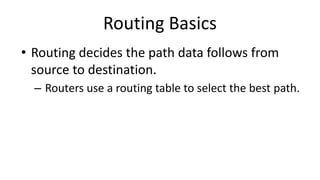
Routing Basics
• Routing decides the path data follows from
source to destination.
– Routers use a routing table to select the best path.
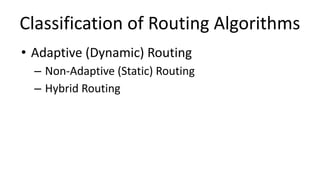
Classification of Routing Algorithms
• Adaptive (Dynamic) Routing
– Non-Adaptive (Static) Routing
– Hybrid Routing
Adaptive (Dynamic) Routing
• Updates routes based on network traffic and
conditions.
– Used in large and complex networks.
Types of Adaptive Routing
• Isolated Routing - Each router takes decision
independently.
– Centralized Routing - Central node decides routes.
– Distributed Routing - Routers share information
with neighbors.
Non-Adaptive (Static) Routing
• Routes do not change once selected.
– Used in small and simple networks.
Types of Static Routing
• Flooding - Sends packets on all outgoing paths.
– Random Walk - Sends packet to a random next
node.
Hybrid Routing
• Combination of Adaptive and Static routing.
– Used when network is divided into multiple
regions.
Common Routing Protocols
• RIP - Uses Hop Count (Small Networks)
– IGRP - Improved RIP (Cisco)
– OSPF - Uses Dijkstra Algorithm (Large Networks)
– EIGRP - Hybrid routing (Cisco)
– BGP - Used on the Internet between ISPs
Summary
• Dynamic routing changes based on network
conditions.
– Static routing remains fixed.
– Hybrid uses both based on network needs.

Unit 4DCN-RoutingAlgorithms-staticdynamic.pdf

  • 1.
  • 2.
    Routing Basics • Routingdecides the path data follows from source to destination. – Routers use a routing table to select the best path.
  • 3.
    Classification of RoutingAlgorithms • Adaptive (Dynamic) Routing – Non-Adaptive (Static) Routing – Hybrid Routing
  • 4.
    Adaptive (Dynamic) Routing •Updates routes based on network traffic and conditions. – Used in large and complex networks.
  • 5.
    Types of AdaptiveRouting • Isolated Routing - Each router takes decision independently. – Centralized Routing - Central node decides routes. – Distributed Routing - Routers share information with neighbors.
  • 6.
    Non-Adaptive (Static) Routing •Routes do not change once selected. – Used in small and simple networks.
  • 7.
    Types of StaticRouting • Flooding - Sends packets on all outgoing paths. – Random Walk - Sends packet to a random next node.
  • 8.
    Hybrid Routing • Combinationof Adaptive and Static routing. – Used when network is divided into multiple regions.
  • 9.
    Common Routing Protocols •RIP - Uses Hop Count (Small Networks) – IGRP - Improved RIP (Cisco) – OSPF - Uses Dijkstra Algorithm (Large Networks) – EIGRP - Hybrid routing (Cisco) – BGP - Used on the Internet between ISPs
  • 10.
    Summary • Dynamic routingchanges based on network conditions. – Static routing remains fixed. – Hybrid uses both based on network needs.