Unit 4: Managing Change Sports Management Mr. Elsesser
Critical Thinking Questions: Managing Change Why do you think change is such a crucial issue for sport organizations to address?  What are some of the ways that change is “tackled” in sport organizations?  Why can change be challenging for an organization to implement?
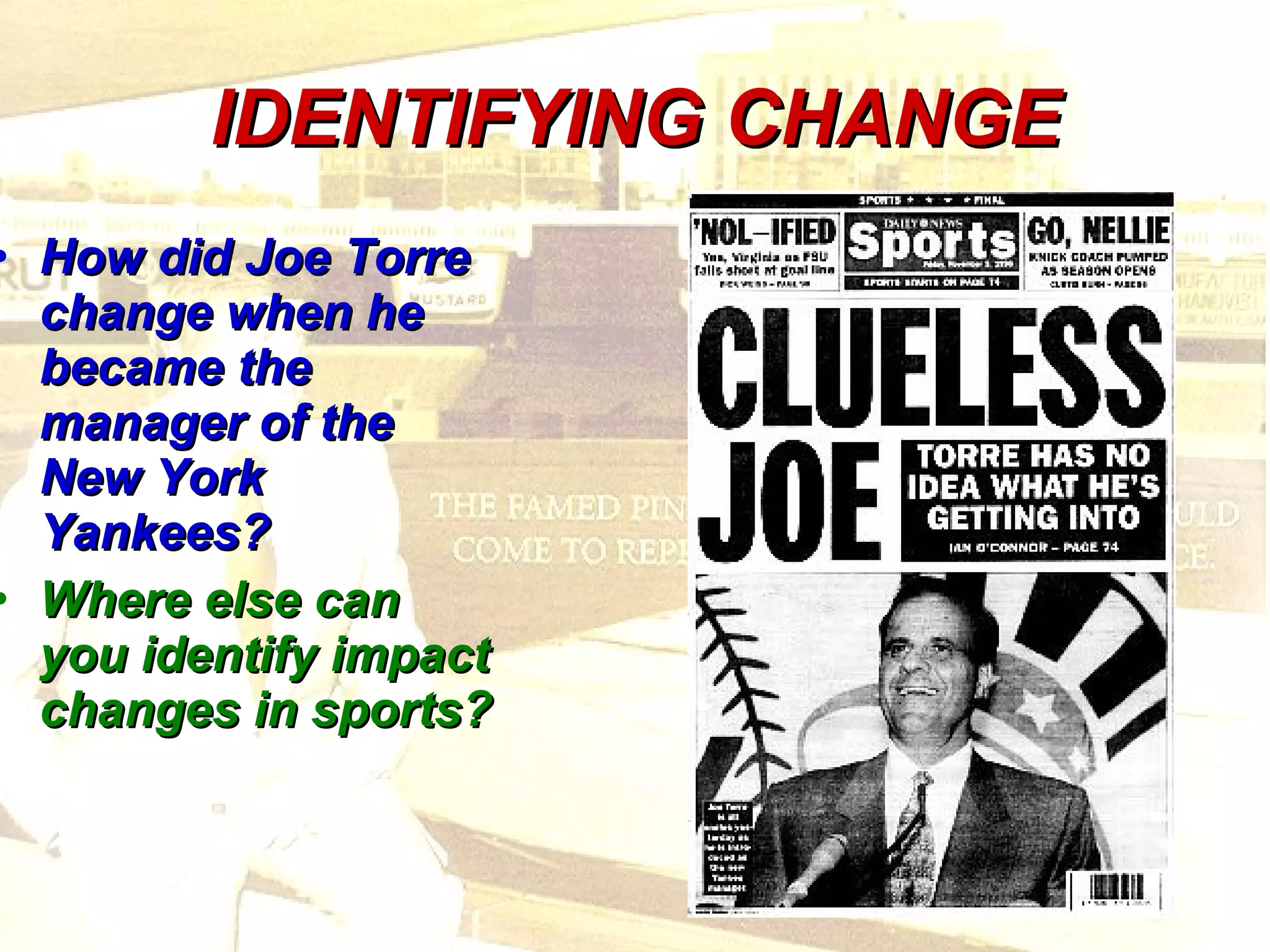
IDENTIFYING CHANGE How did Joe Torre change when he became the manager of the New York Yankees?  Where else can you identify impact changes in sports?
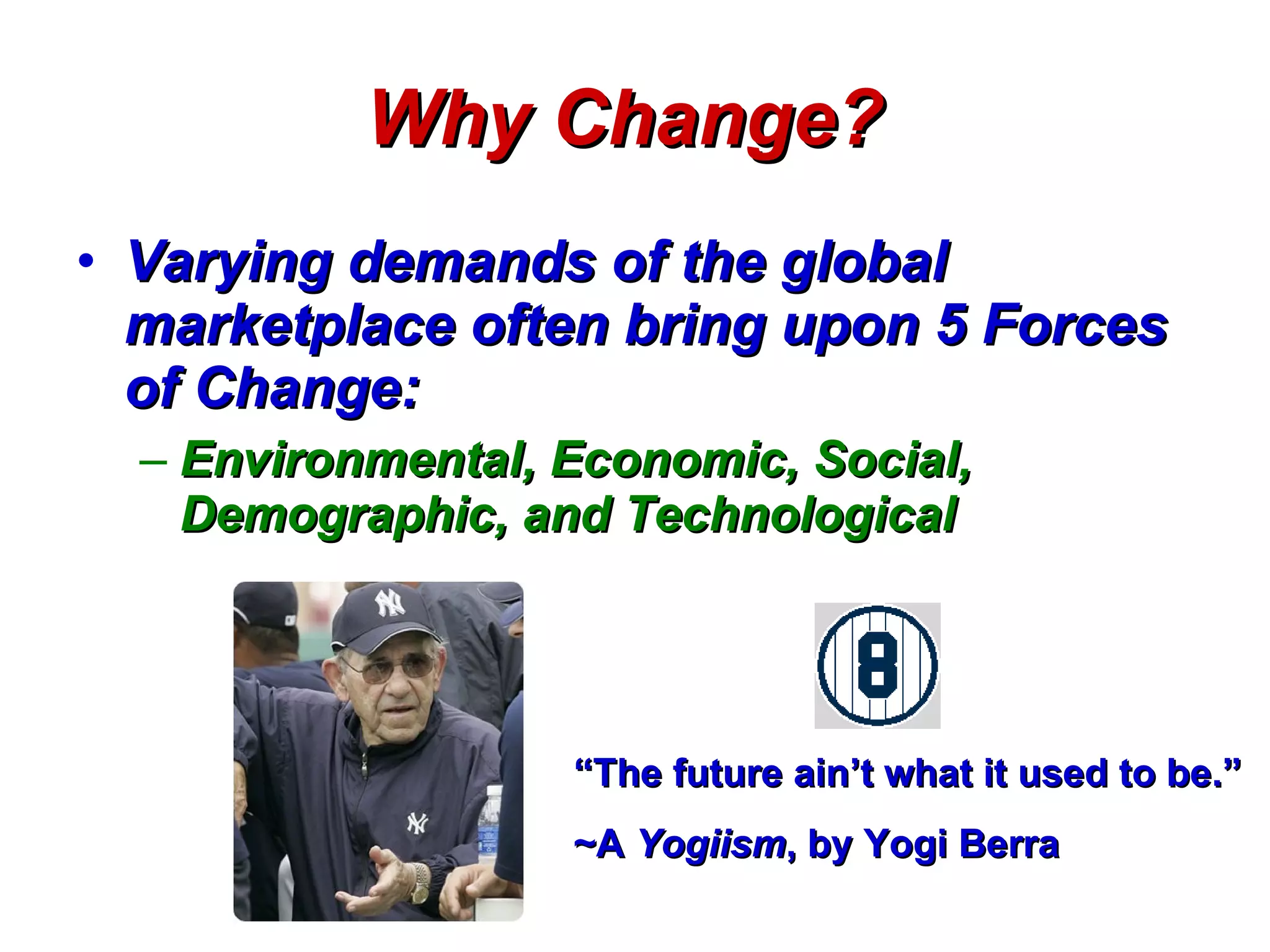
Why Change?   Varying demands of the global marketplace often bring upon 5 Forces of Change: Environmental, Economic, Social, Demographic, and Technological   “ The future ain’t what it used to be.” ~A  Yogiism , by Yogi Berra
Environmental Forces The daily business environment presents many challenges, that result in CHANGE. Results from the daily interaction of internal and external environments. Role of the Sport Manager:
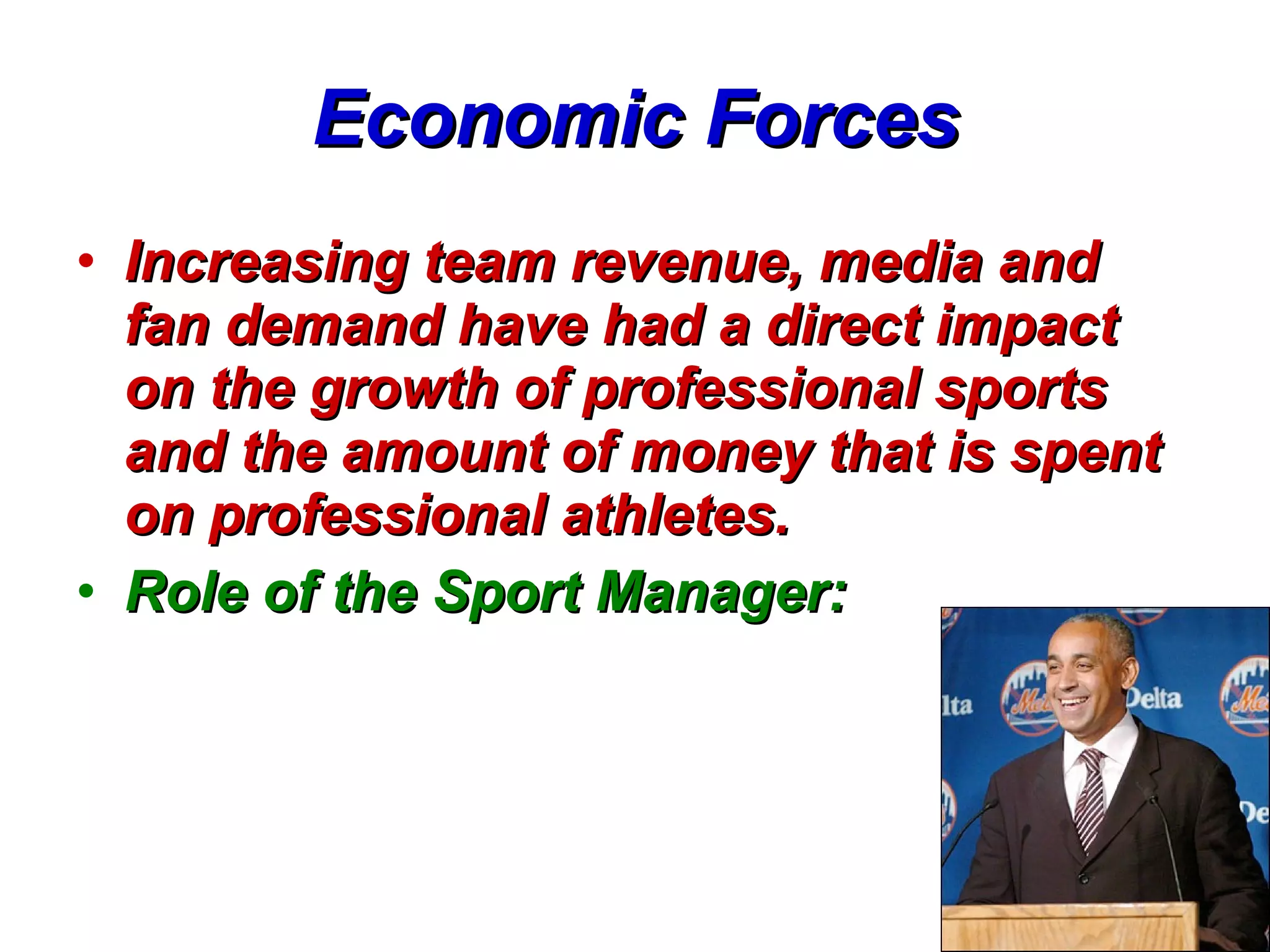
Economic Forces Increasing team revenue, media and fan demand have had a direct impact on the growth of professional sports and the amount of money that is spent on professional athletes.   Role of the Sport Manager:
Social Forces Includes all of the actions of the industry’s fan base: Perceptions of Sports Hatred/Love for certain teams Sporting Industry Stereotypes Role of the Sport Manager:
Technological Forces Includes all facets of technology that are used to market and bring “the team” to their fan base: Cable Networks and Exclusive TV Channels MLB.TV, ESPN360.com Streaming, Satellite and Terrestrial Radio Role of the Sport Manager:
Variables of Change: Refer to what organizations must adapt, shift, or re-create to stay current, to keep or grow market share, or to remain viable as an organization; as they are faced with changes in their marketplace.  There are 4 Variables of Change: All are linked to each other in a system—requiring managers to plan wisely.
Examining the 4 Variables Strategy: The adjustment of strategies at the corporate, business and functional levels; to respond to changes in their environments. EX) Dowling College wants to enhance the performance of their student athletes. Structure: Structure typically follows strategy. A change in strategy causes a change in structure.  EX) The college has added a “Dir. of Academics” in their Athletic office. This is a front-line mgr. that reports to the Athletic Director.
Examining the 4 Variables Technology: Rate of change is increased with technology.  Productivity increases and a competitive advantage is established.  EX) Dowling develops an online homework center for their student athletes, who are required to use it 6 hours per week.  People: The Key Variable of Change. Our Skills and performance change with the other variables as well as our attitudes and behaviors.  EX) Dowling students may change their attiude about academics now that they have high-tech resources to help them soar.
Stages in the Change Process that people go through… 1. ________________ “ it won’t happen,” “it can’t happen here” 2. ________________ They fear it—their comfort zone goes away.  3. ________________ They see what its all about—learn to live it.  4. ________________ Either they conform to it, or they don’t.
Why Change is Resisted: Our Society… Fears Uncertainty Doesn’t like to be inconvenienced Always moves to protect our self-interests Fears Loss Likes to be in Control
How Managers Can Overcome Resistance: Create a Trust Climate. Develop a Change Plan. State why the change is necessary and how it will affect your group.  Create a win-win situation.  Involve People.  Provide support.
Things that need to be understood about RESISTANCE: Before initiating change, you must anticipate how your team will react. 3 Key Components: INTENSITY:
Components of RESISTANCE: SOURCES (3):  Facts: Beliefs: Values: FOCUS (3 viewpoints):  Ourselves: Significant Others: Work Environment:
Organizational Culture The set of values, beliefs, and standards for acceptable behavior that its members share. Importance of Understanding Culture: Examples of positive team culture: Examples of negative team culture:
Sport Team Culture “ Sport team culture originated from the establishment and development of sports team. The sport team culture with which all members voluntarily comply is the total of common faith, morality, spirit, ceremony, intelligence factor, and entertainment life. The function of the sport team culture is found in instructing people, construction of team standards, recovery, spiritual adjustment, and meeting psychological and social demand.”
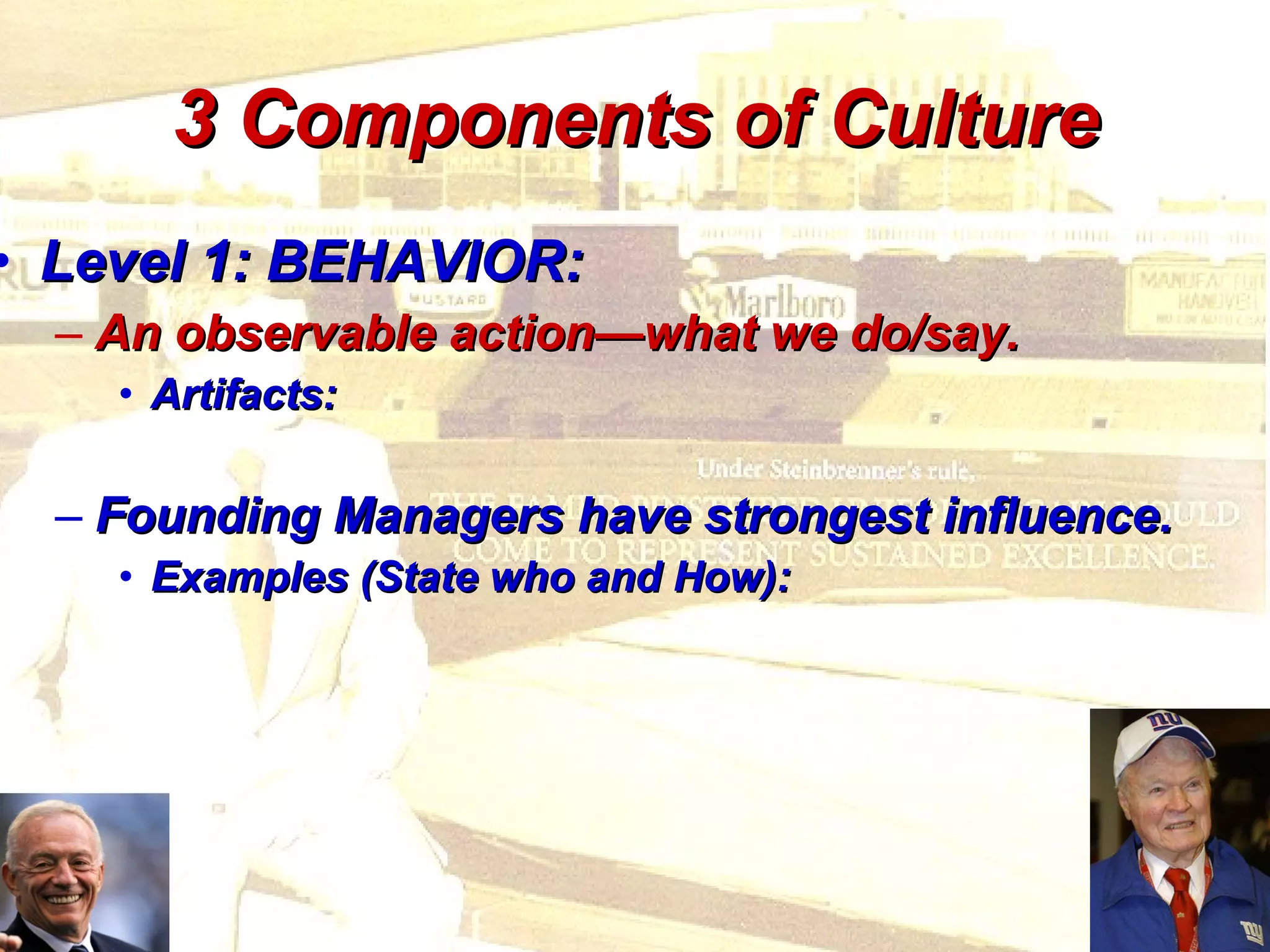
3 Components of Culture Level 1: BEHAVIOR: An observable action—what we do/say. Artifacts: Founding Managers have strongest influence. Examples (State who and How):
3 Components of Culture Level 2: VALUES AND BELIEFS: Operating principles that guide decision making and behavior in an organization. Values: Beliefs: Examples (State who and How):
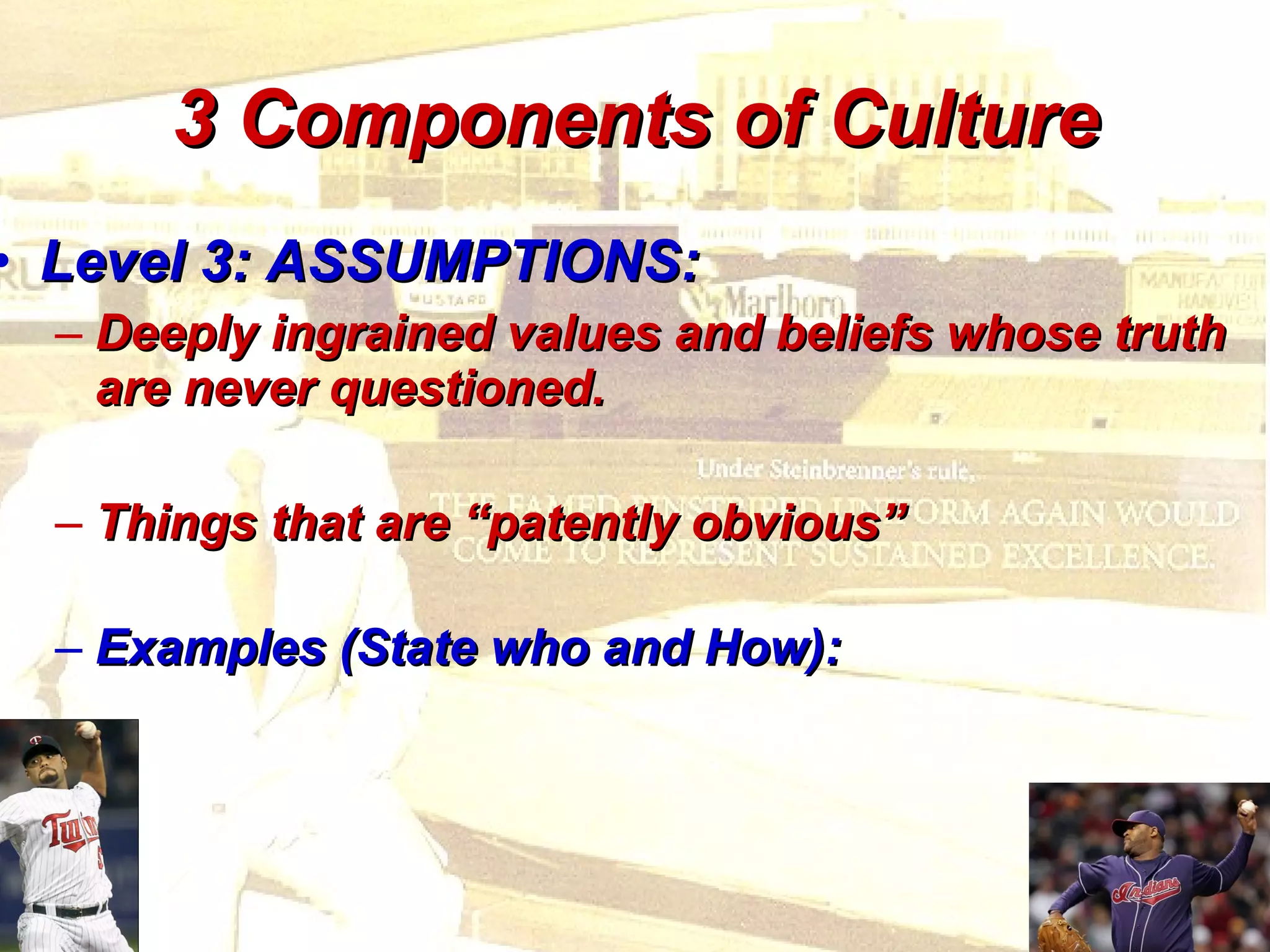
3 Components of Culture Level 3: ASSUMPTIONS: Deeply ingrained values and beliefs whose truth are never questioned. Things that are “patently obvious”  Examples (State who and How):
A Review of TQM Involves a companywide focus on 2 main principles: 1.  2.  Characteristics include: People being known as the organizations most important resource.  Make sure their workforce gets best possible training Stress teamwork.
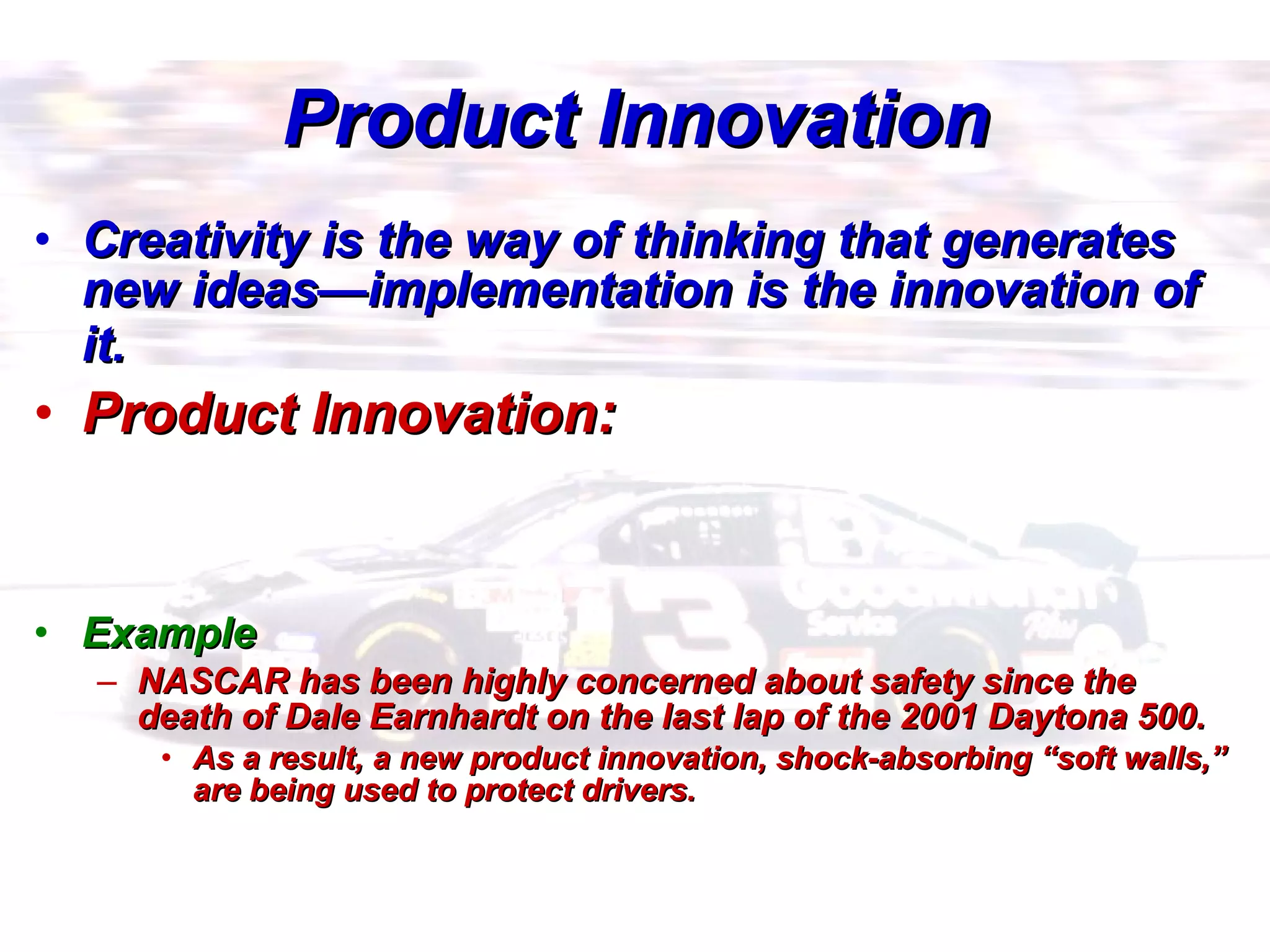
Product Innovation Creativity is the way of thinking that generates new ideas—implementation is the innovation of it.   Product Innovation: Example NASCAR has been highly concerned about safety since the death of Dale Earnhardt on the last lap of the 2001 Daytona 500.  As a result, a new product innovation, shock-absorbing “soft walls,” are being used to protect drivers.
The Learning Organization An organization that learns, adapts, and changes as its environment changes to continuously increase customer value.   Management Importance: Examples: Alcohol polices at sporting events.  Operational policies and processes.  Diversity issues Title IX.
Title IX  (of the Amendments to the Higher Education Act) Passed in 1972 Requires equal access to education, (including athletics), for women.  Increased the number of women playing on college teams from 32,000 to about 163,000.   Led to wide ramifications for the sport industry: Examples:
Effects of Title IX  Complying with Title IX has led to the reduction of some men’s programs to augment financial support for new women’s teams.  Between 1981 and 1999, more than 400 collegiate men’s teams were dropped.  171 wrestling programs 84 men’s tennis teams  DEBATE: Did it work?
Effects of Title IX: Women Coaches and Pay Women by and large have been limited to coaching other women Whereas men commonly coach both men and women.  Men coach women’s NCAA basketball and the WNBA, but women do not tend to coach Men’s NCAA basketball or the NBA. The hourly wage of women in the workforce is only 70% of men.
Organizational Development The ongoing planned change process that organizations use to improve performance. Who is responsible: Change Agents:
Organizational Development (OD) Techniques Lewin’s change model Forcefield analysis Survey feedback Grid OD Sensitivity training Team building Process consultation Job Design and Direct Feedback

Unit 4: Managing Change Notes

  • 1.
    Unit 4: ManagingChange Sports Management Mr. Elsesser
  • 2.
    Critical Thinking Questions:Managing Change Why do you think change is such a crucial issue for sport organizations to address? What are some of the ways that change is “tackled” in sport organizations? Why can change be challenging for an organization to implement?
  • 3.
    IDENTIFYING CHANGE Howdid Joe Torre change when he became the manager of the New York Yankees? Where else can you identify impact changes in sports?
  • 4.
    Why Change? Varying demands of the global marketplace often bring upon 5 Forces of Change: Environmental, Economic, Social, Demographic, and Technological “ The future ain’t what it used to be.” ~A Yogiism , by Yogi Berra
  • 5.
    Environmental Forces Thedaily business environment presents many challenges, that result in CHANGE. Results from the daily interaction of internal and external environments. Role of the Sport Manager:
  • 6.
    Economic Forces Increasingteam revenue, media and fan demand have had a direct impact on the growth of professional sports and the amount of money that is spent on professional athletes. Role of the Sport Manager:
  • 7.
    Social Forces Includesall of the actions of the industry’s fan base: Perceptions of Sports Hatred/Love for certain teams Sporting Industry Stereotypes Role of the Sport Manager:
  • 8.
    Technological Forces Includesall facets of technology that are used to market and bring “the team” to their fan base: Cable Networks and Exclusive TV Channels MLB.TV, ESPN360.com Streaming, Satellite and Terrestrial Radio Role of the Sport Manager:
  • 9.
    Variables of Change:Refer to what organizations must adapt, shift, or re-create to stay current, to keep or grow market share, or to remain viable as an organization; as they are faced with changes in their marketplace. There are 4 Variables of Change: All are linked to each other in a system—requiring managers to plan wisely.
  • 10.
    Examining the 4Variables Strategy: The adjustment of strategies at the corporate, business and functional levels; to respond to changes in their environments. EX) Dowling College wants to enhance the performance of their student athletes. Structure: Structure typically follows strategy. A change in strategy causes a change in structure. EX) The college has added a “Dir. of Academics” in their Athletic office. This is a front-line mgr. that reports to the Athletic Director.
  • 11.
    Examining the 4Variables Technology: Rate of change is increased with technology. Productivity increases and a competitive advantage is established. EX) Dowling develops an online homework center for their student athletes, who are required to use it 6 hours per week. People: The Key Variable of Change. Our Skills and performance change with the other variables as well as our attitudes and behaviors. EX) Dowling students may change their attiude about academics now that they have high-tech resources to help them soar.
  • 12.
    Stages in theChange Process that people go through… 1. ________________ “ it won’t happen,” “it can’t happen here” 2. ________________ They fear it—their comfort zone goes away. 3. ________________ They see what its all about—learn to live it. 4. ________________ Either they conform to it, or they don’t.
  • 13.
    Why Change isResisted: Our Society… Fears Uncertainty Doesn’t like to be inconvenienced Always moves to protect our self-interests Fears Loss Likes to be in Control
  • 14.
    How Managers CanOvercome Resistance: Create a Trust Climate. Develop a Change Plan. State why the change is necessary and how it will affect your group. Create a win-win situation. Involve People. Provide support.
  • 15.
    Things that needto be understood about RESISTANCE: Before initiating change, you must anticipate how your team will react. 3 Key Components: INTENSITY:
  • 16.
    Components of RESISTANCE:SOURCES (3): Facts: Beliefs: Values: FOCUS (3 viewpoints): Ourselves: Significant Others: Work Environment:
  • 17.
    Organizational Culture Theset of values, beliefs, and standards for acceptable behavior that its members share. Importance of Understanding Culture: Examples of positive team culture: Examples of negative team culture:
  • 18.
    Sport Team Culture“ Sport team culture originated from the establishment and development of sports team. The sport team culture with which all members voluntarily comply is the total of common faith, morality, spirit, ceremony, intelligence factor, and entertainment life. The function of the sport team culture is found in instructing people, construction of team standards, recovery, spiritual adjustment, and meeting psychological and social demand.”
  • 19.
    3 Components ofCulture Level 1: BEHAVIOR: An observable action—what we do/say. Artifacts: Founding Managers have strongest influence. Examples (State who and How):
  • 20.
    3 Components ofCulture Level 2: VALUES AND BELIEFS: Operating principles that guide decision making and behavior in an organization. Values: Beliefs: Examples (State who and How):
  • 21.
    3 Components ofCulture Level 3: ASSUMPTIONS: Deeply ingrained values and beliefs whose truth are never questioned. Things that are “patently obvious” Examples (State who and How):
  • 22.
    A Review ofTQM Involves a companywide focus on 2 main principles: 1. 2. Characteristics include: People being known as the organizations most important resource. Make sure their workforce gets best possible training Stress teamwork.
  • 23.
    Product Innovation Creativityis the way of thinking that generates new ideas—implementation is the innovation of it. Product Innovation: Example NASCAR has been highly concerned about safety since the death of Dale Earnhardt on the last lap of the 2001 Daytona 500. As a result, a new product innovation, shock-absorbing “soft walls,” are being used to protect drivers.
  • 24.
    The Learning OrganizationAn organization that learns, adapts, and changes as its environment changes to continuously increase customer value. Management Importance: Examples: Alcohol polices at sporting events. Operational policies and processes. Diversity issues Title IX.
  • 25.
    Title IX (of the Amendments to the Higher Education Act) Passed in 1972 Requires equal access to education, (including athletics), for women. Increased the number of women playing on college teams from 32,000 to about 163,000. Led to wide ramifications for the sport industry: Examples:
  • 26.
    Effects of TitleIX Complying with Title IX has led to the reduction of some men’s programs to augment financial support for new women’s teams. Between 1981 and 1999, more than 400 collegiate men’s teams were dropped. 171 wrestling programs 84 men’s tennis teams DEBATE: Did it work?
  • 27.
    Effects of TitleIX: Women Coaches and Pay Women by and large have been limited to coaching other women Whereas men commonly coach both men and women. Men coach women’s NCAA basketball and the WNBA, but women do not tend to coach Men’s NCAA basketball or the NBA. The hourly wage of women in the workforce is only 70% of men.
  • 28.
    Organizational Development Theongoing planned change process that organizations use to improve performance. Who is responsible: Change Agents:
  • 29.
    Organizational Development Theongoing planned change process that organizations use to improve performance. Who is responsible: Change Agents:
  • 30.
    Organizational Development Theongoing planned change process that organizations use to improve performance. Who is responsible: Change Agents:
  • 31.
    Organizational Development (OD)Techniques Lewin’s change model Forcefield analysis Survey feedback Grid OD Sensitivity training Team building Process consultation Job Design and Direct Feedback