Unit 3.1 The Medieval Village
(1100 – 1700)
Medieval life by Ms.Farida
Words to learn
Terminology Definition
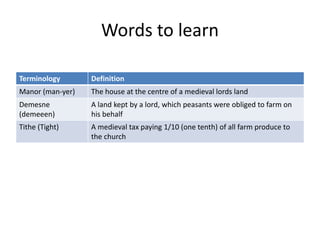
Manor (man-yer) The house at the centre of a medieval lords land
Demesne
(demeeen)
A land kept by a lord, which peasants were obliged to farm on
his behalf
Tithe (Tight) A medieval tax paying 1/10 (one tenth) of all farm produce to
the church
More words to learn
Terminology Definition
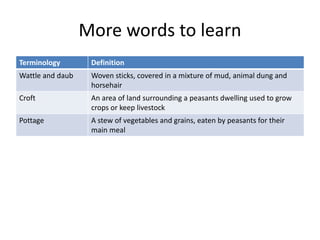
Wattle and daub Woven sticks, covered in a mixture of mud, animal dung and
horsehair
Croft An area of land surrounding a peasants dwelling used to grow
crops or keep livestock
Pottage A stew of vegetables and grains, eaten by peasants for their
main meal
Farming life in medieval
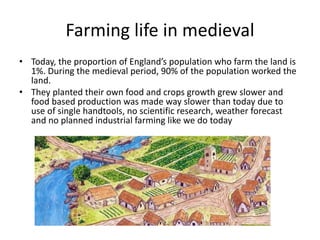
• Today, the proportion of England’s population who farm the land is
1%. During the medieval period, 90% of the population worked the
land.
• They planted their own food and crops growth grew slower and
food based production was made way slower than today due to
use of single handtools, no scientific research, weather forecast
and no planned industrial farming like we do today
Healthcare for medieval people
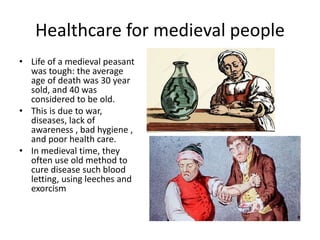
• Life of a medieval peasant
was tough: the average
age of death was 30 year
sold, and 40 was
considered to be old.
• This is due to war,
diseases, lack of
awareness , bad hygiene ,
and poor health care.
• In medieval time, they
often use old method to
cure disease such blood
letting, using leeches and
exorcism
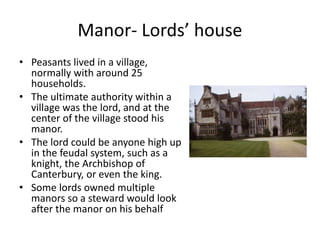
Manor- Lords’ house
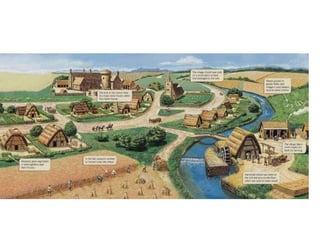
• Peasants lived in a village,
normally with around 25
households.
• The ultimate authority within a
village was the lord, and at the
center of the village stood his
manor.
• The lord could be anyone high up
in the feudal system, such as a
knight, the Archbishop of
Canterbury, or even the king.
• Some lords owned multiple
manors so a steward would look
after the manor on his behalf
Farming the land
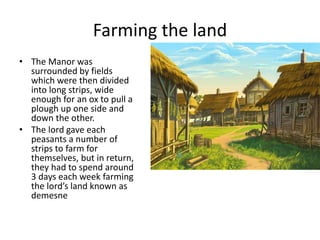
• The Manor was
surrounded by fields
which were then divided
into long strips, wide
enough for an ox to pull a
plough up one side and
down the other.
• The lord gave each
peasants a number of
strips to farm for
themselves, but in return,
they had to spend around
3 days each week farming
the lord’s land known as
demesne
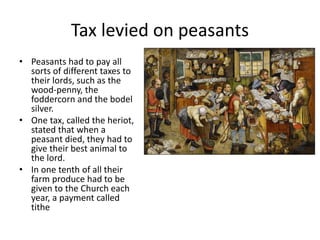
Tax levied on peasants
• Peasants had to pay all
sorts of different taxes to
their lords, such as the
wood-penny, the
foddercorn and the bodel
silver.
• One tax, called the heriot,
stated that when a
peasant died, they had to
give their best animal to
the lord.
• In one tenth of all their
farm produce had to be
given to the Church each
year, a payment called
tithe
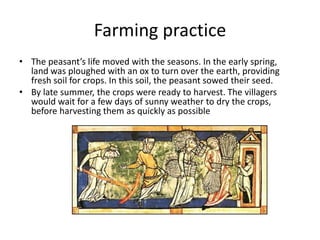
Farming practice
• The peasant’s life moved with the seasons. In the early spring,
land was ploughed with an ox to turn over the earth, providing
fresh soil for crops. In this soil, the peasant sowed their seed.
• By late summer, the crops were ready to harvest. The villagers
would wait for a few days of sunny weather to dry the crops,
before harvesting them as quickly as possible
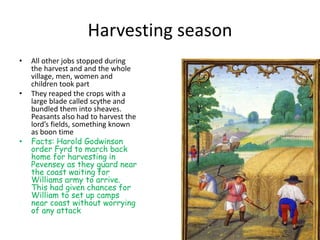
Harvesting season
• All other jobs stopped during
the harvest and and the whole
village, men, women and
children took part
• They reaped the crops with a
large blade called scythe and
bundled them into sheaves.
Peasants also had to harvest the
lord’s fields, something known
as boon time
• Facts: Harold Godwinson
order Fyrd to march back
home for harvesting in
Pevensey as they guard near
the coast waiting for
Williams army to arrive.
This had given chances for
William to set up camps
near coast without worrying
of any attack
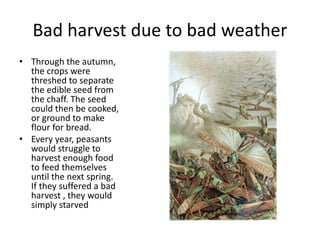
Bad harvest due to bad weather
• Through the autumn,
the crops were
threshed to separate
the edible seed from
the chaff. The seed
could then be cooked,
or ground to make
flour for bread.
• Every year, peasants
would struggle to
harvest enough food
to feed themselves
until the next spring.
If they suffered a bad
harvest , they would
simply starved
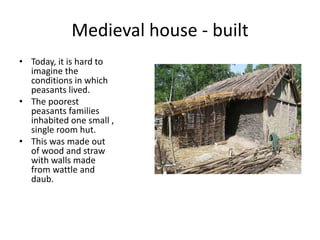
Medieval house - built
• Today, it is hard to
imagine the
conditions in which
peasants lived.
• The poorest
peasants families
inhabited one small ,
single room hut.
• This was made out
of wood and straw
with walls made
from wattle and
daub.
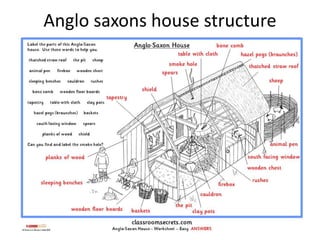
Anglo saxons house structure
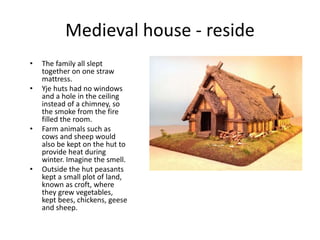
Medieval house - reside
• The family all slept
together on one straw
mattress.
• Yje huts had no windows
and a hole in the ceiling
instead of a chimney, so
the smoke from the fire
filled the room.
• Farm animals such as
cows and sheep would
also be kept on the hut to
provide heat during
winter. Imagine the smell.
• Outside the hut peasants
kept a small plot of land,
known as croft, where
they grew vegetables,
kept bees, chickens, geese
and sheep.
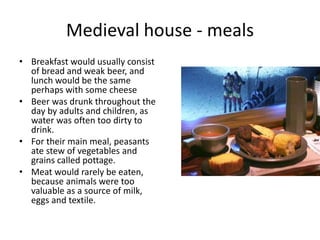
Medieval house - meals
• Breakfast would usually consist
of bread and weak beer, and
lunch would be the same
perhaps with some cheese
• Beer was drunk throughout the
day by adults and children, as
water was often too dirty to
drink.
• For their main meal, peasants
ate stew of vegetables and
grains called pottage.
• Meat would rarely be eaten,
because animals were too
valuable as a source of milk,
eggs and textile.
Holidays
• One building made of durable
stone, aside from the manor,
would normally be the
church.]As they were built of
stone, many medieval churches
still stand at the center of English
villages today
• Around 20 days a year were
religious holidays. Sometimes not
much religious worship would
actually take place. On holy days,
the lords of the manor would
provide feast and
entertainments, and the whole
village celebrated together.
• If the peasants were lucky, the
lord would provide meat and ale.
Medieval jobs
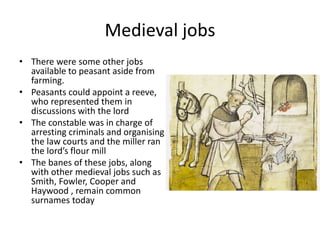
• There were some other jobs
available to peasant aside from
farming.
• Peasants could appoint a reeve,
who represented them in
discussions with the lord
• The constable was in charge of
arresting criminals and organising
the law courts and the miller ran
the lord’s flour mill
• The banes of these jobs, along
with other medieval jobs such as
Smith, Fowler, Cooper and
Haywood , remain common
surnames today
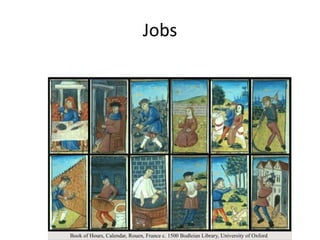
Jobs
The end

Unit 3.1 the medieval village

  • 1.
    Unit 3.1 TheMedieval Village (1100 – 1700) Medieval life by Ms.Farida
  • 2.
    Words to learn TerminologyDefinition Manor (man-yer) The house at the centre of a medieval lords land Demesne (demeeen) A land kept by a lord, which peasants were obliged to farm on his behalf Tithe (Tight) A medieval tax paying 1/10 (one tenth) of all farm produce to the church
  • 3.
    More words tolearn Terminology Definition Wattle and daub Woven sticks, covered in a mixture of mud, animal dung and horsehair Croft An area of land surrounding a peasants dwelling used to grow crops or keep livestock Pottage A stew of vegetables and grains, eaten by peasants for their main meal
  • 4.
    Farming life inmedieval • Today, the proportion of England’s population who farm the land is 1%. During the medieval period, 90% of the population worked the land. • They planted their own food and crops growth grew slower and food based production was made way slower than today due to use of single handtools, no scientific research, weather forecast and no planned industrial farming like we do today
  • 5.
    Healthcare for medievalpeople • Life of a medieval peasant was tough: the average age of death was 30 year sold, and 40 was considered to be old. • This is due to war, diseases, lack of awareness , bad hygiene , and poor health care. • In medieval time, they often use old method to cure disease such blood letting, using leeches and exorcism
  • 6.
    Manor- Lords’ house •Peasants lived in a village, normally with around 25 households. • The ultimate authority within a village was the lord, and at the center of the village stood his manor. • The lord could be anyone high up in the feudal system, such as a knight, the Archbishop of Canterbury, or even the king. • Some lords owned multiple manors so a steward would look after the manor on his behalf
  • 8.
    Farming the land •The Manor was surrounded by fields which were then divided into long strips, wide enough for an ox to pull a plough up one side and down the other. • The lord gave each peasants a number of strips to farm for themselves, but in return, they had to spend around 3 days each week farming the lord’s land known as demesne
  • 9.
    Tax levied onpeasants • Peasants had to pay all sorts of different taxes to their lords, such as the wood-penny, the foddercorn and the bodel silver. • One tax, called the heriot, stated that when a peasant died, they had to give their best animal to the lord. • In one tenth of all their farm produce had to be given to the Church each year, a payment called tithe
  • 10.
    Farming practice • Thepeasant’s life moved with the seasons. In the early spring, land was ploughed with an ox to turn over the earth, providing fresh soil for crops. In this soil, the peasant sowed their seed. • By late summer, the crops were ready to harvest. The villagers would wait for a few days of sunny weather to dry the crops, before harvesting them as quickly as possible
  • 11.
    Harvesting season • Allother jobs stopped during the harvest and and the whole village, men, women and children took part • They reaped the crops with a large blade called scythe and bundled them into sheaves. Peasants also had to harvest the lord’s fields, something known as boon time • Facts: Harold Godwinson order Fyrd to march back home for harvesting in Pevensey as they guard near the coast waiting for Williams army to arrive. This had given chances for William to set up camps near coast without worrying of any attack
  • 12.
    Bad harvest dueto bad weather • Through the autumn, the crops were threshed to separate the edible seed from the chaff. The seed could then be cooked, or ground to make flour for bread. • Every year, peasants would struggle to harvest enough food to feed themselves until the next spring. If they suffered a bad harvest , they would simply starved
  • 13.
    Medieval house -built • Today, it is hard to imagine the conditions in which peasants lived. • The poorest peasants families inhabited one small , single room hut. • This was made out of wood and straw with walls made from wattle and daub.
  • 14.
  • 15.
    Medieval house -reside • The family all slept together on one straw mattress. • Yje huts had no windows and a hole in the ceiling instead of a chimney, so the smoke from the fire filled the room. • Farm animals such as cows and sheep would also be kept on the hut to provide heat during winter. Imagine the smell. • Outside the hut peasants kept a small plot of land, known as croft, where they grew vegetables, kept bees, chickens, geese and sheep.
  • 16.
    Medieval house -meals • Breakfast would usually consist of bread and weak beer, and lunch would be the same perhaps with some cheese • Beer was drunk throughout the day by adults and children, as water was often too dirty to drink. • For their main meal, peasants ate stew of vegetables and grains called pottage. • Meat would rarely be eaten, because animals were too valuable as a source of milk, eggs and textile.
  • 17.
    Holidays • One buildingmade of durable stone, aside from the manor, would normally be the church.]As they were built of stone, many medieval churches still stand at the center of English villages today • Around 20 days a year were religious holidays. Sometimes not much religious worship would actually take place. On holy days, the lords of the manor would provide feast and entertainments, and the whole village celebrated together. • If the peasants were lucky, the lord would provide meat and ale.
  • 18.
    Medieval jobs • Therewere some other jobs available to peasant aside from farming. • Peasants could appoint a reeve, who represented them in discussions with the lord • The constable was in charge of arresting criminals and organising the law courts and the miller ran the lord’s flour mill • The banes of these jobs, along with other medieval jobs such as Smith, Fowler, Cooper and Haywood , remain common surnames today
  • 19.
  • 20.