The Stock Market	& Introduction to the LHA Stock Market Game	Mr. Servello
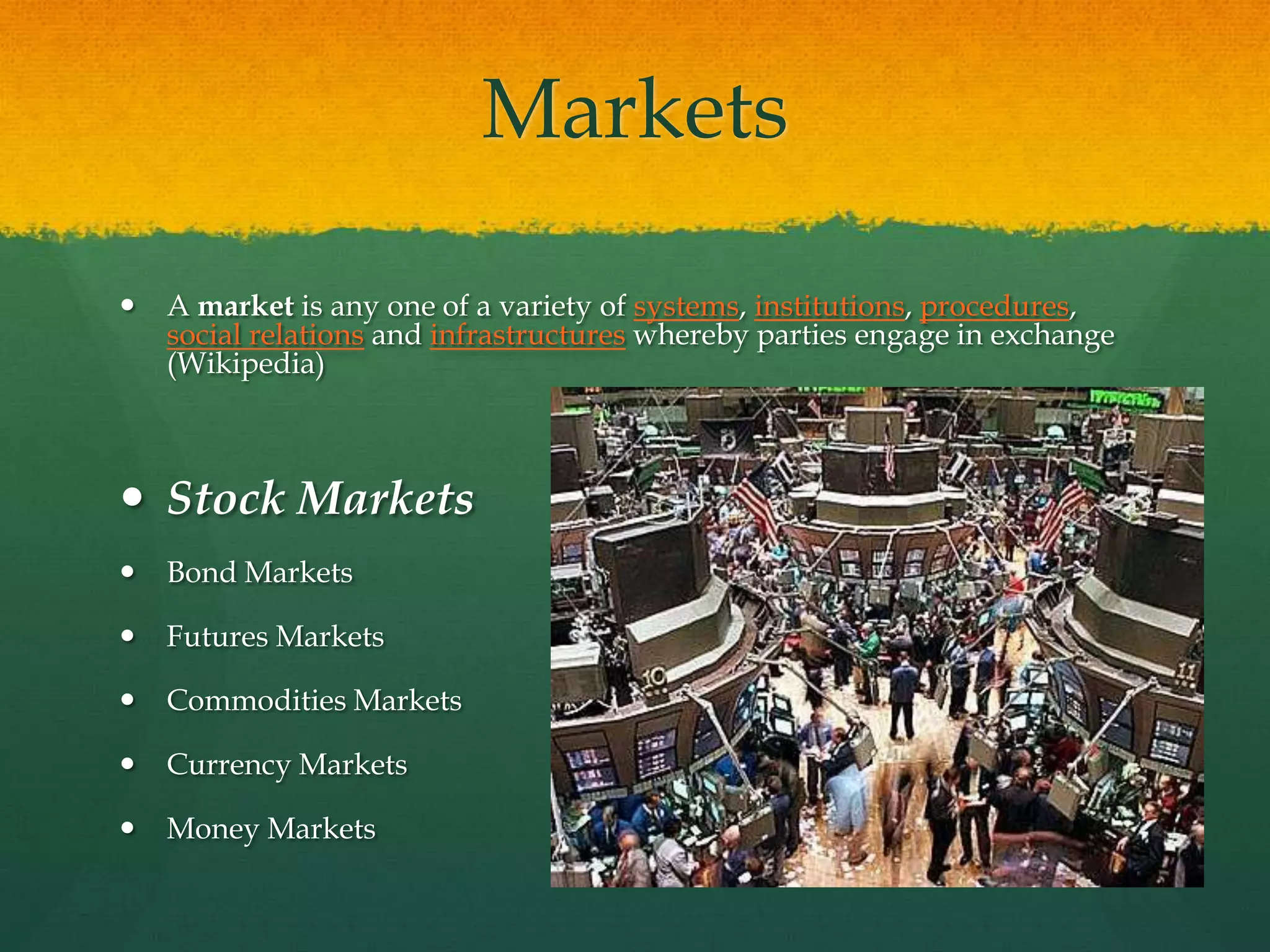
MarketsA market is any one of a variety of systems, institutions, procedures, social relations and infrastructures whereby parties engage in exchange (Wikipedia)Stock MarketsBond MarketsFutures MarketsCommodities MarketsCurrency MarketsMoney Markets
Stocks and BondsCompanies that need $$$ can borrow, but they can also issue BondsA bond is a document that formally promises to pay back a loan under specified terms and a given period of time.
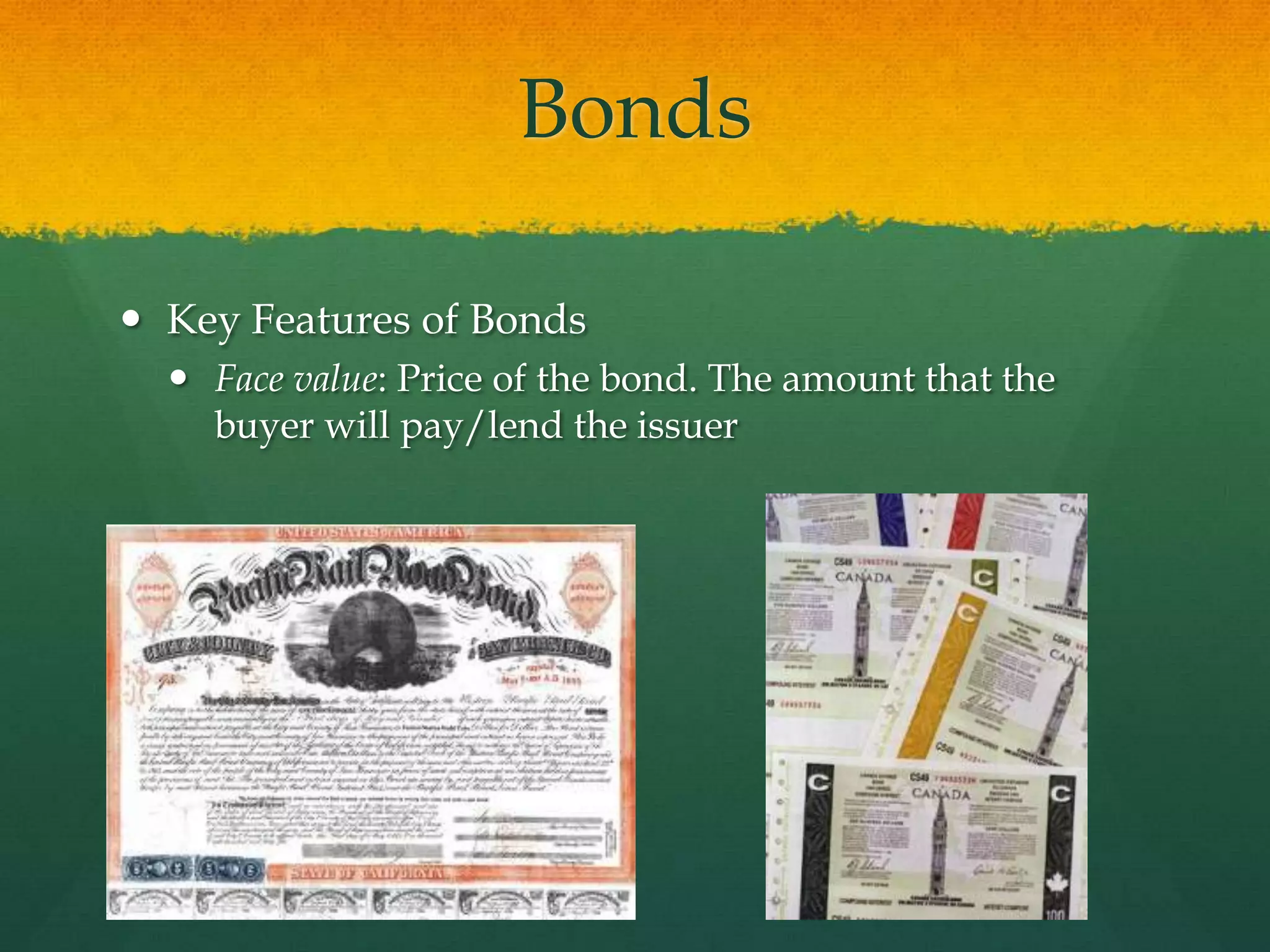
BondsKey Features of BondsFace value: Price of the bond. The amount that the buyer will pay/lend the issuer
BondsKey Features of BondsMaturity date: The date when the Bond expires.  The borrower pays back the lender.  Bonds can also be sold prior to maturity.
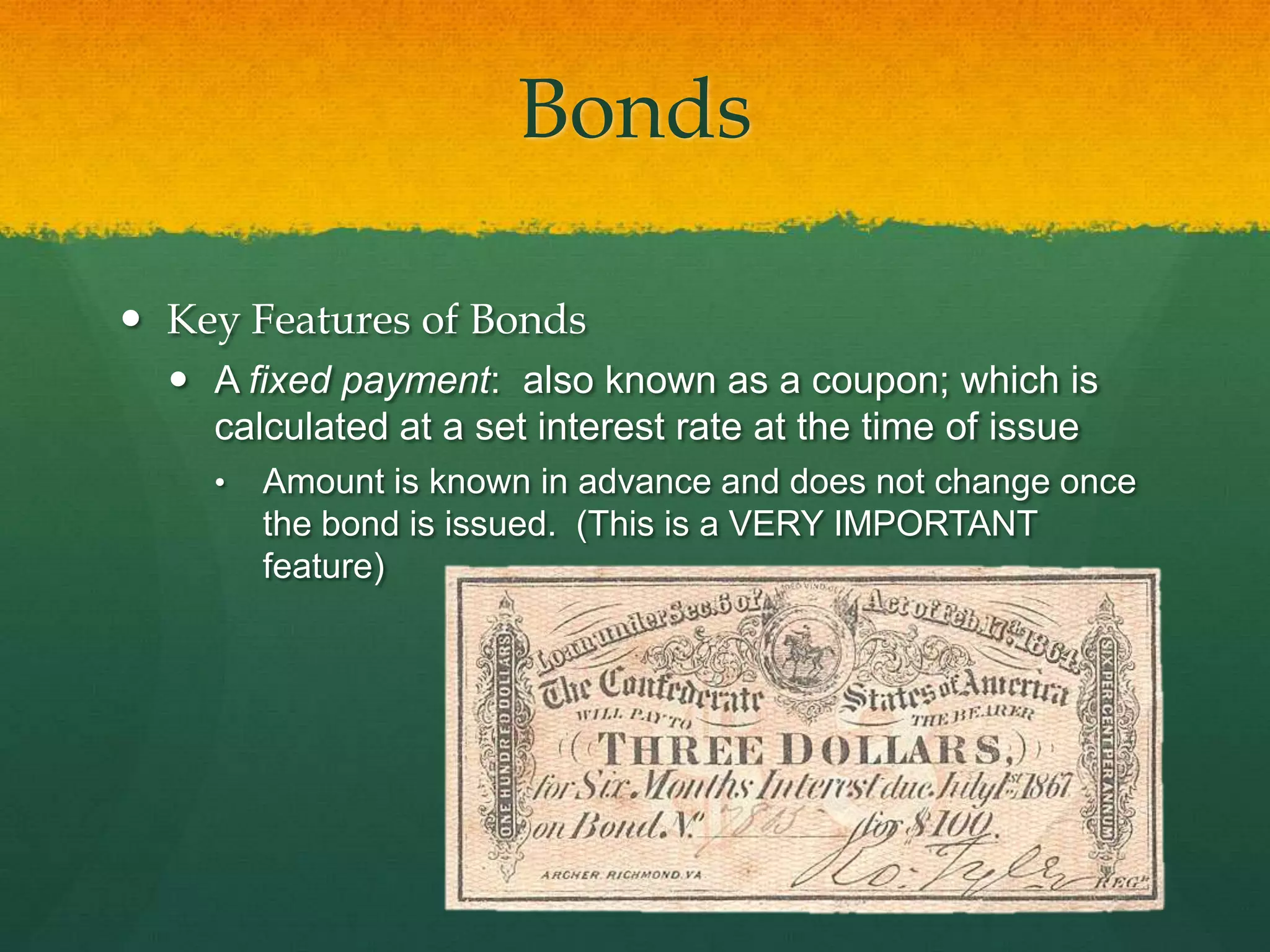
BondsKey Features of BondsA fixed payment:  also known as a coupon; which is calculated at a set interest rate at the time of issueAmount is known in advance and does not change once the bond is issued.  (This is a VERY IMPORTANT feature)BondsKey Features of Bonds	Coupons stay the same
Interest rates change
The result is that bonds can rise or fall in valueWhy Bonds?
Who issues Bonds?CorporateGovernment (Federal or Provincial)MunicipalFinancial Institutions –Mortgage Backed
BenchmarksBenchmarks serve the purpose of comparison.  We compare a certain bond to a benchmark to see if it performs better or worse than the usual.Click here to see a recent table of Canadian Benchmarkshttp://www.tmxmoney.com/HttpController?GetPage=BondsAndRates&Language=en
Bid/Ask Spread?If you are buying a bond, you will pay the Ask Price (always higher)If you are selling a bond, you will received the Bid Price (always lower)The spread or (difference) is kept by the broker as profit.  This is not the same as commission which you will have to pay as well.
Yield to MaturityReceive Coupon payment of 100$ each anniversary100$100$100$Today – Buy Bond 900$Year 3 – Bond Matures 1000$3 Coupon Payments  = 300$Gain from Bond Price = 100$YTM = Gains/Price PaidYTM = 400/900YTM = 44% over 3 years
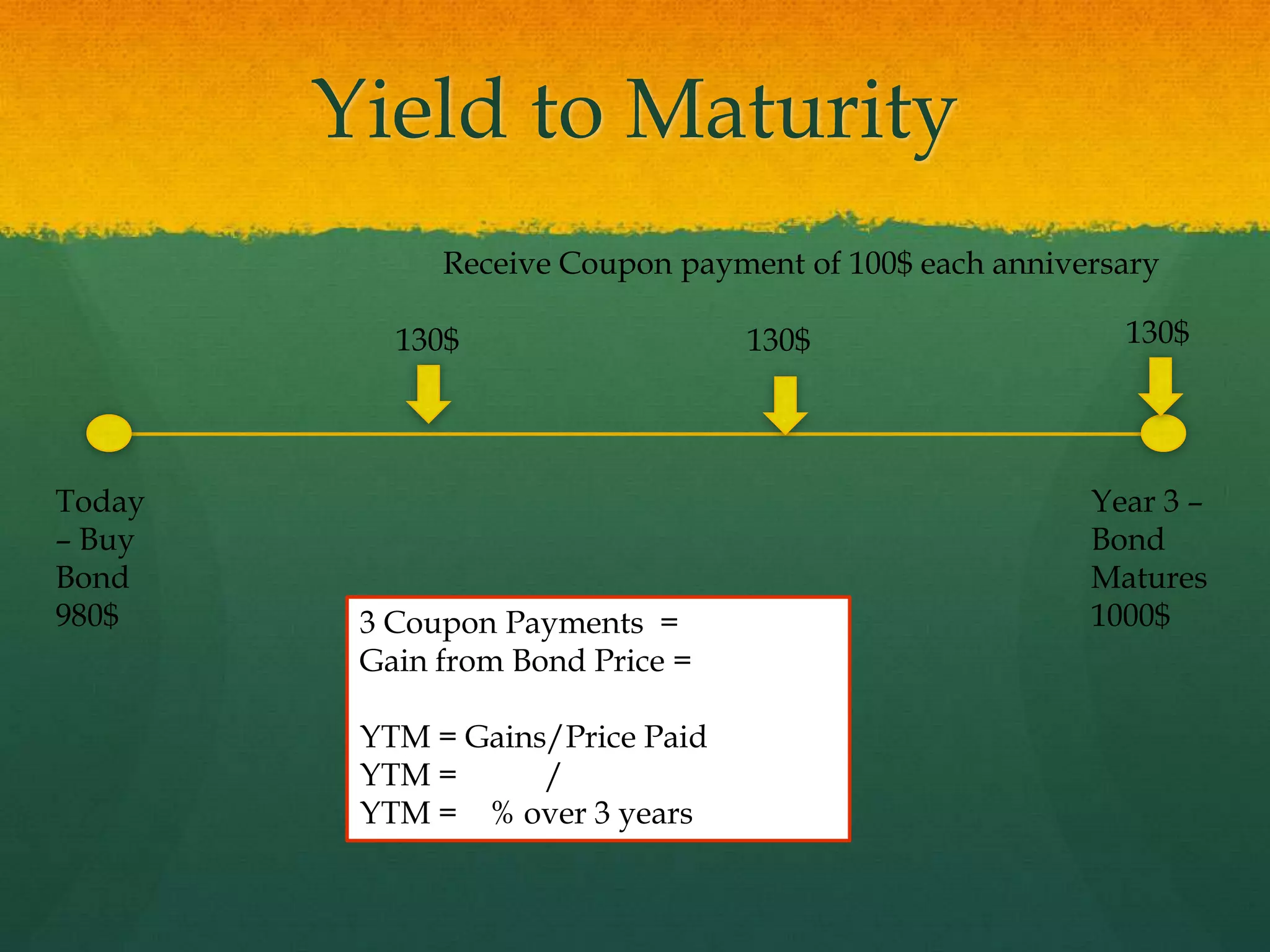
Yield to MaturityReceive Coupon payment of 100$ each anniversary130$130$130$Today – Buy Bond 980$Year 3 – Bond Matures 1000$3 Coupon Payments  =  Gain from Bond Price =  YTM = Gains/Price PaidYTM =           / YTM =    % over 3 years
Do You Recognize Any Companies?
StocksA stock is a certificate that certifies ownership of a certain portion of a firm.When a company issues stocksIt does not borrow funds/add to debtInstead it increase the number of owners
StocksUnlike bonds or direct borrowing, stocks do not promise a fixed annual payment. (Like the coupon)Returns depend on company performance.  If profits are high, the firm may pay dividends.
StocksA capital gain is an increase in the value of an asset. If you buy a share at 10$ and it increases to 15$, your capital gain is 5$A realized capital gain occurs only when the owner sells the stock for a profit
The Common Stock MarketCommon Stock OwnershipDistribution of earnings (variable)Share of assetsRight to votePreferred Stock Similar to Common stock with 2 main differences+ fixed distribution of earnings-- no voting right
Types of Markets - ExchangesPhysical LocationTrading by membersStocks traded are ‘listed’ companiesThere are a number of exchanges around the world; you may have heard of the NYSE or the TSXhttp://en.wikipedia.org/wiki/List_of_stock_exchanges
Bear and BullDescribes upward and downward market trends.  Can be used to describe a security (company), sector or market as a whole
Types of Orders of StockMarket OrderBuy/Sell at market priceLimit OrderBuy/Sell at specific priceStop Loss OrderProtect against big lossesTrailing Stop OrderProtect a profit
Types of Orders of StockGood till CancelledActive until you cancel the orderDay OrderMust be re entered each day if not filledAll or NoneThe entire order must be filled
Common Stock Owners are also referred to as shareholders or equity owners.A brokerage account is where the customer's securities and assets are held in the name of the brokerage firm, rather than you holding the stock certificate yourself. Board of Directors:  A group of individuals that are elected.  Representatives of the stockholders. The roles include such issues  as the hiring/firing of executives, dividend policies, options policies and executive compensation. Every public company must have a Board of Directors.
DividendsDistribution of a portion of a company's earnings, decided by the board of directors, to a class of its shareholders. The dividend is most often quoted in terms of the dollar amount each share receives (i.e. dividends per share or DPS.Most secure and stable companies offer dividends to their stockholders. Their share prices might not move much, but the dividend attempts to make up for this. Common Stock
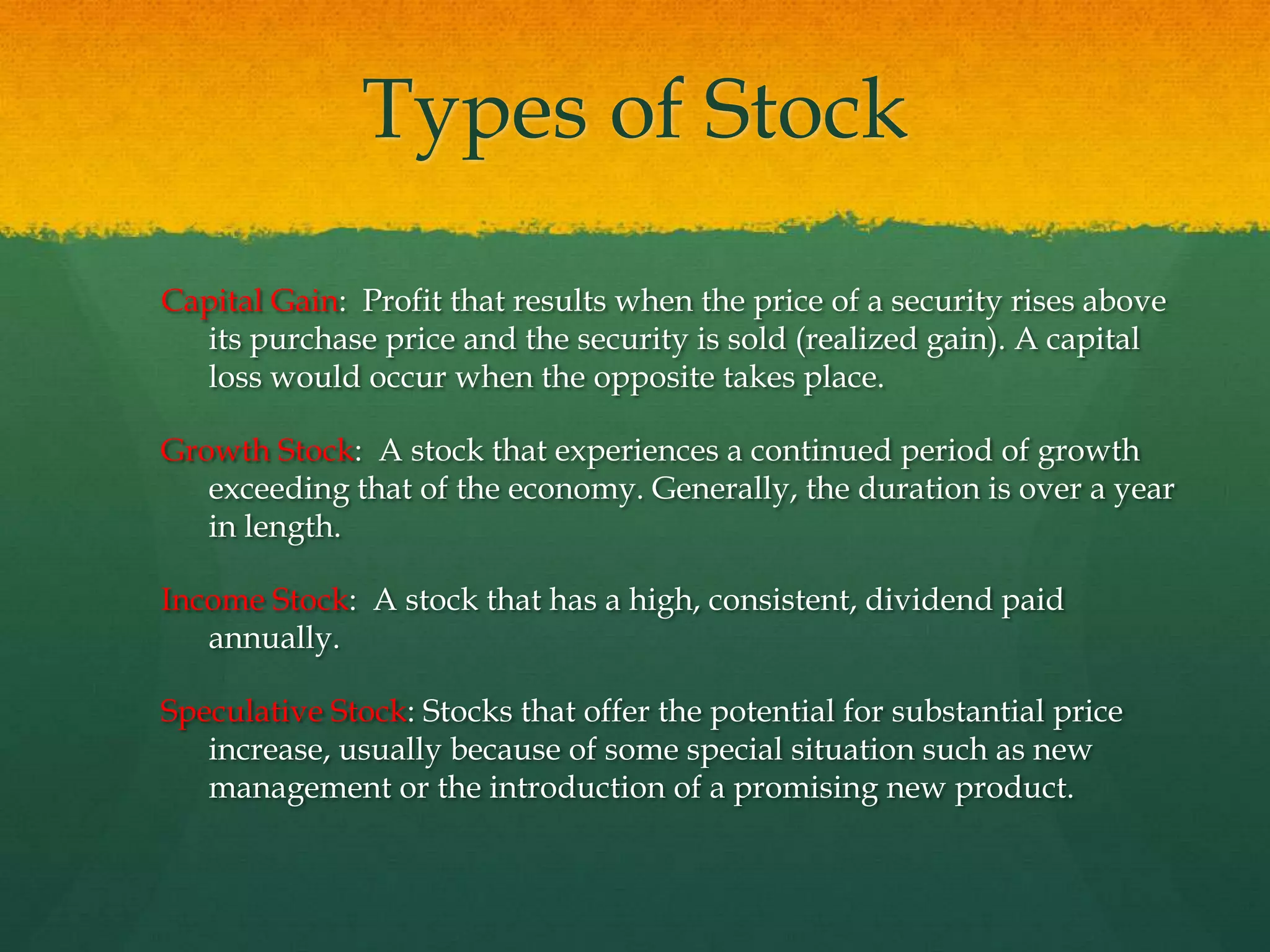
Capital Gain:  Profit that results when the price of a security rises above its purchase price and the security is sold (realized gain). A capital loss would occur when the opposite takes place.Growth Stock:  A stock that experiences a continued period of growth exceeding that of the economy. Generally, the duration is over a year in length.Income Stock:  A stock that has a high, consistent, dividend paid annually.Speculative Stock: Stocks that offer the potential for substantial price increase, usually because of some special situation such as new management or the introduction of a promising new product.Types of Stock
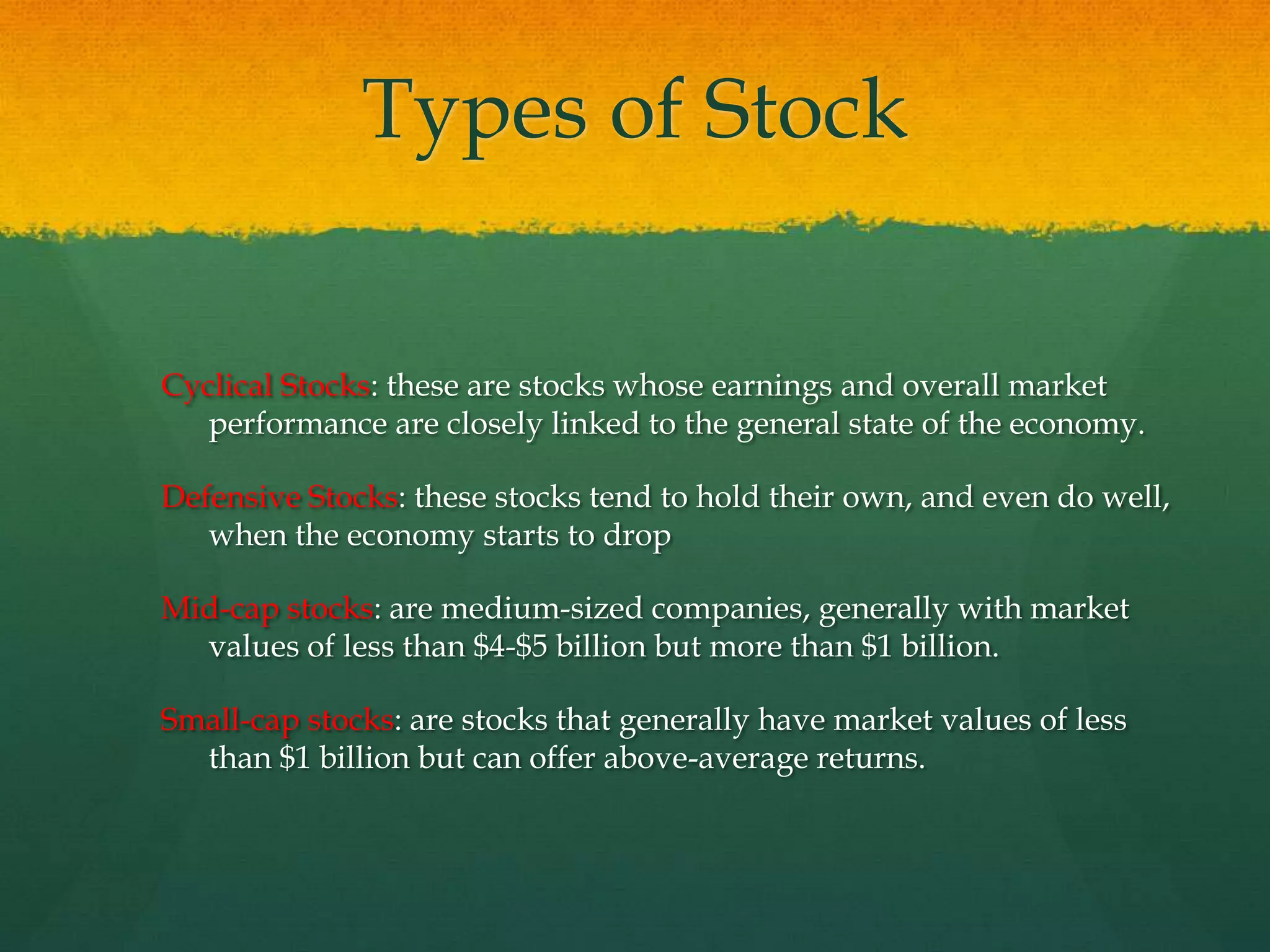
Cyclical Stocks: these are stocks whose earnings and overall market performance are closely linked to the general state of the economy.Defensive Stocks: these stocks tend to hold their own, and even do well, when the economy starts to dropMid-cap stocks: are medium-sized companies, generally with market values of less than $4-$5 billion but more than $1 billion.Small-cap stocks: are stocks that generally have market values of less than $1 billion but can offer above-average returns.Types of Stock
Reading Stock Quotes
Reading Stock QuotesColumns 1 & 252-Week High and Low – The highest and lowest prices the stock traded over the previous 52 weeks (one year) and typically does not include the previous day’s trading.
Reading Stock QuotesColumn 3Company Name & Type of Stock – The name of the company. If no special symbol or letter follows the name, it is common stock. Different symbols indicate different classes of shares (i.e., “pf” means preferred stock).
Reading Stock QuotesColumn 4Ticker Symbol – The unique alphabetic name which identifies the stock. When looking for stock quotes online, you search for a company by the ticker symbol.
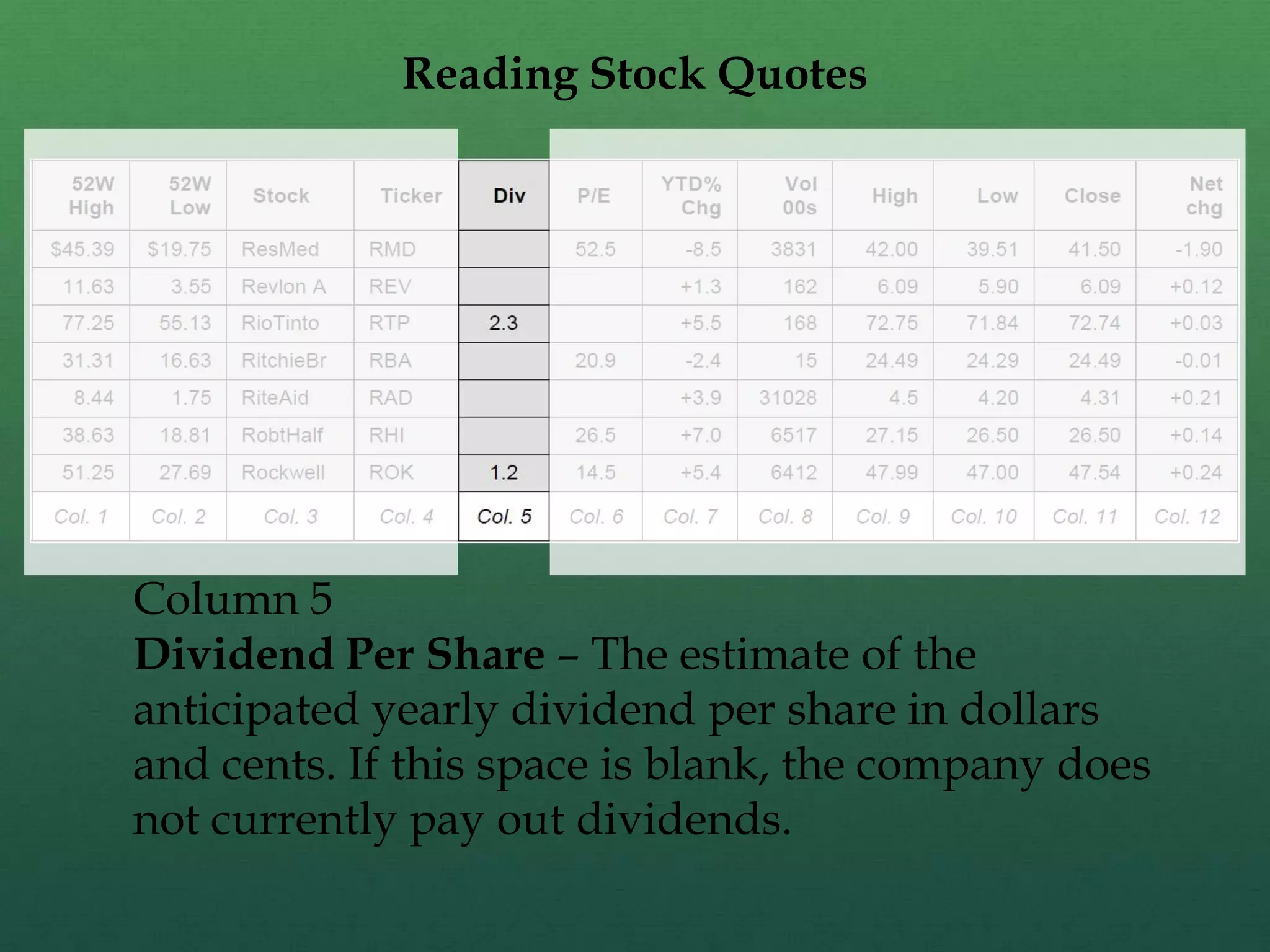
Reading Stock QuotesColumn 5Dividend Per Share – The estimate of the anticipated yearly dividend per share in dollars and cents. If this space is blank, the company does not currently pay out dividends.
Reading Stock QuotesColumn 6Price/Earnings Ratio – Shows the relationship between a stock’s price and the company’s earnings for the last four quarters. Calculated by dividing the current price per share by the earnings per share. (higher is better)
Reading Stock QuotesColumn 7Year-to-Date Percentage Change – Reports gain or loss in each stock’s price as a percentage of its price on January 1.
Reading Stock QuotesColumn 8Trading Volume – The total number of shares traded for the day (in hundreds). Add two zeros to the end of the number listed to get the actual number traded.
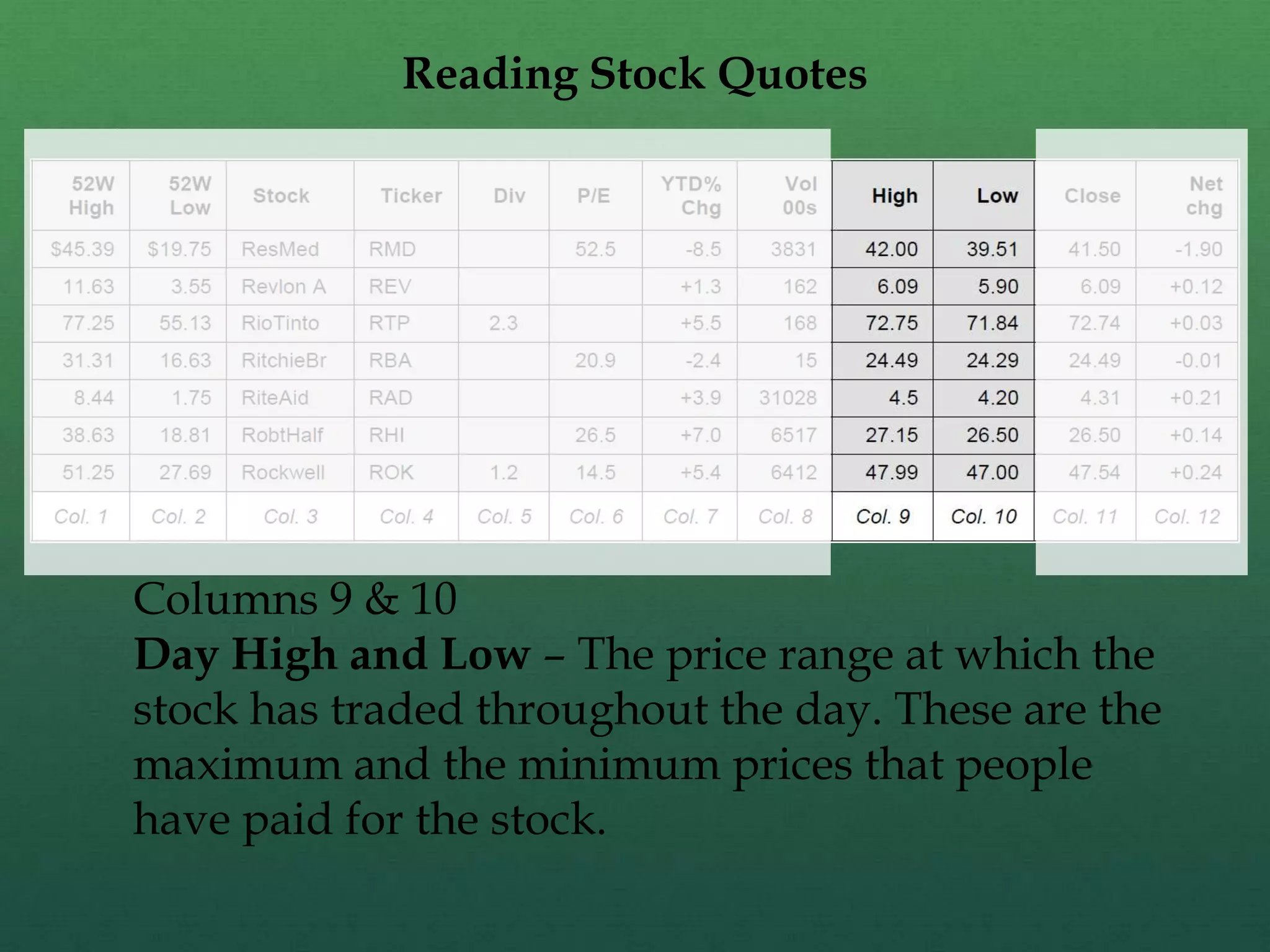
Reading Stock QuotesColumns 9 & 10Day High and Low – The price range at which the stock has traded throughout the day. These are the maximum and the minimum prices that people have paid for the stock.
Reading Stock QuotesColumn 11Close – The last trading price recorded when the market closed on the day..
Reading Stock QuotesColumn 12Net Change – The change in the stock price from the previous day’s closing price in dollars. When the net change is positive, it is recorded as being “up for the day.”
Stock Market IndicatorsMeasures the average performance of a group of stocks on a market.  Gives an overall performance of the market.Canada – S&P/TSXUS – NASDAQ Compsite, Dow Jones Industrial Average etc….List of Indexeshttp://en.wikipedia.org/wiki/List_of_stock_market_indices
DJIAPrice Weighted More expensive stocks makes up bigger portion30 large blue chip companiescross section of industriesLeaders
NASDAQ Composite Index:Based on the stock prices of over 5,000 companies traded on the NASDAQ stock market.National Association of Securities Dealers Automated Quotation System.
S&P 500 (Standard and Poor)Value WeightedPerceived value of company500 large blue chip companiesMost popular benchmark for index fundsWhat Mutual Funds compare themselves against
Determining the Price of StockCoca Cola			vs		Chunky ColaWhat factors would you be considering when trying to decide between buying these two companies?
Determining the Price of a StockPrice affected by:How much $$$ are you excepted to receive (dividends)When are the dividends expected (Payouts, when companies make Profit, they pay dividends to their investors.  The more Shares you have the more Dividends you get)How much risk is involved in the company
Determining the Price of a StockA stock will be worth less if we are unsure about dividendsA stock will be worth more if we are confident about dividends
Determining the Price of a StockPrice of a Stock should be the Present Value of the amounts we are expecting to receive in DividendsAnnouncements of higher expected future dividends or perceived lower risk should increase the firm’s stock price.
Determining the Price of a StockAnother factor that can affect price is Peoples views of a companyOne might call this a bubble because the stock price depends on what people expect that other people expect, etc.
Market EfficiencyIf information is truly public, market prices should reflect that and stock prices are efficient.You are technically not able to ‘beat’ the marketPast Performance NEVER predicts the Future!!!
General Market Strategies
Market CrashesThe Great Wall Street Crash of 1929Aka Black TuesdayThe Crash of 1987Aka Black MondayThe Crash of 2008 (Oct 1 – Oct 10)Black Week Oct 6-Oct 10
LHA Stock Market GameYou will make an Account on www.marketwatch.comSearch for and add yourself to the following game with the password below. Term 1 Game : you will compete against your classmates, each of you has 100 000$ to invest!Game:_______________________Password:___________________

Stock marketv2

  • 1.
    The Stock Market &Introduction to the LHA Stock Market Game Mr. Servello
  • 2.
    MarketsA market isany one of a variety of systems, institutions, procedures, social relations and infrastructures whereby parties engage in exchange (Wikipedia)Stock MarketsBond MarketsFutures MarketsCommodities MarketsCurrency MarketsMoney Markets
  • 3.
    Stocks and BondsCompaniesthat need $$$ can borrow, but they can also issue BondsA bond is a document that formally promises to pay back a loan under specified terms and a given period of time.
  • 4.
    BondsKey Features ofBondsFace value: Price of the bond. The amount that the buyer will pay/lend the issuer
  • 5.
    BondsKey Features ofBondsMaturity date: The date when the Bond expires. The borrower pays back the lender. Bonds can also be sold prior to maturity.
  • 6.
    BondsKey Features ofBondsA fixed payment: also known as a coupon; which is calculated at a set interest rate at the time of issueAmount is known in advance and does not change once the bond is issued. (This is a VERY IMPORTANT feature)BondsKey Features of Bonds Coupons stay the same
  • 7.
  • 8.
    The result isthat bonds can rise or fall in valueWhy Bonds?
  • 9.
    Who issues Bonds?CorporateGovernment(Federal or Provincial)MunicipalFinancial Institutions –Mortgage Backed
  • 10.
    BenchmarksBenchmarks serve thepurpose of comparison. We compare a certain bond to a benchmark to see if it performs better or worse than the usual.Click here to see a recent table of Canadian Benchmarkshttp://www.tmxmoney.com/HttpController?GetPage=BondsAndRates&Language=en
  • 11.
    Bid/Ask Spread?If youare buying a bond, you will pay the Ask Price (always higher)If you are selling a bond, you will received the Bid Price (always lower)The spread or (difference) is kept by the broker as profit. This is not the same as commission which you will have to pay as well.
  • 12.
    Yield to MaturityReceiveCoupon payment of 100$ each anniversary100$100$100$Today – Buy Bond 900$Year 3 – Bond Matures 1000$3 Coupon Payments = 300$Gain from Bond Price = 100$YTM = Gains/Price PaidYTM = 400/900YTM = 44% over 3 years
  • 13.
    Yield to MaturityReceiveCoupon payment of 100$ each anniversary130$130$130$Today – Buy Bond 980$Year 3 – Bond Matures 1000$3 Coupon Payments = Gain from Bond Price = YTM = Gains/Price PaidYTM = / YTM = % over 3 years
  • 14.
    Do You RecognizeAny Companies?
  • 15.
    StocksA stock isa certificate that certifies ownership of a certain portion of a firm.When a company issues stocksIt does not borrow funds/add to debtInstead it increase the number of owners
  • 16.
    StocksUnlike bonds ordirect borrowing, stocks do not promise a fixed annual payment. (Like the coupon)Returns depend on company performance. If profits are high, the firm may pay dividends.
  • 17.
    StocksA capital gainis an increase in the value of an asset. If you buy a share at 10$ and it increases to 15$, your capital gain is 5$A realized capital gain occurs only when the owner sells the stock for a profit
  • 18.
    The Common StockMarketCommon Stock OwnershipDistribution of earnings (variable)Share of assetsRight to votePreferred Stock Similar to Common stock with 2 main differences+ fixed distribution of earnings-- no voting right
  • 19.
    Types of Markets- ExchangesPhysical LocationTrading by membersStocks traded are ‘listed’ companiesThere are a number of exchanges around the world; you may have heard of the NYSE or the TSXhttp://en.wikipedia.org/wiki/List_of_stock_exchanges
  • 21.
    Bear and BullDescribesupward and downward market trends. Can be used to describe a security (company), sector or market as a whole
  • 22.
    Types of Ordersof StockMarket OrderBuy/Sell at market priceLimit OrderBuy/Sell at specific priceStop Loss OrderProtect against big lossesTrailing Stop OrderProtect a profit
  • 23.
    Types of Ordersof StockGood till CancelledActive until you cancel the orderDay OrderMust be re entered each day if not filledAll or NoneThe entire order must be filled
  • 24.
    Common Stock Ownersare also referred to as shareholders or equity owners.A brokerage account is where the customer's securities and assets are held in the name of the brokerage firm, rather than you holding the stock certificate yourself. Board of Directors: A group of individuals that are elected.  Representatives of the stockholders. The roles include such issues as the hiring/firing of executives, dividend policies, options policies and executive compensation. Every public company must have a Board of Directors.
  • 25.
    DividendsDistribution of aportion of a company's earnings, decided by the board of directors, to a class of its shareholders. The dividend is most often quoted in terms of the dollar amount each share receives (i.e. dividends per share or DPS.Most secure and stable companies offer dividends to their stockholders. Their share prices might not move much, but the dividend attempts to make up for this. Common Stock
  • 26.
    Capital Gain: Profit that results when the price of a security rises above its purchase price and the security is sold (realized gain). A capital loss would occur when the opposite takes place.Growth Stock: A stock that experiences a continued period of growth exceeding that of the economy. Generally, the duration is over a year in length.Income Stock: A stock that has a high, consistent, dividend paid annually.Speculative Stock: Stocks that offer the potential for substantial price increase, usually because of some special situation such as new management or the introduction of a promising new product.Types of Stock
  • 27.
    Cyclical Stocks: theseare stocks whose earnings and overall market performance are closely linked to the general state of the economy.Defensive Stocks: these stocks tend to hold their own, and even do well, when the economy starts to dropMid-cap stocks: are medium-sized companies, generally with market values of less than $4-$5 billion but more than $1 billion.Small-cap stocks: are stocks that generally have market values of less than $1 billion but can offer above-average returns.Types of Stock
  • 28.
  • 29.
    Reading Stock QuotesColumns1 & 252-Week High and Low – The highest and lowest prices the stock traded over the previous 52 weeks (one year) and typically does not include the previous day’s trading.
  • 30.
    Reading Stock QuotesColumn3Company Name & Type of Stock – The name of the company. If no special symbol or letter follows the name, it is common stock. Different symbols indicate different classes of shares (i.e., “pf” means preferred stock).
  • 31.
    Reading Stock QuotesColumn4Ticker Symbol – The unique alphabetic name which identifies the stock. When looking for stock quotes online, you search for a company by the ticker symbol.
  • 32.
    Reading Stock QuotesColumn5Dividend Per Share – The estimate of the anticipated yearly dividend per share in dollars and cents. If this space is blank, the company does not currently pay out dividends.
  • 33.
    Reading Stock QuotesColumn6Price/Earnings Ratio – Shows the relationship between a stock’s price and the company’s earnings for the last four quarters. Calculated by dividing the current price per share by the earnings per share. (higher is better)
  • 34.
    Reading Stock QuotesColumn7Year-to-Date Percentage Change – Reports gain or loss in each stock’s price as a percentage of its price on January 1.
  • 35.
    Reading Stock QuotesColumn8Trading Volume – The total number of shares traded for the day (in hundreds). Add two zeros to the end of the number listed to get the actual number traded.
  • 36.
    Reading Stock QuotesColumns9 & 10Day High and Low – The price range at which the stock has traded throughout the day. These are the maximum and the minimum prices that people have paid for the stock.
  • 37.
    Reading Stock QuotesColumn11Close – The last trading price recorded when the market closed on the day..
  • 38.
    Reading Stock QuotesColumn12Net Change – The change in the stock price from the previous day’s closing price in dollars. When the net change is positive, it is recorded as being “up for the day.”
  • 40.
    Stock Market IndicatorsMeasuresthe average performance of a group of stocks on a market. Gives an overall performance of the market.Canada – S&P/TSXUS – NASDAQ Compsite, Dow Jones Industrial Average etc….List of Indexeshttp://en.wikipedia.org/wiki/List_of_stock_market_indices
  • 41.
    DJIAPrice Weighted Moreexpensive stocks makes up bigger portion30 large blue chip companiescross section of industriesLeaders
  • 42.
    NASDAQ Composite Index:Basedon the stock prices of over 5,000 companies traded on the NASDAQ stock market.National Association of Securities Dealers Automated Quotation System.
  • 43.
    S&P 500 (Standardand Poor)Value WeightedPerceived value of company500 large blue chip companiesMost popular benchmark for index fundsWhat Mutual Funds compare themselves against
  • 44.
    Determining the Priceof StockCoca Cola vs Chunky ColaWhat factors would you be considering when trying to decide between buying these two companies?
  • 45.
    Determining the Priceof a StockPrice affected by:How much $$$ are you excepted to receive (dividends)When are the dividends expected (Payouts, when companies make Profit, they pay dividends to their investors. The more Shares you have the more Dividends you get)How much risk is involved in the company
  • 46.
    Determining the Priceof a StockA stock will be worth less if we are unsure about dividendsA stock will be worth more if we are confident about dividends
  • 47.
    Determining the Priceof a StockPrice of a Stock should be the Present Value of the amounts we are expecting to receive in DividendsAnnouncements of higher expected future dividends or perceived lower risk should increase the firm’s stock price.
  • 48.
    Determining the Priceof a StockAnother factor that can affect price is Peoples views of a companyOne might call this a bubble because the stock price depends on what people expect that other people expect, etc.
  • 49.
    Market EfficiencyIf informationis truly public, market prices should reflect that and stock prices are efficient.You are technically not able to ‘beat’ the marketPast Performance NEVER predicts the Future!!!
  • 50.
  • 51.
    Market CrashesThe GreatWall Street Crash of 1929Aka Black TuesdayThe Crash of 1987Aka Black MondayThe Crash of 2008 (Oct 1 – Oct 10)Black Week Oct 6-Oct 10
  • 52.
    LHA Stock MarketGameYou will make an Account on www.marketwatch.comSearch for and add yourself to the following game with the password below. Term 1 Game : you will compete against your classmates, each of you has 100 000$ to invest!Game:_______________________Password:___________________