Unit 3 - Academic The Executive Branch
Day 3.1:  What is the basic makeup of the branch according to Article II? Bell Ringer: 1.  Take 3 minutes to go over Chapter 13. Agenda Bell Ringer Quiz Go over quiz Notes Review
Day 3.2: How did our earliest presidents shape the office? Bell Ringer What are the various titles the president holds? Who is currently the vice-president, Secretary of State and Defense? Name a check the legislative and judicial branch has over the executive. Agenda: Bell Ringer Finish earlier notes. Reading – cover Presidents Washington through, but not including Jackson. In you notes, write down 3 important accomplishments of each prez and three things that support if they are weak or strong. Compare Discussion.
I.  Presidency
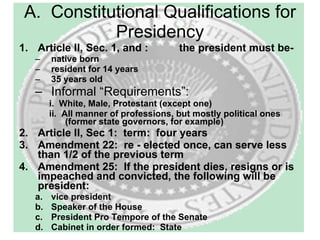
A.  Constitutional Qualifications for Presidency Article II, Sec. 1, and :  the president must be- native born resident for 14 years 35 years old Informal “Requirements”: i.  White, Male, Protestant (except one)  ii.  All manner of professions, but mostly political ones (former state governors, for example) Article II, Sec 1:  term:  four years Amendment 22:  re - elected once, can serve less than 1/2 of the previous term Amendment 25:  If the president dies, resigns or is impeached and convicted, the following will be president: vice president  Speaker of the House President Pro Tempore of the Senate Cabinet in order formed:  State
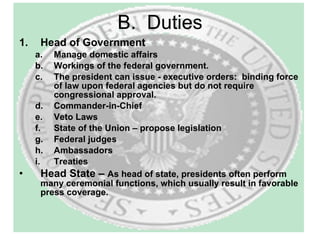
B.  Duties Head of Government  Manage domestic affairs Workings of the federal government.  The president can issue - executive orders:  binding force of law upon federal agencies but do not require congressional approval.  Commander-in-Chief Veto Laws State of the Union – propose legislation Federal judges Ambassadors Treaties Head State –  As head of state, presidents often perform many ceremonial functions, which usually result in favorable press coverage.
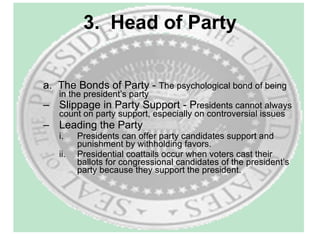
3.  Head of Party a.  The Bonds of Party -  The psychological bond of being in the president’s party Slippage in Party Support - P residents cannot always count on party support, especially on controversial issues Leading the Party Presidents can offer party candidates support and punishment by withholding favors. Presidential coattails occur when voters cast their ballots for congressional candidates of the president’s party because they support the president.
C.  Character or Manner of Ruling Passive: Relies on advisors Pass the blame to them Doesn’t like a lot of info  Active: Makes most decisions Takes the blame Policy wonk (likes to read and know a lot) Negative Dislikes the presidency Accepted it out of reluctance Hates the “limelight” Socially introverted. Positive: Loves “pomp and circumstance.” Enjoys attention of the presidency.  Socially extroverted.
D. Washington Established precedents Dignity and honor of the presidency. Supremacy of federal government and executive branch (Whiskey Rebellion). Foreign affairs –  Neutrality Act Peace with Jay’s Treaty with Britain
E.  Adams and Jefferson Adams Elected by the House of Representatives because no one received a majority. Believed in a strong federal government Loose constructionist – build on the Constitution Passed the Alien and Sedition Acts to silence critics Jefferson a.  Popular among people b.  Strict constructionist – do only what the Constitution says. c.  Slashed the size of the government – fiscally conservative d.  Liberal when it came to rights. e.  Made the LA Purchase reluctantly f.  Sent navy to fight pirates in north of Africa. g.  Embargo Act made him unpopular.
F.  General Trends Presidents become unpopular over their term (usually). Politicians become more moderate overtime (usually). Perspectives on Presidential Power Through the 50’s & 60’s a powerful President was perceived as good. From the 70’s on, presidential power was checked and distrusted by the public.
Jackson - Democrat South Carolina says no to higher tariffs President threatens to invade SC Congress compromises with lower tax Indian Removal Act Supreme Court says it is unconstitutional President says “who cares” and removes them anyway. Veto Says no to 2 nd  Bank of the USA, over Congress’s objection Vetoes more bills than all previous presidents combined Tyler - Whig a.  Called “His Accidency” b.  Congress thinks he is a joke. c.  He vetoes many laws so his Cabinet quits and the Whig party kicks him out. Polk - Democrat a.  Controls all decisions of Mexican War b.  Is jealous of his generals (they are Whigs) c.  Works so hard he gets sick and cannot run again. G. Manifest Destiny Presidents
H. Abraham Lincoln - Republican Led us during Civil War. Suspended habeas corpus. Arrests government officials who want to secede to South. Arrests reporters who sympathize with the South. Declares martial law in some places.  Raises military without permission from Congress. Figures he can do it because the country is mostly Republican.
I.  Weak Presidents Andrew Johnson Southern, racist, and democrat Accidental president. Would not reconstruct the South the way Congress wanted. Impeached, but not removed. Ulysses S. Grant Civil War hero. Failed to reconstruct the South or protect blacks. Trusted corrupt friends too much.
J.  Modern Presidents Teddy Roosevelt Environmentalist Food and Drug inspections Panama Canal 2.  Woodrow Wilson WWI Failed League of Nations 3.  FDR New Deal Elected to four terms. WWII United Nations
Truman Used atom bomb to finish WWII. Fought as underdog to win election in 1948. Continued the New Deal. Sent troops to fight North Korean communists. Eisenhower Brought back troops from Korea. Peaceful, prosperous era. Tried to ignore Civil Rights, but had to send troops to Little Rock to protect black students who attended white school. Kennedy New Frontier – help poor, lower taxes, space program. Bay of Pigs – failed to provide air support for Cubans that were invading communist island. Cuban Missile Crisis – Blockaded island to stop nuclear weapons from going in or out. Soviets agree to take back weapons if we do the same in Turkey. We promise to leave Cuba alone.  Assassinated in Dallas.
7.  Johnson Continues Kennedy's programs. Signs Civil Rights bill. Creates “Great Society” to help poor, working class, young, and elderly. Wins 1964 election by landslide, but is then bogged down by Vietnam. 8.  Nixon Pulls us out of Vietnam. Makes peace with China and USSR. Covers up Watergate scandal. Resigns. 9.  Ford – pardons Nixon and is unable to bring the nation together politically or economically. 10.  Carter – Southern governor that is an outsider.  Bad economy and Americans taken hostage in Iran bogs him down.
11.  Reagan a.  Brings hope to America – “Have pride in yourself.” b.  Get things done without evil government. c.  Cuts taxes and spends bug on military to scare USSR. 12.  Clinton a. Balances budget. b.  Reforms welfare to work. c.  Tax deductions to lower and middle class. d.  Increases spending to education and crime fighting. e.  Impeached because he lied under oath about Lewinsky affair, but not removed.
Bureaucracy White House Staff Cabinet Civil Servants Major Agencies
White House Staff Close advisors, researchers, organize schedule. Most work in Executive Office Building. Closest work in West Wing. Chief of Staff, Press Secretary, Counsel, Communications Director.
Cabinet 13 Departments State Defense Treasury Justice – Attorney General Interior Homeland Security
Civil Servants Use to be Patronage or Spoils System (knew people to get job). Pendleton Act eliminated patronage and made way for Civil Service System.  System= jobs, pay, and promotion depend upon testing, seniority, and professionalism. 5 Characteristics Specialization Hierarchy Explicit Rules Impartiality Merit Promotions
Major Agencies CIA NSA FBI IRS EPA INS
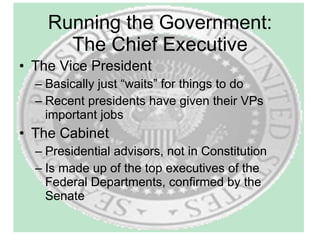
Running the Government: The Chief Executive The Vice President Basically just “waits” for things to do Recent presidents have given their VPs important jobs The Cabinet Presidential advisors, not in Constitution Is made up of the top executives of the Federal Departments, confirmed by the Senate
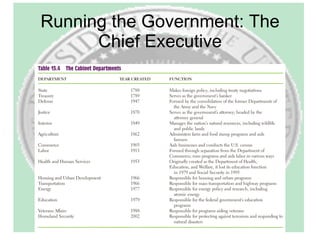
Running the Government: The Chief Executive
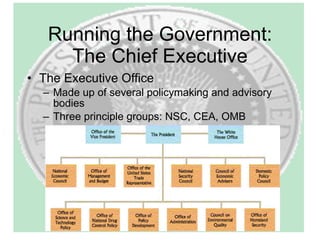
Running the Government: The Chief Executive The Executive Office Made up of several policymaking and advisory bodies Three principle groups: NSC, CEA, OMB Figure 13.1
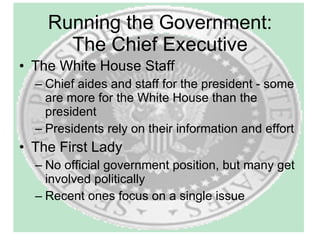
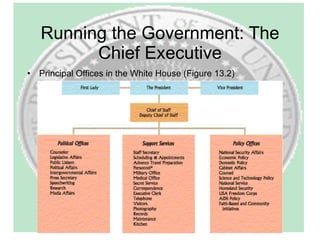
Running the Government: The Chief Executive The White House Staff Chief aides and staff for the president - some are more for the White House than the president Presidents rely on their information and effort The First Lady No official government position, but many get involved politically Recent ones focus on a single issue
Running the Government: The Chief Executive Principal Offices in the White House (Figure 13.2)
Introduction Classic conception of bureaucracy (Max Weber) Hierarchical authority structure Uses task specialization Operate on the merit principle Behave with impersonality A well-organized machine with lots of working parts.
The Bureaucrats Some Bureaucratic Myths and Realities Americans dislike bureaucrats. Bureaucracies are growing bigger each year. Most federal bureaucrats work in Washington, D.C. Bureaucracies are ineffective, inefficient and always mired in red tape.
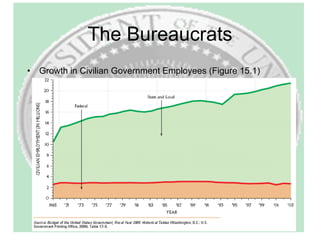
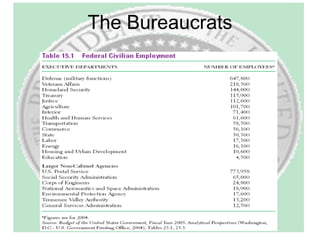
The Bureaucrats Growth in Civilian Government Employees (Figure 15.1)
The Bureaucrats
The Bureaucrats Who They Are and How They Got There Civil Service: From Patronage to Protection. Patronage: Job given for political reasons. Civil Service: System of hiring and promotion based on merit and nonpartisanship (Pendleton Civil Service Act). Merit Principle: Entrance exams and promotion ratings to find people with talent and skill. Office of Personnel Management: The federal office in charge of most of the government’s hiring.
The Bureaucrats Who They Are and How They Got There The Other Route to Federal Jobs: Recruiting from the Plum Book Lists the very top jobs available for Presidential appointment. Presidents work to find capable people to fill the positions. Some plum jobs (ambassadorships) are patronage. Their most important trait is transience.
How Bureaucracies Are Organized The Cabinet Departments 13 Cabinet departments headed by a secretary Department of Justice headed by Attorney General Each has its own budget, staff and policy areas Status as a cabinet department can be controversial.
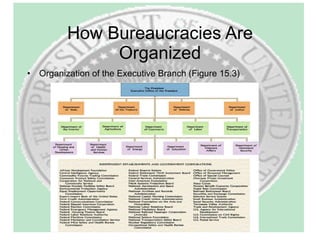
How Bureaucracies Are Organized Organization of the Executive Branch (Figure 15.3)
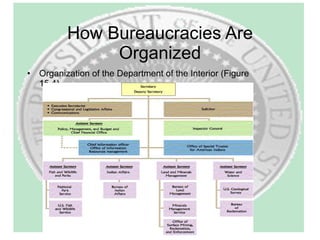
How Bureaucracies Are Organized Organization of the Department of the Interior (Figure 15.4)
Understanding Bureaucracies Bureaucracy and Democracy Presidents Try to Control the Bureaucracy Appoint the right people. Issue executive orders. Tinker with the agency’s budget. Reorganize an agency.
Understanding Bureaucracies Bureaucracy and Democracy Congress Tries to Control the Bureaucracy Influence presidential appointments. Tinker with the agency’s budget. Hold hearings. Rewrite the legislation or make it more detailed.
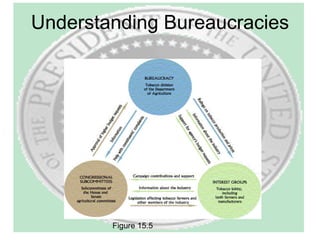
Understanding Bureaucracies Bureaucracy and Democracy Iron Triangles and Issue Networks Iron Triangles: A mutually dependent relationship between bureaucratic agencies, interest groups, and congressional committees or subcommittees. Exist independently of each other. They are tough, but not impossible, to get rid of. Some argue they are being replaced by wider  issue networks  that focus on more policies.
Understanding Bureaucracies Figure 15.5
Understanding Bureaucracies Bureaucracy and the Scope of Government Many state that this is an example of a government out of control. But, the size of the bureaucracy has shrunk. Some agencies don’t have enough resources to do what they are expected to do. Only carry out the policies, Congress and the president decide what needs to be done.

Unit 3 academic

  • 1.
    Unit 3 -Academic The Executive Branch
  • 2.
    Day 3.1: What is the basic makeup of the branch according to Article II? Bell Ringer: 1. Take 3 minutes to go over Chapter 13. Agenda Bell Ringer Quiz Go over quiz Notes Review
  • 3.
    Day 3.2: Howdid our earliest presidents shape the office? Bell Ringer What are the various titles the president holds? Who is currently the vice-president, Secretary of State and Defense? Name a check the legislative and judicial branch has over the executive. Agenda: Bell Ringer Finish earlier notes. Reading – cover Presidents Washington through, but not including Jackson. In you notes, write down 3 important accomplishments of each prez and three things that support if they are weak or strong. Compare Discussion.
  • 4.
  • 5.
    A. ConstitutionalQualifications for Presidency Article II, Sec. 1, and : the president must be- native born resident for 14 years 35 years old Informal “Requirements”: i. White, Male, Protestant (except one) ii. All manner of professions, but mostly political ones (former state governors, for example) Article II, Sec 1: term: four years Amendment 22: re - elected once, can serve less than 1/2 of the previous term Amendment 25: If the president dies, resigns or is impeached and convicted, the following will be president: vice president Speaker of the House President Pro Tempore of the Senate Cabinet in order formed: State
  • 6.
    B. DutiesHead of Government Manage domestic affairs Workings of the federal government. The president can issue - executive orders: binding force of law upon federal agencies but do not require congressional approval. Commander-in-Chief Veto Laws State of the Union – propose legislation Federal judges Ambassadors Treaties Head State – As head of state, presidents often perform many ceremonial functions, which usually result in favorable press coverage.
  • 7.
    3. Headof Party a. The Bonds of Party - The psychological bond of being in the president’s party Slippage in Party Support - P residents cannot always count on party support, especially on controversial issues Leading the Party Presidents can offer party candidates support and punishment by withholding favors. Presidential coattails occur when voters cast their ballots for congressional candidates of the president’s party because they support the president.
  • 8.
    C. Characteror Manner of Ruling Passive: Relies on advisors Pass the blame to them Doesn’t like a lot of info Active: Makes most decisions Takes the blame Policy wonk (likes to read and know a lot) Negative Dislikes the presidency Accepted it out of reluctance Hates the “limelight” Socially introverted. Positive: Loves “pomp and circumstance.” Enjoys attention of the presidency. Socially extroverted.
  • 9.
    D. Washington Establishedprecedents Dignity and honor of the presidency. Supremacy of federal government and executive branch (Whiskey Rebellion). Foreign affairs – Neutrality Act Peace with Jay’s Treaty with Britain
  • 10.
    E. Adamsand Jefferson Adams Elected by the House of Representatives because no one received a majority. Believed in a strong federal government Loose constructionist – build on the Constitution Passed the Alien and Sedition Acts to silence critics Jefferson a. Popular among people b. Strict constructionist – do only what the Constitution says. c. Slashed the size of the government – fiscally conservative d. Liberal when it came to rights. e. Made the LA Purchase reluctantly f. Sent navy to fight pirates in north of Africa. g. Embargo Act made him unpopular.
  • 11.
    F. GeneralTrends Presidents become unpopular over their term (usually). Politicians become more moderate overtime (usually). Perspectives on Presidential Power Through the 50’s & 60’s a powerful President was perceived as good. From the 70’s on, presidential power was checked and distrusted by the public.
  • 12.
    Jackson - DemocratSouth Carolina says no to higher tariffs President threatens to invade SC Congress compromises with lower tax Indian Removal Act Supreme Court says it is unconstitutional President says “who cares” and removes them anyway. Veto Says no to 2 nd Bank of the USA, over Congress’s objection Vetoes more bills than all previous presidents combined Tyler - Whig a. Called “His Accidency” b. Congress thinks he is a joke. c. He vetoes many laws so his Cabinet quits and the Whig party kicks him out. Polk - Democrat a. Controls all decisions of Mexican War b. Is jealous of his generals (they are Whigs) c. Works so hard he gets sick and cannot run again. G. Manifest Destiny Presidents
  • 13.
    H. Abraham Lincoln- Republican Led us during Civil War. Suspended habeas corpus. Arrests government officials who want to secede to South. Arrests reporters who sympathize with the South. Declares martial law in some places. Raises military without permission from Congress. Figures he can do it because the country is mostly Republican.
  • 14.
    I. WeakPresidents Andrew Johnson Southern, racist, and democrat Accidental president. Would not reconstruct the South the way Congress wanted. Impeached, but not removed. Ulysses S. Grant Civil War hero. Failed to reconstruct the South or protect blacks. Trusted corrupt friends too much.
  • 15.
    J. ModernPresidents Teddy Roosevelt Environmentalist Food and Drug inspections Panama Canal 2. Woodrow Wilson WWI Failed League of Nations 3. FDR New Deal Elected to four terms. WWII United Nations
  • 16.
    Truman Used atombomb to finish WWII. Fought as underdog to win election in 1948. Continued the New Deal. Sent troops to fight North Korean communists. Eisenhower Brought back troops from Korea. Peaceful, prosperous era. Tried to ignore Civil Rights, but had to send troops to Little Rock to protect black students who attended white school. Kennedy New Frontier – help poor, lower taxes, space program. Bay of Pigs – failed to provide air support for Cubans that were invading communist island. Cuban Missile Crisis – Blockaded island to stop nuclear weapons from going in or out. Soviets agree to take back weapons if we do the same in Turkey. We promise to leave Cuba alone. Assassinated in Dallas.
  • 17.
    7. JohnsonContinues Kennedy's programs. Signs Civil Rights bill. Creates “Great Society” to help poor, working class, young, and elderly. Wins 1964 election by landslide, but is then bogged down by Vietnam. 8. Nixon Pulls us out of Vietnam. Makes peace with China and USSR. Covers up Watergate scandal. Resigns. 9. Ford – pardons Nixon and is unable to bring the nation together politically or economically. 10. Carter – Southern governor that is an outsider. Bad economy and Americans taken hostage in Iran bogs him down.
  • 18.
    11. Reagana. Brings hope to America – “Have pride in yourself.” b. Get things done without evil government. c. Cuts taxes and spends bug on military to scare USSR. 12. Clinton a. Balances budget. b. Reforms welfare to work. c. Tax deductions to lower and middle class. d. Increases spending to education and crime fighting. e. Impeached because he lied under oath about Lewinsky affair, but not removed.
  • 19.
    Bureaucracy White HouseStaff Cabinet Civil Servants Major Agencies
  • 20.
    White House StaffClose advisors, researchers, organize schedule. Most work in Executive Office Building. Closest work in West Wing. Chief of Staff, Press Secretary, Counsel, Communications Director.
  • 21.
    Cabinet 13 DepartmentsState Defense Treasury Justice – Attorney General Interior Homeland Security
  • 22.
    Civil Servants Useto be Patronage or Spoils System (knew people to get job). Pendleton Act eliminated patronage and made way for Civil Service System. System= jobs, pay, and promotion depend upon testing, seniority, and professionalism. 5 Characteristics Specialization Hierarchy Explicit Rules Impartiality Merit Promotions
  • 23.
    Major Agencies CIANSA FBI IRS EPA INS
  • 24.
    Running the Government:The Chief Executive The Vice President Basically just “waits” for things to do Recent presidents have given their VPs important jobs The Cabinet Presidential advisors, not in Constitution Is made up of the top executives of the Federal Departments, confirmed by the Senate
  • 25.
    Running the Government:The Chief Executive
  • 26.
    Running the Government:The Chief Executive The Executive Office Made up of several policymaking and advisory bodies Three principle groups: NSC, CEA, OMB Figure 13.1
  • 27.
    Running the Government:The Chief Executive The White House Staff Chief aides and staff for the president - some are more for the White House than the president Presidents rely on their information and effort The First Lady No official government position, but many get involved politically Recent ones focus on a single issue
  • 28.
    Running the Government:The Chief Executive Principal Offices in the White House (Figure 13.2)
  • 29.
    Introduction Classic conceptionof bureaucracy (Max Weber) Hierarchical authority structure Uses task specialization Operate on the merit principle Behave with impersonality A well-organized machine with lots of working parts.
  • 30.
    The Bureaucrats SomeBureaucratic Myths and Realities Americans dislike bureaucrats. Bureaucracies are growing bigger each year. Most federal bureaucrats work in Washington, D.C. Bureaucracies are ineffective, inefficient and always mired in red tape.
  • 31.
    The Bureaucrats Growthin Civilian Government Employees (Figure 15.1)
  • 32.
  • 33.
    The Bureaucrats WhoThey Are and How They Got There Civil Service: From Patronage to Protection. Patronage: Job given for political reasons. Civil Service: System of hiring and promotion based on merit and nonpartisanship (Pendleton Civil Service Act). Merit Principle: Entrance exams and promotion ratings to find people with talent and skill. Office of Personnel Management: The federal office in charge of most of the government’s hiring.
  • 34.
    The Bureaucrats WhoThey Are and How They Got There The Other Route to Federal Jobs: Recruiting from the Plum Book Lists the very top jobs available for Presidential appointment. Presidents work to find capable people to fill the positions. Some plum jobs (ambassadorships) are patronage. Their most important trait is transience.
  • 35.
    How Bureaucracies AreOrganized The Cabinet Departments 13 Cabinet departments headed by a secretary Department of Justice headed by Attorney General Each has its own budget, staff and policy areas Status as a cabinet department can be controversial.
  • 36.
    How Bureaucracies AreOrganized Organization of the Executive Branch (Figure 15.3)
  • 37.
    How Bureaucracies AreOrganized Organization of the Department of the Interior (Figure 15.4)
  • 38.
    Understanding Bureaucracies Bureaucracyand Democracy Presidents Try to Control the Bureaucracy Appoint the right people. Issue executive orders. Tinker with the agency’s budget. Reorganize an agency.
  • 39.
    Understanding Bureaucracies Bureaucracyand Democracy Congress Tries to Control the Bureaucracy Influence presidential appointments. Tinker with the agency’s budget. Hold hearings. Rewrite the legislation or make it more detailed.
  • 40.
    Understanding Bureaucracies Bureaucracyand Democracy Iron Triangles and Issue Networks Iron Triangles: A mutually dependent relationship between bureaucratic agencies, interest groups, and congressional committees or subcommittees. Exist independently of each other. They are tough, but not impossible, to get rid of. Some argue they are being replaced by wider issue networks that focus on more policies.
  • 41.
  • 42.
    Understanding Bureaucracies Bureaucracyand the Scope of Government Many state that this is an example of a government out of control. But, the size of the bureaucracy has shrunk. Some agencies don’t have enough resources to do what they are expected to do. Only carry out the policies, Congress and the president decide what needs to be done.