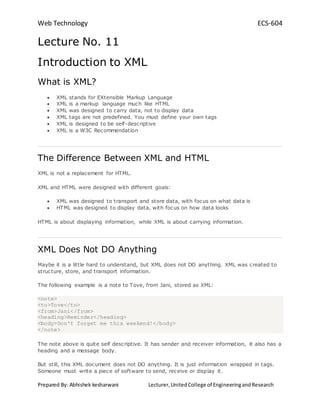
The document provides an introduction to XML, explaining what it is, how it differs from HTML, its core syntax rules and uses. The key points are:
1. XML stands for Extensible Markup Language and is used to carry and store data, unlike HTML which is used to display data. XML allows users to define their own tags.
2. XML documents form a tree structure with a root element and child elements. All elements must have a closing tag and be properly nested.
3. XML is commonly used to transport and share data between incompatible systems by storing data in a standardized, readable text format. It also separates data from presentation to simplify updating dynamic web pages.