1
SPORT CONSUMERSPORT CONSUMER
BEHAVIORBEHAVIOR
Unit 2
Mr. Elsesser
Sports Marketing
2
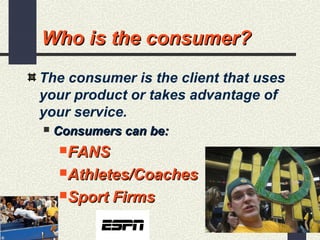
Who is the consumer?Who is the consumer?
The consumer is the client that uses
your product or takes advantage of
your service.
 Consumers can be:Consumers can be:
FANSFANS
Athletes/CoachesAthletes/Coaches
Sport FirmsSport Firms
3
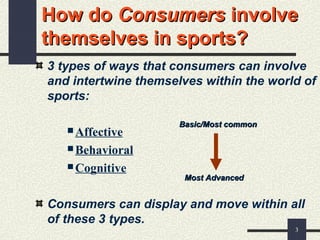
3 types of ways that consumers can involve
and intertwine themselves within the world of
sports:
 Affective
 Behavioral
 Cognitive
Consumers can display and move within all
of these 3 types.
How doHow do ConsumersConsumers involveinvolve
themselves in sports?themselves in sports?
Basic/Most commonBasic/Most common
Most AdvancedMost Advanced
4
BRAINSTORMBRAINSTORM
Write down what do youWrite down what do you
think AFFECTIVEthink AFFECTIVE
INVOLVEMENT is?INVOLVEMENT is?
5
AFFECTIVEAFFECTIVE INVOLVEMENTINVOLVEMENT
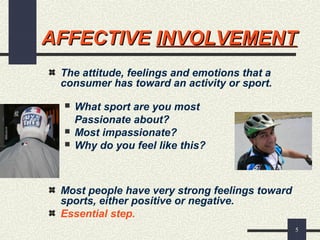
The attitude, feelings and emotions that a
consumer has toward an activity or sport.
 What sport are you most
Passionate about?
 Most impassionate?
 Why do you feel like this?
Most people have very strong feelings toward
sports, either positive or negative.
Essential step.
6
BRAINSTORMBRAINSTORM
Write down what do youWrite down what do you
think BEHAVORIALthink BEHAVORIAL
INVOLVEMENT is?INVOLVEMENT is?
7
BEHAVIORALBEHAVIORAL INVOLVEMENTINVOLVEMENT
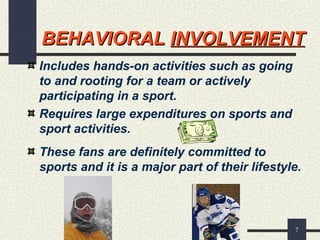
Includes hands-on activities such as going
to and rooting for a team or actively
participating in a sport.
Requires large expenditures on sports and
sport activities.
These fans are definitely committed to
sports and it is a major part of their lifestyle.
8
BRAINSTORMBRAINSTORM
Write down what do youWrite down what do you
think COGNITIVEthink COGNITIVE
INVOLVEMENT is?INVOLVEMENT is?
9
COGNITIVECOGNITIVE INVOLVEMENTINVOLVEMENT
The acquisition of information and
knowledge about a sport.
Magazines, newspapers, internet
blogs, game programs, radio, and TV
are ways that the cognitive fan can
keep up with and learn about a
particular sport or the players.
10
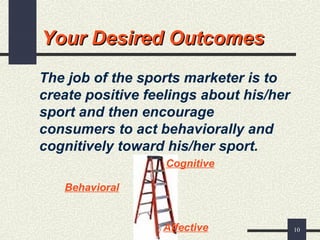
Your Desired OutcomesYour Desired Outcomes
The job of the sports marketer is to
create positive feelings about his/her
sport and then encourage
consumers to act behaviorally and
cognitively toward his/her sport.
Cognitive
Affective
Behavioral
11
TEAM ACTIVITYTEAM ACTIVITY
EMPOWERING YOUR FANS:EMPOWERING YOUR FANS:
 Since your Fantasy Franchises are new toSince your Fantasy Franchises are new to
your area, you need to induce some energyyour area, you need to induce some energy
about your team to your new fan base.about your team to your new fan base.
 You will come up with a strategy that canYou will come up with a strategy that can
be used to engage your fans to movebe used to engage your fans to move
through each level of involvement, startingthrough each level of involvement, starting
with Affective.with Affective.
Turn in one sheet per teamTurn in one sheet per team
12
What are some factorsWhat are some factors
that influence your dailythat influence your daily
choices and behaviors?choices and behaviors?
13
ENVIRONMENTAL FACTORS FORENVIRONMENTAL FACTORS FOR
SPORT INVOLVEMENTSPORT INVOLVEMENT
SIGNIFICANT OTHERS
CULTURAL NORMS AND VALUES
CLASS, RACE, GENDER RELATIONS
CLIMATIC AND GEOGRAPHIC
CONDITIONS
MARKET BEHAVIOR OF SPORT FIRMS
AND ORGANIZATIONS
14
SIGNIFICANT OTHERSSIGNIFICANT OTHERS
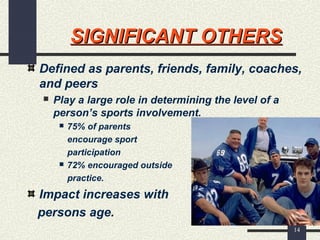
Defined as parents, friends, family, coaches,
and peers
 Play a large role in determining the level of a
person’s sports involvement.
 75% of parents
encourage sport
participation
 72% encouraged outside
practice.
Impact increases with
persons age.
15
CULTURALCULTURAL
NORMS AND VALUESNORMS AND VALUES
American culture emphasizes sports as a way
of teaching character, discipline, fitness and
competition along with other values.
Other countries either don’t emphasize sports
or perhaps promote different ones.
 Ex) American Football vs. European Football
Regions within our own country tend to view
sports differently as part of the culture.
 Ex) High School Football in America
16
SOCIAL CLASS FACTORSSOCIAL CLASS FACTORS
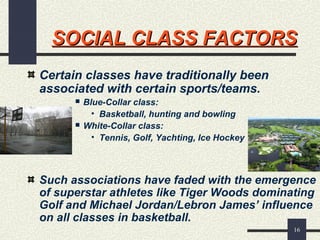
Certain classes have traditionally been
associated with certain sports/teams.
 Blue-Collar class:
• Basketball, hunting and bowling
 White-Collar class:
• Tennis, Golf, Yachting, Ice Hockey
Such associations have faded with the emergence
of superstar athletes like Tiger Woods dominating
Golf and Michael Jordan/Lebron James’ influence
on all classes in basketball.
17
RACE FACTORSRACE FACTORS
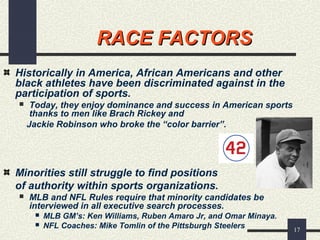
Historically in America, African Americans and other
black athletes have been discriminated against in the
participation of sports.
 Today, they enjoy dominance and success in American sports
thanks to men like Brach Rickey and
Jackie Robinson who broke the “color barrier”.
Minorities still struggle to find positions
of authority within sports organizations.
 MLB and NFL Rules require that minority candidates be
interviewed in all executive search processes.
 MLB GM’s: Ken Williams, Ruben Amaro Jr, and Omar Minaya.
 NFL Coaches: Mike Tomlin of the Pittsburgh Steelers
18
GENDER FACTORSGENDER FACTORS
Females have not always had equal opportunities to
take part in the American sports world.
 1971 – 1 in 27 girls participate in high school sports.
In 1971, Title IX (equal opportunity legislation for sex)
forced schools to provide females the same athletic
opportunities as their male counterparts.
 Present Day - about 1 in 3 girls participate.
Women make up to 40% of spectators
at the major sports in the US.
The WNBA and WUSA have proven that
with the proper financial backing, female
sports can be a profitable market.
19
CLIMATE AND GEOGRAPHYCLIMATE AND GEOGRAPHY
Certain parts of the country emphasize and
are more suited for particular sports.
 Baseball in the South/West, Hockey in the North, Skiing
in Colorado, Surfing in California.
Based upon weather and topography.
Professional organizations have challenged
this by expanding their sports to non-
traditional areas over the last several years
to expand exposure and profit.
 NHL to Carolina, now Kansas City ?
 MLB to Tampa Bay, Arizona, and Washington DC.
20
MARKET BEHAVIOR OF SPORTMARKET BEHAVIOR OF SPORT
FIRMS/ORGANZATIONSFIRMS/ORGANZATIONS
Behavior of sport firms has important
ramifications for consumer involvement
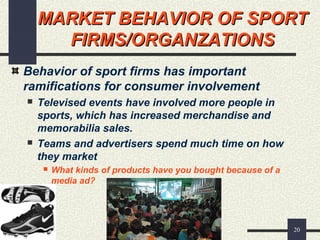
 Televised events have involved more people in
sports, which has increased merchandise and
memorabilia sales.
 Teams and advertisers spend much time on how
they market
 What kinds of products have you bought because of a
media ad?
21
MARKET BEHAVIOR OF SPORTMARKET BEHAVIOR OF SPORT
FIRMS/ORGANZATIONSFIRMS/ORGANZATIONS
Firms have to constantly respond to the
always changing values and wants of their
consumers.

Example: Ski Resorts and Snowboarders.
Products (apparel/equipment) produced
and shown by firms like NIKE or ADIDAS
greatly influence the popularity of sports as
it creates demand for use.
22
INDIVIDUAL FACTORSINDIVIDUAL FACTORS
a.k.a - the “ME” factora.k.a - the “ME” factor
Many factors exist within ourselves that
influence which, if any, sports we participate in
and/or support.
Let’s Examine each Factor:
 SELF CONCEPTSELF CONCEPT
 I will be good at this sport.
 STAGE IN THE FAMILY LIFE CYCLESTAGE IN THE FAMILY LIFE CYCLE
 I want to play this, but I have to do chores.
 PHYSICAL CHARACTERISTICSPHYSICAL CHARACTERISTICS
 I want to play football, but I may be too small.
23
EXAMININGEXAMINING
INDIVIDUAL FACTORSINDIVIDUAL FACTORS
 LEARNING OF A SPORTLEARNING OF A SPORT
 I understand the rules of this game, so I’ll play.
 PERCEPTIONPERCEPTION
 This sport just seems too dangerous for me.
 MOTIVATIONMOTIVATION
 I will jog 5 miles a day so I can make the team.
 ATTITUDESATTITUDES
 I think sports are stupid
 I CAN’T LIVE WITHOUT THEM!
24
DECISION MAKING FORDECISION MAKING FOR
SPORT INVOLVEMENTSPORT INVOLVEMENT
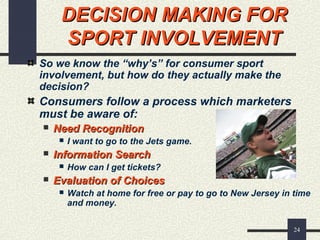
So we know the “why’s” for consumer sport
involvement, but how do they actually make the
decision?
Consumers follow a process which marketers
must be aware of:
 Need RecognitionNeed Recognition
 I want to go to the Jets game.
 Information SearchInformation Search
 How can I get tickets?
 Evaluation of ChoicesEvaluation of Choices
 Watch at home for free or pay to go to New Jersey in time
and money.
25
DECISION MAKING FORDECISION MAKING FOR
SPORT INVOLVEMENTSPORT INVOLVEMENT
 Purchase DecisionPurchase Decision
 I go!!
 Sport ExperienceSport Experience
 I enjoy the game very much but don’t
get home until midnight.
 Evaluation of ExperienceEvaluation of Experience
 Satisfaction=Benefits-CostsSatisfaction=Benefits-Costs
 I would go again.

Unit 2: Sport Consumer Behavior

  • 1.
  • 2.
    2 Who is theconsumer?Who is the consumer? The consumer is the client that uses your product or takes advantage of your service.  Consumers can be:Consumers can be: FANSFANS Athletes/CoachesAthletes/Coaches Sport FirmsSport Firms
  • 3.
    3 3 types ofways that consumers can involve and intertwine themselves within the world of sports:  Affective  Behavioral  Cognitive Consumers can display and move within all of these 3 types. How doHow do ConsumersConsumers involveinvolve themselves in sports?themselves in sports? Basic/Most commonBasic/Most common Most AdvancedMost Advanced
  • 4.
    4 BRAINSTORMBRAINSTORM Write down whatdo youWrite down what do you think AFFECTIVEthink AFFECTIVE INVOLVEMENT is?INVOLVEMENT is?
  • 5.
    5 AFFECTIVEAFFECTIVE INVOLVEMENTINVOLVEMENT The attitude,feelings and emotions that a consumer has toward an activity or sport.  What sport are you most Passionate about?  Most impassionate?  Why do you feel like this? Most people have very strong feelings toward sports, either positive or negative. Essential step.
  • 6.
    6 BRAINSTORMBRAINSTORM Write down whatdo youWrite down what do you think BEHAVORIALthink BEHAVORIAL INVOLVEMENT is?INVOLVEMENT is?
  • 7.
    7 BEHAVIORALBEHAVIORAL INVOLVEMENTINVOLVEMENT Includes hands-onactivities such as going to and rooting for a team or actively participating in a sport. Requires large expenditures on sports and sport activities. These fans are definitely committed to sports and it is a major part of their lifestyle.
  • 8.
    8 BRAINSTORMBRAINSTORM Write down whatdo youWrite down what do you think COGNITIVEthink COGNITIVE INVOLVEMENT is?INVOLVEMENT is?
  • 9.
    9 COGNITIVECOGNITIVE INVOLVEMENTINVOLVEMENT The acquisitionof information and knowledge about a sport. Magazines, newspapers, internet blogs, game programs, radio, and TV are ways that the cognitive fan can keep up with and learn about a particular sport or the players.
  • 10.
    10 Your Desired OutcomesYourDesired Outcomes The job of the sports marketer is to create positive feelings about his/her sport and then encourage consumers to act behaviorally and cognitively toward his/her sport. Cognitive Affective Behavioral
  • 11.
    11 TEAM ACTIVITYTEAM ACTIVITY EMPOWERINGYOUR FANS:EMPOWERING YOUR FANS:  Since your Fantasy Franchises are new toSince your Fantasy Franchises are new to your area, you need to induce some energyyour area, you need to induce some energy about your team to your new fan base.about your team to your new fan base.  You will come up with a strategy that canYou will come up with a strategy that can be used to engage your fans to movebe used to engage your fans to move through each level of involvement, startingthrough each level of involvement, starting with Affective.with Affective. Turn in one sheet per teamTurn in one sheet per team
  • 12.
    12 What are somefactorsWhat are some factors that influence your dailythat influence your daily choices and behaviors?choices and behaviors?
  • 13.
    13 ENVIRONMENTAL FACTORS FORENVIRONMENTALFACTORS FOR SPORT INVOLVEMENTSPORT INVOLVEMENT SIGNIFICANT OTHERS CULTURAL NORMS AND VALUES CLASS, RACE, GENDER RELATIONS CLIMATIC AND GEOGRAPHIC CONDITIONS MARKET BEHAVIOR OF SPORT FIRMS AND ORGANIZATIONS
  • 14.
    14 SIGNIFICANT OTHERSSIGNIFICANT OTHERS Definedas parents, friends, family, coaches, and peers  Play a large role in determining the level of a person’s sports involvement.  75% of parents encourage sport participation  72% encouraged outside practice. Impact increases with persons age.
  • 15.
    15 CULTURALCULTURAL NORMS AND VALUESNORMSAND VALUES American culture emphasizes sports as a way of teaching character, discipline, fitness and competition along with other values. Other countries either don’t emphasize sports or perhaps promote different ones.  Ex) American Football vs. European Football Regions within our own country tend to view sports differently as part of the culture.  Ex) High School Football in America
  • 16.
    16 SOCIAL CLASS FACTORSSOCIALCLASS FACTORS Certain classes have traditionally been associated with certain sports/teams.  Blue-Collar class: • Basketball, hunting and bowling  White-Collar class: • Tennis, Golf, Yachting, Ice Hockey Such associations have faded with the emergence of superstar athletes like Tiger Woods dominating Golf and Michael Jordan/Lebron James’ influence on all classes in basketball.
  • 17.
    17 RACE FACTORSRACE FACTORS Historicallyin America, African Americans and other black athletes have been discriminated against in the participation of sports.  Today, they enjoy dominance and success in American sports thanks to men like Brach Rickey and Jackie Robinson who broke the “color barrier”. Minorities still struggle to find positions of authority within sports organizations.  MLB and NFL Rules require that minority candidates be interviewed in all executive search processes.  MLB GM’s: Ken Williams, Ruben Amaro Jr, and Omar Minaya.  NFL Coaches: Mike Tomlin of the Pittsburgh Steelers
  • 18.
    18 GENDER FACTORSGENDER FACTORS Femaleshave not always had equal opportunities to take part in the American sports world.  1971 – 1 in 27 girls participate in high school sports. In 1971, Title IX (equal opportunity legislation for sex) forced schools to provide females the same athletic opportunities as their male counterparts.  Present Day - about 1 in 3 girls participate. Women make up to 40% of spectators at the major sports in the US. The WNBA and WUSA have proven that with the proper financial backing, female sports can be a profitable market.
  • 19.
    19 CLIMATE AND GEOGRAPHYCLIMATEAND GEOGRAPHY Certain parts of the country emphasize and are more suited for particular sports.  Baseball in the South/West, Hockey in the North, Skiing in Colorado, Surfing in California. Based upon weather and topography. Professional organizations have challenged this by expanding their sports to non- traditional areas over the last several years to expand exposure and profit.  NHL to Carolina, now Kansas City ?  MLB to Tampa Bay, Arizona, and Washington DC.
  • 20.
    20 MARKET BEHAVIOR OFSPORTMARKET BEHAVIOR OF SPORT FIRMS/ORGANZATIONSFIRMS/ORGANZATIONS Behavior of sport firms has important ramifications for consumer involvement  Televised events have involved more people in sports, which has increased merchandise and memorabilia sales.  Teams and advertisers spend much time on how they market  What kinds of products have you bought because of a media ad?
  • 21.
    21 MARKET BEHAVIOR OFSPORTMARKET BEHAVIOR OF SPORT FIRMS/ORGANZATIONSFIRMS/ORGANZATIONS Firms have to constantly respond to the always changing values and wants of their consumers.  Example: Ski Resorts and Snowboarders. Products (apparel/equipment) produced and shown by firms like NIKE or ADIDAS greatly influence the popularity of sports as it creates demand for use.
  • 22.
    22 INDIVIDUAL FACTORSINDIVIDUAL FACTORS a.k.a- the “ME” factora.k.a - the “ME” factor Many factors exist within ourselves that influence which, if any, sports we participate in and/or support. Let’s Examine each Factor:  SELF CONCEPTSELF CONCEPT  I will be good at this sport.  STAGE IN THE FAMILY LIFE CYCLESTAGE IN THE FAMILY LIFE CYCLE  I want to play this, but I have to do chores.  PHYSICAL CHARACTERISTICSPHYSICAL CHARACTERISTICS  I want to play football, but I may be too small.
  • 23.
    23 EXAMININGEXAMINING INDIVIDUAL FACTORSINDIVIDUAL FACTORS LEARNING OF A SPORTLEARNING OF A SPORT  I understand the rules of this game, so I’ll play.  PERCEPTIONPERCEPTION  This sport just seems too dangerous for me.  MOTIVATIONMOTIVATION  I will jog 5 miles a day so I can make the team.  ATTITUDESATTITUDES  I think sports are stupid  I CAN’T LIVE WITHOUT THEM!
  • 24.
    24 DECISION MAKING FORDECISIONMAKING FOR SPORT INVOLVEMENTSPORT INVOLVEMENT So we know the “why’s” for consumer sport involvement, but how do they actually make the decision? Consumers follow a process which marketers must be aware of:  Need RecognitionNeed Recognition  I want to go to the Jets game.  Information SearchInformation Search  How can I get tickets?  Evaluation of ChoicesEvaluation of Choices  Watch at home for free or pay to go to New Jersey in time and money.
  • 25.
    25 DECISION MAKING FORDECISIONMAKING FOR SPORT INVOLVEMENTSPORT INVOLVEMENT  Purchase DecisionPurchase Decision  I go!!  Sport ExperienceSport Experience  I enjoy the game very much but don’t get home until midnight.  Evaluation of ExperienceEvaluation of Experience  Satisfaction=Benefits-CostsSatisfaction=Benefits-Costs  I would go again.