Unit 2 – Sociology of Health Introduction
Introduction to Unit 2 What you will learn about Definitions of health Absolute, relative, cultural relativity, relativity within society Social construction of health Disability, stigma, doctor/patient role Different sociological perspectives on health Functionalist, Marxist, Interactionist Health inequalities Class, gender, race and ethnicity, age
Aims and Objectives What is Health? Types of definition Absolute V. Relative Cultural Relativity Biomedical and traditional models of health and illness
What is Health? Working on your own write a definition of what health is. When you have completed this task join with at least 2 other people and discuss your findings Try to agree on a definition of health in your groups Be prepared to feed back to the class!
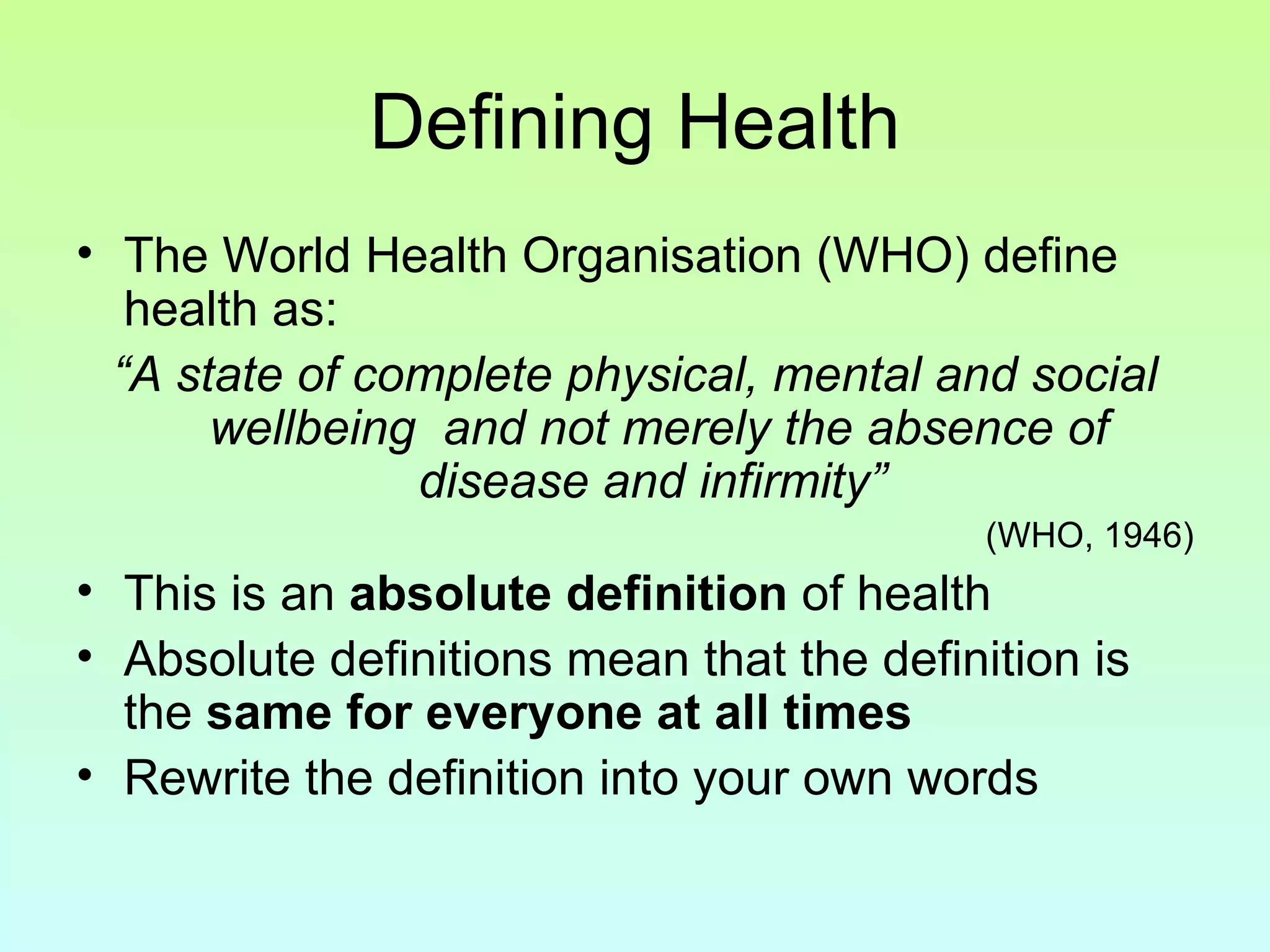
Defining Health The World Health Organisation (WHO) define health as: “ A state of complete physical, mental and social wellbeing  and not merely the absence of disease and infirmity”   (WHO, 1946) This is an  absolute definition  of health Absolute definitions mean that the definition is the  same for everyone at all times Rewrite the definition into your own words
Problems with this definition Who feels well all of the time? If you had a cold would you consider yourself to be in ‘ill health’? Don’t different people have different ideas about what it is to be healthy or ill? The WHO definition is Utopian (i.e. idealised) The real world definition of health has to be something different
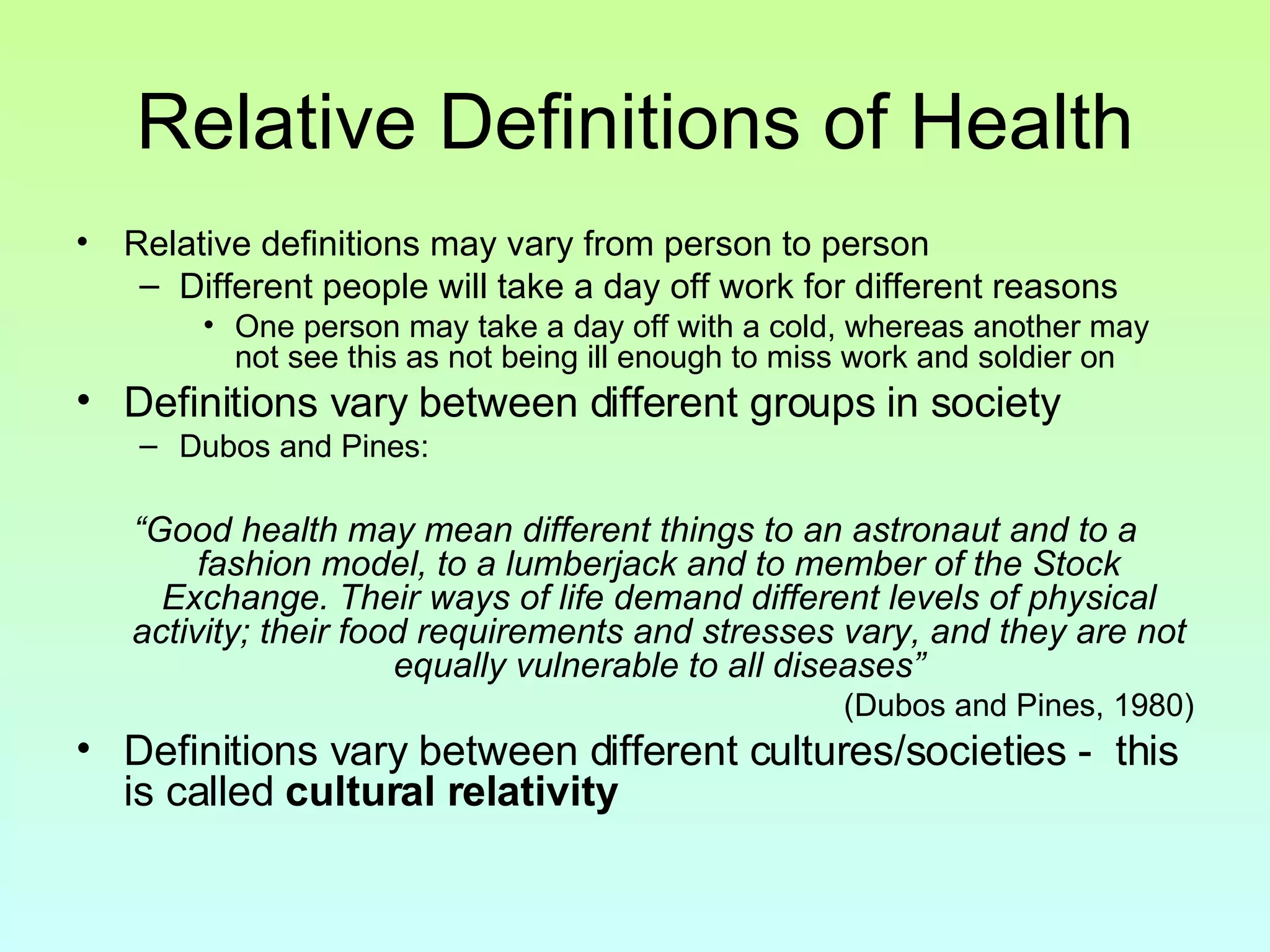
Relative Definitions of Health Relative definitions may vary from person to person Different people will take a day off work for different reasons One person may take a day off with a cold, whereas another may not see this as not being ill enough to miss work and soldier on Definitions vary between different groups in society  Dubos and Pines: “ Good health may mean different things to an astronaut and to a fashion model, to a lumberjack and to member of the Stock Exchange. Their ways of life demand different levels of physical activity; their food requirements and stresses vary, and they are not equally vulnerable to all diseases” (Dubos and Pines, 1980) Definitions vary between different cultures/societies -  this is called  cultural relativity
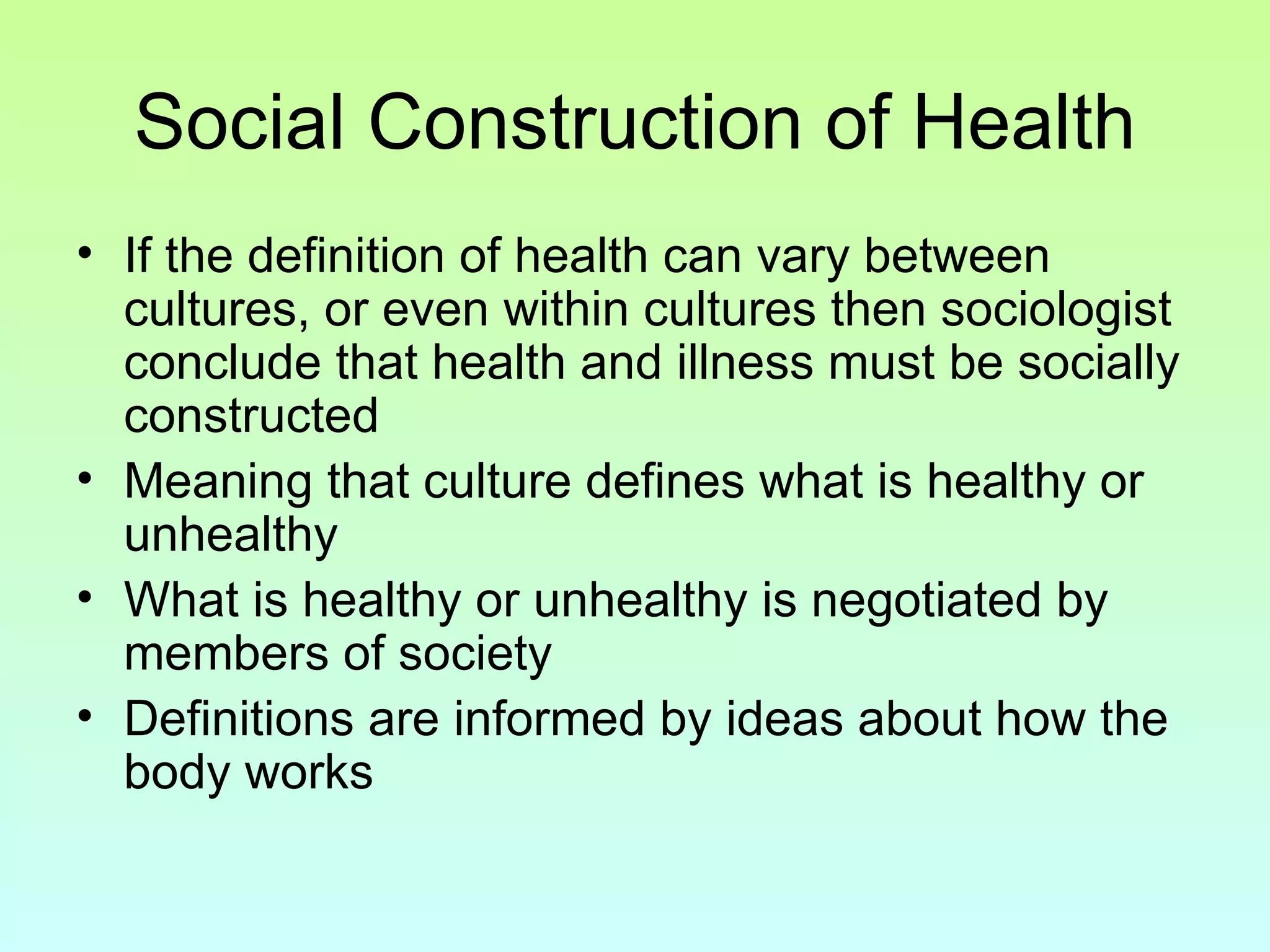
Social Construction of Health If the definition of health can vary between cultures, or even within cultures then sociologist conclude that health and illness must be socially constructed Meaning that culture defines what is healthy or unhealthy What is healthy or unhealthy is negotiated by members of society Definitions are informed by ideas about how the body works
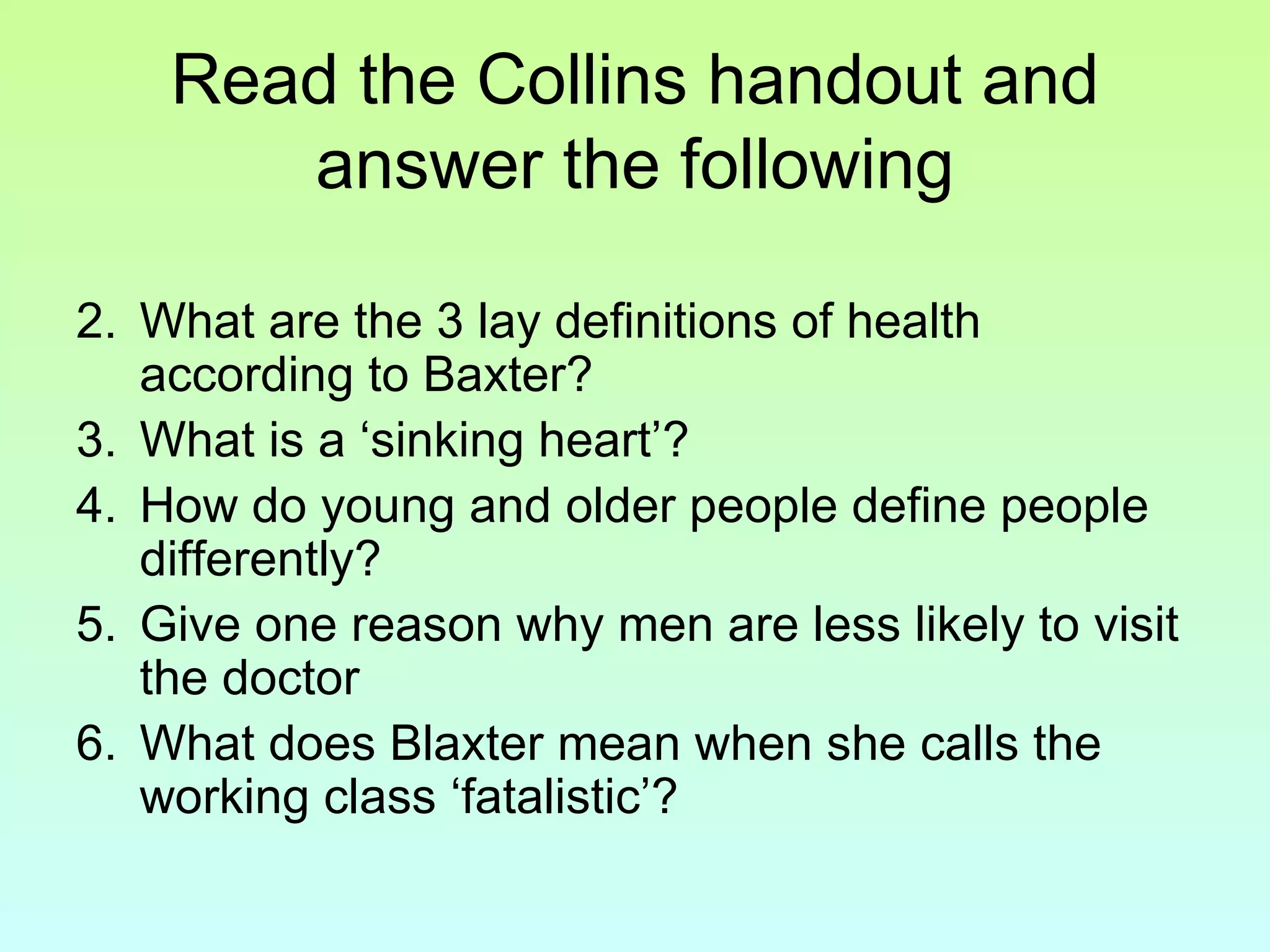
Read the Collins handout and answer the following What are the 3 lay definitions of health according to Baxter? What is a ‘sinking heart’? How do young and older people define people differently? Give one reason why men are less likely to visit the doctor What does Blaxter mean when she calls the working class ‘fatalistic’?
Medical definitions Biomedical model Developed over the past 300 years Idea that the body is like a machine The body and the mind are separate Like a machine it will deteriorate over time It needs regular ‘servicing’ from medical professionals Illness is always caused by something that can be identified Illness is cured by medicine or surgery This gives members of the medical profession considerable power
Traditional definitions Personalistic systems Religion drawn on for explanations of illness Shaman can cure illness – both priest and doctor Sickness can be interpreted supernaturally (evil spirits, curses) Naturalistic systems Balance of the natural elements of the body Ill health caused by imbalance of these elements Found in ancient Greece, China Cured by a physician or herbalist Leslie Mechanistic theories (Western medicine) Equilibrium Theories (like the naturalistic system described above) Ethical Theories ( health as a reward for living in a morally correct way and illness is a punishment for not doing so)
Measuring Health Morbidity This is to do with how ill someone feels Rates of ill health This is difficult to measure as people have different interpretations of their own well-being Mortality This is to do with death Death rates More reliable as it can be more easily measured Therefore this is often the way that health is measured
Summary Relative definitions are better than absolute definitions Health is a social construct as it means different things to different people/groups/societies Western medicine is based on the biomedical model Health is generally measured by looking at morbidity rates

Unit 2 – Sociology Of Healthintro

  • 1.
    Unit 2 –Sociology of Health Introduction
  • 2.
    Introduction to Unit2 What you will learn about Definitions of health Absolute, relative, cultural relativity, relativity within society Social construction of health Disability, stigma, doctor/patient role Different sociological perspectives on health Functionalist, Marxist, Interactionist Health inequalities Class, gender, race and ethnicity, age
  • 3.
    Aims and ObjectivesWhat is Health? Types of definition Absolute V. Relative Cultural Relativity Biomedical and traditional models of health and illness
  • 4.
    What is Health?Working on your own write a definition of what health is. When you have completed this task join with at least 2 other people and discuss your findings Try to agree on a definition of health in your groups Be prepared to feed back to the class!
  • 5.
    Defining Health TheWorld Health Organisation (WHO) define health as: “ A state of complete physical, mental and social wellbeing and not merely the absence of disease and infirmity” (WHO, 1946) This is an absolute definition of health Absolute definitions mean that the definition is the same for everyone at all times Rewrite the definition into your own words
  • 6.
    Problems with thisdefinition Who feels well all of the time? If you had a cold would you consider yourself to be in ‘ill health’? Don’t different people have different ideas about what it is to be healthy or ill? The WHO definition is Utopian (i.e. idealised) The real world definition of health has to be something different
  • 7.
    Relative Definitions ofHealth Relative definitions may vary from person to person Different people will take a day off work for different reasons One person may take a day off with a cold, whereas another may not see this as not being ill enough to miss work and soldier on Definitions vary between different groups in society Dubos and Pines: “ Good health may mean different things to an astronaut and to a fashion model, to a lumberjack and to member of the Stock Exchange. Their ways of life demand different levels of physical activity; their food requirements and stresses vary, and they are not equally vulnerable to all diseases” (Dubos and Pines, 1980) Definitions vary between different cultures/societies - this is called cultural relativity
  • 8.
    Social Construction ofHealth If the definition of health can vary between cultures, or even within cultures then sociologist conclude that health and illness must be socially constructed Meaning that culture defines what is healthy or unhealthy What is healthy or unhealthy is negotiated by members of society Definitions are informed by ideas about how the body works
  • 9.
    Read the Collinshandout and answer the following What are the 3 lay definitions of health according to Baxter? What is a ‘sinking heart’? How do young and older people define people differently? Give one reason why men are less likely to visit the doctor What does Blaxter mean when she calls the working class ‘fatalistic’?
  • 10.
    Medical definitions Biomedicalmodel Developed over the past 300 years Idea that the body is like a machine The body and the mind are separate Like a machine it will deteriorate over time It needs regular ‘servicing’ from medical professionals Illness is always caused by something that can be identified Illness is cured by medicine or surgery This gives members of the medical profession considerable power
  • 11.
    Traditional definitions Personalisticsystems Religion drawn on for explanations of illness Shaman can cure illness – both priest and doctor Sickness can be interpreted supernaturally (evil spirits, curses) Naturalistic systems Balance of the natural elements of the body Ill health caused by imbalance of these elements Found in ancient Greece, China Cured by a physician or herbalist Leslie Mechanistic theories (Western medicine) Equilibrium Theories (like the naturalistic system described above) Ethical Theories ( health as a reward for living in a morally correct way and illness is a punishment for not doing so)
  • 12.
    Measuring Health MorbidityThis is to do with how ill someone feels Rates of ill health This is difficult to measure as people have different interpretations of their own well-being Mortality This is to do with death Death rates More reliable as it can be more easily measured Therefore this is often the way that health is measured
  • 13.
    Summary Relative definitionsare better than absolute definitions Health is a social construct as it means different things to different people/groups/societies Western medicine is based on the biomedical model Health is generally measured by looking at morbidity rates