LO2
By Ashley B
LOCATION RECCE
RISK ASSESSMENT
 Photography risks
 In order to ensure that I am able to take images off the subject that I want to take pictures of I will
need to have their consent. Knowing this I made sure that I sent the subject a email asking them to
kindly accept my request so that I could take and use the photos as my main images in my magazine.
 Area risks
 Before I even take the images that I need of the subject I would need to ensure that the area that I
take the images is safe for both me and the subject ad this way it will make the process of taking and
picking the images for the magazine a lot easier.
 Software risks
 After taking the images I will then move onto the editing stage and I would need to make sure that
the size of the image on the front will fit nicely and professionally but also the images have to be
realistic in order to relate tot eh content that would be on the inside of the magazine.
RISK ASSESSMENT
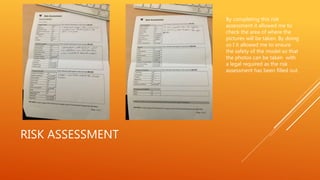
By completing this risk
assessment it allowed me to
check the area of where the
pictures will be taken. By doing
so I it allowed me to ensure
the safety of the model so that
the photos can be taken with
a legal required as the risk
assessment has been filled out.
HAZARDS OF WORK PLACE
 For TV, it is crucial that a health and safety protocol is in
place in case of a hazard. For example, in the event of a fire,
in the work place we would have fully functional fire exits
and a organized and easy to find amount of fire
extinguishers. Additionally, we would need to have the
equipment such as chairs and desks that are resistant to
hazards such as a fire in order to prevent the spread and
reduce the chances of damaged equipment. Also it would
be necessary to endure monthly fire procedures reducing
the chances of someone getting injured.
ISSUES
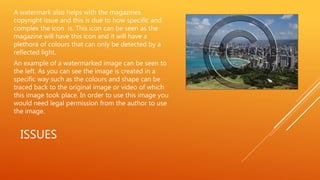
An example of a watermarked image can be seen to
the left. As you can see the image is created in a
specific way such as the colours and shape can be
traced back to the original image or video of which
this image took place. In order to use this image you
would need legal permission from the author to use
the image.
A watermark also helps with the magazines
copyright issue and this is due to how specific and
complex the icon is. This icon can be seen as the
magazine will have this icon and it will have a
plethora of colours that can only be detected by a
reflected light.
ISSUES (CONTINUED)
Also there is IP which stands for intellectual property and what this means is that you
content and images are protected in order to stop people from stealing or using the
images:
• The names of products and brands
• The inventions of the author
• The design of the product and content
• Things that are written, made or produced by the author.
Copyright issues are all IP protection purposes that must take place in order to stop
people from stealing or using an authors content without their permission.
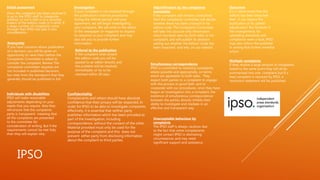
IPSO
Initial assessment
Once the complaint has been received it
is up to the IPSO staff to categorize
whether or not it falls in to a possible
breach of the editors code or a remit. If
a large number of complaints come
through then IPSO will take it into
consideration.
Referral to the publication
If the complaint does breach
the editors code you will be
passed to an editor directly and
the problem will be resolved
immediately or try to be
resolved within 28 days.
Investigation
if your complaint is not resolved through
the publication’s internal procedures
during the referral period, with your
agreement, we will begin investigating
your complaint. We will write to the editor
of the newspaper or magazine to request
its response to your complaint and may
also ask you to provide further
information.
Adjustification by the complaints
committee
If the complaint still remains unresolved
then the complaints committee will decide
whether there has been a breach in he
editors code. The Complaints Committee
will take into account only information
which has been seen by both sides to the
complaint, and will publish its decision
setting out whether the Editors’ Code has
been breached, and why, on our website.
Outcomes
If it is determined that the
editors has been breached
then it can require the
publication of its upheld
adjudication. But however if
the arrangements for
uploading standards and
compliance were a fault, IPSO
may also inform the publisher
in writing that further remedial
action.
Anonymity
If you have concerns about publication
of a decision, you will be given an
opportunity to raise them before the
Complaints Committee is asked to
consider the complaint. Review The
complaints committee requests are
not included in published decisions
but stats from the standpoint that they
generally should be published in full.
Confidentiality
Complainants and others should have absolute
confidence that their privacy will be respected. In
order for IPSO to be able to investigate complaints
effectively, it is essential that neither party
publishes information which has been provided as
part of the investigation, including
correspondence, without the consent of the other.
Material provided must only be used for the
purpose of the complaint and this does not
prevent either party from disclosing information
about the complaint to third parties.
Simultaneous correspondence
IPSO is committed to resolving complaints,
where possible and appropriate, on terms
which are agreeable to both sides. They
expect both parties to a complaint to engage
with the process in good faith, and to
cooperate with our procedures. once they have
begun an investigation into a complaint, the
existence of simultaneous correspondence
between the parties directly inhibits their
ability to investigate and mediate in an
effective and transparent way.
Multiple complaints
If they receive a large amount of complaints
linked to the same point they will all be
summarized into one complaint but If a
lead complaint is resolved by IPSO, a
resolution statement will be published.
Individuals with disabilities
IPSO will make reasonable
adjustments depending on your
needs that you require. Also they
will ensure that the complaints
party is transparent meaning that
all the complaints are presented
to the committee for
consideration of writing. But if the
requirements cannot be met fully
than they will explain why.
Unacceptable behaviour by
complaints
The IPSO staff is always cautious due
to the fact that some complainants
might contact IPSO in distressing
circumstances and may need
significant support and assistance.
EDITORS CODE OF PRACTICE
Accuracy
The Press must not publish inaccurate, misleading or distorted information or images, including headlines not supported by the text. Also significant
inaccuracy, misleading statement or distortion must be corrected immediately, promptly and with prominence, and where appropriate an apology must be
published. In cases involving IPSO, prominence should be as required by the regulator. There is a fair opportunity to reply to significant inaccuracies that should
be given, when reasonably called for. The Press, while able to editorialise and campaign, must distinguish clearly between comment and fact. But a publication
must report fairly and accurately the outcome of an action for a party, unless an agreed settlement states otherwise, or an agreed statement is published.
Privacy
Everyone is entitled to respect his or her private family life, home, health and correspondence, including digital communications. Also the editors will be
expected to justify intrusions
Harassment
They must not persist in telephoning, pursuing or photographing people when asked not to; and they should not remain on property when asked to leave and
must not follow them. If requested, they must identify themselves and who they represent and why. The Editors must ensure these actions are observed by
those working for them and take care not to use non-compliant material from other sources.
Intrusion into grief or shock
When a there are cases involving personal grief or shock, enquiries and approaches must be made with sympathy and publication handled sensitively.
Reporting suicide
When reporting suicide, to prevent simulative acts care should be taken to avoid excessive detail of the method used, while taking into account the media's
right to report legal proceedings.
Children
All pupils should be free to complete their time at school and they must not be photographed at school without permission of the school. Children under 16
must not be interviewed or photographed on problems involving their own or another child’s welfare unless with a responsible adult consent. Children under
16 must not be paid for material involving their welfare or parents or guardians for material about their children.
Children in sex cases
The press must not, even if legally free to do so, identify children under 16 who are victims or witnesses in cases involving sex.
In any press report of a case involving a sexual offence against a child –
• The child must not be identified.
• The adult may be identified.
• The word incest must not be used where a child victim might be identified.
• Care must be taken that nothing in the report implies the relationship between the accused and the child.
COPYRIGHT
Copyright is a very important issue that could result in protecting the authors work so that
it cannot be copied and used under another authors name. This copyright includes all the
content in the magazine from images to the facts that have been researched.
This is relevant to “TV“ as I will release huge amounts of information every month and this
copyright term helps to keep the content safe from being copied or stolen and used under
the name of a different author. An example of this would be a famous artists such as Jay Z,
Rihanna or my subject James Smith and their interview which has very specific information
and content that no one else would be able to obtain in order to include in their own
magazine.
CONCLUSION
 In LO2, I was able to assess and understand the regulations
which TV would have to follow in order to have the
magazine to be published in a safe working environment
for the staff of the company.

Unit 14 - LO2

  • 1.
  • 2.
  • 3.
    RISK ASSESSMENT  Photographyrisks  In order to ensure that I am able to take images off the subject that I want to take pictures of I will need to have their consent. Knowing this I made sure that I sent the subject a email asking them to kindly accept my request so that I could take and use the photos as my main images in my magazine.  Area risks  Before I even take the images that I need of the subject I would need to ensure that the area that I take the images is safe for both me and the subject ad this way it will make the process of taking and picking the images for the magazine a lot easier.  Software risks  After taking the images I will then move onto the editing stage and I would need to make sure that the size of the image on the front will fit nicely and professionally but also the images have to be realistic in order to relate tot eh content that would be on the inside of the magazine.
  • 4.
    RISK ASSESSMENT By completingthis risk assessment it allowed me to check the area of where the pictures will be taken. By doing so I it allowed me to ensure the safety of the model so that the photos can be taken with a legal required as the risk assessment has been filled out.
  • 5.
    HAZARDS OF WORKPLACE  For TV, it is crucial that a health and safety protocol is in place in case of a hazard. For example, in the event of a fire, in the work place we would have fully functional fire exits and a organized and easy to find amount of fire extinguishers. Additionally, we would need to have the equipment such as chairs and desks that are resistant to hazards such as a fire in order to prevent the spread and reduce the chances of damaged equipment. Also it would be necessary to endure monthly fire procedures reducing the chances of someone getting injured.
  • 6.
    ISSUES An example ofa watermarked image can be seen to the left. As you can see the image is created in a specific way such as the colours and shape can be traced back to the original image or video of which this image took place. In order to use this image you would need legal permission from the author to use the image. A watermark also helps with the magazines copyright issue and this is due to how specific and complex the icon is. This icon can be seen as the magazine will have this icon and it will have a plethora of colours that can only be detected by a reflected light.
  • 7.
    ISSUES (CONTINUED) Also thereis IP which stands for intellectual property and what this means is that you content and images are protected in order to stop people from stealing or using the images: • The names of products and brands • The inventions of the author • The design of the product and content • Things that are written, made or produced by the author. Copyright issues are all IP protection purposes that must take place in order to stop people from stealing or using an authors content without their permission.
  • 8.
    IPSO Initial assessment Once thecomplaint has been received it is up to the IPSO staff to categorize whether or not it falls in to a possible breach of the editors code or a remit. If a large number of complaints come through then IPSO will take it into consideration. Referral to the publication If the complaint does breach the editors code you will be passed to an editor directly and the problem will be resolved immediately or try to be resolved within 28 days. Investigation if your complaint is not resolved through the publication’s internal procedures during the referral period, with your agreement, we will begin investigating your complaint. We will write to the editor of the newspaper or magazine to request its response to your complaint and may also ask you to provide further information. Adjustification by the complaints committee If the complaint still remains unresolved then the complaints committee will decide whether there has been a breach in he editors code. The Complaints Committee will take into account only information which has been seen by both sides to the complaint, and will publish its decision setting out whether the Editors’ Code has been breached, and why, on our website. Outcomes If it is determined that the editors has been breached then it can require the publication of its upheld adjudication. But however if the arrangements for uploading standards and compliance were a fault, IPSO may also inform the publisher in writing that further remedial action. Anonymity If you have concerns about publication of a decision, you will be given an opportunity to raise them before the Complaints Committee is asked to consider the complaint. Review The complaints committee requests are not included in published decisions but stats from the standpoint that they generally should be published in full. Confidentiality Complainants and others should have absolute confidence that their privacy will be respected. In order for IPSO to be able to investigate complaints effectively, it is essential that neither party publishes information which has been provided as part of the investigation, including correspondence, without the consent of the other. Material provided must only be used for the purpose of the complaint and this does not prevent either party from disclosing information about the complaint to third parties. Simultaneous correspondence IPSO is committed to resolving complaints, where possible and appropriate, on terms which are agreeable to both sides. They expect both parties to a complaint to engage with the process in good faith, and to cooperate with our procedures. once they have begun an investigation into a complaint, the existence of simultaneous correspondence between the parties directly inhibits their ability to investigate and mediate in an effective and transparent way. Multiple complaints If they receive a large amount of complaints linked to the same point they will all be summarized into one complaint but If a lead complaint is resolved by IPSO, a resolution statement will be published. Individuals with disabilities IPSO will make reasonable adjustments depending on your needs that you require. Also they will ensure that the complaints party is transparent meaning that all the complaints are presented to the committee for consideration of writing. But if the requirements cannot be met fully than they will explain why. Unacceptable behaviour by complaints The IPSO staff is always cautious due to the fact that some complainants might contact IPSO in distressing circumstances and may need significant support and assistance.
  • 9.
    EDITORS CODE OFPRACTICE Accuracy The Press must not publish inaccurate, misleading or distorted information or images, including headlines not supported by the text. Also significant inaccuracy, misleading statement or distortion must be corrected immediately, promptly and with prominence, and where appropriate an apology must be published. In cases involving IPSO, prominence should be as required by the regulator. There is a fair opportunity to reply to significant inaccuracies that should be given, when reasonably called for. The Press, while able to editorialise and campaign, must distinguish clearly between comment and fact. But a publication must report fairly and accurately the outcome of an action for a party, unless an agreed settlement states otherwise, or an agreed statement is published. Privacy Everyone is entitled to respect his or her private family life, home, health and correspondence, including digital communications. Also the editors will be expected to justify intrusions Harassment They must not persist in telephoning, pursuing or photographing people when asked not to; and they should not remain on property when asked to leave and must not follow them. If requested, they must identify themselves and who they represent and why. The Editors must ensure these actions are observed by those working for them and take care not to use non-compliant material from other sources. Intrusion into grief or shock When a there are cases involving personal grief or shock, enquiries and approaches must be made with sympathy and publication handled sensitively. Reporting suicide When reporting suicide, to prevent simulative acts care should be taken to avoid excessive detail of the method used, while taking into account the media's right to report legal proceedings. Children All pupils should be free to complete their time at school and they must not be photographed at school without permission of the school. Children under 16 must not be interviewed or photographed on problems involving their own or another child’s welfare unless with a responsible adult consent. Children under 16 must not be paid for material involving their welfare or parents or guardians for material about their children. Children in sex cases The press must not, even if legally free to do so, identify children under 16 who are victims or witnesses in cases involving sex. In any press report of a case involving a sexual offence against a child – • The child must not be identified. • The adult may be identified. • The word incest must not be used where a child victim might be identified. • Care must be taken that nothing in the report implies the relationship between the accused and the child.
  • 10.
    COPYRIGHT Copyright is avery important issue that could result in protecting the authors work so that it cannot be copied and used under another authors name. This copyright includes all the content in the magazine from images to the facts that have been researched. This is relevant to “TV“ as I will release huge amounts of information every month and this copyright term helps to keep the content safe from being copied or stolen and used under the name of a different author. An example of this would be a famous artists such as Jay Z, Rihanna or my subject James Smith and their interview which has very specific information and content that no one else would be able to obtain in order to include in their own magazine.
  • 11.
    CONCLUSION  In LO2,I was able to assess and understand the regulations which TV would have to follow in order to have the magazine to be published in a safe working environment for the staff of the company.