PowerPoint 2
Handout 2: Rainwater harvesting and grey water
recycling
What is rainwater harvesting?
Rainwater harvesting is a way of saving the rainwater which would
normally flow off a roof and down the drain, and using it as piped water
to flush toilets and for the garden watering, drive wash down,
vehicle and car washing, instead of treated drinking (potable) water. It
is not a new idea: the collection and re-use of rainwater from roofs can
be traced back thousands of years in hot, dry countries around the
Mediterranean. In continental Europe, some 100,000 are installed
annually; Germany has been using and refining the technology since
the early 80s. Rainwater harvesting can also be used in schools,
hospitals, offices, commercial premises; rainwater can typically be
used for toilets, vehicle washing, yard wash down and watering plant
pots/gardens.
Handout 2: Rainwater harvesting and grey water
recycling
Depending on your normal usage, rainwater harvesting can save 30 to
50% of the treated potable drinking water from the mains in houses
and up to 80% of the treated drinking potable water in a business or
commercial building. This in turn can save up to 30 to 50% for the
domestic user and 80% for the commercial user on water bills. Having
metered water is the best way of appreciating the savings that are
being made. A rainwater harvesting system can collect on average up
to 100,000 litres per household, depending on the area and angle of
your roof, and your rainfall and even greater quantities for larger roofed
commercial buildings.
Handout 2: Rainwater harvesting and grey water
recycling
Normally a builder would install a rainwater harvesting system. The skills are the same as
installing a septic tank, but a plumber would be needed to complete the internal
pipework. There are no specific regulations yet that govern rainwater harvesting as such,
although Building Regulations Part H affect siting of the tank and pipe runs, while Part G
refers to internal plumbing regulations. In a properly designed system, the pipework is
entirely separate from the mains water pipework and should be identified as non-potable.
The system can be installed in existing buildings, but will cost more because of the extra
plumbing required. In addition, bungalows and commercial premises are also very
suitable, the only limitation is the area of the roof to capture rain, compared to the
number of users; this puts a limitation on flats and apartments. The tank should be buried
under a car or vehicle park, landscaped area, garden, patio or drive, with space left for
the round access cover. Most systems are designed so that they can accept cars driving
over them if suitably installed. Domestic systems can cost from about £2500 up to over
£4000 including installation costs, depending on the size of tank. Commercial systems
can cost a lot more depending on the size and requirement, but usually have a much
quicker 'pay back' period due to the size of roof and high usage.
Handout 2: Rainwater harvesting and grey water
recycling
A storage tank is fitted to your rainwater drain from your roof, and falling rain enters the
tank through a filter which removes leaves and other matter. The storage tank is usually
buried under car or vehicle parks, a garden or under the entrance access or drive, and
contains a pump which pumps the rainwater to the building where it is piped to the toilets,
and to the outside taps. The filtered, untreated rainwater should only be used for non-
drinking or bathing purposes: toilet flushing, gardens, vehicle and drive wash downs. The
rainwater is filtered as it enters the storage tank, to remove particles and other matter. It
is kept in the dark and kept oxygenated to discourage algal growth, and properly
designed systems are designed with calming inlets, which ensure that any sediment at
the bottom of the tank does not get stirred up. The water is not drinking water fit for
humans. The internal filter should be washed about once a quarter, otherwise
maintenance is not needed. The only moving components - pump and float switch have
an extremely long life. The system should be designed to overflow a few times a year, to
remove floating matter.
Handout 2: Rainwater harvesting and grey water
recycling
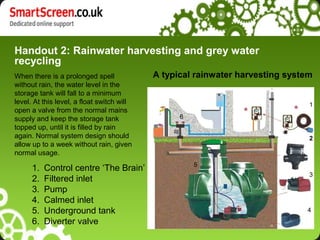
When there is a prolonged spell
without rain, the water level in the
storage tank will fall to a minimum
level. At this level, a float switch will
open a valve from the normal mains
supply and keep the storage tank
topped up, until it is filled by rain
again. Normal system design should
allow up to a week without rain, given
normal usage.
2
4
5
1
3
6
A typical rainwater harvesting system
1. Control centre ‘The Brain’
2. Filtered inlet
3. Pump
4. Calmed inlet
5. Underground tank
6. Diverter valve
Handout 2: Rainwater harvesting and grey water
recycling
The water is collected in a butt or tank installed above or below ground
level. However, for below ground installations the installation engineer
has to ensure adequate access for filter removal and cleaning as well
as disinfection purposes. Typical prices for grey water systems range
from £200 for the smaller system to £1000 for larger installations plus
associated plumbing costs.
Grey water recycling
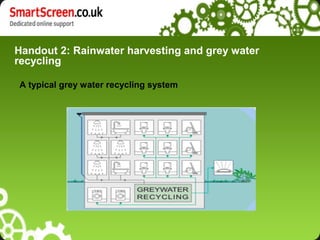
Grey water is the waste water that we drain away after we take a
bath, shower or from our hand basins. This water in much the
same way can be collected and reused for filling our toilet cisterns
for flushing, washing our vehicles, washing our drives and watering
our garden.
Handout 2: Rainwater harvesting and grey water
recycling
When the water is collected from the baths, showers and hand basins
it has to be cleaned and filtered via a cleansing unit to remove all
microbiological and other impurities to ensure that it is safe to reuse.
When it has been adequately cleaned, the water can be piped to the
toilet cistern for flushing purposes, reused for washing our clothes,
cleaning our vehicles and drives as well as watering our gardens.
Maintenance of the cleansing unit involves the removal of a filter within
the unit and rinsing in warm water as well as the replacement of a
disinfection tablet at regular specified intervals.
Handout 2: Rainwater harvesting and grey water
recycling
Depending on your normal usage, grey water recycling can
save up to 30 to 40% of the treated potable drinking water
from the mains in houses and up to 60% of the treated
drinking potable water in a business or commercial
building. This in turn can save up to 30 to 40% for the
domestic user and 60% for the commercial user on water
bills.
The grey water recycling and rain water harvesting
systems can be combined and installed together for
increased long term savings.
Handout 2: Rainwater harvesting and grey water
recycling
A typical grey water recycling system

Unit 102 power_point_2

  • 1.
  • 2.
    Handout 2: Rainwaterharvesting and grey water recycling What is rainwater harvesting? Rainwater harvesting is a way of saving the rainwater which would normally flow off a roof and down the drain, and using it as piped water to flush toilets and for the garden watering, drive wash down, vehicle and car washing, instead of treated drinking (potable) water. It is not a new idea: the collection and re-use of rainwater from roofs can be traced back thousands of years in hot, dry countries around the Mediterranean. In continental Europe, some 100,000 are installed annually; Germany has been using and refining the technology since the early 80s. Rainwater harvesting can also be used in schools, hospitals, offices, commercial premises; rainwater can typically be used for toilets, vehicle washing, yard wash down and watering plant pots/gardens.
  • 3.
    Handout 2: Rainwaterharvesting and grey water recycling Depending on your normal usage, rainwater harvesting can save 30 to 50% of the treated potable drinking water from the mains in houses and up to 80% of the treated drinking potable water in a business or commercial building. This in turn can save up to 30 to 50% for the domestic user and 80% for the commercial user on water bills. Having metered water is the best way of appreciating the savings that are being made. A rainwater harvesting system can collect on average up to 100,000 litres per household, depending on the area and angle of your roof, and your rainfall and even greater quantities for larger roofed commercial buildings.
  • 4.
    Handout 2: Rainwaterharvesting and grey water recycling Normally a builder would install a rainwater harvesting system. The skills are the same as installing a septic tank, but a plumber would be needed to complete the internal pipework. There are no specific regulations yet that govern rainwater harvesting as such, although Building Regulations Part H affect siting of the tank and pipe runs, while Part G refers to internal plumbing regulations. In a properly designed system, the pipework is entirely separate from the mains water pipework and should be identified as non-potable. The system can be installed in existing buildings, but will cost more because of the extra plumbing required. In addition, bungalows and commercial premises are also very suitable, the only limitation is the area of the roof to capture rain, compared to the number of users; this puts a limitation on flats and apartments. The tank should be buried under a car or vehicle park, landscaped area, garden, patio or drive, with space left for the round access cover. Most systems are designed so that they can accept cars driving over them if suitably installed. Domestic systems can cost from about £2500 up to over £4000 including installation costs, depending on the size of tank. Commercial systems can cost a lot more depending on the size and requirement, but usually have a much quicker 'pay back' period due to the size of roof and high usage.
  • 5.
    Handout 2: Rainwaterharvesting and grey water recycling A storage tank is fitted to your rainwater drain from your roof, and falling rain enters the tank through a filter which removes leaves and other matter. The storage tank is usually buried under car or vehicle parks, a garden or under the entrance access or drive, and contains a pump which pumps the rainwater to the building where it is piped to the toilets, and to the outside taps. The filtered, untreated rainwater should only be used for non- drinking or bathing purposes: toilet flushing, gardens, vehicle and drive wash downs. The rainwater is filtered as it enters the storage tank, to remove particles and other matter. It is kept in the dark and kept oxygenated to discourage algal growth, and properly designed systems are designed with calming inlets, which ensure that any sediment at the bottom of the tank does not get stirred up. The water is not drinking water fit for humans. The internal filter should be washed about once a quarter, otherwise maintenance is not needed. The only moving components - pump and float switch have an extremely long life. The system should be designed to overflow a few times a year, to remove floating matter.
  • 6.
    Handout 2: Rainwaterharvesting and grey water recycling When there is a prolonged spell without rain, the water level in the storage tank will fall to a minimum level. At this level, a float switch will open a valve from the normal mains supply and keep the storage tank topped up, until it is filled by rain again. Normal system design should allow up to a week without rain, given normal usage. 2 4 5 1 3 6 A typical rainwater harvesting system 1. Control centre ‘The Brain’ 2. Filtered inlet 3. Pump 4. Calmed inlet 5. Underground tank 6. Diverter valve
  • 7.
    Handout 2: Rainwaterharvesting and grey water recycling The water is collected in a butt or tank installed above or below ground level. However, for below ground installations the installation engineer has to ensure adequate access for filter removal and cleaning as well as disinfection purposes. Typical prices for grey water systems range from £200 for the smaller system to £1000 for larger installations plus associated plumbing costs. Grey water recycling Grey water is the waste water that we drain away after we take a bath, shower or from our hand basins. This water in much the same way can be collected and reused for filling our toilet cisterns for flushing, washing our vehicles, washing our drives and watering our garden.
  • 8.
    Handout 2: Rainwaterharvesting and grey water recycling When the water is collected from the baths, showers and hand basins it has to be cleaned and filtered via a cleansing unit to remove all microbiological and other impurities to ensure that it is safe to reuse. When it has been adequately cleaned, the water can be piped to the toilet cistern for flushing purposes, reused for washing our clothes, cleaning our vehicles and drives as well as watering our gardens. Maintenance of the cleansing unit involves the removal of a filter within the unit and rinsing in warm water as well as the replacement of a disinfection tablet at regular specified intervals.
  • 9.
    Handout 2: Rainwaterharvesting and grey water recycling Depending on your normal usage, grey water recycling can save up to 30 to 40% of the treated potable drinking water from the mains in houses and up to 60% of the treated drinking potable water in a business or commercial building. This in turn can save up to 30 to 40% for the domestic user and 60% for the commercial user on water bills. The grey water recycling and rain water harvesting systems can be combined and installed together for increased long term savings.
  • 10.
    Handout 2: Rainwaterharvesting and grey water recycling A typical grey water recycling system