Module 7 | Slide 1 of 17 2012
Self-Inspection and
quality audits
Basic Principles of GMP
Module 7 | Slide 2 of 17 2012
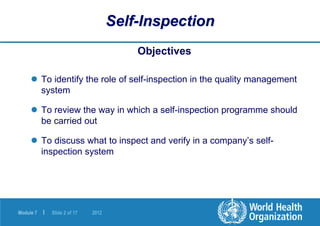
Self-Inspection
Objectives
 To identify the role of self-inspection in the quality management
system
 To review the way in which a self-inspection programme should
be carried out
 To discuss what to inspect and verify in a company’s self-
inspection system
Module 7 | Slide 3 of 17 2012
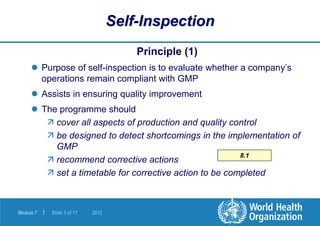
Self-Inspection
Principle (1)
 Purpose of self-inspection is to evaluate whether a company’s
operations remain compliant with GMP
 Assists in ensuring quality improvement
 The programme should
 cover all aspects of production and quality control
 be designed to detect shortcomings in the implementation of
GMP
 recommend corrective actions
 set a timetable for corrective action to be completed
8.1
Module 7 | Slide 4 of 17 2012
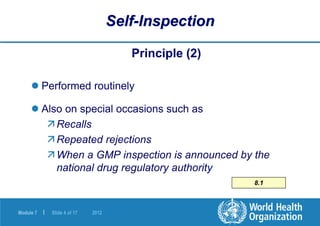
Self-Inspection
Principle (2)
 Performed routinely
 Also on special occasions such as
Recalls
Repeated rejections
When a GMP inspection is announced by the
national drug regulatory authority
8.1
Module 7 | Slide 5 of 17 2012
Self-Inspection
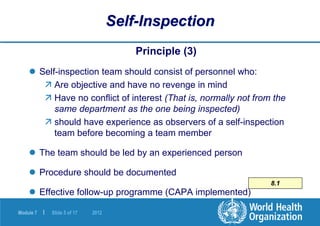
Principle (3)
 Self-inspection team should consist of personnel who:
 Are objective and have no revenge in mind
 Have no conflict of interest (That is, normally not from the
same department as the one being inspected)
 should have experience as observers of a self-inspection
team before becoming a team member
 The team should be led by an experienced person
 Procedure should be documented
 Effective follow-up programme (CAPA implemented)
8.1
Module 7 | Slide 6 of 17 2012
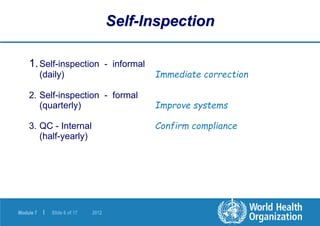
Self-Inspection
1.Self-inspection - informal
(daily) Immediate correction
2. Self-inspection - formal
(quarterly) Improve systems
3. QC - Internal Confirm compliance
(half-yearly)
Module 7 | Slide 7 of 17 2012
8.2
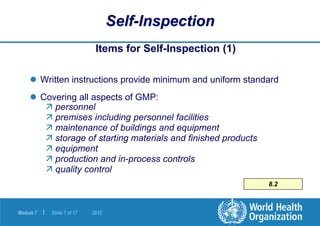
Self-Inspection
Items for Self-Inspection (1)
 Written instructions provide minimum and uniform standard
 Covering all aspects of GMP:
 personnel
 premises including personnel facilities
 maintenance of buildings and equipment
 storage of starting materials and finished products
 equipment
 production and in-process controls
 quality control
Module 7 | Slide 8 of 17 2012
8.2
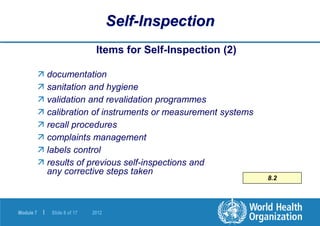
Self-Inspection
Items for Self-Inspection (2)
 documentation
 sanitation and hygiene
 validation and revalidation programmes
 calibration of instruments or measurement systems
 recall procedures
 complaints management
 labels control
 results of previous self-inspections and
any corrective steps taken
Module 7 | Slide 9 of 17 2012
8.3, 8.4
Self-Inspection
The Self-Inspection Team
 Team appointed by management, with:
 authority
 sufficient experience
 may be from inside or outside the company
 experts in their own field
 familiar with GMP
 Frequency should be at least once a year
 Depends on company size, requirements, actrivities
 Often, departments are inspected according to a calender –
one department per month over a one year cycle
Module 7 | Slide 10 of 17 2012
8.5, 8.6
Self-Inspection
Self-Inspection
 Report prepared at completion of inspection, including:
 results
 evaluation
 conclusions
 recommended corrective measures
 Follow-up action
 Effective follow-up programme
 Company management to evaluate both
the report and corrective actions
Module 7 | Slide 11 of 17 2012
8.7
Self-Inspection
Quality Audit
 This is an examination of all or part of quality system
 The aim is to improve it
 Usually conducted by outside experts or team
appointed by management
 Useful to supplement self-inspection programme with
quality audits
 May be extended to suppliers and contractors
Module 7 | Slide 12 of 17 2012
8.8, 8.9
Self-Inspection
Suppliers’ audits and approvals
 Quality Unit (e.g. QA or QC) responsible together with other
relevant departments for approving suppliers
 Ensure that suppliers can reliably supply materials that meet
established specifications
 Suppliers should be evaluated and approved before they are
included in approved supplier's lists
 Should take into account the supplier’s history and nature of
materials to be supplied
 Evaluation may also lead to an audit to assess compliance, e.g.
with GMP
Module 7 | Slide 13 of 17 2012
Self-Inspection
Inspecting the Self-Inspection Programme (1)
 GMP inspectors should preferably check self-inspection
programme at end of an inspection
 Evaluate:
 SOP, team composition
 Annual program / schedule
 Checklists used by the company (are these up to date?)
 Check that inspections are done as schedules
 Reports are available
 CAPAs are taken, implementation is verified, management
involvement
Module 7 | Slide 14 of 17 2012
Self-Inspection
Auditing the Self-Inspection Programme (2)
 The SOP should describe teams, process, items covered, and
the frequency of self-inspection
 Company policy may not permit GMP inspector to see actual
deficiency reports and corrective actions
 GMP Inspectors should be looking for compliance with the self-
inspection SOP - not necessarily at actual deficiencies
recorded
 Seek objective evidence of reports and action
Module 7 | Slide 15 of 17 2012
Self-Inspection
Auditing the Self-Inspection Programme (3)
 Ensure company is not just doing housekeeping or safety
audits
 Check there are “Vertical” as well as normal “Horizontal”
audits; both play valuable role in self-inspection
Module 7 | Slide 16 of 17 2012
Self-Inspection
Group Session
 You are a GMP inspector in a large company with a diverse
range of products
 You are given the SOP, deficiency report form, and the self-
inspection schedule
 Prepare a report of your observations as to whether the
company’s approach to self-inspection meets GMP guidelines
Module 7 | Slide 17 of 17 2012
Self-Inspection
Possible Issues
 Size of the factory; phased inspection
 Source of team leader
 Source of team members
 Reports and feedback

UNIT 10 Self-Inspection and quality audits.ppt

  • 1.
    Module 7 |Slide 1 of 17 2012 Self-Inspection and quality audits Basic Principles of GMP
  • 2.
    Module 7 |Slide 2 of 17 2012 Self-Inspection Objectives  To identify the role of self-inspection in the quality management system  To review the way in which a self-inspection programme should be carried out  To discuss what to inspect and verify in a company’s self- inspection system
  • 3.
    Module 7 |Slide 3 of 17 2012 Self-Inspection Principle (1)  Purpose of self-inspection is to evaluate whether a company’s operations remain compliant with GMP  Assists in ensuring quality improvement  The programme should  cover all aspects of production and quality control  be designed to detect shortcomings in the implementation of GMP  recommend corrective actions  set a timetable for corrective action to be completed 8.1
  • 4.
    Module 7 |Slide 4 of 17 2012 Self-Inspection Principle (2)  Performed routinely  Also on special occasions such as Recalls Repeated rejections When a GMP inspection is announced by the national drug regulatory authority 8.1
  • 5.
    Module 7 |Slide 5 of 17 2012 Self-Inspection Principle (3)  Self-inspection team should consist of personnel who:  Are objective and have no revenge in mind  Have no conflict of interest (That is, normally not from the same department as the one being inspected)  should have experience as observers of a self-inspection team before becoming a team member  The team should be led by an experienced person  Procedure should be documented  Effective follow-up programme (CAPA implemented) 8.1
  • 6.
    Module 7 |Slide 6 of 17 2012 Self-Inspection 1.Self-inspection - informal (daily) Immediate correction 2. Self-inspection - formal (quarterly) Improve systems 3. QC - Internal Confirm compliance (half-yearly)
  • 7.
    Module 7 |Slide 7 of 17 2012 8.2 Self-Inspection Items for Self-Inspection (1)  Written instructions provide minimum and uniform standard  Covering all aspects of GMP:  personnel  premises including personnel facilities  maintenance of buildings and equipment  storage of starting materials and finished products  equipment  production and in-process controls  quality control
  • 8.
    Module 7 |Slide 8 of 17 2012 8.2 Self-Inspection Items for Self-Inspection (2)  documentation  sanitation and hygiene  validation and revalidation programmes  calibration of instruments or measurement systems  recall procedures  complaints management  labels control  results of previous self-inspections and any corrective steps taken
  • 9.
    Module 7 |Slide 9 of 17 2012 8.3, 8.4 Self-Inspection The Self-Inspection Team  Team appointed by management, with:  authority  sufficient experience  may be from inside or outside the company  experts in their own field  familiar with GMP  Frequency should be at least once a year  Depends on company size, requirements, actrivities  Often, departments are inspected according to a calender – one department per month over a one year cycle
  • 10.
    Module 7 |Slide 10 of 17 2012 8.5, 8.6 Self-Inspection Self-Inspection  Report prepared at completion of inspection, including:  results  evaluation  conclusions  recommended corrective measures  Follow-up action  Effective follow-up programme  Company management to evaluate both the report and corrective actions
  • 11.
    Module 7 |Slide 11 of 17 2012 8.7 Self-Inspection Quality Audit  This is an examination of all or part of quality system  The aim is to improve it  Usually conducted by outside experts or team appointed by management  Useful to supplement self-inspection programme with quality audits  May be extended to suppliers and contractors
  • 12.
    Module 7 |Slide 12 of 17 2012 8.8, 8.9 Self-Inspection Suppliers’ audits and approvals  Quality Unit (e.g. QA or QC) responsible together with other relevant departments for approving suppliers  Ensure that suppliers can reliably supply materials that meet established specifications  Suppliers should be evaluated and approved before they are included in approved supplier's lists  Should take into account the supplier’s history and nature of materials to be supplied  Evaluation may also lead to an audit to assess compliance, e.g. with GMP
  • 13.
    Module 7 |Slide 13 of 17 2012 Self-Inspection Inspecting the Self-Inspection Programme (1)  GMP inspectors should preferably check self-inspection programme at end of an inspection  Evaluate:  SOP, team composition  Annual program / schedule  Checklists used by the company (are these up to date?)  Check that inspections are done as schedules  Reports are available  CAPAs are taken, implementation is verified, management involvement
  • 14.
    Module 7 |Slide 14 of 17 2012 Self-Inspection Auditing the Self-Inspection Programme (2)  The SOP should describe teams, process, items covered, and the frequency of self-inspection  Company policy may not permit GMP inspector to see actual deficiency reports and corrective actions  GMP Inspectors should be looking for compliance with the self- inspection SOP - not necessarily at actual deficiencies recorded  Seek objective evidence of reports and action
  • 15.
    Module 7 |Slide 15 of 17 2012 Self-Inspection Auditing the Self-Inspection Programme (3)  Ensure company is not just doing housekeeping or safety audits  Check there are “Vertical” as well as normal “Horizontal” audits; both play valuable role in self-inspection
  • 16.
    Module 7 |Slide 16 of 17 2012 Self-Inspection Group Session  You are a GMP inspector in a large company with a diverse range of products  You are given the SOP, deficiency report form, and the self- inspection schedule  Prepare a report of your observations as to whether the company’s approach to self-inspection meets GMP guidelines
  • 17.
    Module 7 |Slide 17 of 17 2012 Self-Inspection Possible Issues  Size of the factory; phased inspection  Source of team leader  Source of team members  Reports and feedback

Editor's Notes