UNIT 1 TRENDS
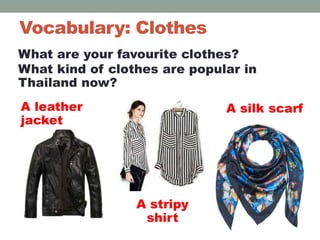
Vocabulary: Clothes
A leather
jacket
A stripy
shirt
A silk scarf
What are your favourite clothes?
What kind of clothes are popular in
Thailand now?
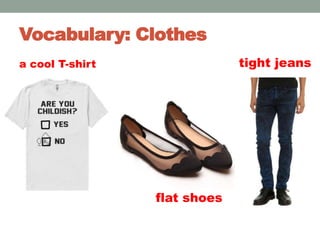
Vocabulary: Clothes
a cool T-shirt
flat shoes
tight jeans
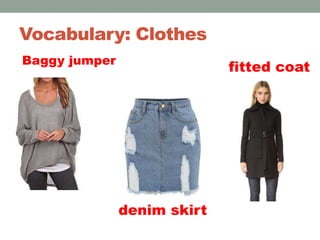
Vocabulary: Clothes
Baggy jumper
fitted coat
denim skirt
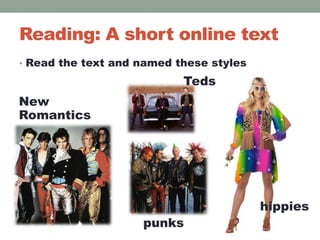
Reading: A short online text
• Read the text and named these styles
hippies
Teds
punks
New
Romantics
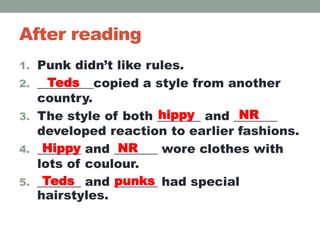
After reading
1. Punk didn’t like rules.
2. _________copied a style from another
country.
3. The style of both _______ and _______
developed reaction to earlier fashions.
4. _______ and _______ wore clothes with
lots of coulour.
5. _______ and _______ had special
hairstyles.
Teds
hippy NR
Hippy NR
Teds punks
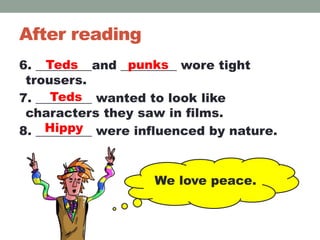
After reading
6. _________and _________ wore tight
trousers.
7. _________ wanted to look like
characters they saw in films.
8. _________ were influenced by nature.
We love peace.
Teds punks
Hippy
Teds
Reading: vocabulary
quiff ponytail loose clothes
dyed hair dog collar safety-pins
extravagant make-up
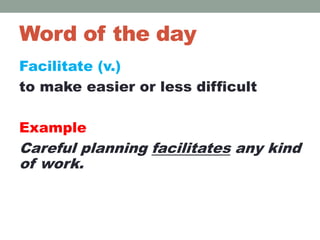
Word of the day
Facilitate (v.)
to make easier or less difficult
Example
Careful planning facilitates any kind
of work.
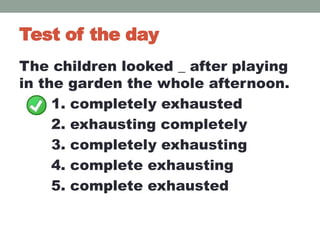
Test of the day
The children looked _ after playing
in the garden the whole afternoon.
1. completely exhausted
2. exhausting completely
3. completely exhausting
4. complete exhausting
5. complete exhausted
THE
END
Language Focus 1
Used to –would
Used to แปลว่า เคยใช้กล่าวถึงเหตุการณ์ในอดีต
I used to…. / didn’t use to…../Did
you use to….?
Would เป็นรูปอดีตของ will ใช้กล่าวถึงเหตุการณ์ในอดีต จะไม่ใช้กับคา
เหล่านี้(be,have,live,love,want,care, etc.)
He would swim / He wouldn’t swim /
Would he swim?
Action Verb and Stative Verb
• action verb หรือ บางคนเรียกว่า dynamic verb คือคากริยาที่
แสดงอาการ การกระทา มีการขยับเขยื้อน เคลื่อนไหว พูดง่ายๆคือ เรานึกภาพออก
ว่าเขาทากริยานั้นๆอย่างไร
• stative verb หรือบางครั้งเรียกว่า state verb หรือ abstract
verb คือคากริยาที่ไม่ได้แสดงการกระทาหรือการเคลื่อนไหว แต่เป็นกริยาที่แสดง
สภาวะ
- Would ไม่ใช้กับ stative verb -
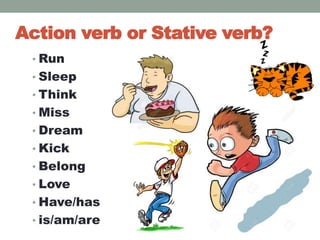
Action verb or Stative verb?
• Run
• Sleep
• Think
• Miss
• Dream
• Kick
• Belong
• Love
• Have/has
• is/am/are
Let’s do the
exercise.
Test of the day
GAT Feb 54
ตอบ C. so that ตามด้วยประโยค
(subject+verb) เปลี่ยนเป็น in order to…
Error Identification
Word of the day
Accumulate (v.)
to gather or collect, often in gradual
degrees
Example
Snow accumulated in the driveway
THE
END
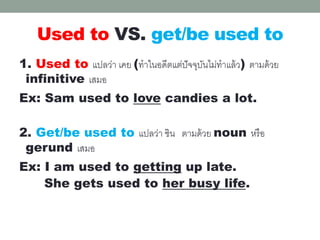
Used to VS. get/be used to
1. Used to แปลว่า เคย (ทาในอดีตแต่ปัจจุบันไม่ทาแล้ว) ตามด้วย
infinitive เสมอ
Ex: Sam used to love candies a lot.
2. Get/be used to แปลว่า ชิน ตามด้วย noun หรือ
gerund เสมอ
Ex: I am used to getting up late.
She gets used to her busy life.
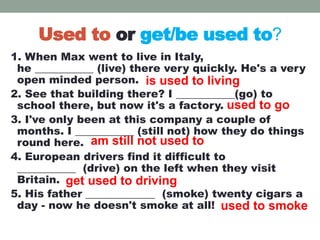
Used to or get/be used to?
1. When Max went to live in Italy,
he ___________ (live) there very quickly. He's a very
open minded person.
2. See that building there? I ___________(go) to
school there, but now it's a factory.
3. I've only been at this company a couple of
months. I ___________ (still not) how they do things
round here.
4. European drivers find it difficult to
___________ (drive) on the left when they visit
Britain.
5. His father _____________ (smoke) twenty cigars a
day - now he doesn't smoke at all!
is used to living
used to go
am still not used to
get used to driving
used to smoke
Let’s do the
exercise.
Test of the day
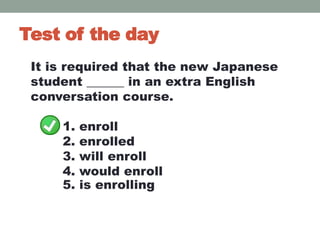
It is required that the new Japanese
student ______ in an extra English
conversation course.
1. enroll
2. enrolled
3. will enroll
4. would enroll
5. is enrolling
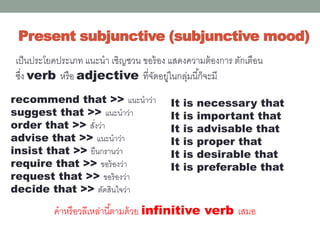
Present subjunctive (subjunctive mood)
It is necessary that
It is important that
It is advisable that
It is proper that
It is desirable that
It is preferable that
recommend that >> แนะนาว่า
suggest that >> แนะนาว่า
order that >> สั่งว่า
advise that >> แนะนาว่า
insist that >> ยืนกรานว่า
require that >> ขอร้องว่า
request that >> ขอร้องว่า
decide that >> ตัดสินใจว่า
เป็นประโยคประเภท แนะนา เชิญชวน ขอร้อง แสดงความต้องการ ตักเตือน
ซึ่ง verb หรือ adjective ที่จัดอยู่ในกลุ่มนี้ก็จะมี
คาหรือวลีเหล่านี้ตามด้วย infinitive verb เสมอ
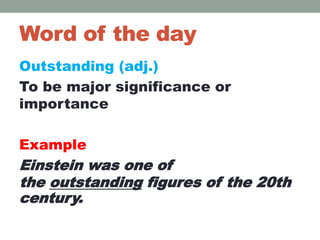
Word of the day
Outstanding (adj.)
To be major significance or
importance
Example
Einstein was one of
the outstanding figures of the 20th
century.
THE
END
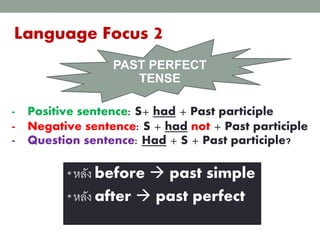
•หลัง before  past simple
•หลัง after  past perfect
- Positive sentence: S+ had + Past participle
- Negative sentence: S + had not + Past participle
- Question sentence: Had + S + Past participle?
Language Focus 2
PAST PERFECT
TENSE
Language Focus 2
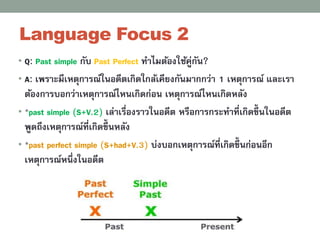
• Q: Past simple กับ Past Perfect ทำไมต้องใช้คู่กัน?
• A: เพรำะมีเหตุกำรณ์ในอดีตเกิดใกล้เคียงกันมำกกว่ำ 1 เหตุกำรณ์ และเรำ
ต้องกำรบอกว่ำเหตุกำรณ์ไหนเกิดก่อน เหตุกำรณ์ไหนเกิดหลัง
• *past simple (S+V.2) เล่ำเรื่องรำวในอดีต หรือกำรกระทำที่เกิดขึ้ นในอดีต
พูดถึงเหตุกำรณ์ที่เกิดขึ้ นหลัง
• *past perfect simple (S+had+V.3) บ่งบอกเหตุกำรณ์ที่เกิดขึ้ นก่อนอีก
เหตุกำรณ์หนึ่งในอดีต
Let’s do the
exercise.
Exercise
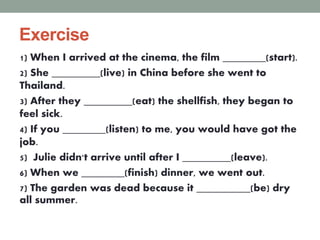
1) When I arrived at the cinema, the film ________(start).
2) She _________(live) in China before she went to
Thailand.
3) After they _________(eat) the shellfish, they began to
feel sick.
4) If you ________(listen) to me, you would have got the
job.
5) Julie didn't arrive until after I _________(leave).
6) When we ________(finish) dinner, we went out.
7) The garden was dead because it __________(be) dry
all summer.
Idioms สานวน/สุภาษิต
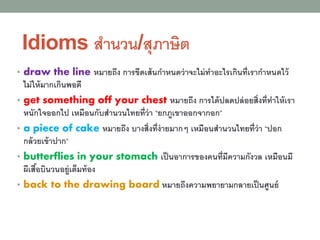
• draw the line หมายถึง การขีดเส้นกาหนดว่าจะไม่ทาอะไรเกินที่เรากาหนดไว้
ไม่ให้มากเกินพอดี
• get something off your chest หมายถึง การได้ปลดปล่อยสิ่งที่ทาให้เรา
หนักใจออกไป เหมือนกับสานวนไทยที่ว่า “ยกภูเขาออกจากอก”
• a piece of cake หมายถึง บางสิ่งที่ง่ายมากๆ เหมือนสานวนไทยที่ว่า “ปอก
กล้วยเข้าปาก”
• butterflies in your stomach เป็นอาการของคนที่มีความกังวล เหมือนมี
ผีเสื้อบินวนอยู่เต็มท้อง
• back to the drawing board หมายถึงความพยายามกลายเป็นศูนย์
Idioms สานวน/สุภาษิต
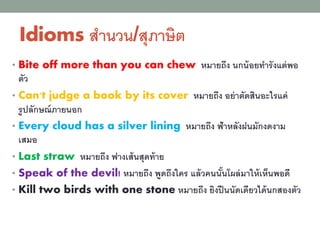
• Bite off more than you can chew หมายถึง นกน้อยทารังแต่พอ
ตัว
• Can't judge a book by its cover หมายถึง อย่าตัดสินอะไรแค่
รูปลักษณ์ภายนอก
• Every cloud has a silver lining หมายถึง ฟ้าหลังฝนมักงดงาม
เสมอ
• Last straw หมายถึง ฟางเส้นสุดท้าย
• Speak of the devil! หมายถึง พูดถึงใคร แล้วคนนั้นโผล่มาให้เห็นพอดี
• Kill two birds with one stone หมายถึง ยิงปืนนัดเดียวได้นกสองตัว


Unit 1 trends

  • 1.
  • 2.
    Vocabulary: Clothes A leather jacket Astripy shirt A silk scarf What are your favourite clothes? What kind of clothes are popular in Thailand now?
  • 3.
    Vocabulary: Clothes a coolT-shirt flat shoes tight jeans
  • 4.
  • 5.
    Reading: A shortonline text • Read the text and named these styles hippies Teds punks New Romantics
  • 6.
    After reading 1. Punkdidn’t like rules. 2. _________copied a style from another country. 3. The style of both _______ and _______ developed reaction to earlier fashions. 4. _______ and _______ wore clothes with lots of coulour. 5. _______ and _______ had special hairstyles. Teds hippy NR Hippy NR Teds punks
  • 7.
    After reading 6. _________and_________ wore tight trousers. 7. _________ wanted to look like characters they saw in films. 8. _________ were influenced by nature. We love peace. Teds punks Hippy Teds
  • 8.
    Reading: vocabulary quiff ponytailloose clothes dyed hair dog collar safety-pins extravagant make-up
  • 9.
    Word of theday Facilitate (v.) to make easier or less difficult Example Careful planning facilitates any kind of work.
  • 10.
    Test of theday The children looked _ after playing in the garden the whole afternoon. 1. completely exhausted 2. exhausting completely 3. completely exhausting 4. complete exhausting 5. complete exhausted
  • 11.
  • 12.
    Language Focus 1 Usedto –would Used to แปลว่า เคยใช้กล่าวถึงเหตุการณ์ในอดีต I used to…. / didn’t use to…../Did you use to….? Would เป็นรูปอดีตของ will ใช้กล่าวถึงเหตุการณ์ในอดีต จะไม่ใช้กับคา เหล่านี้(be,have,live,love,want,care, etc.) He would swim / He wouldn’t swim / Would he swim?
  • 13.
    Action Verb andStative Verb • action verb หรือ บางคนเรียกว่า dynamic verb คือคากริยาที่ แสดงอาการ การกระทา มีการขยับเขยื้อน เคลื่อนไหว พูดง่ายๆคือ เรานึกภาพออก ว่าเขาทากริยานั้นๆอย่างไร • stative verb หรือบางครั้งเรียกว่า state verb หรือ abstract verb คือคากริยาที่ไม่ได้แสดงการกระทาหรือการเคลื่อนไหว แต่เป็นกริยาที่แสดง สภาวะ - Would ไม่ใช้กับ stative verb -
  • 14.
    Action verb orStative verb? • Run • Sleep • Think • Miss • Dream • Kick • Belong • Love • Have/has • is/am/are
  • 15.
  • 16.
    Test of theday GAT Feb 54 ตอบ C. so that ตามด้วยประโยค (subject+verb) เปลี่ยนเป็น in order to… Error Identification
  • 17.
    Word of theday Accumulate (v.) to gather or collect, often in gradual degrees Example Snow accumulated in the driveway
  • 18.
  • 19.
    Used to VS.get/be used to 1. Used to แปลว่า เคย (ทาในอดีตแต่ปัจจุบันไม่ทาแล้ว) ตามด้วย infinitive เสมอ Ex: Sam used to love candies a lot. 2. Get/be used to แปลว่า ชิน ตามด้วย noun หรือ gerund เสมอ Ex: I am used to getting up late. She gets used to her busy life.
  • 20.
    Used to orget/be used to? 1. When Max went to live in Italy, he ___________ (live) there very quickly. He's a very open minded person. 2. See that building there? I ___________(go) to school there, but now it's a factory. 3. I've only been at this company a couple of months. I ___________ (still not) how they do things round here. 4. European drivers find it difficult to ___________ (drive) on the left when they visit Britain. 5. His father _____________ (smoke) twenty cigars a day - now he doesn't smoke at all! is used to living used to go am still not used to get used to driving used to smoke
  • 21.
  • 22.
    Test of theday It is required that the new Japanese student ______ in an extra English conversation course. 1. enroll 2. enrolled 3. will enroll 4. would enroll 5. is enrolling
  • 23.
    Present subjunctive (subjunctivemood) It is necessary that It is important that It is advisable that It is proper that It is desirable that It is preferable that recommend that >> แนะนาว่า suggest that >> แนะนาว่า order that >> สั่งว่า advise that >> แนะนาว่า insist that >> ยืนกรานว่า require that >> ขอร้องว่า request that >> ขอร้องว่า decide that >> ตัดสินใจว่า เป็นประโยคประเภท แนะนา เชิญชวน ขอร้อง แสดงความต้องการ ตักเตือน ซึ่ง verb หรือ adjective ที่จัดอยู่ในกลุ่มนี้ก็จะมี คาหรือวลีเหล่านี้ตามด้วย infinitive verb เสมอ
  • 24.
    Word of theday Outstanding (adj.) To be major significance or importance Example Einstein was one of the outstanding figures of the 20th century.
  • 25.
  • 26.
    •หลัง before past simple •หลัง after  past perfect - Positive sentence: S+ had + Past participle - Negative sentence: S + had not + Past participle - Question sentence: Had + S + Past participle? Language Focus 2 PAST PERFECT TENSE
  • 27.
    Language Focus 2 •Q: Past simple กับ Past Perfect ทำไมต้องใช้คู่กัน? • A: เพรำะมีเหตุกำรณ์ในอดีตเกิดใกล้เคียงกันมำกกว่ำ 1 เหตุกำรณ์ และเรำ ต้องกำรบอกว่ำเหตุกำรณ์ไหนเกิดก่อน เหตุกำรณ์ไหนเกิดหลัง • *past simple (S+V.2) เล่ำเรื่องรำวในอดีต หรือกำรกระทำที่เกิดขึ้ นในอดีต พูดถึงเหตุกำรณ์ที่เกิดขึ้ นหลัง • *past perfect simple (S+had+V.3) บ่งบอกเหตุกำรณ์ที่เกิดขึ้ นก่อนอีก เหตุกำรณ์หนึ่งในอดีต
  • 28.
  • 29.
    Exercise 1) When Iarrived at the cinema, the film ________(start). 2) She _________(live) in China before she went to Thailand. 3) After they _________(eat) the shellfish, they began to feel sick. 4) If you ________(listen) to me, you would have got the job. 5) Julie didn't arrive until after I _________(leave). 6) When we ________(finish) dinner, we went out. 7) The garden was dead because it __________(be) dry all summer.
  • 30.
    Idioms สานวน/สุภาษิต • drawthe line หมายถึง การขีดเส้นกาหนดว่าจะไม่ทาอะไรเกินที่เรากาหนดไว้ ไม่ให้มากเกินพอดี • get something off your chest หมายถึง การได้ปลดปล่อยสิ่งที่ทาให้เรา หนักใจออกไป เหมือนกับสานวนไทยที่ว่า “ยกภูเขาออกจากอก” • a piece of cake หมายถึง บางสิ่งที่ง่ายมากๆ เหมือนสานวนไทยที่ว่า “ปอก กล้วยเข้าปาก” • butterflies in your stomach เป็นอาการของคนที่มีความกังวล เหมือนมี ผีเสื้อบินวนอยู่เต็มท้อง • back to the drawing board หมายถึงความพยายามกลายเป็นศูนย์
  • 31.
    Idioms สานวน/สุภาษิต • Biteoff more than you can chew หมายถึง นกน้อยทารังแต่พอ ตัว • Can't judge a book by its cover หมายถึง อย่าตัดสินอะไรแค่ รูปลักษณ์ภายนอก • Every cloud has a silver lining หมายถึง ฟ้าหลังฝนมักงดงาม เสมอ • Last straw หมายถึง ฟางเส้นสุดท้าย • Speak of the devil! หมายถึง พูดถึงใคร แล้วคนนั้นโผล่มาให้เห็นพอดี • Kill two birds with one stone หมายถึง ยิงปืนนัดเดียวได้นกสองตัว