Unit - 1
Introduction to
Investment Analysis and
Portfolio Management
Investment
• Definition:
“Investment may be defined as an activity that commits funds in
any financial/marketable or physical form in the present
with an expectation of receiving additional return in the
future.”
“Investment is the commitment of current funds in anticipation
of receiving larger inflow of funds in future, the difference
being the income”.
• For example, a Bank deposit is a financial asset, the purchase
of gold is a physical asset and the purchase of bonds and
shares is marketable asset.
• An investor hopes to be compensated for
a. forgoing present consumption,
b. for the effects of inflation, and
c. for taking a risk.
Investment Objectives
• Return
• Risk
• Liquidity
• Hedge against inflation
• Safety
• Tax Benefits
Speculation
• In speculation, there is an investment of funds with an
expectation of some return in the form of capital profit
resulting from the price change and sale of investment.
Speculation is relatively a short term investment. The degree
of uncertainty of future return is definitely higher in case of
speculation than in investment.
• In case of investment, the investor has an intention of keeping
the investment for some period whereas in speculation, the
investor looks for an opportunity of making a profit and “exit-
out” by selling the investment.
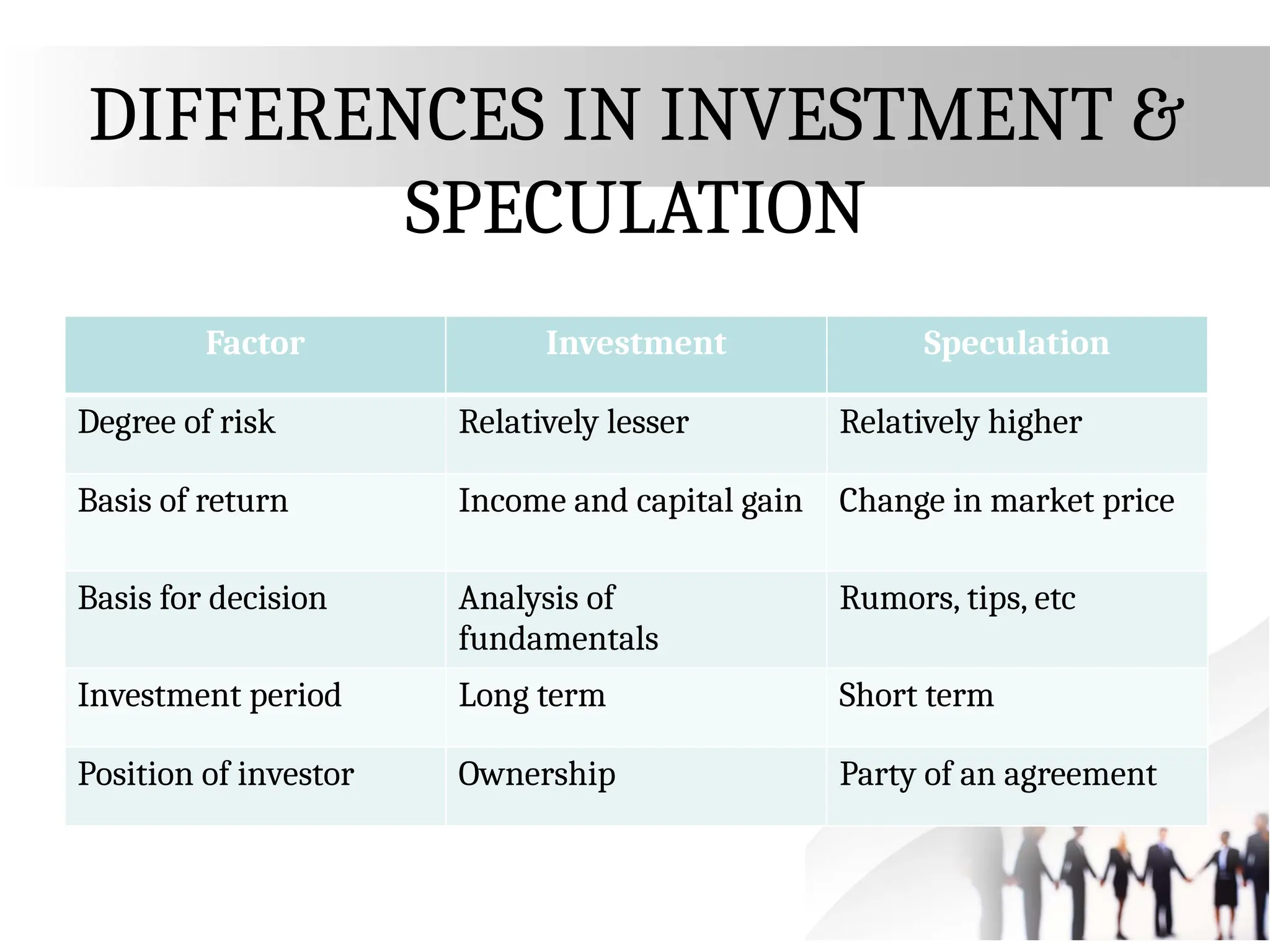
DIFFERENCES IN INVESTMENT &
SPECULATION
Factor Investment Speculation
Degree of risk Relatively lesser Relatively higher
Basis of return Income and capital gain Change in market price
Basis for decision Analysis of
fundamentals
Rumors, tips, etc
Investment period Long term Short term
Position of investor Ownership Party of an agreement
Gambling
• It is usually a very short term investment in a game or
chance. Gambling is different from speculation and
investment. The time horizon involved in gambling is shorter
than speculation and investment.
• People gamble to entertain themselves, earning incomes
would be the secondary factor.
• Gambling employs artificial risks whereas commercial risks
are present in investment
• There is no risk and return tradeoff in the gambling and the
negative outcomes are expected but in investment there is
analysis of risk and return and positive outcomes are
expected.
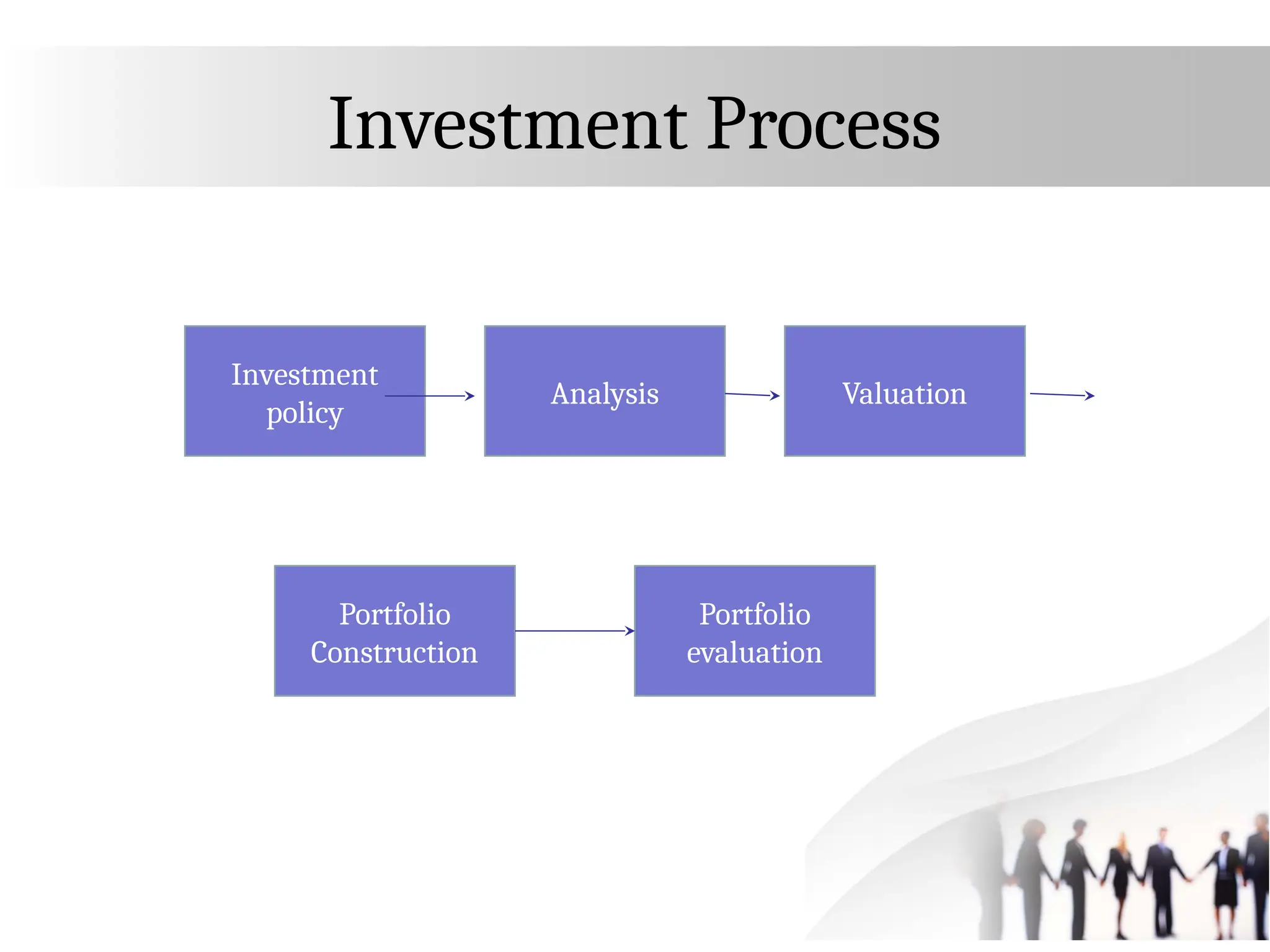
Investment Process
Investment
policy
Analysis Valuation
Portfolio
Construction
Portfolio
evaluation
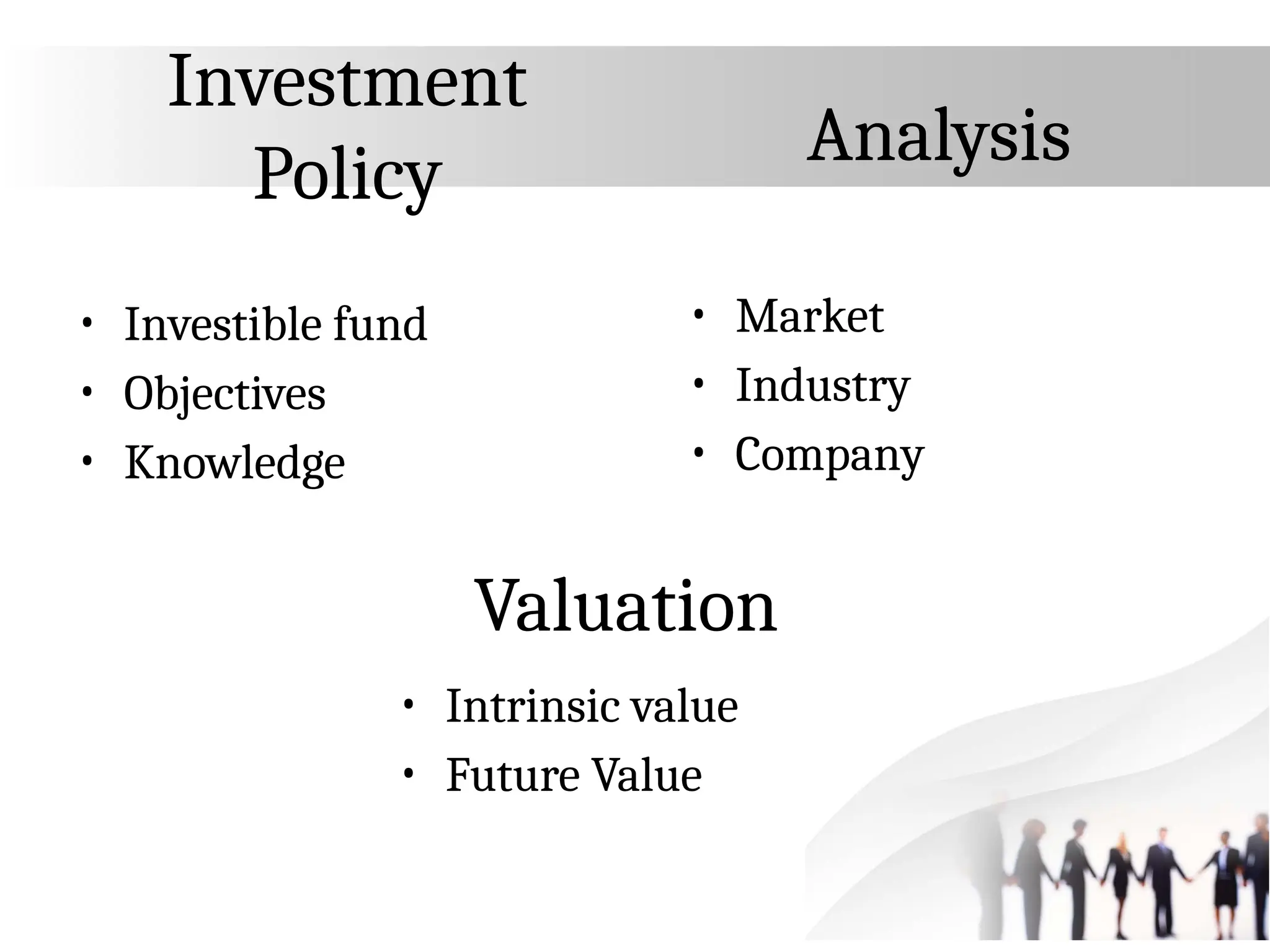
Investment
Policy
• Investible fund
• Objectives
• Knowledge
Analysis
• Market
• Industry
• Company
Valuation
• Intrinsic value
• Future Value
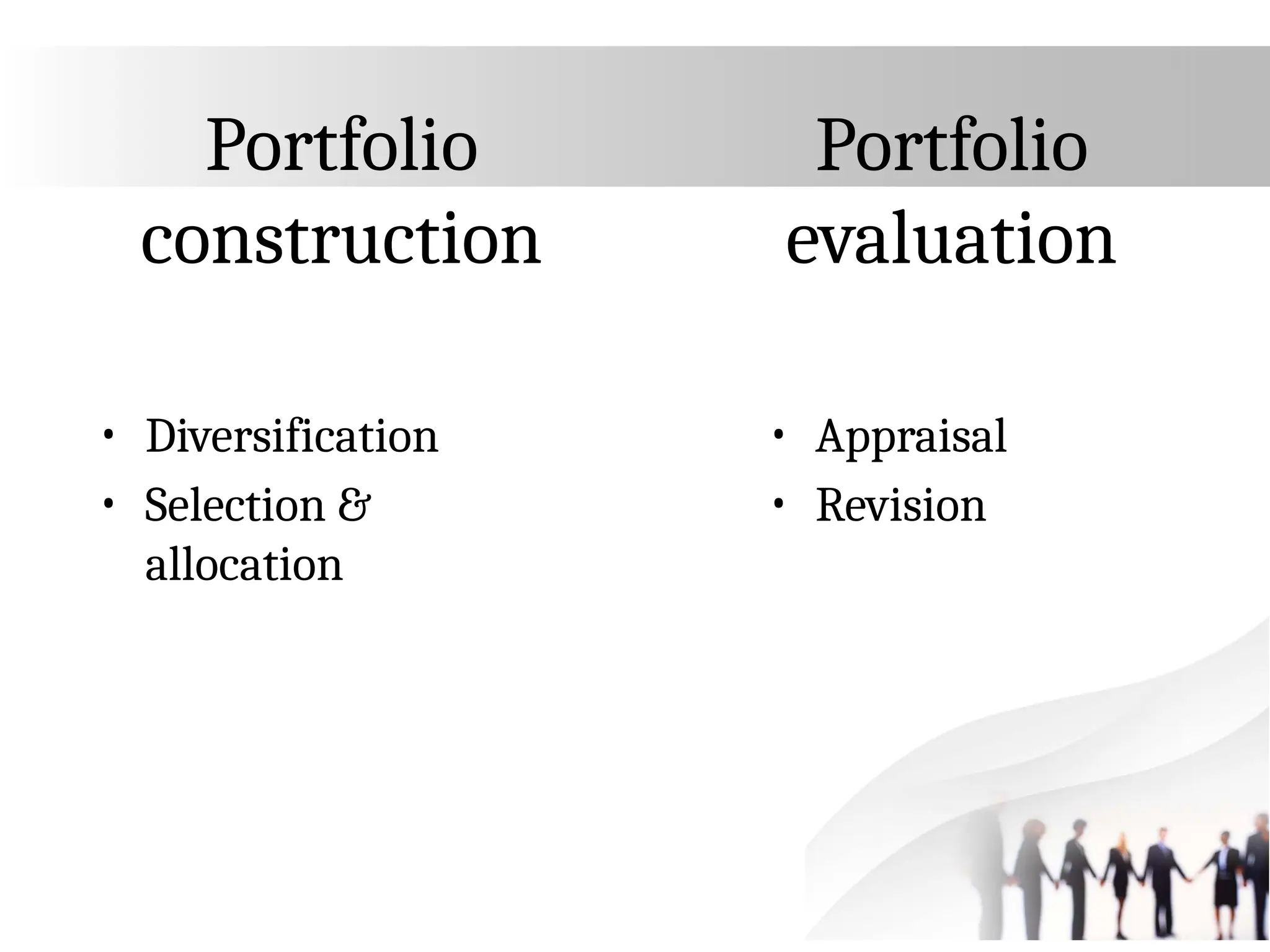
Portfolio
construction
• Diversification
• Selection &
allocation
Portfolio
evaluation
• Appraisal
• Revision
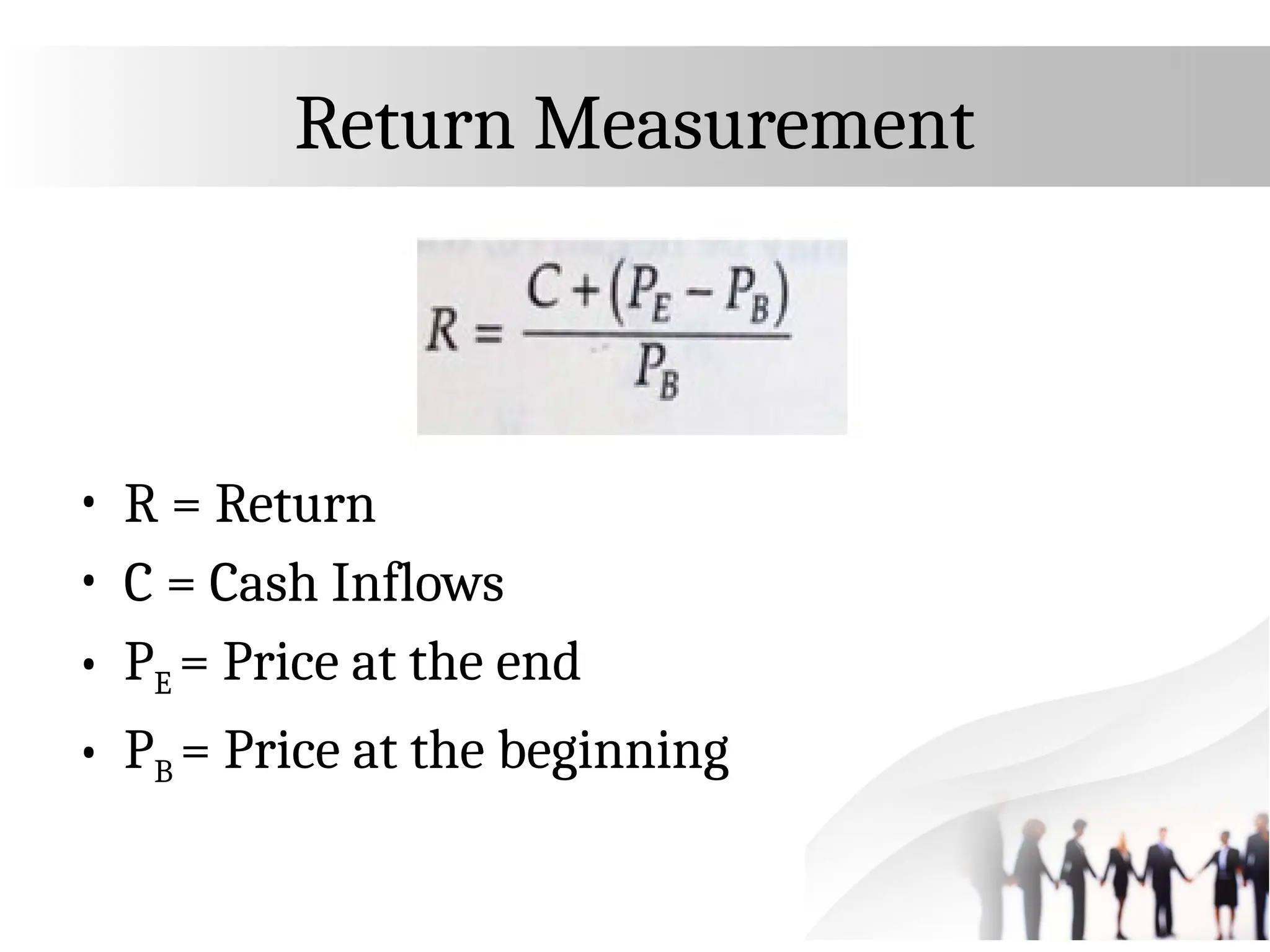
Return Measurement
• R = Return
• C = Cash Inflows
• PE = Price at the end
• PB = Price at the beginning
Question 1:
Grow More Ltd. is evaluating the rate of return on two of its
Assets, I and II. The Asset I was purchased a year ago for
Rs.4,00,000 and since then it has generated cash inflows of Rs.
16,000. Presently, it can be sold for a price of Rs.4,30, 000.
Asset II was purchased a few years ago and its market price in
the beginning and at the end of the current year was Rs.2,40,000
and Rs.2,36,000 respectively. The Asset II has generated cash
inflows of Rs.34,000 during the year. Find out the rate of return
on these assets.
A had purchased a bond at a price of Rs.800 with a coupon
payment of Rs.150 and sold it Rs.1000.
i)What is his holding period return and
ii)If the bond is sold is sold for Rs.750 after receiving Rs.150 as
coupon payment then what is his holding period return?
Question 2:
Expected rate of Return
• The expected return is the profit or loss that an investor anticipates on
an investment that has known historical rates of return (RoR). It is
calculated by multiplying potential outcomes by the chances of them
occurring and then totaling these results. Expected returns cannot be
guaranteed. The expected return for a portfolio containing multiple
investments is the weighted average of the expected return of each of
the investments.
• The expected return on an investment is the expected value of the
probability distribution of possible returns it can provide to investors.
The return on the investment is an unknown variable that has
different values associated with different probabilities. Expected return
is calculated by multiplying potential outcomes (returns) by the
chances of each outcome occurring, and then calculating the sum of
those results
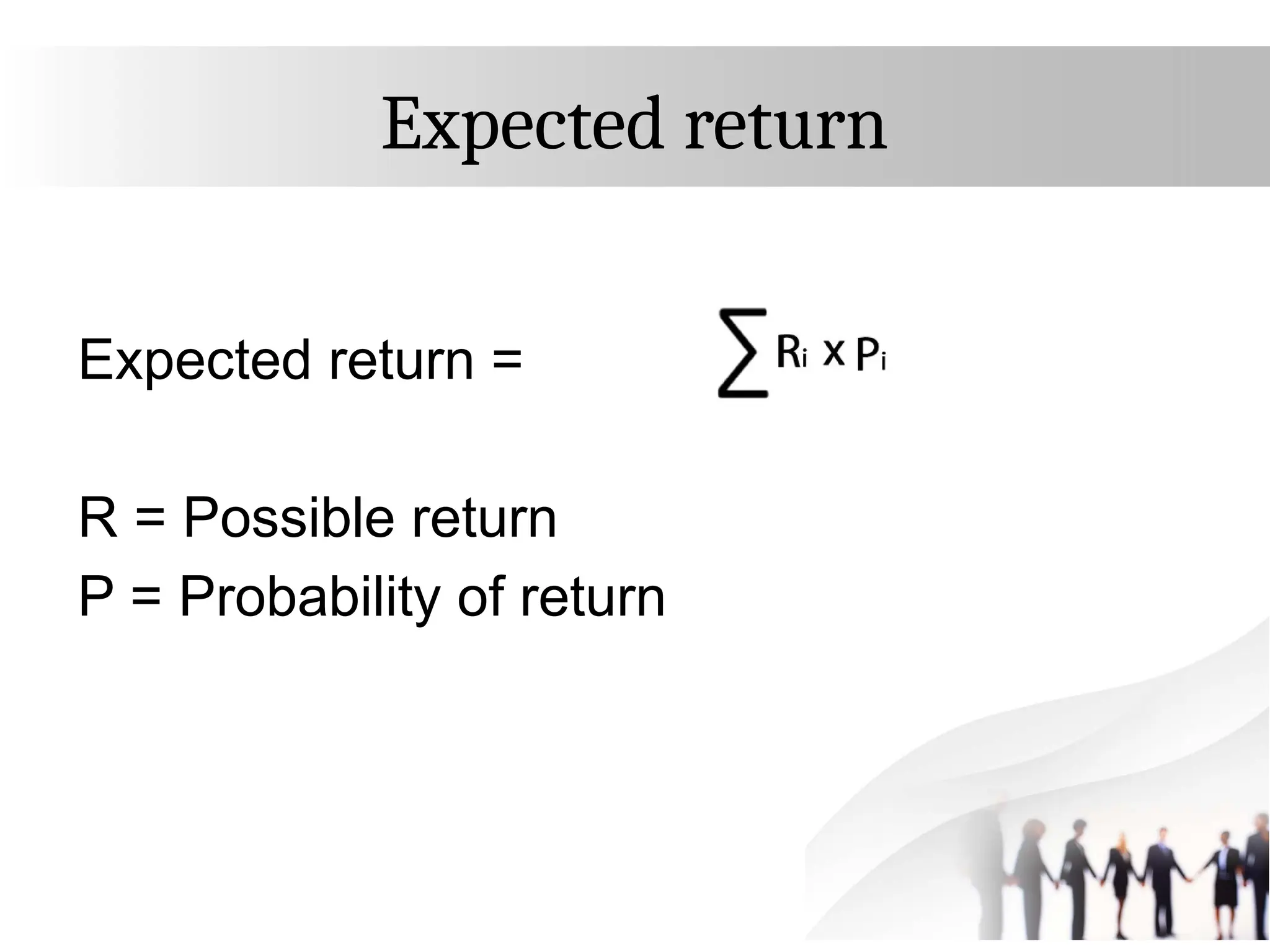
Expected return
Expected return =
R = Possible return
P = Probability of return
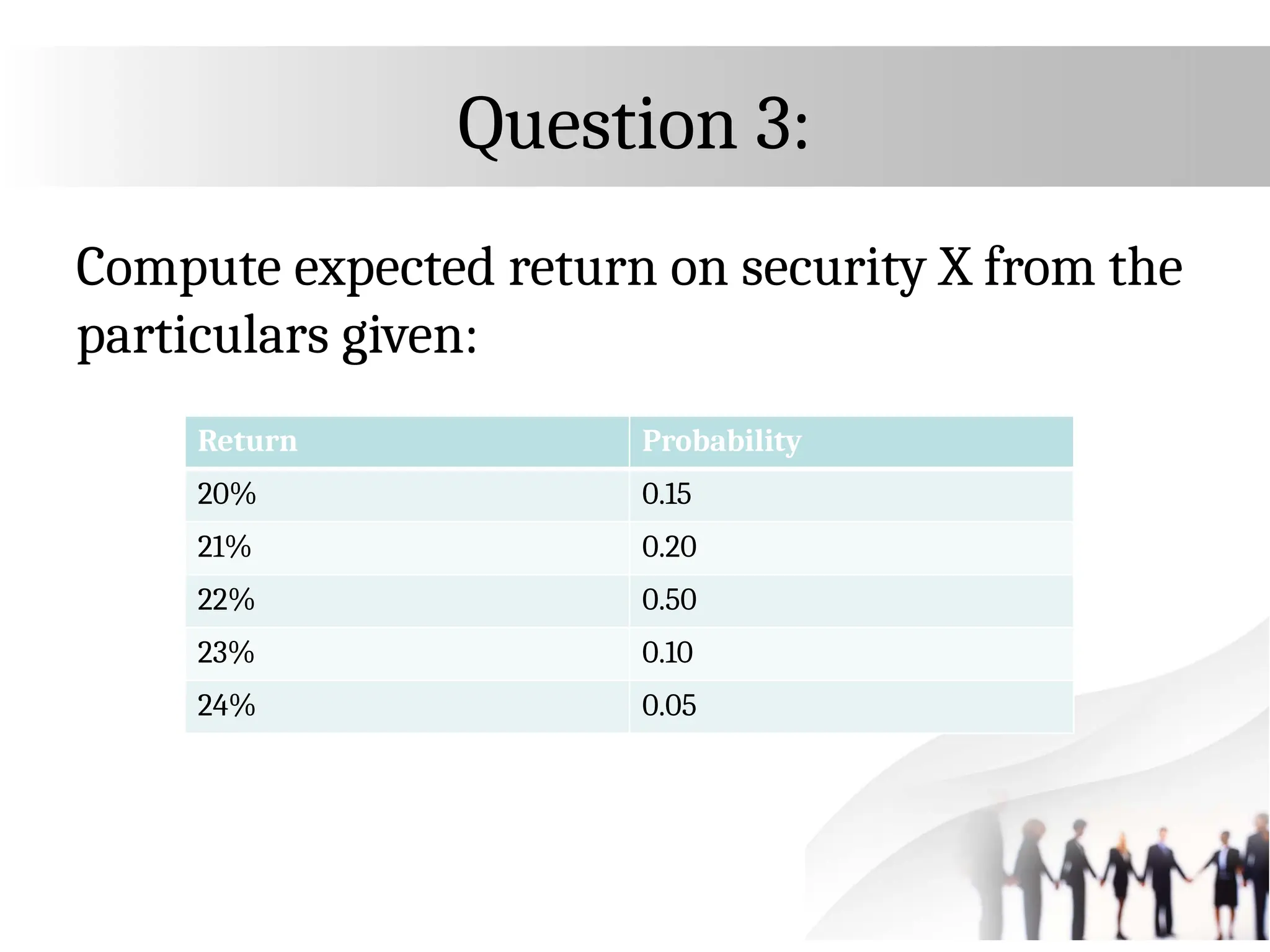
Question 3:
Compute expected return on security X from the
particulars given:
Return Probability
20% 0.15
21% 0.20
22% 0.50
23% 0.10
24% 0.05
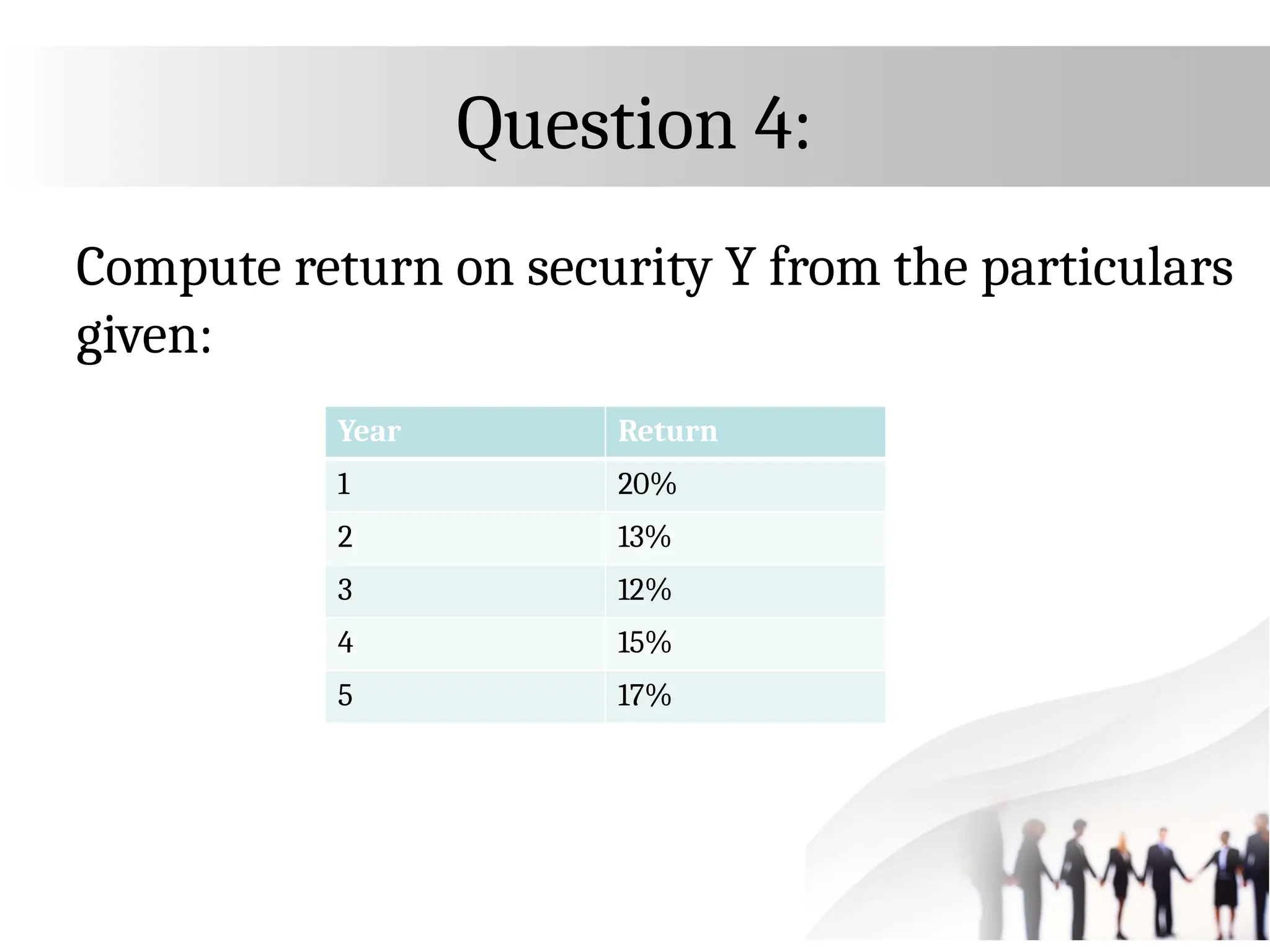
Question 4:
Compute return on security Y from the particulars
given:
Year Return
1 20%
2 13%
3 12%
4 15%
5 17%
Risk
• The dictionary meaning of risk is the possibility of
loss or injury; the degree or probability of such loss.
• Risk is defined in financial terms as the chance that
an outcome or investment's actual gains will differ
from an expected outcome or return. Risk includes
the possibility of losing some or all of an original
investment.
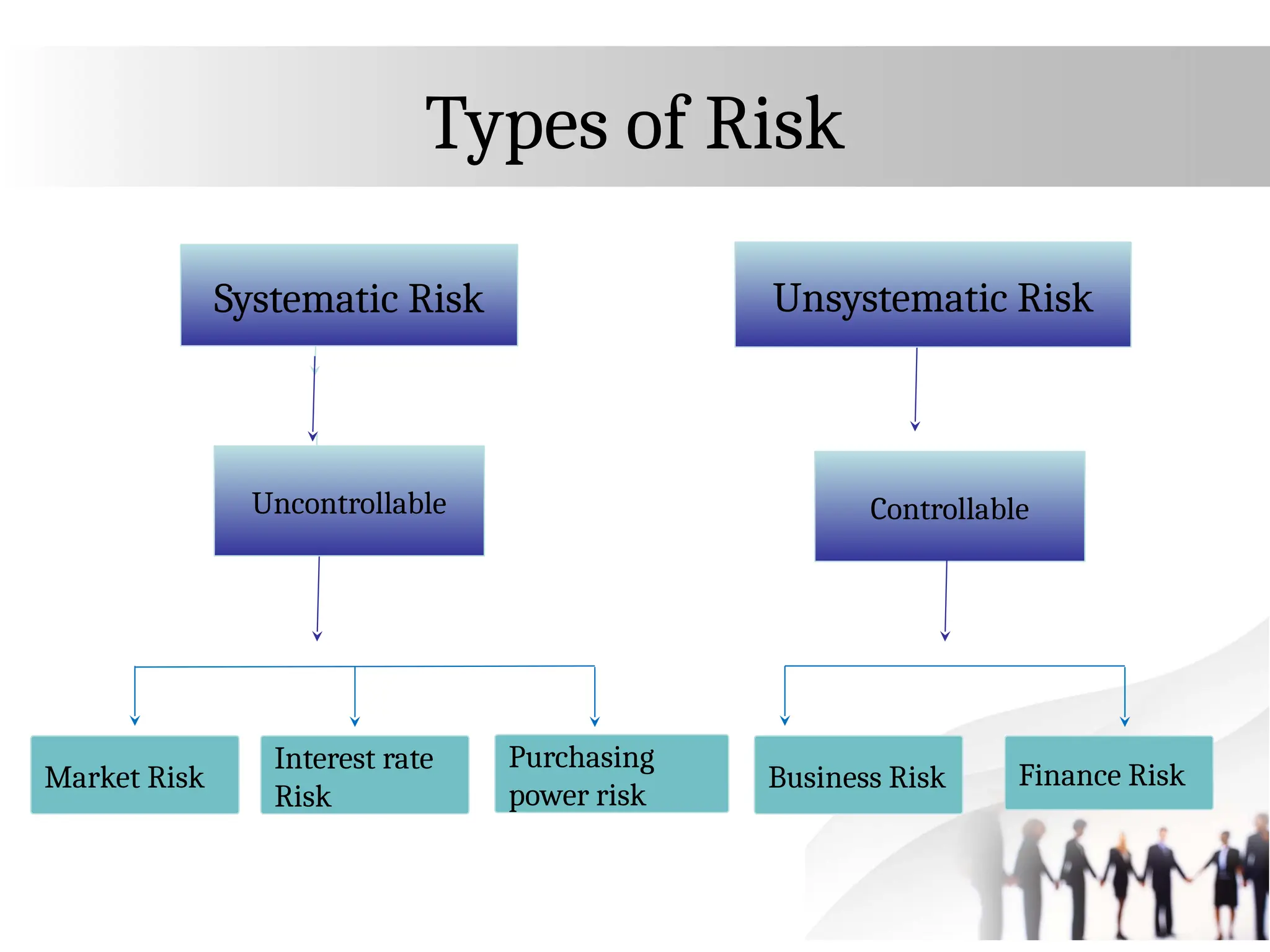
Types of Risk
Systematic Risk Unsystematic Risk
Uncontrollable Controllable
Market Risk
Interest rate
Risk
Purchasing
power risk
Finance Risk
Business Risk
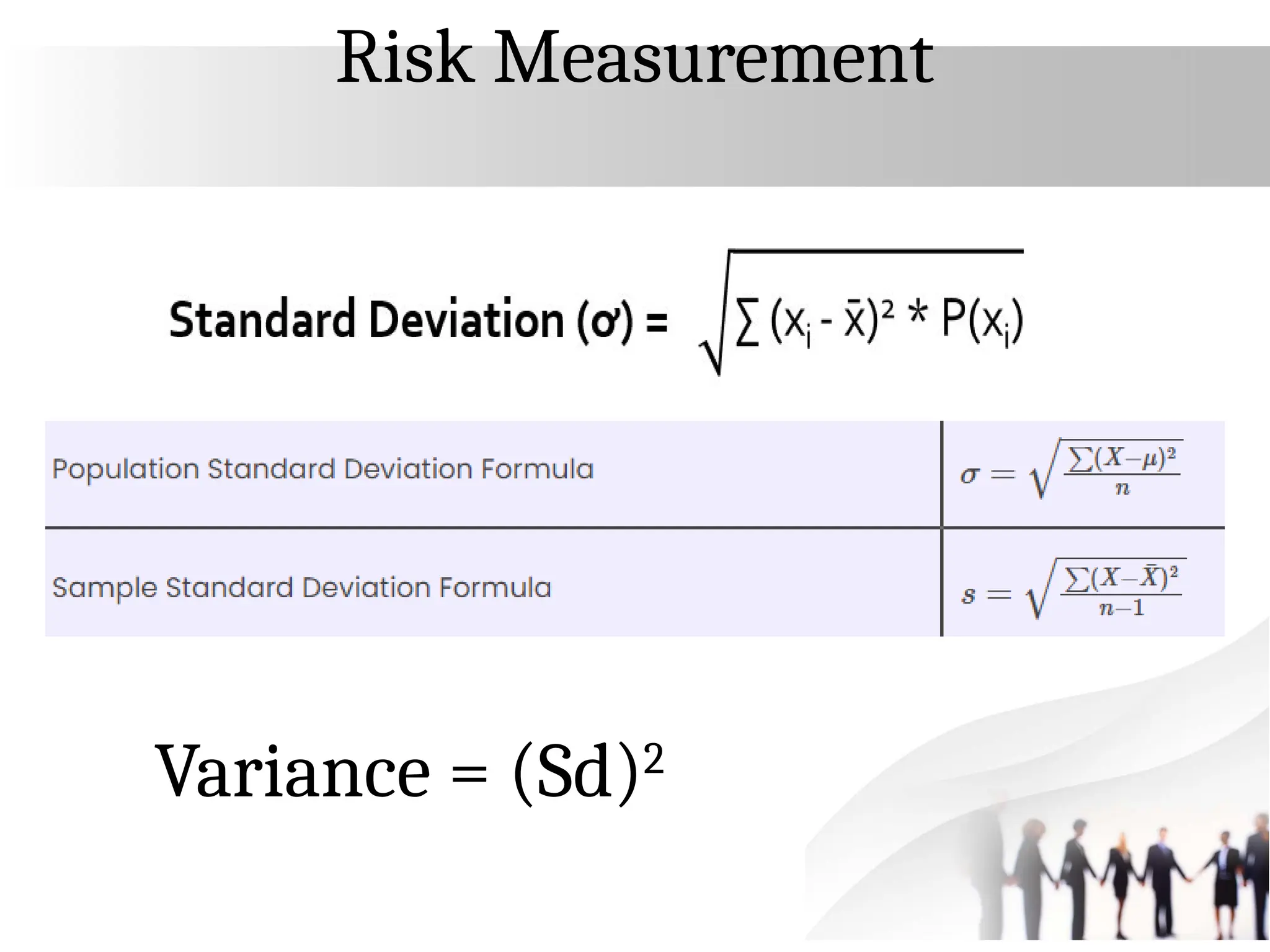
Risk Measurement
Variance = (Sd)2
Question 5:
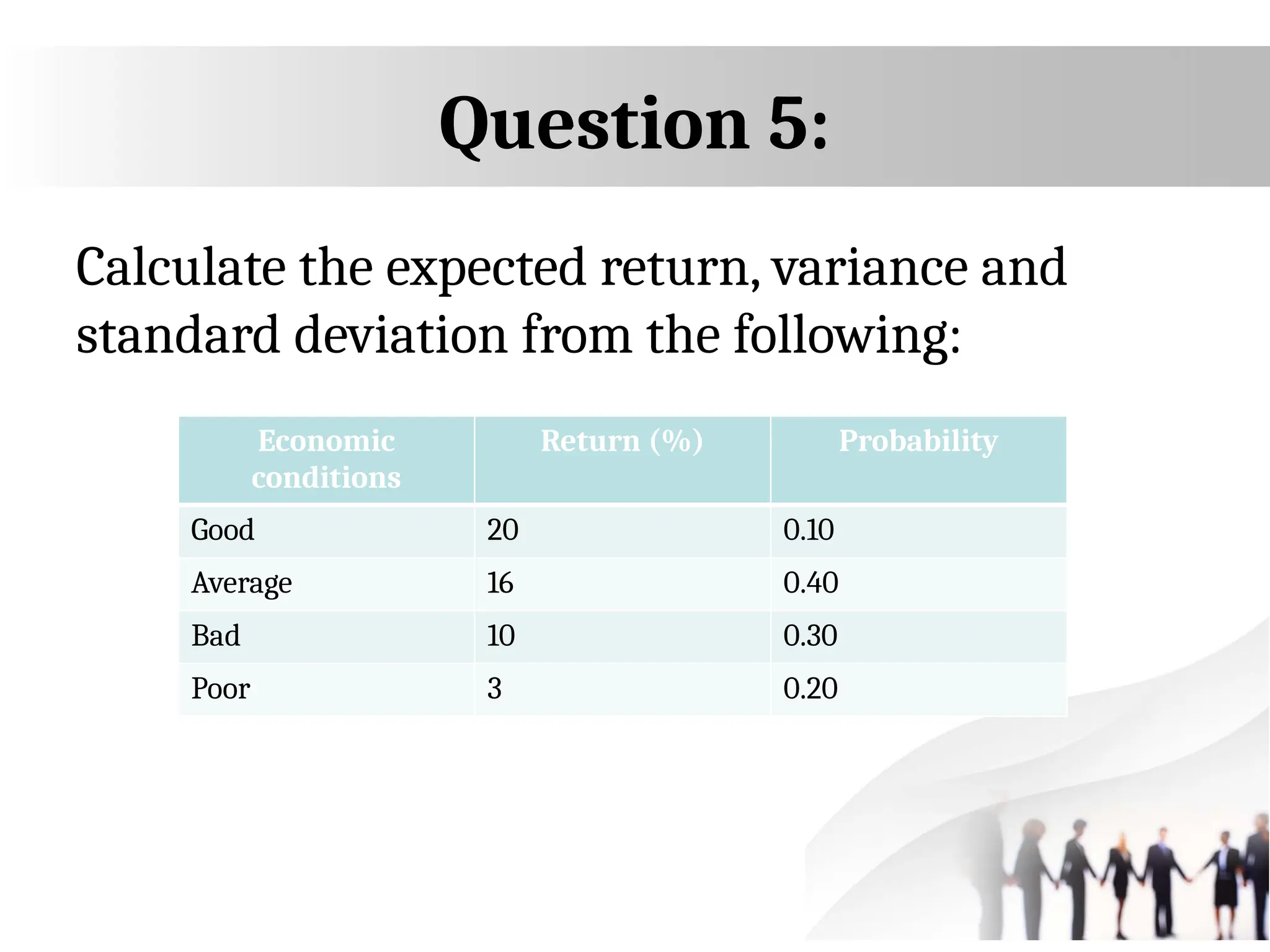
Calculate the expected return, variance and
standard deviation from the following:
Economic
conditions
Return (%) Probability
Good 20 0.10
Average 16 0.40
Bad 10 0.30
Poor 3 0.20
Question 6:
Calculate the return, variance and standard
deviation from the following:
Year Return
1 12%
2 15%
3 21%
4 16%
5 19%
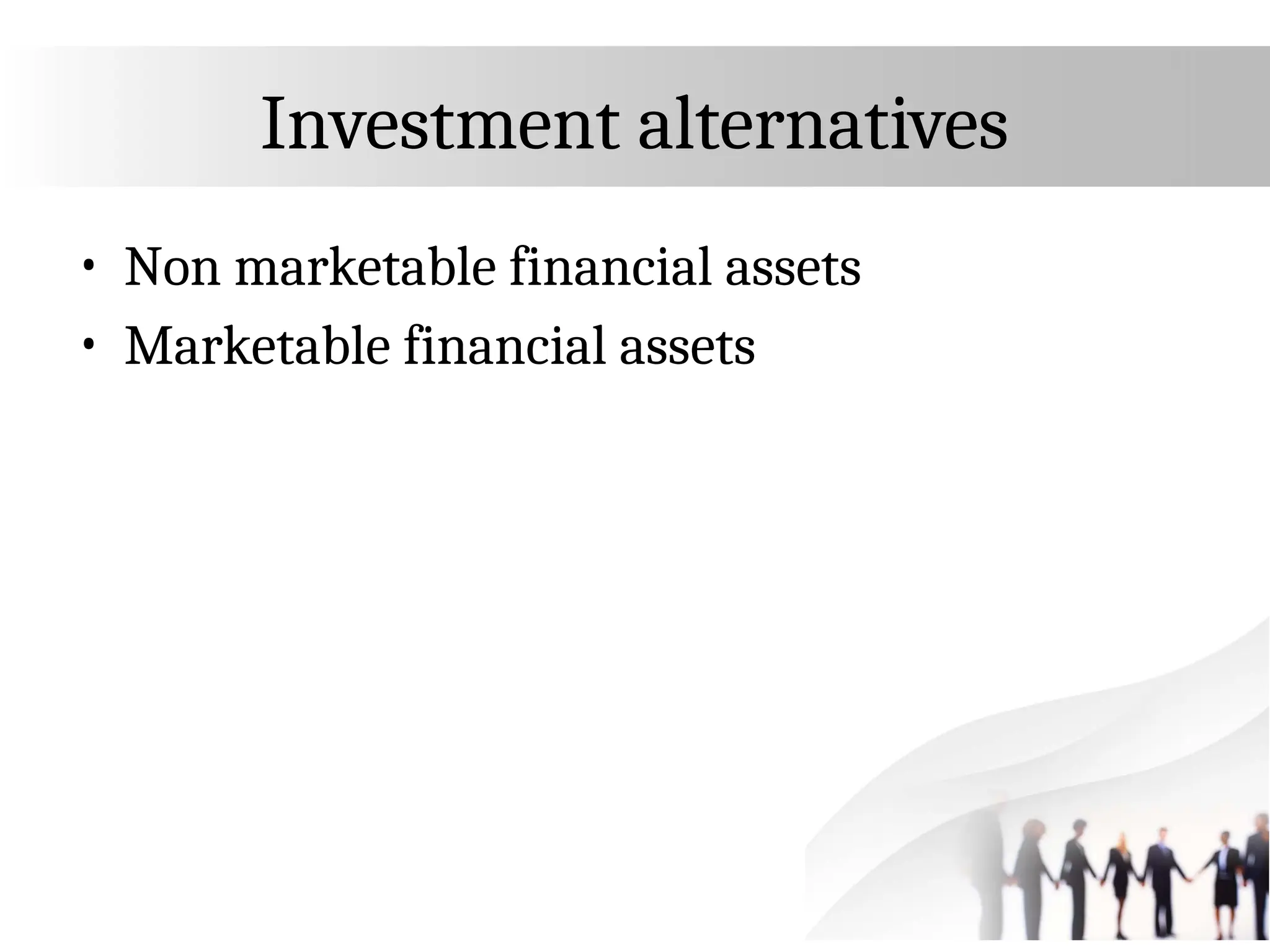
Investment alternatives
• Non marketable financial assets
• Marketable financial assets
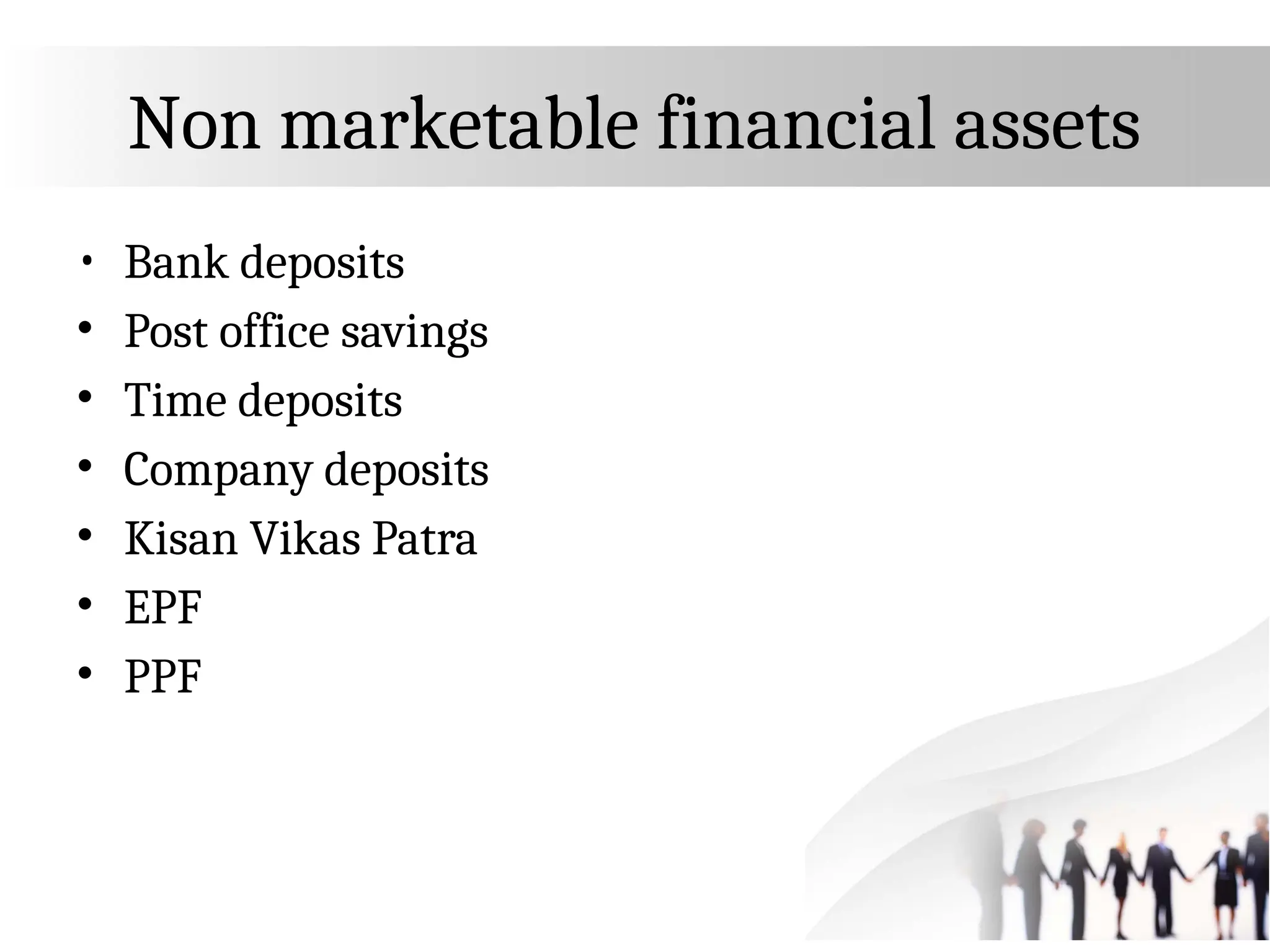
Non marketable financial assets
• Bank deposits
• Post office savings
• Time deposits
• Company deposits
• Kisan Vikas Patra
• EPF
• PPF
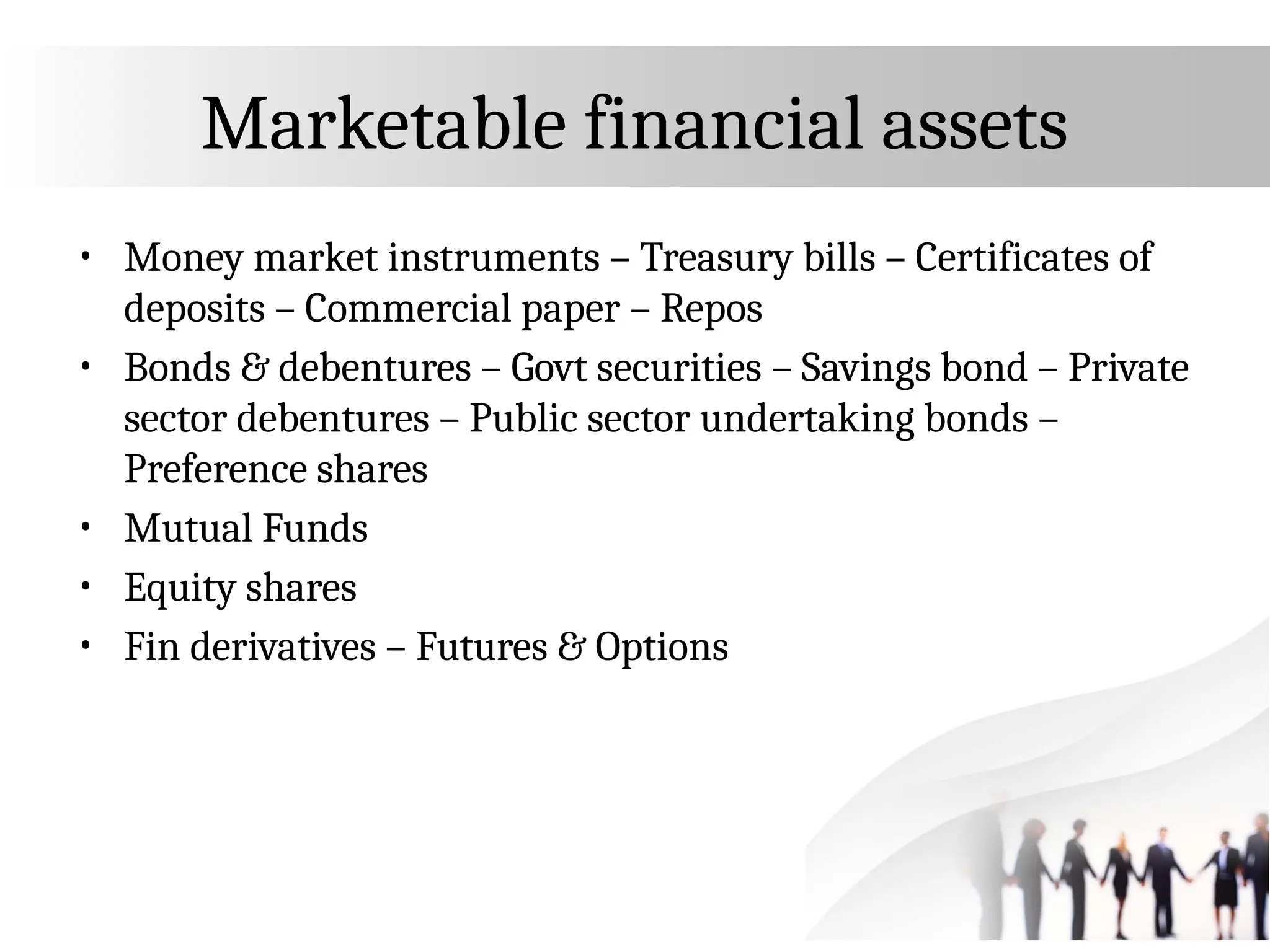
Marketable financial assets
• Money market instruments – Treasury bills – Certificates of
deposits – Commercial paper – Repos
• Bonds & debentures – Govt securities – Savings bond – Private
sector debentures – Public sector undertaking bonds –
Preference shares
• Mutual Funds
• Equity shares
• Fin derivatives – Futures & Options
Stock Valuation Models
• Single-period valuation Model
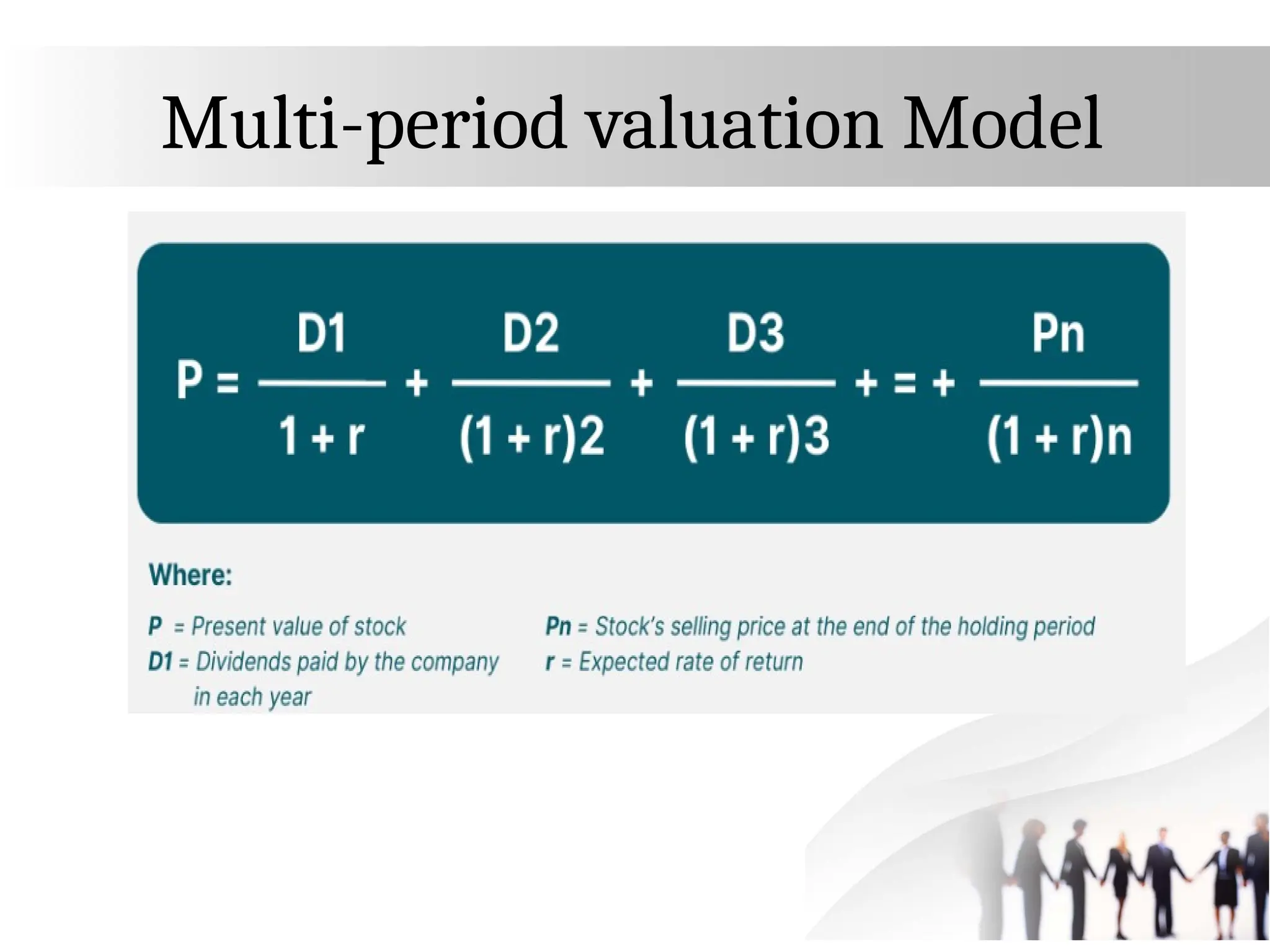
• Multi-period valuation Model
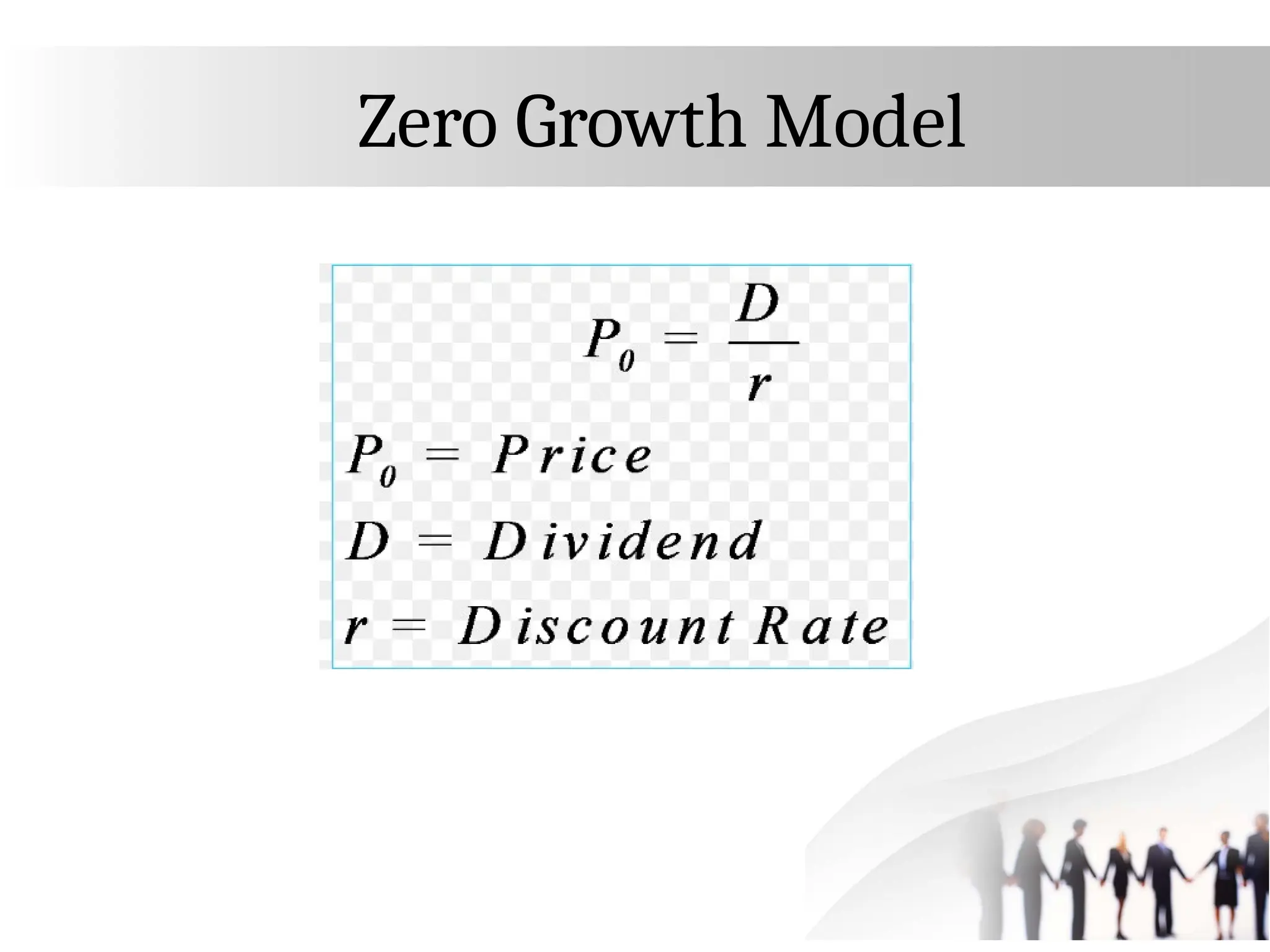
• Zero Growth Model
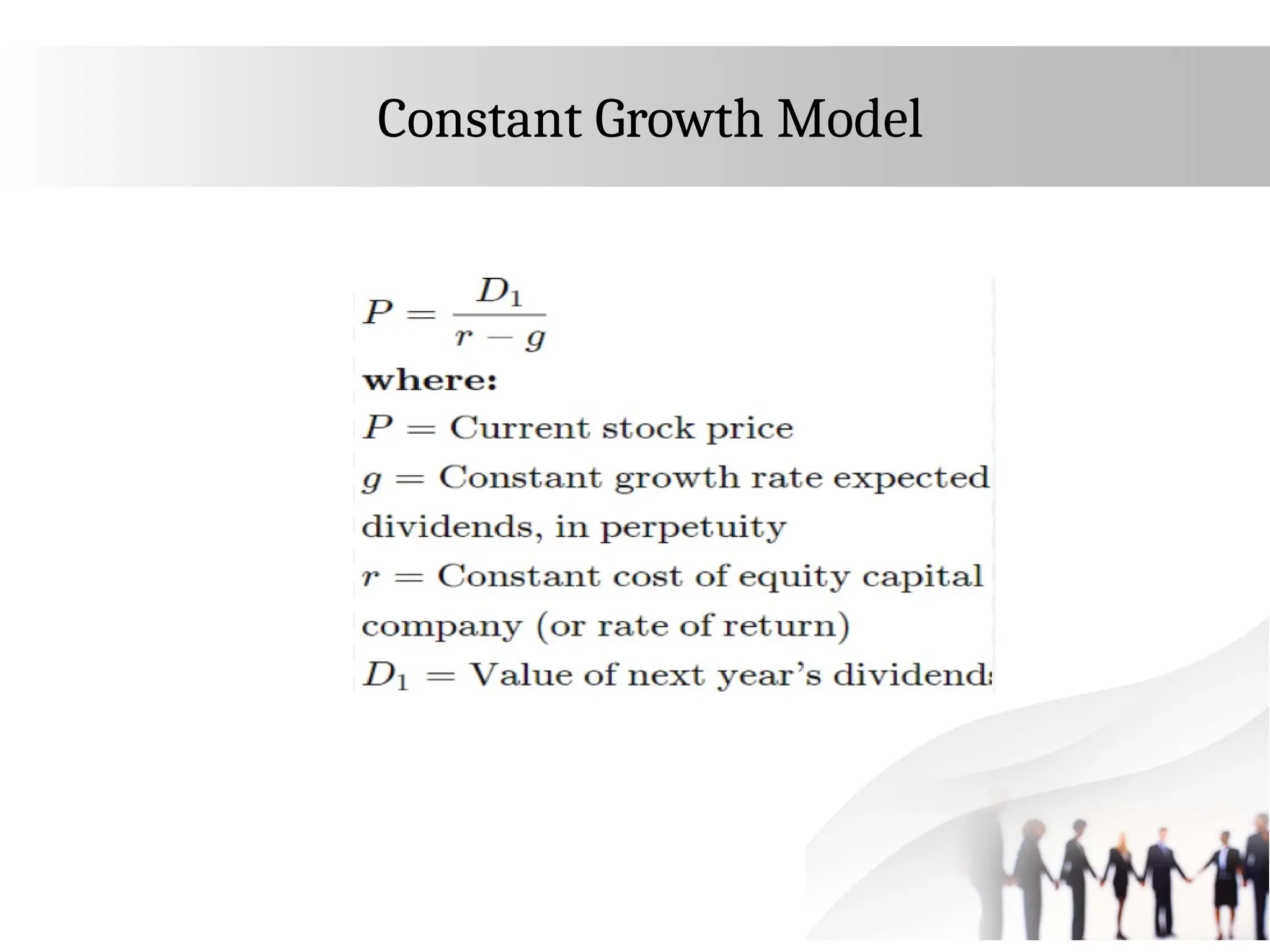
• Constant Growth Model
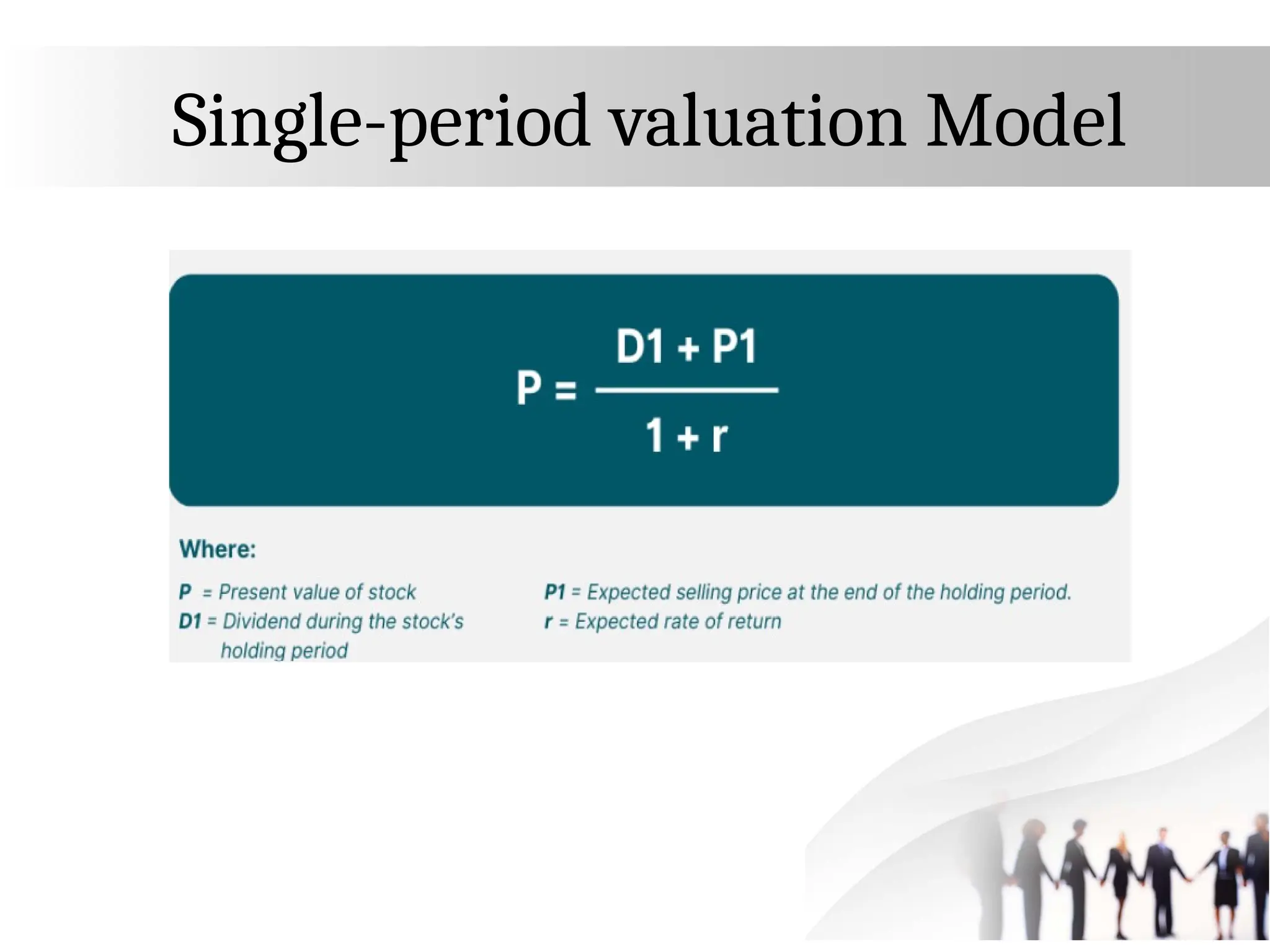
Single-period valuation Model
Question 7:
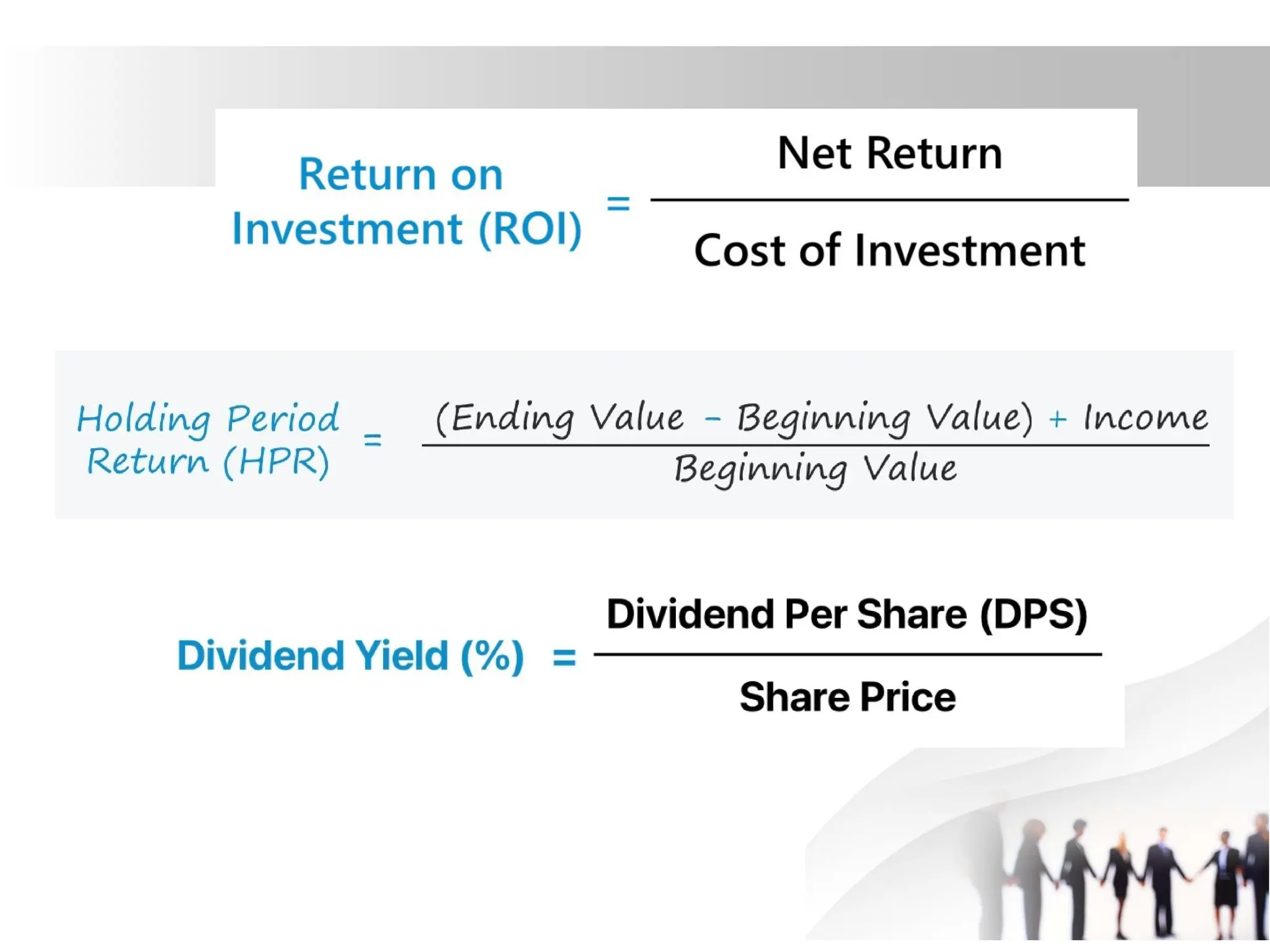
An investor holds shares of TVS from 13.01.2022 to
23.01.2023. The beginning and end period prices are Rs.
335 and Rs. 421. The dividend paid is 35%. Calculate the
Dividend Yield, holding period yield and return on this
investment.
Assume face value of the investment is Rs 10 and rate of
return is 20%. Also, calculate the price of the share and
check if the price stated by the company is feasible.
Multi-period valuation Model
Question 8:
An investor holds shares of TCS for 3years. The end
period price is Rs.520. The dividend paid is 35%, 40% &
25% for 3 years. Assume face value of the share is Rs 10,
and rate of return is 15%, calcuate the price of the share.
If actual price for which you bought the share is Rs.340, is
the investment in share made by worth?
Zero Growth Model
Question 9:
A company is issuing dividend of 25%. The face value of
the share is Rs.10. Assume that the dividend growth is
NIL in this investment and calculate the price of the
share if the rate of return expected is 10%.
Constant Growth Model
Question 10:
A company is issuing dividend of 35% for next year. The
face value of the share is Rs.10. Assume that the constant
dividend growth is 5% in this investment and calculate
the price of the share if the rate of return expected is
12%.
Two step growth model
Bond
A bond is a debt instrument that provides a steady
income stream to the investor in the form of coupon
payments. At the maturity date, the full face value of the
bond is repaid to the bondholder.
Types of Bond Risk
Interest rate risk
Call risk
Credit risk
Market risk
Default risk
Marketability risk
Interest rate risk
Interest rate risk refers to the impact of the movement
in interest rates on bond returns. As rates rise, bond
prices decline. In the event of rising rates, the
attractiveness of existing bonds with lower returns
declines, and hence the price of such bonds falls. The
reverse is also true. Short-term bonds are less exposed to
this risk, while long-term bonds have a high probability
of getting affected.
Call risk
It is specifically associated with the bonds that come
with an embedded call option. When market rates
decline, callable bond issuers often look to refinance
their debt, thus calling back the bonds at the pre-
specified call price. This often leaves the investors in the
lurch, who are forced to reinvest the bond proceeds at
lower rates. Such investors are, however, compensated by
high coupons. The call protection feature also protects
the bond from being called for a particular period giving
investors some relief.
Credit risk
Credit risk results from the bond issuer’s inability to
make timely payments to the lenders. This leads to
interrupted cash flow for the lender, where losses might
range from moderate to severe. Credit history and
capacity to repay are the two most important factors
determining credit risk.
Market risk
Market risk is the probability of losses due to market
reasons like slowdown and rate changes. It affects the
entire market together. In a bond market, no matter how
good an investment is, it is bound to lose value when the
market declines. Interest rate risk is another form of
market risk.
Default risk
Default risk is the bond issuing company’s inability to
make required payments. It is seen as other variants of
credit risk where the borrowing company fails to meet
the agreed terms of the issue.
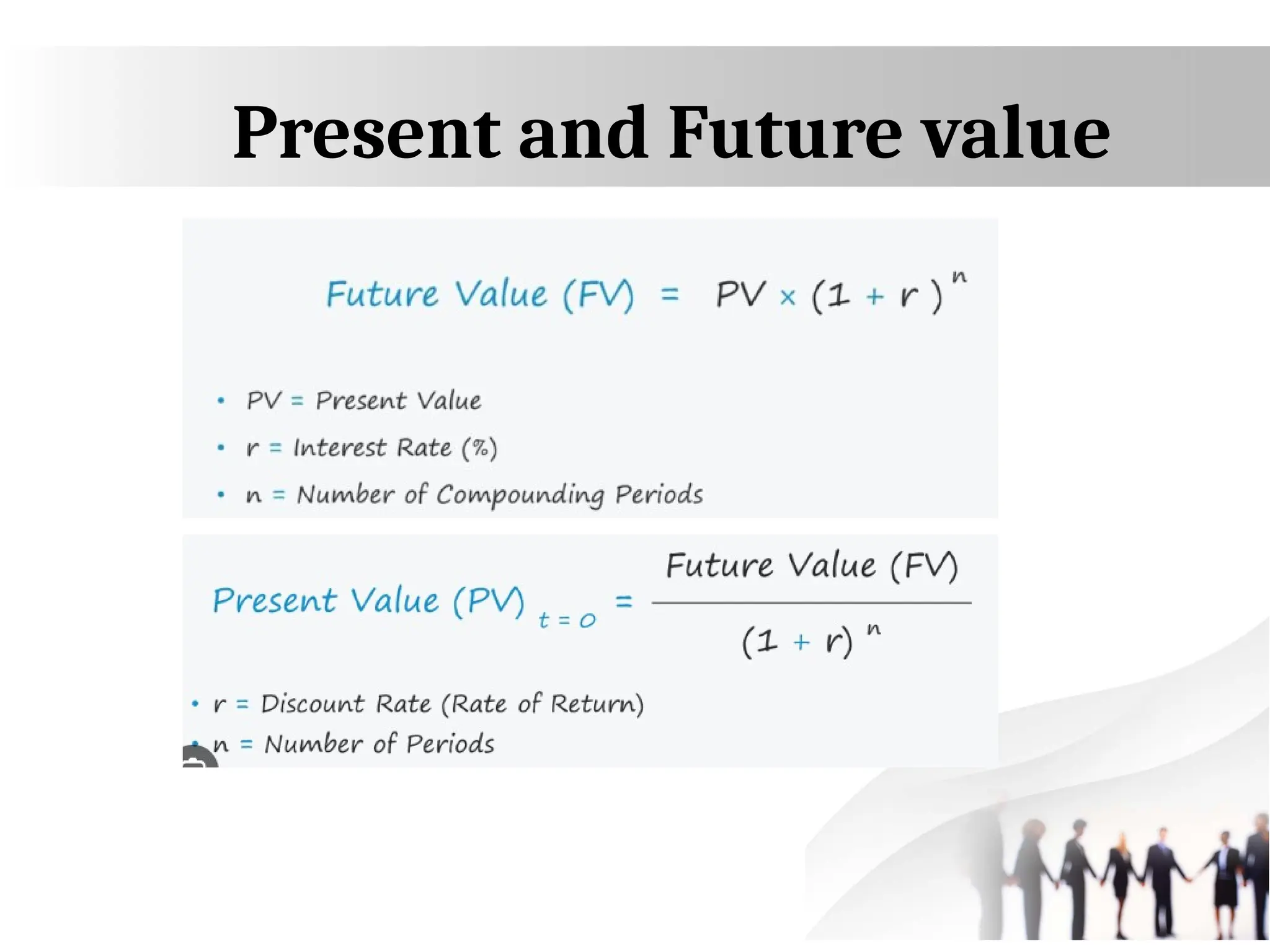
Present and Future value
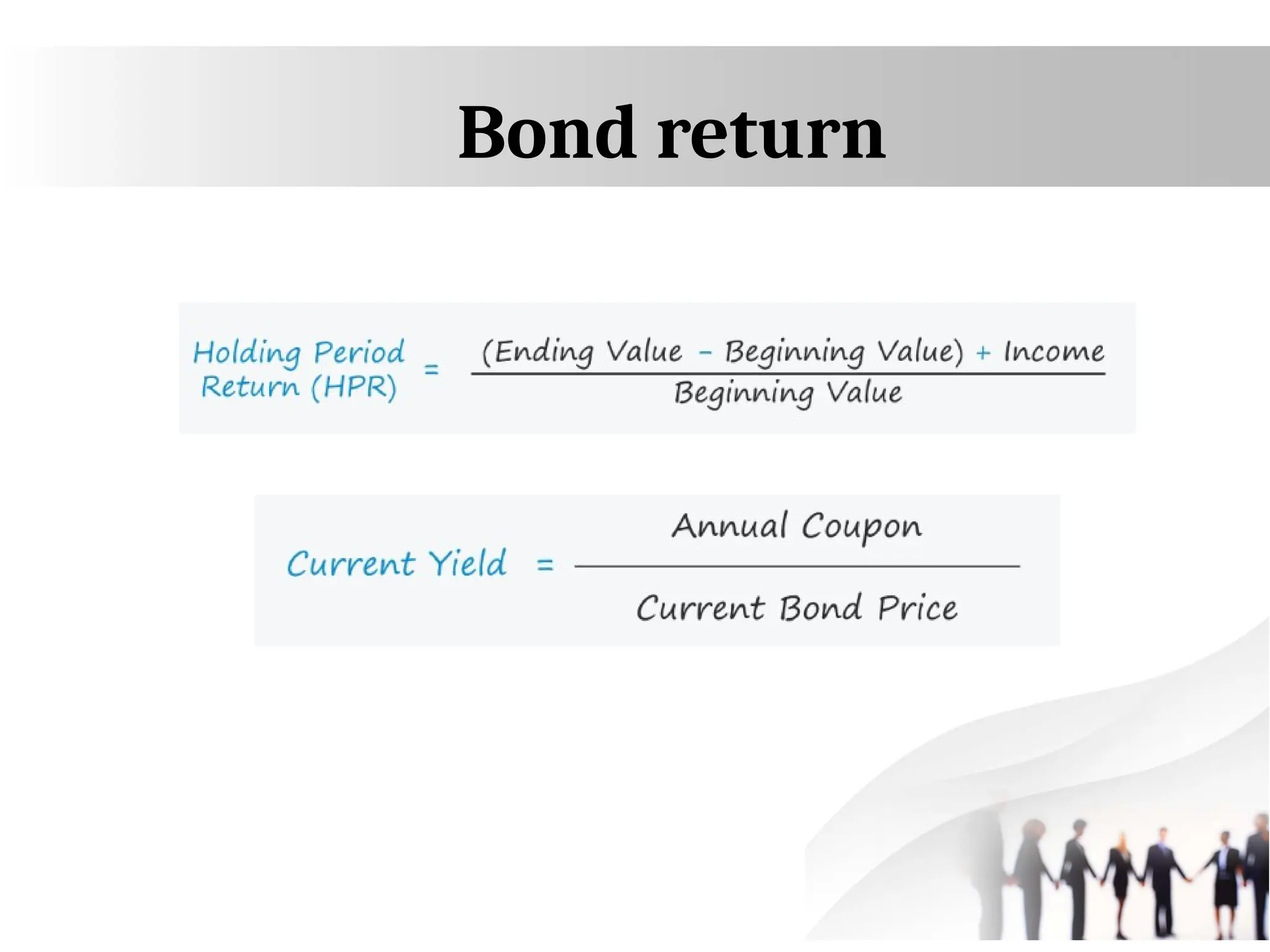
Bond return
Question 11: Bond return
What is the holding period return for a bond that is
currently selling for $1,060 if it was purchased exactly
six-months ago for $1,000 and paid a $20 coupon
today?
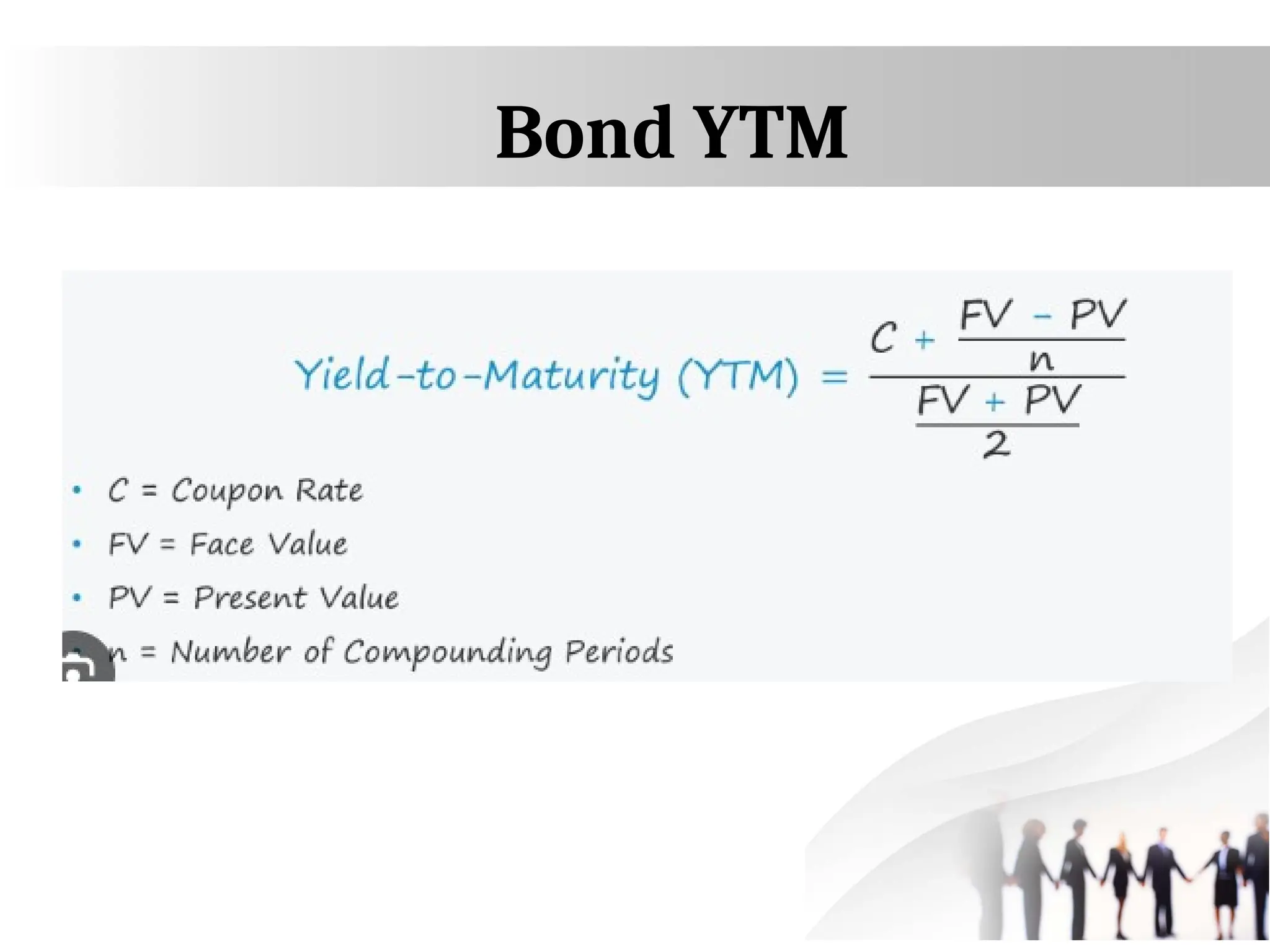
Bond YTM
Question 12: Bond YTM
What is the yield to maturity of a 5 year 6% coupon
bond that is currently priced at Rs.850? Assume face
value to be Rs.1000
Question 13: Bond YTM
What is the yield to maturity for a 3 year bond with a
10% annual coupon if the bond is trading at par?
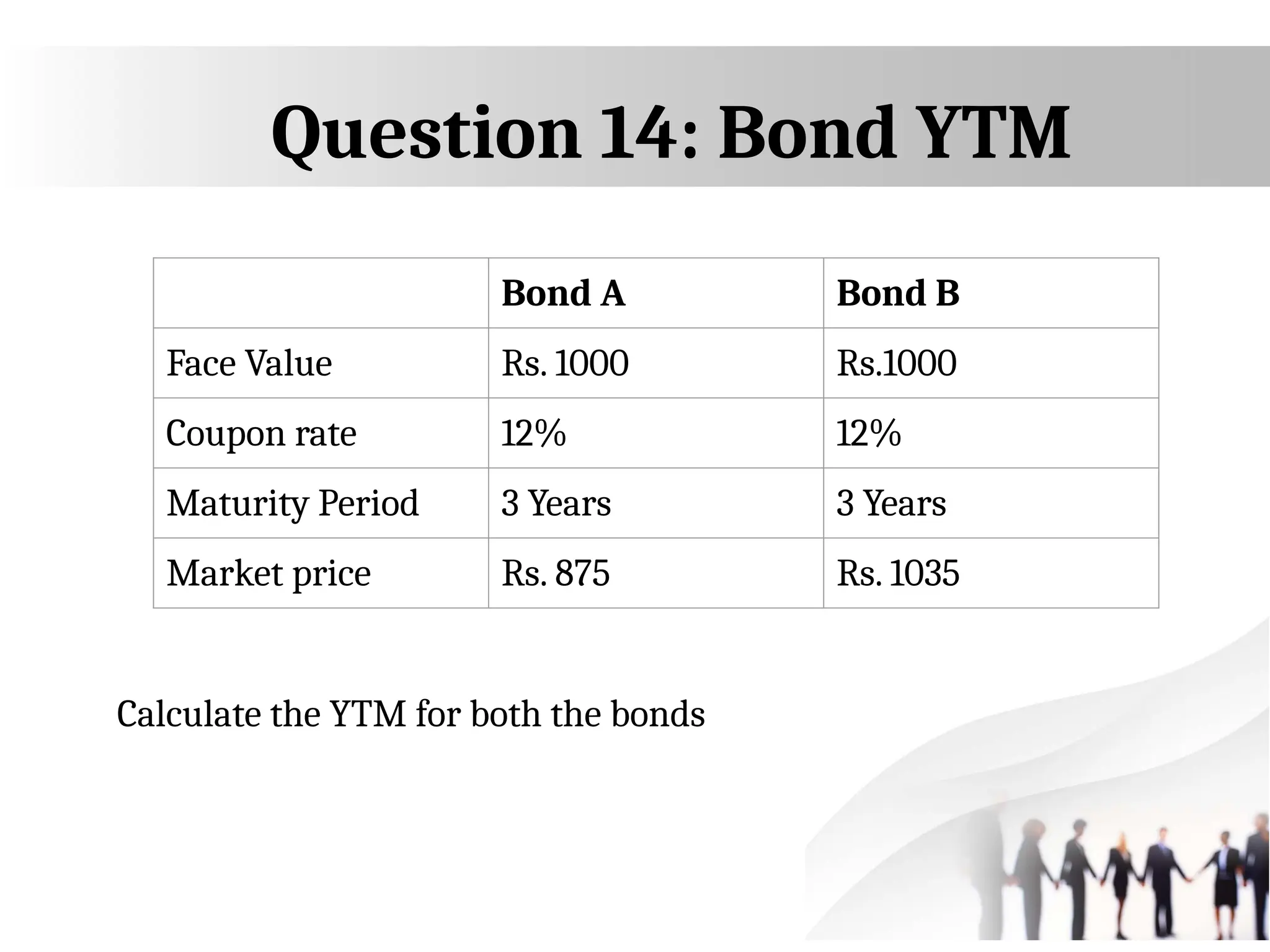
Question 14: Bond YTM
Bond A Bond B
Face Value Rs. 1000 Rs.1000
Coupon rate 12% 12%
Maturity Period 3 Years 3 Years
Market price Rs. 875 Rs. 1035
Calculate the YTM for both the bonds
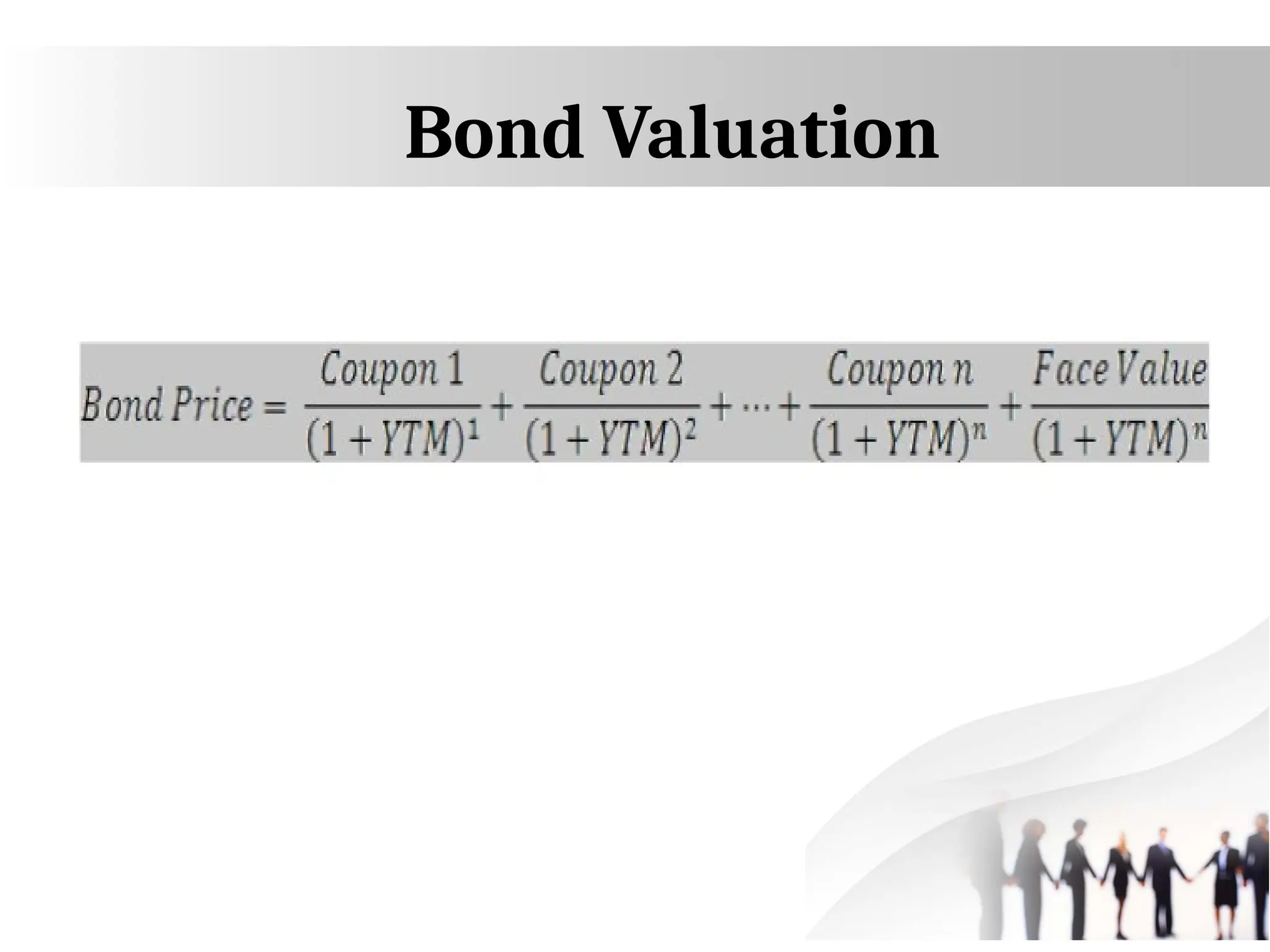
Bond Valuation
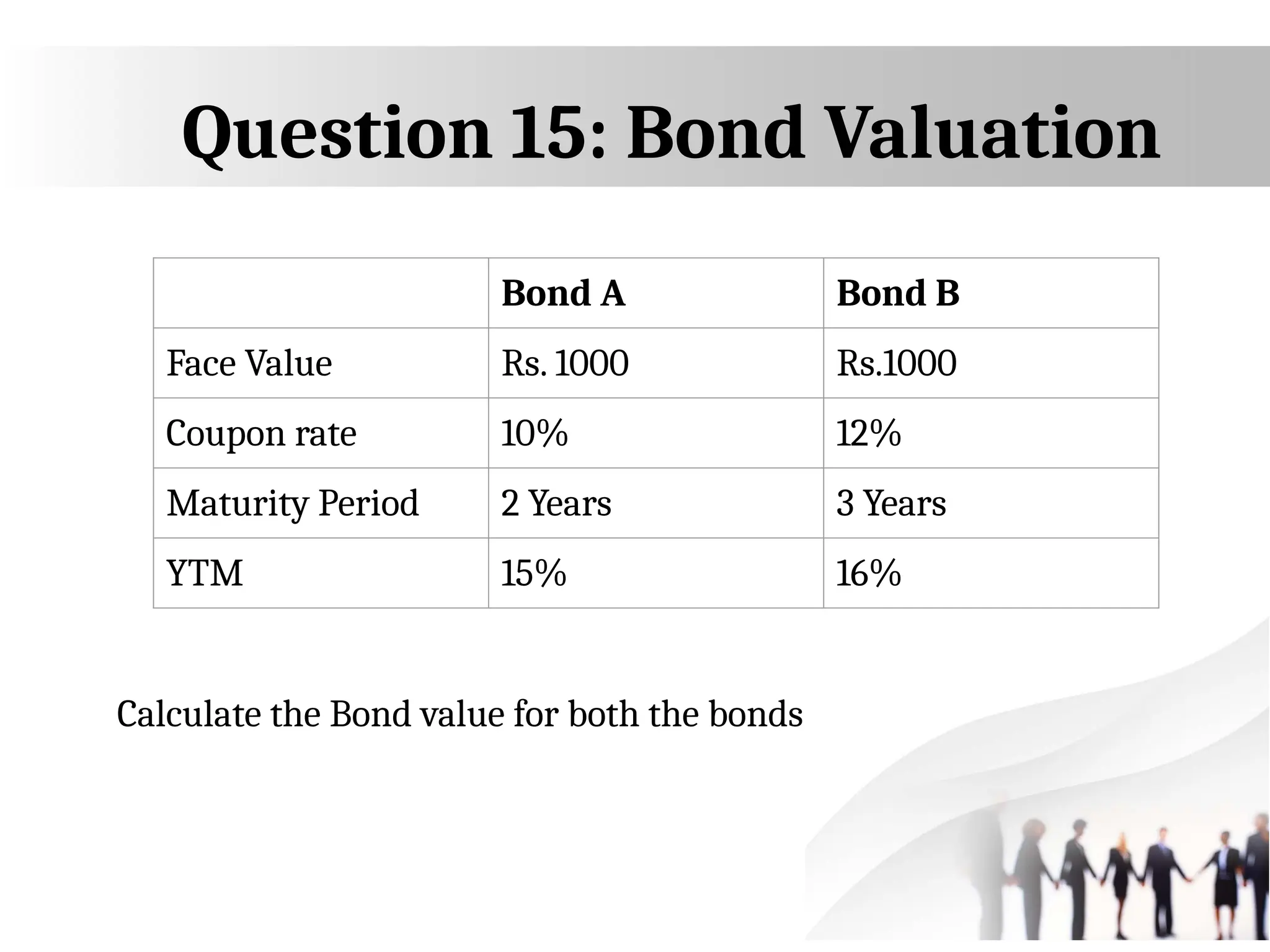
Question 15: Bond Valuation
Bond A Bond B
Face Value Rs. 1000 Rs.1000
Coupon rate 10% 12%
Maturity Period 2 Years 3 Years
YTM 15% 16%
Calculate the Bond value for both the bonds
Question 16: Bond Valuation
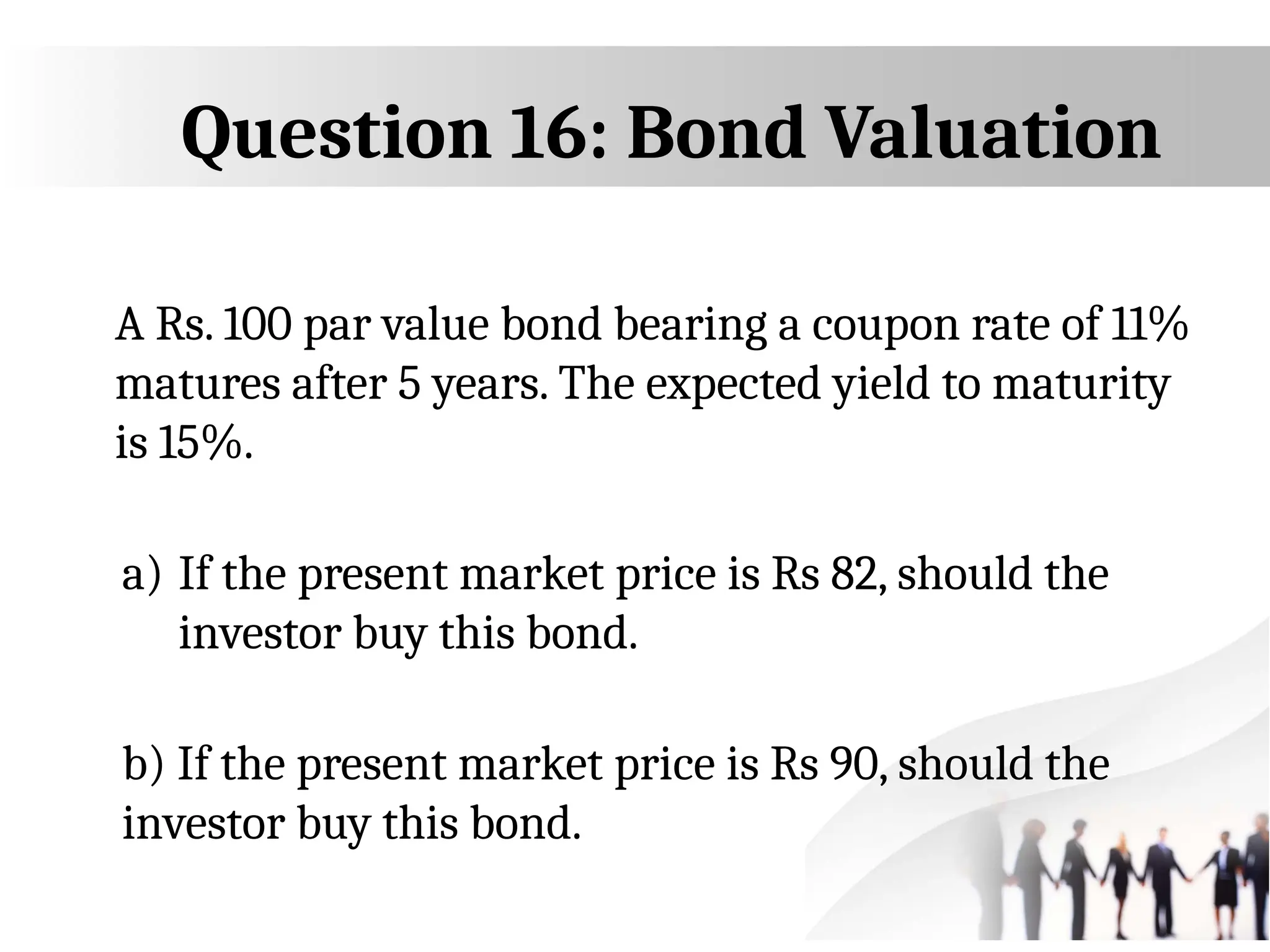
A Rs. 100 par value bond bearing a coupon rate of 11%
matures after 5 years. The expected yield to maturity
is 15%.
a) If the present market price is Rs 82, should the
investor buy this bond.
b) If the present market price is Rs 90, should the
investor buy this bond.
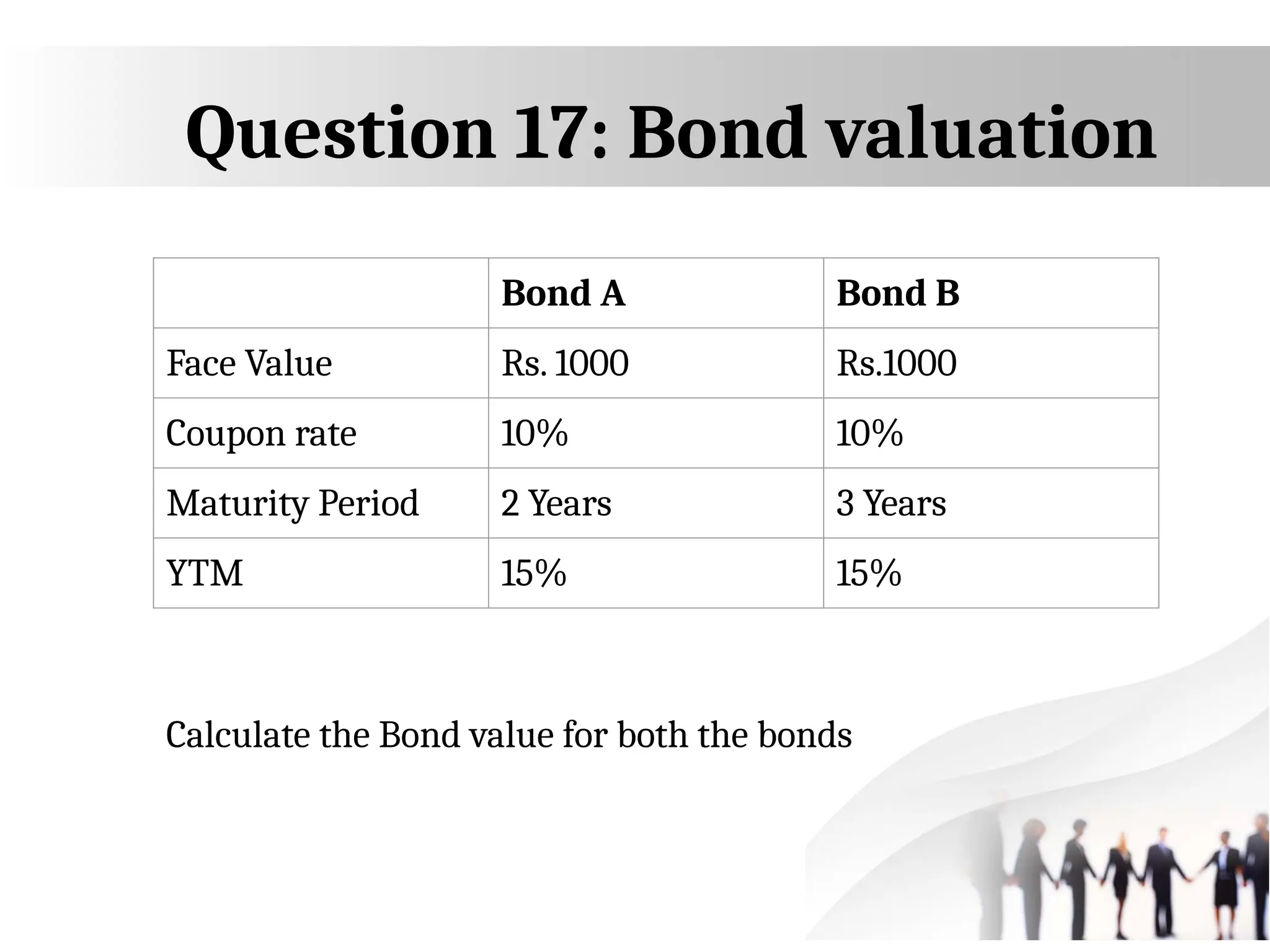
Question 17: Bond valuation
Bond A Bond B
Face Value Rs. 1000 Rs.1000
Coupon rate 10% 10%
Maturity Period 2 Years 3 Years
YTM 15% 15%
Calculate the Bond value for both the bonds
Zero Coupon Bond
A zero-coupon bond, is a debt security that does not pay
interest but instead trades at a deep discount, rendering a
profit at maturity, when the bond is redeemed for its full
face value.
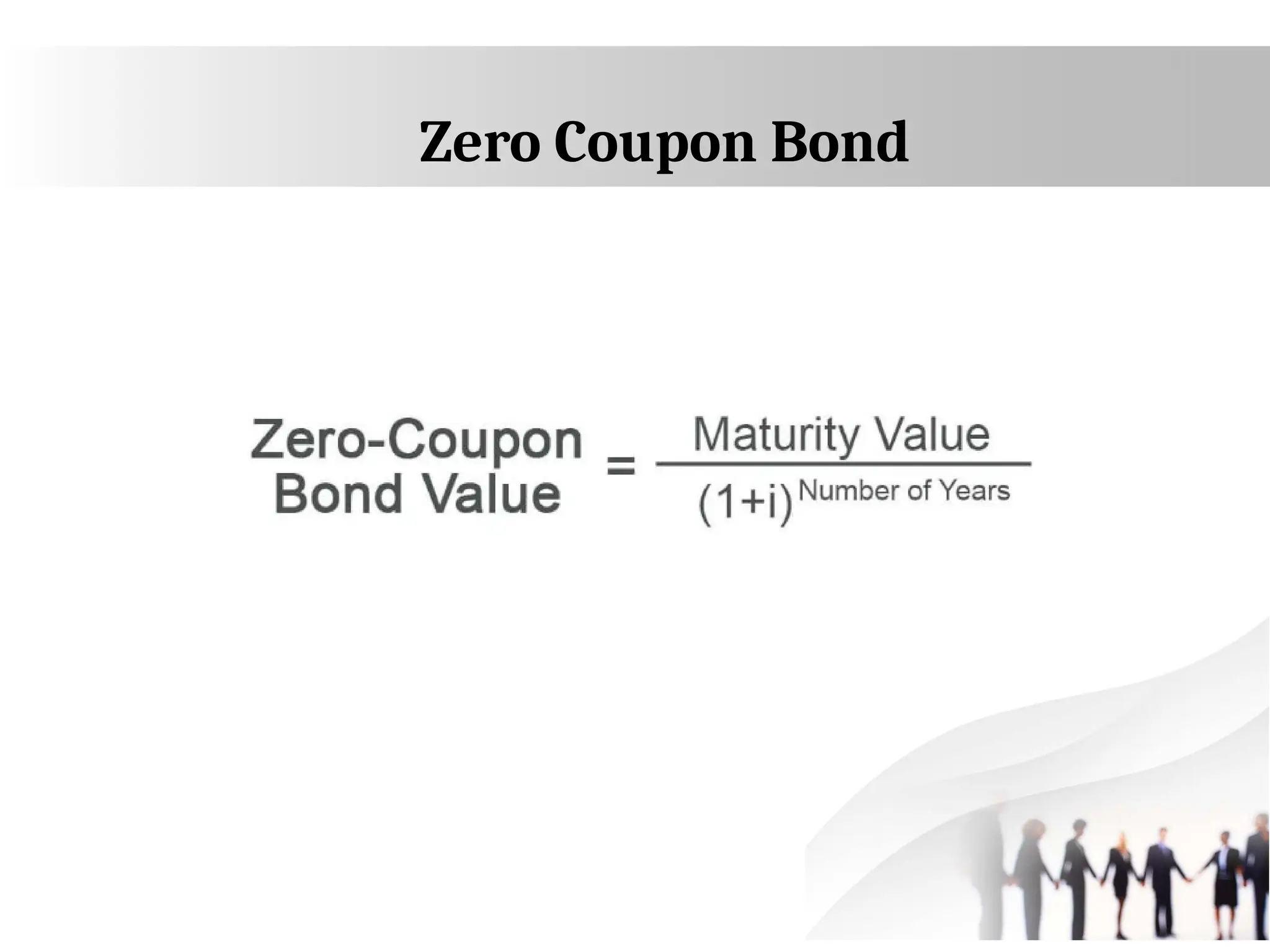
Zero Coupon Bond
Question 18: Zero Coupon Bond
Calculate the value of 5 year Zero coupon bond, if the face
value is Rs.1000 and the estimated return is 12%.
Activity
Prepare & present an investment plan for Rs 10L, with
maximum asset mix; Also substantiate your trade off between
Return & Risk. The investment time horizon is 5 years.
– Slide presentation
– Max 3 to 4 slides
– Table of assets with the expected return

IAPM - Unit 1.pptx investment analysis and portfolio management

  • 1.
    Unit - 1 Introductionto Investment Analysis and Portfolio Management
  • 2.
    Investment • Definition: “Investment maybe defined as an activity that commits funds in any financial/marketable or physical form in the present with an expectation of receiving additional return in the future.” “Investment is the commitment of current funds in anticipation of receiving larger inflow of funds in future, the difference being the income”.
  • 3.
    • For example,a Bank deposit is a financial asset, the purchase of gold is a physical asset and the purchase of bonds and shares is marketable asset. • An investor hopes to be compensated for a. forgoing present consumption, b. for the effects of inflation, and c. for taking a risk.
  • 4.
    Investment Objectives • Return •Risk • Liquidity • Hedge against inflation • Safety • Tax Benefits
  • 5.
    Speculation • In speculation,there is an investment of funds with an expectation of some return in the form of capital profit resulting from the price change and sale of investment. Speculation is relatively a short term investment. The degree of uncertainty of future return is definitely higher in case of speculation than in investment. • In case of investment, the investor has an intention of keeping the investment for some period whereas in speculation, the investor looks for an opportunity of making a profit and “exit- out” by selling the investment.
  • 6.
    DIFFERENCES IN INVESTMENT& SPECULATION Factor Investment Speculation Degree of risk Relatively lesser Relatively higher Basis of return Income and capital gain Change in market price Basis for decision Analysis of fundamentals Rumors, tips, etc Investment period Long term Short term Position of investor Ownership Party of an agreement
  • 7.
    Gambling • It isusually a very short term investment in a game or chance. Gambling is different from speculation and investment. The time horizon involved in gambling is shorter than speculation and investment. • People gamble to entertain themselves, earning incomes would be the secondary factor. • Gambling employs artificial risks whereas commercial risks are present in investment • There is no risk and return tradeoff in the gambling and the negative outcomes are expected but in investment there is analysis of risk and return and positive outcomes are expected.
  • 8.
  • 9.
    Investment Policy • Investible fund •Objectives • Knowledge Analysis • Market • Industry • Company Valuation • Intrinsic value • Future Value
  • 10.
    Portfolio construction • Diversification • Selection& allocation Portfolio evaluation • Appraisal • Revision
  • 11.
    Return Measurement • R= Return • C = Cash Inflows • PE = Price at the end • PB = Price at the beginning
  • 12.
    Question 1: Grow MoreLtd. is evaluating the rate of return on two of its Assets, I and II. The Asset I was purchased a year ago for Rs.4,00,000 and since then it has generated cash inflows of Rs. 16,000. Presently, it can be sold for a price of Rs.4,30, 000. Asset II was purchased a few years ago and its market price in the beginning and at the end of the current year was Rs.2,40,000 and Rs.2,36,000 respectively. The Asset II has generated cash inflows of Rs.34,000 during the year. Find out the rate of return on these assets.
  • 13.
    A had purchaseda bond at a price of Rs.800 with a coupon payment of Rs.150 and sold it Rs.1000. i)What is his holding period return and ii)If the bond is sold is sold for Rs.750 after receiving Rs.150 as coupon payment then what is his holding period return? Question 2:
  • 14.
    Expected rate ofReturn • The expected return is the profit or loss that an investor anticipates on an investment that has known historical rates of return (RoR). It is calculated by multiplying potential outcomes by the chances of them occurring and then totaling these results. Expected returns cannot be guaranteed. The expected return for a portfolio containing multiple investments is the weighted average of the expected return of each of the investments. • The expected return on an investment is the expected value of the probability distribution of possible returns it can provide to investors. The return on the investment is an unknown variable that has different values associated with different probabilities. Expected return is calculated by multiplying potential outcomes (returns) by the chances of each outcome occurring, and then calculating the sum of those results
  • 15.
    Expected return Expected return= R = Possible return P = Probability of return
  • 16.
    Question 3: Compute expectedreturn on security X from the particulars given: Return Probability 20% 0.15 21% 0.20 22% 0.50 23% 0.10 24% 0.05
  • 17.
    Question 4: Compute returnon security Y from the particulars given: Year Return 1 20% 2 13% 3 12% 4 15% 5 17%
  • 18.
    Risk • The dictionarymeaning of risk is the possibility of loss or injury; the degree or probability of such loss. • Risk is defined in financial terms as the chance that an outcome or investment's actual gains will differ from an expected outcome or return. Risk includes the possibility of losing some or all of an original investment.
  • 19.
    Types of Risk SystematicRisk Unsystematic Risk Uncontrollable Controllable Market Risk Interest rate Risk Purchasing power risk Finance Risk Business Risk
  • 20.
  • 21.
    Question 5: Calculate theexpected return, variance and standard deviation from the following: Economic conditions Return (%) Probability Good 20 0.10 Average 16 0.40 Bad 10 0.30 Poor 3 0.20
  • 22.
    Question 6: Calculate thereturn, variance and standard deviation from the following: Year Return 1 12% 2 15% 3 21% 4 16% 5 19%
  • 23.
    Investment alternatives • Nonmarketable financial assets • Marketable financial assets
  • 24.
    Non marketable financialassets • Bank deposits • Post office savings • Time deposits • Company deposits • Kisan Vikas Patra • EPF • PPF
  • 25.
    Marketable financial assets •Money market instruments – Treasury bills – Certificates of deposits – Commercial paper – Repos • Bonds & debentures – Govt securities – Savings bond – Private sector debentures – Public sector undertaking bonds – Preference shares • Mutual Funds • Equity shares • Fin derivatives – Futures & Options
  • 26.
    Stock Valuation Models •Single-period valuation Model • Multi-period valuation Model • Zero Growth Model • Constant Growth Model
  • 27.
  • 29.
    Question 7: An investorholds shares of TVS from 13.01.2022 to 23.01.2023. The beginning and end period prices are Rs. 335 and Rs. 421. The dividend paid is 35%. Calculate the Dividend Yield, holding period yield and return on this investment. Assume face value of the investment is Rs 10 and rate of return is 20%. Also, calculate the price of the share and check if the price stated by the company is feasible.
  • 30.
  • 31.
    Question 8: An investorholds shares of TCS for 3years. The end period price is Rs.520. The dividend paid is 35%, 40% & 25% for 3 years. Assume face value of the share is Rs 10, and rate of return is 15%, calcuate the price of the share. If actual price for which you bought the share is Rs.340, is the investment in share made by worth?
  • 32.
  • 33.
    Question 9: A companyis issuing dividend of 25%. The face value of the share is Rs.10. Assume that the dividend growth is NIL in this investment and calculate the price of the share if the rate of return expected is 10%.
  • 34.
  • 35.
    Question 10: A companyis issuing dividend of 35% for next year. The face value of the share is Rs.10. Assume that the constant dividend growth is 5% in this investment and calculate the price of the share if the rate of return expected is 12%.
  • 36.
  • 37.
    Bond A bond isa debt instrument that provides a steady income stream to the investor in the form of coupon payments. At the maturity date, the full face value of the bond is repaid to the bondholder.
  • 38.
    Types of BondRisk Interest rate risk Call risk Credit risk Market risk Default risk Marketability risk
  • 39.
    Interest rate risk Interestrate risk refers to the impact of the movement in interest rates on bond returns. As rates rise, bond prices decline. In the event of rising rates, the attractiveness of existing bonds with lower returns declines, and hence the price of such bonds falls. The reverse is also true. Short-term bonds are less exposed to this risk, while long-term bonds have a high probability of getting affected.
  • 40.
    Call risk It isspecifically associated with the bonds that come with an embedded call option. When market rates decline, callable bond issuers often look to refinance their debt, thus calling back the bonds at the pre- specified call price. This often leaves the investors in the lurch, who are forced to reinvest the bond proceeds at lower rates. Such investors are, however, compensated by high coupons. The call protection feature also protects the bond from being called for a particular period giving investors some relief.
  • 41.
    Credit risk Credit riskresults from the bond issuer’s inability to make timely payments to the lenders. This leads to interrupted cash flow for the lender, where losses might range from moderate to severe. Credit history and capacity to repay are the two most important factors determining credit risk.
  • 42.
    Market risk Market riskis the probability of losses due to market reasons like slowdown and rate changes. It affects the entire market together. In a bond market, no matter how good an investment is, it is bound to lose value when the market declines. Interest rate risk is another form of market risk.
  • 43.
    Default risk Default riskis the bond issuing company’s inability to make required payments. It is seen as other variants of credit risk where the borrowing company fails to meet the agreed terms of the issue.
  • 44.
  • 45.
  • 46.
    Question 11: Bondreturn What is the holding period return for a bond that is currently selling for $1,060 if it was purchased exactly six-months ago for $1,000 and paid a $20 coupon today?
  • 47.
  • 48.
    Question 12: BondYTM What is the yield to maturity of a 5 year 6% coupon bond that is currently priced at Rs.850? Assume face value to be Rs.1000
  • 49.
    Question 13: BondYTM What is the yield to maturity for a 3 year bond with a 10% annual coupon if the bond is trading at par?
  • 50.
    Question 14: BondYTM Bond A Bond B Face Value Rs. 1000 Rs.1000 Coupon rate 12% 12% Maturity Period 3 Years 3 Years Market price Rs. 875 Rs. 1035 Calculate the YTM for both the bonds
  • 51.
  • 52.
    Question 15: BondValuation Bond A Bond B Face Value Rs. 1000 Rs.1000 Coupon rate 10% 12% Maturity Period 2 Years 3 Years YTM 15% 16% Calculate the Bond value for both the bonds
  • 53.
    Question 16: BondValuation A Rs. 100 par value bond bearing a coupon rate of 11% matures after 5 years. The expected yield to maturity is 15%. a) If the present market price is Rs 82, should the investor buy this bond. b) If the present market price is Rs 90, should the investor buy this bond.
  • 54.
    Question 17: Bondvaluation Bond A Bond B Face Value Rs. 1000 Rs.1000 Coupon rate 10% 10% Maturity Period 2 Years 3 Years YTM 15% 15% Calculate the Bond value for both the bonds
  • 55.
    Zero Coupon Bond Azero-coupon bond, is a debt security that does not pay interest but instead trades at a deep discount, rendering a profit at maturity, when the bond is redeemed for its full face value.
  • 56.
  • 57.
    Question 18: ZeroCoupon Bond Calculate the value of 5 year Zero coupon bond, if the face value is Rs.1000 and the estimated return is 12%.
  • 58.
    Activity Prepare & presentan investment plan for Rs 10L, with maximum asset mix; Also substantiate your trade off between Return & Risk. The investment time horizon is 5 years. – Slide presentation – Max 3 to 4 slides – Table of assets with the expected return

Editor's Notes