INTRODUCTION TO
EPIDEMIOLOGY
Lecture # 1
Assit. Prof. Mussarat Fatima
MSN, MPH, BSc.N,DTA,DWA, RM, RN
intro - epi 1
Epidemiology - Definition
Epidemiology is the study of disease
frequency ,Distribution and determinants of
health related states and events in specified
population and the application of the study
to the control of health problems.
intro - epi 2
Epidemiology is derived from Greek word:
EPI = among
DEMOS = people
LOGOS = study
intro - epi 3
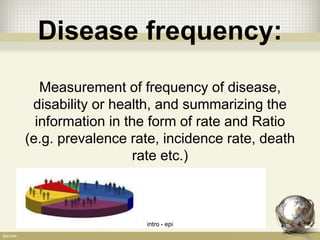
Disease frequency:
Measurement of frequency of disease,
disability or health, and summarizing the
information in the form of rate and Ratio
(e.g. prevalence rate, incidence rate, death
rate etc.)
intro - epi 4
Distribution of Diseases:
Disease is not uniformly distributed in human population.
Distribution patterns in the various sub groups of the
population by time, place and person whether these has
been increase or decrease of diseases over time span.
Whether disease occur in one geographic area than in
others.
intro - epi 5
Determinants of diseases:
This is the real substance of epidemiology.
This aspect of epidemiology is known as
analytical epidemiology Determinants
includes all those factors that influence the
distribution. These may be primary or
secondary.
intro - epi 6
Cont….
• Primary Determinants: Are
causative agent of disease or
disorder e.g. bacteria, virus,
parasite, specific nutrient.
• Secondary Determinants: Include
a multitude of factors that influence
the diseases e.g. socio economic
factor causing malnutrition and
physical environment influencing
causation of respiratory infection.
intro - epi 7
USES OF EPIDEMIOLOGY:
1. To study historically the rise and fall of disease
in the population.
2. Community Diagnosis.
3. Planning and evaluation.
4. Evaluations of individual’s risks and chances.
5. Syndrome identification.
6. Completing the natural history of disease.
7. Searching for causes and risk factors.
intro - epi 8
AIMS OF EPIDEMIOLOGY
a. To describe the distribution of disease, magnitude,
the level, in depth knowledge of health and disease
problems in human population.
b. To identify the etiological factors (contributing
factors, risk factors, aggravating factors) in the origin
or pathogenesis of disease or ill health.
c. To provide the data essential to the planning,
implementation and evaluation of health services for
the prevention, control and treatment of disease and
to setting up of priorities among those services.
intro - epi 9
ULTIMATE GOAL OR AIM OF
EPIDEMIOLOGY IS TAKING EFFECTIVE
ACTION REGARDING:
• To eliminate or reduce, the disease or
Health problem or its consequences.
• To promote the health and well-being of
society as a whole.
intro - epi 10
THE SCOPE OF EPIDEMIOLOGY:
A- Clinical epidemiology: Deals clinical
symptoms of patient and compare its recording
with patients having similar symptoms in groups to
predict a probable diagnosis and proceed to work
to eliminate the occurrence of change.
B- Occupational epidemiology: It involves a
study of health effects on workers with factors to
which they are exposed. Such factors may be
biological environment.
intro - epi 11

Unit 03 Introduction to Epidemiology.ppt

  • 1.
    INTRODUCTION TO EPIDEMIOLOGY Lecture #1 Assit. Prof. Mussarat Fatima MSN, MPH, BSc.N,DTA,DWA, RM, RN intro - epi 1
  • 2.
    Epidemiology - Definition Epidemiologyis the study of disease frequency ,Distribution and determinants of health related states and events in specified population and the application of the study to the control of health problems. intro - epi 2
  • 3.
    Epidemiology is derivedfrom Greek word: EPI = among DEMOS = people LOGOS = study intro - epi 3
  • 4.
    Disease frequency: Measurement offrequency of disease, disability or health, and summarizing the information in the form of rate and Ratio (e.g. prevalence rate, incidence rate, death rate etc.) intro - epi 4
  • 5.
    Distribution of Diseases: Diseaseis not uniformly distributed in human population. Distribution patterns in the various sub groups of the population by time, place and person whether these has been increase or decrease of diseases over time span. Whether disease occur in one geographic area than in others. intro - epi 5
  • 6.
    Determinants of diseases: Thisis the real substance of epidemiology. This aspect of epidemiology is known as analytical epidemiology Determinants includes all those factors that influence the distribution. These may be primary or secondary. intro - epi 6
  • 7.
    Cont…. • Primary Determinants:Are causative agent of disease or disorder e.g. bacteria, virus, parasite, specific nutrient. • Secondary Determinants: Include a multitude of factors that influence the diseases e.g. socio economic factor causing malnutrition and physical environment influencing causation of respiratory infection. intro - epi 7
  • 8.
    USES OF EPIDEMIOLOGY: 1.To study historically the rise and fall of disease in the population. 2. Community Diagnosis. 3. Planning and evaluation. 4. Evaluations of individual’s risks and chances. 5. Syndrome identification. 6. Completing the natural history of disease. 7. Searching for causes and risk factors. intro - epi 8
  • 9.
    AIMS OF EPIDEMIOLOGY a.To describe the distribution of disease, magnitude, the level, in depth knowledge of health and disease problems in human population. b. To identify the etiological factors (contributing factors, risk factors, aggravating factors) in the origin or pathogenesis of disease or ill health. c. To provide the data essential to the planning, implementation and evaluation of health services for the prevention, control and treatment of disease and to setting up of priorities among those services. intro - epi 9
  • 10.
    ULTIMATE GOAL ORAIM OF EPIDEMIOLOGY IS TAKING EFFECTIVE ACTION REGARDING: • To eliminate or reduce, the disease or Health problem or its consequences. • To promote the health and well-being of society as a whole. intro - epi 10
  • 11.
    THE SCOPE OFEPIDEMIOLOGY: A- Clinical epidemiology: Deals clinical symptoms of patient and compare its recording with patients having similar symptoms in groups to predict a probable diagnosis and proceed to work to eliminate the occurrence of change. B- Occupational epidemiology: It involves a study of health effects on workers with factors to which they are exposed. Such factors may be biological environment. intro - epi 11