UNILEVER
The producer of over 400 day to day products we all
use.
THE HISTORY OF UNILEVER
 In the Netherlands during the 1870’s, Jurgens and Van den Bergh open their first factories to produce margarine.
 William Hesketh Lever saw a business opportunity and created ideas for a new soap product.
 In 1884, Lever & Co starts producing ‘Sunlight Soap’.
 1894, Lever & Co create a new affordable product ‘Lifebuoy Soap’ to support personal hygiene and then become
known as the Lever Brothers.
 In the mid 1890’s, the Lever Brothers were selling 40,000 tonnes of soap a year and expanded to America and
Europe.
 By this time Van den Bergh launched a new branded margarine ‘Vitello’.
 In1908, Jurgens and Van den Bergh strike a deal to form an association and share profits .
 Despite this, in 1912 the first profit-sharing deal between Jurgens and Van den Bergh was terminated but the two
companies continued to work together. They later became known as ‘Margarine Unie’.
 In 1922, the Lever Brothers buy the company Walls (which would later become one of their most successful brands)
and begin creating Ice Cream.
 On the 2nd of September 1929, the Lever Brothers and Margarine Unie signed an agreement to create ‘Unilever’.
 In 1930, ‘Unilever’ is officially established.
 Unilever now thrive in helping people to ‘look good, feel good and get more out of life’.
UNILEVER
PRODUCTS
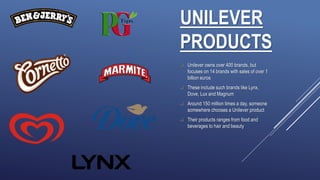
 Unilever owns over 400 brands, but
focuses on 14 brands with sales of over 1
billion euros
 These include such brands like Lynx,
Dove, Lux and Magnum
 Around 150 million times a day, someone
somewhere chooses a Unilever product
 Their products ranges from food and
beverages to hair and beauty
LYNX
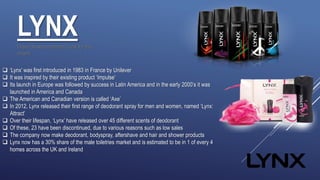
 ‘Lynx’ was first introduced in 1983 in France by Unilever
 It was inspired by their existing product ‘Impulse’
 Its launch in Europe was followed by success in Latin America and in the early 2000’s it was
launched in America and Canada
 The American and Canadian version is called ‘Axe’
 In 2012, Lynx released their first range of deodorant spray for men and women, named ‘Lynx:
Attract’
 Over their lifespan, ‘Lynx’ have released over 45 different scents of deodorant
 Of these, 23 have been discontinued, due to various reasons such as low sales
 The company now make deodorant, bodyspray, aftershave and hair and shower products
 Lynx now has a 30% share of the male toiletries market and is estimated to be in 1 of every 4
homes across the UK and Ireland
I have chosen to rebrand ‘Lynx’ for this
project.
LYNX’S
MARKETING
 Lynx have produced many forms of advertising
with the most popular being TV adverts and
posters
 From 2003, ‘Lynx’ advertisements have
portrayed various ways the products supposedly
helped men attract women
 The most successful being the ‘Lynx Effect:
Spray More, Get More’ advert
 The Lynx brand was worth £80m this year in the
UK alone
 ‘Lynx’ advertises on many mainstream TV
channels but doesn’t advertise on children’s
channels due to their target audience being
teenagers and young adults
 Channels such as E4, BBC THREE, FOX and
BBC One are all channels they regularly
advertise on due to them being what their target
audience tend to watch more frequently
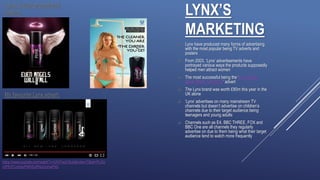
https://www.youtube.com/watch?v=UH31wd1ALjk&index=7&list=PLGU
h2PEjFCoHj4qPNf0ISJPNu0JyhwP9Q
My favourite Lynx advert:
‘Lynx: Excite’ promotional
posters
REBRANDING LYNX
 Lynx’s current target audience is based around11-25 year olds
 I plan to change this to an older audience of around 50-75 year olds
 To do this, I am going to rebrand it in the same sort of smart and sophisticated style as the
original ‘Old Spice’ advertisements had
 I will change the colour scheme to seem more sophisticated and manly
 The current Lynx advertisements use the sexualisation of men and women to attract people to
buy their products
 In my advert, I am going to promote Lynx as a way to take older people back to the good old
days and present themselves as a ‘grey fox’
DEMOGRAHICS
1. Gender: Males
2. Age: 50-75 years
3. Class: Higher
4. Ethnicity: Any
5. Sexuality: Any
6. Income: Middle-Upper
7. Geography: Europe, US and Canada
PSYCHOGRAPHICS
1. Behaviours: Confidence, cleanliness and being well groomed
2. Attitudes: ‘Succeeders and resigned’
3. Beliefs: That they need to keep themselves presentable
4. Aspirations: To stay well presented and sophisticated
5. Interests: The old days from their childhood
6. Opinions: That the old days are the better days
7. Morals and values: To not use sexualisation to gain viewership and
sales
SYNOPSIS OF MY ADVERT
In my advert, it will start by an old man turning on the radio. The radio will begin to start playing modern
pop music which this man doesn’t like so he turns it off. Following this, he walks over to the mirror and
tidies his hair and then sprays the Lynx over himself. As the spray happens, the picture will fade into a
black and white/ noir style. The man will then walk back to the radio which will now be an old fashioned
radio and turn it on again but this time it will play old fashioned jazz music that sounds like its being
played from a record player. The man will then sit down in a lounge chair, light a cigar and smoke it. As
he blows out the smoke the Lynx logo will fade in when the smoke travels across the screen, followed by
the phrase ‘Takes you back to the good old days’ with a voice over as it appears.
DISTRIBUTION PLAN
 To distribute my new Lynx product I will advertise it on different channels such as Yesterday,
Discovery, Dave, Food Network, Really, ITV and BBC One. This is because my new audience of
50-75 year olds tend to watch these types of channels more then the original channels Lynx
advertises on. I will also choose to advertise from 7am-6pm because this is the time most people
around that age are available and willing to watch TV and actually see the advertisement.
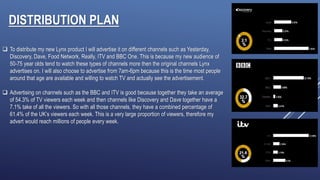
 Advertising on channels such as the BBC and ITV is good because together they take an average
of 54.3% of TV viewers each week and then channels like Discovery and Dave together have a
7.1% take of all the viewers. So with all those channels, they have a combined percentage of
61.4% of the UK’s viewers each week. This is a very large proportion of viewers, therefore my
advert would reach millions of people every week.
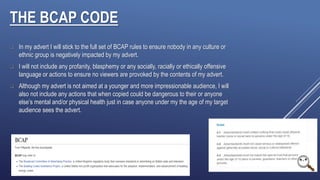
THE BCAP CODE
 In my advert I will stick to the full set of BCAP rules to ensure nobody in any culture or
ethnic group is negatively impacted by my advert.
 I will not include any profanity, blasphemy or any socially, racially or ethically offensive
language or actions to ensure no viewers are provoked by the contents of my advert.
 Although my advert is not aimed at a younger and more impressionable audience, I will
also not include any actions that when copied could be dangerous to their or anyone
else’s mental and/or physical health just in case anyone under my the age of my target
audience sees the advert.
REFERENCES
 http://www.barb.co.uk/whats-new/weekly-viewing-summary?_s=4
 https://en.wikipedia.org/wiki/List_of_digital_terrestrial_television_channels_
(UK)
 http://www.barb.co.uk/whats-new/weekly-viewing-by-channel-group?_s=4
 http://www.unilever.co.uk/aboutus/ourhistory/
 https://www.youtube.com/watch?v=9G7Qex-0j_A

Unilever

  • 1.
    UNILEVER The producer ofover 400 day to day products we all use.
  • 2.
    THE HISTORY OFUNILEVER  In the Netherlands during the 1870’s, Jurgens and Van den Bergh open their first factories to produce margarine.  William Hesketh Lever saw a business opportunity and created ideas for a new soap product.  In 1884, Lever & Co starts producing ‘Sunlight Soap’.  1894, Lever & Co create a new affordable product ‘Lifebuoy Soap’ to support personal hygiene and then become known as the Lever Brothers.  In the mid 1890’s, the Lever Brothers were selling 40,000 tonnes of soap a year and expanded to America and Europe.  By this time Van den Bergh launched a new branded margarine ‘Vitello’.  In1908, Jurgens and Van den Bergh strike a deal to form an association and share profits .  Despite this, in 1912 the first profit-sharing deal between Jurgens and Van den Bergh was terminated but the two companies continued to work together. They later became known as ‘Margarine Unie’.  In 1922, the Lever Brothers buy the company Walls (which would later become one of their most successful brands) and begin creating Ice Cream.  On the 2nd of September 1929, the Lever Brothers and Margarine Unie signed an agreement to create ‘Unilever’.  In 1930, ‘Unilever’ is officially established.  Unilever now thrive in helping people to ‘look good, feel good and get more out of life’.
  • 3.
    UNILEVER PRODUCTS  Unilever ownsover 400 brands, but focuses on 14 brands with sales of over 1 billion euros  These include such brands like Lynx, Dove, Lux and Magnum  Around 150 million times a day, someone somewhere chooses a Unilever product  Their products ranges from food and beverages to hair and beauty
  • 4.
    LYNX  ‘Lynx’ wasfirst introduced in 1983 in France by Unilever  It was inspired by their existing product ‘Impulse’  Its launch in Europe was followed by success in Latin America and in the early 2000’s it was launched in America and Canada  The American and Canadian version is called ‘Axe’  In 2012, Lynx released their first range of deodorant spray for men and women, named ‘Lynx: Attract’  Over their lifespan, ‘Lynx’ have released over 45 different scents of deodorant  Of these, 23 have been discontinued, due to various reasons such as low sales  The company now make deodorant, bodyspray, aftershave and hair and shower products  Lynx now has a 30% share of the male toiletries market and is estimated to be in 1 of every 4 homes across the UK and Ireland I have chosen to rebrand ‘Lynx’ for this project.
  • 5.
    LYNX’S MARKETING  Lynx haveproduced many forms of advertising with the most popular being TV adverts and posters  From 2003, ‘Lynx’ advertisements have portrayed various ways the products supposedly helped men attract women  The most successful being the ‘Lynx Effect: Spray More, Get More’ advert  The Lynx brand was worth £80m this year in the UK alone  ‘Lynx’ advertises on many mainstream TV channels but doesn’t advertise on children’s channels due to their target audience being teenagers and young adults  Channels such as E4, BBC THREE, FOX and BBC One are all channels they regularly advertise on due to them being what their target audience tend to watch more frequently https://www.youtube.com/watch?v=UH31wd1ALjk&index=7&list=PLGU h2PEjFCoHj4qPNf0ISJPNu0JyhwP9Q My favourite Lynx advert: ‘Lynx: Excite’ promotional posters
  • 6.
    REBRANDING LYNX  Lynx’scurrent target audience is based around11-25 year olds  I plan to change this to an older audience of around 50-75 year olds  To do this, I am going to rebrand it in the same sort of smart and sophisticated style as the original ‘Old Spice’ advertisements had  I will change the colour scheme to seem more sophisticated and manly  The current Lynx advertisements use the sexualisation of men and women to attract people to buy their products  In my advert, I am going to promote Lynx as a way to take older people back to the good old days and present themselves as a ‘grey fox’ DEMOGRAHICS 1. Gender: Males 2. Age: 50-75 years 3. Class: Higher 4. Ethnicity: Any 5. Sexuality: Any 6. Income: Middle-Upper 7. Geography: Europe, US and Canada PSYCHOGRAPHICS 1. Behaviours: Confidence, cleanliness and being well groomed 2. Attitudes: ‘Succeeders and resigned’ 3. Beliefs: That they need to keep themselves presentable 4. Aspirations: To stay well presented and sophisticated 5. Interests: The old days from their childhood 6. Opinions: That the old days are the better days 7. Morals and values: To not use sexualisation to gain viewership and sales
  • 7.
    SYNOPSIS OF MYADVERT In my advert, it will start by an old man turning on the radio. The radio will begin to start playing modern pop music which this man doesn’t like so he turns it off. Following this, he walks over to the mirror and tidies his hair and then sprays the Lynx over himself. As the spray happens, the picture will fade into a black and white/ noir style. The man will then walk back to the radio which will now be an old fashioned radio and turn it on again but this time it will play old fashioned jazz music that sounds like its being played from a record player. The man will then sit down in a lounge chair, light a cigar and smoke it. As he blows out the smoke the Lynx logo will fade in when the smoke travels across the screen, followed by the phrase ‘Takes you back to the good old days’ with a voice over as it appears.
  • 8.
    DISTRIBUTION PLAN  Todistribute my new Lynx product I will advertise it on different channels such as Yesterday, Discovery, Dave, Food Network, Really, ITV and BBC One. This is because my new audience of 50-75 year olds tend to watch these types of channels more then the original channels Lynx advertises on. I will also choose to advertise from 7am-6pm because this is the time most people around that age are available and willing to watch TV and actually see the advertisement.  Advertising on channels such as the BBC and ITV is good because together they take an average of 54.3% of TV viewers each week and then channels like Discovery and Dave together have a 7.1% take of all the viewers. So with all those channels, they have a combined percentage of 61.4% of the UK’s viewers each week. This is a very large proportion of viewers, therefore my advert would reach millions of people every week.
  • 9.
    THE BCAP CODE In my advert I will stick to the full set of BCAP rules to ensure nobody in any culture or ethnic group is negatively impacted by my advert.  I will not include any profanity, blasphemy or any socially, racially or ethically offensive language or actions to ensure no viewers are provoked by the contents of my advert.  Although my advert is not aimed at a younger and more impressionable audience, I will also not include any actions that when copied could be dangerous to their or anyone else’s mental and/or physical health just in case anyone under my the age of my target audience sees the advert.
  • 10.
    REFERENCES  http://www.barb.co.uk/whats-new/weekly-viewing-summary?_s=4  https://en.wikipedia.org/wiki/List_of_digital_terrestrial_television_channels_ (UK) http://www.barb.co.uk/whats-new/weekly-viewing-by-channel-group?_s=4  http://www.unilever.co.uk/aboutus/ourhistory/  https://www.youtube.com/watch?v=9G7Qex-0j_A