Procter & Gamble
About the Company
The company managed two dozen $1 billion brands known worldwide,
including Bounty, Crest, Downy/Lenor, Febreze, Gillette, Iams, and Pampers
P&G had
pioneered
marketing
strategies that
were considered
standard industry
practice
Global leader in Branded consumer goods
Goal
As of 2010……
• Sales –
$78.94 billion
• Net income –
$12.74 billion
• market
capitalization –
$186.63 billion
North America - 42%
Western Europe - 21%
Asia - 15%
Central and Eastern
Europe and the
Middle East and
Africa - 13%
Latin America - 9%
Sales Geographically
Company Background
P&G’s approach to entering new markets was via “acquisition or
joint venture on a small scale, and through trial and error, learn
the formula for success before making a major commitment”
P&G focused on three specific choices:
1. To grow P&G’s core brands and categories with an
unrelenting focus on innovation
2. To build our business with unserved and
underserved consumers
3. To continue to grow and develop faster-growing,
higher margin businesses with global leadership
potential
Steps taken for Innovation and R&D
• In June 1999, under
then-CEO Durk
Jager, P&G
reorganized to
boost growth after
net sales slowed to
2.6% growth from
the previous year
• P&G cut 15,000
staff and promised
to deliver more
innovation
Durk Jagger
Seven global
business units
(GBUs) based on
product
categories
replaced the
company’s four
geographic
business units
Three new teams supported the GBUs:
1. A business development team focused on innovating in
existing categories
2. a venture team tasked with acquiring brands in new areas
and nurturing ideas created by the business development
team that did not relate to an existing brand
3. market development organizations that would perform
intensive market research to ensure global products’ success in
local markets
Result
• The firm struggled to
control costs, and its stock
slid from $118 to $52 over 18
months.
• Lafley, who took over as
CEO in 2000, remained
committed to the
reorganization and was
convinced it would deliver
the innovations promised
Analysing the Marketing Strategies
I. Overall Marketing strategy
When Lafley took over, he set a goal to make P&G the
top product-design company in the world
Lafley
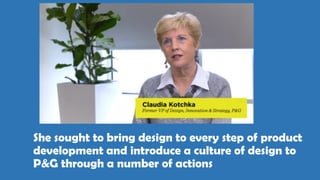
She sought to bring design to every step of product
development and introduce a culture of design to
P&G through a number of actions
• The influx of design had a
strong impact on P&G’s
product development
• Design informed the
innovation process
• Changed the function of
some products, such as the
Tampax Pearl’s more
comfortable applicator
Result
Shift to a more consumer-centric marketing approach
Lafley’s shake-up and
design emphasis articulated
more clearly that P&G’s
brands faced two moments
of truth:
1. On the store shelf
2. When the consumer used
the product and decided
whether it delivered on its
promise
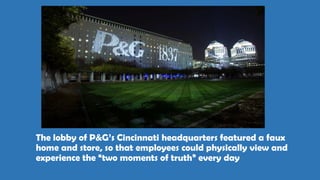
The lobby of P&G’s Cincinnati headquarters featured a faux
home and store, so that employees could physically view and
experience the “two moments of truth” every day
In 2008, P&G wooed recession-wary consumers with more
focused attention to in-store promotions such as coupons,
displays, special offers, and other promotional materials.
Pampers’ 2008
campaign, which
donated funds for one
tetanus vaccine in
developing markets
for each pack of
specially marked
diapers sold, was a
success story
II. Commitment to the Consumer
Innovative approach: VocalPoint, P&G’s word-of-mouth
program that enrolled more than 600,000 women to pitch its
products
June 2010, P&G announced a partnership with Tobii, a leader in
eye tracking, which objectively identified visibility and attention
that consumers gave to packaging, displays, and advertising
Result
The firm leveraged new and innovative ways to learn directly
from consumers, while also building the opportunity to create
more direct, one-on-one relationships with the target audiences
III. Advertising
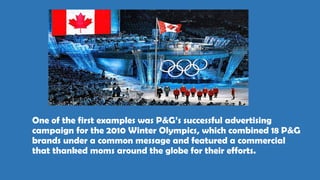
One of the first examples was P&G’s successful advertising
campaign for the 2010 Winter Olympics, which combined 18 P&G
brands under a common message and featured a commercial
that thanked moms around the globe for their efforts.
Soap Operas
The daytime drama As the World Turns
was launched in 1956 to specifically target
women in their homes
Another World, The Young and the Restless,
and Guiding Light were other longtime
P&G-sponsored daytime dramas
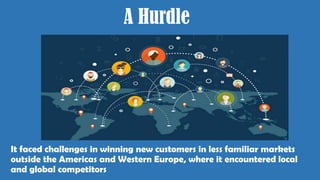
A Hurdle
It faced challenges in winning new customers in less familiar markets
outside the Americas and Western Europe, where it encountered local
and global competitors
Overcame by…..
• Working with agencies, P&G began by first developing a
“media neutral” idea that could be translated across a range of
media
• With Tide, the idea was that the detergent “works wonders on
the fabrics that touch your life.” The story could then be
translated into locally relevant messages
III.a. Sponsorships
III.b. Celebrity Endorsements
Tennis star Roger Federer
was featured in Gillette
Fusion Products ads in the
U.K. in 2010
The YouTube version attracted over 2
million visitors to the Gillette YouTube
channel!
In 2010, Sebastian Vettel, the “youngest ever”61 Formula One
champion, secured a long-term sponsorship with P&G to promote
Head & Shoulders shampoo
The same year, P&G also had at least 16
U.S. Olympic athletes in individual
sponsorship deals!
IV. Media Spending
In early 2009, as the recession took hold, then-
CEO Lafley announced that despite the poor
economic climate, P&G would maintain its
marketing budget
In 2010, P&G increased
ad spending by $1 billion,
with a 20% increase in
media impressions
Higher revenues led to an
increase in dollars spent
McDonald, who became CEO in 2010, stated that P&G would
maintain the same level of spending, while shifting dollars to
digital advertising and other new media to broaden the
audience
Result
Their media campaign has been successful and it
increased their revenues
V. Digital Marketing
Pampers.com: The website contained product information,
similar to the other brand websites under P&G, but also provided
information for new and expectant mothers and served as an
interactive forum
P&G slowed its digital push after the dot-com bubble burst, and
through the early 2000s focused its efforts primarily on television
and print advertisements
The company was back online when it undertook aggressive
marketing of its over-the-counter heartburn treatment Prilosec,
after a 2006 study found that most people dealing with
heartburn conduct research online before making a purchase
P&G launched its first mobile marketing ad campaign in 2006 to
promote Crest Whitening Plus Scope toothpaste
P&G’s line of “My Black is Beautiful” products, targeting African
American women, introduced two web series in 2010 to showcase
its products: Buppies and My Black is Beautiful, showcasing the
collection of P&G products in a makeover setting.
Buppies attracted over 2 million views online after its
launch, while My Black is Beautiful averaged 3.6 million
viewers in its second season on BET!
P&G’s Old Spice television commercial and YouTube sensation,
“The Man Your Man Could Smell Like,” gave P&G its greatest
exposure in the online community in 2010, and bridged the
power of digital and social media
Result
The digital marketing helped the company enter
the market in an innovative and way and
increased its brand equity!
VI. Social Media
In 2007, P&G launched two social media sites: Capessa for
women on Yahoo! Health and the People’s Choice Community,
associated with the People’s Choice awards
In 2010, P&G began using Facebook as a marketing tool and, by
2011, had 15 brands with “friends” in the six-figure range. Pringles
and Old Spice had 9 million and 1.3 million fans, respectively.
P&G rounded out its earlier social media efforts with
Manofthehouse.com, which featured household advice for men,
including tips on grilling burgers, cleaning toilets, and
disciplining children.
Result
The social media outreach helped P&G to increase their
customer base with minimal cost for advertising
About the
company
Innovation
and R&D
I. Overall Marketing strategy
II. Commitment to the consumer
III. Advertising
I. Sponsorships
II. Celebrity Endorsements
IV. Media Spending
V. Digital marketing
VI. Social media
Disclaimer
Created by Madhav Agrawal, BITS Pilani Goa Campus during a
marketing internship by Prof. Sameer Mathur,IIM Lucknow

Procter & Gamble

  • 1.
  • 2.
    About the Company Thecompany managed two dozen $1 billion brands known worldwide, including Bounty, Crest, Downy/Lenor, Febreze, Gillette, Iams, and Pampers
  • 3.
    P&G had pioneered marketing strategies that wereconsidered standard industry practice
  • 4.
    Global leader inBranded consumer goods Goal
  • 5.
    As of 2010…… •Sales – $78.94 billion • Net income – $12.74 billion • market capitalization – $186.63 billion
  • 6.
    North America -42% Western Europe - 21% Asia - 15% Central and Eastern Europe and the Middle East and Africa - 13% Latin America - 9% Sales Geographically
  • 7.
    Company Background P&G’s approachto entering new markets was via “acquisition or joint venture on a small scale, and through trial and error, learn the formula for success before making a major commitment”
  • 8.
    P&G focused onthree specific choices: 1. To grow P&G’s core brands and categories with an unrelenting focus on innovation 2. To build our business with unserved and underserved consumers 3. To continue to grow and develop faster-growing, higher margin businesses with global leadership potential
  • 9.
    Steps taken forInnovation and R&D
  • 10.
    • In June1999, under then-CEO Durk Jager, P&G reorganized to boost growth after net sales slowed to 2.6% growth from the previous year • P&G cut 15,000 staff and promised to deliver more innovation Durk Jagger
  • 11.
    Seven global business units (GBUs)based on product categories replaced the company’s four geographic business units
  • 12.
    Three new teamssupported the GBUs: 1. A business development team focused on innovating in existing categories 2. a venture team tasked with acquiring brands in new areas and nurturing ideas created by the business development team that did not relate to an existing brand 3. market development organizations that would perform intensive market research to ensure global products’ success in local markets
  • 13.
    Result • The firmstruggled to control costs, and its stock slid from $118 to $52 over 18 months. • Lafley, who took over as CEO in 2000, remained committed to the reorganization and was convinced it would deliver the innovations promised
  • 14.
  • 15.
  • 16.
    When Lafley tookover, he set a goal to make P&G the top product-design company in the world Lafley
  • 17.
    She sought tobring design to every step of product development and introduce a culture of design to P&G through a number of actions
  • 18.
    • The influxof design had a strong impact on P&G’s product development • Design informed the innovation process • Changed the function of some products, such as the Tampax Pearl’s more comfortable applicator Result
  • 19.
    Shift to amore consumer-centric marketing approach
  • 20.
    Lafley’s shake-up and designemphasis articulated more clearly that P&G’s brands faced two moments of truth: 1. On the store shelf 2. When the consumer used the product and decided whether it delivered on its promise
  • 21.
    The lobby ofP&G’s Cincinnati headquarters featured a faux home and store, so that employees could physically view and experience the “two moments of truth” every day
  • 22.
    In 2008, P&Gwooed recession-wary consumers with more focused attention to in-store promotions such as coupons, displays, special offers, and other promotional materials.
  • 23.
    Pampers’ 2008 campaign, which donatedfunds for one tetanus vaccine in developing markets for each pack of specially marked diapers sold, was a success story
  • 24.
    II. Commitment tothe Consumer
  • 25.
    Innovative approach: VocalPoint,P&G’s word-of-mouth program that enrolled more than 600,000 women to pitch its products
  • 26.
    June 2010, P&Gannounced a partnership with Tobii, a leader in eye tracking, which objectively identified visibility and attention that consumers gave to packaging, displays, and advertising
  • 27.
    Result The firm leveragednew and innovative ways to learn directly from consumers, while also building the opportunity to create more direct, one-on-one relationships with the target audiences
  • 28.
  • 29.
    One of thefirst examples was P&G’s successful advertising campaign for the 2010 Winter Olympics, which combined 18 P&G brands under a common message and featured a commercial that thanked moms around the globe for their efforts.
  • 30.
    Soap Operas The daytimedrama As the World Turns was launched in 1956 to specifically target women in their homes Another World, The Young and the Restless, and Guiding Light were other longtime P&G-sponsored daytime dramas
  • 31.
    A Hurdle It facedchallenges in winning new customers in less familiar markets outside the Americas and Western Europe, where it encountered local and global competitors
  • 32.
    Overcame by….. • Workingwith agencies, P&G began by first developing a “media neutral” idea that could be translated across a range of media • With Tide, the idea was that the detergent “works wonders on the fabrics that touch your life.” The story could then be translated into locally relevant messages
  • 33.
  • 35.
  • 36.
    Tennis star RogerFederer was featured in Gillette Fusion Products ads in the U.K. in 2010 The YouTube version attracted over 2 million visitors to the Gillette YouTube channel!
  • 37.
    In 2010, SebastianVettel, the “youngest ever”61 Formula One champion, secured a long-term sponsorship with P&G to promote Head & Shoulders shampoo
  • 38.
    The same year,P&G also had at least 16 U.S. Olympic athletes in individual sponsorship deals!
  • 39.
  • 40.
    In early 2009,as the recession took hold, then- CEO Lafley announced that despite the poor economic climate, P&G would maintain its marketing budget
  • 41.
    In 2010, P&Gincreased ad spending by $1 billion, with a 20% increase in media impressions Higher revenues led to an increase in dollars spent
  • 42.
    McDonald, who becameCEO in 2010, stated that P&G would maintain the same level of spending, while shifting dollars to digital advertising and other new media to broaden the audience
  • 43.
    Result Their media campaignhas been successful and it increased their revenues
  • 44.
  • 45.
    Pampers.com: The websitecontained product information, similar to the other brand websites under P&G, but also provided information for new and expectant mothers and served as an interactive forum
  • 46.
    P&G slowed itsdigital push after the dot-com bubble burst, and through the early 2000s focused its efforts primarily on television and print advertisements
  • 47.
    The company wasback online when it undertook aggressive marketing of its over-the-counter heartburn treatment Prilosec, after a 2006 study found that most people dealing with heartburn conduct research online before making a purchase
  • 48.
    P&G launched itsfirst mobile marketing ad campaign in 2006 to promote Crest Whitening Plus Scope toothpaste
  • 49.
    P&G’s line of“My Black is Beautiful” products, targeting African American women, introduced two web series in 2010 to showcase its products: Buppies and My Black is Beautiful, showcasing the collection of P&G products in a makeover setting.
  • 50.
    Buppies attracted over2 million views online after its launch, while My Black is Beautiful averaged 3.6 million viewers in its second season on BET!
  • 51.
    P&G’s Old Spicetelevision commercial and YouTube sensation, “The Man Your Man Could Smell Like,” gave P&G its greatest exposure in the online community in 2010, and bridged the power of digital and social media
  • 52.
    Result The digital marketinghelped the company enter the market in an innovative and way and increased its brand equity!
  • 53.
  • 54.
    In 2007, P&Glaunched two social media sites: Capessa for women on Yahoo! Health and the People’s Choice Community, associated with the People’s Choice awards
  • 55.
    In 2010, P&Gbegan using Facebook as a marketing tool and, by 2011, had 15 brands with “friends” in the six-figure range. Pringles and Old Spice had 9 million and 1.3 million fans, respectively.
  • 56.
    P&G rounded outits earlier social media efforts with Manofthehouse.com, which featured household advice for men, including tips on grilling burgers, cleaning toilets, and disciplining children.
  • 57.
    Result The social mediaoutreach helped P&G to increase their customer base with minimal cost for advertising
  • 58.
    About the company Innovation and R&D I.Overall Marketing strategy II. Commitment to the consumer III. Advertising I. Sponsorships II. Celebrity Endorsements IV. Media Spending V. Digital marketing VI. Social media
  • 59.
    Disclaimer Created by MadhavAgrawal, BITS Pilani Goa Campus during a marketing internship by Prof. Sameer Mathur,IIM Lucknow