ToTCOOP+i PROJECT
Unit 2 : Performance of the role of
Directors and Managers
STRATEGIC PARTNERSHIP FOR INNOVATING THE TRAINING
OF TRAINERS OF THE EUROPEAN AGRI-FOOD COOPERATIVES
Training Objectives
Acquisition of the competence “To perform
the role of Directors and Managers within
business administration of cooperative
companies”
Index
1. Challenges of cooperative sector
2. Conducting discussion groups
3. Decision making
4. Conducting Effective Meetings
5. Conflict resolution
6. Negotiation techniques
7. Teamwork
8. Leadership
1. Challenges of cooperative sector
(1)
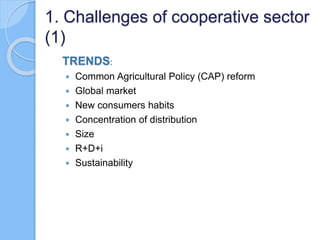
TRENDS:
 Common Agricultural Policy (CAP) reform
 Global market
 New consumers habits
 Concentration of distribution
 Size
 R+D+i
 Sustainability
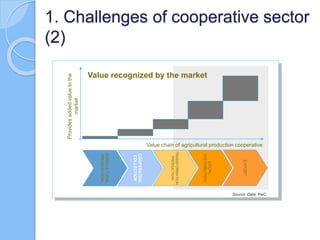
AGRICULTURAL
PRODUCTION
COOPERATIVE
COLLECTION
TRANSFORMATION
PRODUCTION
LOCAL
DISTRIBUTION
EXPORT
Value chain of agricultural production cooperative
Providesaddedvaluetothe
market
Source Data: PwC
Value recognized by the market
1. Challenges of cooperative sector
(2)
1. Challenges of cooperative sector
(3)
• Compete in a global market.
• The importance of gaining size to compete: interco-
operation.
• The need for more effective management and greater
professionalization.
• Opportunity to "evolve" in the agri-food chain, towards
transformation and / or commercialization.
• Consumers Attention: Your Habits Are Changing
• Incorporation of technology
• Immersion in innovation
• Long-term vision: strategy
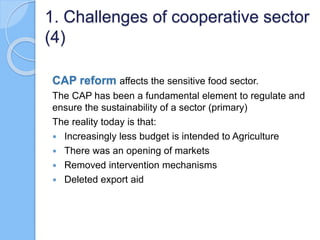
CAP reform affects the sensitive food sector.
The CAP has been a fundamental element to regulate and
ensure the sustainability of a sector (primary)
The reality today is that:
 Increasingly less budget is intended to Agriculture
 There was an opening of markets
 Removed intervention mechanisms
 Deleted export aid
1. Challenges of cooperative sector
(4)
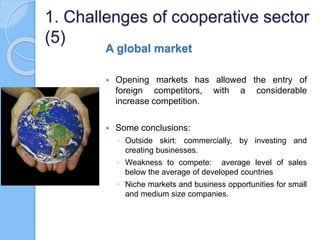
A global market
 Opening markets has allowed the entry of
foreign competitors, with a considerable
increase competition.
 Some conclusions:
◦ Outside skirt: commercially, by investing and
creating businesses.
◦ Weakness to compete: average level of sales
below the average of developed countries
◦ Niche markets and business opportunities for small
and medium size companies.
1. Challenges of cooperative sector
(5)
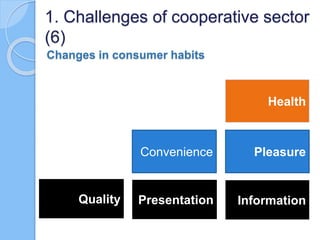
Changes in consumer habits
InformationPresentationQuality
PleasureConvenience
Health
1. Challenges of cooperative sector
(6)
Concentration of distribution
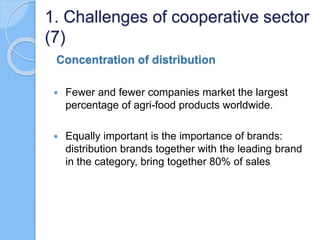
 Fewer and fewer companies market the largest
percentage of agri-food products worldwide.
 Equally important is the importance of brands:
distribution brands together with the leading brand
in the category, bring together 80% of sales
1. Challenges of cooperative sector
(7)
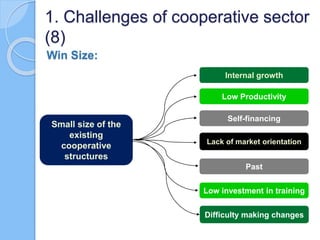
Win Size:
Small size of the
existing
cooperative
structures
Internal growth
Low Productivity
Self-financing
Lack of market orientation
Past
Low investment in training
Difficulty making changes
1. Challenges of cooperative sector
(8)
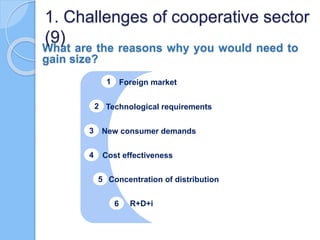
What are the reasons why you would need to
gain size?
1 Foreign market
2 Technological requirements
3 New consumer demands
4 Cost effectiveness
5 Concentration of distribution
6 R+D+i
1. Challenges of cooperative sector
(9)
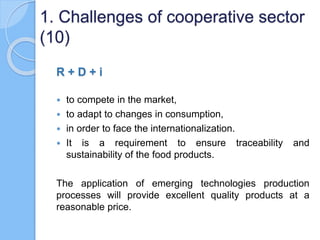
R + D + i
 to compete in the market,
 to adapt to changes in consumption,
 in order to face the internationalization.
 It is a requirement to ensure traceability and
sustainability of the food products.
The application of emerging technologies production
processes will provide excellent quality products at a
reasonable price.
1. Challenges of cooperative sector
(10)
Sustainability
 Regulation
 Legislation
 Agreements
 Environment
 CSR (Corporate Social Responsibility)
 Long-term vision
1. Challenges of cooperative sector
(11)
Which one do you consider most affecting your
cooperative?
1. Challenges of cooperative sector
(12)
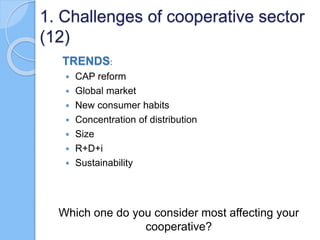
TRENDS:
 CAP reform
 Global market
 New consumer habits
 Concentration of distribution
 Size
 R+D+i
 Sustainability
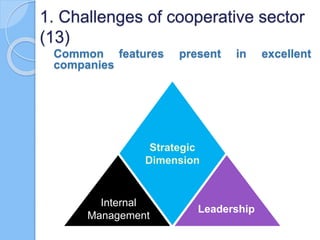
Common features present in excellent
companies
Internal
Management
Leadership
Strategic
Dimension
1. Challenges of cooperative sector
(13)
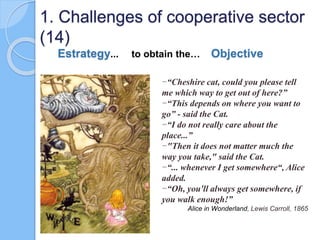
Estrategy... to obtain the… Objective
−“Cheshire cat, could you please tell
me which way to get out of here?”
−“This depends on where you want to
go” - said the Cat.
−“I do not really care about the
place...”
−"Then it does not matter much the
way you take," said the Cat.
−“... whenever I get somewhere“, Alice
added.
−“Oh, you'll always get somewhere, if
you walk enough!”
Alice in Wonderland, Lewis Carroll, 1865
1. Challenges of cooperative sector
(14)
Internal Management
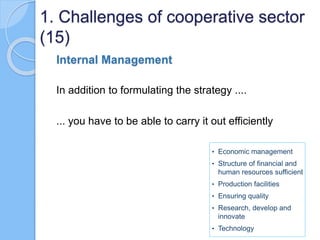
In addition to formulating the strategy ....
... you have to be able to carry it out efficiently
• Economic management
• Structure of financial and
human resources sufficient
• Production facilities
• Ensuring quality
• Research, develop and
innovate
• Technology
1. Challenges of cooperative sector
(15)
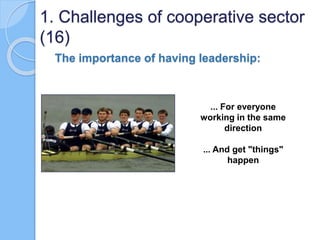
The importance of having leadership:
... For everyone
working in the same
direction
... And get "things"
happen
1. Challenges of cooperative sector
(16)
• Governing Bodies well defined and distinct functions
• With the ability to make decisions
• And getting these are carried out
• Represent an example to follow by the organization
• Motivate and inspire
• Coordinated and communication between them
• Fostering the creation of real equipment staff work in
the cooperative
• Long-term vision
1. Challenges of cooperative sector
(17)
2. Conducting discussion groups
(1)
Discussion Group: Definition
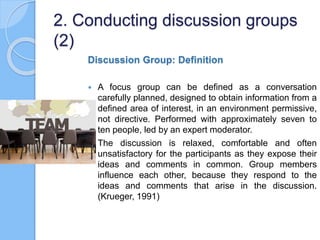
 According Russi (1998) "group is a factory of
speeches that give rise to only one, the same
group."
 According to Hung L. (2005) "A focus group is a
group in which people sit around a round table
(so no one has a privileged position) and a
moderator."
Discussion Group: Definition
 A focus group can be defined as a conversation
carefully planned, designed to obtain information from a
defined area of ​​interest, in an environment permissive,
not directive. Performed with approximately seven to
ten people, led by an expert moderator.
 The discussion is relaxed, comfortable and often
unsatisfactory for the participants as they expose their
ideas and comments in common. Group members
influence each other, because they respond to the
ideas and comments that arise in the discussion.
(Krueger, 1991)
2. Conducting discussion groups
(2)
Phases and methodological requirements
 Planning the content of the deal.
 Plan objectives sought in a script.
 Steer the conversation topics that are of interest
reasons.
2. Conducting discussion groups
(3)
Planning for discussion groups
 Define the objective of the project and its results
 Identify the role of the candidate of the study on the
project
 Resources: staff
 Project Schedule
 Participants
 Guide interview questions
 Plan participant recruitment
 Analysis Plan
 Specify the elements of the final report.
 Establish location / time / date
2. Conducting discussion groups
(4)
The moderator
 the issues raised in the form of open questions
 oversees the development of the game.
 recording the order and content of initial each to
identify partners in the subsequent analysis.
 summons to the group
 establishes the topic of discussion
 allocates space
 limiting the onset and duration of the session
2. Conducting discussion groups
(5)
The members
 The focus groups should be sufficiently small to allow
the opportunity for each participant to share his view on
things and at the same time big enough to provide
diversity of perceptions. It is recommended that the
group size is between 5 and 10 people.
 Duration, no more than 90 minutes
 All participants are responsible for:
◦ contribute their knowledge on the subject in a simple and
accurate
◦ speak with a clear and audible voice
◦ be moderate and respectful use of the time available
◦ respecting dissenting opinions
◦ be mindful not to repeat ideas
2. Conducting discussion groups
(6)
Advantages of this technique
 Discussion groups are socially oriented and placed
participants in situations real and natural.
 The format of the discussions is flexible
 Easy to understand
 High subjective validity
 low cost
 Agility in producing results.
 Get richer and redirecting
 Source of basic data
 Medium-depth analysis
2. Conducting discussion groups
(7)
Limitations of this technique
 The moderator has a lower degree of control
 Participants can influence and interact with each other
 This sharing of control can lead to deviations in the speech or
the appearance of irrelevant topics that require efforts of
moderators to keep the discussion focused on the issue.
 The analysis of the data can be complex
 Occasionally participants modify or even reverse their
positions after interacting with others.
 This technique requires previous training for the moderator to
use tactics more appropriate (pauses, expansions, time to
address an issue, etc.)
 Environment that encourages participants
2. Conducting discussion groups
(8)
3. Decision making (1)
Taking the initiative
Before any situation where we have to make a decision,
going to pose these questions:
 What happens and what is the cause?
 Where are we going?
 What is our response?
 What we are going to decide?
 How can we take the initiative and decide in this
situation?
Conditions for an effective decision-making
 The components of an effective decision.
 The definition and analysis of the problem.
 The evaluation of possible alternatives.
Other considerations
 Becoming aware of our level of proactivity. The core of
influenza and the area of ​​concern.
 Control problems direct, indirect and non-existent.
4. Decision making (2)
In summary, our analysis on the Decision Making Imola
performed on the basis of
PROACTIVITY
3. Decision making (3)
Being proactive is to be responsible for our own lives,
our decisions, and sometimes our environment which
surrounds us. It is the opposite of being reactive, which
is automatically respond to the circumstances and
external events, react to what comes from the outside
and it sounds force us to take urgent decisions (but not
effective).
Our behavior is a function of our decisions,
conscious or unconscious
Proactivity, personal responsibility
3. Decision making (4)
Other considerations
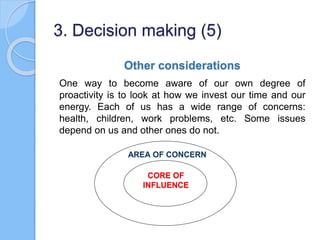
One way to become aware of our own degree of
proactivity is to look at how we invest our time and our
energy. Each of us has a wide range of concerns:
health, children, work problems, etc. Some issues
depend on us and other ones do not.
CORE OF
INFLUENCE
AREA OF CONCERN
3. Decision making (5)
Proactive people focus their efforts, their decisions and
their actions in the circle of influence, devoted to the
problems with respect to what they can do something.
Reactive people focus their efforts in the Circle of
Concern in defects of others, problems in the
environment and in circumstances over which they have
no control, thus decreasing their core influence, and
losing a lot of energy.
3. Decision making (6)
Analysis of possible brakes
 The fair to mistake: NOT ERROR, ONLY RESULTS
 Attitude to membership or mental entrainment
 Postpone.
 Evade responsibility.
 Paralysis by analysis:
So what attitude should we have to make a
decision?
3. Decision making (7)
When we are aware of the risk, we can find the optimal
solution
And if you also have time to develop it and value it, look for
objective information favorable and unfavorable. We will
be motivated to investigate the risk of the action, analyzing
and modifying it if necessary. This is the proper attitude we
should adopt.
3. Decision making (8)
Requirements of a decision well stated
 Be stated in positive
 Be under our responsibility and within our reach
 Be effective
 Be efficient
 Being environmentally friendly
 Be framed in time
3. Decision making (9)
Once covered all these criteria, ensuring that we are willing to
make the effort and it really worth doing, just missing the most
important:
If one of our basic functions as managers and make
decisions within a system (Cooperative, environment), we
have to think of the system when we decided.
MAKING THE DECISION
Reflection without action is a dream
Action without reflection is a nightmare
3. Decision making (10)
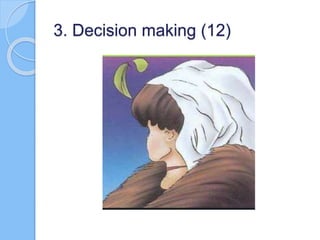
It is convenient to analyze the problem from
different points of view and try to make a list of
possible positive alternatives
These alternatives have to be, besides flexible to
adapt to new changes.
3. Decision making (11)
3. Decision making (12)
Assessment of possible alternatives
Executives who have to make decisions learning to open their
minds to evaluate all possible alternatives, even in the most
adverse situations.
Doing nothing also constitutes a decision and can give a
fatal outcome.
The three most commonly used criteria are:
• The effectiveness of the solution.
• Costs and deadlines for completion.
• The acceptance by the people who "involves"
3. Decision making (13)
4. Conducting Effective Meetings
(1)
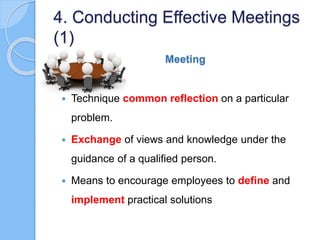
Meeting
 Technique common reflection on a particular
problem.
 Exchange of views and knowledge under the
guidance of a qualified person.
 Means to encourage employees to define and
implement practical solutions
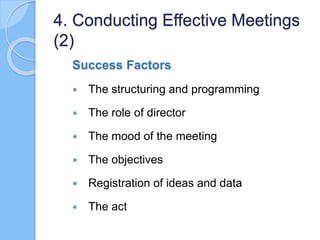
Success Factors
 The structuring and programming
 The role of director
 The mood of the meeting
 The objectives
 Registration of ideas and data
 The act
4. Conducting Effective Meetings
(2)
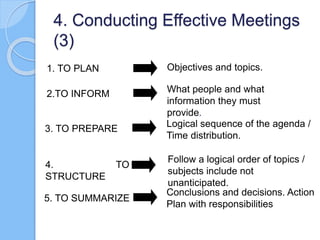
1. TO PLAN
2.TO INFORM
3. TO PREPARE
4. TO
STRUCTURE
5. TO SUMMARIZE
Objectives and topics.
What people and what
information they must
provide.
Logical sequence of the agenda /
Time distribution.
Follow a logical order of topics /
subjects include not
unanticipated.
Conclusions and decisions. Action
Plan with responsibilities
4. Conducting Effective Meetings
(3)
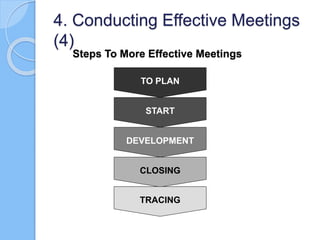
Steps To More Effective Meetings
START
DEVELOPMENT
CLOSING
TRACING
TO PLAN
4. Conducting Effective Meetings
(4)
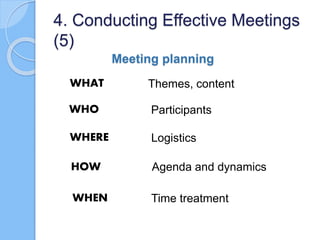
WHAT
WHO
WHERE
HOW
WHEN
Meeting planning
Themes, content
Participants
Logistics
Agenda and dynamics
Time treatment
4. Conducting Effective Meetings
(5)
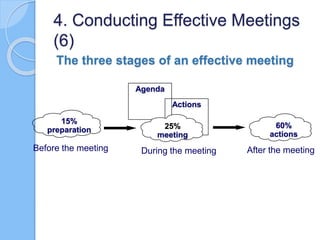
The three stages of an effective meeting
15%
preparation
Before the meeting
Agenda
Actions
25%
meeting
During the meeting
60%
actions
After the meeting
4. Conducting Effective Meetings
(6)
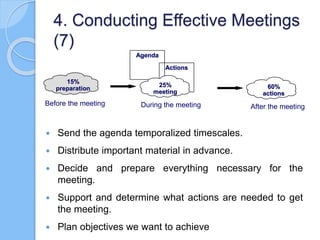
 Send the agenda temporalized timescales.
 Distribute important material in advance.
 Decide and prepare everything necessary for the
meeting.
 Support and determine what actions are needed to get
the meeting.
 Plan objectives we want to achieve
15%
preparation
Before the meeting
Agenda
Actions
25%
meeting
During the meeting
60%
actions
After the meeting
4. Conducting Effective Meetings
(7)
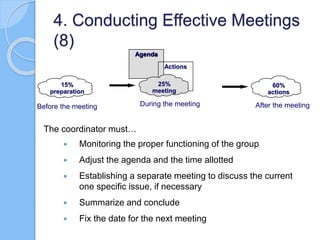
The coordinator must…
 Monitoring the proper functioning of the group
 Adjust the agenda and the time allotted
 Establishing a separate meeting to discuss the current
one specific issue, if necessary
 Summarize and conclude
 Fix the date for the next meeting
15%
preparation
Before the meeting
Agenda
Actions
25%
meeting
During the meeting
60%
actions
After the meeting
4. Conducting Effective Meetings
(8)
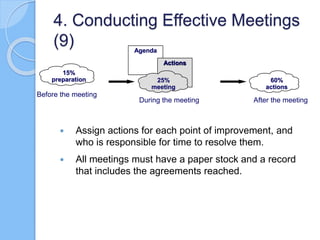
 Assign actions for each point of improvement, and
who is responsible for time to resolve them.
 All meetings must have a paper stock and a record
that includes the agreements reached.
15%
preparation
Before the meeting
Agenda
Actions
25%
meeting
During the meeting
60%
actions
After the meeting
4. Conducting Effective Meetings
(9)
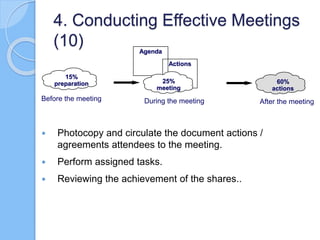
 Photocopy and circulate the document actions /
agreements attendees to the meeting.
 Perform assigned tasks.
 Reviewing the achievement of the shares..
4. Conducting Effective Meetings
(10)
15%
preparation
Before the meeting
Agenda
Actions
25%
meeting
During the meeting
60%
actions
After the meeting
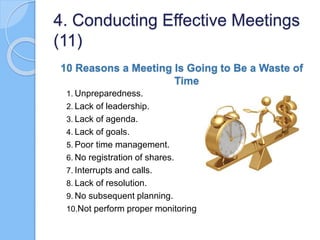
10 Reasons a Meeting Is Going to Be a Waste of
Time
1. Unpreparedness.
2. Lack of leadership.
3. Lack of agenda.
4. Lack of goals.
5. Poor time management.
6. No registration of shares.
7. Interrupts and calls.
8. Lack of resolution.
9. No subsequent planning.
10.Not perform proper monitoring
4. Conducting Effective Meetings
(11)
ASSEMBLIES, reminder!
 Respecting legal deadlines of the calls.
 The calls usually be controlled and bottom shape.
 Time: mornings better than afternoons (not
recommended after eating or at night).
 Logistics: the meeting place, seats, light, visibility,
etc.
 Using the microphone.
 Proper management of the allotted time and
agenda.
 The president does not have to expose all
subjects.
4. Conducting Effective Meetings
(12)
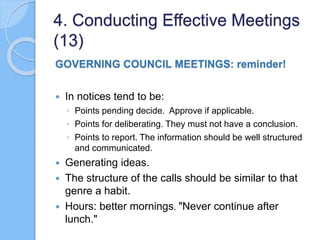
GOVERNING COUNCIL MEETINGS: reminder!
 In notices tend to be:
◦ Points pending decide. Approve if applicable.
◦ Points for deliberating. They must not have a conclusion.
◦ Points to report. The information should be well structured
and communicated.
 Generating ideas.
 The structure of the calls should be similar to that
genre a habit.
 Hours: better mornings. "Never continue after
lunch."
4. Conducting Effective Meetings
(13)
BOARD OF DIRECTORS MEETINGS :
reminder!
 Logistics: the meeting place, seats, light, visibility,
etc. Care for the details.
 The most important points should be treated first.
 Duration recommended: no more than two hours.
 Acta: be collected important points should be well
structured and be clear and minimized.
4. Conducting Effective Meetings
(14)
5. Conflict resolution (1)
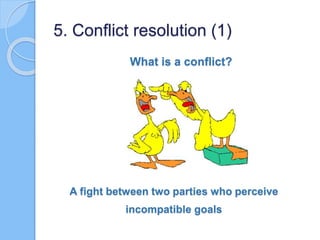
What is a conflict?
A fight between two parties who perceive
incompatible goals
Conflict resolution is the set of knowledge and skills to
understand and intervene in the peaceful and non-violent
resolution of conflicts. It is a discipline that contains many
other things, from mathematics and theoretical physics to
human biology
5. Conflict resolution (2)
Positive value of the conflict:
 Conflict must be seen as a challenge, as a process in
which new positions are reached to achieve the
needs and objectives.
 It allows us to do things in a different way in the
future, to overcome our personal relationships and
with others, having to be considered from a
constructive point of view as the result of diversity of
perspectives.
5. Conflict resolution (3)
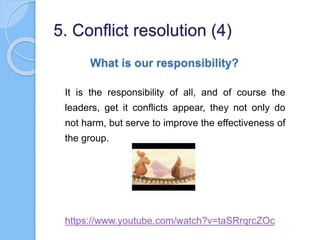
What is our responsibility?
It is the responsibility of all, and of course the
leaders, get it conflicts appear, they not only do
not harm, but serve to improve the effectiveness of
the group.
https://www.youtube.com/watch?v=taSRrqrcZOc
5. Conflict resolution (4)
Main reasons for conflict
 Communication problems
 Power Search
 Dissatisfaction with leadership style
 Weak Leadership
 Lack of mental openness to other options
 Changes in organizational structure
 Distrust
5. Conflict resolution (5)
Some conflict indicators in cooperatives
 Body language
 Systematic disagreement, regardless of the subject
matter
 Withholding important information
 Sudden surprises
 Strong public statements
 Broaden disagreements through the media, bar ....
5. Conflict resolution (6)
Some conflict indicators in
cooperatives
 Conflicts in value systems
 Longing for power
 Increased lack of respect
 Open Opposition
 Lack of clear objectives
 Lack of discussion of progress in relation to the objectives
5. Conflict resolution (7)
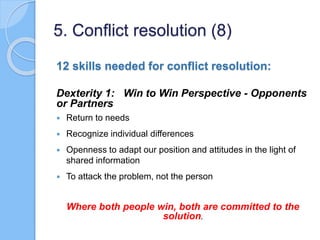
12 skills needed for conflict resolution:
Dexterity 1: Win to Win Perspective - Opponents
or Partners
 Return to needs
 Recognize individual differences
 Openness to adapt our position and attitudes in the light of
shared information
 To attack the problem, not the person
Where both people win, both are committed to the
solution.
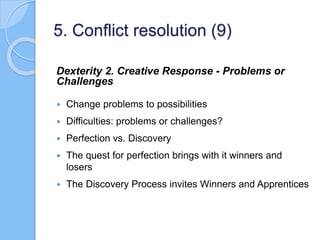
5. Conflict resolution (8)
Dexterity 2. Creative Response - Problems or
Challenges
 Change problems to possibilities
 Difficulties: problems or challenges?
 Perfection vs. Discovery
 The quest for perfection brings with it winners and
losers
 The Discovery Process invites Winners and Apprentices
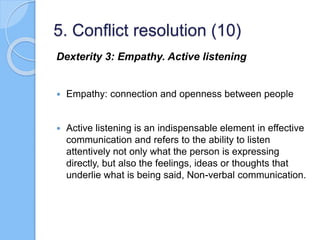
5. Conflict resolution (9)
Dexterity 3: Empathy. Active listening
 Empathy: connection and openness between people
 Active listening is an indispensable element in effective
communication and refers to the ability to listen
attentively not only what the person is expressing
directly, but also the feelings, ideas or thoughts that
underlie what is being said, Non-verbal communication.
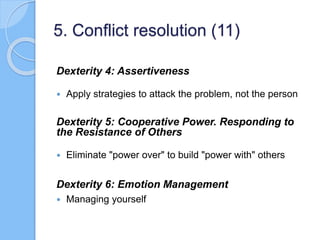
5. Conflict resolution (10)
Dexterity 4: Assertiveness
 Apply strategies to attack the problem, not the person
Dexterity 5: Cooperative Power. Responding to
the Resistance of Others
 Eliminate "power over" to build "power with" others
Dexterity 6: Emotion Management
 Managing yourself
5. Conflict resolution (11)
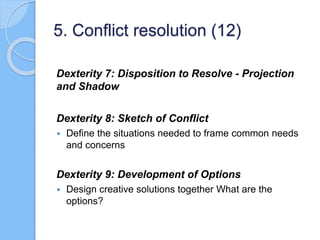
Dexterity 7: Disposition to Resolve - Projection
and Shadow
Dexterity 8: Sketch of Conflict
 Define the situations needed to frame common needs
and concerns
Dexterity 9: Development of Options
 Design creative solutions together What are the
options?
5. Conflict resolution (12)
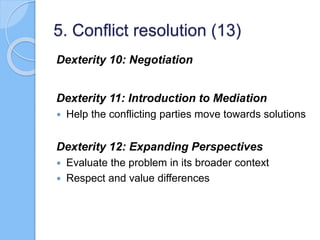
Dexterity 10: Negotiation
Dexterity 11: Introduction to Mediation
 Help the conflicting parties move towards solutions
Dexterity 12: Expanding Perspectives
 Evaluate the problem in its broader context
 Respect and value differences
5. Conflict resolution (13)
Strategies to face conflict
 Separating people from conflict. It separates the
relationship of people, of substance, directly facing the
problem.
 Focus on interests rather than positions:
◦ Interests: It constitutes the essence of the conflict (desires,
restlessness, emotions, etc.). That's what the parties want.
Answer the question why do you say it?
◦ Positions: It constitutes the requirements, demands,
demands. Answer the question what does it say?
 To devise mutually beneficial solutions (that everyone
wins): broaden the options instead of looking for a
single answer.
 Use objective criteria.
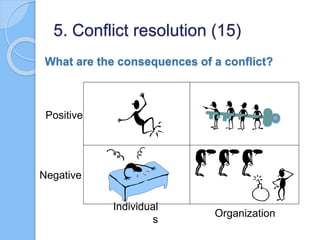
5. Conflict resolution (14)
Positive
Negative
Individual
s
Organization
What are the consequences of a conflict?
5. Conflict resolution (15)
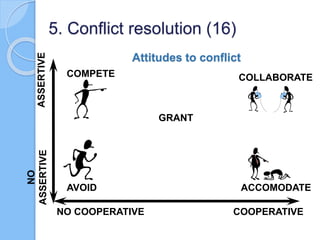
ASSERTIVE
NO COOPERATIVE COOPERATIVE
COMPETE
AVOID
GRANT
ACCOMODATE
COLLABORATE
Attitudes to conflict
NO
ASSERTIVE
5. Conflict resolution (16)
Steps to follow the treatment of conflicts
 Defining the conflict objectively, without assessments,
judgments or complaints, and a constructive manner,
not defensive.
 Analyze the causes, understanding the interests of the
people involved (not to mention the emotional part)
 Define the objectives to which they want to come, that
is, to know what it wants to achieve by establishing an
order of priorities.
5. Conflict resolution (17)
Steps to follow the treatment of conflicts
 Identify all solution options
 Consult the people involved to suggest their own
solutions.
 Treating the ideas of others with respect
 Avoid the evaluation of various options even count
the number of sufficient alternative proposals
5. Conflict resolution (18)
Steps to follow the treatment of conflicts
 Evaluate all the options for the solution.
 Be honest
 Listen actively
 Be open to new options and changes
 Evaluate all options and analyze the results imply that
for each part
 Decide the most appropriate solution and viable
 Implement and evaluate the decision
5. Conflict resolution (19)
6. Negotiation techniques (1)
 Negotiation can be defined as the relationship
established two or more people in connection with a
particular matter with a view to closer agreement and to
reach an agreement that is beneficial to all.
 The negotiation starts when there are differences in the
positions held by the parties. If these positions were
coincident would not need to negotiate. The
negotiations seek to eliminate those differences, usually
approaching positions gradually until reaching a point
acceptable to all.
Basic principles in the negotiation:
 Be hard on the problem and soft on the person
 Putting the focus on needs, not positions
 Emphasize the common areas
 Being creative with options
 Perform clear agreements
6. Negotiation techniques (2)
10 Negotiation Techniques
1. Be courteous, respectful and polite.
2. Speak as if you are going to reach an agreement
3. Start by having calculated your Most Favorable Point and
Most Unfavorable Point.
4. Start negotiating something above your Most Favorable
Point.
5. Rate how many alternatives you have to negotiate.
6. Do not stand against the other side.
7. Give
8. Information is power
9. Do not get up from the chair unless it's a strategy, stay
calm.
10. Everything can be negotiated.
6. Negotiation techniques (3)
Negotiation process
 The preparation
 The discussion
 The signs
 The proposals
 The exchange
 Closure and agreement
6. Negotiation techniques (4)
Characteristics of the negotiator:
 He likes to negotiate
 Enthusiastic
 Great communicator
 Persuasive
 Very observant
 Sociable
 Respectful
 Honest
 Professional
 Meticulous
 Secure and firm
 Agile and resolutive
 Patient
 Creative
6. Negotiation techniques (5)
7. Teamwork (1)
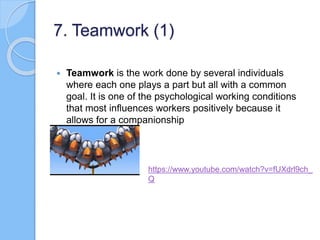
 Teamwork is the work done by several individuals
where each one plays a part but all with a common
goal. It is one of the psychological working conditions
that most influences workers positively because it
allows for a companionship
https://www.youtube.com/watch?v=fUXdrl9ch_
Q
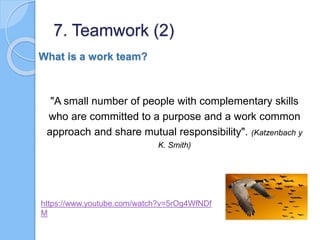
"A small number of people with complementary skills
who are committed to a purpose and a work common
approach and share mutual responsibility". (Katzenbach y
K. Smith)
What is a work team?
7. Teamwork (2)
https://www.youtube.com/watch?v=5rOg4WfNDf
M
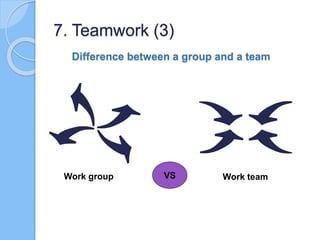
Difference between a group and a team
Work teamWork group VS
7. Teamwork (3)
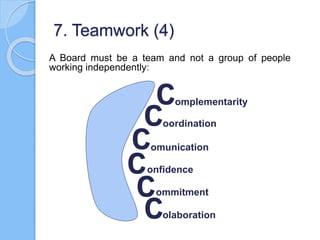
A Board must be a team and not a group of people
working independently:
onfidence
ommitment
olaboration
omplementarity
oordination
omunication
7. Teamwork (4)
Advantages of teamwork
1. Amplitude knowledge. A team has more
information than any of its members separately.
2. Diversity of opinions. Teamwork allows
different points of view when making a decision.
This enriches the work and minimize frustration.
7. Teamwork (5)
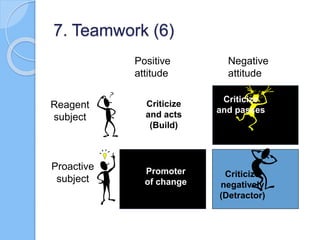
Proactive
subject
Negative
attitude
Reagent
subject
Criticize
and acts
(Build)
Promoter
of change
Criticize
and passes
Criticize
negatively
(Detractor)
Positive
attitude
7. Teamwork (6)
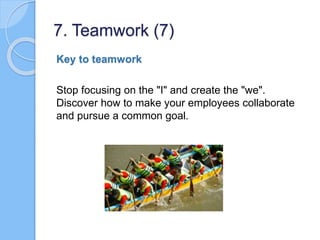
Key to teamwork
Stop focusing on the "I" and create the "we".
Discover how to make your employees collaborate
and pursue a common goal.
7. Teamwork (7)
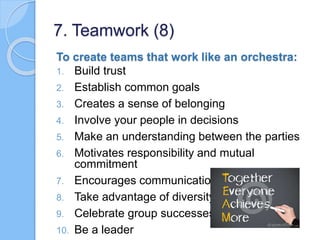
To create teams that work like an orchestra:
1. Build trust
2. Establish common goals
3. Creates a sense of belonging
4. Involve your people in decisions
5. Make an understanding between the parties
6. Motivates responsibility and mutual
commitment
7. Encourages communication
8. Take advantage of diversity
9. Celebrate group successes
10. Be a leader
7. Teamwork (8)
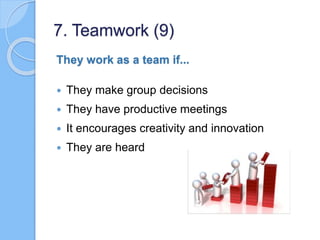
They work as a team if...
 They make group decisions
 They have productive meetings
 It encourages creativity and innovation
 They are heard
7. Teamwork (9)
Do not work as a team if...
 You make all the decisions
 Each area is concerned with its own goals and blames
others not to achieve them
 They are not known or communicate continuously
between them
 There is competition (not "healthy") between areas or
individuals
 Do not trust other members or there is a lack of respect
for their work
 You speak as "I" and not as "we"
7. Teamwork (10)
Characteristics of a cooperative teamwork
Ken Blanchard says that a team to be high-performance, it
must have 7 key features:
 Purposes and values
 Empowerment
 Relationships and communication:
 Flexibility
 Optimum productivity
 Recognition and appreciation
 Morale
7. Teamwork (11)
Keys to work in team
 The cooperative environment is the PURE ESSENCE of
teamwork
 We all need TRAINING to know how I can cooperate
WITH MY INDIVIDUAL WORK on the team
 PART OF A WHOLE PART and I have to see how I can
SUPPORT THE WORK OF OTHERS
 COMMON METHODOLOGY OF WORK
 The individual is worth a lot, but the TEAM SPIRIT can
with everything. What is always going to stay is that we
have walked together and, therefore, we have been
wrong together and we will learn for the next time
7. Teamwork (12)
COLLABORATIVE WORK:
Intentional processes of a group to achieve specific objectives,
more tools designed to support and facilitate work. It refers to
any process involving the work of several people together
ELEMENTS
Objectives: The same of the organization or individuals.
Environment: controlled and closed.
Motivation: the person is convinced by the organization.
Type of process: the group process is formalized.
Individual contribution: knowledge and personal experience at
the service of organizational interests.
Steps of the group process: they must be defined clearly and
in advance.
7. Teamwork (13)
COOPERATIVE WORK:
This is a powerful tool that allows sharing all kinds of
knowledge related to an organization and facilitates the
movement and control of information that is constantly
manipulated. It is a structure of didactic interaction
designed to facilitate the relationship of a final product in
people working together in a group.
ELEMENTS
Positive interdependence.
Promote face-to-face interaction.
Give responsibility to each member of the group.
Develop group skills and interpersonal relationships.
Reflection on the work of the group.
7. Teamwork (14)
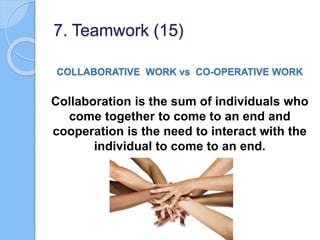
COLLABORATIVE WORK vs CO-OPERATIVE WORK
Collaboration is the sum of individuals who
come together to come to an end and
cooperation is the need to interact with the
individual to come to an end.
7. Teamwork (15)
Fundamental concepts of teamwork
 Implication
 Consolidated equipment
 Value
 Mutual support
 Comprehension
 Confidence
 Flexibility
 Responsibility of work well done
"Support, understanding and trust accelerate
everything. It is necessary that each one contribute
the best of himself “
And the fundamental concept ... COOPERATION FOR A
COMMON OBJECTIVE
7. Teamwork (16)
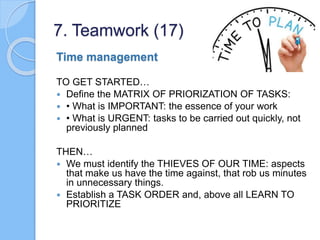
Time management
TO GET STARTED…
 Define the MATRIX OF PRIORIZATION OF TASKS:
 • What is IMPORTANT: the essence of your work
 • What is URGENT: tasks to be carried out quickly, not
previously planned
THEN…
 We must identify the THIEVES OF OUR TIME: aspects
that make us have the time against, that rob us minutes
in unnecessary things.
 Establish a TASK ORDER and, above all LEARN TO
PRIORITIZE
7. Teamwork (17)
THE MAIN FAILURE ...
 Not being clear WHAT IS THE ESSENCE OF MY
BUSINESS, WHAT SHOULD I DO TO MAKE MY
GREATEST EFFORTS
 Dedicate time to LITTLE IMPORTANT THINGS
TO AVOID IT ...
 Perform my own PERSONAL AUDIT, preparing a list of
all the pending tasks and what time I have to dedicate
to each one of them
AND AT THE TIME TO MEET ...
 Good preparation of the meeting * Mark clear objectives
* Do not dilute the attention of these objectives * Follow
correctly the established order * If other issues arise,
write them down and postpone them for a later meeting
7. Teamwork (18)
8. Leadership (1)
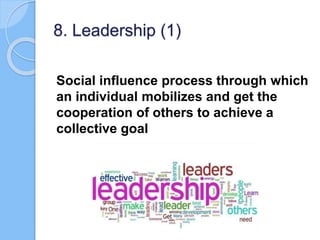
Social influence process through which
an individual mobilizes and get the
cooperation of others to achieve a
collective goal
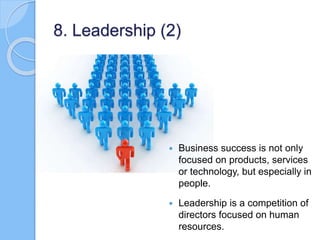
 Business success is not only
focused on products, services
or technology, but especially in
people.
 Leadership is a competition of
directors focused on human
resources.
8. Leadership (2)
"If you want to build a ship, do not begin by cutting
the wood and distributing the work, but first you
must know how to evoke in men the longing for the
free and open sea“
A. de Saint Exupery
8. Leadership (3)