UFCD: Realizar uma exposição sobre
  as organizações Internacionais
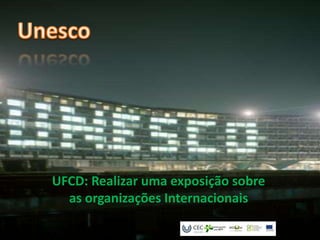
Unesco Definition

United
Nations
Educational
Scientific
Cultural
Organization

                          2
Brief History of Unesco
• As early as 1942, in wartime, the governments of the European
  countries, which were confronting Nazi Germany and its
  allies, met in the United Kingdom for the Conference of Allied
  Ministers of Education (CAME). The Second World War was
  far from over, yet those countries were looking for ways and
  means to reconstruct their systems of education once peace
  was restored. Very quickly, the project gained momentum and
  soon took on a universal note. New governments, including
  that of the United States, decided to join in.


                                                               3
Brief History of Unesco
• Upon the proposal of CAME, a United Nations Conference for
  the establishment of an educational and cultural organization
  (ECO/CONF) was convened in London from 1 to 16
  November 1945. Scarcely had the war ended when the
  conference opened. It gathered together the representatives of
  forty-four countries who decided to create an organization that
  would embody a genuine culture of peace. In their eyes, the
  new organization must establish the “intellectual and moral
  solidarity of mankind” and, in so doing, prevent the outbreak
  of another world war.


                                                                4
Objectives of Unesco
• Attaining quality education for all and lifelong learning;
• Mobilizing science knowledge and policy for sustainable
  development;
• Addressing emerging social and ethical challenges
• Fostering cultural diversity, intercultural dialogue and a culture of
  peace;
• Building inclusive knowledge societies through information and
  communication.
 The Organization focuses, in particular, on two global priorities:
• Africa
• Gender equality


                                                                      5
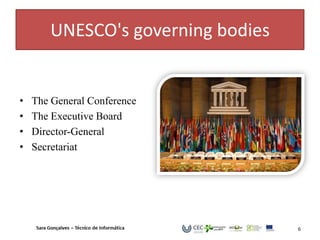
UNESCO's governing bodies


•   The General Conference
•   The Executive Board
•   Director-General
•   Secretariat


                                   6
The General Conference
• Consisting of all Member States and which ordinarily takes
  place once every biennium, is the highest body responsible
  for decisions regarding the activities of that organization,
  approving its Program and Budget. Each Member State
  represents a vote.


                                                             7
The Executive Board
• Is composed of 58 Member States elected by the General
  Conference for a term of four years. Normally meets twice a
  year. Prepare the work of the General Conference and is
  responsible for monitoring implementation of the Programme
  of the Organization.


                                                            8
Director-General

• Is    the    Head      of    the
  Organization, elected by the
  General Conference for a term
  of four years and may be
  reelected for another term. The
  current Director-General Irina
  Bokova is, since 2009,
  Bulgaria.

• UNESCO's Priorities for the
  XXI Century by Irina Bokova.

                                     9
Secretariat
• The Secretariat consists of the Director-General and the Staff
  appointed by him or her. As of mid-2009, the Secretariat
  employed around 2,000 civil servants from some 170
  countries. The staff is divided into Professional and General
  Service categories. More than 700 staff members work in
  UNESCO's 65 field offices around the world.


                                                              10
195 Members of Unesco
• Afghanistan   •   Azerbaijan   • Bolivia
• Albania       •   Bahamas      • Bosnia and
• Algeria       •   Bahrain        Herzegovina
• Andorra       •   Bangladesh   • Botswana
• Angola        •   Barbados     • Brazil
• Antigua and   •   Belarus      • Brunei
  Barbuda       •   Belgium        Darussalam
• Argentina     •   Belize       • Bulgaria
• Armenia       •   Benin        • Burkina Faso
• Austria       •   Bhutan       • Burundi
                                 • Cambodia
                                                  11
195 Members of Unesco
•   Cameroon          •   Congo                Republic Korea
•   Canada            •   Cook Islands     •   Democratic
•   Cape Verde        •   Costa Rica           Republic of the
•   Central African   •   Côte d’Ivoire        Congo
    Republic          •   Croatia          •   Denmark
•   Chad              •   Cuba             •   Djibouti
•   Chile             •   Cyprus           •   Dominica
•   China             •   Czech Republic   •   Dominican
•   Colombia                                   Republic
                      •   Democratic
•   Comoros               Peoples s        •   Ecuador


                                                                 12
195 Members of Unesco
•   Egypt               •   Georgia         •   Hungary
•   El Salvador         •   Germany         •   Iceland
•   Equatorial Guinea   •   Ghana           •   India
•   Eritrea             •   Greece          •   Indonesia
•   Estonia             •   Grenada         •   Iran
•   Ethiopia            •   Guatemala       •   Iraq
•   Fiji                •   Guinea          •   Ireland
•   Finland             •   Guinea-Bissau   •   Israel
•   France              •   Guyana          •   Italy
•   Gabon               •   Haiti           •   Jamaica
•   Gambia              •   Honduras        •   Japan

                                                            13
195 Members of Unesco
• Jordan         •   Lebanon      •   Mali
• Kazakhstan     •   Lesotho      •   Malta
• Kenya          •   Liberia      •   Marshall Islands
• Kiribati       •   Libya        •   Mauritania
• Kuwait         •   Lithuania    •   Mauritius
• Kyrgystan      •   Luxembourg   •   Mexico
• Lao People’s   •   Madagascar   •   Micronesia
  Democratic     •   Malawi       •   Monaco
  Republic       •   Malaysia     •   Mongolia
• Latvia         •   Maldives     •   Montenegro

                                                         14
195 Members of Unesco
•   Morocco       • Niue        • Philippines
•   Mozambique    • Normay      • Poland
•   Myanmar       • Oman        • Portugal
•   Namibia       • Pakistan    • Qtar
•   Nauru         • Palau       • Replubic Of Korea
•   Nepal         • Palestine   • Republic Of
•   Netherlands   • Panama        Moldova
•   New Zealand   • Papua New   • Romania
•   Nicaragua       Guinea      • Russian
•   Niger         • Paraguay      Federation
•   Nigeria       • Peru        • Rwanda

                                                  15
195 Members of Unesco
• Saint Kitts and     •   Serbia          • Sri Lanka
  Nevis               •   Seychelles      • Sudan
• Saint Lucia         •   Sierra Leone    • Suriname
• Saint Vincent and   •   Singapore       • Swaziland
  the Grenadines      •   Slovakia        • Sweden
• Samoa               •   Slovenia        • Switzerland
• San Marino          •   Solom Islands   • Syrian Arab
• São Tome and        •   Somalia           Republic
  Principe                                • Tajikistan
                      •   South Africa
• Saudi Arabia                            • Thailand
                      •   South Sudan
• Senegal
                      •   Spain

                                                          16
195 Members of Unesco
• The former        •   Tuvalu             • United States of
  Yugoslav Republic •   Uganda               America
  of Macedonia      •   Ukraine            • Uruguay
• Timor-Leste       •   United Arab        • Uzbekistan
• Togo                  Emirates           • Vanuatu
• Tonga             •   United Kingdom     • Venezuela
• Trinidad and          of Great Britain   • Viet Nam
  Tobago                and Northern       • Yemen
• Tunisia               Ireland
                                           • Zambia
• Turkey            •   United Republic
                                           • Zimbabwe
• Turkmenistan      •   of Tanzania


                                                                17
18
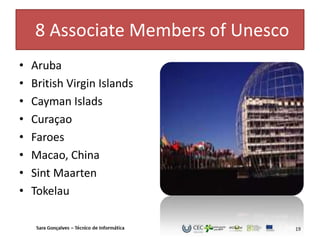
8 Associate Members of Unesco
•   Aruba
•   British Virgin Islands
•   Cayman Islads
•   Curaçao
•   Faroes
•   Macao, China
•   Sint Maarten
•   Tokelau

                                    19
Natural Sciences


“Race for Water: mobilising the public to preserve the planet’s
ocean and freshwater”


                                                                  20
Social and Human Sciences
          “Canadian cities act against racism and discrimination.”


“Spiralling demand and climate change threatening fresh water supplies.”


                                                                           21
Culture
“Egyptian museums one year after   “US$1.02 million project launched in Asia and
the revolution”                    the Pacific for Intangible Cultural Heritage”


                                                                              22
Communication and Information


                                23

Unesco

  • 1.
    UFCD: Realizar umaexposição sobre as organizações Internacionais
  • 2.
  • 3.
    Brief History ofUnesco • As early as 1942, in wartime, the governments of the European countries, which were confronting Nazi Germany and its allies, met in the United Kingdom for the Conference of Allied Ministers of Education (CAME). The Second World War was far from over, yet those countries were looking for ways and means to reconstruct their systems of education once peace was restored. Very quickly, the project gained momentum and soon took on a universal note. New governments, including that of the United States, decided to join in. 3
  • 4.
    Brief History ofUnesco • Upon the proposal of CAME, a United Nations Conference for the establishment of an educational and cultural organization (ECO/CONF) was convened in London from 1 to 16 November 1945. Scarcely had the war ended when the conference opened. It gathered together the representatives of forty-four countries who decided to create an organization that would embody a genuine culture of peace. In their eyes, the new organization must establish the “intellectual and moral solidarity of mankind” and, in so doing, prevent the outbreak of another world war. 4
  • 5.
    Objectives of Unesco •Attaining quality education for all and lifelong learning; • Mobilizing science knowledge and policy for sustainable development; • Addressing emerging social and ethical challenges • Fostering cultural diversity, intercultural dialogue and a culture of peace; • Building inclusive knowledge societies through information and communication.  The Organization focuses, in particular, on two global priorities: • Africa • Gender equality 5
  • 6.
    UNESCO's governing bodies • The General Conference • The Executive Board • Director-General • Secretariat 6
  • 7.
    The General Conference •Consisting of all Member States and which ordinarily takes place once every biennium, is the highest body responsible for decisions regarding the activities of that organization, approving its Program and Budget. Each Member State represents a vote. 7
  • 8.
    The Executive Board •Is composed of 58 Member States elected by the General Conference for a term of four years. Normally meets twice a year. Prepare the work of the General Conference and is responsible for monitoring implementation of the Programme of the Organization. 8
  • 9.
    Director-General • Is the Head of the Organization, elected by the General Conference for a term of four years and may be reelected for another term. The current Director-General Irina Bokova is, since 2009, Bulgaria. • UNESCO's Priorities for the XXI Century by Irina Bokova. 9
  • 10.
    Secretariat • The Secretariatconsists of the Director-General and the Staff appointed by him or her. As of mid-2009, the Secretariat employed around 2,000 civil servants from some 170 countries. The staff is divided into Professional and General Service categories. More than 700 staff members work in UNESCO's 65 field offices around the world. 10
  • 11.
    195 Members ofUnesco • Afghanistan • Azerbaijan • Bolivia • Albania • Bahamas • Bosnia and • Algeria • Bahrain Herzegovina • Andorra • Bangladesh • Botswana • Angola • Barbados • Brazil • Antigua and • Belarus • Brunei Barbuda • Belgium Darussalam • Argentina • Belize • Bulgaria • Armenia • Benin • Burkina Faso • Austria • Bhutan • Burundi • Cambodia 11
  • 12.
    195 Members ofUnesco • Cameroon • Congo Republic Korea • Canada • Cook Islands • Democratic • Cape Verde • Costa Rica Republic of the • Central African • Côte d’Ivoire Congo Republic • Croatia • Denmark • Chad • Cuba • Djibouti • Chile • Cyprus • Dominica • China • Czech Republic • Dominican • Colombia Republic • Democratic • Comoros Peoples s • Ecuador 12
  • 13.
    195 Members ofUnesco • Egypt • Georgia • Hungary • El Salvador • Germany • Iceland • Equatorial Guinea • Ghana • India • Eritrea • Greece • Indonesia • Estonia • Grenada • Iran • Ethiopia • Guatemala • Iraq • Fiji • Guinea • Ireland • Finland • Guinea-Bissau • Israel • France • Guyana • Italy • Gabon • Haiti • Jamaica • Gambia • Honduras • Japan 13
  • 14.
    195 Members ofUnesco • Jordan • Lebanon • Mali • Kazakhstan • Lesotho • Malta • Kenya • Liberia • Marshall Islands • Kiribati • Libya • Mauritania • Kuwait • Lithuania • Mauritius • Kyrgystan • Luxembourg • Mexico • Lao People’s • Madagascar • Micronesia Democratic • Malawi • Monaco Republic • Malaysia • Mongolia • Latvia • Maldives • Montenegro 14
  • 15.
    195 Members ofUnesco • Morocco • Niue • Philippines • Mozambique • Normay • Poland • Myanmar • Oman • Portugal • Namibia • Pakistan • Qtar • Nauru • Palau • Replubic Of Korea • Nepal • Palestine • Republic Of • Netherlands • Panama Moldova • New Zealand • Papua New • Romania • Nicaragua Guinea • Russian • Niger • Paraguay Federation • Nigeria • Peru • Rwanda 15
  • 16.
    195 Members ofUnesco • Saint Kitts and • Serbia • Sri Lanka Nevis • Seychelles • Sudan • Saint Lucia • Sierra Leone • Suriname • Saint Vincent and • Singapore • Swaziland the Grenadines • Slovakia • Sweden • Samoa • Slovenia • Switzerland • San Marino • Solom Islands • Syrian Arab • São Tome and • Somalia Republic Principe • Tajikistan • South Africa • Saudi Arabia • Thailand • South Sudan • Senegal • Spain 16
  • 17.
    195 Members ofUnesco • The former • Tuvalu • United States of Yugoslav Republic • Uganda America of Macedonia • Ukraine • Uruguay • Timor-Leste • United Arab • Uzbekistan • Togo Emirates • Vanuatu • Tonga • United Kingdom • Venezuela • Trinidad and of Great Britain • Viet Nam Tobago and Northern • Yemen • Tunisia Ireland • Zambia • Turkey • United Republic • Zimbabwe • Turkmenistan • of Tanzania 17
  • 18.
  • 19.
    8 Associate Membersof Unesco • Aruba • British Virgin Islands • Cayman Islads • Curaçao • Faroes • Macao, China • Sint Maarten • Tokelau 19
  • 20.
    Natural Sciences “Race forWater: mobilising the public to preserve the planet’s ocean and freshwater” 20
  • 21.
    Social and HumanSciences “Canadian cities act against racism and discrimination.” “Spiralling demand and climate change threatening fresh water supplies.” 21
  • 22.
    Culture “Egyptian museums oneyear after “US$1.02 million project launched in Asia and the revolution” the Pacific for Intangible Cultural Heritage” 22
  • 23.