ECONOMICS
2020-21
INDEX
• UNEMPLOYMENT IN INDIA
• Meaning and types of unemployment
• Causes of unemployment
• Government measures
• Consequences of unemployment
• Vision
• ACKNOWLEDGEMENT
• BIBLIOGRAPHY
CERTIFICATE
This is to certify that AADI HARIYANI , a student of class 11 A
Commerce of The Bishops Co-Ed School Kalyaninagar Pune , has
successfully completed research project on the topic :
“ UNEMPLOYMENT IN INDIA “
Under the guidance of
Mrs Tulika Talukdar
In fulfilment of the ISC 2020-21 Economics Project Submission
conducted by the CISCE , NEW DELHI
Signature of Economics Teacher :
1. Meaning and Types of Unemployment
Unemployment is a situation when there are some able-bodied persons who have
the ability to work and are willing to work at the prevailing wage rate, but are not
able to find work which may yield them some regular income.
The various types of unemployment include:
• FRICTIONAL UNEMPLOYMENT
This type of unemployment exists when there is a lack of adjustment between demand for and
supply of labour force.
• CYCLICAL UNEMPLOYMENT
This type of unemployment is associated with the downswing and depression phases of business
cycle. It is caused due to deficiency in aggregate demand.
.
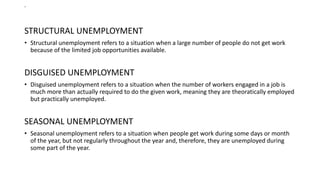
STRUCTURAL UNEMPLOYMENT
• Structural unemployment refers to a situation when a large number of people do not get work
because of the limited job opportunities available.
DISGUISED UNEMPLOYMENT
• Disguised unemployment refers to a situation when the number of workers engaged in a job is
much more than actually required to do the given work, meaning they are theoratically employed
but practically unemployed.
SEASONAL UNEMPLOYMENT
• Seasonal unemployment refers to a situation when people get work during some days or month
of the year, but not regularly throughout the year and, therefore, they are unemployed during
some part of the year.
.
UNDEREMPLOYMENT
• Underemployment refers to a situation when the employed persons are
contributing to production and income which less than what they are really
capable of, such as and engineer working as a clerk.
2. CAUSES OF UNEMPLOYMENT
• ILLITERACY
While 22% Indians fall below the poverty line, it is estimated that more than half of
the population lacks even basic literacy skills. Majority of the jobs today require
basic and advanced skillsets and at this rate of illiteracy present in the country, the
problems of poverty and unemployment remain a big challenge.
• IGNORANCE
• The presence of illiteracy in india gives birth to the presence of ignorance among
people. Ignorance in terms of lack of job opportunities, lack of awareness , less
knowledge on changes in the economy and industries results in a major portion
of the population being unemployed.
.
• MIGRATION
There has been a rapid increase in migration of the rural population to urban areas
due to the lack of employment opportunities and higher wage rate in urban areas
.But jobs are not available for all of them In urban areas as well. This in turn results
in unemployment.
• POPULATION GROWTH
Rapid population growth has directly added to the problem of unemployment by
adding more labour force . Secondly, rapid population growth has also reduced the
resources for capital formation.
• POOR MANAGEMENT
• Not putting the right persons at the right jobs , problem of having
excessive choice resulting into hiring the wrong person and no
motivation for the management to work results into unemployment .
3. GOVERNMENT MEASURES
• RURAL INDUSTRIALISATION
The government has started promoting small-scale industries, helped farmers in
setting up agricultural industries, started Decentralisation of authority and
dispersing industries among small towns and encouraging labour-intensive
techniques instead of capital-intensive techniques to tackle the problem of
unemployment.
• PROMOTION OF SELF EMPLOYMENT
In the recent times , the government of our country has seen the potential of
growth of self employment in terms of contributing to the economy in terms of
GDP and in increasing employment opportunities. More and more Entrepreneurs
are getting help in establishing successful startups.
.
• INCREASING INVESTMENTS
Investing in road-building, bridge-building, construction of houses and schools,
flood control and development of irrigation projects and transportation activites by
the government generates a great scope of employment for the less educated and
unskilled labour group.
• EDUCATIONAL REFORMS
The educational system should be made more vocational, both at school and
college levels . Reconstructing educational system by vocationalising it would
impart appropriate education and training to the younger people to start various
activities of self-employment , both in the urban and rural areas.
4. CONSEQUENCES OF UNEMPLOYMENT
• WASTAGE OF PRODUCTIVE RESOURCES
Idle manpower means that production and income are lower than what they could
actually be if the entire labour force was utilised. This means , lower availability of
goods and services to consumers , lower national output and income, wastage of
resources invested in education and skill formation.
• EXPLOITATION
During the period of unemployment , competition for the limited jobs available is
extremely high and hence leads to depressed wages. Employers are able to exploit
workers by giving them low wages and making them work for longer hours.
.
• SOCIAL AND POLITICAL EFFECTS
Unemployment causes discord in the family, hunger and scarcity disturbances lead
to depression and suicides. Continued unemployment and economic miseries lead
to widespread discontentment , frustration and resentment against the existing
socio-economic system.
• BURDEN ON GOVERNMENT
Unemployment imposes a financial burden on the government. Government has to
take up various programs to generate employment opportunities for unemployed
persons , both in urban and rural areas.
5. VISION
• FULL EMPLOYMENT
Full Employment is defined as the situation when all those who are
able and willing to work at the prevailing wage rate are getting work
and are in fact employed.
Full employment is said to exist in an economy even if there prevails some amount
of frictional unemployment. This is because there might be some amount of
frictional unemployment owing to technological improvements, decrease in
demand for the product of some industries , some persons changing their jobs and
structural changes in the economy.
ACKNOWLEDGEMENT
In the accomplishment of this project successfully , many people have
bestowed upon me their blessings and heart-pledged support, this time I am
utilizing to thank all the people who have been concerned with this project.
I would like to express my special thanks of gratitude to my teacher, Mrs. Tulika
Talukdar as well as our principal, Mr. Shayne McPherson who have given me the
golden opportunity to do this project which indeed helped me in doing a lot of
research on the topic and significantly increase my knowledge of the subject.
Secondly, I would like to thank my parents and friends who helped me in finishing
this project within the limited time.
BIBLIOGRAPHY
• Frank ISC Economics by D K Sethi
• https://www.un.org/development
• https://uis.unesco.org/sites
• https://documents.worldbank.org
• https://worldliteracyfoundation.org/wp-content/uploads
THANK YOU

ECONOMICS PROJECT REPORT FOR STD 12.pptx

  • 1.
  • 2.
    INDEX • UNEMPLOYMENT ININDIA • Meaning and types of unemployment • Causes of unemployment • Government measures • Consequences of unemployment • Vision • ACKNOWLEDGEMENT • BIBLIOGRAPHY
  • 3.
    CERTIFICATE This is tocertify that AADI HARIYANI , a student of class 11 A Commerce of The Bishops Co-Ed School Kalyaninagar Pune , has successfully completed research project on the topic : “ UNEMPLOYMENT IN INDIA “ Under the guidance of Mrs Tulika Talukdar In fulfilment of the ISC 2020-21 Economics Project Submission conducted by the CISCE , NEW DELHI Signature of Economics Teacher :
  • 4.
    1. Meaning andTypes of Unemployment Unemployment is a situation when there are some able-bodied persons who have the ability to work and are willing to work at the prevailing wage rate, but are not able to find work which may yield them some regular income. The various types of unemployment include: • FRICTIONAL UNEMPLOYMENT This type of unemployment exists when there is a lack of adjustment between demand for and supply of labour force. • CYCLICAL UNEMPLOYMENT This type of unemployment is associated with the downswing and depression phases of business cycle. It is caused due to deficiency in aggregate demand.
  • 5.
    . STRUCTURAL UNEMPLOYMENT • Structuralunemployment refers to a situation when a large number of people do not get work because of the limited job opportunities available. DISGUISED UNEMPLOYMENT • Disguised unemployment refers to a situation when the number of workers engaged in a job is much more than actually required to do the given work, meaning they are theoratically employed but practically unemployed. SEASONAL UNEMPLOYMENT • Seasonal unemployment refers to a situation when people get work during some days or month of the year, but not regularly throughout the year and, therefore, they are unemployed during some part of the year.
  • 6.
    . UNDEREMPLOYMENT • Underemployment refersto a situation when the employed persons are contributing to production and income which less than what they are really capable of, such as and engineer working as a clerk.
  • 7.
    2. CAUSES OFUNEMPLOYMENT • ILLITERACY While 22% Indians fall below the poverty line, it is estimated that more than half of the population lacks even basic literacy skills. Majority of the jobs today require basic and advanced skillsets and at this rate of illiteracy present in the country, the problems of poverty and unemployment remain a big challenge. • IGNORANCE • The presence of illiteracy in india gives birth to the presence of ignorance among people. Ignorance in terms of lack of job opportunities, lack of awareness , less knowledge on changes in the economy and industries results in a major portion of the population being unemployed.
  • 8.
    . • MIGRATION There hasbeen a rapid increase in migration of the rural population to urban areas due to the lack of employment opportunities and higher wage rate in urban areas .But jobs are not available for all of them In urban areas as well. This in turn results in unemployment. • POPULATION GROWTH Rapid population growth has directly added to the problem of unemployment by adding more labour force . Secondly, rapid population growth has also reduced the resources for capital formation. • POOR MANAGEMENT • Not putting the right persons at the right jobs , problem of having excessive choice resulting into hiring the wrong person and no motivation for the management to work results into unemployment .
  • 9.
    3. GOVERNMENT MEASURES •RURAL INDUSTRIALISATION The government has started promoting small-scale industries, helped farmers in setting up agricultural industries, started Decentralisation of authority and dispersing industries among small towns and encouraging labour-intensive techniques instead of capital-intensive techniques to tackle the problem of unemployment. • PROMOTION OF SELF EMPLOYMENT In the recent times , the government of our country has seen the potential of growth of self employment in terms of contributing to the economy in terms of GDP and in increasing employment opportunities. More and more Entrepreneurs are getting help in establishing successful startups.
  • 10.
    . • INCREASING INVESTMENTS Investingin road-building, bridge-building, construction of houses and schools, flood control and development of irrigation projects and transportation activites by the government generates a great scope of employment for the less educated and unskilled labour group. • EDUCATIONAL REFORMS The educational system should be made more vocational, both at school and college levels . Reconstructing educational system by vocationalising it would impart appropriate education and training to the younger people to start various activities of self-employment , both in the urban and rural areas.
  • 11.
    4. CONSEQUENCES OFUNEMPLOYMENT • WASTAGE OF PRODUCTIVE RESOURCES Idle manpower means that production and income are lower than what they could actually be if the entire labour force was utilised. This means , lower availability of goods and services to consumers , lower national output and income, wastage of resources invested in education and skill formation. • EXPLOITATION During the period of unemployment , competition for the limited jobs available is extremely high and hence leads to depressed wages. Employers are able to exploit workers by giving them low wages and making them work for longer hours.
  • 12.
    . • SOCIAL ANDPOLITICAL EFFECTS Unemployment causes discord in the family, hunger and scarcity disturbances lead to depression and suicides. Continued unemployment and economic miseries lead to widespread discontentment , frustration and resentment against the existing socio-economic system. • BURDEN ON GOVERNMENT Unemployment imposes a financial burden on the government. Government has to take up various programs to generate employment opportunities for unemployed persons , both in urban and rural areas.
  • 13.
    5. VISION • FULLEMPLOYMENT Full Employment is defined as the situation when all those who are able and willing to work at the prevailing wage rate are getting work and are in fact employed. Full employment is said to exist in an economy even if there prevails some amount of frictional unemployment. This is because there might be some amount of frictional unemployment owing to technological improvements, decrease in demand for the product of some industries , some persons changing their jobs and structural changes in the economy.
  • 14.
    ACKNOWLEDGEMENT In the accomplishmentof this project successfully , many people have bestowed upon me their blessings and heart-pledged support, this time I am utilizing to thank all the people who have been concerned with this project. I would like to express my special thanks of gratitude to my teacher, Mrs. Tulika Talukdar as well as our principal, Mr. Shayne McPherson who have given me the golden opportunity to do this project which indeed helped me in doing a lot of research on the topic and significantly increase my knowledge of the subject. Secondly, I would like to thank my parents and friends who helped me in finishing this project within the limited time.
  • 15.
    BIBLIOGRAPHY • Frank ISCEconomics by D K Sethi • https://www.un.org/development • https://uis.unesco.org/sites • https://documents.worldbank.org • https://worldliteracyfoundation.org/wp-content/uploads
  • 16.