2/05/2019 SEMINAR 1
NET’s
NAVODAYA INSTITUTE OF TECHNOLOGY, RAICHUR
DEPARTMENT OF CIVIL ENGINEERING
A SEMINAR ON
UNDERWATER WINDMILLS
Under the supervision of
Mr. Maheshwar S M
Assistant professor
Department of civil engineering
NIT-Raichur
Presented by
Mohammad Yaseen 3NA16CV427
CONTENTS
 Introduction
 Main parts
 Working principle
 Types
 Advantages
 Disadvantages
 Global resources
 Conclusion
 References
2/05/2019 2SEMINAR
INTRODUCTION
 An Underwater windmill like a device that extracts power
from the tides.
 Renewable energy technologies are becoming an
increasingly favorable alternative to conventional energy
sources to assuage fossil fuel related issues.
 Tidal energy offers a vast and reliable energy source. This
technology is similar to wind energy technology, with the
rotor blades driven not by wind power but by tidal currents.
 The gravitational pull of the moon produces a swift tidal
current, which spins the long blades of the turbine .Which in
turn produces electricity via different parts of underwater
windmill .
2/05/2019 3SEMINAR
INTRODUCTION (cont…)
2/05/2019 4SEMINAR
MAIN PARTS
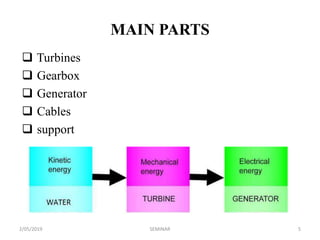
 Turbines
 Gearbox
 Generator
 Cables
 support
2/05/2019 5SEMINAR
TYPES
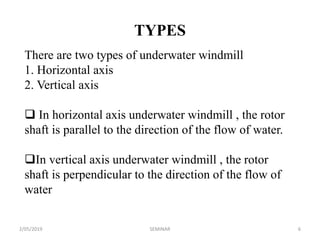
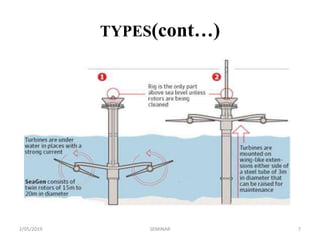
There are two types of underwater windmill
1. Horizontal axis
2. Vertical axis
 In horizontal axis underwater windmill , the rotor
shaft is parallel to the direction of the flow of water.
In vertical axis underwater windmill , the rotor
shaft is perpendicular to the direction of the flow of
water
2/05/2019 6SEMINAR
TYPES(cont…)
2/05/2019 7SEMINAR
PRINCIPLE OF OPERATION
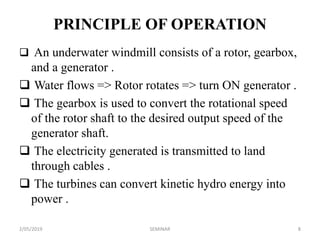
 An underwater windmill consists of a rotor, gearbox,
and a generator .
 Water flows => Rotor rotates => turn ON generator .
 The gearbox is used to convert the rotational speed
of the rotor shaft to the desired output speed of the
generator shaft.
 The electricity generated is transmitted to land
through cables .
 The turbines can convert kinetic hydro energy into
power .
2/05/2019 8SEMINAR
WORKING
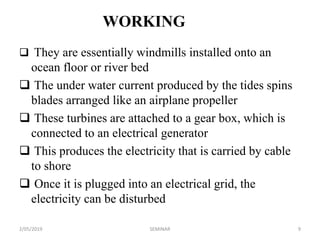
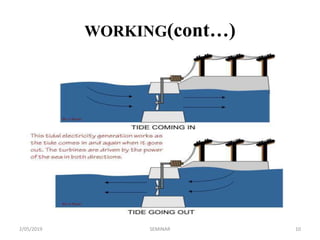
 They are essentially windmills installed onto an
ocean floor or river bed
 The under water current produced by the tides spins
blades arranged like an airplane propeller
 These turbines are attached to a gear box, which is
connected to an electrical generator
 This produces the electricity that is carried by cable
to shore
 Once it is plugged into an electrical grid, the
electricity can be disturbed
2/05/2019 9SEMINAR
WORKING(cont…)
2/05/2019 10SEMINAR
ABOUT TURBINES
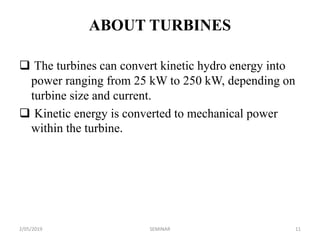
 The turbines can convert kinetic hydro energy into
power ranging from 25 kW to 250 kW, depending on
turbine size and current.
 Kinetic energy is converted to mechanical power
within the turbine.
2/05/2019 11SEMINAR
ADVANTAGES
 Tidal and ocean current is completely renewable.
 Tidal and ocean current produces no emissions.
 Hidden beneath the water.
 Have lesser impact on the environment .
 Low running cost .
 Long lifetime with little maintenance .
 Reduces the dependence upon fossil fuels .
2/05/2019 12SEMINAR
DISADVANTAGES
 The initial cost is too high
 Very difficult to install
 The blade must be coated to avoid corrosion
 Damages habitat up to 500km away
2/05/2019 13SEMINAR
CONCLUSION
 Tides and ocean current play is very important role
in the formation of global climate as well as eco
system for ocean habitats
 We believe that the intense and predictable marine
current resource offers the possibility of clean energy
at a cost that will ultimately be competitive not only
with the other renewable
 But in the long run we believe we can compete head
on with most forms of fossil fuelled power generation
at present-day costs
2/05/2019 14SEMINAR
REFERENCES
 http://www.marineturbines.com/
 http://www.renewable-solarenergy.com/tidal-
energypower. html
 International Energy Agency, World Energy Outlook
2007.
 Prandle, D., Simple theory for designing tidal power
schemes, Advances in Water Resources, 1984.
 Sheth, S. and M. Shahidehpour, Tidal Energy in
Electric Power Systems, in Power Engineering
Society General Meeting, 2005.
 http://www.tidalenergyltd.com/technology.htm
2/05/2019 15SEMINAR

UNDERWATER WINDMILLS PRESENTATION

  • 1.
    2/05/2019 SEMINAR 1 NET’s NAVODAYAINSTITUTE OF TECHNOLOGY, RAICHUR DEPARTMENT OF CIVIL ENGINEERING A SEMINAR ON UNDERWATER WINDMILLS Under the supervision of Mr. Maheshwar S M Assistant professor Department of civil engineering NIT-Raichur Presented by Mohammad Yaseen 3NA16CV427
  • 2.
    CONTENTS  Introduction  Mainparts  Working principle  Types  Advantages  Disadvantages  Global resources  Conclusion  References 2/05/2019 2SEMINAR
  • 3.
    INTRODUCTION  An Underwaterwindmill like a device that extracts power from the tides.  Renewable energy technologies are becoming an increasingly favorable alternative to conventional energy sources to assuage fossil fuel related issues.  Tidal energy offers a vast and reliable energy source. This technology is similar to wind energy technology, with the rotor blades driven not by wind power but by tidal currents.  The gravitational pull of the moon produces a swift tidal current, which spins the long blades of the turbine .Which in turn produces electricity via different parts of underwater windmill . 2/05/2019 3SEMINAR
  • 4.
  • 5.
    MAIN PARTS  Turbines Gearbox  Generator  Cables  support 2/05/2019 5SEMINAR
  • 6.
    TYPES There are twotypes of underwater windmill 1. Horizontal axis 2. Vertical axis  In horizontal axis underwater windmill , the rotor shaft is parallel to the direction of the flow of water. In vertical axis underwater windmill , the rotor shaft is perpendicular to the direction of the flow of water 2/05/2019 6SEMINAR
  • 7.
  • 8.
    PRINCIPLE OF OPERATION An underwater windmill consists of a rotor, gearbox, and a generator .  Water flows => Rotor rotates => turn ON generator .  The gearbox is used to convert the rotational speed of the rotor shaft to the desired output speed of the generator shaft.  The electricity generated is transmitted to land through cables .  The turbines can convert kinetic hydro energy into power . 2/05/2019 8SEMINAR
  • 9.
    WORKING  They areessentially windmills installed onto an ocean floor or river bed  The under water current produced by the tides spins blades arranged like an airplane propeller  These turbines are attached to a gear box, which is connected to an electrical generator  This produces the electricity that is carried by cable to shore  Once it is plugged into an electrical grid, the electricity can be disturbed 2/05/2019 9SEMINAR
  • 10.
  • 11.
    ABOUT TURBINES  Theturbines can convert kinetic hydro energy into power ranging from 25 kW to 250 kW, depending on turbine size and current.  Kinetic energy is converted to mechanical power within the turbine. 2/05/2019 11SEMINAR
  • 12.
    ADVANTAGES  Tidal andocean current is completely renewable.  Tidal and ocean current produces no emissions.  Hidden beneath the water.  Have lesser impact on the environment .  Low running cost .  Long lifetime with little maintenance .  Reduces the dependence upon fossil fuels . 2/05/2019 12SEMINAR
  • 13.
    DISADVANTAGES  The initialcost is too high  Very difficult to install  The blade must be coated to avoid corrosion  Damages habitat up to 500km away 2/05/2019 13SEMINAR
  • 14.
    CONCLUSION  Tides andocean current play is very important role in the formation of global climate as well as eco system for ocean habitats  We believe that the intense and predictable marine current resource offers the possibility of clean energy at a cost that will ultimately be competitive not only with the other renewable  But in the long run we believe we can compete head on with most forms of fossil fuelled power generation at present-day costs 2/05/2019 14SEMINAR
  • 15.
    REFERENCES  http://www.marineturbines.com/  http://www.renewable-solarenergy.com/tidal- energypower.html  International Energy Agency, World Energy Outlook 2007.  Prandle, D., Simple theory for designing tidal power schemes, Advances in Water Resources, 1984.  Sheth, S. and M. Shahidehpour, Tidal Energy in Electric Power Systems, in Power Engineering Society General Meeting, 2005.  http://www.tidalenergyltd.com/technology.htm 2/05/2019 15SEMINAR