Business
Communication
Md. Al-Amin (Mli)
Instructor’s Information
Md. Al-Amin (Mli)
NAC 869
Department of Management
Email: md.alamin@northsouth.edu
Web Address: http://alaminmli.weebly.com
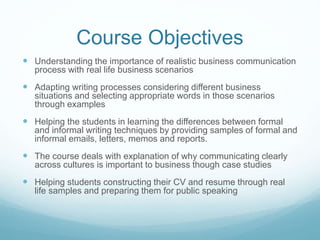
Course Objectives
 Understanding the importance of realistic business communication
process with real life business scenarios
 Adapting writing processes considering different business
situations and selecting appropriate words in those scenarios
through examples
 Helping the students in learning the differences between formal
and informal writing techniques by providing samples of formal and
informal emails, letters, memos and reports.
 The course deals with explanation of why communicating clearly
across cultures is important to business though case studies
 Helping students constructing their CV and resume through real
life samples and preparing them for public speaking
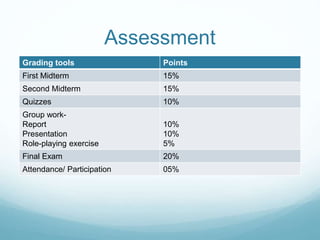
Assessment
Grading tools Points
First Midterm 15%
Second Midterm 15%
Quizzes 10%
Group work-
Report
Presentation
Role-playing exercise
10%
10%
5%
Final Exam 20%
Attendance/ Participation 05%
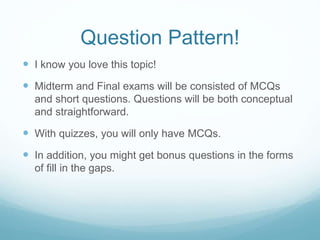
Question Pattern!
 I know you love this topic!
 Midterm and Final exams will be consisted of MCQs
and short questions. Questions will be both conceptual
and straightforward.
 With quizzes, you will only have MCQs.
 In addition, you might get bonus questions in the forms
of fill in the gaps.
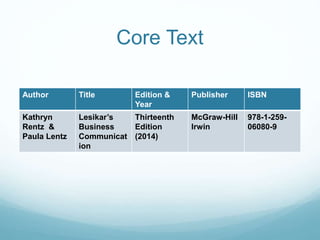
Core Text
Author Title Edition &
Year
Publisher ISBN
Kathryn
Rentz &
Paula Lentz
Lesikar’s
Business
Communicat
ion
Thirteenth
Edition
(2014)
McGraw-Hill
Irwin
978-1-259-
06080-9
Keys to Success
 Attend every single class. Please don’t miss a class unless you have a very
valid reason!
 Take notes. All examples and explanations won’t be available in the slides.
 Make sure you understand the lecture. It’s a strategic imperative.
 Please do ask me questions if you have confusion over the materials.
 See me sooner rather than later if you have problems with the materials.
 Study steadily—this is vital, if you want be good at communicating.
 Read the relevant chapters from textbook in advance.
Session 1
Understanding Workplace
Communication
Learning Outcomes
 What is communication?
 Importance of business communication
 Current Challenges
 Categories of business communication
 Communication networks
 The contexts for communication
 The process of communication
What Is Communication?
 The act of exchanging of information by speaking, writing,
or using some other medium
 Means of sending or receiving information, such as
telephone lines or computers
 Two parties are involved- sender and receiver
Communication Is Important to
Business
 Business Needs Good Communication
 Most People DO NOT Communicate Well
 Improved Communication=Better Chances for Success
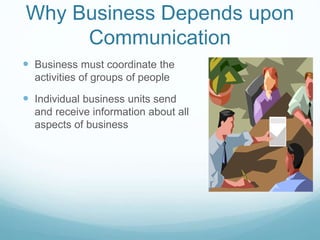
Why Business Depends upon
Communication
 Business must coordinate the
activities of groups of people
 Individual business units send
and receive information about all
aspects of business
Videos on Communication
 https://www.youtube.com/watch?v=YQ3qgIMURgI
 https://www.youtube.com/watch?v=ixSUBl1WNxk
 https://www.youtube.com/watch?v=3FfaPhCKZew
 https://www.youtube.com/watch?v=87HsUukEj4Y&inde
x=4&list=PL058A82A702A180CF
Group Discussion
 Group Discussion on the importance of communication
 Form small groups and identify at least five advantages
of effective communication in the context of a business
organization
Current Challenges
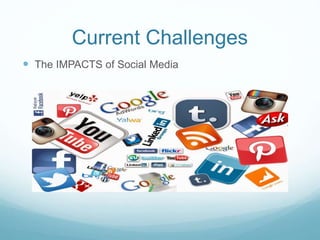
 The IMPACTS of Social Media
Current Challenges (Cont.)
 New media are also increasing the needs for
employees who have social intelligence
 Social Intelligence refers to the ability to quickly
assess the emotions of those around them and adapt
their words, tone, and gestures accordingly
 Globalization has given birth to globally integrated
organizations and global social networks
 Individuals need to achieve cross-cultural
competency
Using Social Intelligence on Social
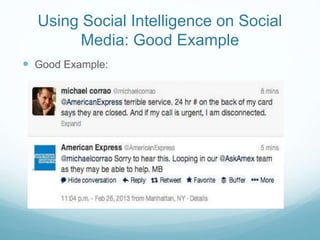
Media: Good Example
 Good Example:
Using Social Intelligence on Social
Media: Bad Example
 British Airways has been under fire quite a bit for its
bad customer service, and social media only promotes
its problem
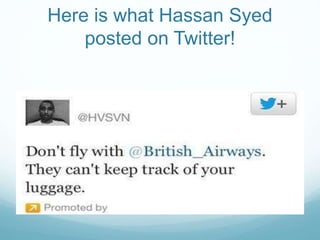
 A customer named Hassan Syed recently paid to
promote a Tweet complaining about British Airways’
customer service after the company lost his father’s
suitcase
Here is what Hassan Syed
posted on Twitter!
What happens next?
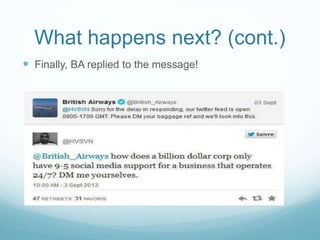
 The tweet was seen by 76,000 users
 It negatively impacted on the reputation of the
organization
 To make things worse, British Airways failed to respond
to the promoted tweet for eight hours
What happens next? (cont.)
 Finally, BA replied to the message!
Group Discussion
 Did you ever experience lack of social intelligence
while communicating on social media?
 Discuss with your neighbor and share the experience
with others
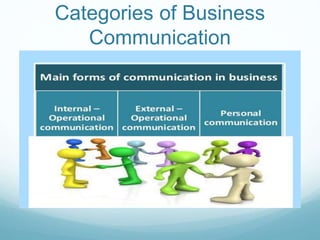
Categories of Business
Communication
Three Categories of Business
Communication
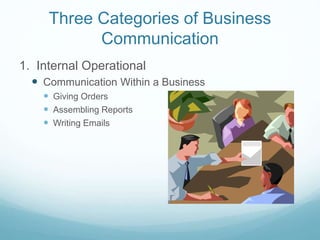
1. Internal Operational
 Communication Within a Business
 Giving Orders
 Assembling Reports
 Writing Emails
Three Categories of Business
Communication
2. External Operational
 Communication Outside Business
 Personal Selling
 Telephoning
 Advertising
 Writing Messages
 Displays a Company’s Etiquette
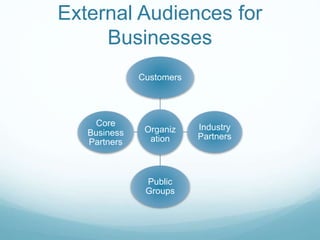
External Audiences for
Businesses
Organiz
ation
Customers
Industry
Partners
Public
Groups
Core
Business
Partners
Three Categories of Business
Communication
3. Personal Communication
 Non-Business-Related Information/Feelings
 Affects Employee Attitude
 Attitude Affects Employee Performance
Group Discussion
 Group discussion on the types of communication
 What type of communication is most important in the
context of a business organization? Give at least 3
reasons to justify your answer.
Communication Networks
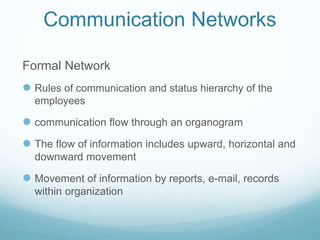
Formal Network
 Rules of communication and status hierarchy of the
employees
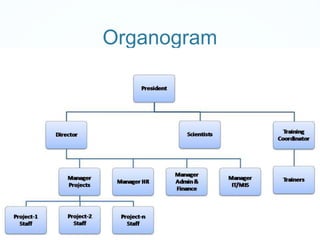
 communication flow through an organogram
 The flow of information includes upward, horizontal and
downward movement
 Movement of information by reports, e-mail, records
within organization
Organogram
 http://saves.org.pk/site/images/stories/organogram.jpg
Communication Networks
(Cont.)
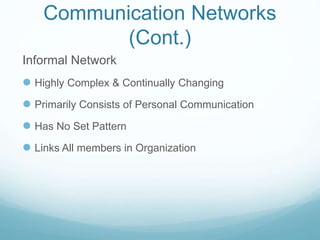
Informal Network
 Highly Complex & Continually Changing
 Primarily Consists of Personal Communication
 Has No Set Pattern
 Links All members in Organization
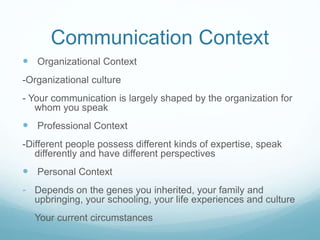
Communication Context
 Organizational Context
-Organizational culture
- Your communication is largely shaped by the organization for
whom you speak
 Professional Context
-Different people possess different kinds of expertise, speak
differently and have different perspectives
 Personal Context
- Depends on the genes you inherited, your family and
upbringing, your schooling, your life experiences and culture
- Your current circumstances
The Process of Communication
 Sensing a communication need
- Why am I communicating ?
 Defining the situation
- Clear sense of the situation
 Consider possible communication strategies
- Analyze the contexts and relationship with the audience
 Selecting a course of action
- Consider the cost and benefit of each option and choose the
most optimum one
The Process of
Communication (Cont.)
 Composing the message
- Craft your presentation message or plan your
conversation or presentation
 Sending the message
- It’s the time to send your message and you are done!
The Process of
Communication (Cont.)
 Receiving the message
- Your chosen channel has delivered the message to the
intended recipient
 Interpreting the message
- Recipient involves interpreting the message once has has
received it
 Deciding on a response
- If the message has been carefully adapted by to the
recipients, it has a good chance of achieving the desired
goals
 Replying to the message
In class assignment
 Think about a recent transaction you had with a
business person or with a staff person at an
organization or at NSU. Describe the process of your
communication.
 if possible, describe the communication context as well
 Form groups and discuss
 Once you have done, send your team representative
to present
Summary
 Importance of Communication to You and to Business
 Current Challenges
 Three main Forms of Communication
 Formal and Informal Networks
 Process of Communication

understanding_workplace_communication_-1.pptx

  • 1.
  • 2.
    Instructor’s Information Md. Al-Amin(Mli) NAC 869 Department of Management Email: md.alamin@northsouth.edu Web Address: http://alaminmli.weebly.com
  • 3.
    Course Objectives  Understandingthe importance of realistic business communication process with real life business scenarios  Adapting writing processes considering different business situations and selecting appropriate words in those scenarios through examples  Helping the students in learning the differences between formal and informal writing techniques by providing samples of formal and informal emails, letters, memos and reports.  The course deals with explanation of why communicating clearly across cultures is important to business though case studies  Helping students constructing their CV and resume through real life samples and preparing them for public speaking
  • 4.
    Assessment Grading tools Points FirstMidterm 15% Second Midterm 15% Quizzes 10% Group work- Report Presentation Role-playing exercise 10% 10% 5% Final Exam 20% Attendance/ Participation 05%
  • 5.
    Question Pattern!  Iknow you love this topic!  Midterm and Final exams will be consisted of MCQs and short questions. Questions will be both conceptual and straightforward.  With quizzes, you will only have MCQs.  In addition, you might get bonus questions in the forms of fill in the gaps.
  • 6.
    Core Text Author TitleEdition & Year Publisher ISBN Kathryn Rentz & Paula Lentz Lesikar’s Business Communicat ion Thirteenth Edition (2014) McGraw-Hill Irwin 978-1-259- 06080-9
  • 7.
    Keys to Success Attend every single class. Please don’t miss a class unless you have a very valid reason!  Take notes. All examples and explanations won’t be available in the slides.  Make sure you understand the lecture. It’s a strategic imperative.  Please do ask me questions if you have confusion over the materials.  See me sooner rather than later if you have problems with the materials.  Study steadily—this is vital, if you want be good at communicating.  Read the relevant chapters from textbook in advance.
  • 8.
  • 9.
    Learning Outcomes  Whatis communication?  Importance of business communication  Current Challenges  Categories of business communication  Communication networks  The contexts for communication  The process of communication
  • 10.
    What Is Communication? The act of exchanging of information by speaking, writing, or using some other medium  Means of sending or receiving information, such as telephone lines or computers  Two parties are involved- sender and receiver
  • 11.
    Communication Is Importantto Business  Business Needs Good Communication  Most People DO NOT Communicate Well  Improved Communication=Better Chances for Success
  • 12.
    Why Business Dependsupon Communication  Business must coordinate the activities of groups of people  Individual business units send and receive information about all aspects of business
  • 13.
    Videos on Communication https://www.youtube.com/watch?v=YQ3qgIMURgI  https://www.youtube.com/watch?v=ixSUBl1WNxk  https://www.youtube.com/watch?v=3FfaPhCKZew  https://www.youtube.com/watch?v=87HsUukEj4Y&inde x=4&list=PL058A82A702A180CF
  • 14.
    Group Discussion  GroupDiscussion on the importance of communication  Form small groups and identify at least five advantages of effective communication in the context of a business organization
  • 15.
    Current Challenges  TheIMPACTS of Social Media
  • 16.
    Current Challenges (Cont.) New media are also increasing the needs for employees who have social intelligence  Social Intelligence refers to the ability to quickly assess the emotions of those around them and adapt their words, tone, and gestures accordingly  Globalization has given birth to globally integrated organizations and global social networks  Individuals need to achieve cross-cultural competency
  • 17.
    Using Social Intelligenceon Social Media: Good Example  Good Example:
  • 18.
    Using Social Intelligenceon Social Media: Bad Example  British Airways has been under fire quite a bit for its bad customer service, and social media only promotes its problem  A customer named Hassan Syed recently paid to promote a Tweet complaining about British Airways’ customer service after the company lost his father’s suitcase
  • 19.
    Here is whatHassan Syed posted on Twitter!
  • 20.
    What happens next? The tweet was seen by 76,000 users  It negatively impacted on the reputation of the organization  To make things worse, British Airways failed to respond to the promoted tweet for eight hours
  • 21.
    What happens next?(cont.)  Finally, BA replied to the message!
  • 22.
    Group Discussion  Didyou ever experience lack of social intelligence while communicating on social media?  Discuss with your neighbor and share the experience with others
  • 23.
  • 24.
    Three Categories ofBusiness Communication 1. Internal Operational  Communication Within a Business  Giving Orders  Assembling Reports  Writing Emails
  • 25.
    Three Categories ofBusiness Communication 2. External Operational  Communication Outside Business  Personal Selling  Telephoning  Advertising  Writing Messages  Displays a Company’s Etiquette
  • 26.
  • 27.
    Three Categories ofBusiness Communication 3. Personal Communication  Non-Business-Related Information/Feelings  Affects Employee Attitude  Attitude Affects Employee Performance
  • 28.
    Group Discussion  Groupdiscussion on the types of communication  What type of communication is most important in the context of a business organization? Give at least 3 reasons to justify your answer.
  • 29.
    Communication Networks Formal Network Rules of communication and status hierarchy of the employees  communication flow through an organogram  The flow of information includes upward, horizontal and downward movement  Movement of information by reports, e-mail, records within organization
  • 30.
  • 31.
    Communication Networks (Cont.) Informal Network Highly Complex & Continually Changing  Primarily Consists of Personal Communication  Has No Set Pattern  Links All members in Organization
  • 32.
    Communication Context  OrganizationalContext -Organizational culture - Your communication is largely shaped by the organization for whom you speak  Professional Context -Different people possess different kinds of expertise, speak differently and have different perspectives  Personal Context - Depends on the genes you inherited, your family and upbringing, your schooling, your life experiences and culture - Your current circumstances
  • 33.
    The Process ofCommunication  Sensing a communication need - Why am I communicating ?  Defining the situation - Clear sense of the situation  Consider possible communication strategies - Analyze the contexts and relationship with the audience  Selecting a course of action - Consider the cost and benefit of each option and choose the most optimum one
  • 34.
    The Process of Communication(Cont.)  Composing the message - Craft your presentation message or plan your conversation or presentation  Sending the message - It’s the time to send your message and you are done!
  • 35.
    The Process of Communication(Cont.)  Receiving the message - Your chosen channel has delivered the message to the intended recipient  Interpreting the message - Recipient involves interpreting the message once has has received it  Deciding on a response - If the message has been carefully adapted by to the recipients, it has a good chance of achieving the desired goals  Replying to the message
  • 36.
    In class assignment Think about a recent transaction you had with a business person or with a staff person at an organization or at NSU. Describe the process of your communication.  if possible, describe the communication context as well  Form groups and discuss  Once you have done, send your team representative to present
  • 37.
    Summary  Importance ofCommunication to You and to Business  Current Challenges  Three main Forms of Communication  Formal and Informal Networks  Process of Communication