Understanding CIL
James Crowley
Developer Fusion
http://www.developerfusion.co.uk/
Overview
 Generating and understanding CIL
 De-compiling CIL
 Protecting against de-compilation
 Merging assemblies
Common Language Runtime (CLR)
 Core component of the .NET Framework
on which everything else is built.
 A runtime environment which provides
A unified type system
Metadata
Execution engine, that deals with programs
written in a Common Intermediate Language
(CIL)
Common Intermediate Language
 All compilers targeting the CLR translate
their source code into CIL
 A kind of assembly language for an
abstract stack-based machine, but is not
specific to any hardware architecture
 Includes instructions specifically designed
to support object-oriented concepts
Platform Independence
 The intermediate language is not interpreted, but
is not platform specific.
 The CLR uses JIT (Just-in-time) compilation to
translate the CIL into native code
 Applications compiled in .NET can be moved to
any machine, providing there is a CLR
implementation for it (Mono, SSCLI etc)
Demo
 Generating IL using the C# compiler
Some familiar keywords with some additions:
.method – this is a method
hidebysig – the method hides other methods with
the same name and signature.
cil managed – written in CIL and should be
executed by the execution engine (C++ allows
portions that are not)
.method private hidebysig static void Main(string[] args) cil managed
{
.entrypoint
// Code size 31 (0x1f)
.maxstack 2
.locals init (int32 V_0,
int32 V_1,
int32 V_2)
IL_0000: ldc.i4.s 50
IL_0002: stloc.0
IL_0003: ldc.i4.s 20
IL_0005: stloc.1
IL_0006: ldloc.0
IL_0007: ldloc.1
IL_0008: call int32 ILDemo.Demo::Remainder(int32,
int32)
IL_000d: stloc.2
IL_000e: ldstr "Remainder is: {0}"
IL_0013: ldloc.2
IL_0014: box [mscorlib]System.Int32
IL_0019: call void [mscorlib]System.Console::WriteLine(string,
object)
IL_001e: ret
} // end of method Demo::Main
.method private hidebysig static void Main(string[] args) cil managed
{
.entrypoint
// Code size 31 (0x1f)
.maxstack 2
.locals init (int32 V_0,
int32 V_1,
int32 V_2)
IL_0000: ldc.i4.s 50
IL_0002: stloc.0
IL_0003: ldc.i4.s 20
IL_0005: stloc.1
IL_0006: ldloc.0
IL_0007: ldloc.1
IL_0008: call int32 ILDemo.Demo::Remainder(int32,
int32)
IL_000d: stloc.2
IL_000e: ldstr "Remainder is: {0}"
IL_0013: ldloc.2
IL_0014: box [mscorlib]System.Int32
IL_0019: call void [mscorlib]System.Console::WriteLine(string,
object)
IL_001e: ret
} // end of method Demo::Main
.entrypoint – the program’s entry point
.maxstack 2 – specifies maximum depth of the
stack at any point during execution
.locals – defines storage locations for variables
local to this method, with new names V_0, V_1,
V_2 (replacing a, b, result)
.method private hidebysig static void Main(string[] args) cil managed
{
.entrypoint
// Code size 31 (0x1f)
.maxstack 2
.locals init (int32 V_0,
int32 V_1,
int32 V_2)
IL_0000: ldc.i4.s 50
IL_0002: stloc.0
IL_0003: ldc.i4.s 20
IL_0005: stloc.1
IL_0006: ldloc.0
IL_0007: ldloc.1
IL_0008: call int32 ILDemo.Demo::Remainder(int32,
int32)
IL_000d: stloc.2
IL_000e: ldstr "Remainder is: {0}"
IL_0013: ldloc.2
IL_0014: box [mscorlib]System.Int32
IL_0019: call void [mscorlib]System.Console::WriteLine(string,
object)
IL_001e: ret
} // end of method Demo::Main
ldc.i4.s – loads the 4-byte integer constant “50”
onto the stack (“s” defines some additional
behaviours to keep the number of op-codes down)
stloc.0 – takes the top value on the stack (ie 50)
and stores it in the local variable at index 0 (ie V_0,
or “a” with our original naming)
.method private hidebysig static void Main(string[] args) cil managed
{
.entrypoint
// Code size 31 (0x1f)
.maxstack 2
.locals init (int32 V_0,
int32 V_1,
int32 V_2)
IL_0000: ldc.i4.s 50
IL_0002: stloc.0
IL_0003: ldc.i4.s 20
IL_0005: stloc.1
IL_0006: ldloc.0
IL_0007: ldloc.1
IL_0008: call int32 ILDemo.Demo::Remainder(int32,
int32)
IL_000d: stloc.2
IL_000e: ldstr "Remainder is: {0}"
IL_0013: ldloc.2
IL_0014: box [mscorlib]System.Int32
IL_0019: call void [mscorlib]System.Console::WriteLine(string,
object)
IL_001e: ret
} // end of method Demo::Main
ldloc.0 and ldloc.1 – loads the value of the local
variable at index 0 (“a”) and index 1 (“b”) onto the
stack
call – makes a call to our Remainder method. The
two arguments are popped off the stack during the
call, and we get the result of the method execution
pushed back on.
Stloc.2 – store the result (which is at the top of the
stack) in local variable at index 2 (“result”)
.method private hidebysig static void Main(string[] args) cil managed
{
.entrypoint
// Code size 31 (0x1f)
.maxstack 2
.locals init (int32 V_0,
int32 V_1,
int32 V_2)
IL_0000: ldc.i4.s 50
IL_0002: stloc.0
IL_0003: ldc.i4.s 20
IL_0005: stloc.1
IL_0006: ldloc.0
IL_0007: ldloc.1
IL_0008: call int32 ILDemo.Demo::Remainder(int32,
int32)
IL_000d: stloc.2
IL_000e: ldstr "Remainder is: {0}"
IL_0013: ldloc.2
IL_0014: box [mscorlib]System.Int32
IL_0019: call void [mscorlib]System.Console::WriteLine(string,
object)
IL_001e: ret
} // end of method Demo::Main
ldstr – loads the string constant onto a stack
ldloc.2 – loads the variable “result” onto the stack
box – turns the “result” variable (a value type) into
an object (reference type)
call – makes the call to WriteLine
ret – returns execution to the callee
Things to note…
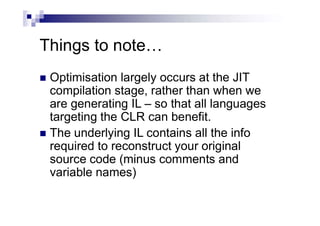
 Optimisation largely occurs at the JIT
compilation stage, rather than when we
are generating IL – so that all languages
targeting the CLR can benefit.
 The underlying IL contains all the info
required to reconstruct your original
source code (minus comments and
variable names)
Demo
 Decompilation using .NET Reflector
De-compilation & Obfuscation
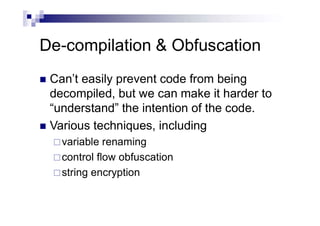
 Can’t easily prevent code from being
decompiled, but we can make it harder to
“understand” the intention of the code.
 Various techniques, including
variable renaming
control flow obfuscation
string encryption
Obfuscation Software
 PreEmptive - Dotfuscator (basic
community edition included in VS 2003)
 Remotesoft Obfuscator
 WiseOwl - Demeanor for .NET
Merging Assemblies
 We can combine the IL of multiple
assemblies to combine assemblies,
without access to the original source code
 For example, merging a required COM
interop wrapper into our main assembly.
ILMerge
 Utility from Microsoft Research that
automatically merges the IL and re-
compiles the assembly.
Demo
 Merging Assemblies
Wrapping Up
 Any questions?
Why do we care?
 Decompilation
 The underlying IL contains all the info required to reconstruct
your original source code (minus comments and variable names)
 .NET Reflector
 ILDASM/ILASM
 Merging multiple assemblies
 We can merge assemblies by merging their IL (ILMerge)
 New Languages
 We can implement new .NET languages provided we can emit
the correct IL

Understanding the Common Intermediate Language (CIL)

  • 1.
    Understanding CIL James Crowley DeveloperFusion http://www.developerfusion.co.uk/
  • 2.
    Overview  Generating andunderstanding CIL  De-compiling CIL  Protecting against de-compilation  Merging assemblies
  • 3.
    Common Language Runtime(CLR)  Core component of the .NET Framework on which everything else is built.  A runtime environment which provides A unified type system Metadata Execution engine, that deals with programs written in a Common Intermediate Language (CIL)
  • 4.
    Common Intermediate Language All compilers targeting the CLR translate their source code into CIL  A kind of assembly language for an abstract stack-based machine, but is not specific to any hardware architecture  Includes instructions specifically designed to support object-oriented concepts
  • 5.
    Platform Independence  Theintermediate language is not interpreted, but is not platform specific.  The CLR uses JIT (Just-in-time) compilation to translate the CIL into native code  Applications compiled in .NET can be moved to any machine, providing there is a CLR implementation for it (Mono, SSCLI etc)
  • 6.
    Demo  Generating ILusing the C# compiler
  • 7.
    Some familiar keywordswith some additions: .method – this is a method hidebysig – the method hides other methods with the same name and signature. cil managed – written in CIL and should be executed by the execution engine (C++ allows portions that are not) .method private hidebysig static void Main(string[] args) cil managed { .entrypoint // Code size 31 (0x1f) .maxstack 2 .locals init (int32 V_0, int32 V_1, int32 V_2) IL_0000: ldc.i4.s 50 IL_0002: stloc.0 IL_0003: ldc.i4.s 20 IL_0005: stloc.1 IL_0006: ldloc.0 IL_0007: ldloc.1 IL_0008: call int32 ILDemo.Demo::Remainder(int32, int32) IL_000d: stloc.2 IL_000e: ldstr "Remainder is: {0}" IL_0013: ldloc.2 IL_0014: box [mscorlib]System.Int32 IL_0019: call void [mscorlib]System.Console::WriteLine(string, object) IL_001e: ret } // end of method Demo::Main
  • 8.
    .method private hidebysigstatic void Main(string[] args) cil managed { .entrypoint // Code size 31 (0x1f) .maxstack 2 .locals init (int32 V_0, int32 V_1, int32 V_2) IL_0000: ldc.i4.s 50 IL_0002: stloc.0 IL_0003: ldc.i4.s 20 IL_0005: stloc.1 IL_0006: ldloc.0 IL_0007: ldloc.1 IL_0008: call int32 ILDemo.Demo::Remainder(int32, int32) IL_000d: stloc.2 IL_000e: ldstr "Remainder is: {0}" IL_0013: ldloc.2 IL_0014: box [mscorlib]System.Int32 IL_0019: call void [mscorlib]System.Console::WriteLine(string, object) IL_001e: ret } // end of method Demo::Main .entrypoint – the program’s entry point .maxstack 2 – specifies maximum depth of the stack at any point during execution .locals – defines storage locations for variables local to this method, with new names V_0, V_1, V_2 (replacing a, b, result)
  • 9.
    .method private hidebysigstatic void Main(string[] args) cil managed { .entrypoint // Code size 31 (0x1f) .maxstack 2 .locals init (int32 V_0, int32 V_1, int32 V_2) IL_0000: ldc.i4.s 50 IL_0002: stloc.0 IL_0003: ldc.i4.s 20 IL_0005: stloc.1 IL_0006: ldloc.0 IL_0007: ldloc.1 IL_0008: call int32 ILDemo.Demo::Remainder(int32, int32) IL_000d: stloc.2 IL_000e: ldstr "Remainder is: {0}" IL_0013: ldloc.2 IL_0014: box [mscorlib]System.Int32 IL_0019: call void [mscorlib]System.Console::WriteLine(string, object) IL_001e: ret } // end of method Demo::Main ldc.i4.s – loads the 4-byte integer constant “50” onto the stack (“s” defines some additional behaviours to keep the number of op-codes down) stloc.0 – takes the top value on the stack (ie 50) and stores it in the local variable at index 0 (ie V_0, or “a” with our original naming)
  • 10.
    .method private hidebysigstatic void Main(string[] args) cil managed { .entrypoint // Code size 31 (0x1f) .maxstack 2 .locals init (int32 V_0, int32 V_1, int32 V_2) IL_0000: ldc.i4.s 50 IL_0002: stloc.0 IL_0003: ldc.i4.s 20 IL_0005: stloc.1 IL_0006: ldloc.0 IL_0007: ldloc.1 IL_0008: call int32 ILDemo.Demo::Remainder(int32, int32) IL_000d: stloc.2 IL_000e: ldstr "Remainder is: {0}" IL_0013: ldloc.2 IL_0014: box [mscorlib]System.Int32 IL_0019: call void [mscorlib]System.Console::WriteLine(string, object) IL_001e: ret } // end of method Demo::Main ldloc.0 and ldloc.1 – loads the value of the local variable at index 0 (“a”) and index 1 (“b”) onto the stack call – makes a call to our Remainder method. The two arguments are popped off the stack during the call, and we get the result of the method execution pushed back on. Stloc.2 – store the result (which is at the top of the stack) in local variable at index 2 (“result”)
  • 11.
    .method private hidebysigstatic void Main(string[] args) cil managed { .entrypoint // Code size 31 (0x1f) .maxstack 2 .locals init (int32 V_0, int32 V_1, int32 V_2) IL_0000: ldc.i4.s 50 IL_0002: stloc.0 IL_0003: ldc.i4.s 20 IL_0005: stloc.1 IL_0006: ldloc.0 IL_0007: ldloc.1 IL_0008: call int32 ILDemo.Demo::Remainder(int32, int32) IL_000d: stloc.2 IL_000e: ldstr "Remainder is: {0}" IL_0013: ldloc.2 IL_0014: box [mscorlib]System.Int32 IL_0019: call void [mscorlib]System.Console::WriteLine(string, object) IL_001e: ret } // end of method Demo::Main ldstr – loads the string constant onto a stack ldloc.2 – loads the variable “result” onto the stack box – turns the “result” variable (a value type) into an object (reference type) call – makes the call to WriteLine ret – returns execution to the callee
  • 12.
    Things to note… Optimisation largely occurs at the JIT compilation stage, rather than when we are generating IL – so that all languages targeting the CLR can benefit.  The underlying IL contains all the info required to reconstruct your original source code (minus comments and variable names)
  • 13.
  • 14.
    De-compilation & Obfuscation Can’t easily prevent code from being decompiled, but we can make it harder to “understand” the intention of the code.  Various techniques, including variable renaming control flow obfuscation string encryption
  • 15.
    Obfuscation Software  PreEmptive- Dotfuscator (basic community edition included in VS 2003)  Remotesoft Obfuscator  WiseOwl - Demeanor for .NET
  • 16.
    Merging Assemblies  Wecan combine the IL of multiple assemblies to combine assemblies, without access to the original source code  For example, merging a required COM interop wrapper into our main assembly.
  • 17.
    ILMerge  Utility fromMicrosoft Research that automatically merges the IL and re- compiles the assembly.
  • 18.
  • 19.
  • 20.
    Why do wecare?  Decompilation  The underlying IL contains all the info required to reconstruct your original source code (minus comments and variable names)  .NET Reflector  ILDASM/ILASM  Merging multiple assemblies  We can merge assemblies by merging their IL (ILMerge)  New Languages  We can implement new .NET languages provided we can emit the correct IL