Understanding the 7-
SegmentDisplay: Basics
and Applications
A deep dive into one of electronics' most enduring and recognizable
components
2.
What is a7-Segment Display?
The Foundation of Digital Display
Technology
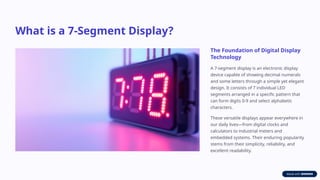
A 7-segment display is an electronic display
device capable of showing decimal numerals
and some letters through a simple yet elegant
design. It consists of 7 individual LED
segments arranged in a specific pattern that
can form digits 0-9 and select alphabetic
characters.
These versatile displays appear everywhere in
our daily lives—from digital clocks and
calculators to industrial meters and
embedded systems. Their enduring popularity
stems from their simplicity, reliability, and
excellent readability.
3.
A Brief Historyof the 7-Segment Display
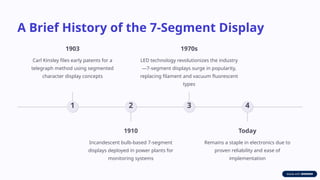
1
1903
Carl Kinsley files early patents for a
telegraph method using segmented
character display concepts
2
1910
Incandescent bulb-based 7-segment
displays deployed in power plants for
monitoring systems
3
1970s
LED technology revolutionizes the industry
—7-segment displays surge in popularity,
replacing filament and vacuum fluorescent
types
4
Today
Remains a staple in electronics due to
proven reliability and ease of
implementation
4.
Anatomy of a7-Segment Display
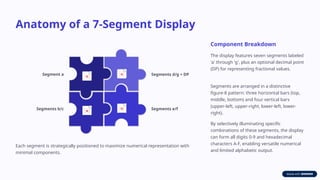
Segments d/g + DP
Segments e/f
Segments b/c
Segment a
Each segment is strategically positioned to maximize numerical representation with
minimal components.
Component Breakdown
The display features seven segments labeled
'a' through 'g', plus an optional decimal point
(DP) for representing fractional values.
Segments are arranged in a distinctive
figure-8 pattern: three horizontal bars (top,
middle, bottom) and four vertical bars
(upper-left, upper-right, lower-left, lower-
right).
By selectively illuminating specific
combinations of these segments, the display
can form all digits 0-9 and hexadecimal
characters A-F, enabling versatile numerical
and limited alphabetic output.
5.
Types of 7-SegmentDisplays
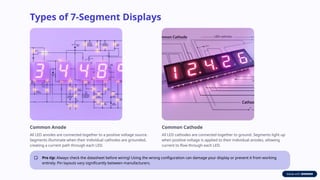
Common Anode
All LED anodes are connected together to a positive voltage source.
Segments illuminate when their individual cathodes are grounded,
creating a current path through each LED.
Common Cathode
All LED cathodes are connected together to ground. Segments light up
when positive voltage is applied to their individual anodes, allowing
current to flow through each LED.
Pro tip: Always check the datasheet before wiring! Using the wrong configuration can damage your display or prevent it from working
entirely. Pin layouts vary significantly between manufacturers.
6.
How Does a7-Segment Display Work?
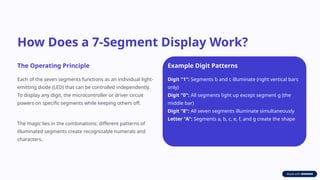
The Operating Principle
Each of the seven segments functions as an individual light-
emitting diode (LED) that can be controlled independently.
To display any digit, the microcontroller or driver circuit
powers on specific segments while keeping others off.
The magic lies in the combinations: different patterns of
illuminated segments create recognizable numerals and
characters.
Example Digit Patterns
Digit "1": Segments b and c illuminate (right vertical bars
only)
Digit "0": All segments light up except segment g (the
middle bar)
Digit "8": All seven segments illuminate simultaneously
Letter "A": Segments a, b, c, e, f, and g create the shape
7.
Controlling 7-Segment Displays
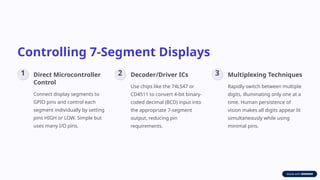
1Direct Microcontroller
Control
Connect display segments to
GPIO pins and control each
segment individually by setting
pins HIGH or LOW. Simple but
uses many I/O pins.
2 Decoder/Driver ICs
Use chips like the 74LS47 or
CD4511 to convert 4-bit binary-
coded decimal (BCD) input into
the appropriate 7-segment
output, reducing pin
requirements.
3 Multiplexing Techniques
Rapidly switch between multiple
digits, illuminating only one at a
time. Human persistence of
vision makes all digits appear lit
simultaneously while using
minimal pins.
8.
Common Applications of7-
Segment Displays
Digital Clocks & Timers
Displaying hours, minutes, and seconds with excellent visibility in any lighting
condition
Calculators
Showing numerical input, results, and basic hexadecimal characters for
scientific calculations
Electronic Meters
Measuring and displaying voltage, current, temperature, and other sensor
readings in real-time
Consumer Appliances
Microwave ovens, washing machines, and scoreboards requiring clear numeric
feedback
9.
Advantages and Limitations
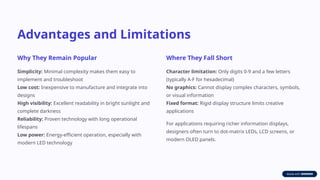
WhyThey Remain Popular
Simplicity: Minimal complexity makes them easy to
implement and troubleshoot
Low cost: Inexpensive to manufacture and integrate into
designs
High visibility: Excellent readability in bright sunlight and
complete darkness
Reliability: Proven technology with long operational
lifespans
Low power: Energy-efficient operation, especially with
modern LED technology
Where They Fall Short
Character limitation: Only digits 0-9 and a few letters
(typically A-F for hexadecimal)
No graphics: Cannot display complex characters, symbols,
or visual information
Fixed format: Rigid display structure limits creative
applications
For applications requiring richer information displays,
designers often turn to dot-matrix LEDs, LCD screens, or
modern OLED panels.
10.
The 7-Segment DisplayToday and Beyond
Despite being over a century old in concept, 7-segment displays remain remarkably relevant in modern electronics. Their
simplicity and reliability ensure continued widespread use across countless applications.
1 Modern Availability
Available in various sizes from
tiny 0.3" to massive outdoor
displays, colors ranging from
classic red to blue, green, white,
and multi-color options, with
brightness levels customizable
for any environment
2 Easy Integration
Integrated modules like
TM1637, MAX7219, and
HT16K33 provide simple I2C or
SPI interfaces for effortless
connection to Arduino,
Raspberry Pi, and other
microcontrollers
3 Cultural Impact
Inspires digital typography
aesthetics and the playful
"calculator spelling" culture
where words are formed by
viewing numbers upside-down
(like 5318008 for "BOOBIES")
The 7-segment display stands as a testament to elegant engineering—sometimes the simplest solution truly is the best.