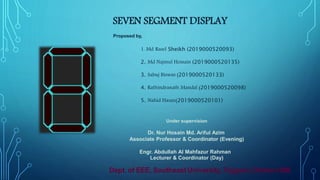
SEVEN SEGMENT DISPLAY
Proposed by,
1. Md Rasel Sheikh (2019000520093)
2. Md Najmul Hossain (2019000520135)
3. Sabuj Biswas (2019000520133)
4. Rathindranath Mandal (2019000520098)
5. Nahid Hasan(2019000520101)
Under supervision
Dr. Nur Hosain Md. Ariful Azim
Associate Professor & Coordinator (Evening)
Engr. Abdullah Al Mahfazur Rahman
Lecturer & Coordinator (Day)
Dept. of EEE, Southeast University, Tejgaon, Dhaka-1208
INDEX
1. Introduction Of SSD
2. History Of SSD
3. Working and Concept Of SSD
4. Material Required For Making a SSD
5. Cost Of Making a SSD
6. Types OF SSD
7. Application Of SSD
8. Advantage OF SSD
9. Disadvantage OF SSD
INTRODUCTION OF SSD
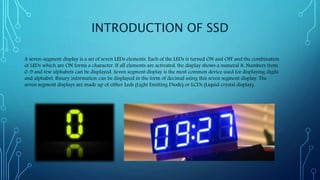
A seven-segment display is a set of seven LEDs elements. Each of the LEDs is turned ON and OFF and the combination
of LEDs which are ON forms a character. If all elements are activated, the display shows a numeral 8. Numbers from
0-9 and few alphabets can be displayed. Seven segment display is the most common device used for displaying digits
and alphabet. Binary information can be displayed in the form of decimal using this seven segment display. The
seven segment displays are made up of either Leds (Light Emitting Diode) or LCDs (Liquid crystal display).
HISTORY OF SSD
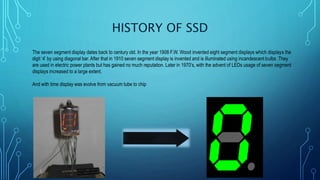
The seven segment display dates back to century old. In the year 1908 F.W. Wood invented eight segment displays which displays the
digit ‘4’ by using diagonal bar. After that in 1910 seven segment display is invented and is illuminated using incandescent bulbs .They
are used in electric power plants but has gained no much reputation. Later in 1970’s, with the advent of LEDs usage of seven segment
displays increased to a large extent.
And with time display was evolve from vacuum tube to chip
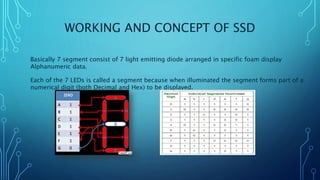
WORKING AND CONCEPT OF SSD
Basically 7 segment consist of 7 light emitting diode arranged in specific foam display
Alphanumeric data.
Each of the 7 LEDs is called a segment because when illuminated the segment forms part of a
numerical digit (both Decimal and Hex) to be displayed.
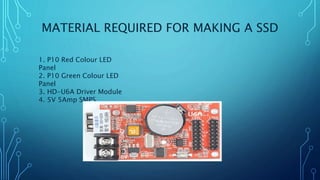
MATERIAL REQUIRED FOR MAKING A SSD
1. P10 Red Colour LED
Panel
2. P10 Green Colour LED
Panel
3. HD-U6A Driver Module
4. 5V 5Amp SMPS
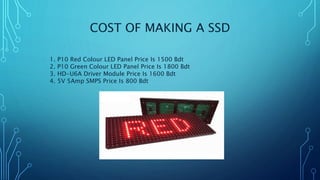
COST OF MAKING A SSD
1. P10 Red Colour LED Panel Price Is 1500 Bdt
2. P10 Green Colour LED Panel Price Is 1800 Bdt
3. HD-U6A Driver Module Price Is 1600 Bdt
4. 5V 5Amp SMPS Price Is 800 Bdt
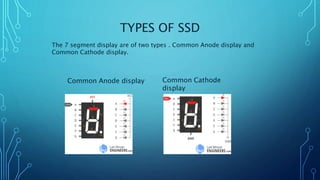
TYPES OF SSD
The 7 segment display are of two types . Common Anode display and
Common Cathode display.
Common Anode display Common Cathode
display
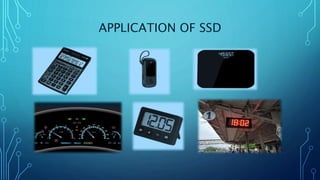
APPLICATION OF SSD
ADVANTAGE OF SSD
Cost: The cost of the entire module of 7 segment display is very cheap as it only
contains LEDs.
Efficiency: LED displays in general are extremely efficient.
Heat dissipation: The heat dissipated from this displays is very less and that
increases the life of the devices.
DISADVANTAGE OF SSD
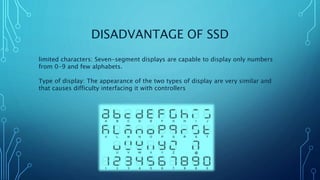
limited characters: Seven-segment displays are capable to display only numbers
from 0-9 and few alphabets.
Type of display: The appearance of the two types of display are very similar and
that causes difficulty interfacing it with controllers
Seven Segment Display (1) (1).pptx

Seven Segment Display (1) (1).pptx

  • 1.
    SEVEN SEGMENT DISPLAY Proposedby, 1. Md Rasel Sheikh (2019000520093) 2. Md Najmul Hossain (2019000520135) 3. Sabuj Biswas (2019000520133) 4. Rathindranath Mandal (2019000520098) 5. Nahid Hasan(2019000520101) Under supervision Dr. Nur Hosain Md. Ariful Azim Associate Professor & Coordinator (Evening) Engr. Abdullah Al Mahfazur Rahman Lecturer & Coordinator (Day) Dept. of EEE, Southeast University, Tejgaon, Dhaka-1208
  • 2.
    INDEX 1. Introduction OfSSD 2. History Of SSD 3. Working and Concept Of SSD 4. Material Required For Making a SSD 5. Cost Of Making a SSD 6. Types OF SSD 7. Application Of SSD 8. Advantage OF SSD 9. Disadvantage OF SSD
  • 3.
    INTRODUCTION OF SSD Aseven-segment display is a set of seven LEDs elements. Each of the LEDs is turned ON and OFF and the combination of LEDs which are ON forms a character. If all elements are activated, the display shows a numeral 8. Numbers from 0-9 and few alphabets can be displayed. Seven segment display is the most common device used for displaying digits and alphabet. Binary information can be displayed in the form of decimal using this seven segment display. The seven segment displays are made up of either Leds (Light Emitting Diode) or LCDs (Liquid crystal display).
  • 4.
    HISTORY OF SSD Theseven segment display dates back to century old. In the year 1908 F.W. Wood invented eight segment displays which displays the digit ‘4’ by using diagonal bar. After that in 1910 seven segment display is invented and is illuminated using incandescent bulbs .They are used in electric power plants but has gained no much reputation. Later in 1970’s, with the advent of LEDs usage of seven segment displays increased to a large extent. And with time display was evolve from vacuum tube to chip
  • 5.
    WORKING AND CONCEPTOF SSD Basically 7 segment consist of 7 light emitting diode arranged in specific foam display Alphanumeric data. Each of the 7 LEDs is called a segment because when illuminated the segment forms part of a numerical digit (both Decimal and Hex) to be displayed.
  • 6.
    MATERIAL REQUIRED FORMAKING A SSD 1. P10 Red Colour LED Panel 2. P10 Green Colour LED Panel 3. HD-U6A Driver Module 4. 5V 5Amp SMPS
  • 7.
    COST OF MAKINGA SSD 1. P10 Red Colour LED Panel Price Is 1500 Bdt 2. P10 Green Colour LED Panel Price Is 1800 Bdt 3. HD-U6A Driver Module Price Is 1600 Bdt 4. 5V 5Amp SMPS Price Is 800 Bdt
  • 8.
    TYPES OF SSD The7 segment display are of two types . Common Anode display and Common Cathode display. Common Anode display Common Cathode display
  • 9.
  • 10.
    ADVANTAGE OF SSD Cost:The cost of the entire module of 7 segment display is very cheap as it only contains LEDs. Efficiency: LED displays in general are extremely efficient. Heat dissipation: The heat dissipated from this displays is very less and that increases the life of the devices.
  • 11.
    DISADVANTAGE OF SSD limitedcharacters: Seven-segment displays are capable to display only numbers from 0-9 and few alphabets. Type of display: The appearance of the two types of display are very similar and that causes difficulty interfacing it with controllers